Intelligence Is the Ability to Adapt to Change
By Synopsix · October 14, 2026 · 13 min read
Only 32% of business leaders say their latest change achieved healthy employee adoption, while 79% of employees report low trust in change. That gap suggests adaptability isn't merely a personal virtue, but a measurable interaction between how people think and the conditions in which they work.
The popular advice is to “be more adaptable,” as though employees can overcome any broken process, overloaded calendar, unclear mandate, or untrustworthy manager through effort alone. That framing is convenient for organizations because it turns a design problem into an employee deficit.
A better interpretation of the phrase intelligence is the ability to adapt to change is more demanding. Intelligence involves detecting changed conditions, updating a working model, revising a strategy, and acting effectively. But whether that intelligence produces results depends on access to information, decision authority, useful feedback, trust, and enough capacity to adjust.
The Hidden Cost of Assuming Adaptability Is Just a Trait
The most revealing finding in current change research isn't that employees resist change. It's that leaders and employees often experience the same change as two different realities. A [2025 Gartner study on healthy change adoption](https://www.gartner.com/en/newsroom/press-releases/2025-07-08-gartner-hr-research-finds-just-32-percent-of-business-leaders-report-achieving-healthy-change-adoption-by-employees) found that only 32% of business leaders believed their latest change achieved healthy employee adoption, while 79% of employees reported low trust in change.
That contradiction changes the question a hiring manager should ask. Instead of “Is this person adaptable?” the better question is, “What does this person do when priorities shift, information is incomplete, authority is unclear, and the cost of adjustment is real?”
A product manager may appear resistant when a new operating model adds meetings without removing old reporting. A nurse may challenge a new workflow because it creates a safety concern. A sales leader may delay adoption because the promised system doesn't fit customer conversations. These behaviors can reflect poor adaptability, but they can also reflect accurate perception.

Resistance isn't a complete diagnosis
The same Gartner research found that 45% of employees said organizational change increased their workload, while 62% said managers didn't reduce existing work to create time for learning and adjustment. Those figures make a simple interpretation of resistance unsafe. People may reject a change because they can't see its logic, don't trust its sponsors, or lack the bandwidth to learn it properly.
> Practical rule: Don't confuse compliance under pressure with cognitive flexibility.
Compliance asks whether someone follows a new instruction. Adaptability asks whether they understand what changed, identify which assumptions no longer hold, preserve the objective, and select a better method. The first can be produced by authority. The second requires judgment.
For CHROs and hiring managers, this distinction has consequences. A candidate who agrees instantly with every proposed change may be agreeable, conflict-averse, or strategically passive. Another candidate who questions a plan may be demonstrating risk detection and a willingness to protect the underlying goal. A useful assessment must observe what happens after feedback, ambiguity, and consequences enter the situation.
The central error is treating adaptability as portable and context-free. A person may adjust quickly in a team with clear priorities and responsive leadership, yet struggle in an environment where every adjustment creates more work and no decision-maker resolves trade-offs. People decisions improve when organizations assess both sides of that relationship: the individual's behavior and the system's capacity to support it.
Why Static Scores Fail in Dynamic Environments
A static score looks attractive because it creates apparent precision. Yet the history of intelligence testing shows that cognitive performance changes as environments change. In 1984, James Flynn reported a 13.8-point rise in mean U.S. IQ scores between 1932 and 1978, approximately 3 points per decade, as documented in the [meta-analysis of intelligence trends](https://academic.oup.com/chidev/article/93/1/e47/8255102).
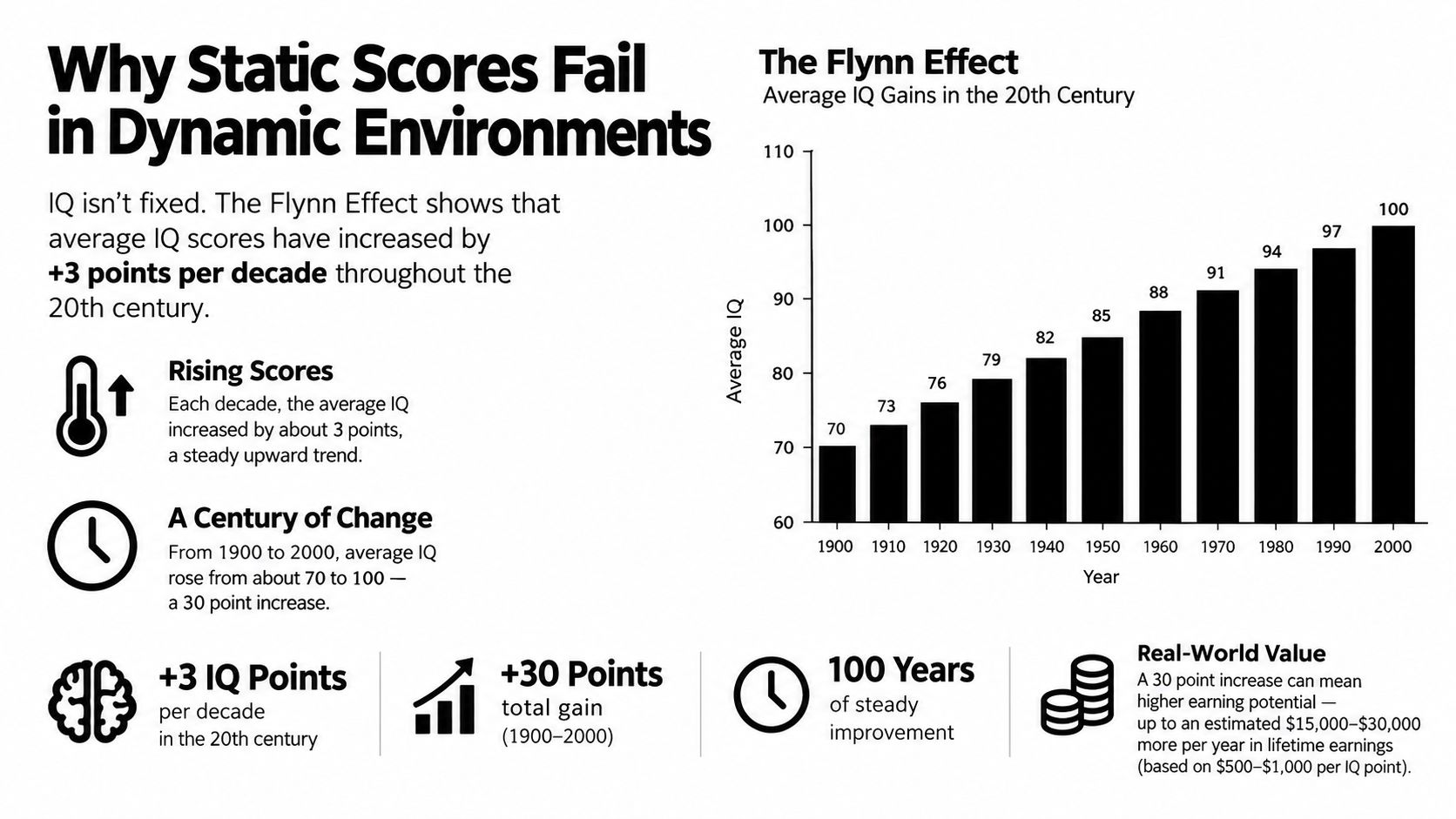
The result wasn't confined to one test or one country. A formal meta-analysis covering 1909 to 2013 examined 271 independent samples, almost 4 million participants, across 31 countries. It estimated annual gains of 0.41 IQ points for fluid intelligence and 0.28 for full-scale IQ, according to the same source.
Performance reflects the environment
The Flynn Effect doesn't prove that people automatically become more capable in every setting, nor does it identify one universal cause. Its importance is narrower and more useful: intelligence-related performance has moved at population level. Education, health, nutrition, information access, technology, and the complexity of everyday problem-solving environments can shape how cognitive ability is expressed.
That matters for employers because job requirements also move. A reasoning profile that suited a stable process may not reveal how someone handles an algorithmic workflow, distributed decisions, unfamiliar tools, or rapidly changing customer expectations. A score can describe performance under the conditions of the assessment. It can't, by itself, show how a person updates behavior when those conditions change.
For teams building digital capability, a practical companion to this people question is [AI in digital marketing for SMEs](https://wispra.com/blog/revolution-of-digital-marketing-how-artificial-intelligence-is-changing-everything-for-sme-visibility-en), which illustrates how changing technology reshapes the work environment rather than merely adding another tool.
Replace snapshots with adjustment evidence
The relevant hiring signal isn't only what a candidate knows today. It is how quickly and accurately they can:
This doesn't make static measures useless. It places them in their proper role. A score can contribute to a broader evidence set, but it shouldn't carry the full burden of predicting performance in a role whose rules, technologies, and relationships are still evolving.
Measuring Cognitive Flexibility Through Simulation
If adaptability means changing behavior in response to changed conditions, assessment should include changed conditions. Asking someone whether they're flexible produces a self-description. Giving them a task with shifting rules produces behavioral evidence.
A functional-MRI task-switching experiment found that participants' behavioral switch costs decreased when switches became more probable, indicating that flexibility can be calibrated through reinforcement learning. Neural activity in lateral frontal and parietal regions tracked unsigned switch-prediction errors, showing that the brain uses environmental feedback to update readiness for change, as described in this [task-switching and cognitive flexibility research](https://pmc.ncbi.nlm.nih.gov/articles/PMC10902878/).
Build the assessment around disruption
A useful simulation doesn't merely make a scenario difficult. It introduces a controlled change and observes whether the participant updates intelligently. The design can follow three phases:
1. Baseline: Give the person a clear objective, initial information, and an ordinary operating condition. This establishes how they reason before disruption. 2. Disruption: Change a constraint, introduce an ambiguous signal, or make the original strategy less effective. The point isn't to create surprise for its own sake. It is to test whether the person notices and interprets the change. 3. Recovery: Provide feedback or a new result, then observe whether the person revises the plan, communicates the trade-off, and returns to the objective.
The strongest signal isn't speed alone. A fast response can be careless, while a slower response can reflect disciplined risk evaluation. Measure response latency, error recovery, strategy revision, information seeking, and goal preservation together.
Look for learning, not performance theater
Repeated trials matter because one scenario can reward prior experience or improvisational confidence. Across multiple rounds, evaluators can see whether someone overcommits to an obsolete approach, adjusts only after explicit instruction, or anticipates likely changes from the feedback pattern.
A role-specific simulation might ask a sales manager to redirect a forecast after a market signal, a plant supervisor to respond to a process deviation, or a people leader to revise staffing after a capability gap appears. The scenario should resemble the decisions the role makes, not a generic puzzle dressed up as science.
The [simulation forecasting method from Synopsix](https://synopsix.ai/blog/simulation-forecasting-method) reflects this shift from abstract trait labels to observable responses. The wider principle applies regardless of vendor: assess the person under baseline, disruption, and recovery conditions, then connect the result to the role's real decision demands.
The Organization as the Moderator of Adaptation
An adaptable employee in a rigid system can look ineffective. The person sees a new signal, but can't access the data. They revise a plan, but lacks authority to move resources. They identify a process failure, but receives punishment for challenging the established method.

Research on dynamic capabilities offers a stronger organizational model. A study of 471 Polish companies, using structural-equation modeling, found that activities involved in developing dynamic capabilities were positively related to economic effectiveness, while also concluding that these capabilities moderated effectiveness rather than determining it alone, as reported in this [study of dynamic capabilities and organizational effectiveness](https://pmc.ncbi.nlm.nih.gov/articles/PMC8084234/).
Adaptation needs an operating system
At organizational level, adaptation involves three connected activities:
An individual may perform the first two and still fail to create value if the third is unavailable. That is why hiring an “adaptable” employee into a role with no autonomy can become a form of organizational theater. The company asks for initiative, then preserves every approval layer that prevents initiative from working.
> The right question isn't whether someone can adapt alone. It's whether the person and the system can adapt together.
Trust is part of that system. The Gartner findings above show why low trust complicates interpretation. When employees expect change to increase workload and don't believe managers will create adjustment capacity, skepticism may be a rational response to organizational history. Leaders should therefore test whether a change is well designed before labeling dissent as a talent problem.
For practical culture diagnostics, the [organizational culture assessment approach from Synopsix](https://synopsix.ai/blog/organizational-culture-assessment) is relevant because behavioral data becomes more useful when leaders examine the environment surrounding it. A candidate's profile should inform a decision about role fit, manager fit, team composition, and available authority, not serve as a verdict detached from context.
The swimmer metaphor is incomplete. Hiring a strong swimmer doesn't make a rip current safe. People analytics should identify both the swimmer's capabilities and the conditions that determine whether those capabilities can produce a useful outcome.
<iframe width="100%" style="aspect-ratio: 16 / 9;" src="https://www.youtube.com/embed/9g8hFF1t_eE" frameborder="0" allow="autoplay; encrypted-media" allowfullscreen></iframe>
The Case for Contextualized Behavioral Assessment
Generic personality tests fail most often when organizations ask them to answer a job-specific question. A broad trait score may describe a tendency, but hiring decisions concern behavior under particular pressures, incentives, relationships, and constraints.
A meta-analysis of 494 studies found that personality measures can predict job performance, but design strongly affects accuracy. Corrected mean validity was .29 for confirmatory studies, more than twice the .12 found in exploratory studies, and rose to .38 when researchers explicitly used job analysis, according to this [meta-analysis of personality measures and job performance](https://onlinelibrary.wiley.com/doi/abs/10.1111/j.1744-6570.1991.tb00696.x).
Context turns traits into decisions
A contextualized question might ask how a person would respond when a customer deadline conflicts with a compliance requirement. A non-contextualized question might ask whether the person considers themselves conscientious. The first creates a link between behavior and a decision environment. The second relies on self-concept and leaves the relevant conditions unspecified.
A review comparing the two approaches found average validities of .24 for contextualized measures and .11 for non-contextualized measures, as reported in the same source. The difference supports a simple design rule: if the role is specific, the evidence should be specific too.
For a sales role, assess how the person handles a changing buying committee, incomplete information, and pressure to overpromise. For a people manager, examine how they communicate a difficult trade-off, respond to dissent, and revise a development plan after feedback. For a safety-critical role, test whether they preserve essential controls while adjusting the operating method.
Use evidence in the right sequence
A defensible assessment process connects four elements:
| Decision element | What to examine | |---|---| | Role demand | The recurring judgments, pressures, and relationships that shape performance | | Behavioral tendency | The person's likely response pattern under those conditions | | Simulation evidence | What the person actually does when rules or information change | | Organizational context | Whether the team provides authority, feedback, trust, and capacity |
This sequence prevents a common HR error: treating a personality label as a prediction without specifying the situation. It also makes development more practical. If someone struggles to revise a strategy after feedback, a manager can coach that behavior directly. If the system withholds information or overloads the role, leadership must address the design problem rather than prescribe resilience.
The goal isn't to eliminate judgment. It is to make judgment more comparable, role-relevant, and transparent.
Turning Adaptability into Actionable Decisions with Synopsix
Adaptability becomes useful for people decisions only when organizations connect three forms of evidence: the behaviors a role requires, how a person responds when conditions shift, and whether the surrounding system supports adjustment. This approach moves beyond blaming employees for change failures. Organizational design can limit adaptation even when an individual shows strong cognitive flexibility.
Synopsix is a people intelligence platform that applies scientifically validated behavioral assessments to hiring, team design, and talent development. Its product suite includes Assessments & Profiles, Intelligence Reports, Predictive Simulations, and Human Interlink, linking behavioral information with role and team decisions.
According to [Synopsix's platform information](https://synopsix.ai), its workflow assesses candidates and employees in under 30 minutes, creates comparable behavioral profiles, translates psychometrics into business signals, and supports action through simulations, compatibility analysis, and development plans. Its [talent assessment and development framework](https://synopsix.ai/blog/talent-assessment-and-development) reflects the principle that assessment should lead to an observable decision rather than end with a report.
Organizations using the platform report 40% faster hiring decisions, 60% fewer mis-hires, and over 50K profiles generated, alongside a claimed 98% assessment accuracy. These are reported platform outcomes, not universal guarantees, and require local validation, job analysis, and responsible governance.
Use Synopsix to connect evidence to action without treating adaptability as a fixed employee trait. Visit synopsix.ai to explore how your organization can measure adaptation in context and address poorly designed change.