Internal Mobility Programs: Boost Talent & Growth
By Synopsix · June 30, 2026 · 20 min read
Companies with strong internal mobility programs retain employees for an average of 5.4 years, nearly twice as long as the 2.9-year average at companies with weak programs, according to LinkedIn's analysis of internal recruiting. That single fact should change how a CHRO frames mobility.
Too many organizations still treat internal mobility programs as a nice cultural benefit. They launch a jobs board, encourage managers to “support careers,” and call it progress. Then they wonder why participation stalls, managers hoard talent, and internal moves produce mixed results.
The missing piece isn't visibility alone. It's judgment.
A modern mobility strategy has to do more than surface openings. It has to help leaders predict whether an employee will succeed in a different role, on a different team, under a different manager, with a different pace of work. That's where predictive behavioral intelligence changes the conversation. The point isn't to build a prettier talent marketplace. The point is to make smarter people decisions before a move becomes an expensive internal mistake.
The Strategic Imperative of Internal Mobility
Internal mobility is no longer just about promotions and lateral transfers. It's a workforce strategy for organizations that want to redeploy capability faster than the market shifts around them.
That matters because most companies still run talent in a reactive pattern. A role opens. A team scrambles. Recruiters search externally. Learning teams respond later. Succession planning happens in parallel, often disconnected from live demand. Internal mobility programs break that pattern when they're designed as an operating system, not a posting board.
What internal mobility actually means
At a practical level, internal mobility includes promotions, lateral moves, project assignments, stretch roles, and cross-functional transitions. But the strategic definition is tighter. It's the disciplined process of matching business demand with internal capability before external hiring becomes the default answer.
The distinction matters. Ad hoc internal moves often depend on manager relationships, visibility, and timing. A real mobility program creates rules, signals, and decision support so movement is fair, timely, and aligned to business need.
Three things separate mature programs from symbolic ones:
Why now
The business environment rewards adaptability. Roles evolve faster. Team structures change more often. New priorities emerge before old org charts have settled. If talent movement depends on informal networks, your response time will always lag.
That's why mobility now sits next to workforce planning, leadership development, and retention strategy. It also connects directly to turnover prevention. Teams that want to keep high-potential employees need visible pathways and credible movement options, not vague promises of future growth. A useful reference on that point is this guide on [ways to reduce employee turnover](https://synopsix.ai/blog/ways-to-reduce-employee-turnover).
> Internal mobility works best when employees don't have to leave the company to find challenge, stretch, and recognition.
A lot of organizations also overlook the enablement side. If employees are expected to move into adjacent roles, they need learning experiences that people will use. In practice, that often means redesigning development so it's more engaging and behaviorally sticky. Teams looking to [boost training engagement](https://groupos.com/blog/gamification-in-elearning) often find that better learning design improves mobility readiness just as much as better job visibility does.
Building the Unshakeable Business Case
Boards approve mobility investment for one reason. It improves business performance while lowering talent risk.
The strongest case is not "people like career growth." The strongest case is that internal mobility gives the business a faster, lower-risk way to place capability where demand is rising, while reducing avoidable hiring costs, stalled roles, and failed placements.

The retention argument is strong, but incomplete
Retention gets executive attention because the cost is visible. Attrition triggers recruiting spend, onboarding time, productivity loss, and disruption for the team left behind. Mobility helps contain that.
But retention alone is too small a frame.
A good mobility program changes how the company allocates talent. It gives business leaders a credible alternative to defaulting to external hiring every time priorities shift. It helps fill adjacent capability gaps faster, broadens leadership exposure, and reduces the number of high-value employees stuck in roles that no longer fit their strengths.
That matters most during change. Reorganizations, new product lines, operating model shifts, M&A integration, and AI-driven role redesign all create talent demand faster than external hiring can reliably solve.
Where ROI actually comes from
The return shows up in operating metrics the CFO and business unit leaders already care about.
That last point deserves more scrutiny because it is where many mobility efforts break down.
I have seen organizations build polished internal marketplaces and still create churn because they confuse mobility volume with mobility quality. A role gets filled internally. Everyone celebrates. Six months later, the employee is underperforming, the receiving manager is frustrated, and the sending team has lost a top contributor. The move looked efficient on paper. It created cost in practice.
Predict human behavior, then make the move
Skills data is necessary, but it is not enough.
Two employees can match the same role requirements and perform very differently once they enter the work. The difference often comes down to behavioral fit. How they handle ambiguity. How they influence without authority. How they respond to pace, conflict, change, and decision pressure. Whether their working style strengthens the target team or creates drag.
That is the missing piece in many internal mobility programs. They identify who could move. They do not assess who is likely to succeed.
> Boardroom test: If you cannot explain why a person is likely to succeed in the target role and team, you are not managing talent strategically. You are approving an internal transfer with limited evidence.
For CHROs, the business case gets much stronger when mobility becomes predictive rather than reactive. That means combining opportunity visibility with evidence on person-role fit, person-team fit, and readiness. It also explains why talent leaders are putting more scrutiny on decision support inside their HR stack, not just workflow and posting tools. This overview of [talent management functionalities that improve fit and decision quality](https://synopsix.ai/blog/top-functionalities-synopsix-transform-talent-management) captures what modern systems now need to support.
The practical trade-off is straightforward. Basic mobility programs increase movement. Predictive mobility programs increase the odds that movement turns into performance. That is the version that holds up in an executive review.
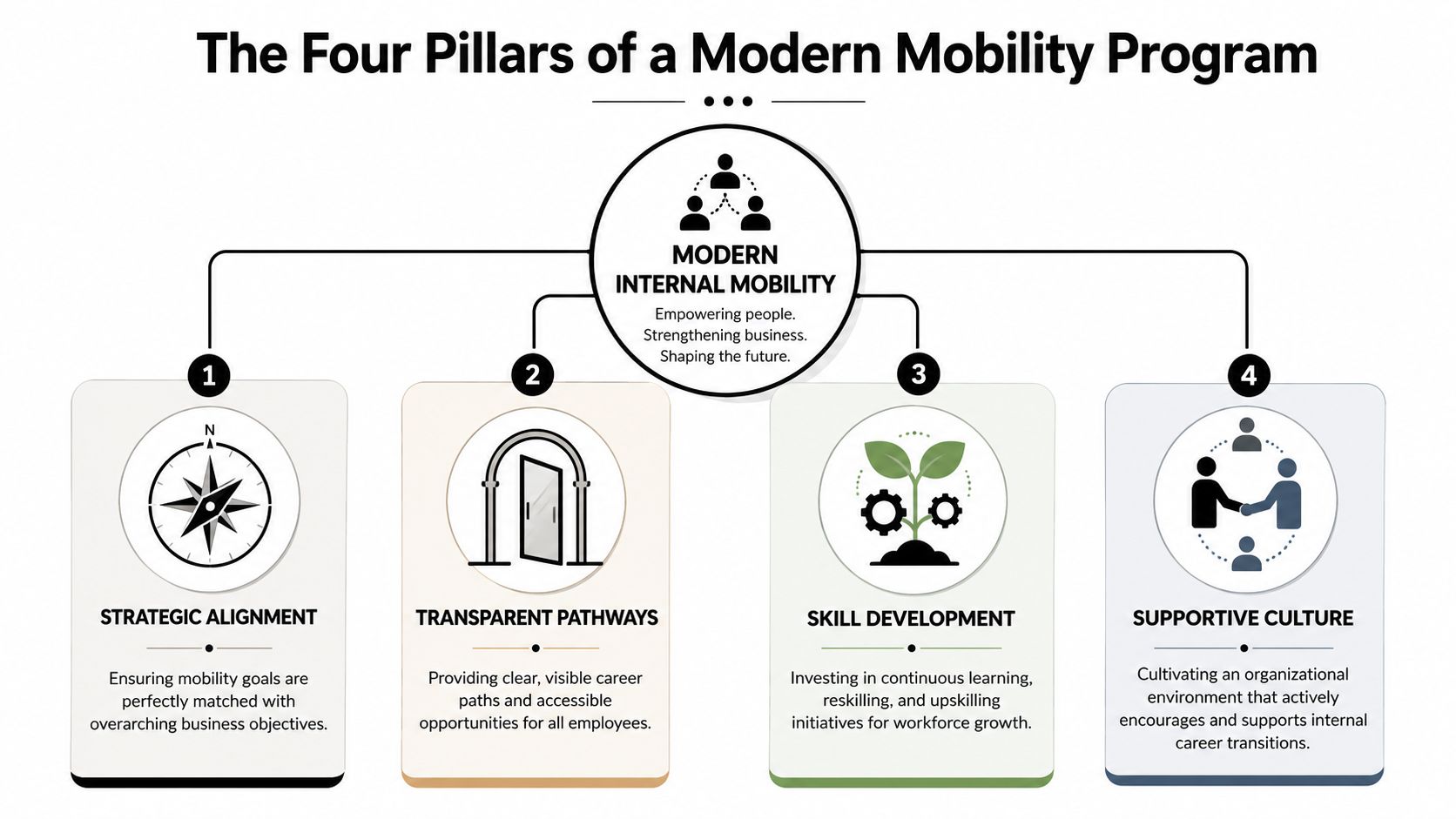
The Four Pillars of a Modern Mobility Program
Internal mobility programs become durable when they're built as an interconnected system. If one pillar is weak, the rest won't hold for long. A polished marketplace without governance creates mistrust. Strong policies without manager support create bottlenecks. Skill data without fit judgment creates internal churn.
The architecture below captures the foundation.
Clear governance and fair policies
Mobility dies when employees think the process is political.
Governance has to answer practical questions in plain language. Who can apply. When can they move. How are internal applicants reviewed. What role does the current manager play. What happens if business-critical talent wants to leave a team. How quickly must hiring managers respond.
Good governance doesn't over-engineer movement. It removes ambiguity.
A few rules usually matter most:
Without these basics, employees assume outcomes are pre-decided. Once that belief takes hold, adoption drops fast.
An intelligent talent marketplace
A marketplace should make opportunity visible, but visibility alone isn't intelligence.
Most organizations need one place where employees can discover open roles, projects, stretch assignments, mentoring options, and development paths. That reduces dependency on who knows whom. It also gives HR and business leaders a live view into movement demand across functions.
Still, many marketplaces disappoint because they behave like internal job boards with better branding. They surface openings, but they don't guide good decisions. Employees browse. Managers post. Recruiters mediate. The process stays reactive.
A stronger marketplace does three things well:
| Capability | Why it matters | |---|---| | Opportunity visibility | Employees can see pathways they would otherwise miss | | Profile quality | The organization gets a usable view of experience, interests, and transferable capability | | Decision support | Leaders can evaluate not only eligibility, but likely success |
Predictive assessments and skill intelligence
This is the pillar most companies underbuild.
Skills data tells you what someone has done, learned, or declared. It doesn't fully tell you how they'll operate in a materially different context. For internal mobility programs, that gap matters more than leaders often admit.
A move can fail even when the employee has the technical baseline. The reasons are usually behavioral. A role may require sustained stakeholder persuasion, rapid switching across priorities, tolerance for ambiguity, or calm under social pressure. If the new role and team environment demand patterns the person doesn't naturally use well, the risk rises.
That's why mobility programs need predictive assessment capability. Not to label people rigidly, but to de-risk decisions with better evidence.
> The right internal move isn't just “Can this person do the work?” It's “Will this person likely thrive in this version of the work, with this team, under these conditions?”
This becomes much easier when the organization has a clear role framework. If job architecture is vague, fit analysis becomes guesswork. Leaders designing internal mobility programs should treat [job architecture design](https://synopsix.ai/blog/job-architecture-design) as core infrastructure, not a side project.
Proactive manager enablement
Managers can either accelerate mobility or stifle it.
Most don't resist mobility because they oppose development in principle. They resist because they're judged on current team output, not on exporting talent well. If you don't address that tension, talent hoarding will persist no matter how elegant the platform looks.
Manager enablement should include:
When these four pillars work together, mobility stops being a periodic campaign. It becomes a repeatable capability.
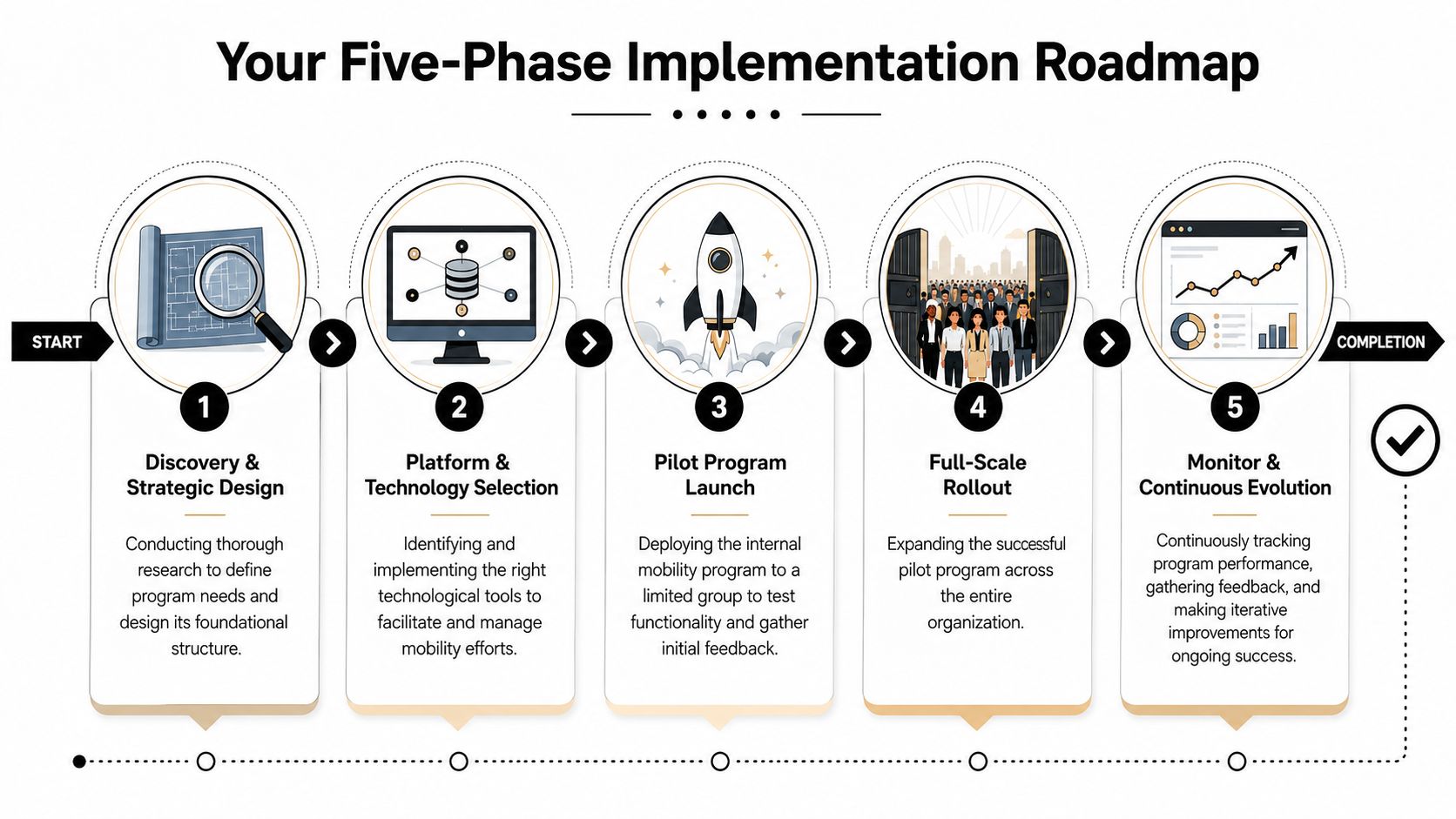
Your Five-Phase Implementation Roadmap
Most internal mobility programs don't fail because the idea is wrong. They fail because leaders launch too wide, too vague, and too fast. A rollout needs sequence. It also needs discipline around scope, ownership, and evidence.
The roadmap below works because it treats mobility as an operating change, not a communications exercise.
Phase one discovery and strategic design
Start with business demand, not technology. Ask which functions face recurring hiring pressure, where capability gaps appear repeatedly, and which roles could realistically be filled from adjacent internal talent.
Then define what mobility should include in your organization. Promotions only won't be enough. Lateral transitions, project-based movement, temporary assignments, and capability-building placements often create the most value because they widen the internal bench.
At this stage, align on a few design choices:
Phase two technology and process integration
Many teams often over-focus on platform selection and under-focus on workflow.
The right technology stack has to connect with your HRIS, ATS, learning environment, and talent data sources. But the system only works if the underlying process is clear. An internal application path that is hidden, slow, or manager-dependent will underperform no matter how strong the front end looks.
Build for these operational realities:
1. Role data has to be clean. If job titles, levels, and role expectations are inconsistent, matching quality suffers. 2. Profiles need substance. Employees should be able to show experience, interests, aspirations, and relevant capabilities. 3. Review flow must be visible. Internal candidates need confidence that their applications won't disappear into a black box. 4. Readiness signals should go beyond resumes. Technical history alone won't support sound redeployment decisions.
Phase three pilot program launch
Pilot in one part of the business where demand is real, leadership is engaged, and roles are diverse enough to test the model properly.
A good pilot should answer practical questions quickly. Are employees willing to apply. Do managers support outbound moves. Can recruiters and HRBPs manage the process without workarounds. Are receiving teams satisfied with the quality of internal matches.
Don't choose a pilot group because it's easy. Choose one where the business problem is visible enough that improvement will matter.
> Pilot principle: If a pilot can't survive real operating pressure, it won't survive scale.
Keep the pilot bounded, but not trivial. Include enough movement types to learn where friction appears. Track where approvals stall, where candidate quality is misunderstood, and where managers need stronger support.
Phase four strategic communication and change management
Mobility isn't adopted because HR sends a launch email. It's adopted when employees believe the process is real and managers believe they won't be punished for participating.
Communication has to answer different questions for different audiences.
| Audience | What they need to hear | |---|---| | Employees | What opportunities exist, how to apply, and what fairness looks like | | Managers | How mobility supports business strength and how transitions will be managed | | Executives | How the program connects to retention, workforce agility, and talent risk | | HR and TA teams | What process changes, which decisions need consistency, and where escalation sits |
Use line managers, HRBPs, and business leaders as translators. Employees trust direct context more than centralized slogans.
Phase five scaling and continuous optimization
Scale only after you can explain what's working, what isn't, and why.
This phase usually exposes the maturity gap. Early enthusiasm can hide weak role data, inconsistent manager behavior, or poor fit assessment. Once more employees enter the system, those flaws surface quickly.
Focus optimization in a few areas:
The organizations that scale best treat internal mobility programs as living systems. They don't freeze the design after launch. They review friction points, retrain managers, improve data quality, and keep making the process easier to trust.
Measuring What Matters Most with Mobility KPIs
If the only metric on your dashboard is number of internal moves, you don't have a performance system. You have an activity count.
The right measurement approach should tell you whether internal mobility programs are becoming faster, fairer, higher quality, and more useful to the business. That means balancing efficiency metrics with talent outcomes and post-move performance indicators.
Build a balanced scorecard
A practical scorecard should combine three lenses.
First, measure whether the process works. Second, measure whether talent outcomes improve. Third, measure whether the business is getting stronger placements, not just more movement.
Here's a useful structure.
| KPI Category | Metric | What It Measures | |---|---|---| | Efficiency | Internal fill rate | How often open roles are filled with internal talent | | Efficiency | Internal application response time | How quickly internal candidates receive acknowledgment and progression updates | | Efficiency | Time to complete internal transfer | How smoothly the organization executes approved moves | | Talent impact | Retention rate of mobile employees vs. overall workforce | Whether internal movers stay and remain engaged after transitions | | Talent impact | Promotion velocity | Whether strong employees are progressing through the organization in a healthy way | | Talent impact | Cross-functional move rate | Whether capability is moving across silos, not just upward | | Performance | Early performance of internal hires in new roles | Whether placement quality is strong after the move | | Performance | Hiring manager satisfaction with internal movers | Whether receiving teams believe the match was effective | | Performance | Post-move ramp quality | How quickly internal movers become productive in the target role |
What experienced talent leaders watch closely
Internal fill rate is useful, but it can mislead. A high rate isn't automatically healthy if weak-fit moves create underperformance or fast regret. Likewise, a growing volume of internal applications may only indicate employee frustration if the process rarely produces decisions.
I've found that the most revealing mobility metrics sit one step past the transaction:
> Good measurement doesn't ask whether mobility is happening. It asks whether the organization is getting better at placing people where they can succeed.
Use KPIs to make decisions, not decorate dashboards
A scorecard should trigger action. If internal candidates abandon the process, inspect response speed and transparency. If receiving managers report mixed success, revisit role definitions and fit assessment. If mobility remains concentrated in a few teams, investigate manager incentives and pathway visibility.
That's the point of measurement. Not celebration. Correction.
Avoiding the Pitfalls That Derail Mobility
Most mobility failures are predictable. They don't come from lack of enthusiasm. They come from weak operating design and poor decision discipline.
The most common mistake is assuming that making opportunities visible is enough. It isn't. Internal mobility programs derail when incentives, process, and fit logic are left unresolved.
Talent hoarding is a system problem
Managers often get blamed for blocking moves, but the root issue is usually structural. If leaders are measured only on current output, they'll protect capacity. That's rational behavior.
Counter it with enterprise-level accountability. Performance expectations for managers should include talent development, internal exports, and succession health. HRBPs should also review blocked or delayed moves, especially when the same leader repeatedly resists transitions.
A few interventions work well:
Opacity destroys trust faster than almost anything else
Employees don't expect every application to succeed. They do expect the process to be real.
Programs lose credibility when internal candidates can't tell whether they're being reviewed fairly, when jobs appear pre-wired, or when current managers learn about applications before expectations are clear. The answer isn't endless policy. It's visible process.
Use clear rules for eligibility, review timing, interview expectations, confidentiality, and transfer handoff. Then train managers and recruiters to follow them consistently.
> If employees believe internal hiring is theater, they'll return to external job searches.
Skill match isn't enough
This is the quiet failure mode that causes the most damage.
A person can have relevant experience and still be wrong for the role context. A top individual contributor can struggle in a role that requires political navigation and broad consensus building. A successful operations manager can misfire in a faster, less structured innovation environment. A technically strong employee can enter a team whose collaboration style clashes badly with their natural working patterns.
That's why fit has to be assessed at three levels:
| Risk area | What to evaluate | |---|---| | Person to role fit | Behavioral demands, pace, ambiguity, influence requirements | | Person to team fit | Collaboration norms, conflict style, decision cadence | | Person to manager fit | Expectations around autonomy, feedback, and control |
Predictive behavioral intelligence improves the quality of internal mobility decisions. Instead of inferring readiness from tenure, current performance, or self-reported interest alone, leaders can examine whether the candidate's likely work style aligns with the actual success conditions of the target role and team.
Don't confuse mobility with movement
Some companies celebrate any transfer as proof the program works. That's a mistake. Internal movement only creates value when it solves a business need and supports employee success at the same time.
Watch for warning signs:
The strongest internal mobility programs reduce these risks by combining transparency with fit discipline. They don't just open doors. They improve the odds that the right people walk through the right ones.
Conclusion The Future of Talent Is Fluid
The strongest CHROs have moved past the question of whether internal mobility deserves investment. The operating question is whether the system is reliable enough to shape succession, redeployment, and workforce planning decisions before a vacancy turns into a scramble.
That distinction matters because mobility is not an internal job board with better branding. It is an operating discipline for allocating talent against shifting business priorities, retaining institutional knowledge, and building leadership depth without defaulting to the external market every time demand changes.
Average programs increase visibility. Strong programs add governance, manager accountability, clear pathways, and outcome tracking. The programs that create durable business value add one more layer: evidence about fit. They assess skills, but they also evaluate the behavioral conditions that determine whether someone is likely to succeed in a specific role, with a specific team, under a specific manager.
That is the future of mobility.
Organizations that continue to treat talent as a string of external requisitions stay stuck in replacement mode. Organizations that use predictive behavioral intelligence to anticipate fit can make internal moves with more confidence and less disruption. That shift is what turns mobility from a reactive process into a proactive talent strategy.
Fluid talent systems do not appear on their own. Leaders set the expectation. Process keeps decisions consistent. Data earns trust.
For teams ready to close the gap between internal movement and internal fit, the next step is straightforward. Add better evidence to the decision.
Synopsix helps organizations make better people decisions by translating behavioral assessment data into practical guidance for hiring, team design, and talent development. If you want to build internal mobility with stronger evidence around person-role and person-team fit, explore [Synopsix](https://synopsix.ai).