Interpersonal Skills Assessment: Predict Smarter Hiring
By Synopsix · October 11, 2026 · 14 min read
A strong interpersonal skills assessment is a structured, validated tool that measures job-relevant behavior and forecasts workplace performance, not merely communication style or personality. In a meta-analysis of personality measures, corrected validity averaged 0.29 in confirmatory studies, compared with 0.12 in exploratory studies, and rose to 0.38 when researchers used job analysis to select the relevant dimensions ([Wiley research](https://onlinelibrary.wiley.com/doi/abs/10.1111/j.1744-6570.1991.tb00696.x)).
That result is counterintuitive because an assessment can feel precise, modern, and engaging while adding little to an actual hiring decision. Recent research on a gamified soft-skills assessment found that adaptability, flexibility, resilience, and decision-making predicted self-reported job and academic performance, yet added no workplace-performance or organizational-citizenship variance beyond cognitive ability and personality ([Cambridge University Press research](https://www.cambridge.org/core/journals/spanish-journal-of-psychology/article/exploring-the-relationship-of-a-gamified-assessment-with-performance/39125B6F3BD27F6B4C1AD514D2330E4A)).
The practical question, then, isn't whether candidates enjoy an assessment or whether its scores look psychometrically credible. It's whether each measured behavior predicts an outcome that matters in a particular role, does so fairly across groups, and improves decisions beyond the information an organization already has.
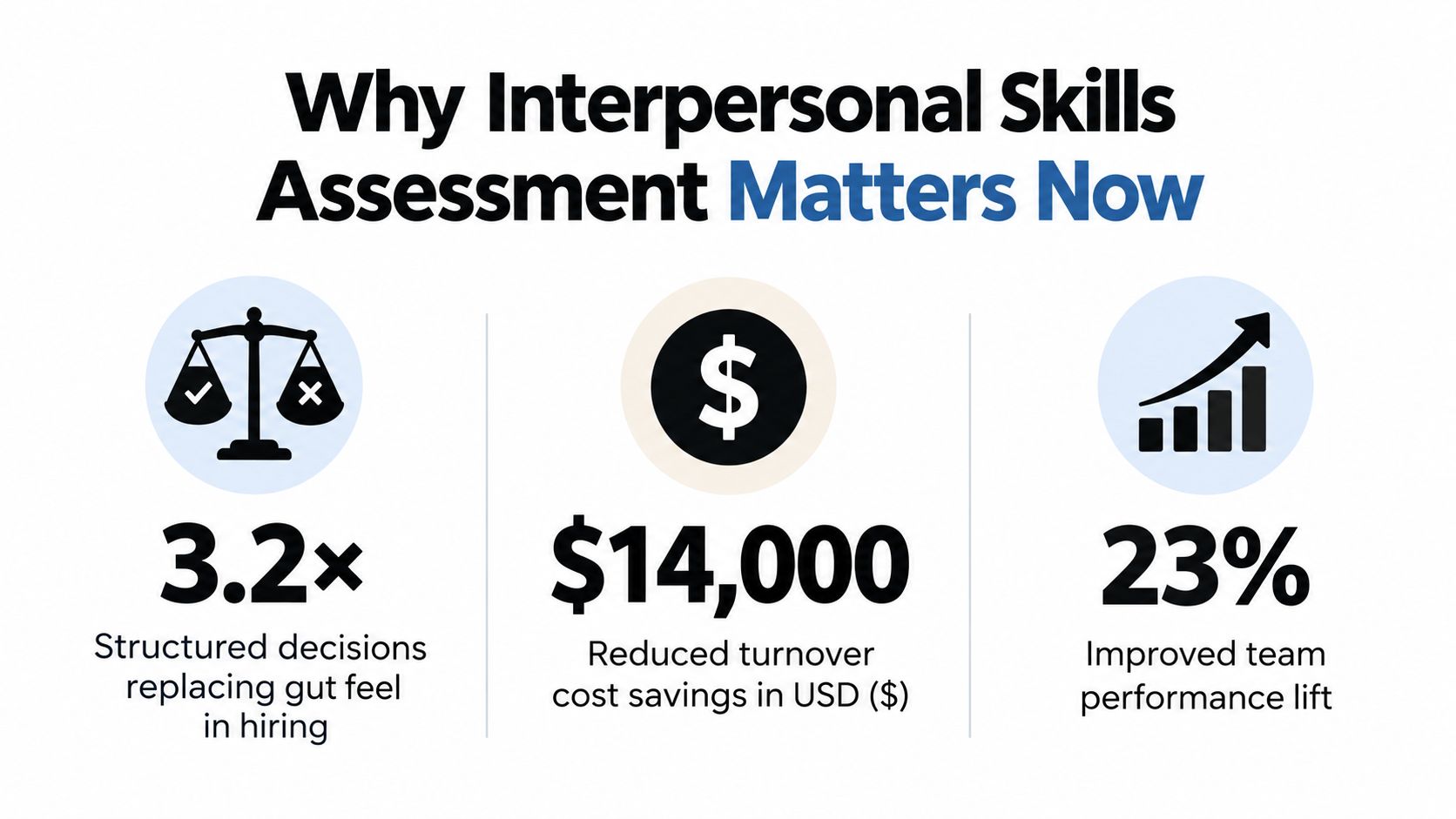
Why Interpersonal Skills Assessment Matters Now
An interpersonal skills assessment should be treated as a decision mechanism, not a feel-good measure of whether someone appears articulate, agreeable, or confident. Organizations use these tools because they need to anticipate behavior under real work conditions, including disagreement, changing priorities, customer pressure, ambiguous authority, and cross-functional dependence. A useful assessment turns those demands into observable behaviors and links the resulting scores to workplace outcomes.
That standard separates evidence from appeal. A polished simulation, a short gamified exercise, or a friendly questionnaire may produce high completion rates and positive reactions. Those signals describe the user experience. They don't establish that the tool predicts retention, manager-rated performance, customer outcomes, or team delivery. The Cambridge study is important precisely because it illustrates how an assessment can appear engaging and credible without providing meaningful incremental prediction beyond cognitive ability and personality ([study of gamified assessment and performance](https://www.cambridge.org/core/journals/spanish-journal-of-psychology/article/exploring-the-relationship-of-a-gamified-assessment-with-performance/39125B6F3BD27F6B4C1AD514D2330E4A)).
The evidence standard
A credible evaluation asks four questions:
People analytics provides the broader context for making those distinctions. The [people analytics overview from Synopsix](https://synopsix.ai/blog/what-is-people-analytics) is useful because it frames workforce data as a decision input rather than a replacement for managerial judgment.
The rest of the evaluation therefore uses four tests: structure, job relevance, fairness, and incremental validity. Branded tools and attractive formats matter less than whether the process withstands comparison with real business outcomes.
Comparing Validated Interpersonal Skills Assessment Methods
Methods shouldn't be ranked by popularity. They should be matched to the behavior an organization needs to observe and the decision it needs to make.
| Method | Best Use | Key Risk | |---|---|---| | Behavioral questionnaires | Measuring selected tendencies efficiently across a broad applicant pool | Traits can be overgeneralized or disconnected from role behavior | | Situational judgment tests | Comparing responses to realistic work dilemmas | Scenarios may measure test-taking skill when they don't mirror the role | | Simulations | Observing adaptive behavior, communication, and judgment in context | Engagement can be mistaken for predictive accuracy | | 360 feedback | Development and multi-rater perspective | Ratings can reflect visibility, relationships, and rater bias |
Behavioral questionnaires
Questionnaires are efficient, but efficiency doesn't resolve the construct problem. They can measure dispositions such as agreeableness, extraversion, or resilience, yet those traits only become useful predictors when job analysis identifies why they matter for a specific role. The personality meta-analysis found that explicitly using job analysis to select dimensions raised average validity to 0.38, compared with a lower overall average in the broader evidence base ([job-analysis-based personality validity findings](https://onlinelibrary.wiley.com/doi/abs/10.1111/j.1744-6570.1991.tb00696.x)).
Situational judgment tests
Situational judgment tests present candidates with work dilemmas and compare their responses against a scoring model. They can sample content-rich decisions at scale, especially where the role involves conflict resolution, prioritization, customer pressure, or policy trade-offs. Their weakness appears when scenarios are generic, culturally narrow, or too distant from the actual work. In that case, the test may reward familiarity with assessment conventions instead of job-relevant judgment. A deeper treatment of design choices appears in Synopsix's guide to [situational judgment tests](https://synopsix.ai/blog/situational-judgment-tests).
Simulations and 360 feedback
Simulations reveal behavior that questionnaires may only infer. They're valuable when the role depends on adapting communication, handling uncertainty, or managing interpersonal friction, but designers must validate the observed behavior against outcomes rather than relying on realism or participant enthusiasm.
360 feedback offers a different advantage. Managers, peers, and direct reports can reveal patterns that a single evaluator misses, making the method valuable for development. It's a weaker standalone hiring gate because raters differ in exposure, relationships, and willingness to report difficult behavior.
For roles shaped by transformation, teams can also use resources on [workplace change challenges](https://www.corporatechallenge.com.au/workplace-change/) to identify the interpersonal situations that scenarios should represent. The method is credible only when its content reflects the actual pressures of the job.
Fairness and Bias Guardrails in Interpersonal Assessment
Standardization doesn't automatically create fairness. It can reduce interviewer inconsistency, but it can also standardize barriers that have nothing to do with collaboration or leadership. Language processing demands, timing, technology experience, disability accommodations, response format, age, cultural norms, and unequal access to technology can all affect how candidates respond.
The central governance question is whether the same score has the same meaning across groups. A low score might indicate weak conflict management, but it might also reflect unfamiliarity with the format, second-language processing, disability-related communication differences, or culturally specific expectations around disagreement and self-promotion. Recent assessment guidance recommends examining measurement invariance across race or ethnicity, gender, age, language, and time, while also considering accommodations and group representation (assessment fairness guidance).
Governance beyond structured scoring
A defensible process should:
The [AI resume screening guide for HR teams](https://makeautomation.co/ai-resume-screening-tools/) provides useful context for a related principle: automation can organize evidence, but it doesn't remove the need to examine how evidence is generated and interpreted.
The U.S. Office of Personnel Management offers a useful structure for fairness and validity. Structured interviews begin with job analysis, use standardized questions tied to critical competencies, and apply consistent ratings. They can demonstrate content, criterion-related, construct, and incremental validity when organizations test those claims rather than assume them ([OPM structured interview guidance](https://www.opm.gov/policy-data-oversight/assessment-and-selection/other-assessment-methods/structured-interviews.pdf)). Fairness is therefore an ongoing audit of construct, administration, scoring, and prediction.
<iframe width="100%" style="aspect-ratio: 16 / 9;" src="https://www.youtube.com/embed/C-Dp372Jsj4" frameborder="0" allow="autoplay; encrypted-media" allowfullscreen></iframe>
What Interpersonal Skills Assessment Should Actually Predict
The phrase “interpersonal skills” hides the most important design decision. A hiring team shouldn't ask whether a candidate has strong interpersonal skills in the abstract. It should ask which behavior the role rewards and which observable outcome should change if the assessment is useful.
For a customer-facing role, relevant behaviors might include de-escalating conflict, identifying the need beneath a request, and communicating clearly under pressure. For a project leader, the target could be expectation management, cross-functional coordination, or responding constructively when delivery assumptions change. For a people manager, the focus might be feedback, conflict resolution, and adapting communication across direct reports. These are narrower and more testable than broad impressions such as “warmth” or “confidence.”
Incremental value is the decision test
The Cambridge research provides a warning for assessment buyers. Measured adaptability, flexibility, resilience, and decision-making predicted self-reported job and academic performance, but the assessment didn't explain additional workplace-performance or organizational-citizenship variance beyond cognitive ability and personality ([research on incremental prediction](https://www.cambridge.org/core/journals/spanish-journal-of-psychology/article/exploring-the-relationship-of-a-gamified-assessment-with-performance/39125B6F3BD27F6B4C1AD514D2330E4A)). Reliability and engagement are useful properties, but neither proves that the tool improves selection.
A practical validation matrix can connect each dimension to a criterion:
| Interpersonal dimension | Possible job behavior | Validation criterion | |---|---|---| | Conflict management | De-escalates disagreement and reaches workable next steps | Manager-rated performance or escalation outcomes | | Adaptive communication | Changes explanation, channel, or level of detail | Customer outcomes or team delivery | | Collaboration | Coordinates dependencies and shares relevant information | Delivery quality or peer-rated contribution | | Resilience | Maintains effective behavior during pressure or setbacks | Retention, performance, or recovery after disruption |
The matrix isn't a universal scoring key. It's a discipline for choosing the smallest assessment battery that can improve a hiring or promotion decision. Organizations should compare the interpersonal measure with personality and cognitive ability, then test whether it adds information that decision-makers can use. If it doesn't, an engaging format remains an experience, not a prediction system.
How to Design, Validate, and Score Interpersonal Skills Assessment
Design starts with the job, not the assessment vendor. A people analytics team should examine the target role, interview strong and weak performers, review meaningful work events, and identify the interpersonal behaviors that distinguish effective execution. Generic competency libraries can provide language, but they shouldn't replace role-specific evidence.
Build the construct
Write items around observable actions and realistic constraints. A scenario for a customer-support role might involve a policy conflict and an upset customer. A scenario for a technical lead might involve a missed dependency and competing stakeholder priorities. The best prompt makes the candidate choose, explain, or demonstrate behavior that resembles the work.
Behavioral-description interviews can add evidence from past behavior. The OPM recommends standardized questions tied to competencies and consistent rating procedures, while describing behavioral questions as particularly relevant to complex professional and managerial work ([structured interview design guidance](https://www.opm.gov/policy-data-oversight/assessment-and-selection/other-assessment-methods/structured-interviews.pdf)).
Create a scoring model
Use behavioral anchors rather than impressionistic labels. A low anchor might describe avoiding the issue or escalating without clarification. A middle anchor might describe acknowledging the problem and proposing a compliant next step. A high anchor might describe clarifying the underlying need, adapting the message, and creating a documented resolution.
Train raters to apply those anchors consistently. The structured interview evidence summarized by an industrial-organizational psychology source reports a validity correlation of 0.51 for structured employment interviews in predicting overall job performance, compared with 0.38 for unstructured interviews ([structured and unstructured interview validity](https://onlinelibrary.wiley.com/doi/10.1002/9781118851715.ch10)). Structure is therefore part of the prediction mechanism, not an administrative detail.
Validate before scaling
Validation should combine several forms of evidence:
1. Content validity: Confirm that scenarios represent real job demands. 2. Criterion-related validity: Compare scores with relevant performance outcomes. 3. Construct validity: Examine relationships with cognitive ability and personality measures. 4. Incremental validity: Test whether the tool improves prediction beyond existing predictors. 5. Fairness evidence: Examine subgroup distributions, accommodations, and differential prediction.
Administration conditions matter too. A 2025 PNAS study found that telling participants they were assessed by AI rather than a human changed their behavior, with participants placing greater emphasis on analytical characteristics ([PNAS study of AI disclosure and assessment behavior](https://www.pnas.org/doi/10.1073/pnas.2425439122)). Organizations should document AI disclosure, keep instructions consistent, and validate results under the same conditions used in actual decisions.
Sample Items and Scoring for Interpersonal Skills Assessment
Consider a representative hiring process for a client-facing project coordinator. The role depends on expectation management, conflict handling, and adaptive communication. The assessment should not ask whether the candidate is “a people person.” It should present behaviorally specific situations.
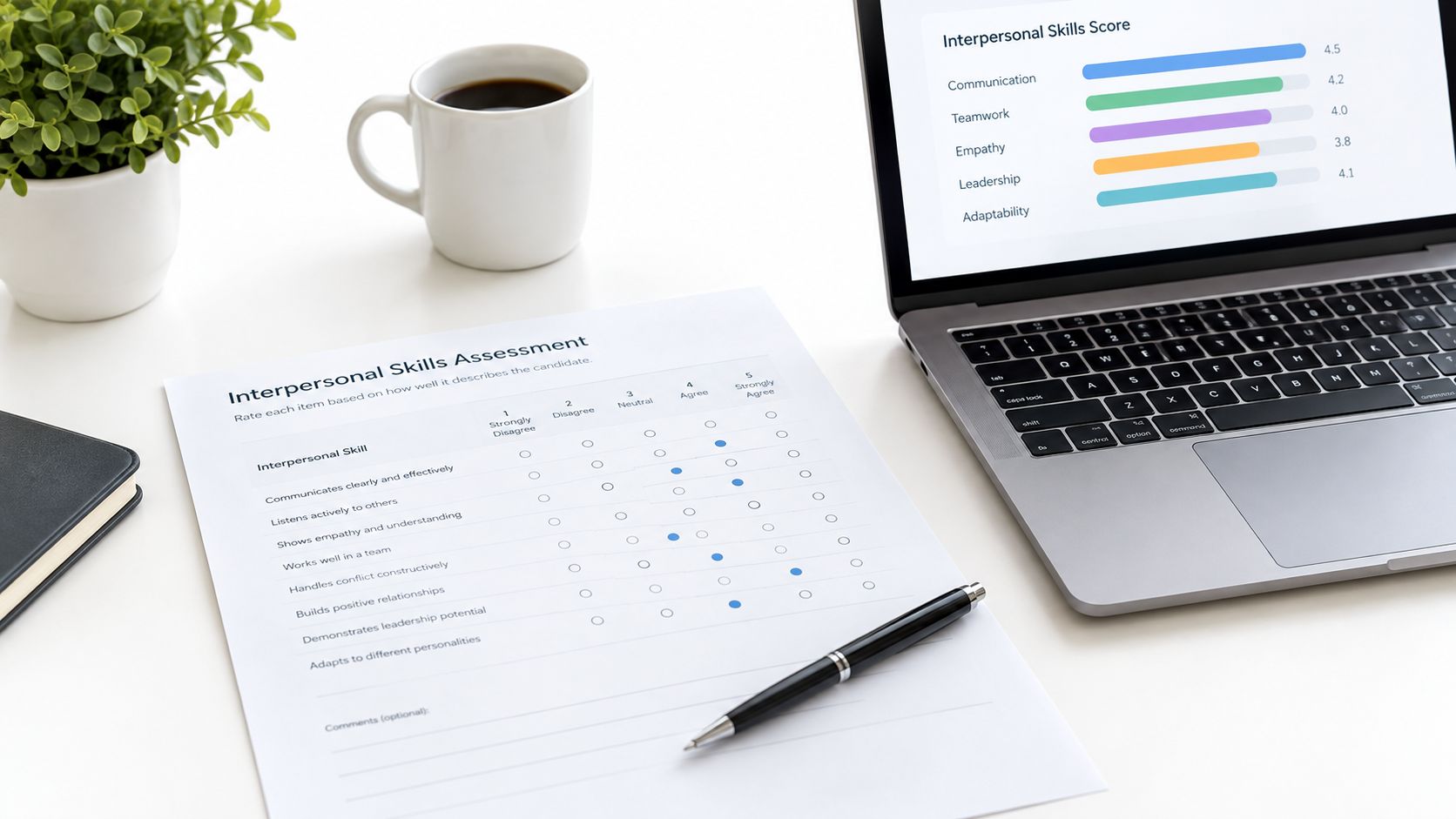
Behavioral-description item
Question: Tell us about a time when a stakeholder disagreed with your proposed approach. What did you do first, how did you adapt your communication, and what happened next?
A structured rater could look for three signals:
Situational judgment item
Prompt: A client asks for a delivery date that conflicts with an internal dependency. Which response best reflects effective coordination?
A. Promise the date and ask the delivery team to find a way to meet it. B. Reject the request immediately because the dependency makes it impossible. C. Clarify the client's priority, verify the dependency, and present realistic options with consequences. D. Wait until the internal team resolves the issue before responding.
The scoring key should reflect the role's documented demands, not a rater's preferred personality. C demonstrates clarification, cross-functional coordination, and expectation management. The item should sit alongside other scenarios because one response can't establish a stable interpersonal profile.
Interpreting the result
Suppose a candidate performs strongly on conflict de-escalation but weakly on expectation management across several items. The appropriate interpretation isn't “poor communicator.” It's a narrower development or selection signal: the candidate may handle tension constructively but need evidence of proactive coordination.
That distinction protects candidates from personality impressions masquerading as skill measurement. Aggregate scores, behavioral anchors, structured evidence, and role-specific criteria should inform the decision together.
Integrating Interpersonal Skills Assessment with People Intelligence
An assessment becomes more useful when it connects to a workflow that moves from evidence to action. A practical model has four stages: assess, profile, translate, and act.
First, assess the behaviors that job analysis identifies as relevant. Then generate a comparable behavioral profile, so decision-makers can distinguish a candidate's observed tendencies from broad labels. Translation comes next. A profile should connect collaboration, influence, adaptive communication, and friction risk to the demands of a particular role, such as leadership, sales, or project delivery.
From profile to decision
Action can include structured follow-up questions, targeted simulations, onboarding priorities, or team-complementarity analysis. Predictive simulations can test how likely friction might arise under a defined work condition, while team visualizations can expose complementary strengths and tension points before a hire changes group dynamics.
Synopsix is one example of a people-intelligence platform that combines behavioral assessments, comparable profiles, role-focused intelligence reports, predictive simulations, compatibility analysis, and development plans. Its use in this workflow should still be governed by the same standards as any other tool, including role relevance, fairness review, and outcome validation.
The administration context deserves special attention. The PNAS finding on AI disclosure means organizations should document whether participants know AI is involved and keep instructions consistent ([research on assessment context and AI disclosure](https://www.pnas.org/doi/10.1073/pnas.2425439122)). A profile produced under one disclosure condition shouldn't be assumed to represent behavior under another.
The same principle applies to supporting materials. Even something as peripheral as [real estate agent headshots](https://secta.ai) belongs to a different measurement problem than interpersonal behavior. Visual polish, branded presentation, and candidate experience can support adoption, but they mustn't be confused with evidence that a score predicts workplace outcomes.
Common Mistakes and Best Practices for HR Leaders
HR leaders weaken an interpersonal skills assessment when they use an unstructured conversation as a proxy for measurement, choose an attractive tool without incremental-validity evidence, let one score override all other information, or skip validation when the role changes. Fairness also fails when teams treat an initial review as a permanent compliance checkbox.
A durable operating checklist is concise:
An assessment should reduce uncertainty, not replace judgment. Its credibility comes from the quality of the decision system around it.
---
Synopsix helps organizations turn validated behavioral assessments into comparable profiles, role-specific intelligence, predictive simulations, and team-complementarity insights. Visit [Synopsix](https://synopsix.ai) to evaluate interpersonal behavior as evidence for better hiring, team design, and talent development decisions.