Interview Question Design: A Framework for Hiring Success
By Synopsix · July 3, 2026 · 16 min read
Structured interviews with standardized questions yield roughly 60% higher predictive validity than unstructured interviews, which research describes as almost useless for predicting future job performance ([Erik Bern](https://erikbern.com/2018/05/02/interviewing-is-a-noisy-prediction-problem.html)). That single fact should change how most companies think about hiring.
Too many interview loops still run on instinct. A hiring manager scans a resume, asks whatever comes to mind, and leaves with a vague impression of whether they'd “work well together.” That approach feels efficient. It isn't. It confuses comfort, similarity, and verbal fluency with actual job capability.
Good interview question design is a system, not a script. It starts with the business outcome you need, converts that into competencies, matches those competencies to the right question types, and then scores answers against clear evidence. That's how you predict-human-behavior-synopsix-smarter-people-decisions. Not by asking clever questions. By designing questions that produce comparable signal.
Why Most Interviews Fail to Predict Success
Most interviews fail for a simple reason. They aren't built to predict anything.
They're built to fill time, confirm first impressions, and make interviewers feel informed. Those are different goals, and they produce very different outcomes. When teams rely on conversational interviews, they usually reward confidence, polish, and similarity to the interviewer. They rarely isolate the behaviors that drive performance in the actual role.
Gut feel creates noise
In unstructured interviews, every interviewer asks different questions, probes different details, and applies a private scoring model in their head. One interviewer values executive presence. Another values technical depth. A third remembers only the candidate's strongest or weakest moment. The result isn't a hiring framework. It's a stack of opinions.
A disciplined process fixes that by standardizing what gets measured and how. If every candidate gets the same core questions tied to the same competencies, the team can compare answers on evidence instead of memory.
> Practical rule: If two interviewers couldn't explain why they gave different ratings using the same criteria, the process isn't measuring performance. It's measuring preference.
There's also a communication trap here. Interviewers often think a “good conversation” means a good interview. It doesn't. Strong interviewing requires listening, concise prompting, and clean follow-up. If your managers need to sharpen those habits, resources on [effective communication for coaches](https://www.coachful.co/blog/communication-skills-in-coaching) are useful because coaching and interviewing share the same discipline of drawing out evidence without leading the other person.
Prediction starts with validity
The necessary shift is mental before it's procedural. Hiring isn't a chemistry test between manager and candidate. It's an evidence collection exercise. That means the interview has to be built with validity in mind, which is why understanding [validity in psychology](https://synopsix.ai/blog/validity-in-psychology) matters for anyone designing selection processes.
A strong interview doesn't ask, “Do I like this person?” It asks:
What usually goes wrong
Three patterns show up repeatedly in weak interview processes:
| Failure pattern | What interviewers do | What it causes | |---|---|---| | Casual conversation | Follow the resume without a plan | Inconsistent evidence across candidates | | Trick questions | Reward speed or cleverness | False confidence about actual job readiness | | Vague scoring | Debrief from memory and impressions | Bias, recency effects, and weak decisions |
The fix isn't to make interviews robotic. It's to make them intentional. The best processes still feel human, but they're engineered to capture job-relevant evidence.
From Job Description to Core Competencies
Most bad interview questions can be traced back to a bad starting point. The team begins with the job description, copies the bullet points, and turns them into generic prompts like “Tell me about your communication skills” or “How do you handle pressure?” Those questions sound relevant, but they're too broad to measure anything well.
The better approach is to work backward from business outcomes. Start with what the role must deliver. Then define the behaviors, judgment, and technical skills required to deliver it consistently.
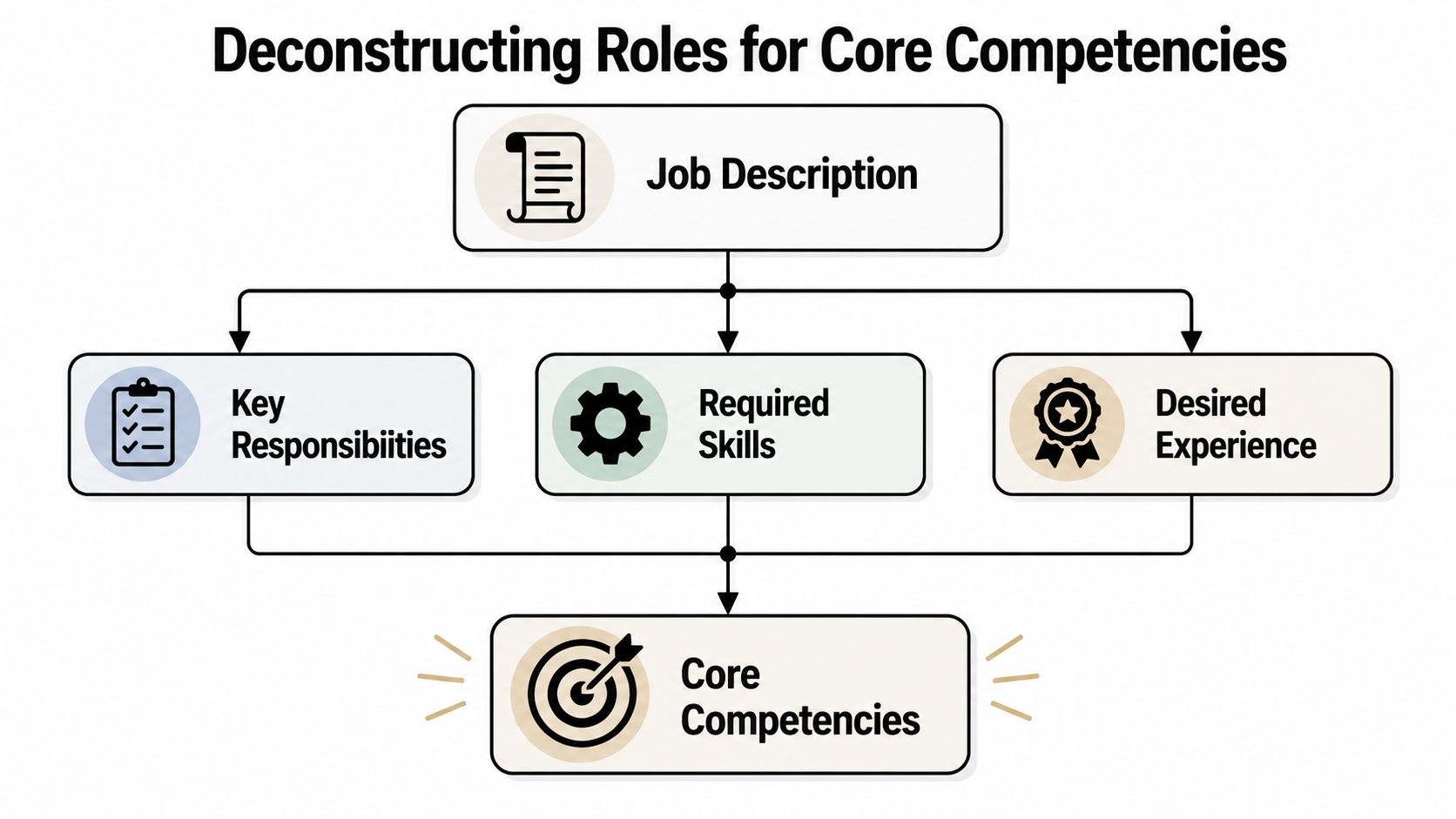
Start with outcomes, not adjectives
Take a Sales Manager role. Most job descriptions list broad traits like leadership, communication, forecasting, stakeholder management, and strategic thinking. Those terms are too fuzzy on their own. Ask three leaders what “strong communication” means and you'll get three different answers.
Instead, define what success looks like in business terms. For example:
1. Build a stable pipeline discipline so the team can forecast with credibility. 2. Improve rep performance through coaching, not just pressure. 3. Coordinate with marketing and finance so coverage, targets, and reporting stay aligned. 4. Retain strong sellers while managing out poor fit quickly.
Once those outcomes are clear, the competencies become more concrete.
Turn role requirements into observable behaviors
Here's a practical translation:
| Business outcome | Competency | Observable behavior | |---|---|---| | Reliable forecasting | Analytical judgment | Separates signal from noise, explains assumptions, updates view when new data arrives | | Better rep performance | Coaching | Diagnoses performance gaps and gives targeted feedback tied to behavior | | Cross-functional alignment | Influence | Gains buy-in without formal authority and resolves conflict with evidence | | Team stability | Talent judgment | Distinguishes skill issues from motivation or role mismatch |
That's the level where interview question design starts to work. You're no longer hiring for “great communicator.” You're hiring for a person who can align finance, challenge weak pipeline assumptions, and coach a rep through a stalled quarter.
> When interview questions aren't tied to business outcomes, interviewers end up measuring style instead of impact.
That gap shows up outside classic HR roles too. A useful example comes from design hiring, where a [BrainStation guide on UX interviews](https://brainstation.io/career-guides/ux-designer-interview-questions) points to a recurring weakness: interview frameworks often fail to require candidates to connect their decisions to business metrics, even as projected 2026 expectations for senior roles increasingly emphasize measurable business impact.
A simple competency drafting method
Use this four-part template with hiring managers before you write a single interview question:
This step takes discipline, but it saves enormous time later. If the competency model is weak, every question downstream will be weak too.
Matching Question Types to Your Competencies
Once the competencies are clear, the next mistake is using the same question format for everything. That's where many interview loops lose signal. Different competencies require different question types.
The most useful categories are behavioral, situational, and technical questions. Each serves a different purpose. The key is matching the format to what you're trying to learn.
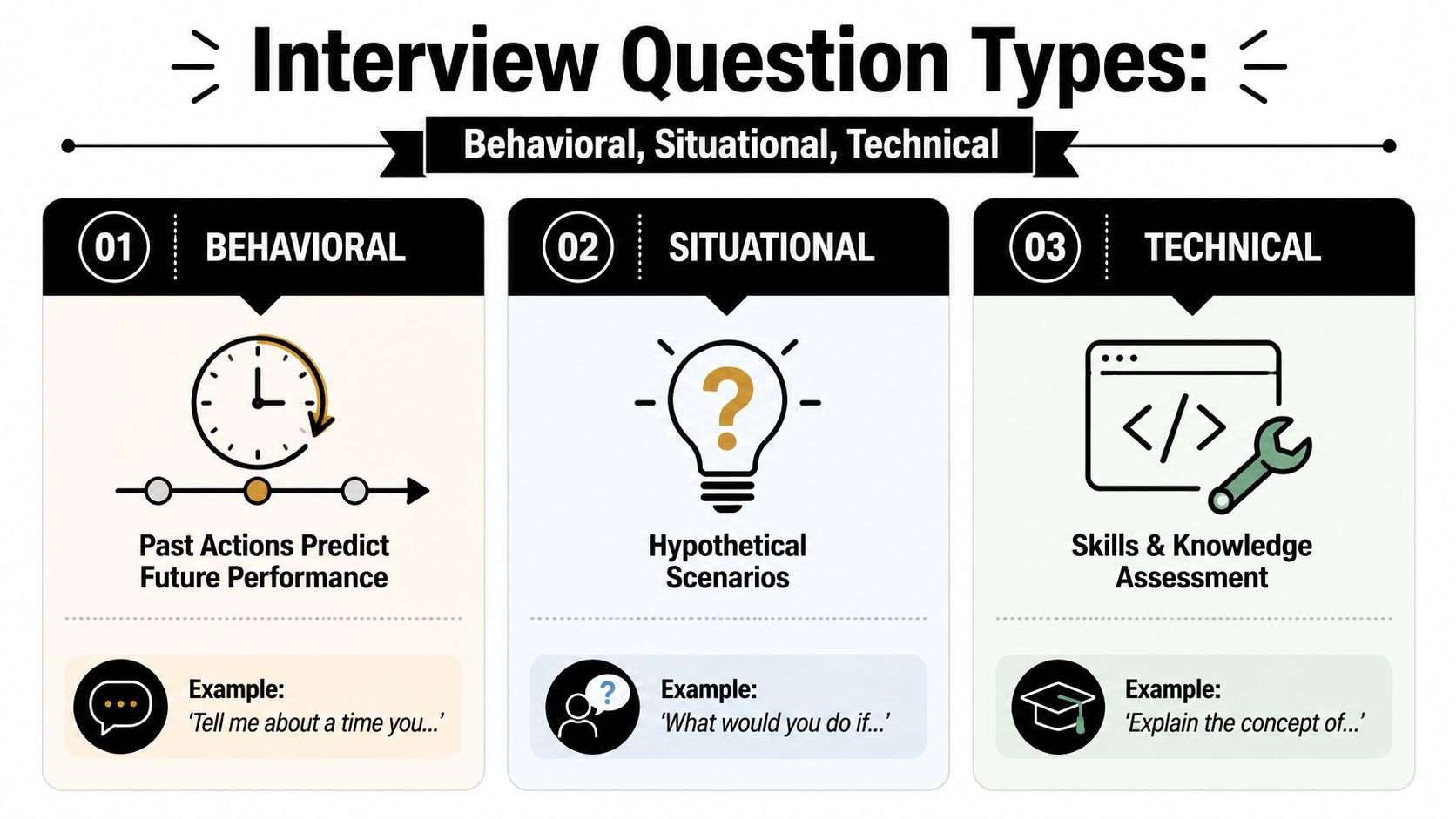
Use the right tool for the evidence you need
Behavioral questions ask about real past actions. They're powerful because they force candidates to describe what they did under real constraints. According to [PIN's summary of behavioral interview research](https://www.pin.com/blog/behavioral-interview-questions/), behavioral interview questions are 55% predictive of future on-the-job performance, compared with 10% for traditional unstructured interviews, with that validity gap supported across 85 years of research.
Situational questions present a scenario and ask what the candidate would do. These are useful when the role involves judgment in edge cases, ambiguity, or leadership trade-offs that may not appear cleanly in a candidate's past examples.
Technical questions test knowledge, process fluency, or methodological depth. These matter for roles where getting the work right depends on domain expertise, not just general intelligence or interpersonal skill.
Later in the process, many teams pair structured interviews with [work sample testing](https://synopsix.ai/blog/work-sample-testing) because interviews reveal how candidates explain and reason, while work samples reveal what they can produce under job-like conditions.
Here's a compact comparison:
| Question type | Best for | Strong example | Main risk | |---|---|---|---| | Behavioral | Proven patterns of action | “Tell me about a time you had to influence a skeptical stakeholder.” | Candidate gives a polished but shallow story | | Situational | Judgment under uncertainty | “What would you do if two leaders wanted conflicting outcomes?” | Interviewer scores style instead of reasoning | | Technical | Role-specific knowledge | “Walk me through how you'd validate this analysis.” | Becomes trivia instead of applied skill |
A short explainer can help anchor the distinction:
<iframe width="100%" style="aspect-ratio: 16 / 9;" src="https://www.youtube.com/embed/fr-mwiyhZAo" frameborder="0" allow="autoplay; encrypted-media" allowfullscreen></iframe>
Match formats to competencies, not interviewer preference
A balanced interview plan often looks like this:
Example mapping
For a Sales Manager, you might design the set this way:
The objective isn't variety for its own sake. It's coverage. You want evidence across action, judgment, and skill.
Crafting Questions That Generate Signal Not Noise
A well-chosen question type still won't help if the prompt itself is weak. Interview question design breaks down when questions are vague, leading, overloaded, or so polished that candidates can guess the expected answer.
Strong questions do three things well. They focus on one competency, force specificity, and create room for follow-up.
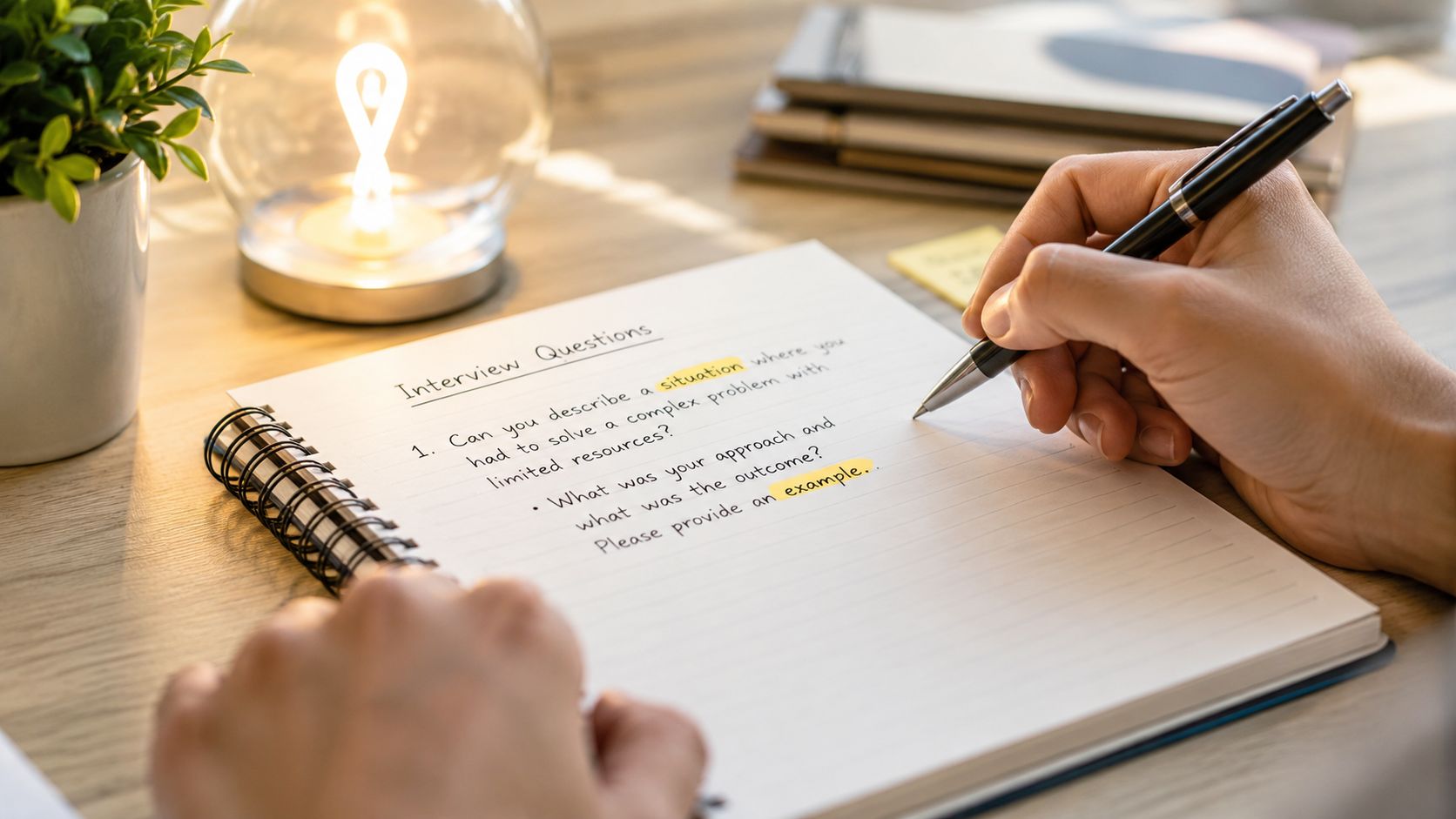
Write prompts that pull for evidence
A good question usually includes four ingredients:
1. A real context 2. A clear action prompt 3. A request for the candidate's own role 4. An invitation to explain outcome and learning
For example, instead of asking, “How do you manage stakeholders?” ask, “Tell me about a time a key stakeholder disagreed with your recommendation. What was the situation, what did you do, and what happened?”
That wording matters. It reduces abstraction and makes it harder to answer with theory alone.
What to avoid
Weak interview prompts often fall into familiar traps:
If you want inspiration for broader prompt libraries, curated collections like [interview questions for professionals](https://proficiently.com/prompts/interview-questions-to-ask/) can be useful as raw material. The important part is editing those questions so each one measures a specific competency in your environment.
> A strong interview question makes it easy for a qualified candidate to provide evidence, and hard for an unqualified candidate to hide behind generalities.
Test the thought process, not just the answer
One of the most underused techniques in interview question design is controlled ambiguity. Give the candidate incomplete information and see what they do. Do they rush to solve the problem, or do they pause and ask clarifying questions?
That distinction matters. As noted by [Nielsen Norman Group's guidance on answering UX interview questions](https://www.nngroup.com/articles/answer-ux-job-interview-questions/), a common design mistake is failing to test whether candidates can decipher intent and ask clarifying questions, even though that ability is more predictive in situational assessments than the final answer itself.
A simple example:
> You're launching a new process across two teams, and adoption is lagging. What would you do?
Don't add more detail immediately. Wait. Strong candidates usually ask who owns the process, what resistance looks like, whether adoption is measured, and what constraints exist. Weak candidates often jump straight to a generic solution.
A practical editing checklist
Before a question goes into an interview loop, check it against this list:
The best questions don't sound fancy. They sound precise.
Designing a Rubric for Consistent Scoring
Even excellent questions fail if interviewers score them loosely. Many hiring teams then backslide into bias. They standardize the prompts, then improvise the evaluation.
A rubric solves that. It forces the team to define what a strong, mixed, or weak answer looks like before the first interview starts.
Keep the rubric simple and behavioral
For most roles, a 1 to 5 scale works well. What matters isn't the number itself. What matters is the anchor behind it.
Experts cited by [Yardstick's guidance on statistical analysis interview questions](https://yardstick.team/interview-questions/statistical-analysis) recommend using only 3 to 4 high-quality, in-depth questions and giving 10 to 15 minutes per question so interviewers can probe the candidate's experience and reasoning thoroughly. That depth only pays off if the team knows what to listen for.
Here's a practical example for a collaboration question:
| Score | Behavioral anchor | |---|---| | 1 | Worked in isolation, blamed others, gave no evidence of alignment | | 3 | Coordinated with others when necessary, but influence approach was basic or reactive | | 5 | Proactively aligned stakeholders, anticipated resistance, adapted message, and drove a clear outcome |
That's much better than “strong answer” versus “weak answer.” It tells interviewers what behaviors justify the rating.
Build the rubric from observable evidence
For each interview question, define:
Then require interviewers to write notes tied to evidence, not adjectives. “Strong executive presence” isn't enough. “Aligned sales and finance on forecast assumptions after conflicting views surfaced” is useful.
A more detailed scoring framework is easier to maintain when teams align around explicit [candidate evaluation criteria](https://synopsix.ai/blog/candidate-evaluation-criteria) rather than broad impressions.
> Good rubrics don't eliminate judgment. They channel it.
What this changes in debriefs
When the panel debriefs, the conversation improves immediately. Instead of “I just didn't feel convinced,” interviewers have to point to a gap in evidence. Instead of debating charisma, they compare examples against pre-agreed anchors.
That makes the decision cleaner, fairer, and much easier to defend.
How to Pilot and Calibrate Your Interview Process
A question that sounds strong in a hiring design session can still fail in a live interview. I've seen well-intended loops break for predictable reasons: the prompt is too broad, the interviewer starts coaching, the candidate answers a different question than the one on the scorecard, or two panelists hear the same answer and score it a full level apart.
That is why piloting matters. If interview design is supposed to predict business outcomes, not just create a polished candidate experience, every question has to prove it can produce repeatable evidence under real conditions.
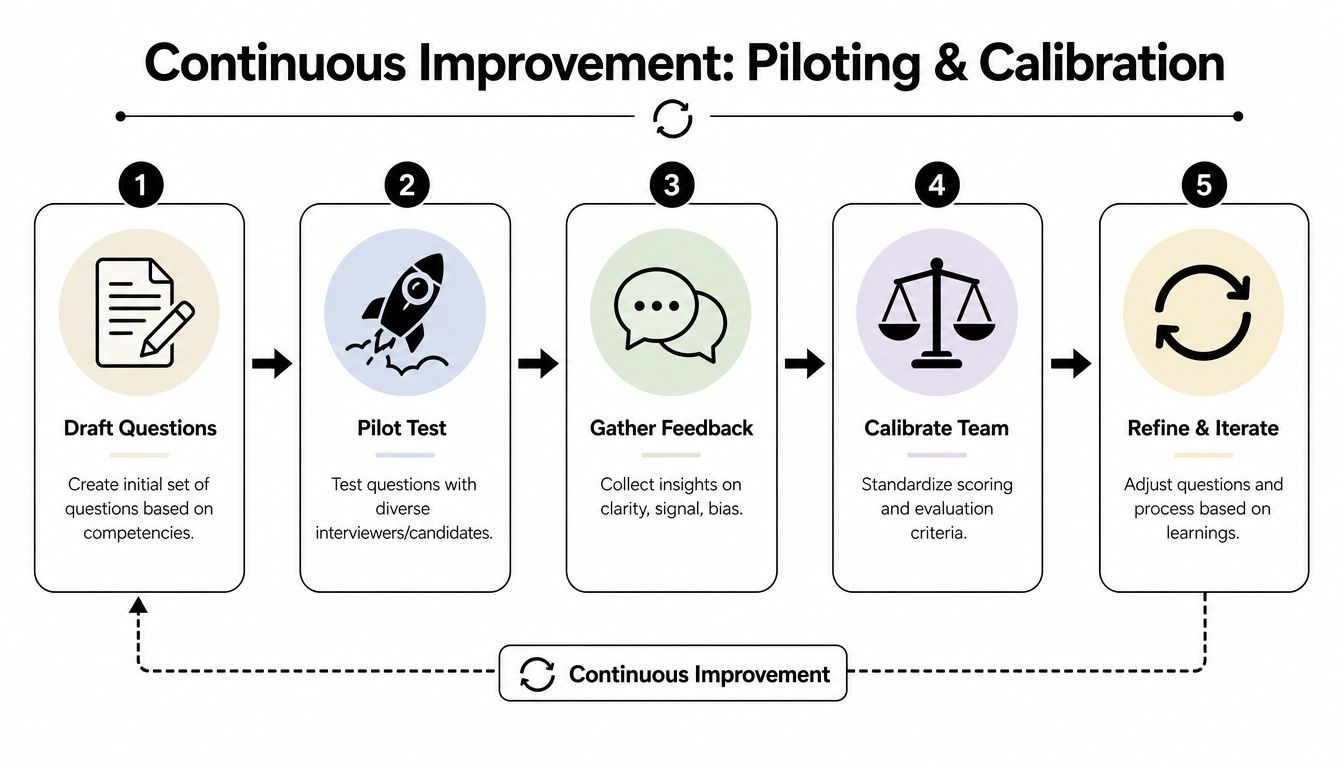
Pilot before you operationalize
Start with a controlled pilot. Use internal volunteers, recent hires, or a small first slate of candidates. The goal is to find where the design breaks before it scales across the full process.
Watch for a few specific failure points:
The pilot should be observed closely. Review recordings or notes. Count how often interviewers interrupt, over-explain, or ask follow-ups that drift away from the competency being tested. A process that only works with your most experienced interviewer is not ready for broad use.
Calibrate the panel
Calibration turns a set of questions into a usable decision system.
Run live calibration sessions with the panel. Use sample answers, compare scores, and force the group to explain the evidence behind each rating. If one interviewer gives a 4 for strategic judgment and another gives a 2, the conversation should get specific fast. What did each person hear? Which rubric anchor did they use? What evidence was missing?
One pattern shows up in almost every calibration session. Interviewers talk too much. They fill silence, rescue weak answers too early, or turn a structured question into a collaborative discussion. Candidate talk time should dominate because the point of the interview is to collect evidence, not to showcase the interviewer's thinking. In practice, that usually means retraining interviewers to ask the question, probe with discipline, then stop talking.
For technical hiring, calibration gets even stronger when the panel reviews examples of role-specific interview design instead of relying on generic question banks. Resources on [mastering AI engineer interviews](https://www.thirstysprout.com/post/ai-engineer-interview-questions) are useful because they show how to test applied reasoning and trade-off judgment rather than memorized definitions.
Measure calibration against outcomes
The strongest teams do more than hold calibration meetings. They check whether the interview accurately predicts success on the job.
Track interview scores against early performance indicators, ramp speed, quality of hire, manager confidence after onboarding, and retention at the milestones that matter for the role. Some questions will correlate with strong performance. Others will add no value, even if interviewers like asking them. Cut those questions.
This is the part many companies skip. They treat interview design as a one-time project instead of an operating system that should improve as hiring data accumulates. Synopsix takes the opposite view. The point is to connect interview evidence to business outcomes so the process gets sharper over time, not just more standardized.
A calibrated interview process is never finished. It gets stronger each time you remove noise, tighten scoring, and keep only the questions that predict real performance.