Key Person Risk: How to Spot and Reduce It
By Synopsix · September 11, 2026 · 15 min read
A founder's death can cut firm sales by about 60% within four years, and survival rates can fall by roughly 20% during the first two years after the loss. Key person risk is therefore a financial and operational exposure, not a succession footnote.
For a CHRO, the uncomfortable question isn't whether the organization has talented people. It's whether the business can still sell, deliver, decide, and retain trust when one indispensable person is suddenly unavailable. If the answer depends on heroic effort, private knowledge, or a frantic search through old messages, the company has already accepted a single point of failure.
What Key Person Risk Really Means for Your Business
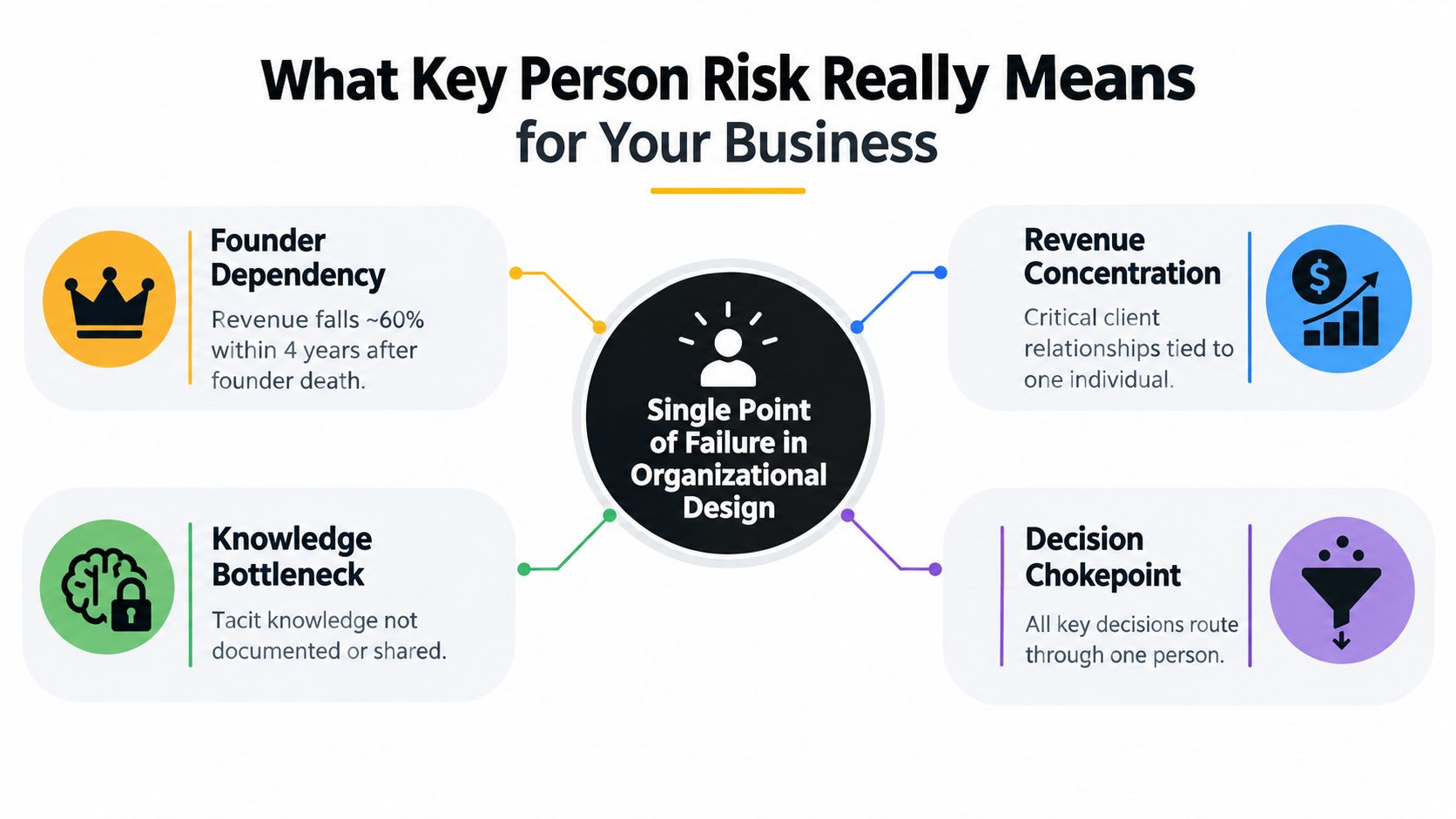
Key person risk is best understood as a failure in organizational design. It exists when revenue, decisions, relationships, or institutional knowledge are concentrated in one individual and no functional substitute can absorb the work quickly. The founder-mortality benchmark makes the consequence clear: research summarized by [Monocacy Accounting](https://monocacycpa.com/business-services/business-valuation/succession-planning/key-person-risk/) links founder death with a sales decline of about 60% within four years, alongside a roughly 20% reduction in survival rates during the first two years.
That isn't ordinary retention risk. Losing a good employee creates disruption. Losing a key person can remove a revenue engine, a customer relationship network, a regulatory memory, or the decision authority that keeps work moving. The distinction is irreplaceability, not seniority. A technical specialist, account executive, operations lead, or executive assistant can carry the exposure just as easily as a founder.
Three concentration anchors
Start the assessment with three questions:
These anchors connect people risk to the balance sheet. A salesperson's departure can weaken forecast confidence. An approver's absence can slow execution. A specialist's exit can make delivery, compliance, or product support unreliable.
> Practical rule: If a qualified colleague can't take over a critical workflow using shared records and documented decision rights, that workflow has a key person dependency.
The first move is a business impact assessment, not a generic talent review. Map which people control which outcomes, then rank the consequences of absence using a structured [business impact assessment](https://synopsix.ai/blog/business-impact-assessment). Ignoring the exposure after that point isn't an oversight. It's a design choice, and crises or buyers eventually expose it.
Why This Risk Is Bigger and More Common Than It Looks
Key person risk is common, yet many organizations still manage it informally. A [Nationwide overview of key person risks](https://www.nationwide.com/business/solutions-center/risk-management/key-person-risks) cites a National Association of Insurance Commissioners survey finding that 71% of small businesses depend on one or two key individuals for organizational success. The same source summarizes a management gap, with 55% of organizations assessing key person risk only within enterprise risk management and 27% doing so systematically.
That combination matters. Companies can carry substantial dependency while treating it as an anecdotal concern owned by a founder, finance leader, or HR business partner. Insurance, however, has turned the exposure into a formal financial category. One estimate values the global key person insurance market at USD 31.1 billion in 2024, rising to USD 32.1 billion in 2025 and reaching a projected USD 45 billion by 2035, with a projected 3.4% CAGR from 2025 to 2035, according to [WiseGuyReports' market estimate](https://www.wiseguyreports.com/reports/key-person-insurance-market).
Three forces making the exposure auditable
| Force | Signal | What It Means for Exposure | |---|---|---| | Business dependency | Small businesses often rely on one or two people for organizational success | Revenue and continuity can hinge on individuals rather than systems | | Insurance underwriting | Key person coverage is treated as a recurring risk-management category | Succession depth and financial consequences deserve explicit assessment | | M&A scrutiny | Buyers and investors examine concentrated relationships, decisions, and knowledge | Weak redundancy can affect price, terms, closing confidence, and transition demands |
The market evidence doesn't mean every business needs a policy. It does mean boards should stop treating key person risk as a soft HR topic. Financial protection addresses one layer. It doesn't replace a successor, restore a customer relationship, or recreate tacit knowledge.
Private-equity and M&A commentary increasingly connects concentration with valuation, closing risk, and post-close execution. As Forbes' analysis of key person risk in private equity argues, buyers can't solve concentrated dependency by spending more after the deal. Boards that wait for a triggering event are usually the ones explaining the discount afterward.
Early Warning Signs That Concentration Is Building
Key person risk rarely begins with an obvious crisis. It appears in operating patterns that leaders normalize because the person is reliable. Your dashboard should identify those patterns before an absence turns them into a financial event.
Watch the work, not just the org chart
Tacit knowledge concentration shows up when a process is documented only in fragments, a vacation message reveals that nobody else knows the next step, or a team can't triage an inbox without its owner. This predicts poor transition readiness and slower execution under pressure.
Single-relationship ownership is visible when a client, regulator, supplier, or partner insists on dealing with one named employee. A handoff meeting gets postponed, the backup is introduced too late, or the relationship record contains activity but not context. That predicts revenue fragility and weaker negotiating power.
Decision bottlenecks appear when approvals route through one person, escalation queues stall during travel, or deal velocity drops whenever that individual is unavailable. This is decision concentration, and it often hides behind a reputation for quality control.
The fourth signal is behavioral withdrawal. Declining engagement, reduced collaboration, lower willingness to share context, or quiet disengagement can indicate that an individual is carrying too much load, withholding knowledge, or preparing to leave. Behavioral data shouldn't become a surveillance shortcut. Used responsibly, it helps leaders investigate concentration before an exit interview reveals what the operating model ignored.
Put leading indicators on the dashboard
Use [organizational network analysis](https://synopsix.ai/blog/organizational-network-analysis) to identify who teams consult, not only who owns a process formally. Review the results alongside workflow records, client-contact patterns, decision logs, and manager observations.
For practical guidance on customer dependency controls, [Bizbe's resource on how to mitigate concentration risk in 2026](https://www.bizbe.com/blog/customer-concentration-risk) offers a useful complement to internal people-risk analysis. The important point is ownership: the CHRO, CFO, and functional leader should review these indicators together.
<iframe width="100%" style="aspect-ratio: 16 / 9;" src="https://www.youtube.com/embed/2_iBdz9WPRY" frameborder="0" allow="autoplay; encrypted-media" allowfullscreen></iframe>
Don't wait for a resignation to validate the signal. Treat each concentration pattern as a leading indicator tied to a predicted layer of damage, revenue, transition readiness, or performance under pressure.
Proven Ways to Reduce Key Person Risk
The right controls don't eliminate high performers. They stop the organization from confusing individual excellence with organizational capacity. Deploy four controls, and assign each one to the exposure layer it addresses.
Build succession depth
Succession planning addresses transition readiness. For critical roles, run 9-box readiness reviews, name interim coverage, and score bench depth based on demonstrated capability rather than manager confidence. A succession plan that lists a person with no tested exposure is not a plan. It's a hope statement.
Use the [succession planning process](https://synopsix.ai/blog/succession-planning-process) to connect role requirements, readiness evidence, development actions, and temporary coverage.
Make expertise transferable
Cross-training breaks knowledge concentration. Pair the incumbent with a cross-training partner, rotate job shadows, and require paired decision-making for work that currently depends on private judgment. The backup must practice the work while the expert is present, not receive a folder after the expert leaves.
Knowledge capture supports both transition and pressure performance. Convert expertise into runbooks, decision logs, process libraries, customer context, escalation paths, and recorded exceptions. Documentation should answer what to do, why it matters, when to escalate, and who has authority to decide.
Test the bench, don't admire it
Talent assessment addresses performance under pressure. Competency models and scenario-based interviews reveal whether a potential successor can handle ambiguity, conflict, customer pressure, and trade-offs. A title match isn't a capability match.
Track the controls with operating metrics:
| Control | Exposure Layer | Primary KPI | |---|---|---| | Succession planning | Transition readiness | Ready-now successor ratio | | Cross-training | Performance under pressure | Number of critical workflows with a practiced backup | | Knowledge capture | Financial and operational continuity | Knowledge coverage percentage | | Talent assessment | Capability and behavioral fit | Single-points-of-failure count per function |
Define the metrics before the review begins. A ready-now successor ratio shows whether critical roles have credible immediate coverage. Knowledge coverage percentage shows how much essential work is documented and accessible. Single-points-of-failure count per function tells the executive team where the design remains fragile.
Covering only one layer fails. Insurance can't transfer a relationship. Documentation can't guarantee judgment. A successor can't perform well if nobody has tested the behavioral demands of the role.
How People Intelligence and Psychometrics Change the Game
Traditional risk reviews see job titles, reporting lines, and written responsibilities. They often miss the behavioral concentration underneath. Two people can hold similar roles while one carries the core decision logic, customer trust, conflict resolution, or informal influence that keeps the function working.
Human decision-making isn't purely rational. [Research on human decision-making](https://www.sciencedirect.com/topics/computer-science/human-decision-making) describes unconscious mental processes and emotions as important parts of how people choose. A 2023 study on behavioral determinants found that personal norms and conformity with expected peers' actions had the largest impact on decision-making, while expected material payoffs and normative expectations were least important among the factors examined, as reported in [Humanities and Social Sciences Communications](https://www.nature.com/articles/s41599-023-01745-4).
Replace the org-chart view with a behavioral map
People-intelligence platforms and psychometric assessments add a missing layer. They can map cognitive style, decision patterns, interpersonal strengths, stress responses, and collaboration tendencies against the actual demands of a role. That helps leaders identify:
Research on decision prediction also supports using behaviorally grounded features rather than relying only on numerical inputs. One approach described by [OpenReview research on predicting human decisions](https://openreview.net/pdf?id=u39P8vE3Gf) used psychological insight features linked to mechanisms such as sensitivity to the probability that one option will produce a better outcome, reflecting a regret-minimization model.
The practical value is not a prettier assessment report. It's a behavioral heatmap showing who carries a function and where a replacement would struggle. Use that evidence to choose cross-training partners, test succession scenarios, and avoid placing a technically capable but behaviorally mismatched successor into a high-pressure relationship role.
Psychometric insight is a force multiplier. It makes succession plans more credible and knowledge transfer more targeted, provided leaders use it as decision support rather than as a deterministic label.
What Buyers and Boards Now See in Key Person Risk
Buyers don't assess key person risk only by asking who owns the role. They ask whether the business can preserve revenue, delivery, and relationships after ownership changes. That turns behavioral concentration into a valuation question.
The most dangerous profile is the duopoly trap: strong process depth without relationship depth, or strong relationship depth without process depth. A company may have excellent runbooks and still depend on one rainmaker whose customers trust that individual rather than the brand. Another business may have broad customer relationships but rely on one technical expert to deliver what was sold.
| Profile | Process Depth | Relationship Depth | Valuation Treatment | |---|---|---|---| | Institutionalized operation | Strong | Broad and shared | Greater continuity confidence | | Documented but personality-led | Strong | Concentrated | Discount or stronger transition protections | | Relationship-rich but operationally fragile | Weak | Broad | Execution risk and integration concern | | Single-point business | Weak | Concentrated | Material continuity concern and tougher terms |
A buyer may respond with a longer transition commitment, retention arrangements, earnout conditions, continuity representations, or a lower price. Those mechanisms don't remove the underlying exposure. They transfer some of the uncertainty into deal structure.
The CHRO should therefore bring behavioral concentration into portfolio and transaction reviews. Ask whether customers would remain through a handoff, whether successors can make decisions under pressure, and whether technical knowledge is accessible without the incumbent. Process depth supports delivery, but it doesn't automatically preserve trust. Relationship depth supports retention, but it doesn't automatically preserve quality.
Boards should also understand the financing context. Leadership teams evaluating [using an SBA loan broker](https://gosbaloans.com/guide/sba-loan-broker/) or any other capital route need a credible continuity narrative, because lenders and investors care about whether cash generation depends on one unavailable person.
Key person risk now moves the multiple, the terms, and the confidence of the buyer. It belongs in due diligence before the buyer prices it for you.
Your Implementation Roadmap With Metrics and Templates
Run the work as a four-phase operating cycle next quarter. Keep the first pass focused on critical roles, then expand after leaders have tested the method.
Phase 1, assess exposure
Create a role-level inventory with the functional leader, CFO, and CHRO. Score each critical role qualitatively or on a consistent internal scale across four dimensions:
| Role | Revenue Influence | Decision Authority | Relationship Ownership | Tenure and Knowledge Depth | Current Backup | |---|---|---|---|---|---| | Critical role | Low, medium, high | Low, medium, high | Low, medium, high | Low, medium, high | Named person or none |
Require evidence for every high rating. Use pipeline ownership, approval records, customer-contact data, escalation history, and documentation reviews. Don't let a seniority label substitute for exposure evidence.
Phase 2, map behavioral risk
Layer psychometric and people-intelligence outputs onto the exposure inventory. Identify who could backfill whom, where two people have complementary strengths, and where a team relies on one decision style or relationship pattern.
The output should be a heatmap, not a stack of individual reports. Mark roles with high business exposure and weak behavioral coverage as immediate priorities. Separate capability gaps from willingness, capacity, and relationship-transfer gaps.
Phase 3, assign a control bundle
Every high-risk role gets four named actions:
1. Successor candidate: Identify an interim and a longer-term option. 2. Cross-training partner: Pair the incumbent with someone who practices the work. 3. Knowledge format: Choose a runbook, decision log, process library, or relationship brief. 4. Retention trigger: Define the conditions that require an executive conversation, workload correction, development plan, or targeted retention action.
This bundle prevents the common failure of assigning documentation to nobody and succession to a spreadsheet.
Phase 4, instrument the dashboard
Use a 30-60-90 cadence. At 30 days, complete the role inventory and identify the highest exposures. At 60 days, test handoffs and review behavioral coverage. At 90 days, report movement, unresolved dependencies, and decisions required from the CEO or board.
| Metric | Definition | Target Threshold | Measurement Cadence | |---|---|---|---| | Ready-now successor ratio | Ready-now successors divided by key roles | Set an internal minimum and flag any role with no credible successor | Monthly | | Relationship transfer index | Critical relationships with an active, tested secondary contact | Every priority relationship has shared coverage | Monthly | | Documentation coverage | Critical workflows with current, accessible operating documentation | All priority workflows have an owner and review date | Monthly | | Single-points-of-failure count | Critical functions dependent on one person | Downward trend until no priority function lacks backup | Monthly | | Flagged-talent voluntary attrition | Voluntary exits among people identified as concentrated dependencies | Immediate executive review after any flagged exit | Monthly and quarterly |
Use a one-page board view with four panels: highest-exposure roles, changes since the prior review, controls completed, and decisions required. Add one short narrative for the most material dependency, including the financial outcome at risk, the named backup, and the date of the next handoff test.
A dashboard that only reports completed training is useless. Report whether someone else can now make the decision, manage the relationship, find the knowledge, and maintain performance when the incumbent isn't available.
---
Synopsix helps CHROs turn behavioral assessments into practical intelligence for succession, team design, and key person risk mitigation. Visit [Synopsix](https://synopsix.ai) to map hidden dependencies, compare successor capabilities, and build a more resilient leadership pipeline.