Leadership and Succession Planning: Mastering Leadership &
By Synopsix · June 28, 2026 · 17 min read
predict-human-behavior-synopsix-smarter-people-decisions
Only 19% of organizations have formal, documented succession plans, which leaves most companies exposed when a key leader exits unexpectedly, according to [ScottMadden's succession planning analysis](https://www.scottmadden.com/insight/succession-planning-why-it-must-be-a-2025-priority/). That number should change how boards, CEOs, and CHROs think about leadership and succession planning.
Too many companies still treat succession as a replacement chart tucked into an HR folder. It isn't. It's a business continuity discipline. It determines whether strategy survives executive turnover, whether customer relationships remain stable, and whether the next generation of leaders is ready for the jobs they may inherit.
The old model is familiar. Someone performs well, gains visibility, earns sponsorship, and gets labeled “high potential.” Then a vacancy appears, and the organization hopes that reputation translates into readiness. Sometimes it does. Often it doesn't.
A better model starts with a harder question. Can you predict how this person will behave in a bigger, more complex role under pressure, ambiguity, and political friction? If you can't answer that with evidence, you're not doing succession planning. You're making a gamble.
The Hidden Risk in Your Leadership Ranks
Boards rarely get surprised by whether a leadership change will happen. They get surprised by how much value leaks out while the organization scrambles to respond.
That risk sits below the surface until a key role opens. Then the symptoms show up fast. Decision rights get fuzzy. Operating reviews lose traction. Customers start asking who owns the account. Internal successors who looked strong on paper struggle once the scope, pressure, and visibility increase.

Why the real risk is usually hidden
In my experience, leadership gaps do not create one clean failure point. They create drag across the system. A regional leader leaves and commercial decisions slow down. A functional head exits and priorities get renegotiated every week. The CEO spends time stabilizing the bench instead of driving the plan.
The deeper problem is how companies decide who is "ready." Many still confuse strong performance in the current role with capacity for a larger one. They rely on sponsor opinion, executive familiarity, and visibility in talent reviews. Those inputs matter, but they are not enough for a decision with enterprise consequences.
> Practical rule: If your succession plan lives in people's heads, you do not have a succession plan.
A successor slate built on reputation alone is a risk register disguised as a talent process. It leaves the business exposed to the same kind of judgment error that shows up in [the cost of a bad hire in senior roles](https://synopsix.ai/blog/cost-of-a-bad-hire): slow execution, team instability, and expensive course correction after the fact.
Leadership and succession planning is a resilience strategy
Strong leadership and succession planning protects business continuity, but that is only the baseline. The primary advantage is decision quality. Companies with stronger pipelines do not wait for a vacancy to test whether someone can lead through ambiguity, scale, conflict, and political pressure. They test for those conditions in advance.
That is the shift many organizations still have not made. The legacy model asks, "Who has performed well and earned confidence?" A stronger model asks, "What evidence do we have that this person will operate effectively in a bigger, more complex role?" Those are different questions. One looks backward. The other reduces future risk.
What fails is the annual exercise where names go into boxes, executives debate executive presence, and HR documents opinions. What works is a system that defines success for the role, uses objective assessments and simulations to examine likely behavior, and targets development to the gaps that matter.
The hidden risk in your leadership ranks is not a lack of talent. It is overconfidence in subjective judgment, with too little proof of readiness in critical situations.
The Business Case for Proactive Succession Planning
Most executive teams say succession matters. Far fewer fund it as if they mean it. Despite 90% of organizations rating succession planning as important, only 37% invest in the necessary resources to make it successful. This misalignment is critical, as Korn Ferry research found that 80% of organizations lack confidence in their leadership pipeline and half of all external executive hires fail within their first year, as summarized in [these succession planning statistics](https://www.imocha.io/blog/succession-planning-statistics).
For a CHRO, that's the entire business case in one view. Leaders know the issue is important. They don't resource it. Then they compensate with expensive external searches and emergency transitions.
What the C-suite should actually care about
Succession planning gets traction when it's discussed in operating terms, not HR terms. The questions that matter are blunt:
Those are business continuity questions. They affect execution, investor confidence, and organizational stability.
A weak pipeline also creates second-order costs. Teams pause while waiting for decisions. Peers take on extra load. High-potential talent loses confidence when advancement appears arbitrary. The organization starts paying twice, once for the leadership gap and again for the failed attempt to close it.
For a practical breakdown of how poor people decisions ripple into cost, this analysis of the [cost of a bad hire](https://synopsix.ai/blog/cost-of-a-bad-hire) is useful because the same logic applies at the leadership level, where the blast radius is larger.
The metrics that matter more than sentiment
Many companies track whether successors are “identified.” That's too shallow. A stronger operating review includes indicators like these:
| Focus area | What to examine | |---|---| | Bench strength | Whether critical roles have credible internal options, not just names on a list | | Readiness | Whether successors can step in now, soon, or only after targeted development | | Time to fill | How quickly the organization can cover a leadership gap without external dependency | | Transition quality | Whether newly placed leaders stabilize the role or create downstream friction |
> Succession planning isn't a talent exercise with a strategic halo. It's a capital allocation decision about where leadership risk is acceptable and where it isn't.
What works and what wastes time
What works is selective investment. Prioritize the roles where leadership failure would interrupt strategy, revenue, or stakeholder confidence. Build evidence around readiness. Hold leaders accountable for developing successors.
What wastes time is trying to map every role with equal depth. Mature succession systems don't start broad. They start where the business can least afford to be wrong.
A Modern Framework for Building Your Leadership Pipeline
A durable pipeline isn't built with an annual talent review. It's built with a repeatable operating model. I use four pillars for leadership and succession planning because they force the organization to connect business risk, talent evidence, development action, and transition discipline.
Consider structural design. If one pillar is weak, the whole system becomes unstable.
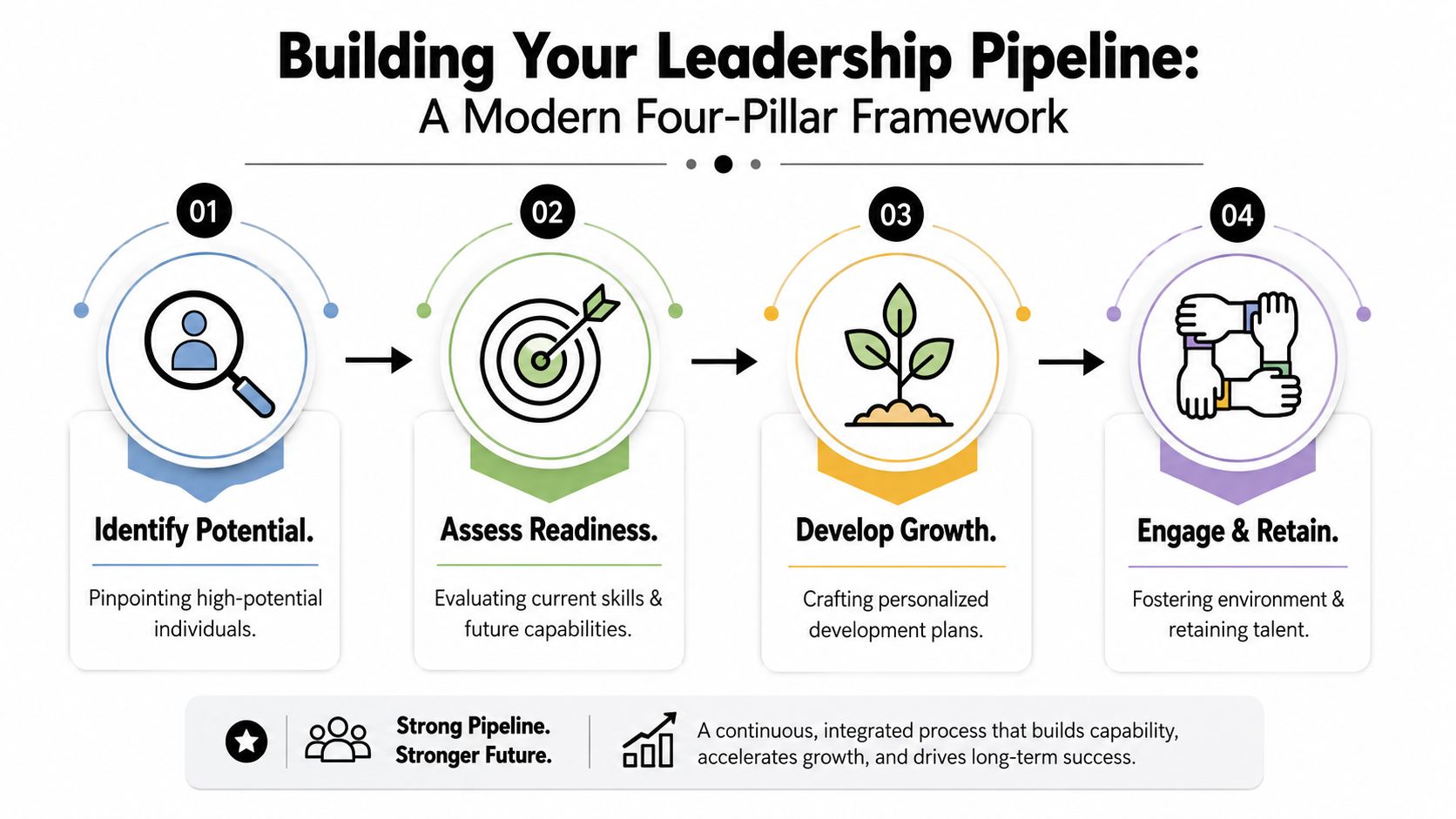
The four pillars
#### Identify
Start with the roles that matter most, not the people who are most visible. The question is which positions carry disproportionate business risk if they're vacant or poorly filled.
That changes the conversation immediately. Instead of asking, “Who are our high potentials?” you ask, “Which roles would hurt us most if we got them wrong?”
#### Assess
Once the role is clear, test candidates against future requirements. However, many organizations still rely on manager opinion, tenure, and performance history.
That approach misses the core issue. A person can be excellent in the current role and still be a risky choice for the next one. Assessment must evaluate future capability, behavioral fit, and decision-making patterns under the conditions the next job will create.
A helpful companion read is this overview of [what a leadership pipeline is](https://synopsix.ai/blog/what-is-leadership-pipeline), especially if your organization still confuses succession with simple replacement planning.
#### Develop
Development should be role-specific, not generic. A successor for a regional operating role needs different experiences than a successor for a functional specialist role or a CEO-track role.
The best development plans don't just assign learning content. They create exposure to the type of complexity the future role will demand.
#### Transition
Most organizations under-manage this stage. They focus heavily on candidate selection, then assume the move itself will take care of itself.
It won't. The new leader needs decision rights, stakeholder mapping, knowledge transfer, and clear expectations in the first phase of the role. Without that, a strong candidate can still fail in the handoff.
One system, not four separate activities
These pillars must work together. If Identify is vague, Assess becomes political. If Assess is weak, Development becomes generic. If Transition is neglected, the prior work gets wasted at the point of execution.
For a useful perspective on designing a more inclusive pipeline, Baz Porter's piece on a [succession framework for women leaders](https://bazporter.com/post/leadership-succession-planning) adds practical context that many standard frameworks miss.
Identifying Critical Roles and Defining Success
Most succession efforts begin with people. That's usually the first mistake.
Start with roles. More specifically, start with role risk. To effectively manage leadership risk, organizations must first identify critical roles by three specific metrics: revenue impact, knowledge concentration, and replacement timeline, then assess internal talent readiness using standardized tools to generate precise readiness ratings for 2-3 successor candidates per role, according to [PIN's succession planning guide](https://www.pin.com/blog/succession-planning-guide/).
The three filters that sharpen the conversation
If a leadership team can't agree on which roles are critical, the rest of the process will turn political. These three filters cut through that problem.
This is more useful than relying on hierarchy alone. Some vice president roles are less risky than a specialized operational leader who holds deep customer trust and knows how the system works.
Build a success profile, not a job description
A job description captures scope and responsibilities. A success profile should define what great performance will require in the future version of the role.
That means clarifying:
| Element | Questions to answer | |---|---| | Capabilities | What must this leader be able to do under pressure? | | Experiences | What kinds of business situations should they already have handled? | | Behavioral demands | What patterns of influence, judgment, and adaptability matter most? | | Context | How is the role changing as the business changes? |
A weak profile sounds generic. It asks for “executive presence,” “strategic thinking,” and “strong communication.” A useful profile is sharper. It specifies whether the role requires turnaround capability, cross-functional influence, tolerance for ambiguity, board communication, or disciplined execution through complexity.
> The right question isn't who performed well here. It's who can succeed there.
Separate performance from future fit
Experienced CHROs add real value by helping the organization stop promoting the best current operator into a role that demands a different kind of leadership.
The shift sounds small, but it changes succession quality. Once the role's future demands are explicit, readiness becomes easier to evaluate and development becomes easier to target. That's how you move from subjective nomination to disciplined selection.
Assessing and Developing Talent with Predictive Intelligence
The biggest flaw in traditional succession planning is that it confuses visibility with readiness. Someone is known by senior leaders, has delivered in a current role, and presents well in talent reviews. That often becomes enough.
It shouldn't be.
While 73% of organizations claim to have succession plans, only 27% report high confidence in their leaders' effectiveness, revealing a critical failure in moving from intuitive identification to data-backed validation. Organizations using scientifically validated behavioral assessments to map leadership competencies reduce mis-promotions by 60% and accelerate decision-making by 40%, according to [Hanover Search's review of succession planning best practices](https://www.hanoversearch.com/en-us/blog/mastering-succession-planning-best-practices-for-leadership-continuity/).
Why the old methods break down
The classic tools still have value, but they're often used beyond their limits.
A 9-box grid can help structure a talent discussion. Manager nomination can surface context that no system sees. Performance data matters. But none of those methods reliably predicts how a person will behave in a larger, more ambiguous leadership role.
That's why the most important upgrade in leadership and succession planning is predictive intelligence. The objective is not to label people more elegantly. It's to understand likely behavior before a promotion makes the risk expensive.
A modern evaluation stack should include:
For teams reviewing options, this guide to [talent assessment tools](https://synopsix.ai/blog/talent-assessment-tools) is a practical starting point.
Predicting human behavior is the point
Most succession plans ask whether someone is ready. Better ones ask ready for what, with whom, and under which conditions.
That's where assessments and simulations become valuable. They help leaders examine whether a candidate is likely to stay decisive under pressure, collaborate across power centers, or create avoidable friction in a team that already has strong personalities and competing mandates.
A polished internal candidate can still be a poor fit for a volatile environment. A quieter candidate can be the stronger successor because they process complexity well, regulate conflict, and build trust faster. Subjective reviews often miss both patterns.
> Board-level test: If two executives strongly disagree about a candidate, you need evidence that can resolve the disagreement. You don't need louder opinions.
Development should follow the same logic. Generic leadership programs rarely move readiness in a meaningful way. Strong development plans are built from assessed gaps and matched to future role demands. That may mean strategic project leadership, interim accountability, cross-functional exposure, or targeted coaching tied to observed behavioral risk.
Here's a useful demonstration of how a modern platform can translate assessment data into actionable people decisions:
<iframe width="100%" style="aspect-ratio: 16 / 9;" src="https://www.youtube.com/embed/grtFDeLpyAU" frameborder="0" allow="autoplay; encrypted-media" allowfullscreen></iframe>
What more rigorous development looks like
The strongest pipelines use a mix of evidence and observation.
This is the practical edge of a predictive model. It doesn't eliminate judgment. It disciplines judgment with better inputs.
Common Succession Planning Pitfalls to Avoid
Most failed succession efforts don't collapse because leaders forgot to identify names. They fail because the underlying assumptions are weak. The organization trusts intuition too much, communicates too little, and underestimates the transition itself.
The most neglected problem is often the handoff. Most content focuses on 'planning' by identifying successors, but recent 2025–2026 research indicates that 50% of leadership transitions fail due to poor execution of the transition phase, not flawed candidate selection. This 'transition friction' is a major, yet unaddressed, pitfall, according to [Aprio's article on leadership continuity in nonprofits](https://www.aprio.com/insights-events/succession-planning-ensuring-leadership-continuity-in-nonprofits-ins-article-np/).
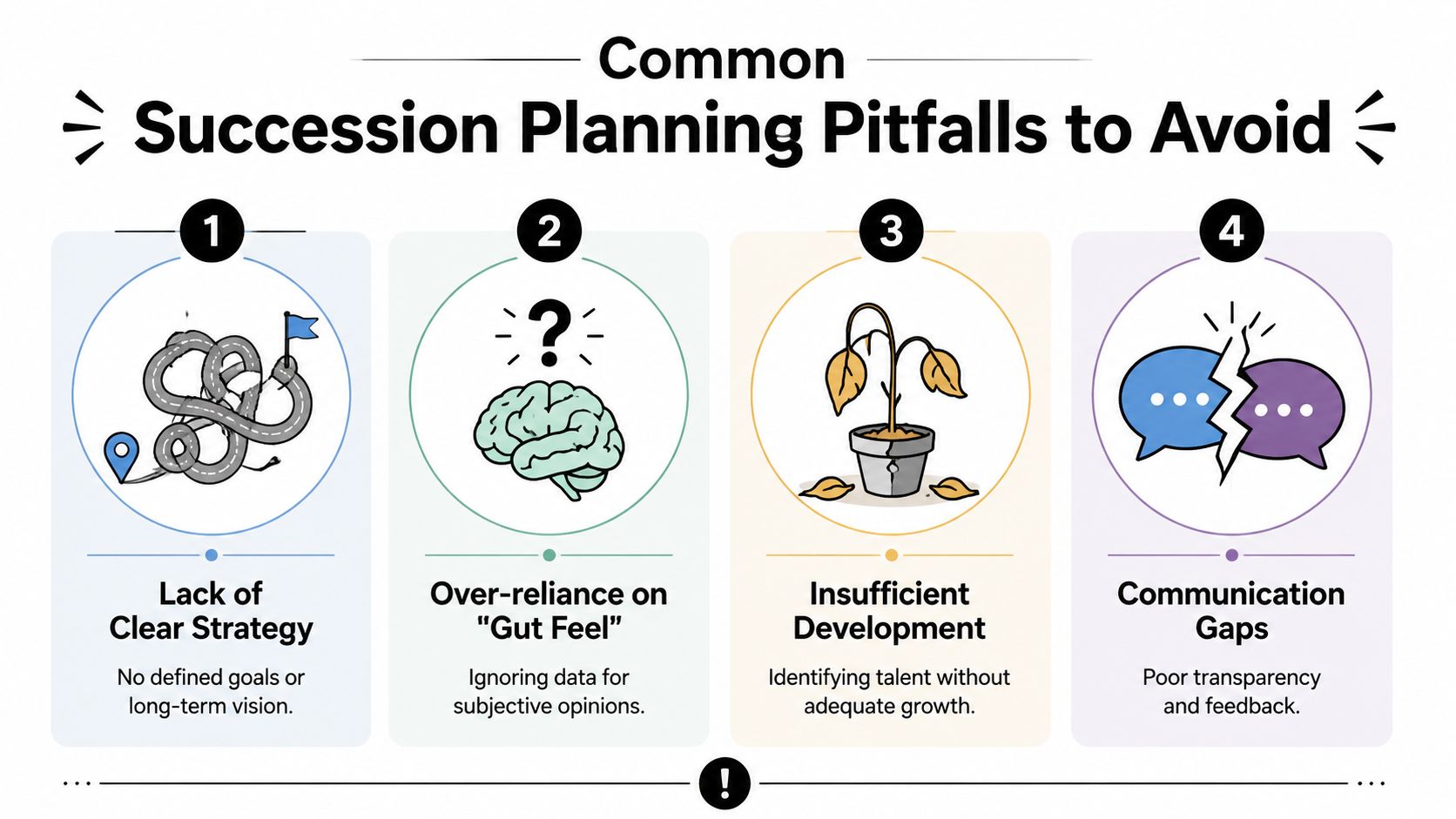
Pitfall one: promoting the proven operator without testing future fit
The flawed assumption is that strong past performance equals readiness for a broader role.
A better approach is to test against future conditions. Evaluate how the person handles ambiguity, enterprise trade-offs, political complexity, and leadership scale before making the move.
Pitfall two: relying on gut feel in talent reviews
Executive judgment matters. Unstructured executive judgment is where bias hides.
Use structured criteria, evidence from assessment, and role-specific discussion prompts. That doesn't remove human judgment. It makes it more reliable.
Pitfall three: naming successors without investing in development
Many organizations enjoy the optics of a successor slate. Fewer do the harder work of preparing those people.
The practical fix is straightforward:
> A successor list without developmental follow-through is just a comfort document.
Pitfall four: mishandling transparency and transition friction
Some organizations say nothing, fearing politics. Others overpromise, creating entitlement. Both approaches create trouble.
A stronger practice is disciplined transparency. Be clear about how the process works, what readiness means, and what development is required. Then treat transition as its own managed phase, with stakeholder mapping, knowledge transfer, and early support for the incoming leader.
The “crown prince” problem usually appears when a company treats succession as a single winner-take-all contest. A healthier system keeps multiple candidates in motion, updates readiness based on evidence, and makes mobility part of leadership culture rather than a private sponsorship game.
From Replacement Planning to Building a Leadership Culture
The organizations that handle succession well don't think in terms of backups. They think in terms of leadership supply. They build a culture where future role readiness is discussed openly, developed intentionally, and tested before it becomes urgent.
That's the fundamental shift in leadership and succession planning. Move from replacement planning to capability building. Move from annual debate to ongoing evidence. Move from “Who do we like?” to “Who has shown they can handle the next level?”
What that culture looks like in practice
A leadership culture is visible in everyday management choices. Managers create stretch opportunities. Executives participate in calibration. Boards ask for readiness evidence, not just succession names. HR embeds development into normal operating rhythms instead of treating it like a special project.
It also means connecting succession to the broader growth agenda. For leaders in smaller companies, some of the same discipline shows up in broader operating decisions like these [small business growth strategies](https://emailscout.io/small-business-growth-strategies/). Growth gets fragile when leadership depth doesn't keep pace with business ambition.
The standard worth holding
A modern succession process should be able to answer four questions clearly:
1. Which roles carry the most risk if left open or poorly filled? 2. What does success look like in those roles? 3. Which people have demonstrated evidence of future fit? 4. How will the transition be managed so the appointment succeeds?
If those answers are vague, the process is still built on opinion.
The companies that gain an advantage here aren't necessarily the ones with the biggest HR teams. They're the ones willing to abandon flattering assumptions. They stop equating tenure with readiness. They stop treating talent reviews as proof. They start using data to predict human behavior, develop against real role demands, and make smarter people decisions before a vacancy forces the issue.
---
If you want a more rigorous way to turn assessment data into practical decisions on hiring, team design, and leadership readiness, [Synopsix](https://synopsix.ai) gives leaders a structured path from behavioral insight to action. It helps organizations compare profiles, interpret psychometrics in business language, and use simulations and development guidance to build stronger, evidence-based leadership pipelines.