Leadership Assessment for Talent Development
By Synopsix · October 3, 2026 · 13 min read
Leadership assessment for talent development works only when it separates today's performance from tomorrow's potential. That distinction matters because a market intelligence summary found that 69% of organizations say they understand high-potential leaders' development needs, but only 50% assess enterprise potential separately from current-role performance. If you've ever watched a strong individual contributor stall after promotion, you already know why that gap exists. The question is not whether someone performed well last quarter, it's whether they can lead at the next level, in messier conditions, with broader accountability.
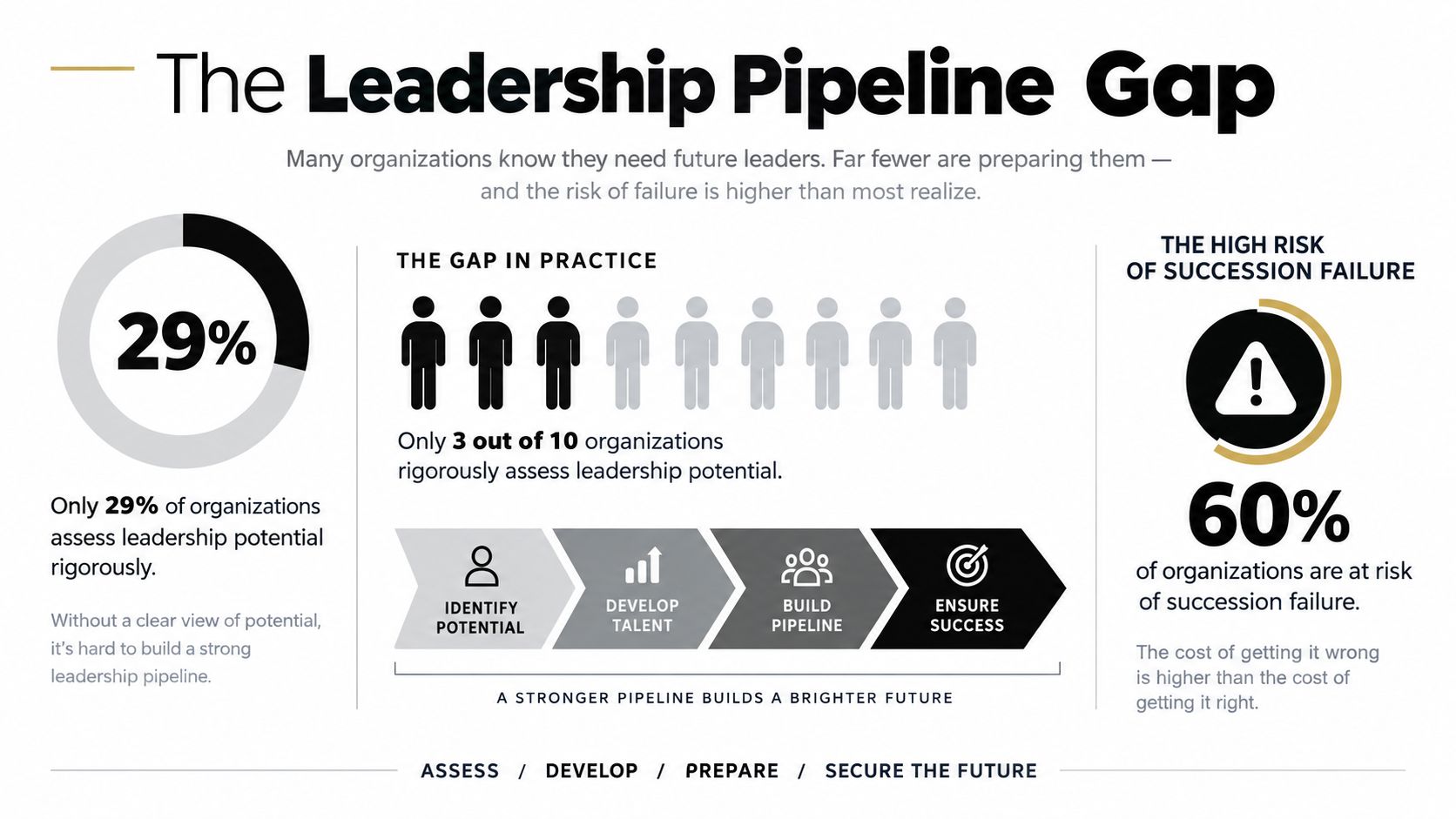
Why Most Leadership Pipelines Underperform
A review identified 11 distinct techniques in leadership assessment, reflecting a shift from one-time appraisal toward evaluation across multiple waves [evaluation of leadership research article](https://nucleus.iaea.org/sites/connect/DLPpublic/Shared%20Documents/Section%205/Section%205%20Tool%205%20-%20Evaluating%20the%20Effectiveness%20of%20Leadership%20Research%20Article.pdf). Yet many succession systems still treat a strong performance record as evidence of readiness for any larger role.
The error is easy to make. Current-role performance is like a score from the road already traveled. Enterprise potential concerns how someone will handle a different route, with wider decisions, unfamiliar stakeholders, and greater ambiguity. A person who delivers through personal execution may still need to build influence, develop other leaders, or make sound choices without clear answers.
> Practical rule: A succession discussion should explain why a candidate is likely to succeed in a different role, not only document success in the current one.
A useful review asks three questions:
1. Are high-potentials chosen for results, or for learning agility? 2. Are development investments tied to actual skill gaps? 3. Can internal candidates lead at the next level, or only in the job they already know?
These questions expose whether the pipeline distinguishes present contribution from expanding capacity. If the answers depend mainly on a manager's confidence, the process is too informal. A formal structure should show who is extending their range, who is excelling within a familiar scope, and what evidence supports each judgment. That structure is the foundation of [building a leadership pipeline](https://synopsix.ai/blog/building-leadership-pipeline).
Assessment makes that evidence useful when it connects psychometric signals to action. A potential score alone does not develop anyone. AI-enabled assessment can help translate patterns in reasoning, motivation, or behavior into targeted coaching, practice assignments, and follow-up checks, while keeping current performance visible as a separate measure.
For a broader talent view, pair assessment with an [employee performance tracking platform](https://www.hrmanagement365.com/talent-performance/). This keeps delivery in the present role from being mistaken for capacity to lead at enterprise level, and gives talent leaders a clearer basis for coaching, promotion, and succession decisions.
What Leadership Assessment Really Means in Talent Development
Leadership assessment is best understood as a cardiovascular blueprint, not a blood-pressure reading. A single symptom tells you something is happening right now. A blueprint tells you how much load the system can handle, where it may fail under stress, and what kind of development support it needs before the pressure rises.
That's the main difference between assessment and evaluation. Evaluation scores what already happened. Assessment looks underneath the result and asks what the person is likely to do next. Training then builds skill in a chosen direction, but it works better when the organization already knows what the leader needs to strengthen.
A modern leadership assessment usually examines underlying capacities such as reasoning style, personality tendencies, motivation, and leadership potential. Those signals matter because future roles often ask for behavior that a person hasn't needed in the current job. A strong operator may still need help with enterprise thinking, cross-functional influence, or ambiguity tolerance.
> Leadership assessment should answer, “What will this person do when the job changes?” not “How did this person do in the job they already know?”
That's why assessment sits at the center of talent development. It gives HR and business leaders a diagnostic layer for succession planning, learning investments, and readiness decisions. Without that layer, programs drift toward generic development, where everyone gets the same course and nobody gets the right intervention.
A modern process also separates current-role performance from enterprise potential. That distinction prevents a common mistake, promoting the person who looks strongest in a familiar context, then discovering they were never tested on strategic breadth, influence without authority, or pressure in a broader system.
For that reason, assessment is not a finishing step. It's a translation layer. It turns psychometric signals into talent decisions that are more defensible, more targeted, and easier to explain to line leaders. The next step is knowing which dimensions deserve your attention in the first place.
The Psychometric Dimensions That Predict Leadership Growth
The most useful leadership assessment for talent development doesn't try to measure everything. It measures the dimensions that help explain how someone will think, relate, and persist when the work gets harder. The point isn't to create a score for its own sake. It's to predict growth under real organizational pressure.
Cognitive ability tells you how someone handles complexity
Cognitive ability matters because leadership often means solving problems that don't have a precedent. Fluid reasoning and pattern recognition help a person make sense of new data, new markets, and new political dynamics. In plain business language, this is the difference between a leader who copies yesterday's answer and one who can build a response when the playbook no longer fits.
Personality shows how the person tends to show up
The Big Five gives talent teams a stable language for behavior. Conscientiousness points to execution discipline, openness supports learning agility, and emotional stability matters when the room gets tense. A large meta-analysis of personality measures and job performance reviewed 494 studies and found usable results from 97 independent samples with a total sample size of 13,521, with corrected validity varying by research strategy and job analysis use [personality and job performance meta-analysis](https://onlinelibrary.wiley.com/doi/abs/10.1111/j.1744-6570.1991.tb00696.x). That doesn't mean personality predicts everything. It does mean it's useful when it's measured carefully and interpreted in context.
Motivation explains what will keep the leader engaged
Motivation drivers like achievement, affiliation, and power-social tell you what kind of work energizes someone. A technically brilliant leader may still stall if the role doesn't match their motives. A person driven by influence may thrive in a role that needs stakeholder alignment, while someone with a strong achievement drive may shine in a turnaround or build phase.
The older Big Five work studies also showed Conscientiousness was consistently related to performance across occupational groups, while Extraversion was especially valid in social-interaction roles such as managers and sales [Big Five and work outcomes study](https://onlinelibrary.wiley.com/doi/10.1111/j.1744-6570.1991.tb00688.x). That's useful in talent development because it reminds us that “good leader” isn't one universal profile, context matters.
| Dimension | What It Measures | Predicted Outcome | Current Role vs Enterprise Potential | |---|---|---|---| | Cognitive ability | Reasoning, pattern recognition, problem solving | Handling ambiguity and novel challenges | Strong for enterprise potential, especially in complex roles | | Conscientiousness | Discipline, follow-through, reliability | Execution quality and consistency | Often supports current-role performance and scale-up readiness | | Openness | Curiosity, flexibility, learning orientation | Learning agility and adaptation | Strong indicator of potential in changing environments | | Emotional stability | Composure under pressure | Pressure tolerance and steadier judgment | Useful in both, but especially in higher-stakes roles | | Motivation drivers | What energizes effort and persistence | Role fit and sustained commitment | Helps separate fit for now from fit for the next level | | Social competencies | Influence, collaboration, change leadership | Team and enterprise outcomes | Often the bridge from personal success to enterprise leadership |
When these dimensions are combined, they give a clearer picture than any one score alone. That's also why leadership development planning works better when assessment outputs are translated into role-relevant signals instead of a generic personality summary. For a more detailed breakdown of tool categories, see this [guide to psychometric test types](https://synopsix.ai/blog/psychometric-test-types).
Choosing the Right Assessment Method for Your Organization
Most HR teams inherit an assessment method because someone bought it first. That's a weak design principle. The better question is which method fits the decision you're trying to make, the size of the cohort, and the kind of development action you want afterward.
Compare the methods by the decision they support
Psychometric inventories are fast and scalable, so they work well when you need an initial screen across a large population. They're especially helpful for spotting patterns in reasoning style, personality, and motivation. Business simulations take longer, but they show how people behave in context, which makes them stronger for evaluating leadership judgment.
360-degree feedback is valuable when you need to surface reputation, blind spots, and behavioral impact. It's less useful as a standalone predictor of future leadership capacity, because it reflects how others experience the person today. Structured interviews sit somewhere in between, especially when the interview is anchored to the role and scored consistently.
> A single method rarely gives enough signal. A fast psychometric screen paired with a deeper simulation or 360 tends to give leaders both reach and relevance.
| Method | Predictive Validity | Time to Administer | Development Value | Best Use Case | |---|---|---|---|---| | Psychometric inventories | Moderate to strong when validated | Fast | High for diagnosis | Large cohorts, early screening | | Business simulations | Strong for observed behavior | Slower | High for targeted growth | Critical roles, promotion readiness | | 360-degree feedback | Strong for behavior awareness | Moderate | High for coaching | Reputational blind spots, team leadership | | Structured interviews | Moderate when standardized | Moderate | Moderate | Selection and calibration conversations |
The right mix depends on organizational stage and role criticality. A company building its first formal pipeline may start with a broad psychometric screen, then deepen into simulations for the few roles that matter most. A more mature enterprise may already be using 360s and interviews, then add a psychometric layer to tighten comparability.
One practical caution, don't choose the tool just because it's familiar. Choose it because it helps you make the next decision with more confidence. If the result won't change a promotion, a coaching plan, or a succession discussion, the method is probably too shallow for the business need.
A Practical Workflow to Run Leadership Assessment at Scale
A leadership assessment process falls apart when it lives as a one-off event. The fix is a workflow that starts with a decision and ends with a development action. Once the talent team sees it that way, the process becomes repeatable instead of anecdotal.
Here's a four-step structure that works in a quarter:
1. Scope the population and the decision Decide whether you're identifying future leaders, calibrating succession, or supporting a specific development program. A broad population needs different tools than a small group of successors for a critical role.
2. Select instruments that map to the leadership dimensions you care about If strategic breadth matters, measure for it. If collaboration under pressure matters, don't rely on a score that only describes style. The assessment should match the business question, not the vendor catalog.
3. Administer, score, and triangulate in one place An AI-enabled platform can reduce the manual work of report building and comparison. Synopsix is one option that turns behavioral assessments into role signals, then organizes outputs for leadership, fit, and development use without forcing the team to stitch together five separate documents.
4. Deliver feedback and attach each result to an action Every insight should lead to a stretch assignment, coaching theme, succession note, or learning path. Otherwise, the assessment becomes a file instead of a decision tool.
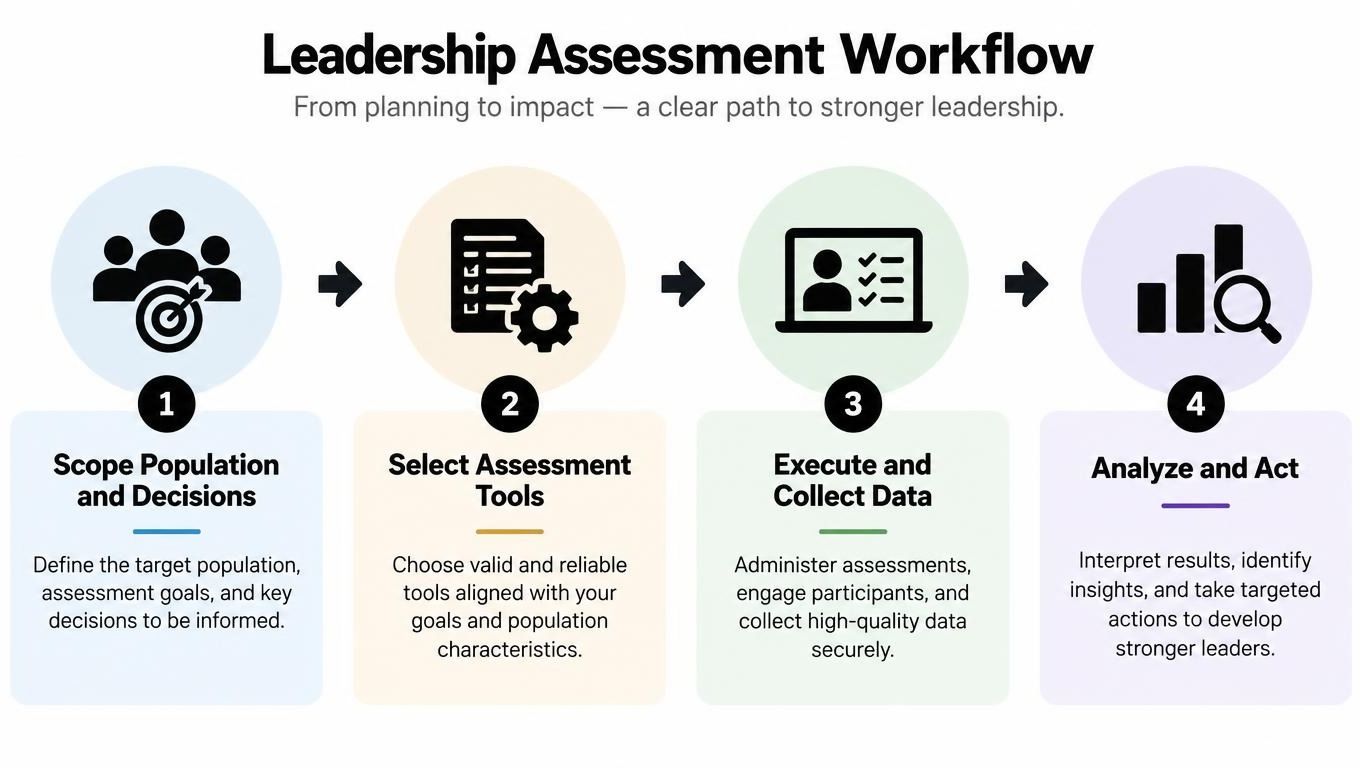
A good workflow also includes checkpoints for fairness, communication, and stakeholder calibration. If line leaders don't understand what the assessment can and can't tell them, they'll overread the score or ignore it. If the talent team doesn't revisit the outputs, the process loses credibility fast.
<iframe width="100%" style="aspect-ratio: 16 / 9;" src="https://www.youtube.com/embed/SRlRyztMQeQ" frameborder="0" allow="autoplay; encrypted-media" allowfullscreen></iframe>
Turning Assessment Results Into Real Development Outcomes
A mid-sized technology company used leadership assessment to work with twelve mid-level managers who were flagged as high-potential but underdeveloped on collaboration and strategic orientation. The talent team didn't stop at the report. They assigned stretch projects, targeted coaching, and peer-learning circles, then reassessed the same dimensions later in the cycle.
The movement was visible in the work. Cross-functional collaboration scores improved by 39%, strategic thinking rose by 28%, and the company had a clearer succession slate for two newly created director roles. Those results mattered because they came from specific actions tied to specific gaps, not from a general “leadership training” label [leadership development planning](https://synopsix.ai/blog/leadership-development-planning).
The three operating rules that made the change stick
The lesson is simple. Assessment only matters when it changes the next quarter's behavior, the next opportunity, or the next succession conversation. A report is useful only if it changes what the organization does next.
Metrics and Governance That Prove the Program Works
A leadership assessment program is only credible when it can show progress in the same language business leaders use for any other investment. That means separating the metrics into a few clear buckets instead of relying on one vanity score.
Track the program from four angles
A psychometric tool also needs governance, not just administration. Quarterly talent reviews help calibrate what the scores mean in practice. An annual psychometric audit checks for fairness and drift, and that review should include HR, L&D, and the CHRO so the process doesn't become a black box.
A few common mistakes show up again and again. Teams lean on a single score instead of combining evidence. They use assessment for hiring only and never bring it into development. They also forget adverse-impact monitoring, which makes the whole program harder to defend.
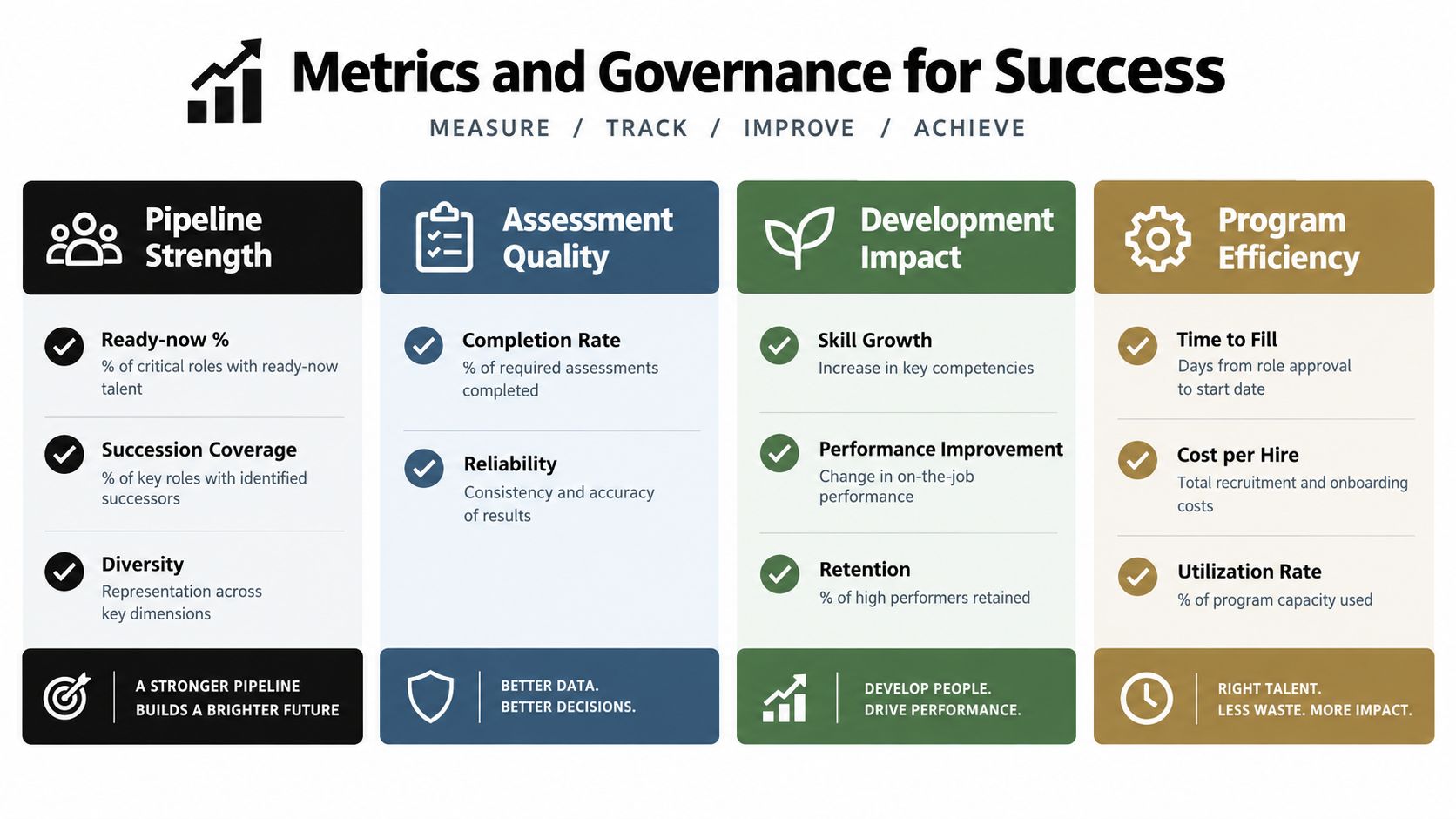
For the first quarter, keep the checklist simple. Define three metrics per bucket, assign owners, establish a baseline, and schedule a 90-day review. That keeps the program provable instead of performative, and it gives leaders a reason to trust the data when the next promotion cycle arrives.
---
If you want to turn leadership assessment into a repeatable talent system, Synopsix helps translate psychometric results into role-specific signals, development actions, and succession insights. Visit [Synopsix](https://synopsix.ai) to see how assessment can move from static scores to concrete decisions for hiring, leadership, and development.