Leadership Assessment Tools: A Strategic Guide
By Synopsix · August 24, 2026 · 15 min read
The most popular advice about leadership assessment tools is also the least useful: buy a respected instrument, administer it consistently, and better talent decisions will follow. That logic confuses assessment activity with business impact. A questionnaire can produce polished charts while hiring managers still promote the most confident interviewee, executives still ignore development recommendations, and HR still treats leadership data as a one-time hiring file.
The better question isn't, “Which tool is best?” It's, “Which evidence should influence this decision, and what will we do with the result afterward?” That shift matters because leadership assessment has become mainstream. A 2023 Talent Development study reported that 77% of responding organizations used 360-degree assessments, ahead of MBTI at 68% and DiSC at 61%, as summarized in the [history and overview of leadership assessments](https://www.sciencedirect.com/science/article/abs/pii/S104898431100155X). Adoption is no longer the problem. Alignment, validity, interpretation, and follow-through are.
Why Most Leadership Assessment Programs Underperform
More data doesn't automatically produce better judgment. In many organizations, the assessment arrives after the role has already been informally decided. Leaders want confirmation, not evidence. A candidate receives a personality profile, a hiring panel discusses whether the result “feels right,” and the organization calls the process objective.
That isn't objective decision-making. It's subjective judgment with a report attached.
The gap between adoption and impact usually starts with an unclear purpose. A tool used for executive selection must answer a different question from one used for coaching a newly promoted manager. A self-report inventory can support reflection, but it shouldn't carry the same decision weight as observed behavior, a structured simulation, or validated evidence tied to job performance.
The tool isn't the talent strategy
High-impact programs define the decision before selecting the instrument. They identify the leadership competencies that matter in the role, determine which behaviors reveal those competencies, and decide how the results will affect hiring, promotion, development, or succession planning.
Low-impact programs reverse that sequence. They purchase a familiar brand, distribute assessments broadly, and then search for a business use. The result is predictable:
> Practical rule: Never approve a leadership assessment program until you can state the decision it will improve, the behavior it will measure, and the action that follows the result.
Adoption is only the starting line
The field has matured beyond attractive descriptions and face validity. A 2021 review in PubMed emphasized the need to evaluate validity, reliability, and fit for purpose before choosing an assessment, reflecting a broader move toward evidence-based measurement. The question isn't whether leaders recognize themselves in the report. The question is whether the instrument measures the intended construct consistently and supports a defensible decision.
That standard changes how HR should judge success. A program that produces high completion rates but no better promotion conversations is underperforming. A program that identifies development needs but doesn't connect them to coaching is collecting unused information. The strongest programs treat assessment as a talent operating system, not an isolated HR event.
Understanding How Leadership Assessment Tools Work
Leadership assessment tools do not create business value simply because employees complete them. Their value depends on whether each method produces relevant evidence for a defined talent decision, then informs development beyond the initial hiring or promotion event.
Begin with the construct, the capability the organization needs to understand. Decision-making, adaptability, coaching, and strategic judgment require different evidence. An organization that claims to need strategic leaders but measures only sociability has selected the wrong target. A consistent score cannot correct a poorly defined construct.
Reliability measures whether an assessment produces stable, consistent results. A scale that displays a different weight each time cannot support a serious decision. For group-level inference, expert guidance commonly uses reliability of at least .70 as a minimum benchmark. Stronger tools also provide reliability evidence across large, diverse normative samples. HR teams should review the assessment's technical documentation and its intended use, rather than accepting a polished report at face value.
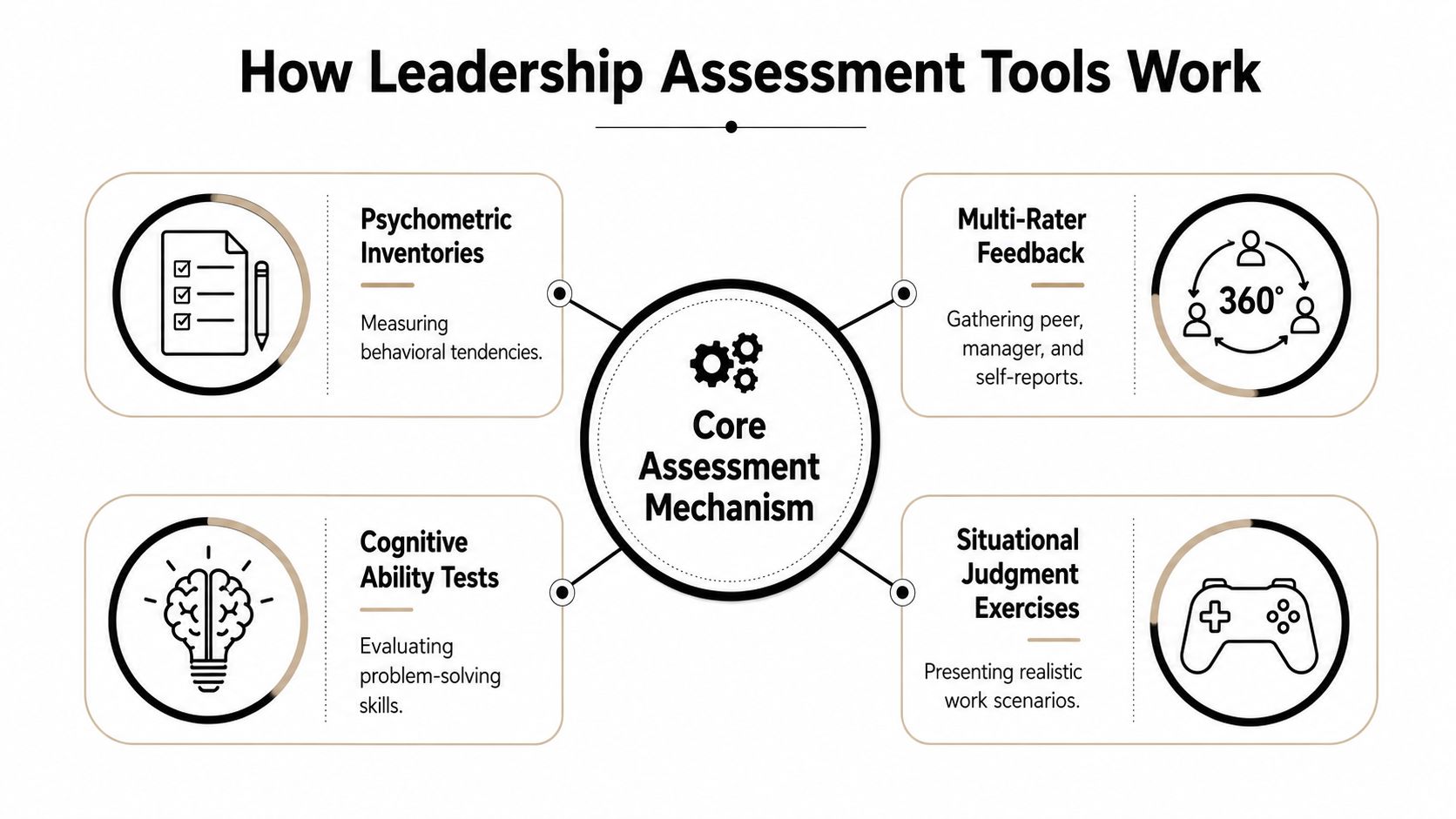
Four common evidence sources
Use methods in combination when the decision demands more than one type of evidence. A behavioral inventory can clarify a recurring pattern, while a simulation tests whether the person can adapt that pattern to role demands. A 360 can identify a blind spot, while coaching and later observation establish whether behavior changes.
For a practical explanation of how competencies should connect to measurement, consult this [guide to competency assessments](https://hiredbyskill.com/blog/competency-based-assessments). HR teams can also use Synopsix's [leadership competency assessment guide](https://synopsix.ai/blog/how-to-assess-leadership-competencies) to connect role expectations with assessment outputs. The right design keeps assessment data useful for hiring, manager coaching, succession planning, and ongoing leadership development.
Business Use Cases and Measurable Benefits
Leadership assessment creates business value only when it changes decisions and development actions. Hiring is the common entry point, yet stopping there leaves useful evidence idle after the offer is signed.
Hiring benefits from comparable information when interviews produce uneven evidence or candidates present a persuasive leadership story. Use an assessment to test capabilities tied to the role, then combine the results with interviews, references, and role-specific evaluation. The tool should sharpen judgment, not replace it.
Promotion deserves equal attention. Technical performance often receives more visibility than coaching, delegation, judgment, or the ability to deliver results through other people. A structured assessment makes those requirements explicit before an individual contributor moves into leadership. It cannot remove promotion risk, but it can expose the risks the organization must address.
Use the data across the talent lifecycle
The strongest programs keep assessment findings active after the selection decision.
The broader case for assessment rests on validation, not attractive reports. A meta-analysis summarized in a business outcomes paper aggregated 114 validation studies, with an average sample size of 835, and reported validity coefficients as high as 0.71 for one competency and 0.54 overall, as documented in this [peer-reviewed discussion of leadership assessment validation](https://pmc.ncbi.nlm.nih.gov/articles/PMC6687842/). These findings do not establish that every vendor tool predicts performance. They show that properly validated instruments can add meaningful evidence to hiring, promotion, coaching, succession, and pipeline decisions.
Track whether managers use the findings, whether targeted behaviors change, and whether successors gain the experience required for future roles.
> Assessment earns its budget when managers change a decision or a development action because of the evidence.
Selection Criteria for Choosing the Right Tool
Don't begin vendor selection with a feature checklist. Begin with the decision and the behavior you need to predict. Then ask vendors to prove that their method is suitable for that use.
| Criterion | What to Look For | Red Flags | |---|---|---| | Purpose | Clear distinction between selection, promotion, development, and succession use | One report marketed as suitable for every decision | | Construct validity | Evidence that the tool measures the leadership capabilities it claims to measure | Personality labels presented as proof of leadership readiness | | Reliability | Reported internal consistency and appropriate reliability evidence, with group-level reliability commonly benchmarked at .70 or higher according to [DDI's assessment guidance](https://www.ddi.com/blog/leadership-assessment-types) | No technical manual or only testimonials | | Criterion-related validity | Evidence connecting scores with relevant performance outcomes | Claims based only on participant satisfaction | | Normative sample | Norms that are relevant to your industry, leadership level, geography, and workforce | Percentile comparisons with no explanation of the reference group | | Behavioral specificity | Items and exercises tied to observable, job-relevant behavior | Abstract statements that participants can interpret any way they choose | | Rater design | Multiple informed raters, clear instructions, and safeguards against retaliation or popularity effects | Unstructured nominations or one manager's opinion treated as complete evidence | | Fairness | Group-level analysis of item performance, outcomes, and potential bias | “Objective” marketing with no fairness documentation | | Actionability | Reports that map findings to coaching, development, or decision criteria | Long technical reports with no practical next step | | Administration | Secure data handling, appropriate access controls, and a respectful participant experience | Unclear ownership, retention, or consent practices |
Validity outranks familiarity
The Authentic Leadership Inventory marked an important development in leadership-specific measurement because its creators reported initial validation through empirical testing, rather than relying solely on intuitive appeal. The larger lesson is simple: a recognizable framework isn't automatically a defensible instrument.
Ask for the technical documentation. Review the sample, the constructs, the scoring model, the validation studies, and the intended use. For a concise explanation of the distinction between consistency and accuracy, see this resource on [assessment validity and reliability](https://synopsix.ai/blog/assessment-validity-and-reliability).
Treat bias as a design issue
A 360-degree process can gather more perspectives without becoming unbiased. Raters may show selective recall, halo effects, leniency, or prototype effects. Item content can also reflect one group's experiences more than another's, as discussed in this [bias-focused assessment document](https://apps.dtic.mil/sti/tr/pdf/ADA119898.pdf).
That makes rater selection, behavior-level wording, calibration, and fairness testing as important as the vendor brand. The best tool is the one whose method fits your decision and whose evidence survives scrutiny in your context.
Implementation Best Practices That Drive Adoption
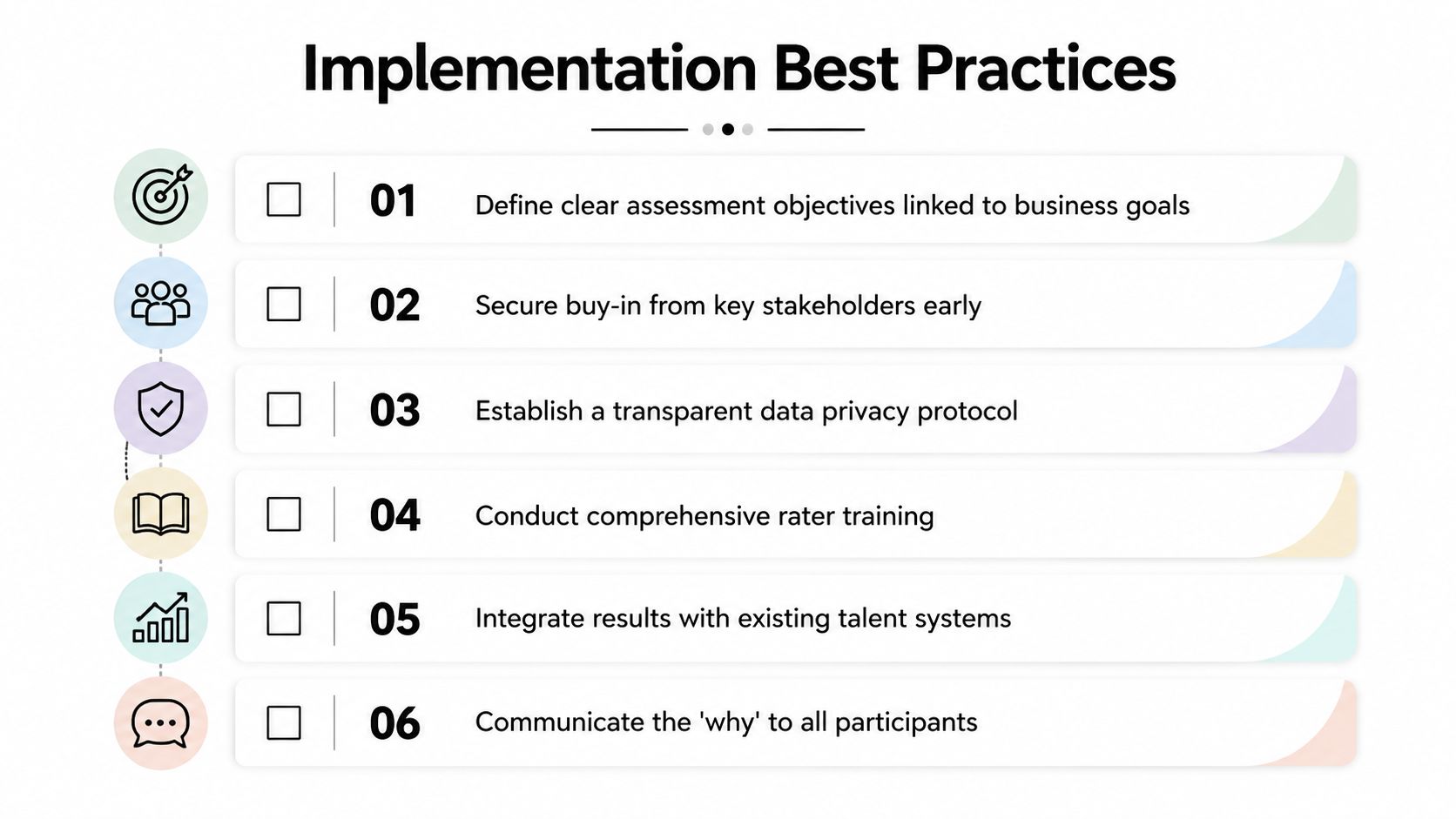
Implementation fails when HR treats assessment as a software launch. Participants need to understand the purpose, managers need to know how to use the result, and executives need to see how the process supports a real talent decision.
Establish the operating rules first
Write the assessment purpose in plain language. Tell participants whether the process supports development, selection, promotion, or several distinct decisions with different safeguards. Explain who sees individual results, how feedback will be delivered, and what action the organization expects afterward.
Then prepare managers and raters. Raters need clear behavioral definitions, enough exposure to the leader's work, and guidance to distinguish a specific observation from a general impression. Participants need a qualified debrief, especially when the report includes sensitive feedback or potential derailers.
A strong launch includes:
Assessment fatigue is usually a design failure. Organizations create it by asking people to complete irrelevant instruments, repeating similar surveys, or withholding the outcome. Keep the method focused on the decision and make the follow-through visible.
Use the following video as a discussion aid for leaders who need a practical introduction to assessment implementation:
<iframe width="100%" style="aspect-ratio: 16 / 9;" src="https://www.youtube.com/embed/thVW3SHZjkQ" frameborder="0" allow="autoplay; encrypted-media" allowfullscreen></iframe>
Measuring ROI and Business Impact
HR teams lose executive support when they report only participation, completion, or the number of profiles generated. Those metrics describe program activity. They don't demonstrate that leadership decisions improved.
Start with a baseline before deployment. Define the business outcome that the assessment should influence, identify the current process, and record how managers make decisions today. The baseline might involve time to productivity, promotion success, regrettable retention, leadership role readiness, team performance indicators, or the quality of development plans.
Use a measurement chain
Connect the assessment to outcomes through a sequence rather than claiming direct causation:
1. Evidence: The assessment identifies a relevant capability, risk, or development need. 2. Action: A manager assigns coaching, practice, role exposure, or a specific leadership goal. 3. Behavior: The leader demonstrates a changed behavior in observable work situations. 4. Outcome: The team or talent process shows a meaningful improvement tied to that behavior.
This chain helps executives distinguish leading indicators from lagging indicators. Completion and debrief attendance are leading indicators of adoption. Quality of development actions and manager follow-up indicate whether the organization is using the data. Promotion readiness, retention, productivity, and team outcomes are later indicators that require careful interpretation.
Don't attribute every favorable result to the assessment. Hiring conditions, manager changes, compensation, reorganizations, and training can affect the same outcomes. Compare assessment-informed decisions with the prior process where practical, document other interventions, and review results across roles or cohorts without exposing individual data unnecessarily.
A sound ROI review asks:
That approach earns credibility because it measures decision quality and behavior change, not just tool usage.
Building Continuous Leadership Development Pipelines
Organizations waste leadership assessment data when they use it only to rank candidates. A hiring decision answers who enters the role. It doesn't answer how that person will become effective, who is ready for the next role, or where the organization has succession risk.
A lifecycle model turns assessment into a feedback loop. Establish role expectations, assess current leaders and emerging talent, translate findings into development plans, provide coaching and stretch experiences, then reassess relevant behaviors over time. The organization builds a clearer picture of readiness instead of relying on annual impressions.
The approach also supports retention. Leaders are more likely to see a future in the organization when feedback connects to concrete opportunities, such as leading a cross-functional initiative, mentoring a successor, or gaining exposure to a strategic decision. Aon's [2025 to 2026 leadership research](https://www.aon.com/insights/reports/2025/leadership-in-transition) identifies post-hire development as a growing focus and points to untapped potential for broader assessment across the leadership talent pool. That direction is right. Assessment should follow the leader's career, not end at the offer letter.
For organizations building the operating model, this [leadership pipeline guide](https://synopsix.ai/blog/building-leadership-pipeline) provides a useful structure for connecting evidence to succession and development. Teams may also consider [adopting an AI chief of staff](https://www.flaex.ai/blog/ai-chief-of-staff) when leaders need operational support to turn priorities, feedback, and follow-up actions into consistent routines.
Use leadership assessment tools to make the pipeline more visible, not to create another ranking exercise. The strongest systems show what each leader can do now, what the next role requires, what evidence is missing, and which development action should close that gap.
---
Synopsix turns scientifically validated behavioral assessments into practical guidance for hiring, team design, and leadership development, including comparable profiles, role-specific intelligence, predictive simulations, compatibility analysis, and development plans. Visit [Synopsix](https://synopsix.ai) to see how your organization can connect assessment evidence with better leadership decisions and a stronger talent pipeline.