Leadership Competency Model: The 2026 Guide
By Synopsix · June 22, 2026 · 16 min read
A lot of CHROs are dealing with the same quiet failure pattern. A strong individual contributor gets promoted because everyone trusts their judgment, output, and work ethic. Six months later, the team is confused, decisions are slow, peers are frustrated, and HR is trying to separate a capability gap from a support gap.
That problem usually isn't about effort. It's about using the wrong evidence for the decision.
Past performance in a specialist role tells you something important, but it doesn't tell you whether someone can align a team, handle conflict, make calls with incomplete information, or lead across functions. A leadership competency model gives you a better decision system. Used well, it turns leadership from a vague promise into a defined set of observable behaviors you can hire for, assess, develop, and promote against.
The primary opportunity isn't building the document. It's activating the model so hiring, promotion, and development decisions stop depending on manager instinct alone.
Beyond Promotions Based on Past Performance
The classic scenario is easy to recognize.
Your best engineer becomes engineering manager. Your top salesperson becomes sales director. Your most dependable operations lead gets a larger team because “they've earned it.” The promotion makes sense on paper. Then the cracks show. The new leader keeps solving problems personally instead of through others. Feedback conversations get delayed. Priorities change without context. The team starts waiting for direction or working around the leader altogether.
None of that means the person was a bad hire internally. It means the organization promoted based on what was easiest to see.
What usually gets mistaken for leadership readiness
Organizations often reward three signals that matter, but don't predict leadership on their own:
Those signals are useful. They're just incomplete.
A leadership role changes the job. The work shifts from doing to directing, from personal excellence to team performance, from knowing the answer to creating conditions where others can execute. That's why promotion decisions anchored only in historical performance create expensive noise in the pipeline.
> Past success explains why someone excelled before. It doesn't automatically explain how they'll lead.
A leadership competency model helps because it asks a different question. Not “Who deserves the promotion?” but “Who has shown the behaviors this role requires?”
That distinction matters in succession planning and internal mobility. If your organization is building clearer pathways into management, this overview of [internal mobility strategies](https://synopsix.ai/blog/what-is-internal-mobility) is a useful companion to competency work.
Why this matters to the business
When leadership choices are too subjective, three things happen fast:
1. Mis-promotions increase. You place people into roles that stretch the wrong muscles. 2. Development gets generic. Coaching turns into broad advice instead of targeted gap closing. 3. Promotion debates drag on. Leaders argue from anecdote because no shared standard exists.
A competency model fixes that only if it becomes operational. That means it has to shape candidate reviews, interview guides, succession slates, and development plans. Otherwise, it's just a polished HR artifact that everyone praises and no one uses.
What Is a Leadership Competency Model Really
A leadership competency model is a blueprint for what good leadership looks like in your organization. Not in theory. In your context, with your strategy, your culture, and your operating realities.
Job descriptions tell people the role. A competency model defines the behaviors that make someone effective in the role.
A blueprint, not a trait list
The best analogy is architectural. A blueprint doesn't say, “Build something impressive.” It specifies what has to exist, how the parts fit together, and what standards the structure must meet. Leadership models should work the same way.
A weak model reads like a personality wish list. It's full of labels such as executive presence, strong communication, resilience, or influence. Those words sound sensible, but they're too elastic. Different managers interpret them differently, which means your hiring and promotion process stays subjective.
A stronger model defines leadership in observable terms. Instead of “strategic thinking,” it might describe scanning for business shifts, connecting resource choices to strategic priorities, or translating enterprise direction into team decisions. Once behavior is visible, it can be assessed.
The shift from judgment to evidence
A foundational milestone in this field came from the U.S. Office of Personnel Management, whose [Proficiency Levels for Leadership Competencies](https://www.opm.gov/policy-data-oversight/assessment-and-selection/competencies/proficiency-levels-for-leadership-competencies.pdf) framework defines graded behavioral expectations and reflects a move away from vague leadership potential judgments toward structured, behavior-based evaluation. That change matters because large organizations need a common language for hiring, development, and promotion decisions.
That same logic applies in the private sector. If one business unit thinks leadership means speed and another thinks it means collaboration, your standards aren't portable. You can't compare talent fairly across teams or levels.
What a model should and should not do
A practical model should do these things:
It should not become a recycling bin for every admirable trait in the company.
> Practical rule: If a manager can't point to behavior they actually observed, the competency isn't defined tightly enough.
Many organizations often overcomplicate the wrong thing. They debate wording for weeks, then skip the harder work of calibrating what the behavior looks like at each leadership layer. The model ends up elegant, broad, and hard to use. A real leadership competency model should make decisions easier, not more ceremonial.
The Core Components of an Effective Model
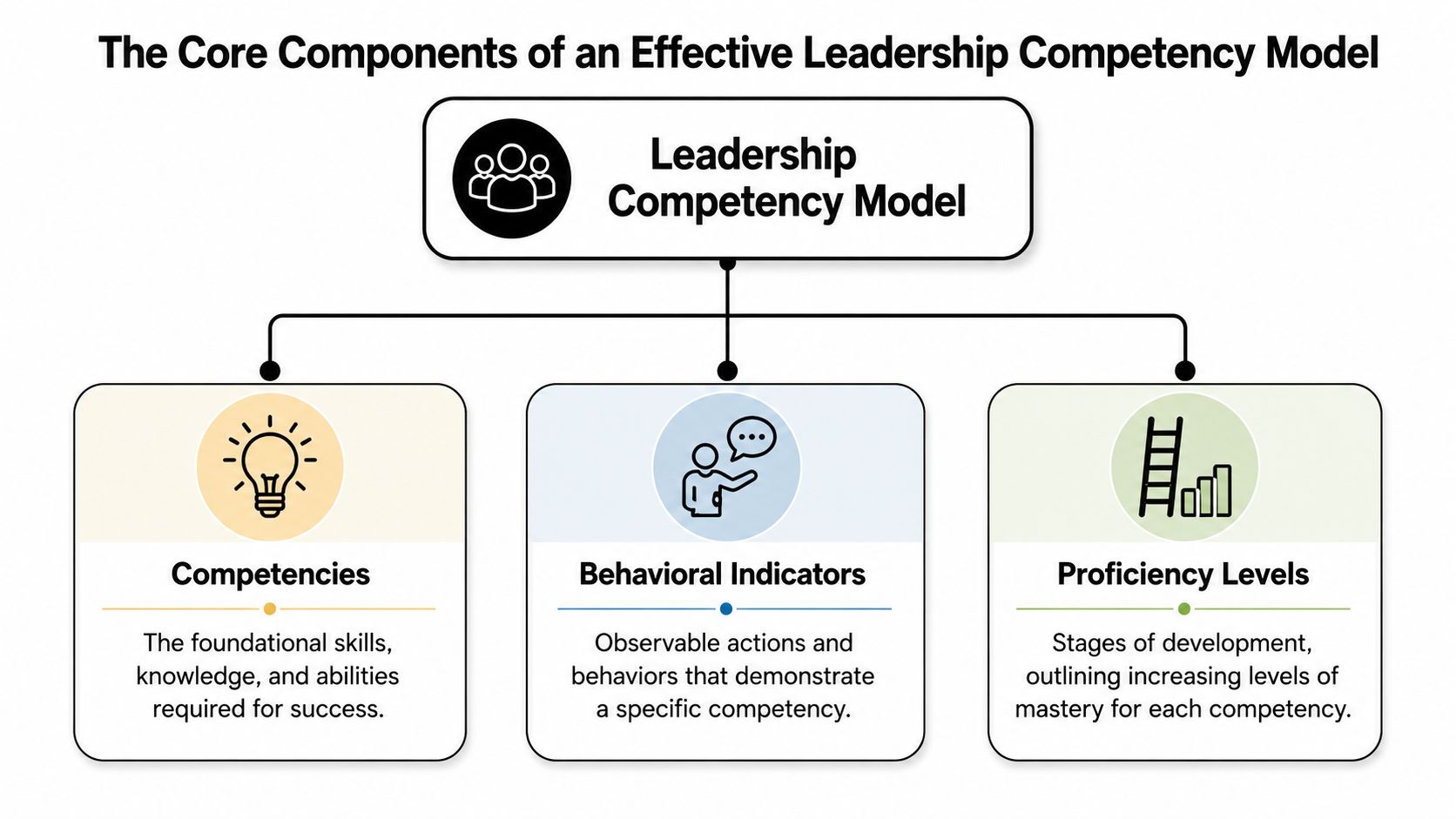
A strong leadership competency model has three moving parts. If one is missing, the model usually breaks under real use.
Competencies define the capability
A competency is the broad capability the organization cares about. Examples might include decision quality, coaching others, enterprise thinking, or stakeholder influence. This is the headline layer.
The trap is stopping there. If all you have is a list of competencies, you don't yet have a usable model. You have labels.
Behavioral indicators make the model observable
Behavioral indicators translate a competency into actions that managers can see. They answer the question, “What does this look like on the job?”
For example, if the competency is conflict management, indicators might include addressing tension directly, separating personalities from issues, and moving teams toward resolution without escalation theater. The point is specificity. The behavior should be concrete enough for interviewers, assessors, and managers to use consistently.
Many teams benefit from stronger competency mapping discipline. If you need a practical primer on that mechanics layer, this article on [competency mapping](https://synopsix.ai/blog/what-is-competency-mapping) is useful.
Proficiency levels make it scalable
Proficiency levels distinguish early leadership from mature leadership. A new manager and a division leader may share a competency label, but the scope, complexity, and expected consistency are different.
That grading is what turns a framework into a real operating tool. Without levels, promotion criteria become blurry and development plans stay generic.
Here's the simplest way to think about the structure:
| Component | What it answers | Why it matters | |---|---|---| | Competencies | What capability matters | Creates shared language | | Behavioral indicators | What it looks like in practice | Improves consistency in assessment | | Proficiency levels | How advanced the behavior must be | Supports promotion and readiness decisions |
Keep behavior separate from other signals
A technically sound model should define competencies as observable behaviors and calibrate them by leadership level. DDI recommends structuring the framework around [Knowledge, Experience, Competencies, and Personal Attributes](https://www.ddi.com/blog/leadership-competency-framework) so organizations can validate the model and embed it into hiring, development, and performance systems.
That separation matters more than many teams realize.
When organizations blur these together, they overvalue pedigree, underweight behavior, and make it harder to explain decisions. A model becomes more defensible and more useful when everyone knows which evidence belongs in which bucket.
Choosing the Right Type of Model for Your Business
Not every organization needs the same model architecture. The design should reflect the decision problem you're trying to solve.
If your main issue is inconsistent people manager quality, a common leadership core may be enough. If the challenge is that sales leaders, plant leaders, and product leaders succeed in different ways, a single universal model will feel neat but perform badly.
The main model choices
Most companies end up choosing among three patterns.
Core leadership model This defines a common set of expectations for all leaders. It's useful when you need enterprise-wide consistency, especially for hiring managers, promotion committees, and foundational leadership development.
Role-specific model This adds differences by function, business unit, or level. It works well when success in one leadership role depends heavily on context. A plant leader may need stronger emphasis on operational discipline. A product leader may need sharper cross-functional influence and ambiguity management.
Hybrid model This is often the strongest option. It combines a small shared core with role-specific overlays. You get consistency where it matters and precision where it counts.
> A universal model is easier to launch. A tailored model is usually easier to trust.
Generic vs custom competency models
For many CHROs, the decision isn't just model type. It's whether to adopt an off-the-shelf framework or invest in a custom one.
| Factor | Generic (Off-the-Shelf) Model | Custom-Built Model | |---|---|---| | Speed to implement | Faster to start with | Slower because it requires design and validation | | Language quality | Often polished and familiar | Can reflect the business more directly | | Cultural fit | May feel borrowed | Can mirror actual leadership expectations | | Strategic alignment | Usually broad | Easier to tie to strategy and operating model | | Ease of buy-in | Simple at first because the content feels recognizable | Stronger over time if leaders see themselves in it | | Diagnostic value | Can become too general for hard decisions | Better suited to role-specific judgment | | Maintenance | Simpler if used lightly | Requires governance discipline |
What usually works in practice
A purely generic model tends to create a fast launch and a weak finish. Managers nod along because the language is recognizable, but they still interpret it differently. Nothing much changes in interviews, promotions, or development reviews.
A fully custom model can also fail if the design team tries to invent a new leadership vocabulary no one uses.
The middle path is usually best. Start with a small, stable leadership core. Then tailor a limited set of differentiators by level or role family. That gives you enough consistency to run enterprise talent decisions, without flattening meaningful differences across the business.
How to Design and Validate Your Own Model
Most failed competency models don't fail because the competency language is terrible. They fail because the design process was disconnected from strategy, rushed through validation, or copied too heavily from published frameworks.
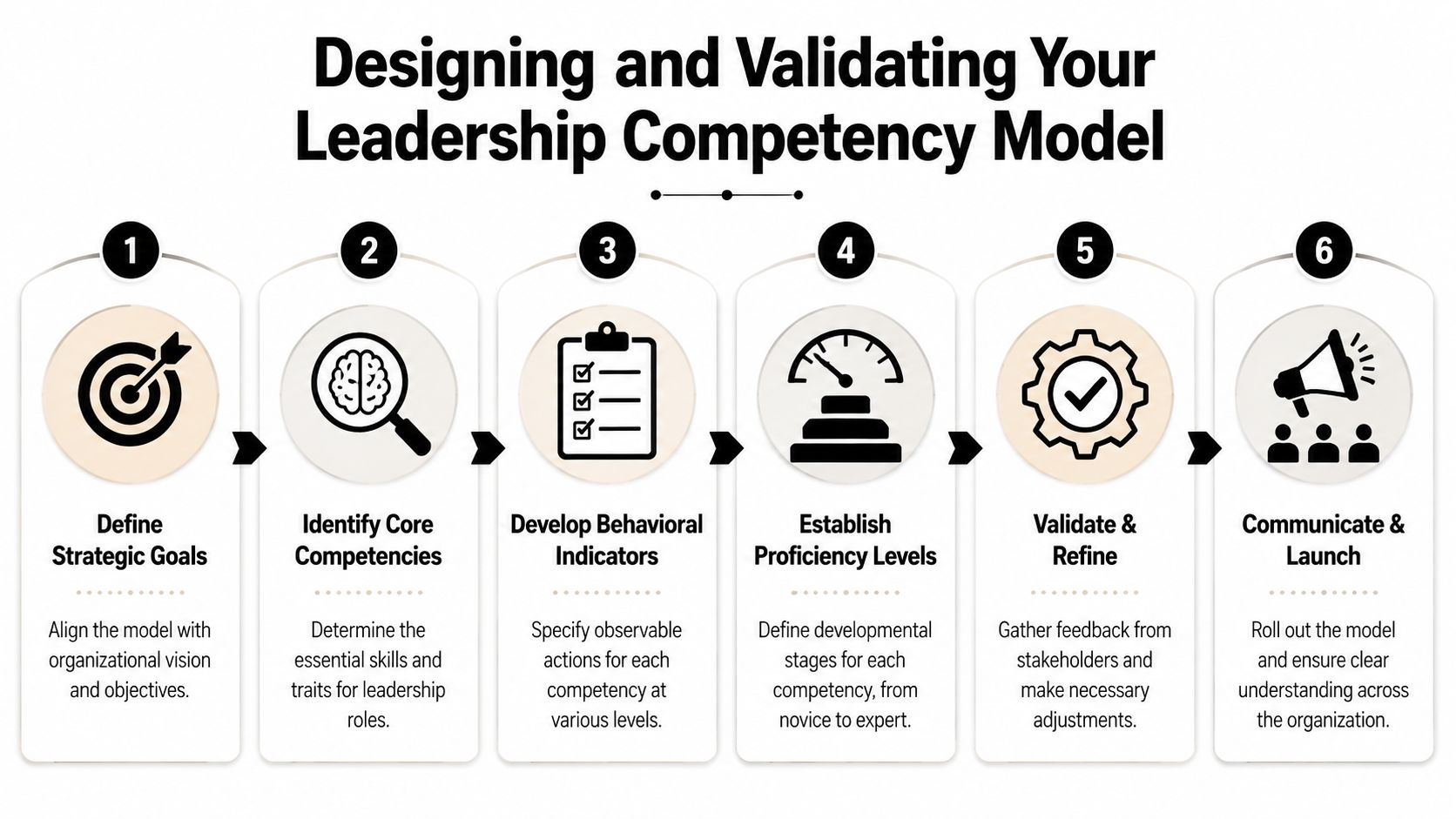
The design work should feel closer to operating model translation than HR wordsmithing.
Start with business direction, not competency libraries
Before drafting anything, pin down what leadership must enable over the next planning horizon. That may include faster cross-functional execution, stronger manager quality after a reorg, cleaner succession into critical roles, or better integration after acquisition activity.
If the strategy needs leaders who can operate across functions and make decisions with incomplete information, the model should reflect that. If your growth plan depends on first-line manager quality, don't let the framework get hijacked by executive-only language.
A practical starting sequence looks like this:
1. Define the business shifts leadership must support. 2. Identify critical roles and leadership layers where better decisions matter most. 3. Interview strong leaders and key stakeholders about what effective performance looks like. 4. Draft competencies and behavioral indicators using language managers recognize. 5. Calibrate proficiency by level so expectations rise with scope. 6. Pilot before full rollout and refine where managers struggle to apply it.
For teams building the broader architecture around learning and skill development, this [guide to competency frameworks](https://learnstream.io/blog/competency-based-training-framework/) is a useful complement because it connects design choices to training use cases.
Don't confuse familiarity with validity
A lot of published models look polished because they contain all the expected terms. Communication. Adaptability. Emotional intelligence. Collaboration. Strategic thinking. The problem is that sameness can make a model easy to adopt and hard to differentiate.
A health-sector revalidation found one model matched an average of 85% of competencies across five other models, suggesting substantial cross-model sameness, according to [SullivanCotter's discussion of leadership competency models](https://sullivancotter.com/resources/leadership-competency-models-for-the-next-era-of-health-system-leadership). That should worry any CHRO trying to use a framework to improve promotion quality or role-specific prediction.
> If your model sounds like every other model, it probably won't help you make better choices than every other model.
Validate with real users before enterprise rollout
Validation is where the model earns trust. Don't limit this to executive signoff. Put the draft in front of hiring managers, HR business partners, assessors, and leaders who will apply it.
Ask practical questions:
Later, when the framework moves into assessment and selection, teams often need stronger rigor in the tools they pair with the model. That's where a review of [talent assessment tools](https://synopsix.ai/blog/talent-assessment-tools) can help sharpen the implementation side.
Use the video below as a quick visual companion to the build process.
<iframe width="100%" style="aspect-ratio: 16 / 9;" src="https://www.youtube.com/embed/XTyzWHt0_3A" frameborder="0" allow="autoplay; encrypted-media" allowfullscreen></iframe>
Activating Your Model Across the Talent Lifecycle
A leadership competency model creates value only when it changes decisions. That means translating the framework into repeatable actions across hiring, onboarding, performance management, development, and succession.
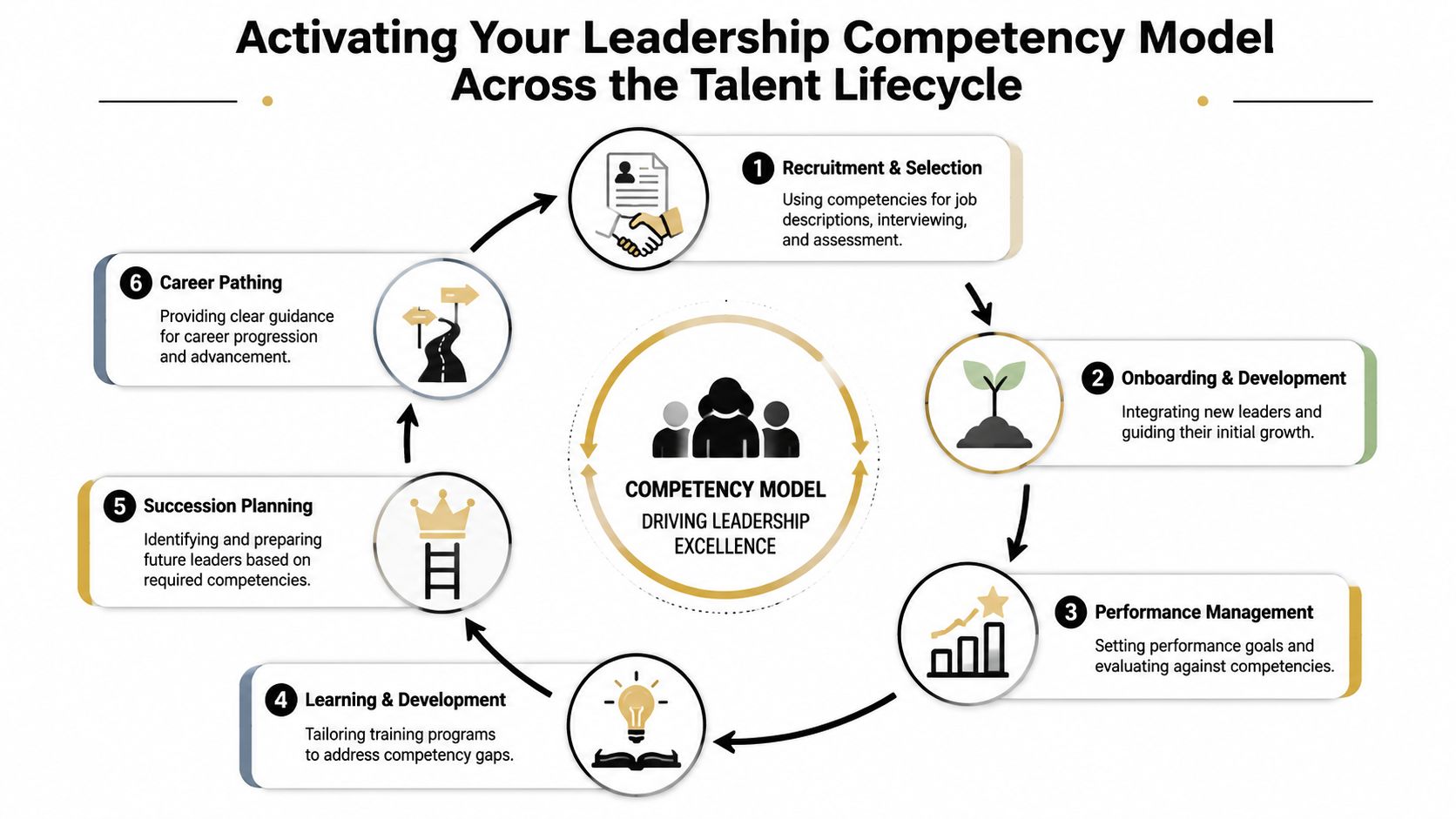
In hiring, use the model to structure evidence
Most leadership interviews still overweight charisma, confidence, and similarity to prior successful leaders. A competency model gives interviewers a cleaner script.
Instead of asking broad questions about leadership style, build interview prompts around defined behaviors. If one competency is decision quality, ask for a specific example of a high-stakes decision made with incomplete information. If another is people development, ask how the candidate diagnosed a capability gap and changed their management approach.
This also improves panel calibration. Interviewers compare evidence against the same framework rather than trading impressions after the fact.
In promotions, use it to judge readiness, not reward history
Promotion reviews often get stuck between merit and readiness. The model helps separate the two.
Someone may deserve recognition for strong performance and still need development before stepping into broader leadership scope. That isn't punitive. It's precision. The model gives leaders language for saying, “High performer, not yet ready for this level of people leadership,” without collapsing into politics.
A 2020 study in Frontiers in Psychology found that eight distinct leadership competencies measured within a company framework were predictive of later promotion outcomes, showing that clearly defined multi-factor models can support advancement decisions at scale, as reported in [the study published on PMC](https://pmc.ncbi.nlm.nih.gov/articles/PMC7419574/).
In development, move from generic training to targeted gap closing
The model also changes how development works. Once leaders are assessed against defined behaviors, L&D can stop assigning the same content to everyone with the same title.
Use the framework to build:
If you're looking for practical examples of how organizations build developmental experiences around leadership capabilities, these [frameworks for building innovative leaders](https://www.svsb.ai/blog/leadership-development-program-examples) offer helpful ideas.
> The model should show up wherever someone asks, “What does readiness look like here?”
The pattern is simple. If the framework only lives in HR documentation, it won't influence talent outcomes. If it shapes interview design, promotion discussions, and development priorities, it becomes a predictive system rather than a static checklist.
Governance and Future-Proofing Your Framework
Most organizations treat the launch of a leadership competency model as the finish line. It's the midpoint.
A leadership framework is a living system. If no one owns it, no one updates it. If no one updates it, managers revert to instinct and local definitions of leadership.

Put real governance around the model
Start with clear ownership. In most companies, the right arrangement is shared accountability across talent, HRBPs, and business leadership. One team maintains the architecture. Another monitors how managers use it. Business leaders pressure-test whether it still reflects the work.
A workable governance rhythm includes:
Update for the work leaders actually do now
Leadership work has shifted. More roles require influence across boundaries, faster adaptation, and broader system awareness than older models captured.
Recent revisions increasingly add domains such as boundary spanning, system awareness, and agility, and the challenge is keeping those competencies current as work changes faster than annual HR cycles, as reflected in the NCHL Health Leadership Competency Model materials.
That has a direct implication for governance. Don't wait for a full redesign every few years. Revalidate portions of the model when the operating environment changes materially. New technology, AI-enabled workflows, reorganizations, and shifts in decision rights all change what good leadership looks like.
The goal isn't constant churn. It's disciplined relevance.
A framework that stays current gives CHROs something rare: a common language for leadership that still adapts to the business. That's what turns a competency model from an HR artifact into infrastructure.
---
If you want to turn a leadership competency model into a decision system, [Synopsix](https://synopsix.ai) helps teams connect behavioral assessment data to practical actions in hiring, promotion, team design, and development. Instead of leaving leaders to interpret abstract psychometrics, Synopsix translates assessment results into clear business signals, comparable profiles, and role-specific guidance so people decisions become more consistent, faster, and easier to defend.