Leadership Credibility: What It Is and How to Measure It
By Synopsix · October 27, 2026 · 17 min read
You're preparing a promotion recommendation. The candidate delivers results, presents confidently and has strong executive support, yet their team has become reluctant to challenge decisions. Before you approve the move, you need to know whether employees believe this person can lead, or have learned not to disagree.
Leadership credibility helps explain that difference. For HR leaders, the practical challenge is to separate a leader's reputation from observable behavior, then identify whose confidence is weakening and why.
What Leadership Credibility Means at Work
Say a newly promoted operations director knows the numbers cold. After she reverses two decisions in one month without explaining what changed, her team stops bringing her bad news. She still has authority, but employees are becoming less willing to rely on her judgment.
Leadership credibility is the degree to which employees believe a leader is both capable and dependable. Field research described in [MIT Sloan Management Review](https://sloanreview.mit.edu/article/why-people-believe-in-their-leaders-or-not/) identifies perceived competence and trustworthiness as its core components, formed through direct and indirect observation of performance.

Think of a bridge with competence and trustworthiness as its pillars. Employees need confidence that the leader understands the work and that their commitments mean something. If either pillar weakens, people may route around the leader by seeking informal approvals or withholding concerns.
Look for behavior rather than status
Employees update their judgments when promises are kept, problems are resolved and decisions are explained. They also hear colleagues' accounts, so a leader's reputation extends beyond personal interactions.
Seniority, charisma and a favorable self-rating aren't substitutes for that evidence. Nor does changing a decision automatically destroy credibility. The important distinction is whether the leader explains the new information and accepts responsibility for the consequences.
For HR, start with observable indicators: decision quality, follow-through, transparency about trade-offs, and alignment between stated priorities and actual spending or time allocation.
> Practical rule: Assess what employees can verify, not what the leader intended them to believe.
The Five Components Employees Judge
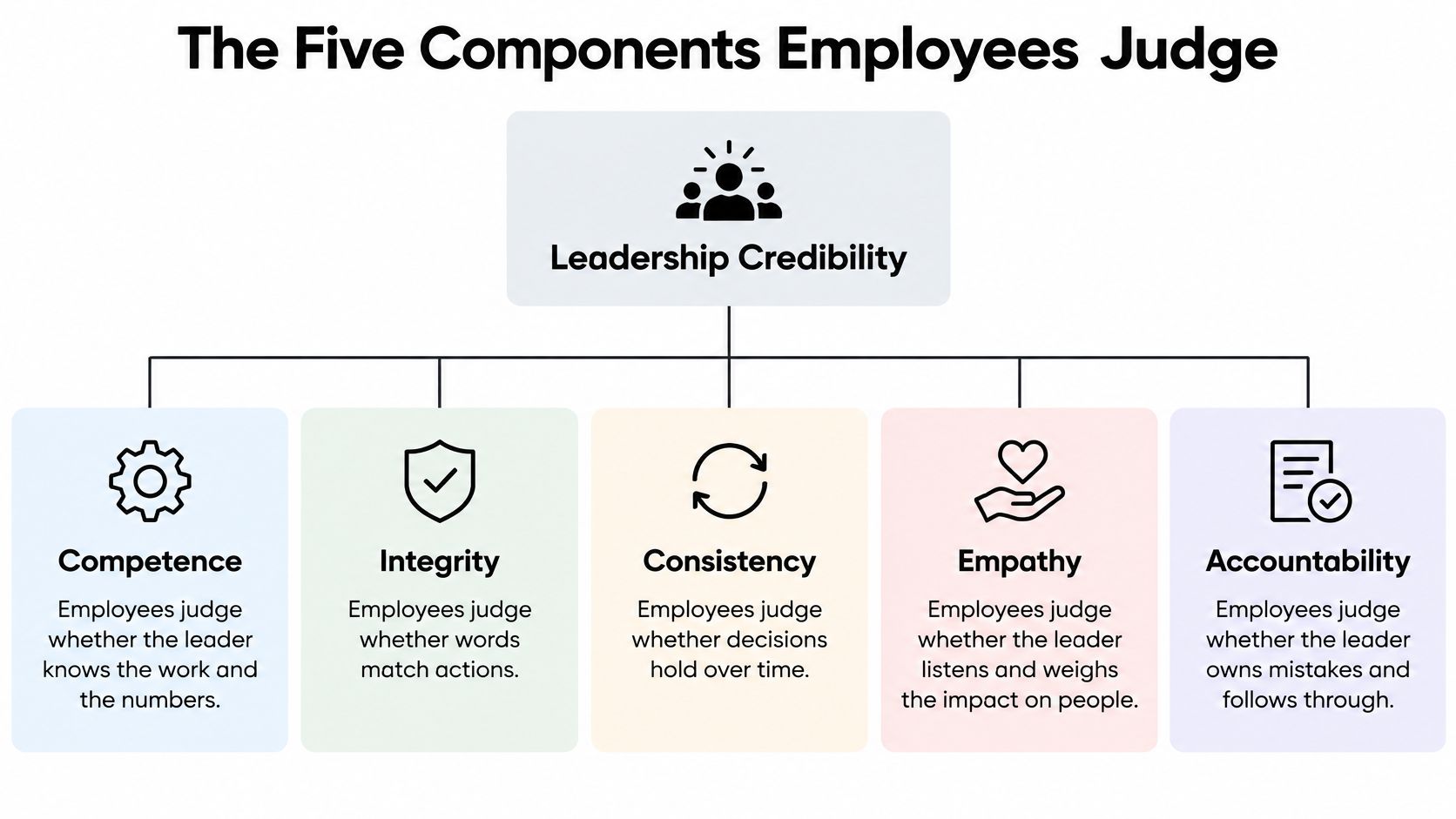
For practical assessment, translate the broad ideas of capability and dependability into competence, integrity, consistency, empathy and accountability. These are behavioral lenses, not a claim that every organization needs an identical scoring model.
The five components of leadership credibility
| Component | What Employees Observe | Example Signal | Typical Failure | |---|---|---|---| | Competence | Sound judgment and domain skill | Decisions hold up under review | Confident calls that keep getting reversed | | Integrity | Consistent honesty about facts and motives | Admits errors openly | Spin when results miss target | | Consistency | Same standards applied across time and people | Priorities match budget changes | Stated values drop under pressure | | Empathy | Attention to how decisions affect people | Asks about workload before setting targets | Strategy announced with no view of team impact | | Accountability | Ownership of outcomes, good and bad | Names own part in a missed goal | Blame passed down the chain |
Translate each label into evidence
Competence Can the leader diagnose the problem, weigh alternatives and explain the decision? Examine the reasoning available at the time, not just whether the eventual outcome was favorable. A lucky result doesn't prove sound judgment.
Integrity Look for accurate accounts of facts and motives, particularly when disclosure is uncomfortable. A leader who changes the definition of success after missing a target, without saying so, creates a different signal from someone who acknowledges the miss.
Consistency Check whether employees encounter the same standards on a calm Monday and during a crisis. Apply the same test across favored teams and difficult relationships. Consistency doesn't mean refusing to adapt; it means explaining adaptations without inventing convenient exceptions.
Empathy Ask whether the leader investigates how decisions affect employees. Before raising targets, for example, do they ask about workload, staffing and competing demands? Listening without considering what employees say isn't enough.
Accountability Watch what happens after an unsuccessful decision. A credible leader identifies their own contribution, names corrective actions and follows through instead of passing blame down the reporting line.
Competence and integrity are useful starting gates: can this person make a sound call, and can employees rely on their account of it? The remaining components help explain how that confidence holds up in daily work.
Use a decision-level self-check
Choose a recent decision and mark each component evident, mixed or not yet observable, attaching a concrete example. Don't turn missing evidence into a negative score.
For communication behavior, use [communication for impact](https://synopsix.ai/blog/communication-for-impact) to focus the discussion on what employees understood. Kushan Business Solutions LLC's resource on [empowering teams through trust](https://gamayaa.com/empowering-through-trust-balancing-control-and-autonomy-in-small-business-leadership/) offers a related lens for discussing control and autonomy.
How Credibility Moves Business Results
Consider a plant manager announcing a shift consolidation. If employees have seen him honor previous commitments, they may still dislike the decision but engage with the handover plan. If he has repeatedly reversed course, the discussion may instead center on whether his assurances are believable.
The same announcement can therefore require very different management work.

A [systematic review of leader credibility](https://pmc.ncbi.nlm.nih.gov/articles/PMC9309999/) reports positive associations with performance-appraisal acceptance, innovation, reduced follower burnout and belief in leader apologies; it also discusses a trust-in-leadership meta-analysis covering 47 samples and 12,945 participants, which found significant relationships with job performance, organizational citizenship behavior, turnover intention, commitment and job satisfaction.
Distinguish acceptance from agreement
The mechanism is relational. Employees who regard a leader as credible have a stronger basis for accepting difficult feedback and deciding that change communication deserves attention. That doesn't mean they approve of every choice.
The review also distinguishes attitudes from behavior: trust relationships were generally stronger for attitudinal outcomes. A favorable survey response isn't proof of improved execution. Employees may believe a manager while still lacking resources, skills or authority to implement a decision.
Use this discussion as a prompt for a leadership-development conversation.
<iframe width="100%" style="aspect-ratio: 16 / 9;" src="https://www.youtube.com/embed/id6vEr5F6fI" frameborder="0" allow="autoplay; encrypted-media" allowfullscreen></iframe>
Connect leader ratings to specific outcomes
Measure credibility separately for direct managers and senior leaders. Employees can trust their supervisor while doubting enterprise decisions, and a generic leadership rating won't reveal the distinction.
Then examine decision acceptance, engagement, retention risk and voluntary collaboration alongside the ratings. The broader question of [leadership effectiveness](https://synopsix.ai/blog/what-is-leadership-effectiveness) includes delivery conditions as well as employee perceptions.
Treat these relationships as diagnostic evidence, not causal proof. If acceptance improves after a leadership intervention, check whether staffing, incentives or the decision itself also changed before assigning credit.
How Fast Credibility Builds and Breaks
Building confidence can take substantially longer than losing it. In [Seton Hall University's leadership research](https://www.shu.edu/leadership/news/next-generation-evidence-for-leadership-effectiveness.html), employees reported a median 13–24 months to build trust in an immediate leader, compared with a median loss time within 12 months; 44.1% reported that trust could be lost within six months and 69.6% within one year.
How long trust takes to build and lose
| Stage | Reported Figure | What It Means | |---|---|---| | Building trust in an immediate leader | Median 13–24 months | Allow time for cumulative proof of reliability | | Losing trust in an immediate leader | Median within 12 months | Don't assume an established reputation is secure | | Trust could be lost within six months | 44.1% of respondents | Monitor concerns early rather than waiting for annual reviews | | Trust could be lost within one year | 69.6% of respondents | Review credibility throughout the leadership transition |
These are reported trust timelines, not a countdown predicting when an individual leader will lose credibility. They also don't establish that risk disappears after someone's initial tenure.
Establish early evidence of capability
The same study identified ability as the strongest driver of both trust formation and loss, ahead of integrity and benevolence. Charisma or transparency alone won't compensate for repeatedly mishandling the basics.
For a newly promoted leader or an executive entering an unfamiliar market, use a practical starting sequence:
Monitor decision follow-through, perceived managerial capability and willingness to raise concerns from the start. Use these as potential early warnings rather than waiting for engagement or retention outcomes.
> A quiet team may be confident, discouraged or afraid. Silence alone won't tell you which.
Metrics to Track and Who to Segment By
An overall trust score can hide both the people who doubt a leader and the reason for their doubt. Build a dashboard that combines employee perceptions with observable behavior and outcomes.
Credibility metrics HR teams can track
| Metric | Data Source | Healthy Direction | Warning Sign | |---|---|---|---| | Decision acceptance rate | Short pulse survey after major decisions | Stable or rising | Quiet non-compliance or repeated reopening of decisions | | Commitment follow-through rate | Project tracking of leader commitments | Most dates met or moved with early notice | Deadlines shifted without explanation | | Competence and benevolence scores | Segmented survey items | Both at or above the organization average | High competence with low benevolence | | Speak-up rate | Skip-level sessions and anonymous channels | Concerns raised early | Problems surface only in exit interviews | | Regretted attrition under the leader | HRIS exit data grouped by manager | Within team norms | Clusters of high performers leaving one team | | Promotion-to-performance alignment | Talent review data | Promoted leaders meet results targets | Promotions tied to visibility rather than results |
Read the measures together
Decision acceptance and commitment follow-through help distinguish understanding from execution. Ask employees whether they understand a decision's rationale separately from whether they support it.
Speak-up data needs particular care. More reported concerns may indicate deteriorating conditions, or employees becoming more comfortable reporting existing problems. Review the timing, substance and handling of concerns before judging the direction.
Likewise, regretted attrition is an outcome to investigate, not a verdict on a manager. Consider role changes, compensation and team composition. An organization average is also a comparison point, not an automatic standard of health.
Segment before interpreting
[Qualtrics' 2025 employee trust findings](https://www.qualtrics.com/articles/customer-experience/customer-employee-trust-2025/) put favorable trust in senior leadership at 65% among U.S. employees, compared with 83% among VP and C-suite respondents and 56% among individual contributors; senior-leader competence was rated favorably at 70%, compared with 56% for benevolence, falling to 42% among employees aged 55 and older.
The same account reports Gartner findings that employees were 4.3 times more likely to trust senior leaders who explain decisions and 6.5 times more likely to trust those who genuinely address their concerns. These associations make explanation and responsiveness useful intervention targets, but they aren't guaranteed treatment effects.
Segment by hierarchy, tenure, age and trust dimension, while protecting anonymity. Don't publish small groups that allow respondents to be identified.
When diagnosing a frontline problem, give frontline evidence appropriate weight rather than allowing favorable executive ratings to overwhelm it. Senior colleagues and employees doing the work have different opportunities to observe the leader.
Assessment Methods Compared
Choose the method to match the decision. No single tool captures credibility completely, and combining methods is useful only when each contributes different evidence.
Credibility assessment methods compared
| Method | What It Measures | Strength | Limitation | Best Use | |---|---|---|---|---| | Validated behavioral assessment | Tendencies in judgment, communication and pressure responses | Comparable profiles across candidates | Describes tendencies, not guaranteed performance | Hiring shortlists and leadership pipeline screens | | Performance and retention metrics | Results delivered and whether people stay | Hard outcome data | Lagging and confounded by market and team factors | Checking whether credibility is turning into results | | Predictive simulation | Likely response to conflict, missed targets or change | Tests behavior before a costly decision | Quality depends on validation and scenario design | Promotion and role-fit decisions and friction forecasts |
Separate tendencies, perceptions and outcomes
A validated behavioral assessment can support consistent candidate comparisons. Check that its validation is relevant to the intended use, population and role. A profile describes tendencies; it doesn't establish that employees will trust someone in a particular organization.
Performance and retention metrics show what happened, but not necessarily why. Compare leaders facing reasonably similar circumstances, and investigate whether results depended on unsustainable workloads or inherited advantages.
A predictive simulation adds a prospective view. Give candidates a role-relevant scenario involving conflict, a missed target or reorganization, then assess their reasoning, communication and handling of competing demands against predefined criteria.
Add the employee perspective
360 feedback helps expose differences between self-perception and what peers or direct reports experience. Protect anonymity, require sufficient participation within reporting groups and tell respondents how the results will be used.
Coachful's [leadership feedback framework for executive coaches](https://www.coachful.co/blog/leadership-360-assessment-template) can support a structured coaching conversation. For implementation questions, a [360 assessment for leadership](https://synopsix.ai/blog/360-assessment-for-leadership) should be considered alongside the organization's confidentiality and decision-making rules.
Among available tools, Synopsix combines Assessments & Profiles, Intelligence Reports, Predictive Simulations and Human Interlink to translate assessment results into business-language risk indicators and views of team complementarity and tension. Use those outputs alongside interviews, feedback and documented outcomes, not as an automatic promotion recommendation.
Its vendor-reported 98% assessment accuracy is a claim to test, not a benchmark to accept without clarification. Ask what accuracy means, what outcome was predicted, how the sample was selected and whether performance holds in your organization.
> Verification test: Before using any score to exclude or promote someone, establish what it measures, what it misses and how a person can challenge an inaccurate interpretation.
A Roadmap Across Hiring, Promotion and Development
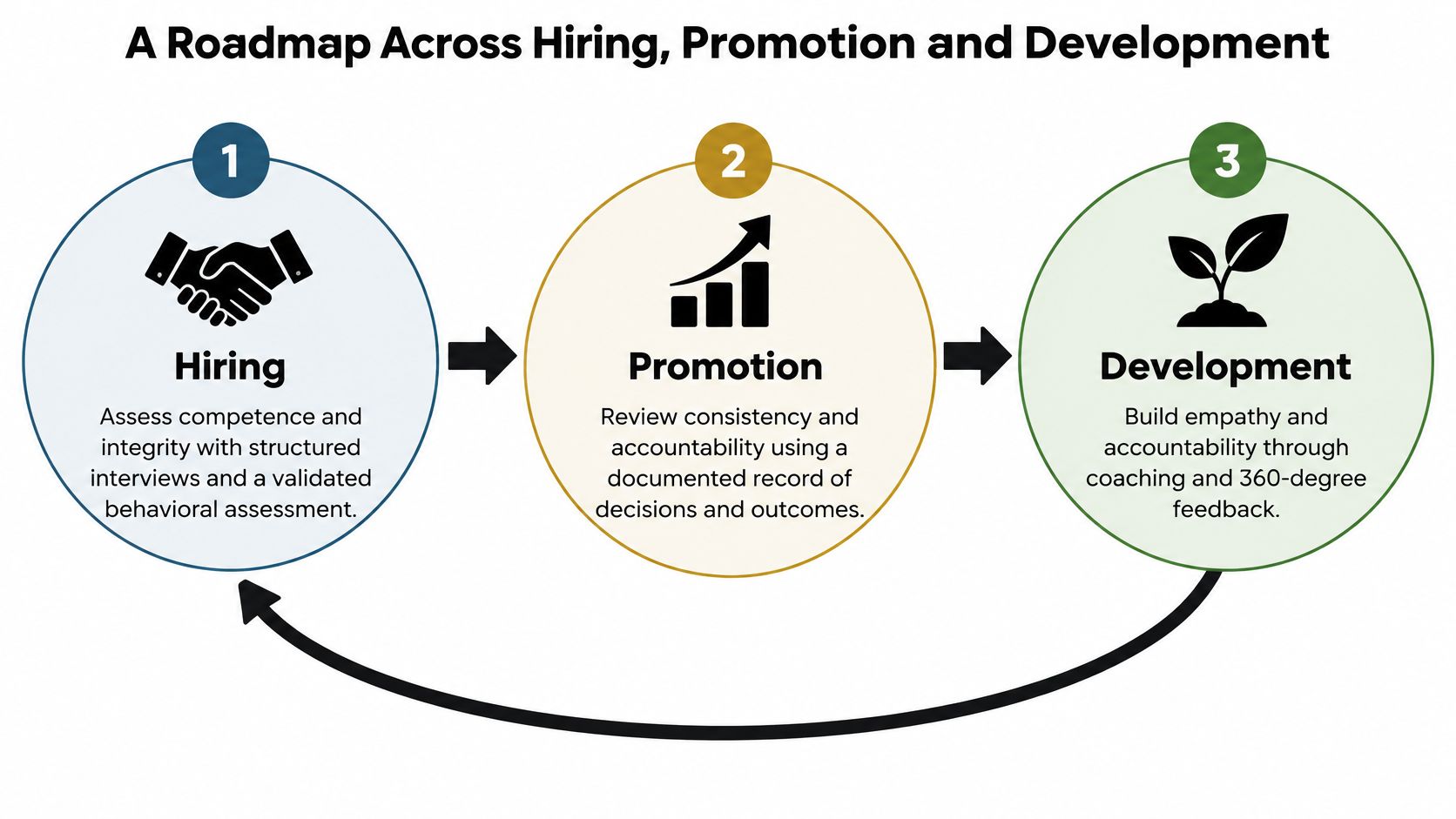
Use a shared evidence record across people processes, rather than commissioning a new assessment whenever a decision becomes urgent. Record the behavior observed, its context, the source of the evidence and any uncertainty that remains.
The loop connects selection decisions with later development and observed performance.
Run the loop through each people process
1. Hiring Assess competence and integrity through structured interviews, work-relevant evidence and a validated behavioral profile. Record why each rating was assigned, including contradictory evidence, so panel confidence doesn't become a substitute for a defensible judgment.
2. Onboarding As a practical starting plan, ask the new leader to publish three to five commitments with dates during their first 90 days, then review progress monthly. Choose commitments within their authority and include dependencies, so employees can distinguish a broken promise from a clearly explained constraint.
3. Promotion Review all five credibility components using 360 feedback, the team's operating record and a simulation of a difficult decision in the proposed role. Test whether the candidate can handle the new scope rather than assuming success in the current job guarantees readiness.
4. Development Target the weakest component with one stretch assignment and one coach rather than prescribing a generic leadership course. Define the behavior employees should be able to observe afterward, and name who will provide feedback on whether it changed.
5. Sustain Maintain a decision log recording the choice, rationale, owner, subsequent changes and explanation for any reversal. Review unresolved commitments during existing operating meetings so accountability remains part of the work rather than a separate reporting exercise.
Match the intervention to the actual gap
Consider a hypothetical sales director whose team trusts her pricing calls but not her forecasts. She negotiates well, yet repeatedly changes revenue expectations without identifying which assumptions failed.
A presentation-skills course would miss the problem. Her development plan should focus on consistency and follow-through, using a monthly forecast review with published misses, explanations and corrective actions.
The coach can help her distinguish uncertainty from avoidable overconfidence. Her manager can check whether updated forecasts arrive early enough for finance and operations to act.
Don't evaluate the intervention by whether employees liked the review meeting. Check whether they received clearer assumptions, earlier warnings and a more usable account of what changed.
Keep access to the evidence record proportionate to its purpose. Coaching notes shouldn't automatically become selection evidence, and an employee's confidential comment shouldn't be copied into a promotion pack without appropriate safeguards.
The governing rule is straightforward: credibility is rebuilt through evidence, not announcements. A development plan becomes meaningful when colleagues can identify what the leader now does differently.
Confirm Credibility Gaps Before Your Next Promotion
Promotion decisions fail quietly when reviewers argue from impressions while employees have already formed a pattern. A baseline credibility check on one team gives you evidence while the stakes are still manageable. Credibility is asymmetric: it can take well over a year to build and erode within months. It is also segmented, so a single overall trust score can hide which level, tenure group or function doubts the leader and what specifically they doubt.
Use the five behavioral components with a small set of relevant measures, such as commitment follow-through, decision acceptance and the timing of concerns. Choose the question before collecting more information. Are employees doubting technical judgment, honesty about constraints or attention to workload? Each concern needs different evidence and a different intervention.
Avoid the shortcuts that distort decisions
For director candidates, distinguish team leadership from board responsibilities. SeatSignal's resource on [governance readiness for aspiring directors](https://getseatsignal.com/tools/board-readiness-assessment) adds a governance lens, while employee evidence still shows whether people experience reliable judgment, candor and follow-through.
Make the calibration meeting decisive
Give the pilot a clear working name that describes the team and the question it answers, and name an HR owner. Segment results by level and tenure, then compare behavioral profiles with 360 feedback and performance evidence. If the average looks acceptable only because optimistic groups cancel out skeptical ones, treat that as a finding rather than noise.
Use business-language reports to organize questions, simulations to examine possible friction before a move, and Human Interlink to explore team complementarity and tension points. Treat each output as a hypothesis to verify against the role and the people involved.
At the calibration meeting, ask reviewers to separate observed facts, interpretations and unresolved questions. Record disagreement instead of forcing confident consensus, and specify what additional evidence would change the recommendation. Check vendor-reported gains against your organization's baseline before they influence budget or policy. Define the outcome and comparison method in advance, including what counts as a mis-hire and when a hiring decision begins and ends.
Schedule the meeting before the promotion decision, with a named owner responsible for closing evidence gaps. Leave with a documented recommendation, a development action and a review date.
Synopsix offers behavioral profiles, business-language intelligence reports and simulations to support hiring, promotion and leadership development. Visit [Synopsix](https://synopsix.ai) to explore how these tools could support a team-level credibility pilot, then compare the outputs with employee feedback and operating evidence before making your next leadership decision.