Leadership Development Planning: A Practical Playbook for HR
By Synopsix · July 28, 2026 · 16 min read
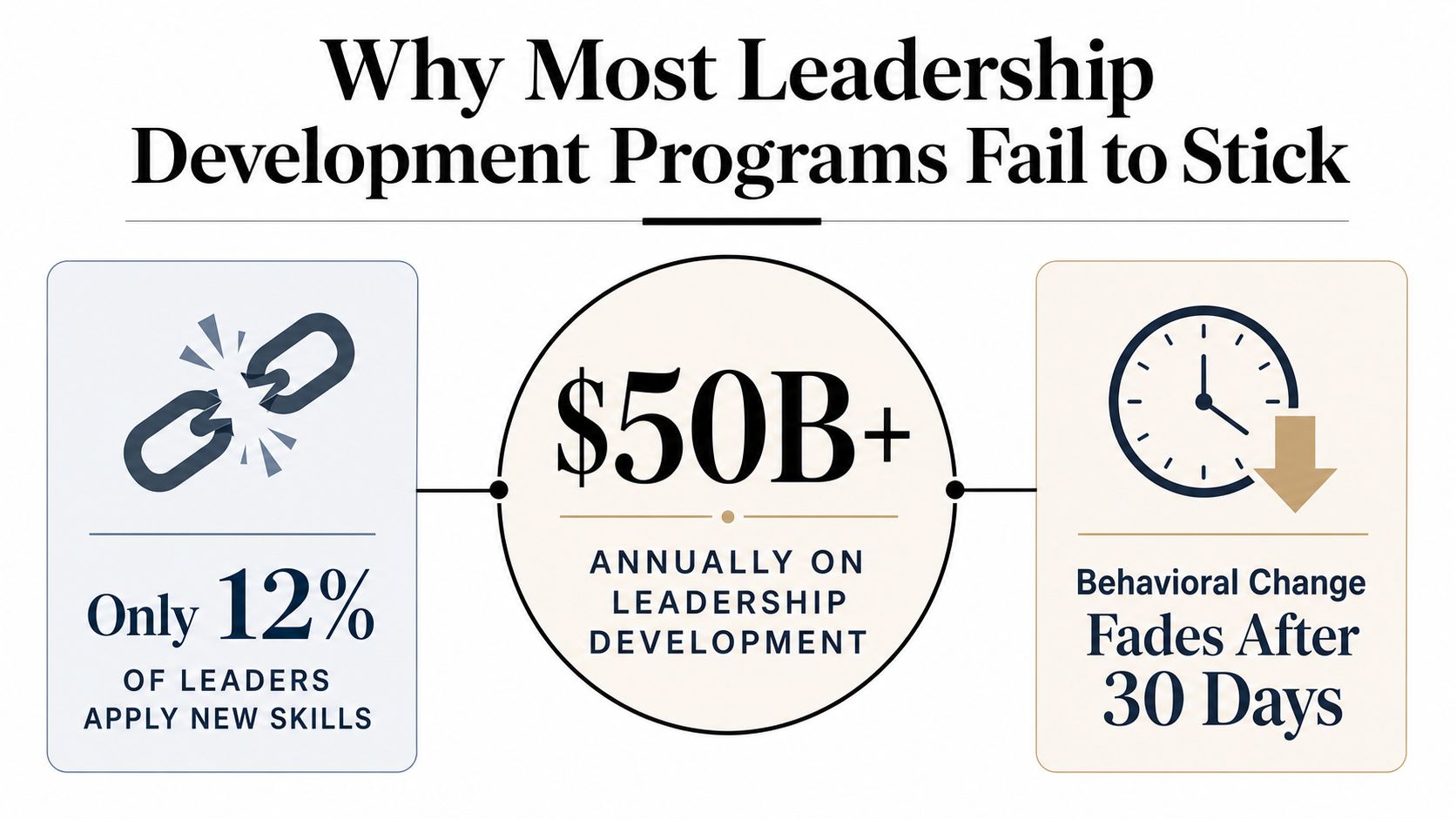
Most leadership development planning fails for a simple reason. Organizations keep treating training as if it were the same thing as behavior change, then they wonder why the program looks active on paper and inert in the business. The market tells the same story, leadership development was valued at about $45 billion in 2023 and projected to grow at a CAGR of 8.5% from 2024 to 2030. One industry estimate also placed annual worldwide spending at $366 billion, which makes the problem less about access and more about execution [source](https://careertrainer.ai/en/reports/leadership-development-effectiveness-statistics/).
Many companies buy more leadership content than they can ever absorb. Gallup's 2025 State of the Global Workplace reported that only 44% of managers worldwide said they had received management training, and the Chartered Management Institute found that 82% of UK managers entering a management role had not received formal management or leadership training [source](https://www.kinkajouconsulting.com/post/topleadershipdevelopmentstatistics). A program can look generous and still be badly designed. If the behavior never shifts, the budget was spent on activity, not leadership.
That's why I'd start with one hard question, what exactly are you trying to change? If the answer is just “offer training,” the result is usually a slide deck, a workshop, and a few polite surveys. If the answer is “change how managers make decisions, coach people, and handle ambiguity inside real work,” the plan has to look very different. For teams that need production support around learning content, it's also worth [find production partners for training](https://www.moonb.io/blog/corporate-training-video-production) early, because the delivery format matters as much as the message.
Why Most Leadership Development Programs Fail to Stick
The fastest way to weaken a leadership initiative is to confuse attendance with capability. Many organizations celebrate enrollments, completions, and positive feedback, then discover six months later that the same management habits are still in place. That pattern is why recent U.S. survey data showing 71% of organizations offer leadership training, while 75% rate those programs as “not very effective,” should not surprise anyone [source](https://www.kinkajouconsulting.com/post/topleadershipdevelopmentstatistics).
Why the usual model breaks down
Most programs fail because they stop at exposure. People sit through a class, take notes, maybe even enjoy the session, but nothing in the system forces transfer back into the job. The design problem is not content volume, it's the lack of follow-through, reinforcement, and accountability.
> Practical rule: If the plan doesn't change how a leader behaves in actual meetings, actual decisions, and actual coaching moments, it isn't a development plan. It's education.
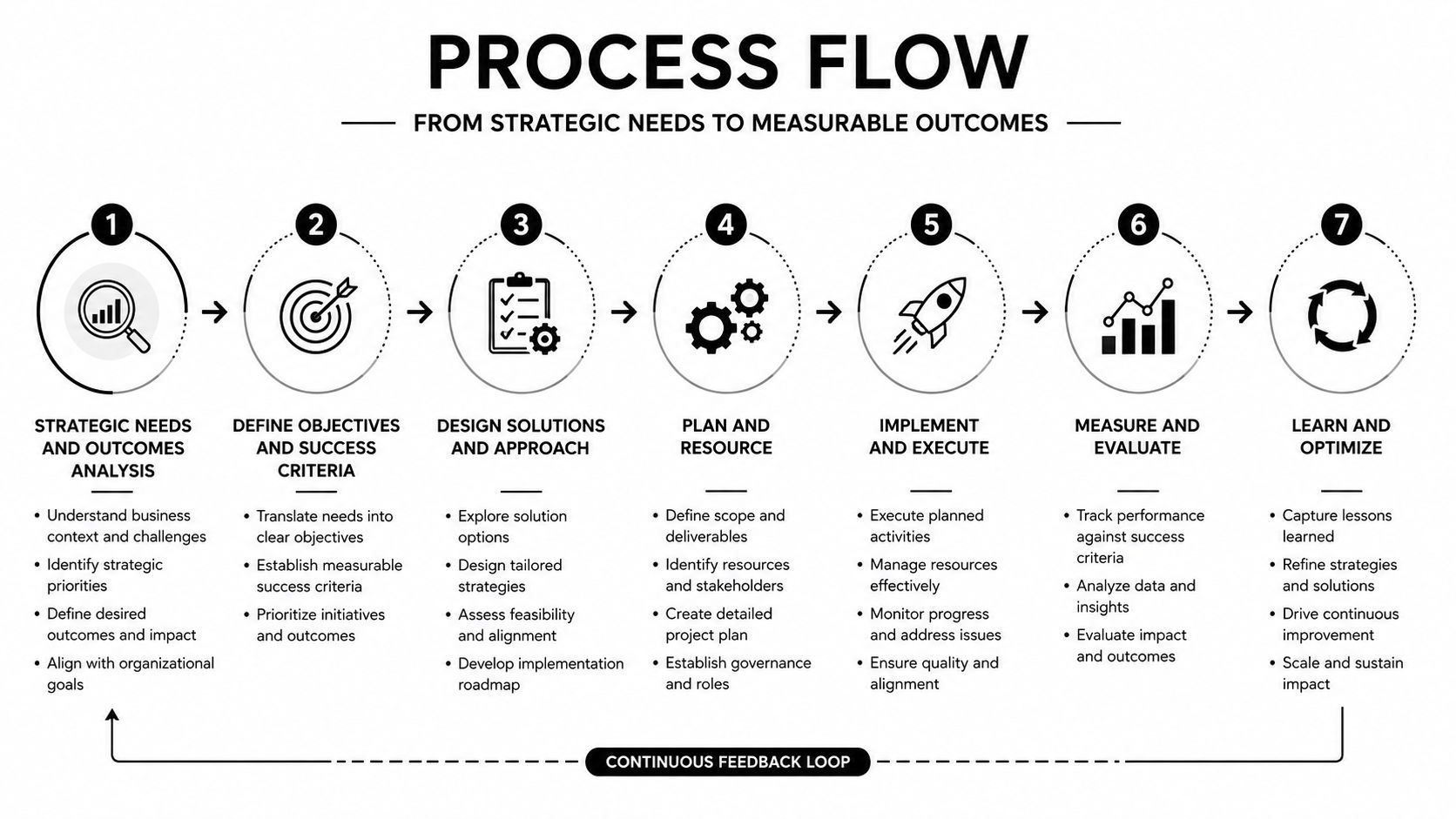
The strongest research-backed design logic starts before any training calendar exists. A high-value approach begins with strategic needs and gaps analysis, then defines desired outcomes, then builds the learning plan around those outcomes [source](https://pmc.ncbi.nlm.nih.gov/articles/PMC11505461/). McKinsey's leadership work also points to four intervention sets that matter in implementation, contextualizing the program to strategy, ensuring organizational reach, linking learning to new settings over time, and using system reinforcement to lock in change [source](https://www.mckinsey.com/~/media/mckinsey/featured%20insights/leadership/whats%20missing%20in%20leadership%20development/whats-missing-in-leadership-development.pdf).
One practical mistake I see often is building a beautiful curriculum before deciding how the organization will support application. If managers are too busy to coach, if the participant never gets a stretch assignment, and if senior leaders never talk about the new behaviors, the program decays fast. If you need to produce learning assets that people will use, the content has to be built for repetition and reinforcement, not just a one-time event.
What good looks like instead
Effective leadership development planning starts with baseline assessment, clear measurable goals, and explicit behavior expectations. It also treats leadership as a system, not a class. That means the work includes what happens before promotion, what happens after promotion, and what happens when the participant returns to the pressure of the day job.
A useful test is simple. Can you describe the behavior you want to see, the setting where it should appear, and the person who will notice it first? If not, the plan is still too abstract.
Starting with Strategic Needs and Outcomes Analysis
A leadership plan built around competencies usually starts in the wrong place. The better starting point is the business need, then the behavior change that should follow, especially in the next operating cycle, not just in a generic framework. That difference matters because the right development target during a sales-led expansion is rarely the same as the right target during a restructuring or a digital transformation.
Begin with the business problem, not the tool
Start by naming the business pressure in plain language. If the organization is expanding into new markets, leaders may need stronger cross-functional coordination and faster decision quality. If succession risk is the concern, the plan should focus on readiness for the next role, not comfort in the current one. If hybrid work has made manager capability uneven, the development plan should target coaching, communication, and visibility across dispersed teams.
That sequence is more reliable than opening with an assessment vendor. Research syntheses on leadership plan design point to aligning the program with organizational strategy, selecting mastery outcomes at multiple levels, and having participants build individualized plans tied to career pathways and business plans. In practice, that means writing the business outcome first and the learning activity second.
A strategic needs analysis works best when it forces trade-offs. You will not build every capability at once. You choose the few that matter most because leadership development loses focus when it tries to solve every problem in the company.
Translate strategy into measurable outcomes
Once the business need is clear, define the outcome at three levels.
That structure keeps the plan from drifting into vague goals like “develop leadership presence.” It also forces HR to explain why a behavior matters in context. A leader who can run better one-on-ones is not being developed for etiquette, they are being developed because stronger manager behavior improves the quality of execution across the team.
Pair this analysis with [strategic workforce planning](https://synopsix.ai/blog/strategic-workforce-planning), because leadership development works better when it is tied to where the organization expects demand, scarcity, and capability gaps to appear.
> Business-first planning is slower at the start, but it saves time later because fewer resources get spent on the wrong cohort, the wrong skills, or the wrong promise.
Selecting Assessments That Predict Leadership Behavior
The assessment market is crowded, and most of it sounds more precise than it is. The right question is not whether an instrument is complex, it's whether it helps you predict leadership behavior and create a usable development plan. If the output can't be translated into action quickly, you're collecting opinion data, not decision data.
Choose for actionability, not jargon
A good assessment should tell you three things clearly. What behaviors are showing up now, where the current risk sits, and which development actions are likely to matter most. Psychometric tools can help with underlying tendencies, while 360 feedback surfaces how others experience the leader. Behavioral simulations are useful when you want to see how someone responds under pressure, and AI-driven platforms can turn assessment output into comparable profiles and practical guidance.
The difference between these options is not subtle. Self-assessment is useful for reflection, but it can miss blind spots. Multi-rater feedback catches patterns others see, but it can become noisy if the organization hasn't defined the behaviors it cares about. Simulation-based tools reveal decision habits, but they need to be tied to business-relevant scenarios or the results stay academic. For a practical comparison of psychometric tools and how they're interpreted, I'd point teams to [psychometric assessment tools](https://synopsix.ai/blog/psychometric-assessment-tools).
The strongest evaluation criteria are simple:
Keep the output readable for managers
Most managers don't need a psychometric lecture. They need a short read on risk, fit, and what to do next. That's where scientifically validated behavioral assessments are helpful, because they can translate profile data into business language instead of leaving HR to decode technical reports.
> Useful standard: if a manager can't explain the assessment result to a direct report in under two minutes, the assessment probably needs simpler reporting.
Synopsix is one example of a people intelligence platform that turns behavioral assessments into comparable profiles, risk indicators, fit recommendations, and role-specific development guidance. It's relevant here because it compresses the distance between assessment and action, which is exactly what constrained HR teams need when they can't afford a long interpretation cycle.
The caution is assessment fatigue. If you ask leaders to complete too many instruments, they stop taking any of them seriously. One well-chosen tool that feeds a specific plan is worth more than a stack of disconnected questionnaires.
Designing Individual Development Plans Using the 70/20/10 Model
The best development plans are short enough to use and specific enough to govern action. That's why the old habit of building a long, narrative document usually fails. Leaders don't need a biography of their own gaps. They need a plan they can revisit after a real meeting, a real project, or a real coaching conversation.
Build around work, relationships, and formal learning
The 70/20/10 model is still useful because it reminds HR teams where growth happens. About 70% comes from on-the-job work such as stretch assignments and projects, 20% from relationships such as mentoring, coaching, networking, and shadowing, and 10% from formal learning such as workshops, reading, or credentials [source](https://www.vantageleadership.com/our-blog/5-best-practices-for-creating-a-leadership-development-plan/).
That doesn't mean formal training is unimportant. It means training should support application, not substitute for it. A new manager might take a short course on feedback, but growth happens when they run the next difficult conversation and receive coaching on what they said, how they said it, and what the other person did next.
A one-page plan works well because it forces discipline. Include the current strength, the target behavior, the stretch assignment, the relationship support, and the review date. If a plan runs longer than that, people usually stop reading it and the document becomes ceremonial.
Match the action to the capability
Different goals need different learning actions. If a leader needs better cross-functional influence, a cross-team project is more useful than another workshop. If the goal is coaching, then structured practice with manager feedback beats passive content. If the goal is judgment under pressure, the leader needs exposure to decisions where the stakes are real, not hypothetical.
For practical exercises and facilitator ideas that can be adapted into working sessions, [United We Transform's tips](https://unitedwetransform.com/exercises/facilitator-tips-practical-ideas-to-improve-your-leadership-skills/) are useful because they stay closer to application than theory. That matters when the calendar is crowded and development time is scarce.
A short list makes the model easier to operationalize:
<iframe width="100%" style="aspect-ratio: 16 / 9;" src="https://www.youtube.com/embed/80lm4REbPCw" frameborder="0" allow="autoplay; encrypted-media" allowfullscreen></iframe>
Discipline is sequencing. Don't front-load the workshop and hope the assignment appears later. Start with the action the leader must take, then choose the support that will help them succeed inside that action.
Building Cohort Programs and Integrating with Talent Processes
Cohorts matter because leadership is social work as much as individual work. A cohort gives participants peer pressure, shared language, and a reason to keep showing up when the job gets busy. The trick is not to build a “leadership class.” The trick is to design a business cohort that solves real work while developing real people.
Use cohorts to create reach and accountability
The most feasible cohort programs for lean HR teams are tied to a current business challenge. That could be improving manager capability in a new operating model, building readiness for a product launch, or preparing successors for a critical function. The cohort then works on real assignments, shares what's working, and learns in the context of a problem the organization already cares about.
McKinsey's four intervention sets become practical. Contextualize the cohort to strategy. Give it enough reach that the organization can notice the impact. Link learning to new settings over time. Use system reinforcement so the new behavior doesn't vanish when the program ends [source](https://www.mckinsey.com/~/media/mckinsey/featured%20insights/leadership/whats%20missing%20in%20leadership%20development/whats-missing-in-leadership-development.pdf).
That matters because many programs die at graduation. Participants go back to old incentives, old habits, and old expectations. If the manager, the sponsor, and the promotion process all ignore the new behaviors, the development effort loses authority.
Connect development to succession, reviews, and promotion
Leadership development planning gets stronger when it's tied to talent decisions. If succession planning identifies a gap, the development plan should address it explicitly. If performance reviews talk about leadership behavior, the development goals should mirror those expectations. If promotion criteria ignore coaching or change leadership, managers will keep promoting for technical excellence alone.
That integration does two things. First, it tells participants the organization is serious. Second, it stops development from becoming a side project that competes with real work.
> Operational truth: A leadership program gets its credibility from what the company rewards, not from what HR publishes.
For teams with a broader talent architecture, this is also the point where leadership development should connect to manager enablement. Hiring managers need to know how to support stretch assignments, how to give developmental feedback, and when to move someone into a more demanding setting. Without that, the best cohort design still depends on individual goodwill.
Measuring What Matters in Leadership Development
A clean dashboard can still miss the point. Completion rates, attendance, and satisfaction are easy to count, but they do not show whether leaders changed how they lead or whether the business felt the difference. The better test is blunt. Did people behave differently, and did that behavior help the organization?
Track behavior change before you chase ROI
Start with a baseline before the program launches. Capture what managers already do in the target behaviors through manager observation, peer feedback, and business metrics the company already tracks. Then measure the same behaviors on a steady cadence after launch so change is visible instead of assumed.
The core question is straightforward: Did people apply the new skill in real work? That is where leadership development proves its value, because leadership is demonstrated in decisions, conflict, coaching, and how teams are managed. For a practical view of how organizations define leadership effectiveness, [what is leadership effectiveness](https://synopsix.ai/blog/what-is-leadership-effectiveness) is a useful companion reference.
Reporting should stay light enough that people will keep doing it. Quarterly reviews usually fit because they line up with business planning and leave enough time for behavior to show up in the work. Report too often and the numbers get noisy. Report too rarely and executives stop paying attention.
Use a simple measurement framework
| Measurement Level | Example Metrics | Data Collection Method | Reporting Cadence | |---|---|---|---| | Individual behavior | Feedback quality, delegation follow-through, coaching consistency | Manager observation, peer input, 360 feedback | Monthly or quarterly | | Team impact | Team clarity, execution reliability, manager effectiveness signals | Team pulse checks, leader check-ins, peer review | Quarterly | | Organizational impact | Succession readiness, promotion readiness, leader turnover, pipeline strength | HRIS data, talent reviews, succession maps | Quarterly and annual |
This framework works because it keeps behavior, team experience, and business outcomes in separate buckets. A leader's actions are not the same as a team's perception, and neither is the same as what the business can see in the pipeline. You do not need a heavy analytics stack to start. You need a baseline, a consistent review cycle, and a shared definition of the behavior you want to improve.
Qualitative evidence matters too. A manager's written example, a sponsor's observation, or a team's before-and-after story can explain the numbers better than a dashboard alone. The goal is not to produce more reporting. It is to make the signal credible enough that leaders trust it and act on it.
Developing Leaders for Future Work Not Just Current Roles
The biggest mistake in leadership development planning is training people for yesterday's role map. High performance in a current role is useful, but it isn't enough to predict future readiness. Many organizations still over-weight technical excellence and under-weight adaptability, coaching ability, and decision quality under uncertainty.
Build for what the role will become
Future-work skills matter because work is changing faster than org charts. Leaders increasingly need to manage ambiguity, influence across functions, and make judgment calls without perfect information. If the organization is reshaping roles through digitization or redesign, then the leadership plan has to prepare people for that reality instead of replaying the current structure.
That starts with looking at succession risk over the next 24 months. Retirement and attrition analysis can show where the pipeline may break, and then development choices can be matched to those risk points. A leader who might move into a broader role soon needs different preparation than someone who just needs to strengthen current performance.
If your audience is external-facing or advisory-led, [B2B newsletters for consultancies](https://newsletterasaservice.com/consulting-firms) can be useful for tracking how market messaging and client expectations are changing, which often shapes the kind of leadership judgment teams need in the field.
The contrarian takeaway is simple. Don't promote people only because they are excellent in a narrow specialty. Build plans that test whether they can lead through uncertainty, connect across silos, and coach others into stronger performance. That's the pipeline that holds up when the org chart changes.
---
Synopsix helps HR teams turn behavioral assessment data into practical development guidance, so leadership plans can move from opinion to action faster. If you're building leadership development planning that has to work with limited time, tighter budgets, and higher expectations for future-ready leaders, visit [Synopsix](https://synopsix.ai) to see how it supports that process.