Leadership in Sales: Building Winning Teams
By Synopsix · August 8, 2026 · 12 min read
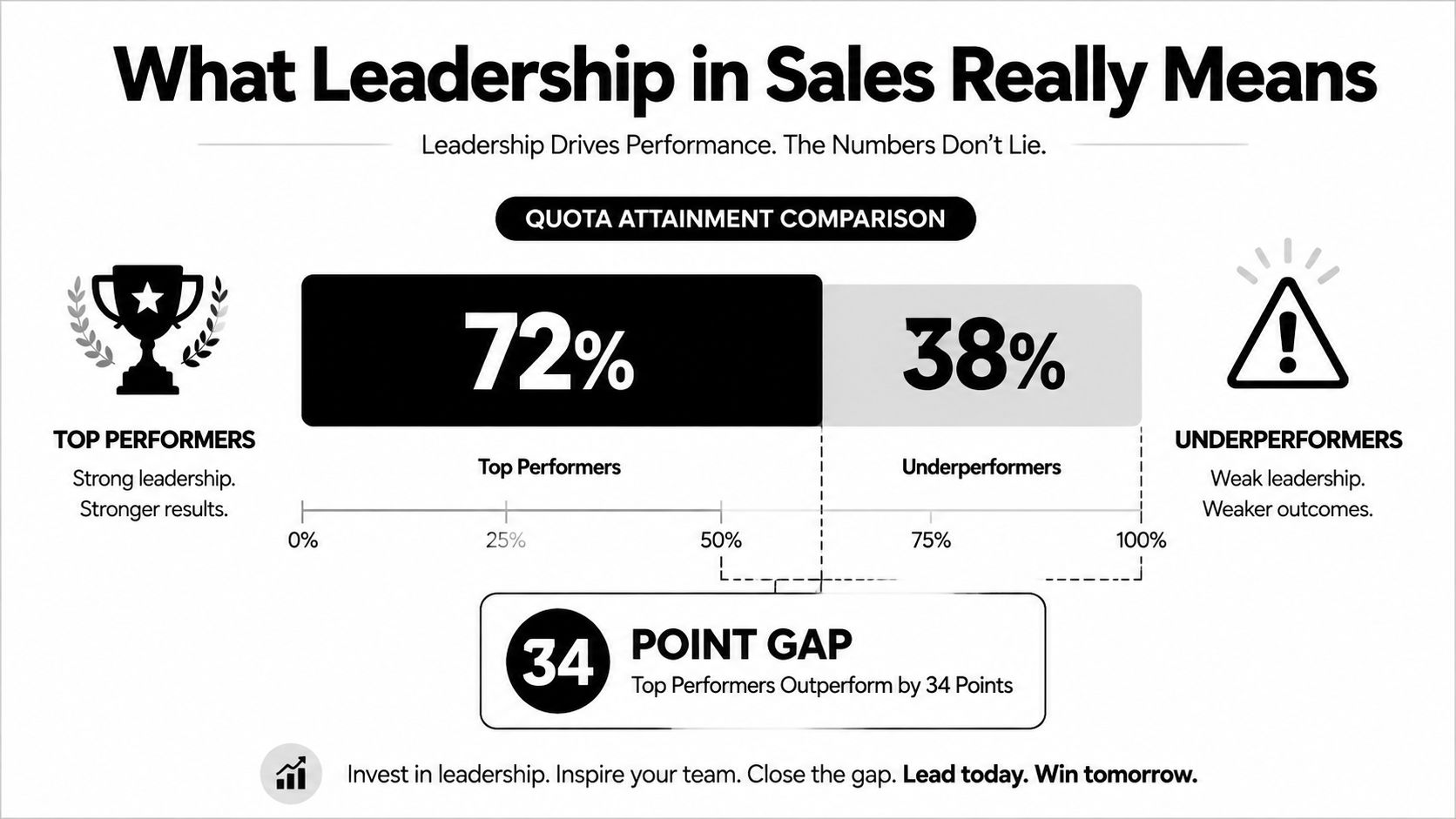
Leadership in Sales is not a personality contest. The clearest benchmark says high-performing sales managers delivered 105% average annual quota attainment versus 54% for underperformers, which is a leadership gap you can measure in revenue, not adjectives. The best leaders don't just “motivate” people, they build an operating system that shapes cadence, information flow, and decision quality every day. That is why the question is less about who sounds inspiring and more about who can create conditions for consistent overperformance.
What Leadership in Sales Really Means
The metric that changes the conversation
A sales leader's credibility is measured by how the team executes against quota. The clearest benchmark here is the gap between 105% versus 54% attainment, because it shows leadership quality in revenue terms, not in impressions or slogans. The same research found top managers scoring 19% higher in self-discipline, 20% higher in being success-driven, and 27% higher in priority focus, which points to behavior you can observe, coach, and assess (Leveleleven research summary).
Good sales leadership works like an operating system. It sets the cadence, decides what information gets surfaced, and turns market signals into actions the team can use. That includes how pipeline reviews run, how coaching time gets allocated, and how quickly the team reacts when the forecast starts to drift.
Operating system over inspiration
Motivation fades fast when the workflow is inconsistent. I have seen managers give a strong speech and still run an uneven org because no one defined what good looks like in the review cadence, the coaching rhythm, or the standards for trade-offs. The stronger model is practical, leaders design the system, then people operate inside it.
> Practical rule: if a leader cannot point to the exact meetings, metrics, and decision points that shape rep behavior, they are managing by personality instead of leadership.
That also changes how managers should be evaluated. Ask whether the team understands priorities, whether forecasting is stable, and whether execution is easier for the reps doing the work. A stronger assessment goes beyond instinct, which is where a [sales competency assessment](https://synopsix.ai/blog/sales-competency-assessment) helps compare leaders against the behaviors their role requires. For a broader view of how teams surface and use market signals, you can [find sales intelligence insights](https://www.yalc.ai/blog/what-is-sales-intelligence/). Sales leadership is measured by the quality of the operating environment it creates.
Core Competencies That Separate Top Sales Leaders
What the best managers do differently
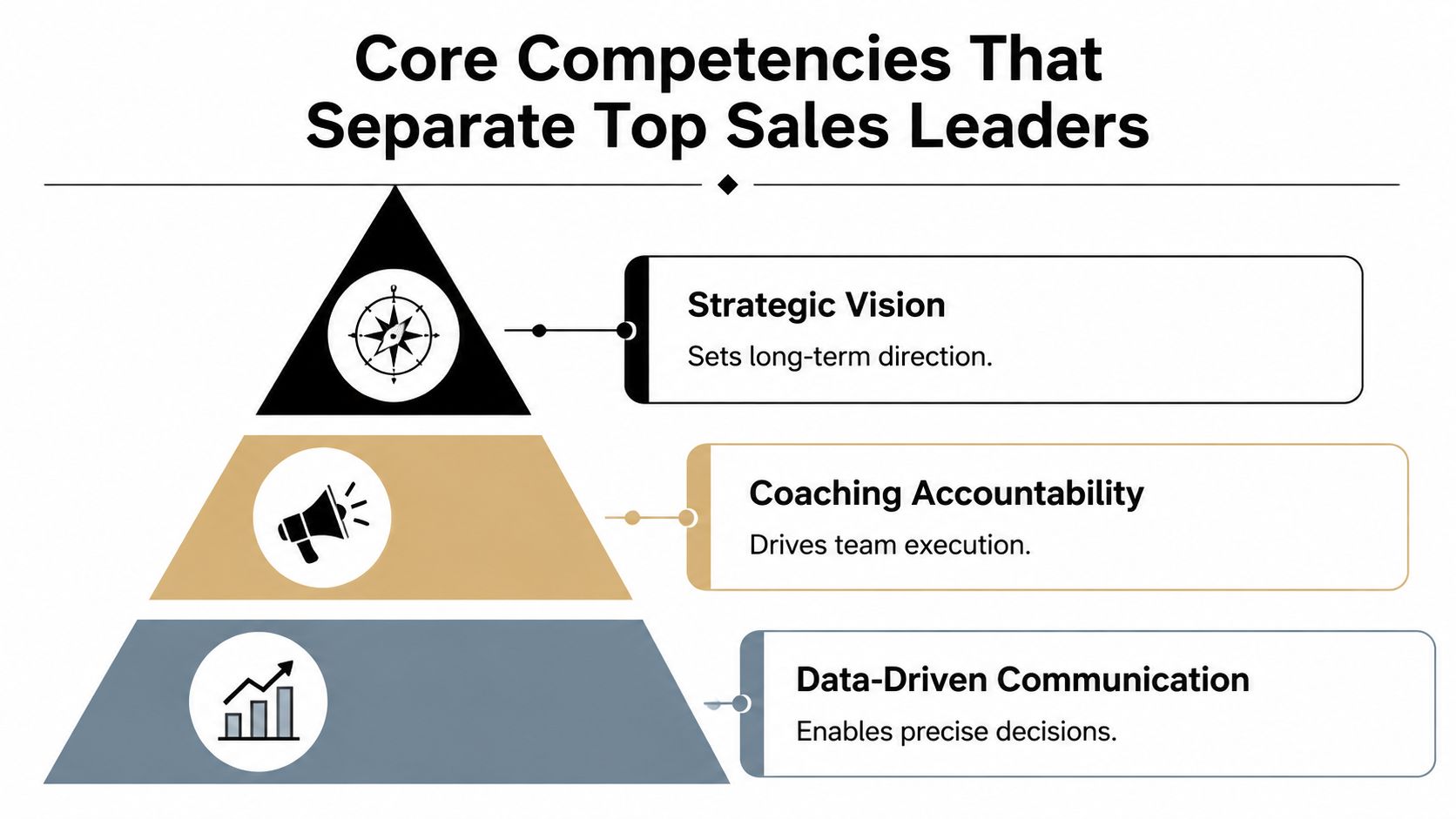
Strong sales leadership shows up in observable behavior. Top managers scored 19% higher in self-discipline, 20% higher in being success-driven, and 27% higher in priority focus than lower-performing peers. Those differences show up in the way they run the team, with tighter follow-through, better use of coaching time, and clearer trade-off decisions when the quarter gets messy.
That is why a competency model for sales leaders should start with behavior. Self-discipline looks like consistent pipeline inspection and follow-through. Success-drive shows up in the willingness to coach against weak spots instead of protecting comfort. Priority focus is visible when a manager knows which deals, reps, and motions deserve attention this week, not just this quarter.
A structured lens helps hiring and promotion
Harvard Business Review's 7-attribute framework is useful because it breaks strong sales leadership into observable dimensions instead of one fuzzy trait bucket ([HBR](https://hbr.org/2015/09/the-7-attributes-of-the-most-effective-sales-leaders)). That matters in hiring, succession planning, and performance reviews because you can compare candidates against a model instead of a feeling.
A sales organization that wants cleaner decisions can pair that framework with behavioral assessment and role-specific evidence. The internal guide on [sales competency assessment](https://synopsix.ai/blog/sales-competency-assessment) fits naturally alongside a scorecard built around actual manager decisions, rep outcomes, and coaching habits.
The same logic applies to how teams use market signals. A manager who can [find sales intelligence insights](https://www.yalc.ai/blog/what-is-sales-intelligence/) is usually better at turning scattered information into coaching priorities, forecast calls, and account focus.
> Top managers do not just know what matters, they make the team's attention map visible.
That is the difference between a manager who sounds strong and one who drives repeatable execution. The first can win a room. The second can build a bench.
Designing the Metrics Rhythm Leaders Use
Weekly, monthly, and quarterly have different jobs
Sales leaders lose discipline when every review happens at the same altitude. Weekly meetings should stay on controllable activity, calls, meetings, and email response. Monthly reviews should move into pipeline velocity and win rate. Quarterly reviews should pull back to strategic effects like deal-size trends and coaching outcomes, which is where you can see whether the operating system is working ([Allego](https://www.allego.com/blog/improve-sales-performance-metrics/)).
That layered cadence matters because activity alone does not explain conversion. A rep can be busy and still fail to move deals forward. A team can post strong meeting volume and still miss targets if discovery is weak or opportunity qualification is inconsistent.
Deal-level data makes coaching real
The strongest leaders do not stop at dashboard totals. They instrument deal-level data, including meetings opened, value language used, critical business problems identified, proof points used, and how those variables affect conversion ratio ([Force Management](https://www.forcemanagement.com/blog/how-leaders-leverage-data-to-boost-sales-performance-and-revenue)). That turns coaching into evidence-based work. Instead of telling a rep to “do better discovery,” the leader can point to where discovery broke down and what language correlated with stronger movement.
A useful rhythm looks like this:
The point is to create a cause-and-effect loop from behavior to revenue. If you wait until quota misses appear, you are already late. If you set the rhythm before problems show up, you can diagnose issues while they are still fixable. For a practical reference on building cleaner metric definitions, see the [Voicedial.ai sales KPIs guide](https://voicedial.ai/sales-kpi-examples/) and our guide on [improving sales team performance](https://synopsix.ai/blog/how-to-improve-sales-team-performance).
<iframe width="100%" style="aspect-ratio: 16 / 9;" src="https://www.youtube.com/embed/V3KlbC0Mx2Y" frameborder="0" allow="autoplay; encrypted-media" allowfullscreen></iframe>
How Sales Leadership Connects to Business Results
Sales leadership shows up in revenue through a few concrete mechanisms, and the clearest evidence is tied to coaching, target attainment, and growth. Effective sales leaders are associated with 27% higher revenue growth, and strong sales leadership structures have a 50% higher chance of meeting sales targets ([PK Solutions Group](https://pksolutionsgroup.com/2024/09/what-happens-next-comes-down-to-sales-leadership/), Niche Capital Co). In the same body of findings, high-performing leadership teams spend 20% more time coaching, and that coaching time is linked to an average 17% increase in sales performance.
The churn problem makes leadership more valuable
Sales remains hard to stabilize. Annual turnover is estimated at 35% in sales, compared with 13% across other professions, and the average tenure of a sales leader is about 18 months ([Niche Capital Co](https://nichecapitalco.com/53-essential-sales-leadership-statistics-for-2022/)). That makes leadership a pressure role, not a ceremonial one. Bad habits recycle quickly, while good habits only stick if the manager keeps reinforcing them through a steady operating cadence.
| Outcome | Impact | Source | |---|---:|---| | Revenue growth | 27% higher with effective sales leaders | [PK Solutions Group](https://pksolutionsgroup.com/2024/09/what-happens-next-comes-down-to-sales-leadership/) | | Target attainment | 50% higher chance of meeting sales targets with strong leadership structure | [Niche Capital Co](https://nichecapitalco.com/53-essential-sales-leadership-statistics-for-2022/) | | Coaching time | 20% more time coaching among high-performing leadership teams | [PK Solutions Group](https://pksolutionsgroup.com/2024/09/what-happens-next-comes-down-to-sales-leadership/) | | Sales performance | 17% increase linked to that coaching time | [PK Solutions Group](https://pksolutionsgroup.com/2024/09/what-happens-next-comes-down-to-sales-leadership/) |
Leadership protects revenue and talent
That churn profile changes how leadership should be budgeted and measured. The role is not just about morale or manager coverage. It protects revenue continuity, steadies execution, and reduces the drag that shows up every time a team loses a manager or a new one has to rebuild habits from scratch. A practical adjacent resource on team ramping and enablement is [shorten ramp time with enablement](https://www.thesocialsearchsg.com/insights/what-is-sales-enablement), because onboarding speed and leadership quality usually move together.
The right conclusion is simple. Sales leadership is a revenue mechanism, and the leader's job is to keep the system producing under pressure. If leaders do not set the rhythm, targets become harder to trust and harder to hit.
Evidence-Based Assessment and Team Design
Sales organizations make expensive people decisions with too much intuition. Interviews catch confidence and communication style, but they often miss how someone will behave under quota pressure, team conflict, or forecast stress. That's why scientifically validated behavioral assessments and predictive simulations belong in leadership decisions, especially for hiring, promotion, and succession planning.
A practical workflow for people decisions
A stronger workflow starts with assessment, not with a resume. Candidates and employees can be assessed in under 30 minutes, then converted into comparable behavioral profiles, then translated into business-language intelligence reports with risk indicators and fit recommendations. From there, leaders can act through simulations, compatibility analysis, and development plans instead of arguing from instinct.
A clean sequence looks like this:
1. Assess role fit early. Use psychometrics to compare actual behavior against the demands of a sales leadership role. 2. Generate comparable profiles. Put candidates, incumbents, and internal promotions into the same behavioral frame. 3. Translate findings into business language. The decision-maker should see risks, strengths, and fit recommendations without decoding technical jargon. 4. Test with simulations and compatibility analysis. This surfaces friction before a promotion or team assignment is finalized.
Predictive simulations matter because they expose tension before it becomes turnover or missed targets. Compatibility mapping matters because leadership teams are rarely homogeneous, and complementarity often beats similarity. A tool like Synopsix fits this workflow by turning assessments into operational guidance, though the bigger point is the method, not the platform name.
Team design should show where friction will appear
Visual team mapping, like Human Interlink-style views, helps leaders see where capability overlaps, where judgment gaps exist, and where a team may be too aligned in one dimension and too weak in another. That becomes especially useful when you're deciding who should manage a new segment, who should be promoted, or where coaching investment will matter most.
> Best use case: don't wait for a promotion to reveal a mismatch. Surface the mismatch while the decision is still reversible.
For a deeper look at candidate evaluation, the guide on [sales candidate assessment](https://synopsix.ai/blog/sales-candidate-assessment) is a useful companion. The practical upside of this approach is fewer mis-hires, faster decisions, and a leadership pipeline built around fit instead of hope.
Why Traditional Leadership Traits Fall Short in AI-Era Selling
A lot of sales leadership content still celebrates the same familiar virtues, coaching, communication, and leading by example. Those traits still matter, but they're not enough when buyers are more informed, digital motion is dominant, and reps are competing in workflows shaped by AI. Gartner projected that by 2025, 80% of B2B sales interactions between suppliers and buyers would occur in digital channels, which shifts the whole leadership job toward diagnosis and adaptation.
The leader is now a strategy-execution designer
When buyers arrive better prepared, managers can't rely on motivation to close the gap. They need to help reps interpret buyer context, use better judgment, and coordinate with marketing, product, and customer success more deliberately. That's why the strongest modern leaders look less like cheerleaders and more like operating-system designers who shape information flow and decision cadence.
This also explains why sales has become an underrated training ground for executives. The role builds ownership, cross-functional influence, strategic thinking, and team building, all of which matter outside the revenue function too. The leadership skill set is broadening, not shrinking.
AI changes what good leadership rewards
AI-assisted workflows don't remove the need for leadership, they raise the standard for it. Reps can access more information faster, buyers can self-educate, and generic pitches get ignored sooner. In that environment, the winning manager is the one who improves diagnosis, reinforces judgment, and makes the team more adaptable than the next competitor's team.
LinkedIn's recent leadership commentary on sales teams points in the same direction, with an emphasis on deeper prospect research, timing outreach to market events, and using real buyer context rather than generic pitches ([LinkedIn sales leadership commentary](https://www.linkedin.com/top-content/leadership/leadership-in-sales-teams/underrated-sales-leadership-strategies/)). The leaders who fall behind will be the ones treating AI as a productivity add-on instead of a leadership redesign issue. The leaders who stay ahead will redesign how people decide, not just how fast they work.
A Practical Implementation Framework
Good intentions don't change people decisions. Systems do. For hiring, promotion, and development, the cleanest approach is to replace résumé-first and interview-only judgments with a three-part model built on behavioral evidence, simulation, and role-specific coaching.
Hiring, promotion, and development each need a different filter
For hiring, start with assessment-based behavioral profiles and structured interviews, then compare candidates against the actual demands of the sales leadership role. For promotion, run predictive simulations and compatibility analysis before someone is promoted into management, because good rep behavior doesn't automatically transfer into leader behavior. For development, give managers intelligence reports tied to the competency benchmarks already established, then coach against the specific gaps that show up in those reports.
The decision rhythm can be simple:
A 90-day setup for a stronger bench
A practical rollout starts by defining the role profile, then running baseline assessments across current and future leaders. After that, pilot simulations for promotion decisions and measure how fast decisions move, how many mis-hires or mis-promotions you avoid, and whether the leadership bench becomes more predictable over time. That gives HR and revenue leaders a common language for people decisions.
If your organization wants to build the kind of leadership system described here, Synopsix turns scientifically validated assessments into business-ready reports, compatibility views, and simulation-based decision support. Visit [Synopsix](https://synopsix.ai) to see how evidence-based people intelligence can help you hire, promote, and develop sales leaders with more confidence.