Leadership Readiness Assessment: A Practical Guide
By Synopsix · August 28, 2026 · 16 min read
Most organizations overestimate their leadership bench strength. A leadership readiness assessment is the structured, multi-method way to replace that optimism with evidence before promotion, hiring, or succession decisions.
The urgency is clear. Only 13% of HR leaders say their organization's leaders are very capable of anticipating and reacting to change, and only 18% of leaders feel very prepared to lead through change, according to [People Matters' summary of 2026 DDI research](https://sea.peoplemattersglobal.com/news/leadership/only-13percent-of-leaders-are-prepared-to-lead-change-hr-leaders-warn-of-a-widening-gap-48196). A separate summary reports that just 8% of executives demonstrate the ability to lead change effectively, leaving 92% unprepared for transformational demands, as covered by HR Executive.
That gap changes the CHRO's question. You're not trying to identify people who look like leaders in a stable environment. You're deciding who can deliver in a defined role when priorities shift, information is incomplete, stakeholders disagree, and the business can't afford a slow learning curve.
What a Leadership Readiness Assessment Actually Is
A leadership readiness assessment is a structured, multi-method judgment of whether a specific candidate can succeed in a specific leadership role under the conditions that role will create. It combines observed behavior, structured evidence, stakeholder input, and carefully selected psychometrics to produce a decision about readiness.
It isn't a personality test with a leadership label attached. It isn't a 9-box placement based on manager opinion. It isn't generic executive coaching repackaged as measurement. Those tools can contribute useful information, but none should stand alone as the verdict.
The output should answer a practical question: Can this person perform the critical leadership behaviors required at this level, in this operating environment, now or after defined development?
Four decisions the assessment must support
A useful program should solve four business problems:
That last point matters. A readiness score that sits in a dashboard without changing a people decision is measurement theater.
For organizations also evaluating workforce capability during technology change, an [AI readiness assessment](https://kagool.com/ai-readiness-assessment-for-business/) offers a useful adjacent lens. It reinforces the same principle: readiness must examine whether people can perform under real operating demands, not merely whether they possess an attractive abstract profile.
The right output is a role-linked verdict, not a permanent label stuck on a person. Someone can be ready for one leadership role and unsuitable for another because the roles demand different judgment, influence, pace, and tolerance for ambiguity.
A Short History of How Readiness Testing Became a Business Tool
Leadership readiness assessment began with observed performance, not self-description. The modern assessment-center tradition started in Germany in 1929 for military officer selection, then moved into business and public-sector settings as a multi-method approach to evaluating leadership potential, according to this [history of assessment centers](https://kcpltd.com/ACT%20FACTSHEET%202%20-%20HISTORY%20OF%20ASSESSMENT%20CENTRES.pdf).
Its core idea still holds: place a candidate in a demanding situation and observe the choices that follow. Multiple assessors can examine how the person handles competing priorities, communicates under pressure, and makes decisions with incomplete information. That evidence gives promotion and succession panels more value than asking whether a candidate considers themselves decisive or collaborative.
The method entered commercial use as organizations sought stronger ways to select managers. DDI's founding in 1970 marked a major step in bringing assessment-center methodology into business. Its stated purpose was to observe, evaluate, and predict leader behavior. Later products included Manager Ready, launched in 2011, which assessed frontline leaders in realistic situations. These milestones are documented in the assessment-center history reference.
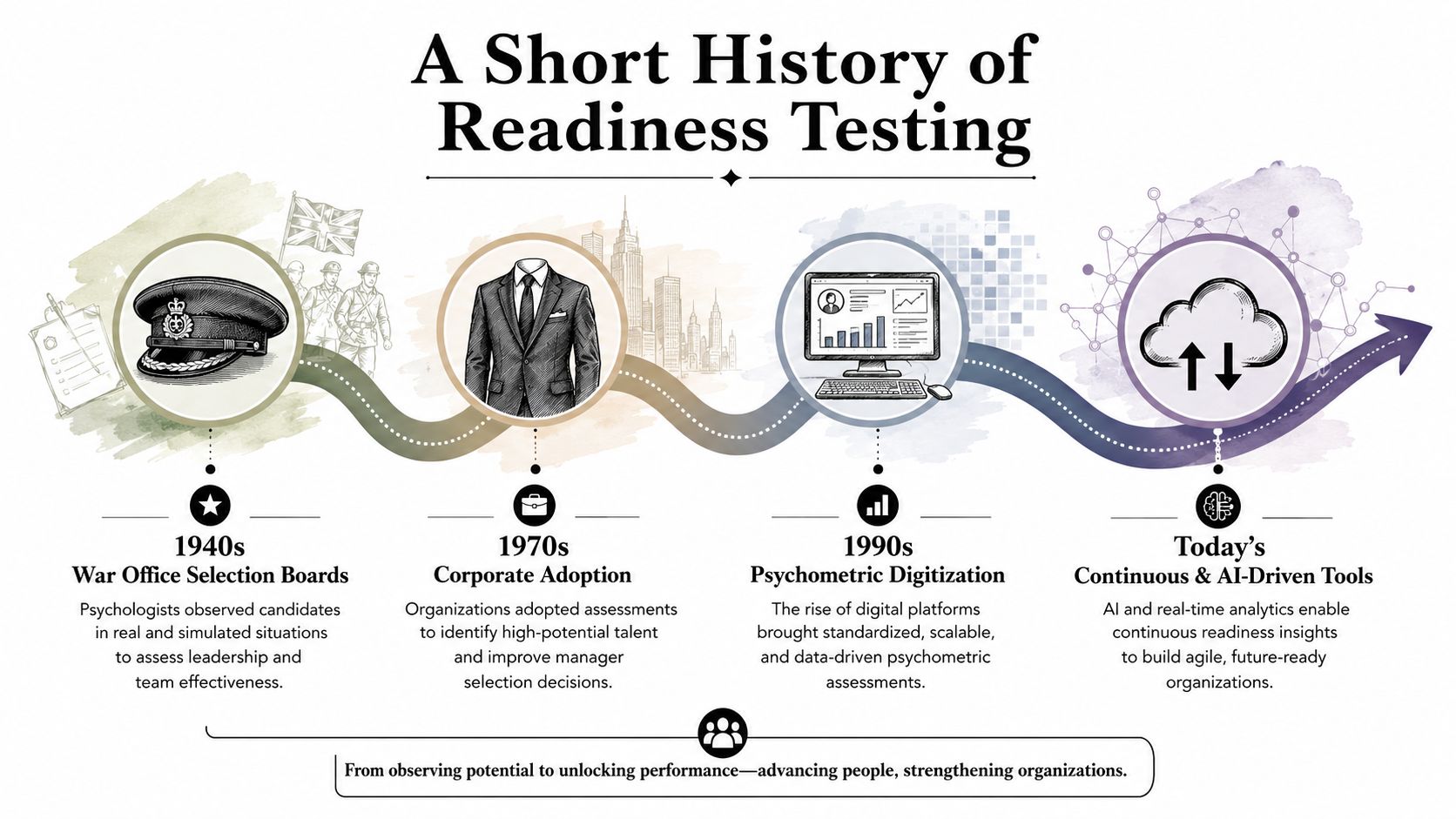
The business lesson matters more than the chronology. Readiness testing became useful when it shifted from generic traits to structured evidence gathered through multiple methods, assessors, and scenarios. For this quarter's talent decisions, use that evidence to issue a role-specific, volatility-tested verdict. Then connect the verdict directly to promotion gates, successor slates, and development actions. A candidate's readiness should reflect the demands of the target role and the conditions in which they must perform, not a permanent score attached to the person.
The Core Components Every Modern Assessment Combines
A defensible assessment starts with the role, not the vendor catalogue. Build the evaluation around the behaviors and outcomes that distinguish success in the target position, then select methods that expose those requirements from different angles.
| Component | What it measures | Why it matters | |---|---|---| | Competency framework | Role-specific behaviors and outcomes | Anchors every instrument to the job | | Structured behavioral measures | Past behavior, judgment, and communication | Replaces informal impressions with scored evidence | | Simulations | Observable behavior under pressure and ambiguity | Shows how candidates act rather than how they describe themselves | | 360-degree feedback and stakeholder input | Reputation, influence, and follow-through | Captures patterns candidates can't fully self-report | | Psychometrics | Cognitive ability, personality, and judgment indicators | Adds risk information and supports a broader decision |
Start with the competency map
A competency framework should describe what the leader must do, not what leadership sounds like. For a transformation role, that may include making decisions with partial information, communicating trade-offs, and maintaining execution discipline while priorities change. For a stable operational role, reliability, process control, and coaching consistency may carry more weight.
Structured interviews then test those competencies with consistent questions and scoring rubrics. Interviewers should record behavioral evidence, not summarize whether they “liked” the candidate.
Observe behavior directly
Simulations are the center of gravity. An in-basket exercise can reveal prioritization. A role-play can surface conflict management and listening. A group problem-solving task can show how someone creates alignment without formal control. A presentation can expose whether the candidate turns complexity into a decision people can act on.
The value of assessment-center recommendations isn't theoretical. A [meta-analysis of individual assessment centers](https://pubmed.ncbi.nlm.nih.gov/24865578/) found that assessor recommendations were useful predictors of job performance, with validity higher for managerial roles and higher when a cognitive ability test was included.
Use psychometrics as context, not destiny
Personality and cognitive measures add signal, but they shouldn't become the headline score. Research has linked Extraversion and Openness with leadership, while another review concluded that leadership-related personality should be measured at the facet level, rather than only through broad traits. Those findings come from [personality and leadership research](https://home.ubalt.edu/tmitch/642/articles%20syllabus/judge%20bono%20llies%20gerhardt%20pers%20and%20ldrship%202002.pdf) and a [review of leadership-selection research](https://apps.dtic.mil/sti/tr/pdf/ADA308094.pdf).
The strongest design accepts that every method has blind spots. Structured interviews can miss execution. Simulations can be affected by unfamiliarity with the format. 360 feedback can reflect reputation more than future capability. Psychometrics can identify tendencies without proving performance.
> Practical rule: Never let one instrument overrule a pattern that appears across several independent sources of evidence.
Multi-method design also has a strong selection-science foundation. A landmark review of selection methods.doc) reported estimated validity of .51 for general mental ability, .65 when combined with an integrity test, and .63 when combined with a structured interview for predicting job performance. The implication for leadership decisions is clear: combinations are more defensible than isolated scores.
Generic Potential Versus Role-Specific Readiness
Generic potential asks whether someone appears to possess broad leadership qualities, such as strategic thinking, learning agility, confidence, or executive presence. Role-specific readiness asks a harder question: Can this person handle the actual demands of the next role in the environment we're entering?
The generic approach is attractive because it's cheaper to administer and easier to explain. One framework can be applied across functions, and a single score makes talent reviews feel orderly. But that convenience creates false confidence. A person may score well on abstract leadership traits and still struggle to lead a restructuring, integrate an acquisition, manage a technical team, or make unpopular trade-offs during a downturn.
Role-specific readiness loads the assessment with the role's complexity and volatility. That means simulations based on current business threats, scenario prompts involving real stakeholder tensions, and behavioral benchmarks calibrated to the level of accountability. It may also include job shadowing or work samples that reveal how the candidate handles the pace and ambiguity of the target position.
| Dimension | Generic Potential | Role-Specific Readiness | |---|---|---| | Primary question | Does this person resemble a leader? | Can this person succeed in this role? | | Evidence | Broad traits and career history | Observed behavior in relevant scenarios | | Context | Often stable or abstract | Explicitly tied to volatility and business conditions | | Output | Potential label or talent-review score | Readiness verdict and development requirements | | Decision use | Broad pipeline discussion | Promotion, succession, or hiring action |
The evidence supports making context central. The [2026 Global Leadership Study](https://www.harvardbusiness.org/wp-content/uploads/2026/06/CRE7722_ENT_2026-LDS_Research-Findings.pdf) identifies functioning effectively amid ongoing change, uncertainty, and stress as the top leadership capability. That finding shifts assessment design away from “high potential” as a general identity and toward future-role performance under pressure.
Before buying a platform, decide which verdict you need. If the business question is merely who appears promising, generic potential may be sufficient. If the question is who should receive a promotion, inherit a critical team, or enter a succession slate, use a role-specific design. [Synopsix's guidance on assessing leadership potential](https://synopsix.ai/blog/how-to-assess-leadership-potential) is useful for separating broad potential signals from evidence needed for an actual leadership decision.
Designing and Validating an Assessment You Can Defend
A leadership readiness assessment becomes defensible through disciplined design. Don't start by selecting a test and then searching for a business justification. Start with the job and build backward.
Five design decisions
First, conduct job analysis and competency mapping. Interview role holders, high-performing leaders, managers, and key stakeholders. Identify the behaviors tied to outcomes in the specific role family. A generic leadership library can provide language, but it shouldn't determine the final model.
Second, select instruments that match the competencies. Use simulations for observable judgment, structured interviews for behavioral evidence, 360 feedback for stakeholder patterns, and psychometrics for cognitive, personality, or judgment indicators. Demand evidence of predictive validity and reliability rather than accepting vendor marketing language. [Assessment validity and reliability](https://synopsix.ai/blog/assessment-validity-and-reliability) should be treated as a procurement requirement, not a technical footnote.
Third, set cut-scores against meaningful benchmarks. A pass mark shouldn't exist because a consultant chose a convenient threshold. Tie readiness bands to demonstrated behavior, role outcomes, and the amount of development the organization can realistically provide.
Fourth, pilot the design. Run the assessment with a pilot group large enough to test feasibility, completion time, rater calibration, candidate experience, and the clarity of the reports. A pilot is where you find out that a simulation tests stamina rather than strategic judgment, or that two competencies are so overlapping that raters can't distinguish them.
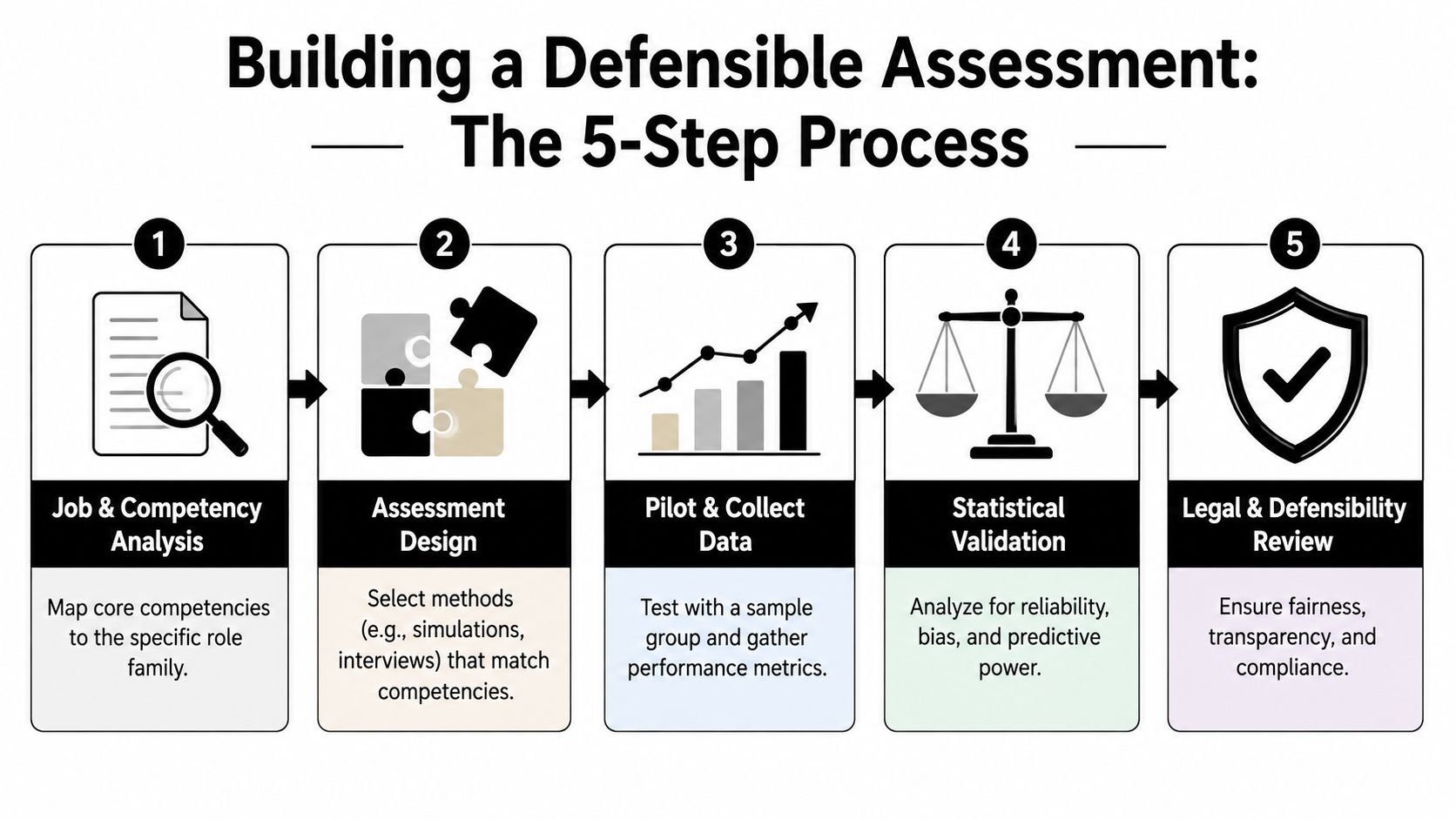
Fifth, complete adverse-impact analysis and documentation. Review outcomes across relevant demographic groups, document the assessment logic, record rater training, and create a validation report. Re-validation should occur on a defined calendar and after major changes to strategy, role scope, or operating conditions.
A program that can't explain why each method exists won't survive executive scrutiny. A program that can't show fairness review creates avoidable legal and reputational exposure.
<iframe width="100%" style="aspect-ratio: 16 / 9;" src="https://www.youtube.com/embed/vr4cnQNEnig" frameborder="0" allow="autoplay; encrypted-media" allowfullscreen></iframe>
The standard is not statistical perfection. The standard is a transparent chain from job requirements to assessment evidence to decision rule. Candidates should understand what is being assessed, decision-makers should understand how scores were produced, and the organization should know when the model needs updating.
Wiring the Output Into Succession, Promotion, and Hiring
Assessment data creates value only when it changes a workforce decision. Establish the decision rules before candidates complete the process, otherwise senior stakeholders will reinterpret results to preserve their preferred choices.
A practical readiness architecture uses three verdicts:
The verdict should flow into existing systems. Map it to the 9-box grid without allowing the grid to replace the evidence. Add it to succession-pool depth charts so executives can see where coverage depends on one person. Use the same role profile in external hiring shortlists, so internal candidates aren't held to one standard while applicants are judged through unstructured interviews.
A promotion gate in practice
Suppose a business needs a leader for a function facing rapid change. An internal candidate may have strong results in the current role but weak simulation evidence in stakeholder alignment and decision-making under uncertainty. The correct action isn't an automatic promotion or an automatic rejection. It's a documented verdict that specifies whether the gap is developable within the required horizon and who owns the development plan.
Every readiness verdict should trigger a documented people decision within thirty days. That decision must name the action, owner, timing, and evidence required to revisit the verdict.
Before building the pipeline, leaders should [identify business-critical roles](https://www.turnonwork.com/tag/succession-planning-framework/) and define which vacancies would create unacceptable execution risk. Then connect assessment outcomes to the [succession planning process](https://synopsix.ai/blog/succession-planning-process), rather than storing them in a separate talent program.
An assessment that doesn't change a promotion, succession, or hiring decision is wasted budget.
Common Pitfalls That Undermine the Whole Program
Readiness programs usually fail through operating choices, not because assessment science is unusable. The first mistake is treating assessment as a one-off event. A reorganization, strategy shift, or new operating model can make an old verdict irrelevant.
Corrective move: Establish cadence reviews and revalidate the role profile when the work changes. Keep the assessment current enough to reflect the conditions leaders must handle now.
The second mistake is running only a personality inventory and calling the result readiness. Personality can provide useful risk indicators, and research supports links between specific traits and leadership. It still can't demonstrate whether someone can execute a role-specific decision process under pressure.
Corrective move: Enforce multi-method design. Pair psychometrics with structured interviews, simulations, and stakeholder evidence.
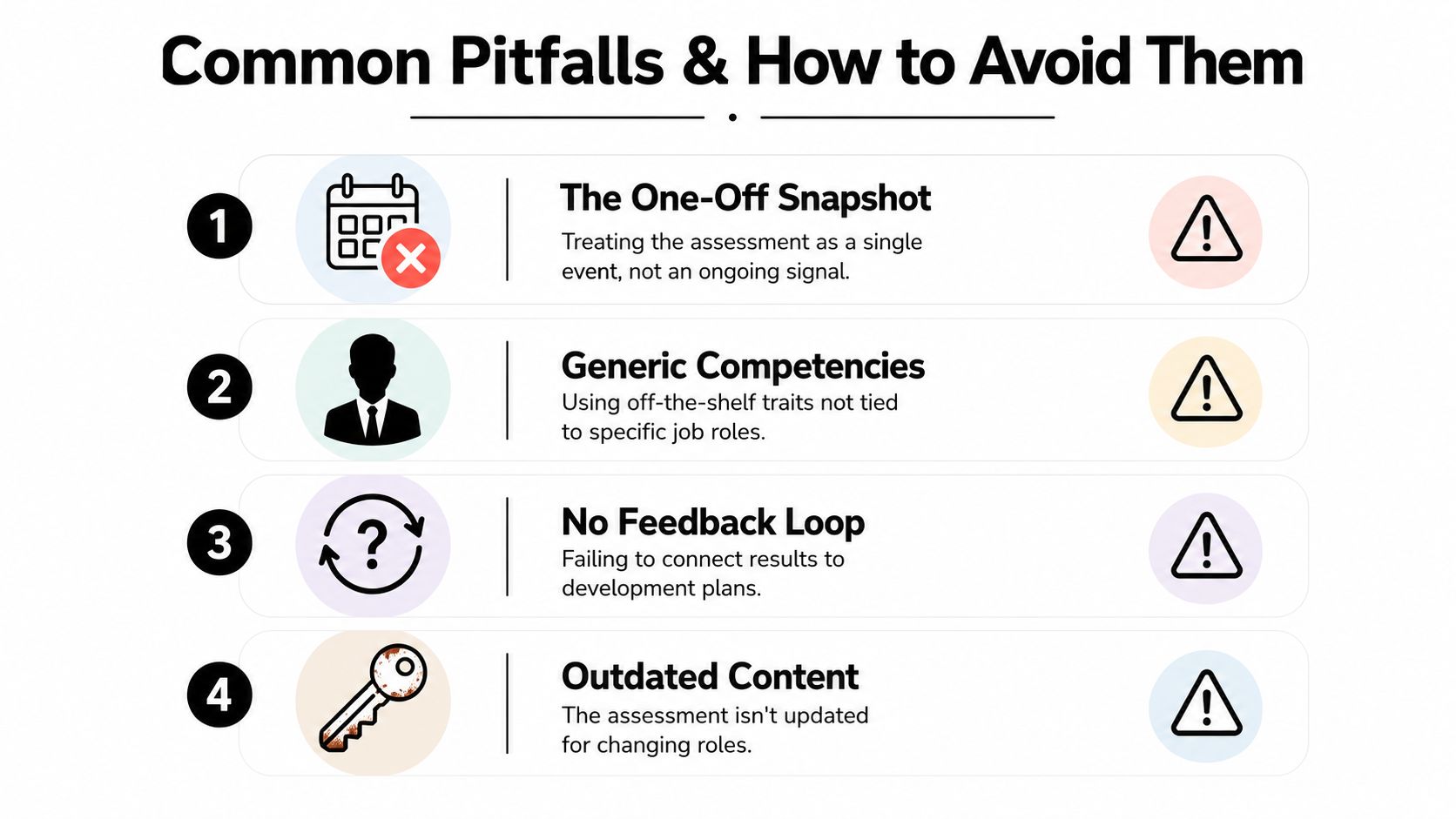
Five failure patterns to eliminate
The corrective principle is simple: readiness is a living operating signal. Refresh it, challenge it, act on it, and give candidates a credible route to improve.
A 90-Day Rollout Plan and the KPIs That Prove It Works
A quarter is enough to establish a functioning first version if the team limits scope. Start with a small set of leadership roles where promotion and succession decisions are already active. Don't attempt to assess every role before proving that the workflow changes decisions.
Days 1 to 30
Define the target roles, map competencies, choose the assessment methods, and appoint executive sponsors. Agree on readiness definitions, decision rights, privacy rules, and the process for challenging a result.
Days 31 to 60
Run the pilot with two cohorts, conduct simulations, calibrate raters, review candidate experience, and finalize cut-scores against relevant business outcomes. Use this period to remove redundant exercises and fix reports that managers can't interpret.
Days 61 to 90
Integrate scores into succession software and applicant tracking workflows. Train hiring panels, launch dashboards, communicate the policy, and require every completed assessment to produce a decision record.
| Phase | Key Actions | KPIs / Success Measures | |---|---|---| | Days 1 to 30 | Define roles, competencies, methods, sponsors, and decision rules | Role coverage, sponsor alignment, assessment design approval | | Days 31 to 60 | Pilot cohorts, run simulations, calibrate raters, set cut-scores | Completion rate, rater consistency, candidate experience, adverse-impact ratio | | Days 61 to 90 | Integrate workflows, train panels, launch dashboards, communicate policy | Assessment-to-onboarding cycle time, decision-record completion, internal fill tracking | | Quarterly review | Examine decisions and outcomes | Time-to-lead, mis-promotion rate at 12 months, internal leadership fill rate | | Annual or strategy-triggered review | Revalidate instruments and role models | Validity evidence, fairness review, updated competency mapping |
Track time-to-lead for first-time people managers, mis-promotion rate at 12 months, internal fill rate of leadership roles, and assessment-to-onboarding cycle time. Add leading indicators such as assessment completion rate and adverse-impact ratio.
Review the program quarterly. Revalidate instruments annually or after a major strategy shift. The CHRO should own the governance rhythm, while talent acquisition, people analytics, business leaders, and legal partners each own the parts they can influence.
---
Synopsix offers behavioral assessments, comparable profiles, role-specific intelligence reports, predictive simulations, compatibility analysis, and development plans that can connect leadership evidence to practical talent decisions. Visit [Synopsix](https://synopsix.ai) to evaluate how its people-intelligence workflow could support your leadership readiness assessment and succession process.