Manager Onboarding Playbook for the First Year
By Synopsix · October 31, 2026 · 15 min read
“Give a new manager a 90-day plan, and they'll be ready to lead.” It's popular advice, but it confuses a useful starting period with the whole transition. A manager can learn company systems quickly; building judgment through goal setting, performance conversations, conflict, and difficult decisions takes sustained practice.
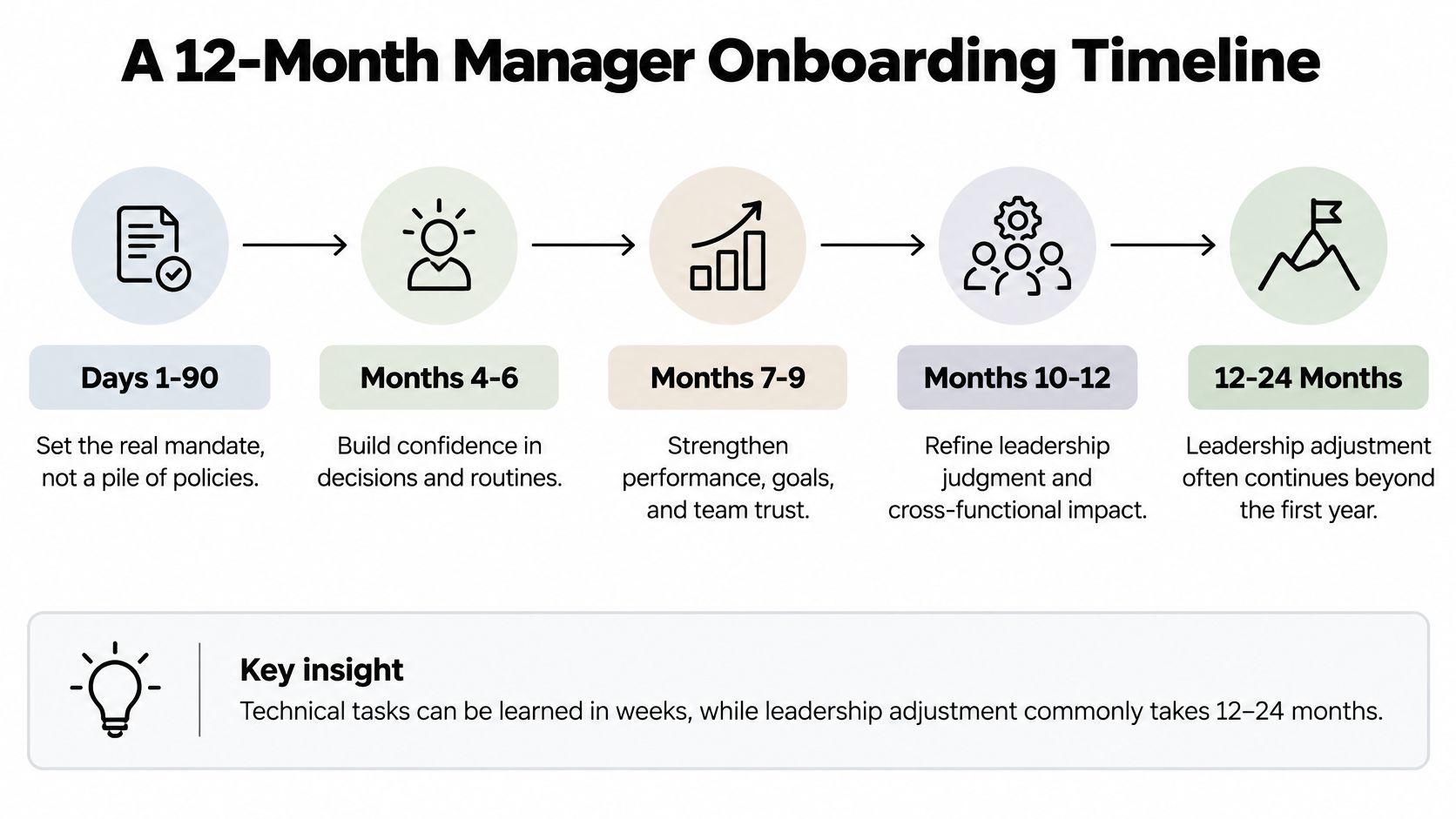
Treat manager onboarding as a 6–12 month system, not a one-day orientation or a stack of slides. The first 90 days establish the mandate and working relationships. The months that follow give the manager support to apply that mandate to real people decisions. And measure capability gains separately from retention: a manager can become more confident without becoming more likely to stay.
A 12-Month Manager Onboarding Timeline
| Phase | Window | Primary job | Must finish | Gate check | |---|---|---|---|---| | Pre-boarding | Before day 1 | Mandate and handoff | Success metrics, decision rights, stakeholder map, readiness packet | Packet complete and owner named | | First month | Days 1–30 | Relationships and diagnosis | Meetings with the team, boss, peers, and critical stakeholders; culture read | Manager can explain the role and its priorities at day 30 | | Second month | Days 31–60 | Prioritized agenda | Operating rhythm and a short list of changes | Manager and boss agree on priorities at day 60 | | Third month | Days 61–90 | Visible commitments | Feedback on priorities and a 6–12 month plan | Confidence and early outcomes reviewed at day 90 | | Integration year | Months 4–12 | Judgment practice | Goal cycle, reviews, conflict, hard conversations | Decision quality and team health reviewed |
Each phase needs a named buddy or mentor, weekly milestones, stakeholder meetings, shadowing, strategic discussions, feedback loops, and progress tracking. At the 30-, 60-, and 90-day gates, check role clarity, confidence, relationship quality, and early business outcomes. Also verify that the stakeholder meetings scheduled for that week happened.
Leadership adjustment commonly takes 12–24 months, so the first 90 days should launch the transition rather than declare it complete. The [SHRM guidance on effective onboarding](https://www.shrm.org/topics-tools/news/talent-acquisition/employers-risk-driving-new-hires-away-poor-onboarding) reports that about one-third of executives miss expectations within their first two years, and fewer than one-third of surveyed senior executives received meaningful onboarding support. It also reports that 76% of surveyed U.S. HR leaders said their organizations weren't onboarding new hires effectively, while 47% said their programs successfully retained them. Those findings make each gate a check on whether the manager has the relationships, authority, and support to do the work, not just whether they've completed orientation.
Make the gates practical
Before the manager starts, name the gate owner and finish the readiness packet. Circle the table row that matches the start date, then put the next gate review on the calendar. At each review, ask the manager and team members what success looks like, where authority remains unclear, and which commitments have moved from discussion into action.
A digital checklist can keep milestones visible, but completion isn't proof that a manager has learned to lead. For a useful distinction between activity tracking and outcomes, see this guide to [measuring digital onboarding success](https://videolearningai.com/blog/digital-employee-onboarding-process).
Checklists for Each Kind of Manager
A single checklist can miss the distinct risks of each appointment. A first-time manager needs practice shifting from individual work to leading others; an external hire needs help understanding how decisions and relationships work inside the organization. Match the support to the transition, and assign a person to own it.
| Manager type | Main risk | Checklist emphasis | Support owner | |---|---|---|---| | First-time manager | Authority shift and unfamiliar people-management work | Delegation, feedback scripts, weekly boss check-in, stop-doing list | Skip-level plus coach | | External senior hire | Culture and organizational politics complicate the transition | Stakeholder map, decision rights, candid culture briefings | Executive sponsor plus buddy | | Internal promotion | Old peer ties and an unfinished prior role | Public authority reset and written handoff of old work | Former manager plus HR | | Frontline team lead | Floor pressure crowds out practice | Short on-the-job reps and protected one-to-one time | Direct manager |
Research cited in the [SHRM Foundation's onboarding guidance](https://www.shrm.org/topics-tools/news/employee-relations/viewpoint-5-key-steps-to-effective-manager-onboarding) found that, among 295 first-time managers, 46.1% struggled with managerial and personal effectiveness, while 43.4% struggled with leading team achievement. The same study found that 74% reported receiving support such as training, mentoring, or coaching. These figures point to a practical gap: assigning a title does not give a new manager a chance to practise the work.
Match the checklist to the person
First-time manager. When a strong individual contributor becomes a team lead, their old workload can crowd out the new job. Give them a feedback script, schedule a weekly one-to-one with their own boss, and agree on which responsibilities they will stop doing. The aim is to make delegation and feedback part of the working week, not extra tasks squeezed around it.
External senior hire. An executive may understand the role and still misread how decisions get made. Start with a stakeholder map, clarify decision rights, and arrange candid culture briefings with colleagues who will speak plainly. An executive sponsor can help interpret reactions and flag when the hire has misunderstood an informal rule. The [manager competencies guide](https://synopsix.ai/blog/competency-of-manager) can help the organization name the capabilities the role requires, then connect those capabilities to specific coaching and feedback.
Internal promotion. Former peers may continue treating the new manager as a colleague, while the manager's old responsibilities remain unfinished. Have the former manager announce the authority change to the team and write down which work will transfer. Check after the first month that the handoff has happened and that decision rights are understood.
Frontline team lead. Long classroom sessions may pull a floor-based lead away from the team without giving them practice in the moments that matter. Coach through short, real-work exercises and protect one-to-one time. The Corning Glass Works finding cited by SHRM is a retention comparison: employees who attended structured orientation were 69% more likely to remain with the company for up to three years than those who did not. Retention is one outcome to track; it does not show by itself whether the manager has built the skills to lead.
For each manager, choose the relevant row, name its support owner, and remove activities that do not address that transition's risks.
How to Run the Program Week by Week
A manager's onboarding does not end when the orientation calendar does. Judgment-heavy work takes practice over months, so assign owners before day one and keep support in place as real decisions arise.
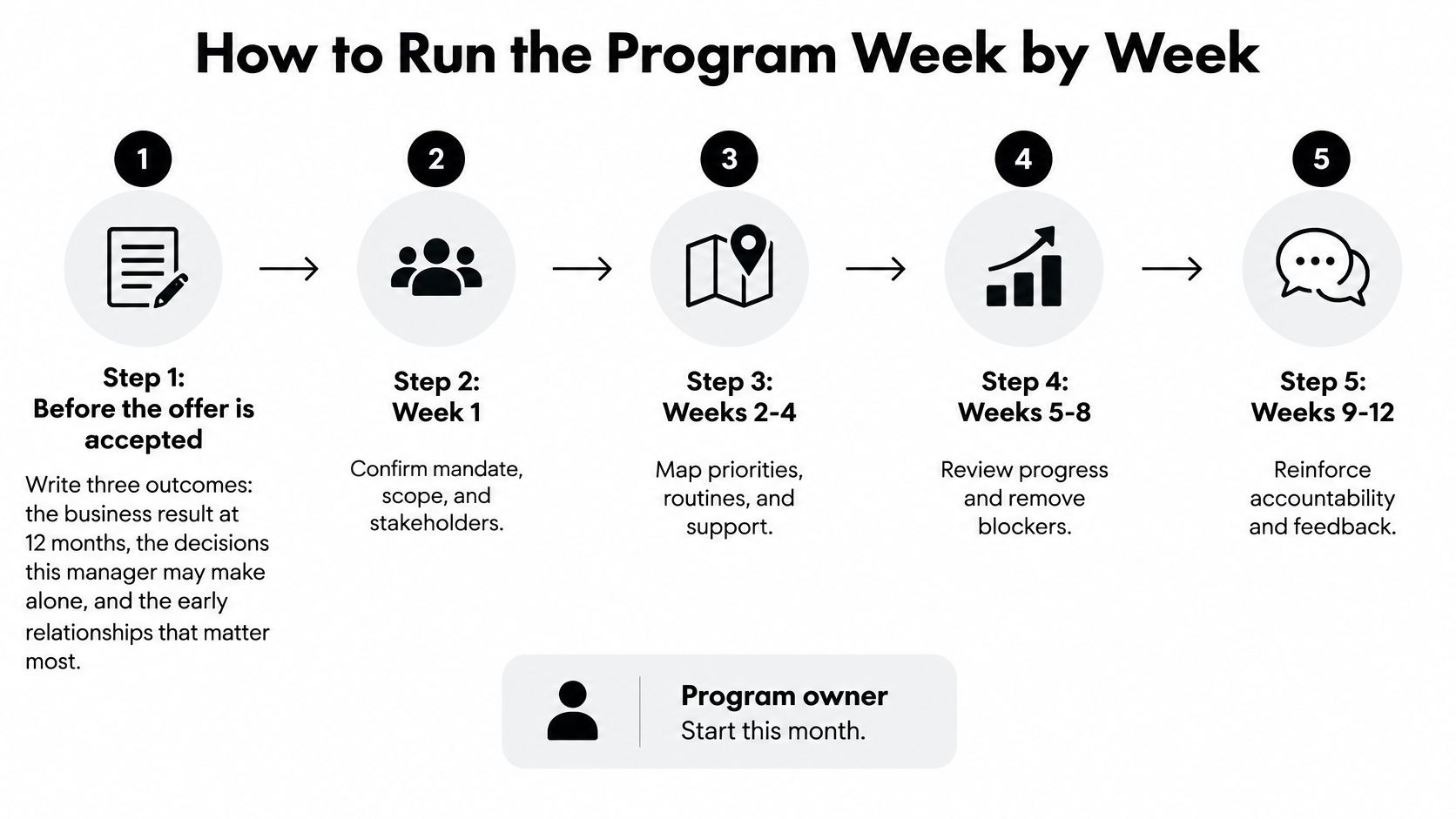
1. Before the offer is accepted, define three outcomes. The hiring manager specifies the business result expected at 12 months, the decisions the new manager can make independently, and the decisions that remain with their boss. Failure mode: the offer lists responsibilities but leaves authority and success criteria unclear.
2. Prepare a manager readiness packet. HR owns the packet; the recruiter and hiring manager supply its contents. Include why the person was selected, what success means, relevant interview evidence, promised development opportunities, working preferences, and risks that need support. Separate observed facts from interpretation. Assessment notes should guide support, not become permanent labels. In the [2025 HR leader survey on onboarding handoffs](https://enboarder.com/blog/enboarder-2025-hr-leader-survey-winning-the-first-90-days), 36% of surveyed HR leaders described their onboarding handoff as effective, and 28.8% said hiring managers had provided new hires no training or guidance. The same survey found that 83% of HR professionals see room for improvement in onboarding, while half identify workflow automation as a major challenge. Failure mode: the manager must guess what the organization promised or why the role was designed this way.
3. Assign two support people with different jobs. The manager's boss coaches judgment; a buddy helps the new manager understand informal norms and find the right people. Schedule both first meetings before day one. Failure mode: one friendly contact is expected to provide both cultural guidance and accountability.
4. Hold a weekly 30-minute check for the first 90 days. The boss owns the meeting. Spend 5 minutes reviewing stakeholder meetings completed, 10 minutes assigning an owner to one blocker, 10 minutes rehearsing a people decision, and 5 minutes recording the next commitment. At day 30, use the rehearsal time to compare recruiting promises with the job in hand. Failure mode: the meeting becomes a status recital, with no decision practiced and no blocker assigned.
5. Reconcile expectations at day 30. HR and the manager's boss compare the role described during recruiting with the work the manager is doing. Reset the scope in writing where needed. Track whether the packet was ready before day one, any gap between promised and actual responsibilities, how promptly employee blockers are cleared, and whether the manager understands the role. Failure mode: the gap between the pitch and the job persists until it damages trust.
6. Review the agenda at days 60 and 90. The manager's boss owns the outcome review; the team and peers provide feedback. Compare the manager's priorities with what people experience in practice. A completed slide deck is not evidence that the manager can make sound decisions. Failure mode: activity is mistaken for agreement or progress.
7. From month 4, coach live work. The manager's boss or coach observes a feedback conversation or goal-setting meeting, discusses the choices made, and records what the manager will try next time. Continue the practice as the work changes: a 90-day orientation cannot prepare someone for every judgment call across a 6–12 month transition. Failure mode: support stops just as the manager begins facing decisions that orientation alone cannot teach.
> Owner rule: HR owns the process. The manager's boss owns whether the manager can deliver the work.
Metrics That Prove the Manager Is Working
Course completion tells you someone attended. It doesn't tell you whether the manager's team understands its goals, whether feedback is happening, or whether the manager is making better decisions. Use a short scorecard that the manager and their boss can review together.
| Metric | When | Useful signal | Reset if | |---|---|---|---| | Role clarity | Days 30, 60, 90 | Manager and team state the same quarter goals | Mandates still conflict | | Confidence to lead | Before and after the program | A measured rise, such as 23.8 to 26.8 | Flat after day 90 | | Role knowledge | Before and after the program | A measured rise, such as 52.8 to 68.2 | Decision rights remain unclear | | Stakeholder meetings | Weekly for 90 days | Scheduled milestones completed that week | Culture meetings are skipped | | Team one-to-ones | Monthly | Most direct reports receive regular one-to-ones | Only favored reports get time | | First meaningful feedback conversation | By day 60 | A performance or priority conversation happened | Meetings are status updates only | | Regrettable team attrition | Months 4–12 | Stable or explained | A spike follows the manager's start | | Intention to stay | Separate from capability | Tracked on its own line | Assumed to follow confidence |
A 2025 University of San Francisco doctoral practice study measured 12 managers before and after a structured onboarding program built around 10 factors. Average confidence-to-lead scores rose from 23.8 to 26.8, a 13% increase (t(21) = 2.33, p = .03); average knowledge scores rose from 52.8 to 68.2, a 29% increase (t(21) = 2.94, p = .01). The study reported an eta-squared value of 0.20 for confidence. These results from the [University of San Francisco practice study](https://repository.usfca.edu/cgi/viewcontent.cgi?article=1338&context=dnp) offer a measurement model, not a guaranteed lift.
The sample was small and included managers with different amounts of time in role: 50% had held their roles for at least four months, 33% for at least 12 months, and 16.7% for at least 16 months. The study didn't find a statistically significant increase in participants' intention to stay. Don't treat a capability gain as evidence of a retention gain.
Collect signals that show behavior
Before day one, choose three baseline measures, such as role knowledge, clarity of decision rights, and the proportion of direct reports with regular one-to-ones. Track weekly milestones during the first 90 days, aim for a real feedback conversation by day 60, and read team health at the six- and twelve-month marks. Add goal-setting quality and timeliness, escalation volume, delivery reliability, and internal mobility to your view through the first year. To build a sound approach to measuring outcomes beyond attendance, see this guide to [measuring learning impact with LearnStream](https://learnstream.io/blog/how-to-measure-training-effectiveness/).
Report capability and retention on separate lines. A manager can learn the role and gain confidence while their intention to stay remains unchanged; each outcome needs its own measure and follow-up.
Pitfalls That Leave Managers Unprepared
A slide deck can explain a manager's responsibilities. It cannot prepare them to exercise judgment when a performance conversation turns difficult or team priorities collide. That is why onboarding should continue beyond day 90: managers need practice across the full cycle of setting goals, reviewing performance, and resolving conflict. Keep months 4–12 on the calendar, with a named coach or supervisor responsible for reviewing real decisions and adjusting support.

A study of 295 first-time managers found 59.3% struggled with the shift to people management and authority, 46.1% with managerial and personal effectiveness, and 43.4% with leading team achievement. Yet only 74% reported receiving support such as training, mentoring, or coaching, according to the [study of why new managers struggle](https://www.matcgroup.com/instructional-design/why-new-managers-struggle-and-how-better-leadership-onboarding-fixes-it/). A formal appointment changes the job title; it does not automatically build the judgment the job requires.
Pair each failure with a visible fix
Mistaking course completion for behavior change leaves a major gap. Finishing a module shows that a manager attended, not that they delegate fairly or make expectations clear. Have them practise with a real situation, then check for observable signs: whether one-to-ones happen, employees can explain their goals, and delivery remains reliable.
Feedback also needs practice. Regular, meaningful feedback can support employee engagement, but a scheduled conversation alone does not show whether it helped. Ask the manager to rehearse a real conversation, then check whether the employee understands what to continue or change.
Set up a follow-up routine the manager's boss can observe without turning it into surveillance:
At month six, review how the manager handles decisions, where they still need support, and what team members say has changed. If the review does not alter the support plan, it is probably measuring completion rather than capability. For warning signs that a manager's behavior is affecting the team, use this guide to [recognize signs of a bad manager](https://synopsix.ai/blog/signs-bad-manager).
A mentoring video can give the manager and coach a shared prompt for discussing how guidance applies to real people decisions.
<iframe width="100%" style="aspect-ratio: 16 / 9;" src="https://www.youtube.com/embed/TfOcbqjpRS8" frameborder="0" allow="autoplay; encrypted-media" allowfullscreen></iframe>
Test the Promotion Before Day One
A promotion or external hire can look strong on paper and still create friction in the team. Before announcing the move, test the person against the actual role, the team they'll lead, and the decisions they'll need to make. The point isn't to predict every interaction. It's to identify which judgment gaps need coaching first.
Three checks before the start
1. Assess the transition risks. Run a short behavioral assessment before or at appointment. Write the result as practical coaching priorities: where the person may fit well, what situations could challenge them, and which two conversations deserve early practice. Use the [leadership readiness assessment guide](https://synopsix.ai/blog/leadership-readiness-assessment) to frame readiness around the role rather than a generic image of a leader. Turn the most important people-leadership risk into a month-one practice item, then review it during the weekly milestone check.
2. Check compatibility with the team. Map the people the new manager will need to work with and where their working styles may complement or clash. Don't treat a team map as a verdict on anyone. Use it to prepare specific questions: Who needs decisions in writing? Where could authority be misunderstood? Which relationships need an early conversation?
3. Simulate the change before announcing it. Walk through the hire, promotion, or reorganization as a team scenario. Consider who may welcome the move, who may feel overlooked, and where authority or responsibility could become contested. Multi-participant simulations can test a hire, promotion, or reorg before it happens in real life. Leadership and succession analysis can also model succession scenarios, simulate conflicts, and detect dysfunctional-leadership risk. For an internal promotion, use those conversations to plan how the new manager will reset relationships with former peers.
> Put the assessment to work: turn a likely challenge into a coached conversation, not a label in a file.
This week, choose one upcoming manager move. Write its three twelve-month outcomes, assemble the readiness packet, and run the team scenario before anyone is told. That gives the manager's boss, HR, and the new manager a shared starting point for support.
---
If you're preparing a promotion, hire, or reorganization, [Synopsix](https://synopsix.ai) can help assess role fit, map team compatibility, and simulate how a change may affect the people involved. Use those insights to make the readiness packet specific and turn the key risks into a practical development plan.