Mentoring Relationships: Types, Benefits and Pitfalls
By Synopsix · November 2, 2026 · 17 min read
In 2024, 30.1% of recent U.S. college graduates reported having no mentoring relationships during college, according to the [Center for Engaged Learning](https://www.centerforengagedlearning.org/mentoring-matters/). That gap is the starting point for most programs. Plenty of people never get a first mentor, while others get assigned one and are left to hope the pairing works. A better approach treats mentoring as a relationship you diagnose, test, and reset over time, not a one time administrative match.
What Mentoring Relationships Are and Why They Matter
Say a junior analyst meets a senior engineer once a month for a year. At first they talk about technical choices and difficult clients. Later the conversations turn to promotion, how to handle a stalled project, and which role she should aim for next. No single meeting changes her career, but the pattern of advice, perspective, and encouragement over time changes how she makes decisions.
That's a mentoring relationship. It's a sustained, personal, developmental bond in which a more experienced person shares knowledge, perspective, and encouragement with a less experienced one.
It is more like a trail guide than a map. A map gives everyone the same directions. A guide walks with one person, notices where they struggle, and adjusts the route.

How mentoring differs from nearby support
Coaching is usually shorter and tied to one skill, such as presenting or giving feedback. Manager feedback is tied to current performance in the current job. Mentoring looks further ahead. It connects today's choices to long term growth, professional identity, and the next stage of a career.
The scale helps explain why access matters. The [history of formal mentoring in the United States](https://pmc.ncbi.nlm.nih.gov/articles/PMC11473108/) traces the modern organized movement to 1904, when Ernest K. Coulter created a "big brothers" initiative to provide guidance to children. By 2005, an estimated 17.6 million young people could have benefited from a mentor, yet only 2.5 million were participating in formal one-to-one mentoring relationships.
You can test any arrangement with three questions.
If one answer is no, you may have useful advice or good management, but you don't yet have mentoring relationships that can compound.
Types of Mentoring Relationships and When Each Fits
Start by scanning the options side by side, because the labels often hide practical differences in setup and workload.
| Type | How it is set up | Typical duration | Best used for | |---|---|---|---| | One-to-one formal program | Assigned by an organization with defined goals | 6-12 months | Skills and career development for new hires | | Informal mentoring | Self-selected and open-ended | Often several years | Long-term career guidance and professional identity | | Group mentoring | One mentor with several mentees | 3-12 months | Scaling access when experienced mentors are scarce | | Reverse mentoring | Junior employee mentors a senior leader | 3-6 months | Digital skills and awareness of inclusion issues | | Peer mentoring | Colleagues at similar levels exchange support | Ongoing | Shared problem solving and mutual encouragement | | Sponsorship | Senior leader actively advocates for a protégé | Until a goal such as promotion is reached | Visibility in promotion and assignment decisions |
Two variables separate most of these types. The first is who chooses the pairing, the organization, the individuals, or both together. The second is how long the relationship is meant to last, a fixed term, a project, or an open ended bond. Once you name those two choices, the right format usually becomes clearer.
Examples in practice
A formal program might pair a new hire in finance with a finance director for six months to build budgeting judgment. An informal pairing might begin after a conference talk and continue for years as the younger person changes employers. Group mentoring could put one operations leader with four supervisors who share scheduling problems and learn from each other's fixes.
Reverse mentoring flips the usual hierarchy. A digital native coaches a senior leader on new tools, customer habits, or language that excludes younger staff. Peer mentoring keeps authority flat, for example five first time managers meeting monthly to rehearse difficult conversations and compare what worked.
> Sponsorship differs in kind, not just degree. A sponsor spends influence, names the protégé in rooms they're not in, and advocates in promotion and assignment decisions.
That distinction matters because advice alone doesn't change who gets visible work. Pair mentoring with [stretch assignments that build workplace skills](https://www.hrmanagement365.com/2026/10/04/opportunities-for-development/) and the mentee gets both guidance and evidence of capability. If you're weighing mentoring against coaching for a senior leader, compare the purpose first, as set out in this guide to [executive and life coaching roles](https://synopsix.ai/blog/executive-and-life-coach). Coaching targets a defined change, mentoring carries experience across a longer arc, and sponsorship changes access. Choose the type from the outcome you need and the number of experienced people you can realistically support without burning them out.
Benefits and Risks the Evidence Supports
Mentoring works, but not dramatically on average. That's the honest headline, and it should shape how you design and sell a program internally.
The visual below balances the gains against the limits you need to plan for.
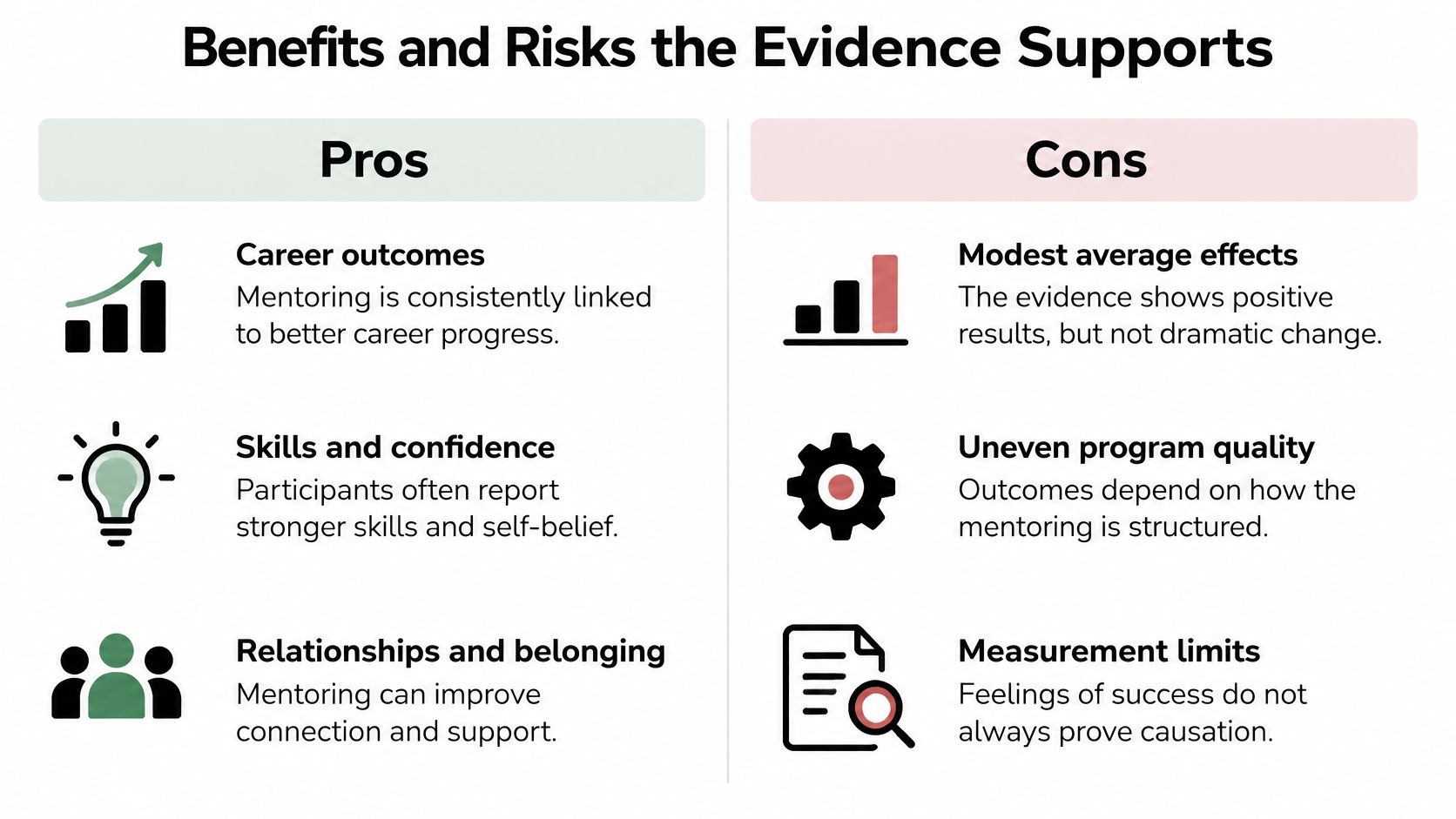
A [foundational multidisciplinary meta-analysis published in 2007](https://pmc.ncbi.nlm.nih.gov/articles/PMC2352144/) found mentoring consistently associated with positive behavioral, attitudinal, health, relational, motivational, and career outcomes, while average effects were generally modest rather than dramatic. Read the ranges as a guide to expectations, not as a promise for any single pair.
| Setting or outcome | Reported effect | What it means | |---|---|---| | Youth mentoring | 0.03 to 0.14 | Modest effect that repeats across many participants | | Academic mentoring | 0.11 to 0.36 | Widest range of effects in the review | | Workplace mentoring | 0.03 to 0.19 | Small average effect that depends on relationship quality | | Pooled performance outcomes | r = 0.08 (95% CI 0.06 to 0.10) | 31 studies and 10,250 participants; fail-safe N of 159 |
A small average still matters when it repeats across many people. If hundreds of employees make slightly better career decisions, stay connected, or build a skill a little faster, the organization feels the accumulation. The spread also tells you design matters. Academic mentoring showed the widest range, and workplace results shifted with relationship quality, setting, and outcome type.
The pooled performance figure is the clearest caution. A corrected correlation of 0.08 means the association is real but small, and the fail-safe N of 159 means many unpublished null studies would be needed to eliminate that statistical association. Assigning a mentor won't guarantee large performance gains.
The short video below gives a plain language view of what good mentoring looks like day to day.
<iframe width="100%" style="aspect-ratio: 16 / 9;" src="https://www.youtube.com/embed/rY7r6A_J_jQ" frameborder="0" allow="autoplay; encrypted-media" allowfullscreen></iframe>
Risks that deserve equal weight
Each benefit appears under conditions. Career progress needs relevant experience and honest feedback, skills need practice between meetings, and belonging needs trust. Name one specific developmental, career, or relational objective before you start, because vague goals make every result look like success or failure depending on mood.
Matching Mentors and Mentees Beyond Similarity
A comfortable match can still leave both people learning little. Similar backgrounds, communication styles, or job functions may make conversation easy, but effective mentoring also needs complementary perspectives. A mentor can offer experience the mentee does not yet have, while shared expectations make their differences useful. For a structured way to assess how people may fit and work together, see this overview of [compatibility matches in people decisions](https://synopsix.ai/blog/compatibility-matches).
Five steps for a defensible match
1. Define the development goal in one sentence. Write, “Prepare for a first team lead role,” rather than “general career advice.” A clear goal helps identify the experience and guidance that would be relevant.
2. List expectations on five alignment points. Have each person note expectations for confidentiality, meeting cadence, sponsorship, career goals, and authority. Differences can be discussed; unspoken differences are harder to address once the relationship is underway.
3. Identify required behaviors, not generic labels. Ask what the goal demands in practice, such as giving candid feedback, planning under uncertainty, or influencing without formal authority. Then consider mentors who demonstrate those behaviors.
4. Shortlist two or three mentors. Compare potential mentors against the required behaviors and the five alignment points, then check whether they have capacity. A strong match who cannot make time may be less useful than another qualified mentor who can.
5. Confirm expectations in a first meeting and write them down. Record the goal, cadence, boundaries, and how either person can ask for a reset. Treat the match as a starting point to review, not a decision that cannot change.
Behavioral measures can inform the search when they relate directly to the goal. A [meta-analysis of personality measures](https://onlinelibrary.wiley.com/doi/abs/10.1111/j.1744-6570.1991.tb00696.x) covered 494 studies, with usable results from 97 independent samples totaling 13,521 people. Across confirmatory studies, the corrected mean validity of personality measures for job performance was .29, compared with .12 in exploratory studies. When researchers used job analysis to select the measures, mean validity rose to .38.
The practical point is that a measure can be more informative when the desired behaviors are defined first. Corrected validities for Big Five dimensions ranged from .16 for extraversion to .33 for agreeableness. No single personality profile is therefore a universal recipe for a good mentor.
> A validity coefficient describes the strength of an association across people. It does not determine whether one specific person will be a good match.
Use evidence to guide questions, not to assign people by label. A profile may prompt a conversation about feedback style or decision-making, but the pair still needs to test whether their expectations and working styles fit in practice.
Your one page matching brief
Before confirming a pairing, record the goal in one sentence, three required behaviors, notes on the five expectation points, two or three shortlisted mentors, and whether capacity is confirmed. Add a date for the first expectations meeting. If these details are unclear, pause and resolve them before matching. Revisit the brief after the pair has met, and adjust the pairing if the goal, expectations, or practical fit are not holding up.
Preparing Mentors and Mentees Before the First Meeting
Many failures start before the first conversation. The mentor has goodwill but no preparation, and the mentee arrives hoping useful topics will somehow appear.
Mentor checklist
1. Complete brief training on listening, goal setting, and boundaries, including what to do when a topic needs HR or a specialist. 2. Confirm realistic capacity in writing, including meeting length, frequency, and the maximum number of mentees. 3. Agree limits in advance for sponsorship, confidentiality, and topics outside your experience.
Mentee checklist
1. Write the one development goal in your own words, not your manager's wording. 2. Bring two real situations where you want advice, with dates and decisions you face. 3. State what you're not ready to discuss so boundaries are clear while trust is still forming.
Mentor capacity is a design limit, not a personal shortcoming. If a senior person already supports several mentees, reduce the load or move some demand into group mentoring. Make it easy for any eligible employee to ask, too, so access doesn't go only to people who are already visible. A prepared first meeting then turns expectations into a shared agreement both people can revisit at the first check in.
Tracking Progress and Resetting a Struggling Pairing
A mentoring relationship isn't static. It moves through formation, active growth, and either renewal or closure, and each phase needs a different check.
The timeline below shows where those checks belong.
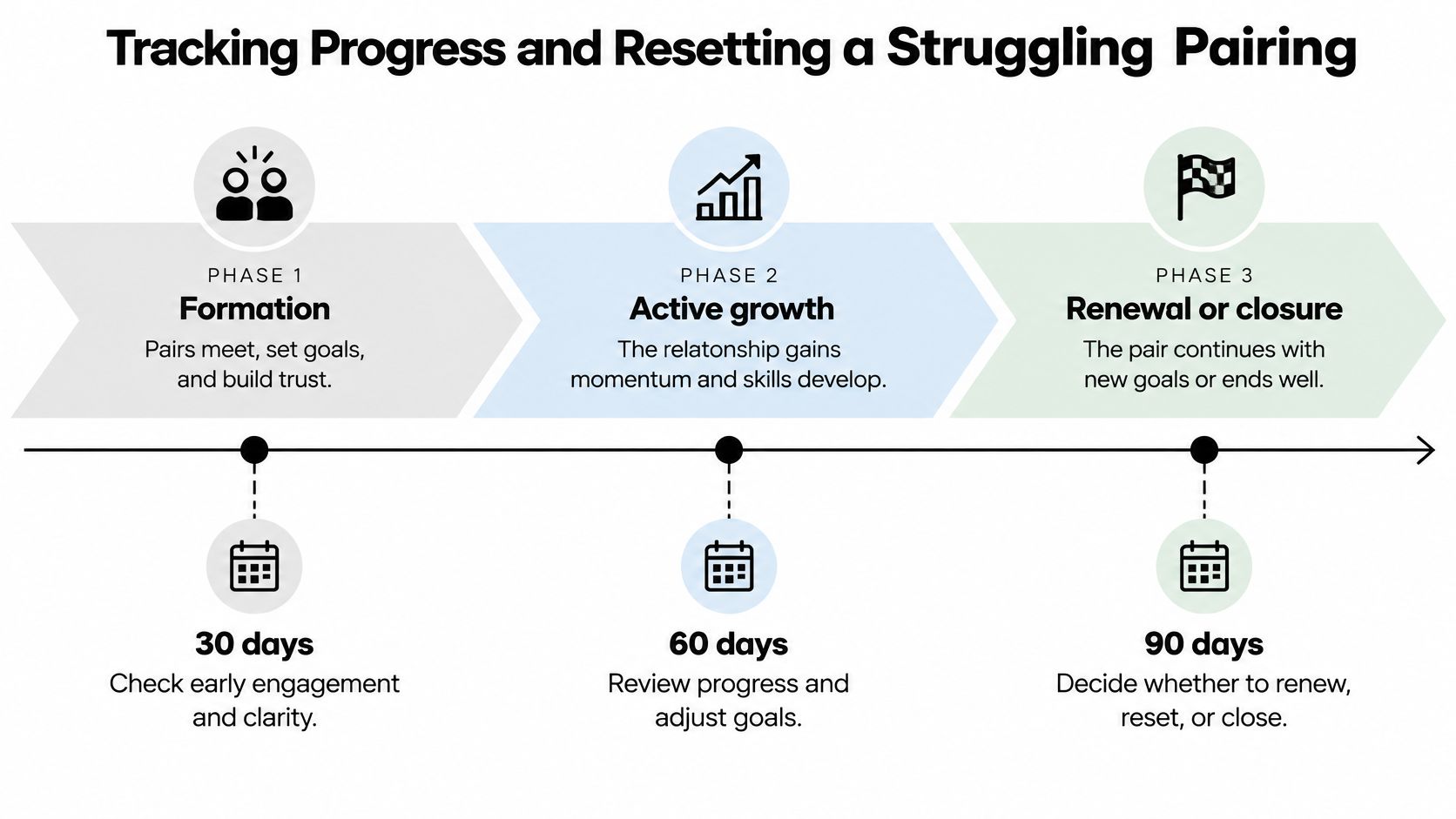
Plan formation in the first 30 days, active growth through the middle months, and a renewal or closure decision before the term ends. That rhythm fits how these relationships last. In the formal mentoring history cited earlier, most relationships lasted an average of about nine months, while 38% of mentors remained involved for at least 12 months.
The 30, 60, and 90 day health check
Ask the same five questions at each interval. Is the goal still aligned, is trust growing, does the mentee feel psychologically safe enough to disagree, is effort reciprocal, and is there observable progress? A [2025 policy analysis on mentoring resets](https://pdfs.semanticscholar.org/9f6b/8f6548c465ae8ea7715b0ce812f3013beac6.pdf) recommends treating matching as contestable and revisable, limiting mentor overload, preventing prospective mentees from being excluded, and using periodic evaluation or relationship "resets" rather than assuming every pairing will remain effective.
Trust needs rechecking, not a one time rating. Work teams can feel safe early and then pull back when deadlines, status differences, or conflicting styles start to bite. If a mentee stops bringing real problems, treat that as data, not politeness.
| Signal at a check-in | Likely diagnosis | Recommended action | |---|---|---| | Meetings continue but goals have drifted | Misaligned expectations | Renegotiate goals and meeting cadence | | Both want the relationship but communication is strained | Solvable communication problem | Hold a facilitated expectations conversation | | Mentee avoids raising concerns or disagreement | Low psychological safety | Add a second mentor or review the pairing with the program lead | | No observable progress toward the goal by day 90 | Fundamental mismatch or unclear objective | Rematch with a clearer goal | | Mentor misses sessions or describes being overloaded | Mentor capacity limit | Reduce the mentor's load or add group mentoring | | Mentee is making progress and both are satisfied | Healthy relationship | Continue and set the next 90-day goal |
Walk the table in order. Drift with regular meetings usually means expectations, not commitment, so renegotiate. Strained communication where both people still want the relationship is often solvable with a facilitated conversation about cadence, directness, and confidentiality. Silence is different. When a mentee avoids concerns, don't push harder inside the same pairing until a program lead has checked safety in private.
The hardest call is no progress by day 90. A solvable problem improves after you clarify expectations and both people try a new approach. A fundamental incompatibility shows the same flat pattern even after that effort. At that point, rematch with a clearer goal and say plainly that fit, not fault, is the reason.
Missed sessions point to capacity, so fix the workload rather than urging resilience. A healthy pair still needs a decision, which is to continue with a fresh 90 day goal instead of coasting on good rapport.
> Ask both people the same questions in private. You'll hear about safety, overload, and drift sooner, and rematching carries far less stigma when the program normalizes it from day one.
Don't judge success by satisfaction alone. Track whether the pair is still meeting and whether goals are being reached alongside how each person feels. End every 90 day cycle with one of four decisions for your mentoring relationships, continue, renegotiate, add a second mentor, or rematch.
Measuring Impact Without Overstating Results
Satisfaction is easy to measure and easy to misread. A mentee can feel supported while showing no change in skills, work assignments, promotion, or retention. Positive feelings matter, but they do not establish that mentoring caused later outcomes.
To understand progress, separate what the program provides from what participants do and what changes over time.
Use four layers, not one score
Each layer helps locate a different kind of gap. If the relationship is strong but participants do not use new skills at work, they may need opportunities to practice, not more meetings. If outcomes look positive but some groups have weaker access to mentors, the results may reflect unequal access rather than mentoring itself. This layered approach also supports [leadership development planning](https://synopsix.ai/blog/leadership-development-planning) by showing where a development pipeline stalls.
Evaluation methods can make conclusions harder to trust. A [2025 scoping review](https://www.frontiersin.org/journals/medicine/articles/10.3389/fmed.2025.1616148/abstract) examined 94 graduate-medical-education studies. Only 27 used theoretical frameworks, and evaluations commonly relied on non-validated tools and descriptive, self-reported outcomes. These limitations point to a practical need: define what success means, use consistent measures, and distinguish reported experience from observed change.
Break results down by demographic and career group, and track who never gets a first mentor, not only how satisfied matched participants feel. An overall average can hide unequal access or different experiences across groups.
Where possible, compare participants with colleagues who did not join and are similar in role, tenure, and starting performance. A before-and-after comparison is weaker because change may have other causes, but it offers more context than testimonials alone. State clearly what the design can and cannot show.
Your first evaluation should answer four questions: Who had access? How many mentors had capacity? Which relationships reached their goals? How did outcomes differ across groups? If those answers are missing, describe the findings as early signals, not proof of impact.
Schedule Your First 90-Day Mentoring Review
You can set this up this week without buying anything or redesigning the whole program. The discipline is in the dates and the shared record.
1. Write the one sentence goal for each pairing and store it where both people can see it. 2. Book the 30, 60, and 90 day check ins in calendars before the first mentoring meeting happens. 3. Record the health signals at each check in using the same fields for every pair. 4. Choose the matching action for each signal, including rematch when the pattern calls for it. 5. Answer the four evaluation questions at the end of the cycle before you report results.
With many pairings, consistent comparison becomes the hard part. Keep one shared sheet with goal, meeting persistence, signal, action, and outcome by group. Synopsix, a people intelligence platform, can support that comparison work. Its internal mobility analysis identifies high-potential employees, recommends individual and team coaching, and simulates how each person would react to change, while Human Interlink maps how people collaborate, influence each other and create friction across teams, shown as a living graph. Use aids like these to inform decisions, not to replace the conversations.
Your immediate action is small. Book the first 30 day check in today and confirm the goal in writing.
---
If you're building mentoring relationships that need consistent matching, health checks, and honest reset decisions, Synopsix can help you compare behavioral evidence across people and teams before small fit problems become stalled pairings. Visit [Synopsix](https://synopsix.ai) to see how its people intelligence platform supports better mentoring, mobility, and team design decisions.