Organizational Alignment Guide to Drive Results
By Synopsix · August 7, 2026 · 14 min read
The strongest alignment signal I've seen isn't a slide deck or a town hall. It's the gap between what leaders say the strategy is and what people do on a Tuesday afternoon. That gap is expensive, because LSA Global's research across 410 companies in 8 industries found that highly aligned companies grew revenue 58% faster and were 72% more profitable than unaligned peers, with gains that also showed up in customer retention, customer satisfaction, team leadership, and employee engagement ([LSA Global research](https://lsaglobal.com/insights/proprietary-methodology/lsa-3x-organizational-alignment-model/)).
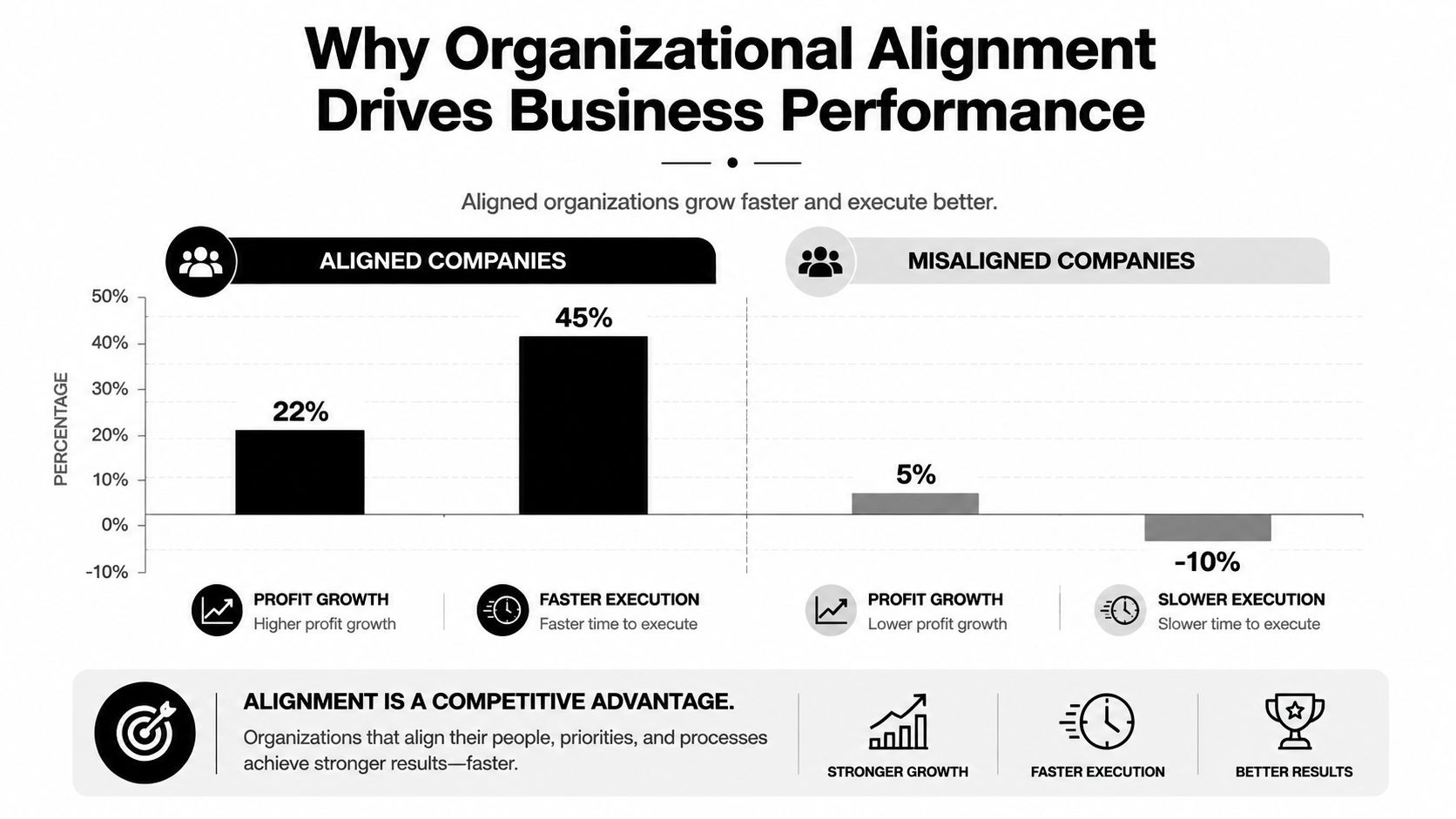
Organizational alignment isn't a culture slogan. It's the degree to which strategy, structure, processes, people, and culture pull in the same direction, and the business outcomes are visible when that fit is strong. I've watched well-funded teams lose momentum because they were enthusiastic but not coordinated, and I've also seen leaner organizations outperform because everyone understood priorities, boundaries, and decision rights.
The business case is simple. Alignment reduces rework, improves customer experience, and makes management more consistent. If you want a practical lens on how this connects to operating model choices, the relationship between alignment and [organizational design](https://synopsix.ai/blog/what-is-organizational-design) is where most leaders should start.
Why Organizational Alignment Drives Business Performance
A clear strategy only improves performance when people translate it into daily decisions. In the LSA Global research, aligned firms were 2.23 times better at retaining customers, 3.2 times better at satisfying customers, 8.71 times better at leading teams, and 16.8 times better at engaging employees. Those gaps matter because they show alignment reaching finance, operations, customer success, and people management at the same time, instead of staying trapped in planning documents ([LSA Global research](https://lsaglobal.com/insights/proprietary-methodology/lsa-3x-organizational-alignment-model/)).
Alignment is a cross-functional performance variable
I push executives to treat alignment as a performance system, not an HR initiative. When sales, operations, product, and people leaders each optimize their own priorities, the company absorbs the cost in handoffs, confusion, and missed expectations. When priorities line up, teams spend less time translating intent and more time executing work that fits the strategy.
What matters in practice is whether leaders can describe how a strategic priority changes day-to-day choices.
> Practical rule: if leaders can't describe how a strategic priority changes daily decisions, the organization isn't aligned yet.
AVMK Research's 2019 organizational alignment survey found that 113 respondents reported frequent misalignment across the organization, including horizontal, diagonal, and vertical gaps. Respondents also estimated that people spent over 30% of their time and energy dealing with misalignment issues, which makes the problem operational rather than abstract (AVMK Research 2019).
What executives should care about
The executive question is whether the organization can convert priorities into synchronized action without wasting time. Alignment deserves budget and governance because it shapes revenue growth, profitability, and the quality of execution across the enterprise.
If you need to build the case internally, start with outcomes leaders already track. Customer retention, customer satisfaction, employee engagement, and leadership effectiveness are not soft metrics when they connect to how the company operates. They show whether alignment is changing behavior and decision patterns, not just improving the story people tell about the strategy.
Alignment also depends on how the operating model is designed. A useful starting point is a practical view of [organizational design](https://synopsix.ai/blog/what-is-organizational-design), because structure, decision rights, and process flow shape whether strategy becomes consistent action or stays an abstract agreement.
The Five Dimensions of Organizational Alignment
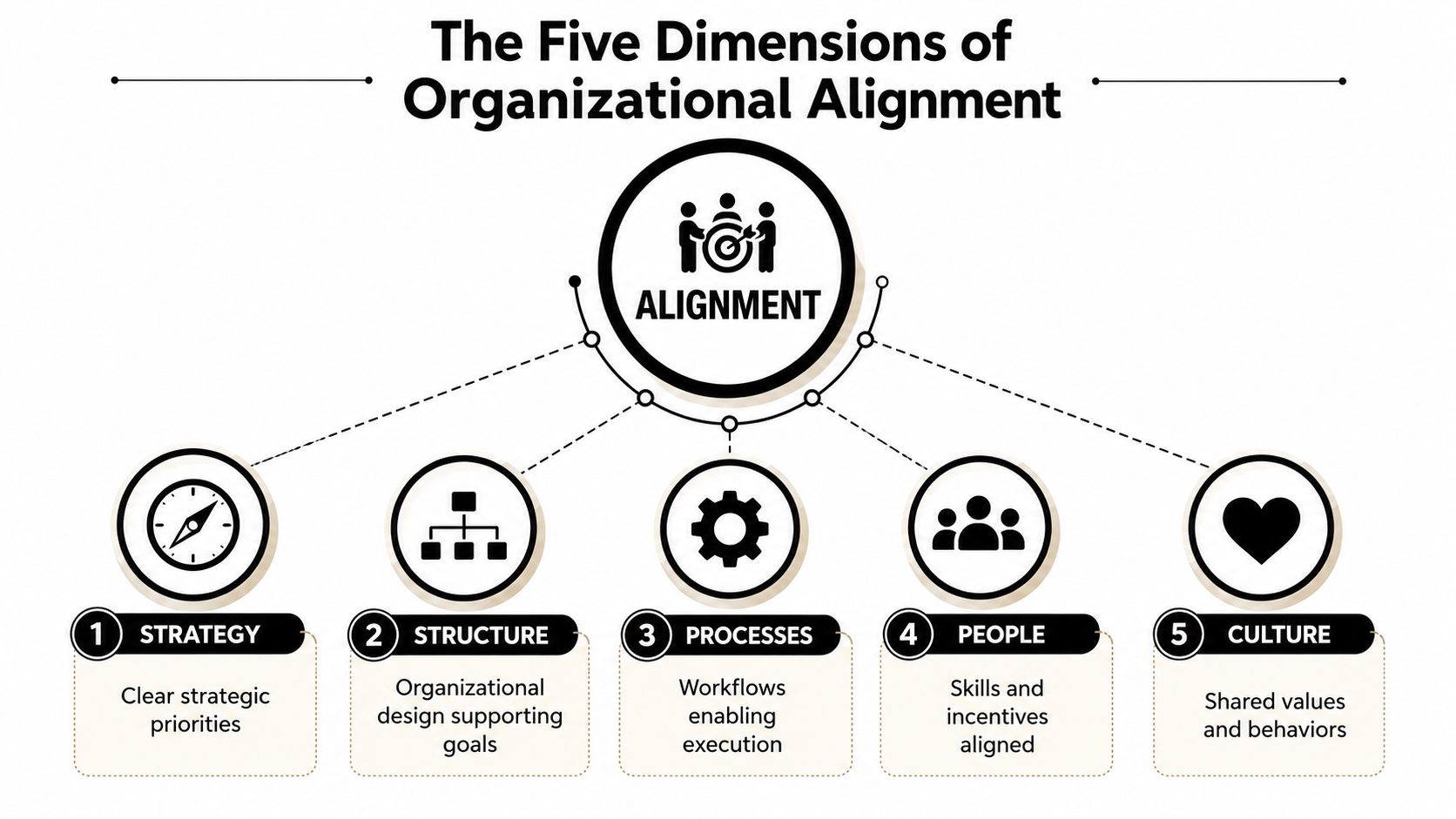
A lot of leaders talk about alignment as if it were one thing. It isn't. Research on organizational alignment and performance consistently treats it as a multi-dimensional construct spanning strategy, structure, processes, people, and culture ([doctoral study](https://digitalcommons.chapman.edu/cgi/viewcontent.cgi?article=1091&context=business_articles)), and that is the right way to think about it.
Strategy and structure
Strategy answers where the organization is going. Structure determines whether reporting lines, spans of control, and decision rights help people get there. A clear strategy with the wrong structure creates bottlenecks. A strong structure with a vague strategy creates motion without direction.
In practice, alignment work gets tested. Leaders can agree on priorities and still leave too many decisions trapped in the wrong layer of the organization. If a team knows the destination but still has to wait for approval on every meaningful move, the strategy is not translated into daily execution.
Processes and people
Processes are the routines that turn priorities into output. When they are aligned, work moves cleanly across functions. When they are not, teams invent side channels, approvals multiply, and accountability gets blurry.
People alignment matters just as much. Skills, incentives, and role clarity have to fit what the strategy requires. If you promote for the wrong behaviors, the rest of the system feels it quickly. I have seen organizations articulate collaboration as a core priority, then reward individual heroics and short-term fixes. The formal message says one thing. The incentive system says another.
Culture as behavior consistency
Culture is where alignment becomes visible in day-to-day behavior. The Oxford University repository describes alignment as matching values with strategic goals and keeping daily behavior consistent with those values ([Oxford repository](https://ora.ox.ac.uk/objects/uuid:9f647391-625a-42ab-86ae-e90599916f5a)). The 2013 Organizational Alignment Model paper makes the same point more directly, saying alignment requires compatibility between paths and consistency within them ([2013 paper](https://www.cabri-sbo.org/uploads/files/Documents/seminar_paper_2013_vector_group_cabri_seminar_cabri_9th_annual_seminar_english_13._organizationalalignmentmodel_vectorgroup_paper.pdf)).
That matters because culture is often where leaders see the gap between agreement and behavior. A leadership team may sound aligned in the room, yet frontline managers still make decisions that protect local targets, delay escalation, or avoid difficult trade-offs. Survey language can look healthy while decision patterns tell a different story.
The practical check is simple. If any one of the five dimensions drifts, the organization can still look busy while performance deteriorates underneath.
Leaders need to inspect all five, not only the one that is easiest to discuss in a meeting. Strategy may be clear but not executable. Processes may be tidy but support the wrong priorities. People may be capable but rewarded against collaboration. Culture may sound healthy in surveys while real behavior pulls the organization somewhere else.
The Consensus Trap Why Agreement Doesn't Equal Alignment
The most common mistake in alignment work is assuming that shared language means shared direction. It doesn't. Teams can agree on the strategy, nod through the same slides, and still make decisions that optimize local goals at the expense of the whole system. That's why better communication alone rarely fixes the problem.
Shared messaging is not the same as fit
A research-oriented framing from Dauphine PSL describes alignment as a fit among goals, activities, information, technology, processes, and environment, not just everybody saying the same thing ([Dauphine PSL paper](https://executive-education.dauphine.psl.eu/fileadmin_exed/user_upload/KREMNEVA_Maria_2024_compressed.pdf)). That distinction matters because a polished narrative can hide friction. A leadership team may feel aligned inside the room while frontline teams are still working around missing information, conflicting priorities, or unclear authority.
The trap shows up when managers celebrate consensus signals. Everyone attended the workshop. Everyone used the same terms. Everyone signed off on the roadmap. None of that proves the operating model can support execution.
Alignment needs measurement, not sentiment
That's why alignment should be measured as a gap problem. Look at whether top priorities are translated to role-level actions, whether cross-functional dependencies are explicit, and whether the organization has a way to review drift before it compounds. Dashboards and regular reviews matter more than another round of messaging.
A useful internal reference point is people analytics, because it forces leaders to pair perception with evidence. If you want the people side to be measurable, [people analytics](https://synopsix.ai/blog/what-is-people-analytics) provides the discipline to turn behavior, movement, and role data into something leaders can act on.
The harder truth is that agreement can even mask misalignment. A team may agree to one objective in public while continuing to reward different behavior in private. When that happens, the organization gets harmony on paper and confusion in practice.
Five Operating Mechanisms That Sustain Alignment
Alignment survives when it is built into operating rhythms, not when it depends on one annual offsite. McKinsey's framework names five mechanisms that keep strategy connected to execution, direction setting, performance management, governance, interactions and communication, and capabilities and mindsets (McKinsey). Those five mechanisms are useful because they describe where alignment either holds or breaks.
What each mechanism does
Direction setting clarifies what matters now, and what doesn't. Performance management ties goals, reviews, and rewards to the same priorities so people aren't incentivized to behave differently from the strategy. Governance sets who decides what, which prevents bottlenecks and territorial conflict.
Interactions and communication keep dependencies visible, especially across functions that don't report to one another. Capabilities and mindsets make sure people can work the aligned way, not just talk about it. If a company lacks the skill to make cross-functional decisions quickly, no amount of messaging will fix that.
What this looks like in practice
In many organizations, the annual plan is where alignment begins, but the quarterly business review is where it either survives or dies. Teams that use structured planning, clear scorecards, and regular check-ins catch drift early. Teams that rely on memory and informal coordination often discover misalignment after the damage is visible.
> Operational insight: alignment is a cadence problem as much as it is a strategy problem.
The video below is useful because it shows how execution rhythms can support a tighter connection between priorities and action.
<iframe width="100%" style="aspect-ratio: 16 / 9;" src="https://www.youtube.com/embed/EVxmhGRQgHY" frameborder="0" allow="autoplay; encrypted-media" allowfullscreen></iframe>
The point isn't process for its own sake. The point is to create repeated moments where leaders can check whether the organization is still moving in the same direction, and correct course before friction hardens into habit.
Measuring Alignment Through Decision Latency and Goal Cascades
If alignment can't be observed, it usually isn't being managed. The most practical metrics are the ones that show whether decisions move, whether priorities cascade, and whether information travels cleanly through the organization. An expert framework recommends tracking the percentage of employees who can articulate the organization's top priorities, average time from identified need to decision made, percentage of decisions made at the appropriate organizational level, and decision reversal rate because those signals reveal where shared context or authority boundaries are breaking down ([Dr. Marc Consulting](https://drmarcconsulting.com/alignment_metrics_that_drive_performance/)).
Alignment Measurement Metrics
| Metric | What It Measures | Target Benchmark | Warning Signs | | --- | --- | --- | --- | | Employee priority clarity | Whether people can state the top priorities | High role-level understanding | Conflicting answers across teams | | Decision latency | Time from identified need to decision | Short, consistent turnaround | Slow approvals, repeated escalation | | Decision level fit | Whether decisions happen at the right layer | Clear authority boundaries | Leaders deciding issues that should sit lower | | Decision reversal rate | How often decisions get undone | Low reversal frequency | Rework, re-litigation, confusion | | Information accuracy | Whether teams work from the same facts | Shared, reliable context | Version conflicts, duplicate analysis | | Relevant information access | Whether people can get what they need fast | Easy access to current data | Search time, dependency delays |
The other useful lens is strategic correspondence. A business-IT alignment study shows how misalignment can be operationalized by comparing strategic emphasis across external positioning, innovation, operational efficiency, and customer orientation, then measuring the correspondence between business and IT strategy profiles ([business-IT alignment study](https://pmc.ncbi.nlm.nih.gov/articles/PMC8497189/)). That matters because it turns a vague complaint into a gap analysis.
Why these signals outperform surveys
Surveys still have a place, but they often capture sentiment instead of behavior. Decision latency and reversal rates are harder to argue with because they show how the organization behaves under load. If a team says it is aligned but decisions keep ricocheting upward and then back down, the operating system is telling you something different.
I'd rather see a rough dashboard with the right behavioral measures than a polished engagement score with no execution evidence. Alignment is not a vibe. It's a pattern.
Common Implementation Pitfalls and How to Avoid Them
The costliest alignment failures usually come from leaders trying to force consistency where the organization needs clearer trade-offs, cleaner decision rights, or more room for local adaptation. In volatile conditions, pushing too hard on uniformity slows decisions and cuts off experimentation.
I saw this with a global team that had a strong strategic narrative, yet every region read it differently. Corporate responded by asking for more alignment, which only extended approval cycles for local teams. The fix was not another messaging push. It was a sharper line between what had to be standardized and what could be adapted locally.
The three mistakes that show up most often
First, leaders confuse alignment with centralization. They pull more decisions upward because they want consistency, then wonder why execution slows. The organization becomes cautious, and people stop using judgment where they should.
Second, leaders over-index on communication. They hold more meetings, send more updates, and assume the gap will close. If roles, incentives, and governance still do not fit, the extra communication only adds noise.
Third, leaders standardize everything in a volatile environment. Alignment can turn into rigidity. The CCL discussion of alignment in a polycrisis context is useful here, because it highlights the tension between shared direction and local adaptation ([CCL](https://www.ccl.org/articles/leading-effectively-articles/organizational-alignment-polycrisis/)). Too much rigidity makes a company slower at the exact moment it needs judgment and speed.
AVMK Research's finding that people spent over 30% of their time and energy dealing with misalignment issues is a warning sign, not a curiosity. That is the hidden tax of unclear priorities, duplicated effort, and constant reconciliation ([AVMK Research 2019](https://avmkresearch.com/.cm4all/uproc.php/0/Intermediate%20results%20April%205%20Organizational%20Alignment%20research%202019%20.pdf?cdp=a&_=169eda6b2c1)).
> A healthy alignment program reduces friction, but it does not remove judgment. If every exception requires escalation, the system is already too rigid.
Avoiding that outcome means defining the few things that must stay fixed, making decision authority explicit, and reviewing where local autonomy still adds value. Alignment should create speed through clarity, not sameness for its own sake. For a practical way to connect behavioral signals to those choices, see [behavioral assessment tools](https://synopsix.ai/blog/behavioral-assessment-tools). And for teams that need to translate behavior into hiring and interview readiness, the guide on [behavioral answers for LATAM candidates](https://www.latojobs.com/blog/how-to-answer-behavioral-interview-questions) is a useful reference.
Using Behavioral Assessments to Drive Alignment
The fastest way to move alignment from abstract strategy to daily behavior is to compare role requirements with actual behavioral patterns. Scientifically validated assessments help because they produce comparable profiles leaders can use to see where people are likely to complement one another, where friction may surface, and where role fit is weak. For a closer look at the tooling side, [behavioral assessment tools](https://synopsix.ai/blog/behavioral-assessment-tools) give a practical frame for turning profiles into action.
From people data to organizational signals
Synopsix is one example of a people intelligence platform that translates behavioral assessments into hiring, team design, and development guidance. Used well, that kind of system helps leaders avoid mis-promotions, speed up hiring decisions, and spot where a team's natural tendencies do not match its current operating demands. The useful part is not the score itself, it is the business interpretation.
Compatibility analysis matters here. When you visualize tension points and complementary styles, you stop guessing which team mix will work and start comparing likely patterns of cooperation or strain. In my experience, this is especially valuable for leadership pipelines, because high performers in one environment do not always scale into another without support.
Why behavioral consistency matters most
Alignment improves when people understand what behavior the role requires and the organization rewards that behavior consistently. That is the point where strategy, hiring, and development finally connect. It also makes interview preparation more relevant, which is why I often point managers to practical resources like [behavioral answers for LATAM candidates](https://www.latojobs.com/blog/how-to-answer-behavioral-interview-questions) when they need a cleaner, more consistent interview signal.
The goal is aligning natural strengths, role expectations, and company values so decisions become more predictable and execution less chaotic. In practice, that means managers can explain why one candidate will thrive in a fast-moving team while another needs clearer structure, and they can do it before the mismatch shows up in performance reviews. That is what turns alignment from an abstract aspiration into observable behavior.