Organizational Behavior Analysis: A Leadership Guide
By Synopsix · October 5, 2026 · 17 min read
McKinsey's review of team behavior found that a defined set of observable behaviors explained 69% to 76% of the differences between low- and high-performing teams in efficiency, results, and innovation across teams in 42 countries. The strongest drivers were trust, communication, novel thinking, and decision making. McKinsey's team-health analysis points to a management truth many leadership teams still ignore: behavior isn't soft data. It's an operating variable.
Organizational behavior analysis turns that variable into a decision system. It helps leaders understand why two people with similar credentials produce different results, why a technically excellent team keeps missing commitments, and why a change program stalls after the launch meeting. The useful question isn't whether employees are “engaged” in the abstract. It's what they do under pressure, what their environment reinforces, and how those patterns affect business outcomes.
The organizations that get value from this work don't commission a culture report and file it away. They connect behavioral evidence to hiring, team composition, leadership development, and measurable operating results. They define the behavior, identify the business outcome, change the surrounding conditions, and review the signal often enough to adjust.
Why Behavior Is the Most Overlooked Lever in Your Organization
Leaders often treat performance gaps as motivation problems. That framing is convenient, but it points attention in the wrong direction. Persistent results usually reflect a combination of individual behavior, team norms, managerial reinforcement, role design, and the information people use to make decisions.
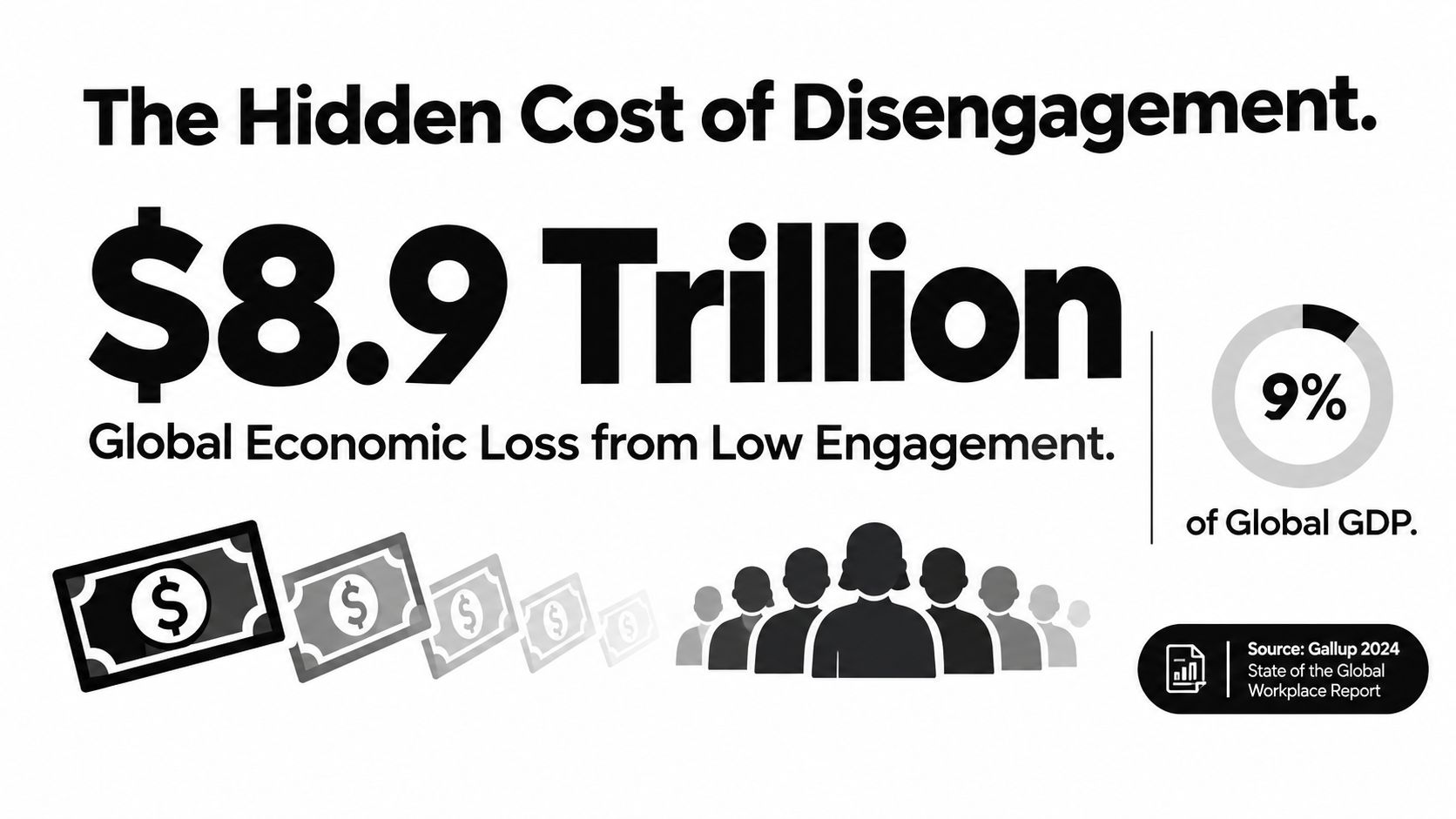
A director hires two candidates with nearly identical résumés, similar references, and comparable technical scores. Within the first year, one handles ambiguity, seeks useful feedback, and brings the right people into difficult decisions. The other waits for perfect information, avoids conflict, and struggles when the role changes shape. The difference isn't visible in a résumé. It appears in decision making under pressure, collaboration style, learning behavior, and response to uncertainty.
Most organizations collect these signals informally, if they collect them at all. An interviewer remembers who sounded confident. A manager labels someone “not strategic.” A promotion committee debates whether a candidate has executive presence. Those observations may contain useful information, but they aren't reliable until leaders define the behavior and assess it consistently.
Replace motivation slogans with behavioral evidence
A practical analysis starts with three questions:
Organizational effectiveness depends on this connection between behavior and system design. Leaders looking for a broader operating framework can also review [organizational effectiveness](https://synopsix.ai/blog/organizational-effectiveness) through this same lens.
Behavior is measurable, but measurement alone isn't the point. The point is to make better decisions about who joins a team, how work gets organized, which leaders need targeted support, and where an operating model creates friction. If an analysis doesn't change a decision, a workflow, or a manager's next action, it has produced description rather than intelligence.
What Organizational Behavior Analysis Actually Means
Organizational behavior analysis is the systematic study of how individuals, groups, and structures behave inside an organization, followed by the translation of those patterns into workforce decisions. It differs from casual culture commentary because it starts with a question, tests that question with evidence, and connects the result to an outcome.
The field developed through several intellectual traditions. Historical summaries identify 1913 as a widely cited milestone, when Hugo Münsterberg connected psychology with behavior at work. They also trace the field's consolidation into the early 1940s, after earlier contributions from Adam Smith, Max Weber, and the Hawthorne Studies redirected attention toward social and psychological factors in organizations. This historical overview of organizational behavior provides useful context for why modern analysis combines individual, social, and structural perspectives.
Start with the individual
Suppose a sales representative has strong product knowledge but takes longer than peers to become productive. OBA examines the behavioral variables that might explain the difference, including resilience after rejection, learning agility, planning discipline, and decision style. It then tests whether those variables relate to ramp progress, opportunity management, or quota attainment in that specific role.
That doesn't mean a personality profile should determine a hiring decision. It means leaders should compare multiple forms of evidence and ask whether the role requires the behavior being assessed. A trait is useful only in context.
Move to the group
A product team can contain talented individuals and still miss delivery commitments. Analysis at the group level examines communication density, conflict patterns, psychological safety, decision rights, and the quality of shared mental models. The goal is to identify how people interact, not to assign blame to the most visible person in the room.
Examine the organization
At the organizational level, leaders study how structure, incentives, informal networks, and management routines shape behavior. In a large firm, a function may claim to value cross-functional execution while its promotion system rewards local optimization. Employees then behave rationally within a system that produces a poor enterprise result.
> Practical rule: Treat OBA as a decision discipline, not a survey instrument.
Surveys, assessments, interviews, performance data, and collaboration signals are inputs. The analysis becomes valuable only when it produces a repeatable action, such as changing an interview rubric, redesigning team interfaces, coaching a manager, or revising an incentive.
The Three Levels Every Analysis Must Cover
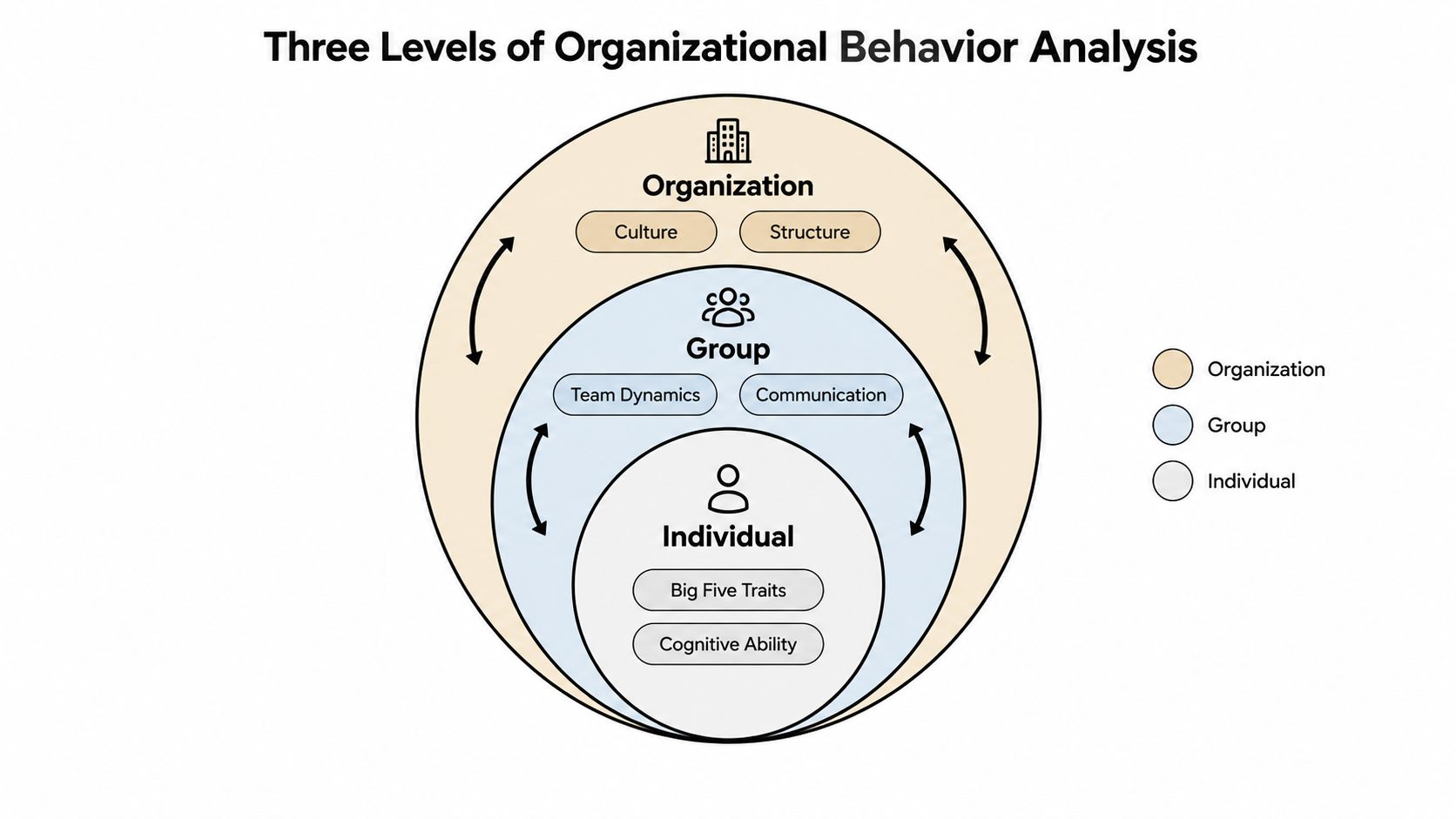
A serious OBA program operates across individual, group, and organizational levels at the same time. These aren't separate reports. They are nested layers. Individual tendencies affect team interaction, team norms shape individual behavior, and organizational systems determine which patterns survive.
Individual behavior supports people decisions
At the individual level, leaders may examine the Big Five personality traits, cognitive ability, motivational drivers, job knowledge, and work samples. The useful assumption isn't that traits are universally good or bad. It's that their value depends on the demands of the role and the surrounding environment.
A meta-analysis covering 494 studies, 97 independent samples, and a total of 13,521 people found corrected mean personality validity of .29 in confirmatory studies and .38 when job analysis guided the selection of personality measures. [The meta-analysis on personality and job performance](https://onlinelibrary.wiley.com/doi/abs/10.1111/j.1744-6570.1991.tb00696.x) supports a disciplined use of personality data, not personality absolutism.
This level informs hiring, onboarding, role placement, and individual development. It should never replace job analysis or structured evidence.
Group behavior explains emergent performance
Groups create dynamics that no individual profile can predict alone. Team composition, coordination norms, conflict behavior, psychological safety, and shared mental models all matter. Frameworks such as Katzenbach and Smith or GRPI can help leaders examine purpose, roles, processes, and relationships without reducing team performance to a single engagement score.
The group model assumes that performance emerges through interaction. A team may need complementary strengths rather than a collection of people who resemble its current top performer.
Organizational systems determine what scales
At the organizational level, leaders can use the Competing Values Framework or Schein's levels of culture to examine how structure, norms, symbols, incentives, and leadership routines shape execution. The organizational model assumes that systems influence behavior repeatedly, often more powerfully than a one-time training session.
The decisions differ by level:
Use all three. If you analyze only individuals, you risk blaming people for system failures. If you analyze only culture, you may produce language without an intervention.
Data Sources and Metrics That Actually Predict Performance
People analytics teams collect too much data and connect too little of it to decisions. Start with data that reflects behavior in a role, a team, or a business process. Then establish how the signal will be interpreted before collecting more.
The strongest foundation usually includes structured interviews, validated assessments, work samples, 360 feedback, performance reviews, tenure and turnover data, collaboration signals, and customer feedback tied to teams. Structured interviews, job knowledge tests, work samples, and empirically keyed biodata rank highly for criterion-related validity in a [2026 review of selection-system design](https://www.cambridge.org/core/journals/industrial-and-organizational-psychology/article/revisiting-the-design-of-selection-systems-in-light-of-new-findings-regarding-the-validity-of-widely-used-predictors/A20984B138319E3D432E643978BF026D).
| Data Source | Predicts | Reliability | Common Misuse | |---|---|---|---| | Structured interview | Job-relevant behavior and decision quality | Stronger when questions and scoring are standardized | Letting interviewer chemistry override evidence | | Work sample | Ability to perform a defined task | High when the task mirrors real work | Testing a skill the role rarely requires | | Validated assessment | Role-relevant traits, reasoning, or preferences | Useful when matched to job analysis | Treating a profile as a universal fit score | | 360 feedback | Perceived leadership and collaboration behavior | Improves with specific prompts and multiple perspectives | Using popularity as a proxy for effectiveness | | Turnover and tenure data | Retention risk and cohort patterns | Strong for trend detection, weak for motive diagnosis | Assuming all departures have the same cause | | Collaboration telemetry | Coordination patterns and network structure | Valuable as context, not a verdict | Monitoring activity instead of outcomes | | Engagement survey | Perceptions and climate signals | Useful for diagnosis when segmented | Treating a score as proof of performance |
When budgets are tight, invest first in structured selection, role-relevant work samples, clear performance measures, and manager-quality data. Add network or collaboration analysis when the business problem involves coordination. Use engagement data to generate hypotheses, not to close the case.
For a practical framework for connecting HR data to decisions, see [people analytics in HR](https://synopsix.ai/blog/people-analytics-in-hr). The test for every metric is simple: who will act on it, what will they do, and which business result should change?
Quantitative Versus Qualitative Methods in Practice
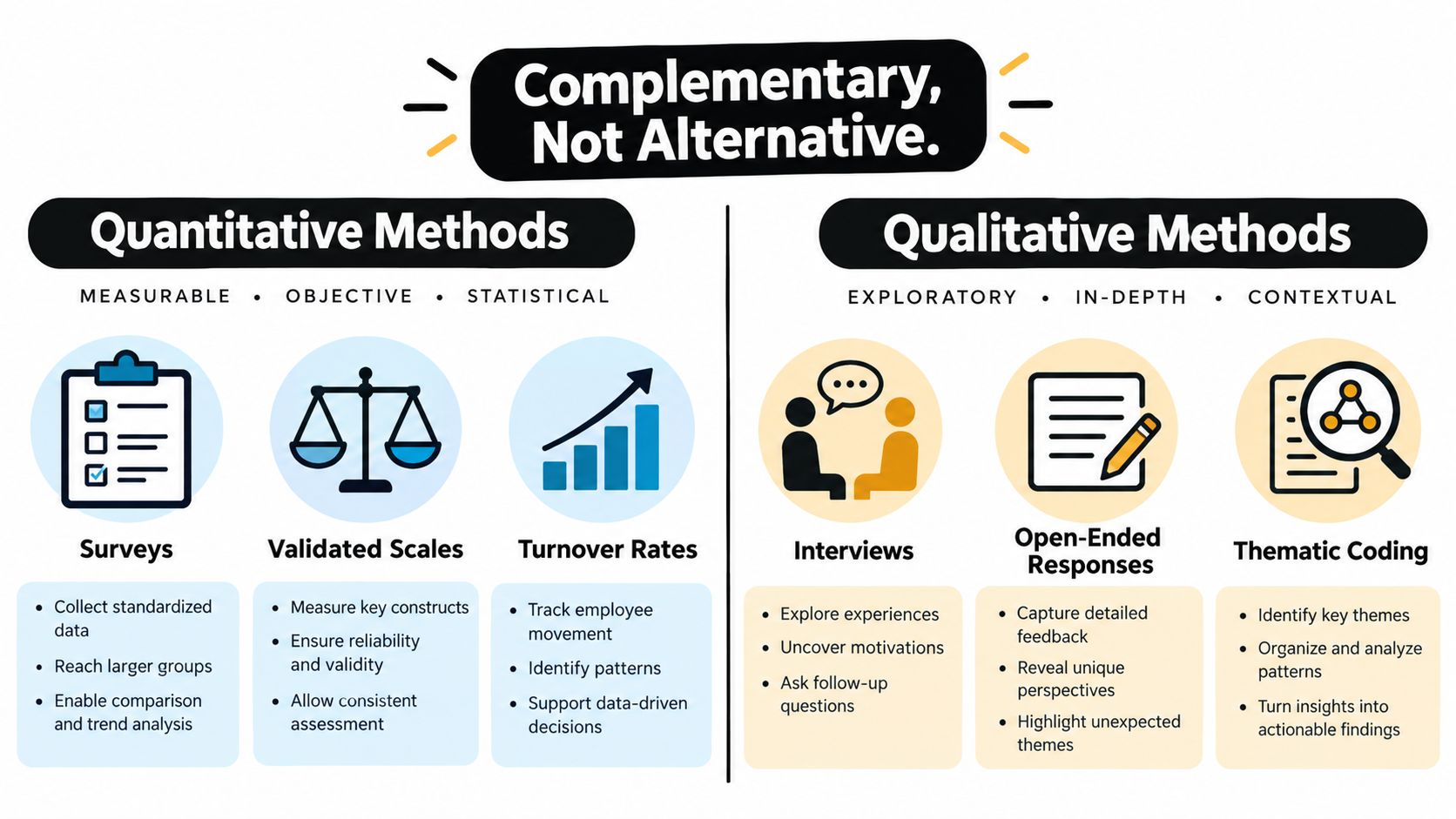
Quantitative and qualitative methods answer different questions. Treating them as competing camps is a mistake. Quantitative methods show where a pattern exists and how consistently it appears. Qualitative methods explain what people experience, what triggers the behavior, and which change might work.
What numbers reveal
Quantitative OBA can use validated survey scales, structured assessment scores, turnover regression, performance distributions, and network metrics from collaboration tools. It is especially useful when executives need to compare units, identify an outlier, test a relationship, or monitor movement over time.
The research base supports a range of designs. An open research guide identifies five common designs for studying behavior at work: naturalistic observation, survey research, field study, field experiment, and laboratory experiment. [OpenStax's guide to scientific method in organizational research](https://openstax.org/books/organizational-behavior/pages/a-scientific-method-in-organizational-research) also describes large-scale studies across organizations and multi-city populations, illustrating why evidence should extend beyond anecdotes.
What conversations uncover
Qualitative work includes structured interviews, stay interviews, focus groups, observation, and ethnographic analysis. It exposes context that a score cannot show. A regional team may display an unusual attrition pattern in the data, while a structured conversation reveals that new hires are routinely excluded from key customer calls and receive contradictory priorities from two managers.
That explanation changes the intervention. The organization may need clearer decision rights and manager coordination, not a generic resilience workshop.
Leaders can also use a [line of best fit in Google Sheets](https://gpt.space/de/blog/google-sheets-line-of-best-fit) to inspect a relationship visually during early analysis. The chart won't prove causation, but it can help a team see whether a suspected pattern deserves deeper investigation.
> Use quantitative analysis to locate the problem. Use qualitative analysis to understand the mechanism.
Choose the method based on the decision. Use quantitative evidence for comparison and monitoring, qualitative evidence for diagnosis and design, and both when the decision affects hiring, promotion, team structure, or significant investment. The higher the consequence and the more uncertain the mechanism, the less acceptable a single data source becomes.
Turning Analysis Into Hiring, Team Design, and Leadership Decisions
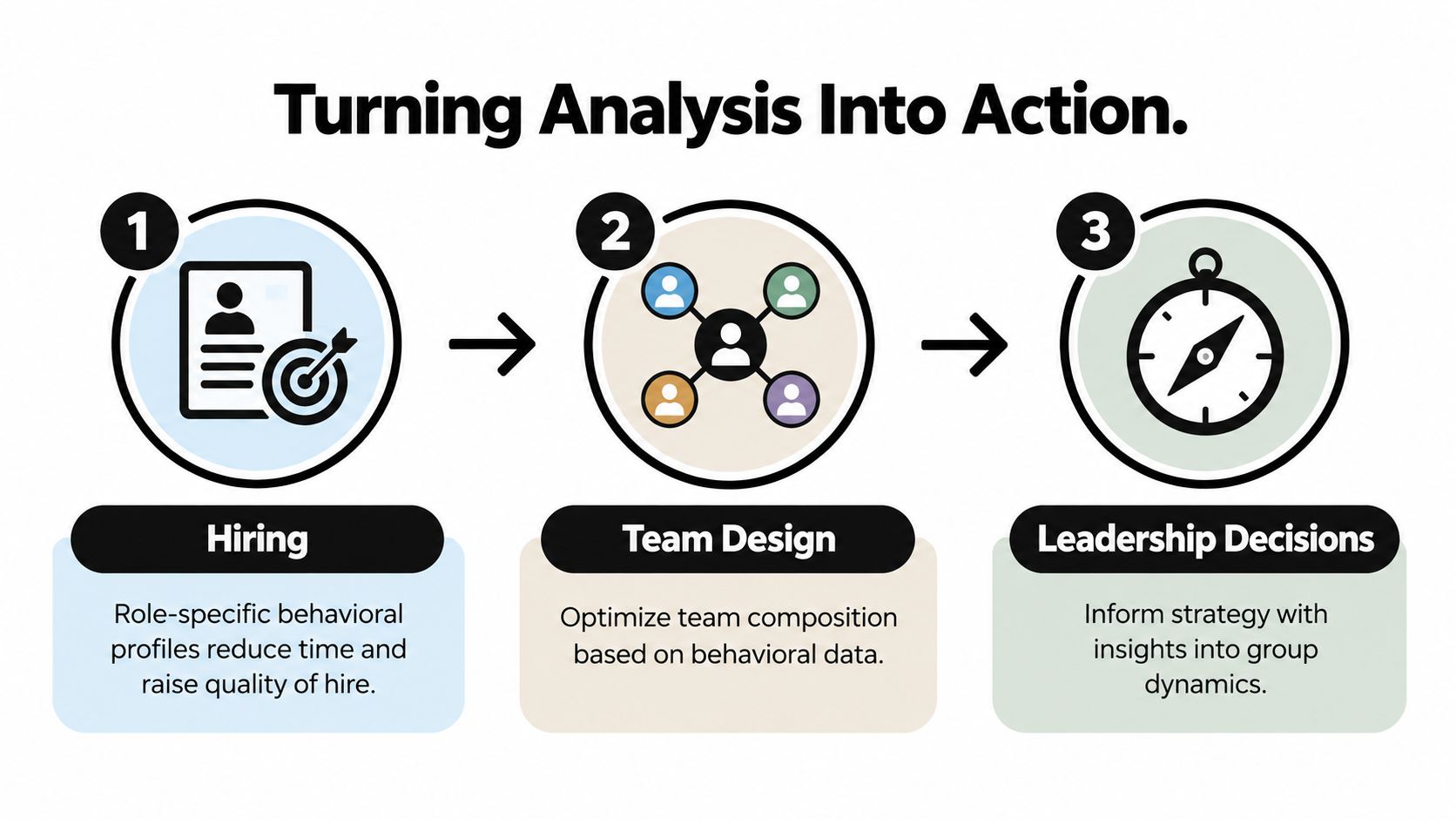
Analysis earns its place when it changes a workflow. The most effective organizations connect behavioral findings to three decision paths: selecting people for role demands, composing teams for complementary behavior, and developing leaders against specific risks.
Hiring needs a behavioral scorecard
Start with job analysis. Define the situations that make the role difficult, then identify the behaviors that distinguish effective performance in those situations. A hiring panel can assess judgment, learning behavior, collaboration, and follow-through with structured questions and work samples instead of relying on a general impression.
The output should be a role-specific behavioral profile, not a generic ideal employee. Recruiters use it to structure interviews. Hiring managers use it to compare evidence. Talent leaders use it to review quality of hire after the person has had time to perform.
Team design needs complementarity
Don't clone your current top performer across every team. A balanced group may need a strong operator, a challenger, a relationship builder, and someone who turns ambiguity into a workable plan. The correct mix depends on the work, the decision environment, and the team's existing strengths.
Use team profiles, interaction data, and network patterns to identify concentration risk. If every decision flows through one person, the issue isn't just workload. It may be a dependency that slows execution and suppresses ownership.
Leadership development needs a route to action
Assessment output should lead to targeted coaching, succession mapping, and calibrated development plans. A leader who avoids difficult feedback needs a different intervention from a leader who creates excessive debate before making a decision. Both may receive a low score on “leadership effectiveness,” but the behavior and remedy aren't the same.
AI-powered people intelligence platforms can aggregate assessment data, produce comparable behavioral profiles, simulate team scenarios, and route clear recommendations to recruiters, HR business partners, and managers. A platform such as Synopsix describes workflows that connect assessments and profiles with intelligence reports, predictive simulations, compatibility analysis, and development planning. Leaders evaluating these tools should focus less on the interface and more on data governance, decision ownership, and review cadence.
Resources on [AI for workforce engagement](https://yellow.ai/employee-experience-ai/) can broaden the discussion toward employee experience, but engagement technology should still connect to observable behavior and business decisions. For team-level compatibility questions, [compatibility matches](https://synopsix.ai/blog/compatibility-matches) can provide a useful conceptual reference.
Measuring the Impact of Your People Intelligence Program
A people intelligence program needs a measurement design before it needs a dashboard. Separate leading indicators, which show whether behavior is changing, from lagging indicators, which show whether the business result followed.
| Category | Indicator | Cadence | What It Tells You | |---|---|---|---| | Leading | Assessment completion and decision adoption | Per hiring or talent cycle | Whether the workflow is being used | | Leading | Behavior change velocity | Regular manager review | Whether targeted actions are appearing in daily work | | Leading | Manager one-to-one cadence | Regular operating review | Whether reinforcement and feedback are occurring | | Leading | Internal mobility signals | Periodic talent review | Whether people are moving toward better role alignment | | Lagging | Regrettable attrition | Quarterly review | Whether targeted cohorts are staying | | Lagging | Promotion time in role | Talent-cycle review | Whether development and readiness are improving | | Lagging | Engagement to performance relationship | Quarterly analysis | Whether perception data connects to outcomes | | Lagging | Revenue per employee | Business review | Whether workforce changes support enterprise performance |
Use a simple ROI logic. First, baseline the behavioral gap. Next, estimate the business value of closing it. Then divide that value by program cost and track the ratio over time. The estimate must be explicit about assumptions, or executives will mistake a precise spreadsheet for causal proof.
Don't let an engagement score become the program's success metric. A score can move without predicting turnover, performance, or customer outcomes. Pair perception data with behavior and business measures.
A quarterly dashboard should contain three numbers: movement in the target behavior index, retention of the targeted cohort, and one business outcome tied to the intervention. A platform can consolidate those leading and lagging indicators, but the executive team still has to decide what action follows.
For practical ideas that help managers create participation and connection, explore [PSW Events engagement ideas](https://pswevents.com/employee-engagement-activities/). Activities are useful only when they support the behavior the organization actually wants to reinforce.
Real-World Examples and What Leaders Should Do Next
Leaders often ask for case studies with exact performance lifts. Unsupported precision creates false confidence, so use a different standard. The relevant contrast is between a team that changes its operating behavior after analysis and a team that merely stores the findings.
Consider an illustrative SaaS company with a recurring onboarding problem. New hires receive the same training, but their early experience varies sharply by manager and peer support. An analysis shows that the issue isn't a lack of content. It's inconsistent access to context, unclear escalation paths, and managers who give feedback only after a problem becomes visible.
The leadership team changes onboarding pairings, defines the behaviors managers must reinforce, and reviews early signals with the cohort. The analysis matters because it changes who supports the new hire, what managers do, and when the organization checks progress.
Now consider an illustrative professional services firm that commissions an exhaustive organizational study. It produces dozens of dashboards, a long list of cultural themes, and a higher engagement score after a communication campaign. Leaders don't change staffing decisions, manager routines, incentives, or team interfaces. Utilization then deteriorates because the system still rewards the same conflicting priorities.
The first team converted insight into workflow. The second converted insight into reporting. Only the first created a testable management intervention.
A practical 90-day agenda
Remote and hybrid work deserve particular care. A 2025 bibliometric review identifies gaps in research on teleworking's effects on team cohesion and collaboration, along with limited geographic representation. [The review of teleworking and organizational behavior research](http://www.scielo.org.co/scielo.php?script=sci_arttext&pid=S0123-59232025000400403) reinforces the need to test assumptions across cultures, time zones, and working arrangements rather than importing advice designed for co-located teams.
AI creates a similar responsibility. 64% of workers reported using AI at work during the previous 12 months, according to [PwC's workforce research](https://www.pwc.com/gx/en/issues/workforce/hopes-and-fears.html). Leaders should measure whether AI improves decision quality, feedback, and role clarity, or instead creates overreliance and accountability gaps. Adoption is a behavior change, not a software rollout.
The next move is straightforward. Pick one decision, define the behavior behind it, connect the behavior to an outcome, and instrument the workflow before expanding the program.
---
Synopsix offers AI-powered assessments, behavioral profiles, simulations, compatibility analysis, and development guidance that connect organizational behavior analysis with practical hiring, team design, and leadership decisions. Visit [Synopsix](https://synopsix.ai) to see how your people data can move from scattered signals to an operating workflow.