Organizational Culture Assessment: A Practical Playbook
By Synopsix · October 13, 2026 · 16 min read
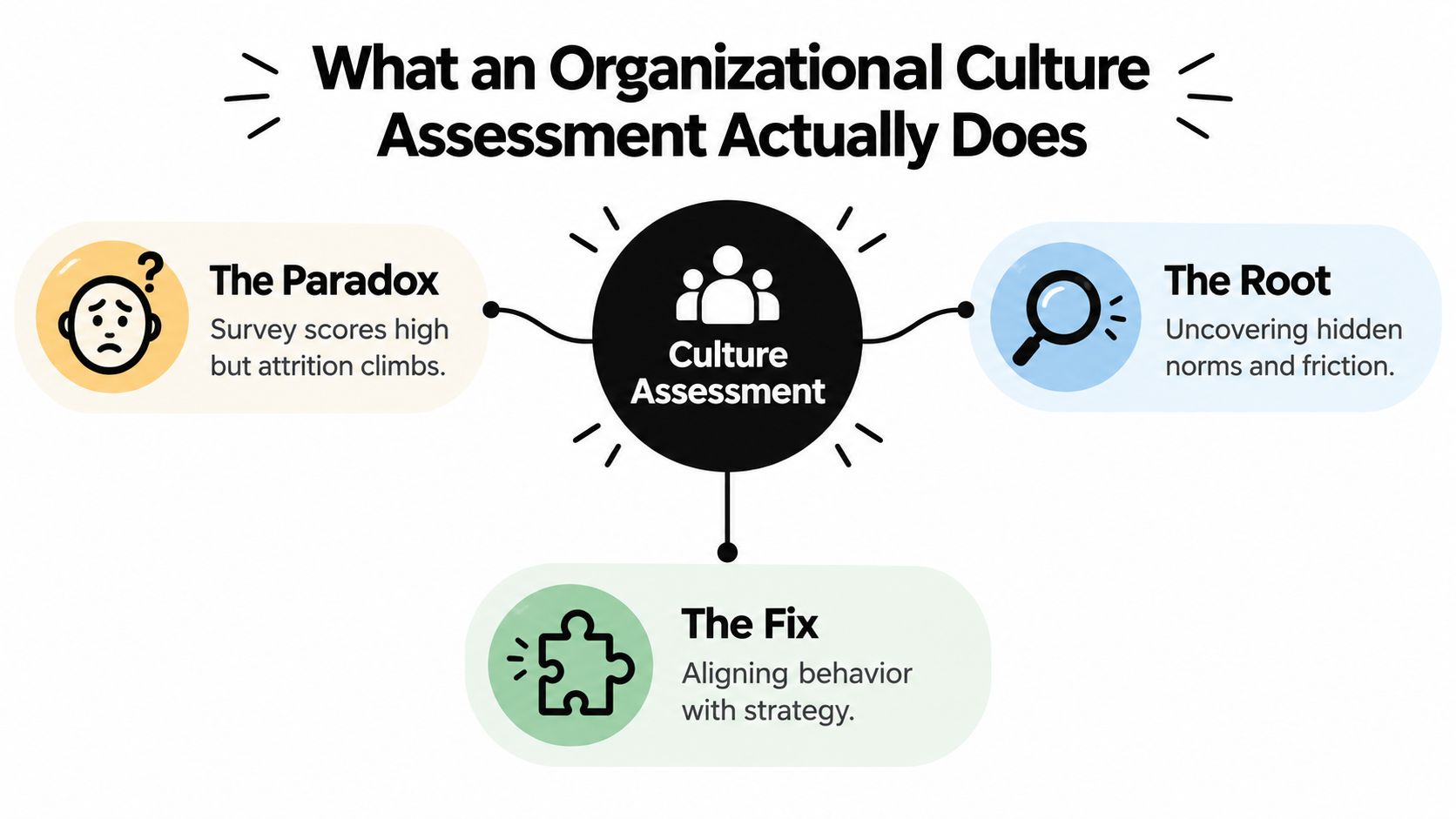
The engagement survey came back healthy. Leaders celebrated the scores, then noticed that experienced people were still leaving, promotions were producing friction, and two business units couldn't agree on how decisions should be made. The data wasn't necessarily wrong. It was answering a narrower question than the one leadership needed answered.
An organizational culture assessment examines the shared norms, values, and behaviors that shape how work gets done. It asks what people reward, tolerate, escalate, avoid, and repeat, especially when formal policies and stated values don't settle the issue. Engagement measures motivation and commitment. Sentiment captures how people feel. Employee experience describes how work is encountered. Culture concerns the patterns that guide behavior across those experiences.
The practical answer is a diagnostic loop, not a single score: choose an instrument, collect comparable evidence, triangulate survey results with behavior and operational signals, then act and reassess. That discipline helps HR leaders avoid treating a polished dashboard as proof of how the organization really operates.
What an Organizational Culture Assessment Actually Does
Culture assessment becomes useful when it moves from opinion to observable diagnosis. A survey may show that employees value collaboration, but the stronger question is whether promotions favor individual heroics, whether managers share information across functions, and whether teams escalate problems early or conceal them until they become expensive.
This distinction matters because engagement and culture are related but not interchangeable. An engaged employee may be motivated and committed while working inside a culture that rewards internal competition. A dissatisfied employee may be reacting to weak management, inadequate resources, or conflicting incentives rather than a dysfunctional organizational norm. [Guidance on the limitations of employee surveys](https://www.swgroup.com/insights-events/insights/limitations-of-employee-surveys-in-assessing-organisational-culture) makes the diagnostic risk clear: nonresponse, question wording, and other forms of bias can affect what a survey appears to show.
Separate the signal from the label
Start by defining culture operationally. Look for repeated patterns in:
These are not abstract values. They're behavioral evidence. A statement such as “we value accountability” becomes diagnostically meaningful only when you can observe ownership in handoffs, post-mortems, performance conversations, and escalation routines.
For leaders working on customer behavior specifically, practical [customer focused culture tips](https://supportgpt.app/blog/tag/customer-centric-culture) can help translate broad service values into observable team habits. The same principle applies to any culture theme: define the behavior before measuring the belief.
Use a four-part loop
A credible assessment follows four connected decisions.
1. Select the instrument. Choose a framework that matches the decision, whether that's current versus desired culture, organizational capability, behavioral norms, or team fit. 2. Collect multiple forms of evidence. Combine structured survey responses with interviews, observation, text, and operational indicators. 3. Triangulate before interpreting. Treat a score as a signal that needs corroboration, not as a verdict. 4. Act and reassess. Convert gaps into specific behaviors, assign ownership, and define when you'll test whether patterns changed.
The [practical distinction between stated and lived culture](https://synopsix.ai/blog/understanding-a-culture) is useful here. Your assessment should reveal not only what leaders say matters, but what the organization reinforces when deadlines, incentives, and pressure arrive.
Choosing the Right Instrument for Your Diagnostic
Instrument choice should follow the decision you need to make. A framework designed to compare current and desired culture won't automatically explain why a team misses handoffs. A behavioral profile can clarify role fit, but it shouldn't be presented as a complete organization-wide culture survey.
The Organizational Culture Assessment Instrument, or OCAI, is built on Kim Cameron and Robert Quinn's Competing Values Framework. It maps culture across internal versus external focus and flexibility versus control, producing four archetypes: clan, adhocracy, market, and hierarchy. The Cameron Institute reports that OCAI has been used for more than 40 years, administered to more than 24 million respondents across over 10,000 organizations, with historical validation work supporting its measurement approach. [The Cameron Institute's OCAI overview](https://cameron.institute/ocai/) provides the framework's background and evidence.
The Denison model takes a capability-oriented route. It measures involvement, consistency, adaptability, and mission, with each trait divided into three five-item indexes. Its 60-item instrument has 12 indexes and uses five-point Likert response scales. Validation included responses from 35,474 individuals across 160 organizations, with confirmatory factor analysis supporting the proposed structure and relationships with organizational-effectiveness measures supplying criterion-related evidence. [The Denison validation paper](https://denisonconsulting.com/wp-content/uploads/2019/05/diagnosing_organizational_cultures_validating_a_mo.pdf) explains the model mechanics.
| Instrument | Framework Type | Validation Evidence | Best Use Case | |---|---|---|---| | OCAI | Four competing culture archetypes | Reliability coefficients above 0.70 in one reported sample and close to 0.80 in another, with extensive use documented by the Cameron Institute | Comparing current and desired culture and creating a shared language | | Denison Organizational Culture Survey | Four traits and 12 indexes | Confirmatory factor analysis and criterion-related evidence from a large multi-organization validation | Diagnosing organizational capabilities tied to effectiveness | | Organizational Culture Inventory | Behavioral norms and cultural styles | Requires careful review of the vendor's validation, sample, and interpretation process | Examining behaviors the organization implicitly expects or reinforces | | Hofstede-based approaches | Cultural dimensions applied to organizational language and practices | A 2024 text-based validation reported Procrustes congruence coefficients from .913 to .976 against survey structures, [as documented in the study](https://www.tandfonline.com/doi/full/10.1080/1359432X.2024.2360225) | Scalable analysis of recurring organizational text, especially in multinational settings | | Behavioral profile platforms | Individual and team behavioral tendencies | Best treated as probabilistic evidence that must be checked against role criteria and observed outcomes | Hiring, team composition, development, and interaction risk |
OCAI's simplicity is an advantage when leaders need a common map. It can mislead when people interpret a preferred archetype as automatically superior. Denison offers finer-grained organizational diagnosis, but its detail creates more work after the report arrives. The Organizational Culture Inventory can expose behavioral norms that values surveys miss, while Hofstede-derived approaches need careful attention to whether national and organizational concepts are being conflated.
Behavioral assessments require a separate caution. A review of HEXACO traits found that the traits explained 20.1% of variance in counterproductive work behavior, 17.2% in organizational citizenship behavior, and 6.7% in task performance. The review available through Tilburg University shows why profile data should guide structured inquiry rather than determine hiring or promotion by itself.
Before buying, run an explicit criterion-validity and interpretation-risk audit. Ask which outcome the tool predicts, in which population it was tested, whether current and desired culture are analyzed separately, and what evidence would disconfirm the report. A deeper [assessment validity and reliability guide](https://synopsix.ai/blog/assessment-validity-and-reliability) can support that review, but the final decision should remain tied to your operational question.
Preparing the Organization for a Diagnosis
The quality of a culture assessment is often decided before anyone receives a survey invitation. If senior leaders haven't agreed on the question, employees will infer their own reasons for the exercise. That uncertainty can reduce trust, distort responses, and leave managers unsure what they're expected to do with the findings.
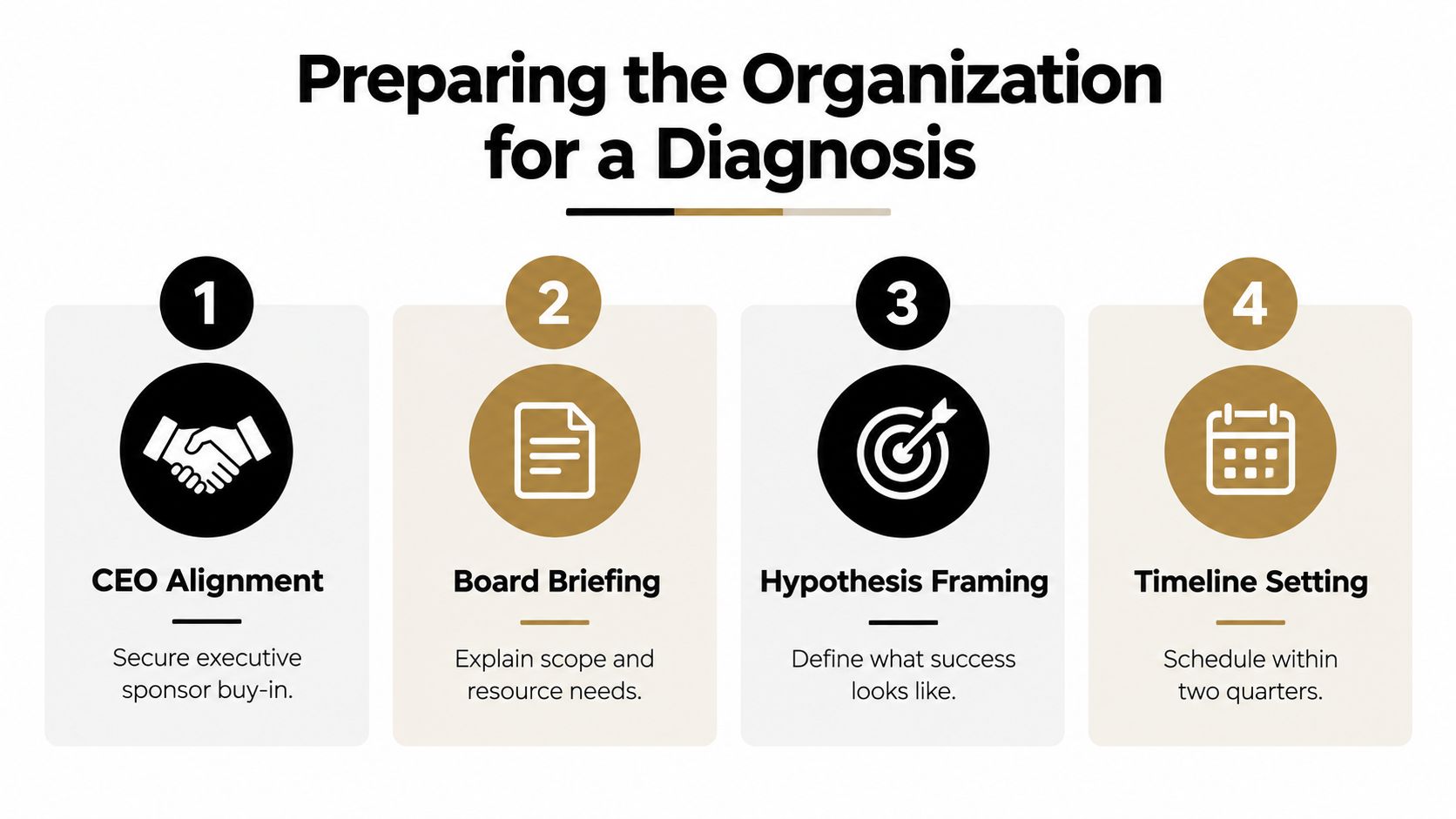
Begin with stakeholder alignment. The CEO should understand the business decision the assessment will inform. The board may need a concise explanation of scope, risk, and resources. Functional leaders should agree that the process can examine uncomfortable behaviors, including their own, rather than becoming a public-relations exercise.
Frame a testable hypothesis
Avoid launching with “we want to understand our culture.” That goal is too broad to guide sampling or action. Write a hypothesis that connects a suspected cultural pattern to a business risk.
Examples include:
The hypothesis isn't a conclusion. It tells you which evidence to collect and what alternative explanations to test.
Build the sample and communication plan
Your sample frame should allow comparison across business units, tenure bands, levels, and geographies where those distinctions matter. Don't promise subgroup reporting if the groups are too small to protect anonymity or produce interpretable results. Also pull baseline operational data before launch, such as turnover patterns, internal movement, safety or ethics incidents, customer complaints, productivity indicators, and promotion outcomes, where those measures are available and appropriate.
The launch message should answer four questions plainly:
1. Why is the organization doing this now? 2. Who will see raw responses? 3. What decisions might follow? 4. When will employees hear what changed?
Protect the people behind the data
Use a short ethics checklist:
Preparation isn't administrative overhead. It establishes whether employees view the assessment as a credible inquiry or another survey that disappears into a slide deck.
Designing Surveys, Interviews, and Observation Protocols
A strong instrument package gives you breadth, meaning, and behavior. Surveys make comparison possible. Interviews reveal how employees interpret events. Observation shows what happens in recurring work. None of the three should carry the diagnosis alone.
Design the survey in separate blocks. Ask about current culture before ideal culture, because the first set of answers can anchor the second. Keep the framework dimensions intact, then add a small set of operational items tied to the hypothesis.
Adaptable items might include:
Use the same response scale within a construct, define what the endpoints mean, and avoid combining two ideas in one item. “Leaders communicate clearly and support innovation” is two measures disguised as one.
Ask for incidents, not opinions
A structured interview guide should contain 8 to 10 prompts that ask for specific episodes:
1. Tell me about a recent decision that crossed functional boundaries. 2. Who was involved, and who was left out? 3. What happened when someone disagreed with the preferred direction? 4. Describe a promotion that clearly reflected the organization's stated values. 5. Describe one that didn't. 6. When does bad news travel quickly here? 7. When does it get delayed or softened? 8. What behavior receives informal status? 9. What happens after a project failure? 10. Which routine would you change first if you had authority?
Interviewers should probe for sequence, actors, consequences, and exceptions. “People don't trust leadership” is a theme. “The team stopped raising quality issues after two escalations were treated as performance failures” is a testable account.
A focused [interview question design resource](https://synopsix.ai/blog/interview-question-design) can help teams build prompts that produce incidents rather than rehearsed values statements.
Observe the rituals where culture appears
Create a lightweight observation sheet for meetings, hiring loops, post-mortems, planning sessions, and customer escalations. Record who speaks, who decides, how dissent is handled, whether evidence changes the decision, and what follow-up gets assigned. Don't rate personalities. Capture interactions and consequences.
> Design principle: A survey tells you what people perceive. An interview explains the meaning. Observation tests whether the claimed norm appears in work.
Triangulation starts at design time. Every major conclusion should have a planned route to at least two sources, and ideally a third operational signal.
Analyzing Quantitative and Qualitative Data Together
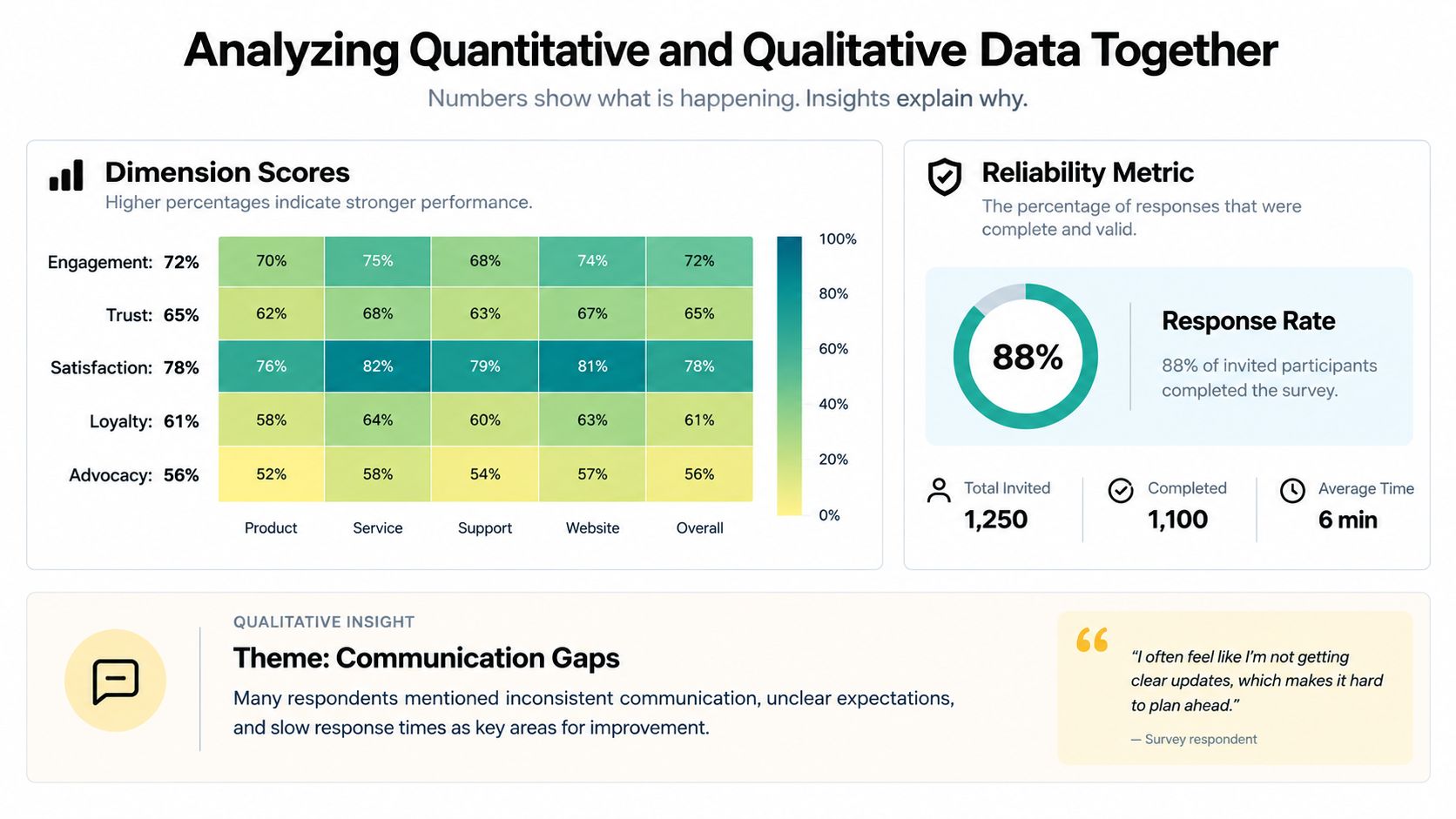
Analysis should make uncertainty visible. A culture heatmap without response-rate context encourages false precision, while interview themes without prevalence estimates can overrepresent the most articulate participants.
Start with the quantitative layer. Score each framework dimension according to the instrument's rules, then calculate subgroup results only where the sample is adequate and anonymity can be maintained. Report response rate, sample size, reliability, and confidence limits for the comparisons you intend to make. The [CIPD evidence review on organizational culture and performance](https://www.cipd.org/globalassets/media/knowledge/knowledge-hub/evidence-reviews/2023-pdfs/organisational-culture-and-performance-scientific-summary.pdf) highlights why this discipline matters. Meta-analytic correlations between culture measures and performance outcomes varied from zero in one study to 0.20 and 0.40 in others, depending on the construct, outcome, industry, and research design.
A useful output is a heatmap that includes:
Don't treat reliability as a decorative footnote. One OCAI validation study found Cronbach's alpha values from .71 to .80 for the four original profiles, while another OCAI-based validation reported values from 0.60 to 0.80 across dimensions. [The Australian OCAI study in PLOS ONE](https://journals.plos.org/plosone/article?id=10.1371/journal.pone.0092879) also found that reliability and predictive usefulness are different questions.
Code the stories against the model
For interviews and open text, create a codebook linked to the chosen framework. A statement about delayed escalation might map to consistency, psychological safety, hierarchy, or accountability, depending on the model and the wording. Have more than one analyst review a subset of responses, discuss disagreements, and preserve disconfirming cases instead of forcing every account into the dominant theme.
The merge happens at the level of a claim. Suppose a business unit shows a concerning collaboration score. Interviews repeatedly describe information being withheld during handoffs. Operational data shows recurring customer complaints tied to missed context. That combination supports an action hypothesis. A high score with no behavioral or operational corroboration should remain a question, not a conclusion.
Test alternative explanations
Low trust may reflect a recent reorganization, unclear decision rights, or a manager-specific pattern. High engagement may coexist with a culture that produces avoidable risk. Desired-culture scores can also be aspirational statements rather than reliable predictors of job satisfaction. Validation research found that current-culture relationships with job satisfaction behaved as expected in one OCAI study, while ideal-culture relationships did not.
Before writing recommendations, ask: What else could explain this result? Then collect the evidence needed to distinguish those explanations.
Turning Findings Into Hiring, Team, and Development Actions
A culture diagnosis earns its keep when it changes a decision. The translation should happen at three levels: who you hire, how you compose teams, and which behaviors people practice after joining.
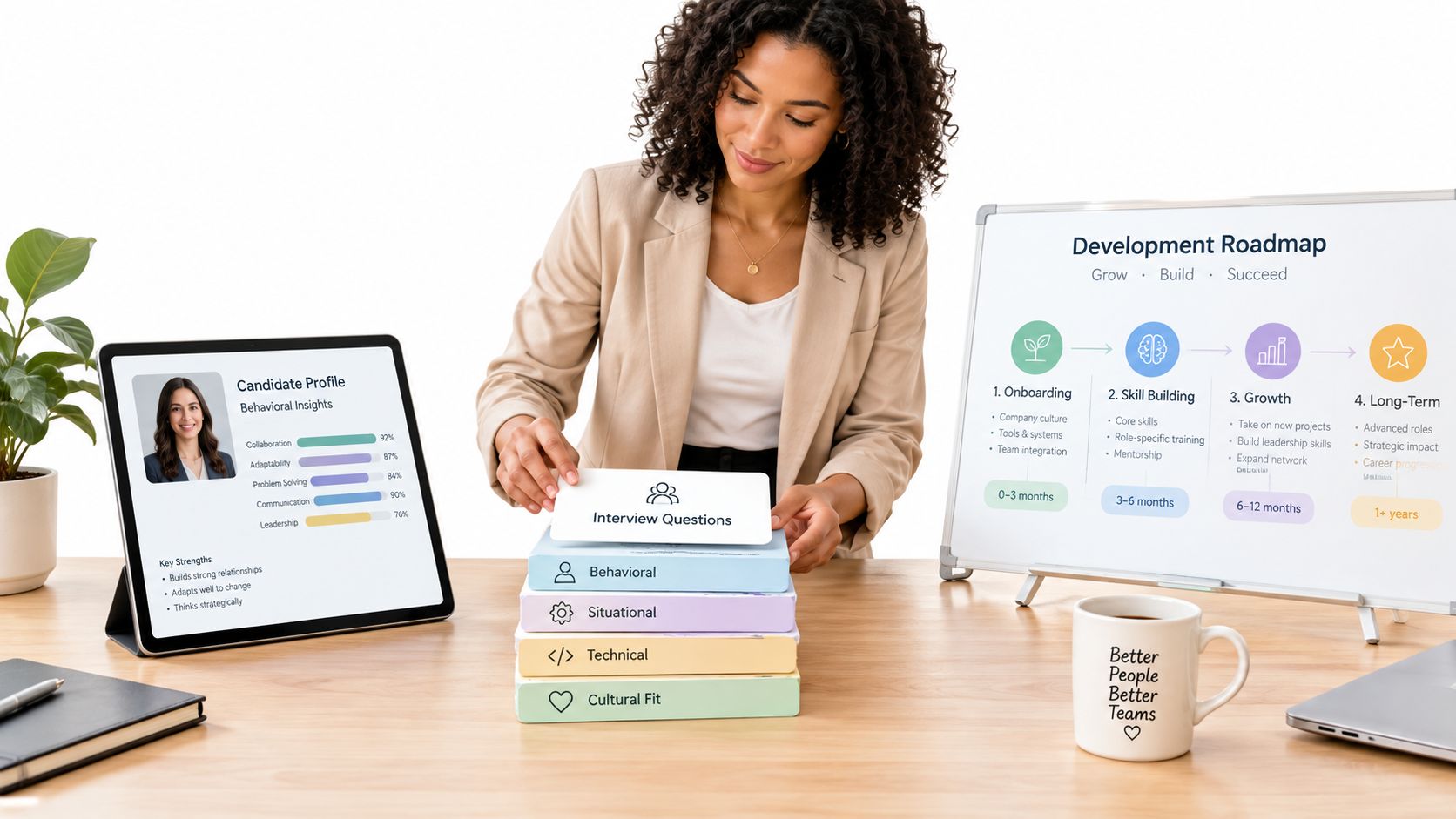
For hiring, convert the cultural gap into behavioral evidence. If the organization needs stronger cross-functional trust, define the relevant behaviors, then write structured probes about sharing incomplete information, repairing a missed handoff, and challenging a powerful stakeholder. A behavioral profile can focus the interview, but it shouldn't replace role evidence, simulations, references, and structured scoring.
For team design, look for complementarity rather than uniformity. A team may need people who create context, people who demand clarity, people who challenge assumptions, and people who close decisions. The assessment should identify likely tension points, then give the manager a plan for using those differences instead of labeling them as fit or misfit.
For development, write behavior-level goals. “Be more collaborative” isn't a development plan. “Invite the dependent function into planning, document the decision rationale, and review unresolved handoffs in the weekly operating meeting” is specific enough to observe.
A worked translation
Suppose the diagnosis finds low cross-functional trust. The action chain could look like this:
A retention program can complement this work. Practical [engagement tactics that boost retention](https://redactai.io/blog/how-to-reduce-employee-turnover) are most useful when they address the diagnosed behavior and management practice rather than adding generic perks.
Here's where Synopsix fits as one possible behavioral data layer. Its platform generates comparable behavioral profiles, translates assessment results into business signals, and supports team complementarity analysis, simulations, and development planning. Used appropriately, that information can sit alongside culture survey results and operational evidence, not substitute for them.
<iframe width="100%" style="aspect-ratio: 16 / 9;" src="https://www.youtube.com/embed/mDtlGNDGyuI" frameborder="0" allow="autoplay; encrypted-media" allowfullscreen></iframe>
The decision rule is simple: every recommendation should name the behavior, the actor, the context, the reinforcement mechanism, and the evidence that will show whether the behavior changed.
Communicating Results, Avoiding Pitfalls, and Setting the Cadence
Leaders need different versions of the same diagnosis. The CEO and board need risk indicators, strategic implications, and decisions required. Managers need team-level patterns, examples, and a short list of behaviors to practice. Employees need a transparent summary of what was heard, what won't be shared, and what will happen next. Individual responses should remain anonymous.
Avoid four predictable errors:
A practical cadence includes a three-month pulse focused on the behaviors selected for action, followed by a 12-month full reassessment using the same core instrument. Track predefined behavioral KPIs alongside the survey, such as escalation timing, cross-functional handoff quality, promotion patterns, safety or ethics incidents, customer complaints, or retention patterns. Don't claim culture changed because sentiment improved. Show which behaviors shifted and whether the relevant operational signal moved with them.
> Final check: Before approving the report, ask whether each major claim has a survey signal, a behavioral or narrative signal, and an operational interpretation.
---
Synopsix helps HR teams connect validated behavioral assessments with hiring, team design, and development decisions through comparable profiles, role insights, simulations, and team complementarity analysis. Visit [Synopsix](https://synopsix.ai) to see how its people intelligence platform can add a behavioral layer to your organizational culture assessment.