Organizational Design Consulting: A Practical Guide
By Synopsix · November 6, 2026 · 17 min read
More than half of respondents said interventions intended to change knowledge, attitudes, or behaviors were often or always difficult, according to a [practitioner survey published in the Journal of Organization Design](https://link.springer.com/article/10.1186/s41469-019-0053-x). That reframes organizational design consulting: drawing a different hierarchy isn't the hardest part. Getting people to decide, collaborate, and deliver differently is.
A useful redesign therefore starts before anyone moves a reporting line. Leaders record how the organization works today, specify what should improve, and agree when they'll check the results. The new chart is a proposal. Changes in day-to-day performance are the proof.
What Organizational Design Consulting Covers
Organizational design consulting is advisory work that changes how a company is structured so it can deliver its strategy. The org chart is the visible drawing. The operating model is the plumbing: it determines how work, information, and decisions flow.
This is an established advisory discipline, not an HR exercise. An [IBISWorld industry profile](https://www.homeworkforyou.com/static_media/uploadedfiles/ibisworld%20management%20consulting%20january%202021.pdf) estimated that organizational design services accounted for 25.5% of U.S. management-consulting revenue in 2020, making it the sector's second-largest service category, serving private companies, government agencies, nonprofits, and financial institutions.
The six components consultants redesign
| Component | Question it answers | Example evidence | |---|---|---| | Reporting lines and spans | Who reports to whom, and how wide is each manager's span? | Span-of-control variability across units | | Decision rights | Who decides what, and where do escalations stop? | Escalations per month reaching the executive team | | Roles and capacity | Which roles exist, and do critical roles have enough people? | Critical-role capacity against demand | | Processes and coordination | How do work and information move between teams? | Customer lead time and duplicated activities | | Talent and behaviors | Which skills and mindsets does the model need? | Capability coverage and adoption gaps | | Governance | Who resolves cross-functional conflicts and reviews performance? | Decision cycle time |
Say a manufacturer wants to sell ongoing maintenance services rather than equipment alone. Moving service employees under a new director won't settle who prices contracts, approves exceptions, or owns customer renewals. Consultants must connect those responsibilities to authority, staffing, incentives, and customer handoffs.
That distinction separates structure from design. Structure describes the arrangement of roles. Design tests whether that arrangement enables the work the strategy requires.
> Practical rule: For every proposed structural change, name the decision or workflow that should improve and the evidence that would demonstrate it.
A consultant's deliverables should therefore include more than boxes and job titles. Expect role definitions, decision rules, interface agreements, capability requirements, and a measurement plan. Without those connections, employees may keep using familiar approval routes beneath a newly published chart.
When Your Organization Needs a Design Consultant
A merger or acquisition is a clear trigger for outside help. Leaders inherit overlapping functions, competing approval chains, and different assumptions about authority. An independent facilitator can help them resolve those choices without treating either legacy organization as the automatic template.
Growth creates a different problem. Founders who once approved every important decision become bottlenecks, while managers lack clear authority to act without them. A new strategy can expose similar gaps when the organization needs capabilities its existing departments weren't built to provide.
Repeated missed targets also justify investigation, particularly when capable teams keep failing at the same handoffs. But poor performance alone doesn't prove that the structure is wrong.
A short leadership self-check
Use these questions to distinguish a design problem from a local management issue:
Look for inconsistent answers, not just uncomfortable ones. If executives describe different owners for the same decision, they haven't agreed on accountability.
For a hypothetical warning sign, consider managers with two direct reports alongside managers with more than twenty. That deserves investigation, not an automatic equalization exercise: technical complexity and coaching demands may justify different spans. Likewise, approvals passing through several levels or teams reporting the same metric differently suggest unclear operating rules.
When redesign isn't the answer
If the problem is an individual leader's capability, unsuitable pay, or an unresolved performance issue, changing everyone's reporting lines is an expensive distraction. Use [workforce planning analytics](https://synopsix.ai/blog/workforce-planning-analytics) to separate capacity shortages from coordination problems before deciding the scope.
AI-related role changes also need a named accountable owner before departments start redesigning independently. That owner should coordinate technology, HR, and operations so task automation doesn't accidentally remove development opportunities or leave nobody responsible for exceptions.
Frameworks and Methodologies Consultants Use
Consultants rarely apply a single framework throughout an engagement. They combine methods according to the questions leaders need answered, rather than forcing every problem through a preferred template.
Methodologies matched to the problem they solve
| Methodology | Core question | Best fit | Main output | |---|---|---|---| | Spans and layers analysis | Are there too many or too few management layers? | Overgrown hierarchies after rapid growth | Layer map and span targets | | Decision-rights mapping | Who owns each recurring decision? | Slow approvals and unclear accountability | Decision-rights matrix | | Process-based redesign | Which end-to-end workflows cross too many handoffs? | Customer-facing delays and duplicated work | Value-chain map and interface design | | Operating model design | How do structure, processes, people, and technology fit together? | Strategy change or post-merger integration | Target operating model blueprint | | Network and collaboration analysis | Where does information actually flow? | Friction across units and informal bottlenecks | Collaboration map and bottleneck list | | Culture and capability mapping | Which roles, strengths, and values exist today? | Culture-led change or leadership transitions | Role and strengths map by level |
Choose methods by the unanswered question
Use spans and layers analysis for an overgrown hierarchy, but never alone. HR records can reveal reporting relationships and management concentrations. They won't tell you whether a manager makes necessary technical decisions or merely forwards requests.
For example, removing a management layer without reallocating its approval authority leaves employees searching for a replacement approver. The hierarchy becomes shorter while the actual decision path remains unresolved.
Combine decision-rights mapping with process redesign when approvals and handoffs delay customers. Trace a real request from arrival to completion. Record who supplies information, who recommends action, who decides, and who can stop the process.
Don't assign joint final ownership merely to avoid disagreement. Separate consultation from approval, and specify the circumstances that require escalation.
Use network analysis when the formal chart looks sensible but work still stalls. An informal expert may connect departments without any designated coordination role. [Organizational network analysis](https://synopsix.ai/blog/organizational-network-analysis) helps distinguish that valuable connector from a bottleneck created by excessive dependence on one person.
There's a collection trade-off. Spans analysis can begin with existing HR records, while network analysis requires careful collection and interpretation of collaboration information. Define privacy boundaries and the business question before gathering interaction data.
> Ask a prospective consultant to explain which diagnostic method they'd start with, what information it requires, and what finding would change their recommendation.
A useful answer describes competing explanations. A weak answer begins with a predetermined structure.
Metrics That Prove a Redesign Works
In McKinsey's survey of 2,063 executives, only about 23% of redesigns both met their objectives and improved performance, while 44% lost momentum during implementation. Leaders need an operating scorecard, not just confirmation that employees have moved into new positions.
Record the starting position before announcing changes. Otherwise, teams may alter how they count work, making later comparisons unreliable.
Operating metrics to baseline before a redesign
The entries below describe what to record, not external benchmarks. The span range is an illustrative example.
| Metric | How to measure it | Example baseline | |---|---|---| | Decision cycle time | Days from request to approved decision | Median days for a budget approval | | Duplicated activities | Count of teams performing the same task | Number of parallel reporting packs | | Escalation frequency | Escalations per month reaching the executive team | Escalations per 100 decisions | | Span-of-control variability | Spread of direct reports across managers | Hypothetical range from 3 to 14 direct reports | | Customer lead time | Days from request to delivery | Average days to fulfil a customer request | | Critical-role capacity | Available headcount or hours against demand | Open hours on key roles versus backlog |
Assign each metric an owner, definition, baseline, target, and review date. Specify where timestamps come from, which cases are excluded, and whether a measure applies to all work or a defined sample.
Review the scorecard on a fixed cadence for at least two quarters after launch. Treat that period as a practical monitoring commitment, not a universal research threshold. Keep definitions stable so a cleaner reporting process doesn't masquerade as operational improvement.
Make the financial comparison credible
Build the ROI case from specific operating gains: less duplicated effort, shorter customer waits, and faster decisions that release work. Compare those gains with consulting fees, implementation costs, training, and transition-related productivity losses.
Don't count every hour saved as cash savings. Explain whether managers will remove expenditure, absorb additional demand, or redeploy capacity. Avoid counting the same benefit under both shorter lead time and higher productivity.
Pair efficiency measures with safeguards. Faster approvals aren't an improvement if employees bypass necessary controls, and fewer escalations aren't helpful if teams conceal unresolved problems.
A completed hierarchy is a milestone, not a return on investment. Judge the redesign by what employees can deliver under the new operating rules.
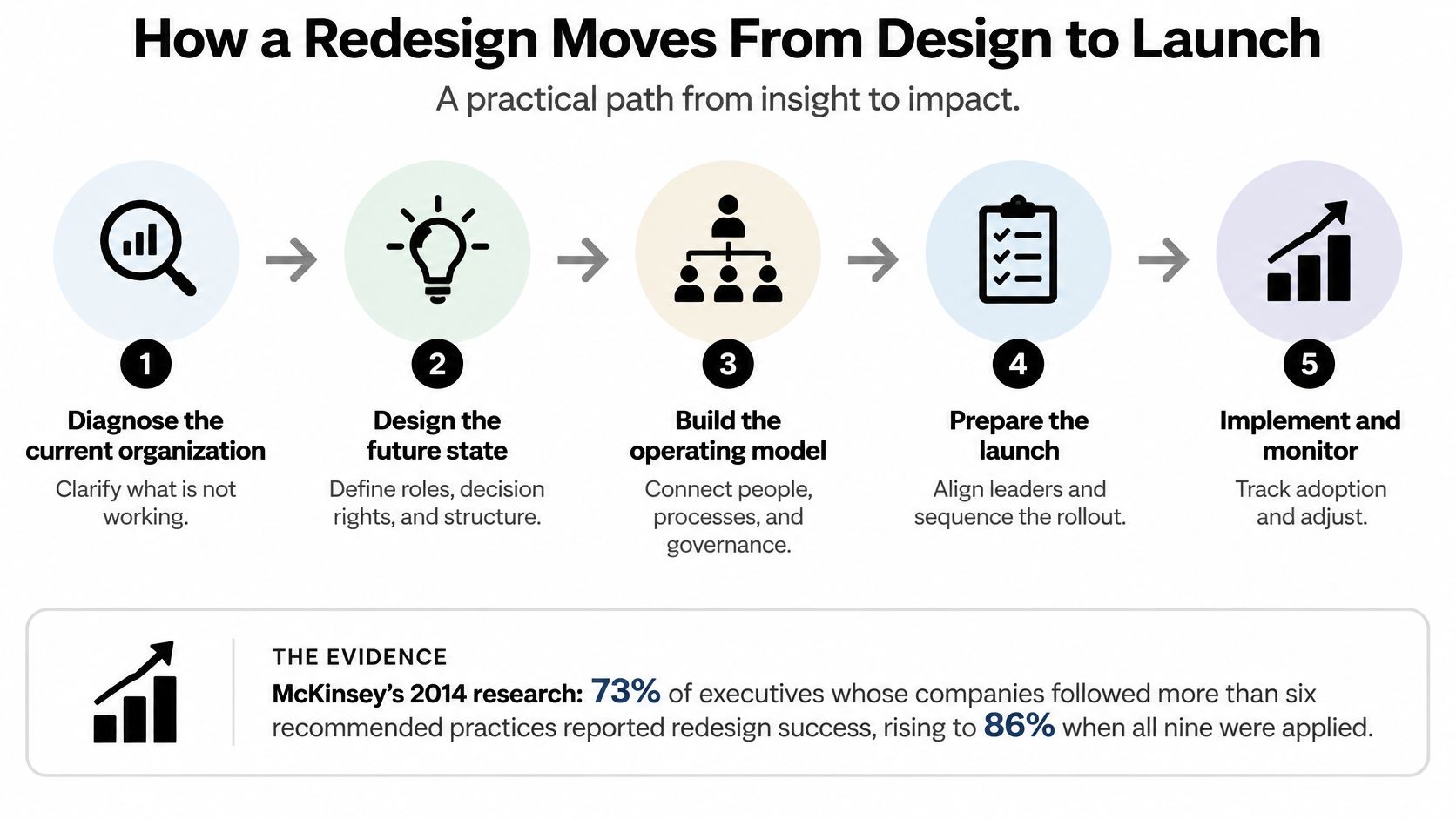
How a Redesign Moves From Design to Launch
In [McKinsey's 2014 organizational-redesign research](https://www.mckinsey.com/~/media/mckinsey/business%20functions/organization/our%20insights/mckinsey%20on%20organization/mckinsey%20on%20organization%20agility%20and%20organization%20design.pdf), 73% of executives whose companies followed more than six recommended practices reported success, rising to 86% when all nine were applied; the analysis also described a typical reorganization taking about ten months, with more than half reporting productivity declines during the transition. This is older evidence, but its emphasis on coordinated implementation remains useful.
The broad sequence connects diagnosis with ongoing monitoring.
Turn the design into working agreements
1. Align leaders on objectives and design criteria. Agree what the organization must accomplish and which constraints it must preserve. The common slip is debating who reports to whom before agreeing on the goal.
2. Set the operating baselines. Confirm the measures that will test the proposed changes. Skipping this step lets sponsors claim gains later without a defensible comparison.
3. Define decision rights and accountable roles. Give owners the authority, information, and resources needed to act. Naming an owner without authority creates responsibility without control.
4. Specify mindset and behavior changes. Describe observable actions, such as consulting another function before committing delivery capacity. Treating structure as sufficient leaves employees following incompatible habits.
5. Pilot critical interfaces. Test difficult handoffs with actual work and a clear route for resolving exceptions. Launching everywhere simultaneously makes it harder to identify what caused a problem.
6. Publish the decision-rights matrix to affected managers. Walk through realistic decisions so managers can explain the rules to their teams. Sending the document only to executives leaves operational users guessing.
7. Track productivity and employee-risk indicators weekly. Watch backlog, rework, workload concerns, and unresolved role questions. Waiting until quarter end can leave a manageable issue unaddressed through the transition.
8. Run a time-bound governance forum. Give cross-functional disputes an owner, resolution deadline, and route back into normal management. An open-ended forum can become another permanent approval layer.
Protect continuity during the transition
Build temporary coverage, manager training, and reduced change capacity into the rollout plan. Include the expected productivity dip in the financial model rather than assuming uninterrupted output.
Set explicit conditions for expanding, adjusting, or pausing the pilot. Leaders should be able to change an interface without reopening every structural decision.
Case Studies of Redesigns in Practice
These are illustrative composites, not reported client results. Each shows how a consultant can translate a structural concern into a testable operating change.
Illustrative bank merger
A bank formed by merging two regional units retains separate approval chains for equivalent credit decisions. Relationship managers seek approval through both routes because neither legacy leadership team has relinquished authority.
Consultants start with decision-rights mapping, separating risk oversight from commercial approval. They define the final decision owner, retain necessary controls, and pilot the consolidated route in a region before extending it.
The success test is decision cycle time for comparable applications, supported by checks on exceptions and control quality. Publishing a unified reporting chart wouldn't resolve the duplicate approval requirement on its own.
Illustrative nonprofit growth
A growing nonprofit has managers with two direct reports in one department and twenty-five in another. These hypothetical spans prompt a review, but the consultant doesn't assume every manager should supervise the same number of people.
A spans-and-layers review examines work complexity and coaching requirements. Network analysis then identifies a program coordinator who informally resolves nearly every cross-department scheduling conflict.
The proposed design redistributes coordination responsibilities and formalizes the escalation route. Leaders judge it against the recorded scheduling backlog, manager workload, and dependence on that coordinator, rather than span uniformity alone.
Illustrative retailer using AI
A retailer introduces AI assistance into customer service. Instead of immediately removing roles, leadership appoints an accountable operating-model owner and separates routine drafting from sensitive complaints, refunds, and judgment-heavy exceptions.
The team defines human review responsibilities and creates a reskilling pathway before considering role reductions. Managers explain what employees will stop doing, what they'll learn, and who remains accountable when the tool is wrong.
The pilot compares customer lead time, rework, capability coverage, and employee concerns with the pre-launch position. This approach is intended to reduce uncertainty and protect development opportunities, not to promise that automation will have no employment consequences.
> In each scenario, the useful question is whether the changed operating rules solve the original problem without creating a worse one.
How People Intelligence Strengthens Team and Role Design
People intelligence adds behavioral evidence to structural analysis. Validated assessments produce comparable profiles, while team simulations let leaders examine a proposed hire, promotion, or reorganization before committing to it. The practical value is not prediction for its own sake. It is a baseline. If you record how people work together before a change, you can check afterward whether collaboration, decision rights, and performance moved.
A team-profile discussion should connect individual differences to actual responsibilities.
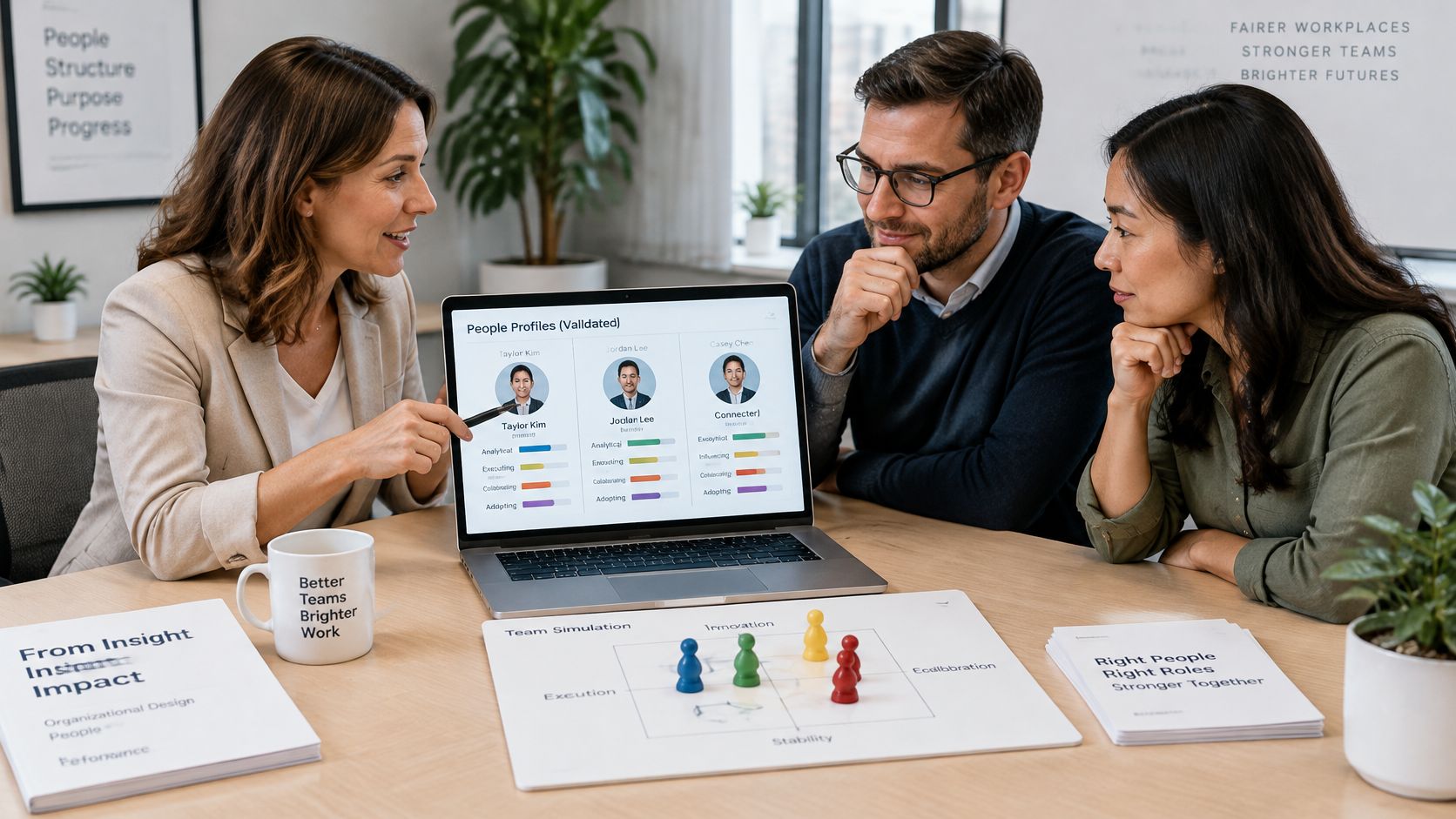
An illustrative sales-team merger
Consider a regional sales-team merger. Two teams are combining, and leadership must select a leader for the merged unit without assuming that the strongest individual salesperson will be the strongest manager.
Start by mapping both teams' roles and reporting relationships. Define what the combined leader must do: allocate accounts, coach managers, negotiate shared resources, and resolve competing regional priorities.
Compare candidate leaders against those requirements using consistent behavioral evidence, structured interviews, and demonstrated performance. A [team role assessment](https://synopsix.ai/blog/team-role-assessment) can help distinguish complementary working styles from missing capabilities.
Then simulate the merged team to surface hypotheses about friction. If regional managers may compete over account ownership, clarify allocation authority and dispute resolution before launch rather than expecting personal compatibility to settle the issue.
The accompanying video offers another way to consider people evidence in decision-making.
<iframe width="100%" style="aspect-ratio: 16 / 9;" src="https://www.youtube.com/embed/cr8sLxde1m8" frameborder="0" allow="autoplay; encrypted-media" allowfullscreen></iframe>
Benchmark behaviors without cloning the team
Behaviors associated with a high-performing team can provide a reference profile. Compare candidates and internal leaders against the same role-relevant standard, and distinguish useful behaviors from superficial similarity.
Constructive challenge may matter more than matching the communication style of current executives. A benchmark should help identify complementary strengths, not reproduce the existing team indiscriminately. Cloning feels safe because it promises harmony, yet a merged team usually needs someone who fills its gaps rather than one more copy of its dominant style.
Assessments and simulations inform decisions; they do not establish certainty about an individual's future behavior. Require validation for the intended use, informed consent, fairness checks, appropriate access controls, and human judgment about context.
After launch, run a fixed review cadence. Compare predicted friction with observed collaboration at thirty, sixty, and ninety days, and treat each gap between forecast and reality as a design signal. Keep the conclusions open to correction rather than treating a profile as a permanent label.
Choose a Partner and Confirm Your Next Step
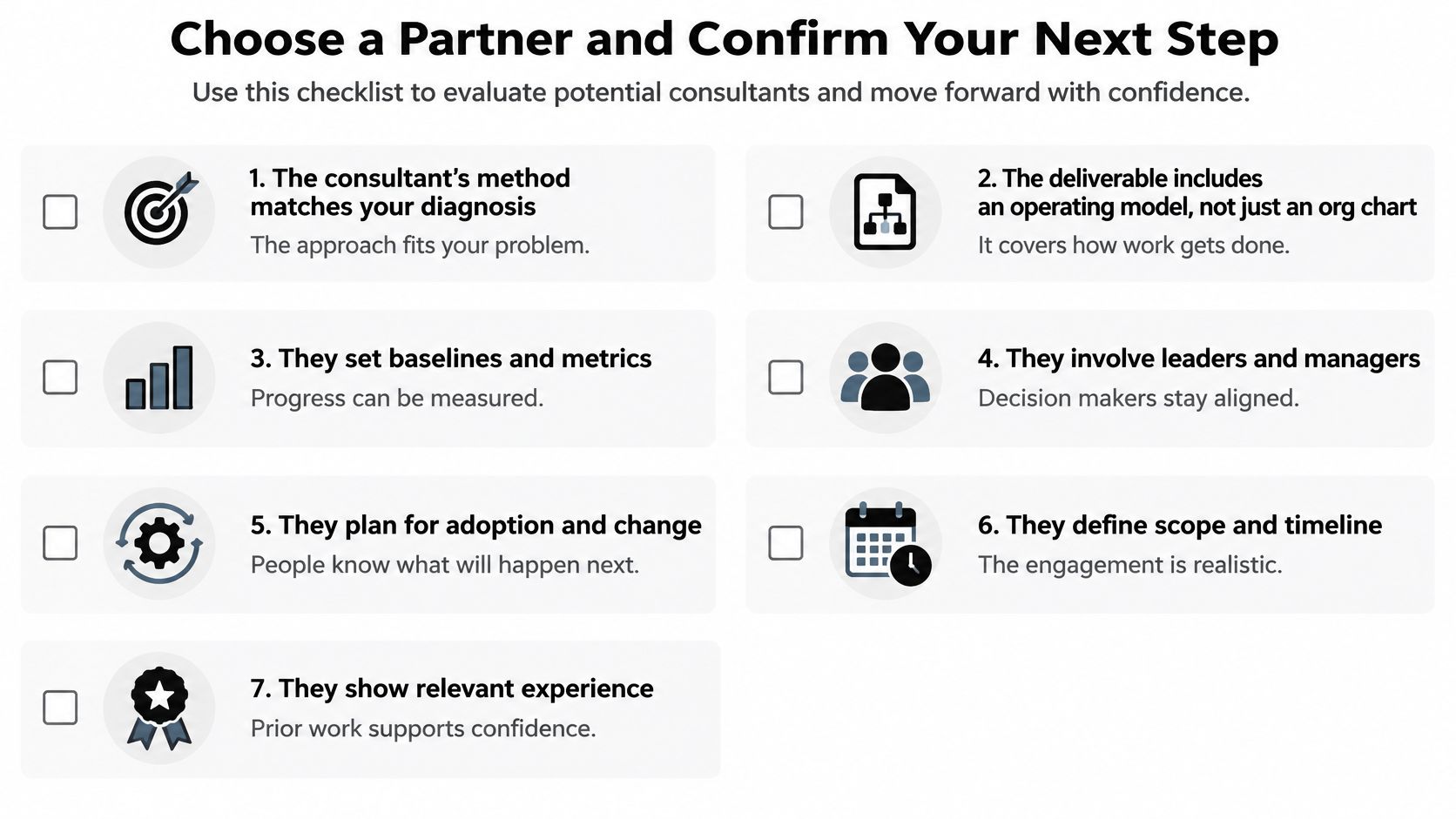
Use a selection checklist that tests how the consultant will work, not merely how confidently they present a proposed structure.
Use the visual checklist to support the selection conversation.
Challenge the commercial proposal
Ask how fees relate to the operating outcomes the engagement is intended to improve. Establish who owns implementation, what happens when the pilot exposes a flaw, and which support remains after launch.
Red flags include promised savings without operating measures, no implementation plan, and a method the engagement team can't explain. For assessment and simulation vendors, examine validation evidence as carefully as presentation quality. Hire Sense's [background on the recruitment platform](https://hire-sense.io/about) is a useful starting point for understanding a recruitment provider's scope before comparing it with broader organizational-design needs.
At Synopsix, we start by absorbing the organization's Org DNA, including culture, values, business priorities, and assessments already run. We can deliver a defensible hiring call in under 48 hours, but a hiring decision and an organizational redesign have different scopes.
Wolf C. describes the broader application:
> "Synopsix is so much more than a talent acquisition gadget! It supports not only candidate sourcing and selection, but also enables organizational design by mapping roles, teams, and reporting structures."
Choose three operating metrics and record their baselines this month. Use the findings to determine whether you need external design expertise, targeted management action, or better people evidence before changing the organization.
---
Synopsix offers behavioral assessments, comparable profiles, and team simulations to help leaders evaluate people and role choices within an organizational redesign. Visit [Synopsix](https://synopsix.ai) to explore how those capabilities can support your next hiring, promotion, or team-design decision alongside a measurable operating plan.