Organizational Effectiveness Guide to People and Performance
By Synopsix · September 16, 2026 · 17 min read
A team can have a strong strategy, modern technology, and generous resources, yet still underperform. Gallup's meta-analysis of 82,248 business and work units involving 1.8 million employees found that highly engaged teams had nearly double the odds of success on a composite of financial, customer, retention, safety, quality, shrinkage, and absenteeism outcomes compared with teams in the bottom half of engagement. The practical lesson is uncomfortable but useful: organizational effectiveness isn't produced by an org chart alone. It emerges from the way people, decisions, culture, and execution work together.
Consider two companies entering the same market with similar products and comparable funding. In the first, leaders clarify priorities, managers give useful feedback, and hiring decisions reflect the behaviors the strategy requires. Teams know who owns decisions and can challenge weak assumptions without damaging trust. In the second, leaders announce the same priorities but change them frequently, managers avoid difficult conversations, and new hires are selected mainly for experience rather than behavioral fit. Both organizations may look efficient from the outside. Only one consistently converts plans into results.
That distinction matters as organizations adopt AI, respond to changing employee expectations, and face pressure to improve performance without exhausting their people. Effectiveness is a system property, not a single engagement initiative, training course, or software purchase.
Introduction Why Some Organizations Consistently Outperform
Organizational effectiveness describes an organization's ability to align its people, strategy, and execution so it can deliver meaningful results over time. The definition sounds straightforward. Applying it is harder because failure rarely comes from one isolated weakness.
A company may have a clear strategy but lack the skills to execute it. It may have talented employees but conflicting priorities. It may redesign performance management while employees still distrust the ratings and reward decisions attached to it. In each case, the visible problem appears in one place, while the constraint sits somewhere else.
Gallup's research gives this topic a practical foundation. Its engagement meta-analysis found that highly engaged teams showed 23% higher profitability, 18% higher productivity in sales, 78% lower absenteeism, and 21% lower turnover in high-turnover organizations, with 51% lower turnover in low-turnover organizations. These findings come from a broad set of industries and countries, so engagement shouldn't be treated as a soft culture score detached from business performance. [Gallup's Q12 meta-analysis](https://www.gallup.com/workplace/321725/gallup-q12-meta-analysis-report.aspx) connects workplace conditions with a composite view of organizational outcomes.
> Practical rule: Diagnose the people system behind the result, not just the result itself.
This guide moves from meaning to application. It defines what organizational effectiveness includes, separates its main drivers, compares useful diagnostic frameworks, explains how to measure it without creating a dashboard of disconnected numbers, and shows how leaders can turn behavioral insight into better hiring, team design, and development decisions.
The central argument is simple: organizations improve when they make better decisions about people and the conditions in which people work. Org charts still matter, but trust, decision quality, role clarity, and behavioral fit often determine whether that structure functions as intended.
What Organizational Effectiveness Really Means
Think of an organization as an engine. An engine doesn't perform because one part is excellent. It performs when fuel, timing, components, controls, and maintenance work together. Organizational effectiveness follows the same logic. People provide capability and motivation, strategy sets direction, and execution converts priorities into outcomes.
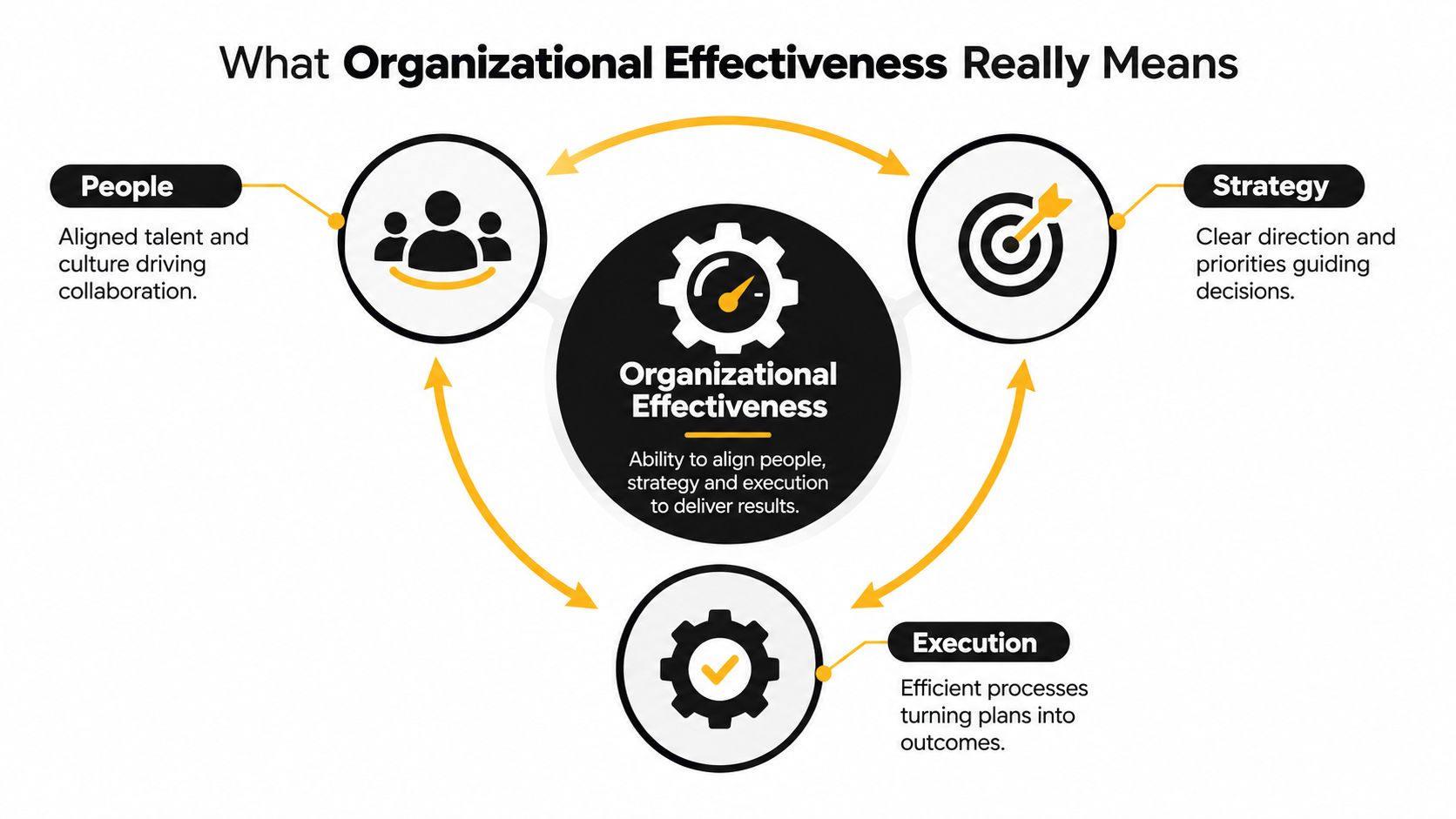
A useful working definition is the organization's ability to align people, strategy, and execution to deliver sustained results. Each word matters:
Effectiveness is not the same as efficiency
Efficiency asks whether a team uses fewer resources, less time, or fewer steps to complete work. Productivity asks how much output employees generate. Effectiveness asks a more consequential question: are people doing the right work, in the right way, to achieve the organization's purpose?
A team can process requests quickly and still be ineffective if it resolves the wrong customer problem. A sales function can hit activity targets while attracting poor-fit customers. A company can reduce headcount and appear more efficient while weakening the capabilities required for future performance.
That's why leaders need more than isolated operational indicators. They need a composite view that connects outcomes with the conditions producing them.
Engagement provides a measurable people signal
Gallup's Q12 framework measures workplace conditions such as role clarity, recognition, development, and connection to mission. Gallup reports that global engagement has remained below 25% for more than a decade, while best-practice organizations consistently reach around 70% engagement. In the United States, 31% of employees were engaged in 2024, the lowest level in a decade and the same level recorded in 2014, while 17% were actively disengaged. [Gallup's employee engagement research](https://www.gallup.com/workplace/229424/employee-engagement.aspx) also estimates that low engagement cost the world $10 trillion in 2025, equal to 9% of global GDP.
These figures don't mean engagement is the entire definition of effectiveness. They show why it functions as a useful diagnostic proxy. If employees lack clarity, recognition, development, or mission connection, leaders should investigate the management practices, role design, and decision systems surrounding them.
For a broader explanation of how priorities and teams connect, see this guide to [organizational alignment](https://synopsix.ai/blog/organizational-alignment). Alignment is the bridge between a good plan and coordinated action.
The Five Drivers That Shape How Organizations Perform
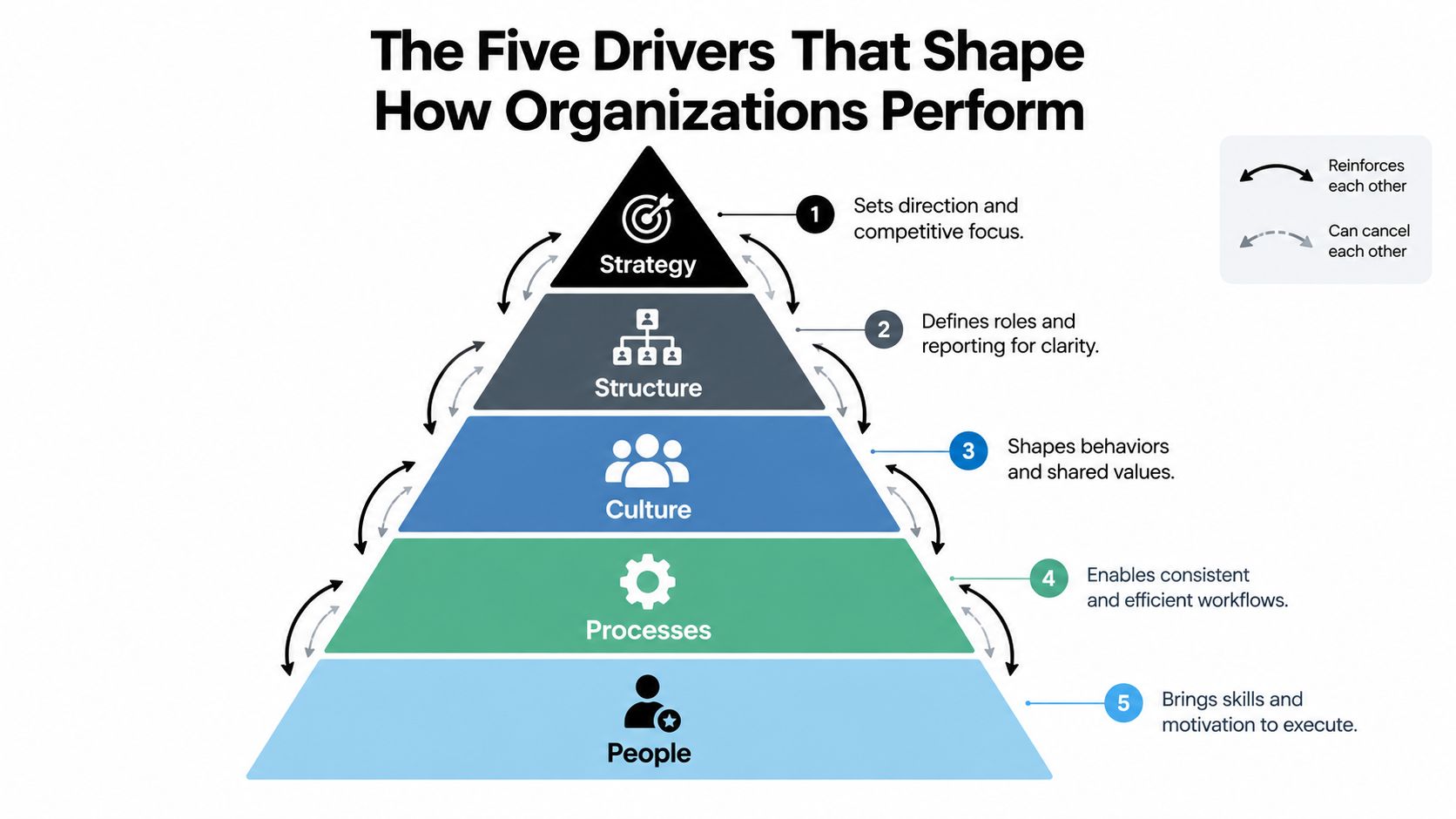
Organizational effectiveness usually reflects five interacting drivers: strategy, structure, culture, processes, and people. Treating them as separate categories helps diagnosis, but treating them as independent solutions creates confusion. Each driver can reinforce the others or cancel them out.
Strategy sets the test for every other choice
Strategy identifies where the organization will compete, serve, or create value. It should tell leaders which capabilities matter, which trade-offs they must accept, and which decisions deserve speed.
A growth strategy that depends on consultative selling requires different hiring signals from a strategy based on high-volume transactional sales. A product strategy built around experimentation needs different leadership behaviors from one built around operational consistency. If leaders don't translate strategy into observable requirements, hiring and development become disconnected from business priorities.
Research on 29 organizations found that proactive, externally oriented, and multifaceted managerial strategies were more strongly associated with high effectiveness and improvement over time than demographics, finances, or organizational structure. [The Management Science study](https://pubsonline.informs.org/doi/10.1287/mnsc.32.1.87) supports a practical conclusion: leaders shouldn't focus only on internal optimization. They must also design how the organization reads its market and coordinates across functions.
Structure clarifies accountability
Structure answers who owns work, who makes decisions, and how information moves. A matrix can support collaboration when decision rights are explicit. It can create paralysis when several leaders believe they own the same outcome.
The best structure isn't necessarily the simplest one. It is the one that makes accountability visible enough for people to act without constant escalation.
Culture turns formal rules into daily behavior
Culture shows employees what the organization rewards, tolerates, and ignores. A company may publish values such as openness and customer focus, but employees learn the culture from promotion decisions, meeting behavior, and how leaders respond to bad news.
A meta-analysis covering 84 empirical studies and 94 independent samples found positive associations between clan, adhocracy, and market cultures and different effectiveness criteria, including employee attitudes, innovation, quality, and financial performance. [The culture and effectiveness meta-analysis](https://pubmed.ncbi.nlm.nih.gov/21244127/) supports the view that culture configuration can affect both people outcomes and hard performance outcomes.
Processes create repeatability
Processes determine how work moves from intention to completion. Clear workflows reduce avoidable friction, while poorly designed processes force employees to compensate through extra meetings, workarounds, or personal relationships.
People supply capability and behavior
People bring skills, judgment, motivation, and behavioral patterns. The relevant question isn't only whether someone can perform a task. It's whether their working style fits the role, manager, team, and strategy.
For hiring teams evaluating technology that supports this work, a curated overview of the [best TA platforms](https://shorepod.com/post/the-12-best-talent-acquisition-software-platforms-for-2025) can help compare recruiting infrastructure. The platform decision still needs to follow the organizational diagnosis, not replace it.
<iframe width="100%" style="aspect-ratio: 16 / 9;" src="https://www.youtube.com/embed/P9-4yxfznhw" frameborder="0" allow="autoplay; encrypted-media" allowfullscreen></iframe>
The diagnostic question is therefore not “which driver is broken?” but “which driver is currently limiting the others?” Strong processes cannot rescue an unclear strategy. Skilled employees can't compensate indefinitely for distrustful management. A healthy culture can amplify disciplined execution, while a culture that punishes candor can make even advanced systems unreliable.
Frameworks That Make Effectiveness Practical
Leaders need a framework that turns a broad concept into a decision tool. No single model fits every situation. A culture lens helps explain behavior, a strategy-execution lens clarifies priorities, and a system-alignment lens shows where the parts fail to connect.
A study of managerial strategy found that proactive, externally oriented, and multifaceted approaches were associated with both high effectiveness and improvement over time. That finding favors frameworks that examine how leaders connect internal capabilities with external demands, rather than models focused only on hierarchy or cost control.
Choosing an Organizational Effectiveness Framework
| Framework Lens | Core Focus | Best When | |---|---|---| | System alignment | Fit between people, structure, processes, strategy, and execution | Several functions appear busy, but results remain inconsistent | | Culture-effectiveness | Shared behaviors, values, employee attitudes, innovation, quality, and financial outcomes | Leaders suspect that norms and management behavior are blocking performance | | Strategy-execution | Strategic clarity, external orientation, decision rights, and cross-functional coordination | The strategy is sound, but teams struggle to prioritize or act consistently |
The system-alignment lens works well for organization-wide diagnosis. It helps CHROs identify whether a capability gap is caused by hiring, role design, leadership, workflow, or conflicting incentives. Its weakness is breadth. A system map can reveal many relationships without immediately identifying which intervention should come first.
The culture-effectiveness lens is more useful when employees understand the strategy but behave in ways that undermine it. Meta-analytic evidence links clan, adhocracy, and market cultures with different effectiveness criteria, including employee attitudes, innovation, quality, and financial performance. That makes culture a performance variable, not a decorative label. Its trade-off is that culture assessment can become abstract unless leaders connect stated values to observable decisions.
The strategy-execution lens is strongest when teams need sharper priorities. It asks whether managers actively scan the external environment, coordinate across boundaries, and make trade-offs visible. It can expose a common failure mode: leaders announce a strategy but leave employees to infer what it means for hiring, collaboration, and resource allocation.
> Decision test: Choose the framework that explains the decision you need to make, not the framework with the most impressive vocabulary.
Hiring is where these lenses become concrete. If a strategy requires customer empathy and rapid adaptation, competency mapping can translate those requirements into observable behaviors, interview evidence, and assessment criteria. This practical resource on [how competency mapping works in hiring](https://career-central.com/blog/what-is-competency-mapping) provides useful context for connecting organizational priorities with selection decisions.
How to Measure Organizational Effectiveness With Confidence
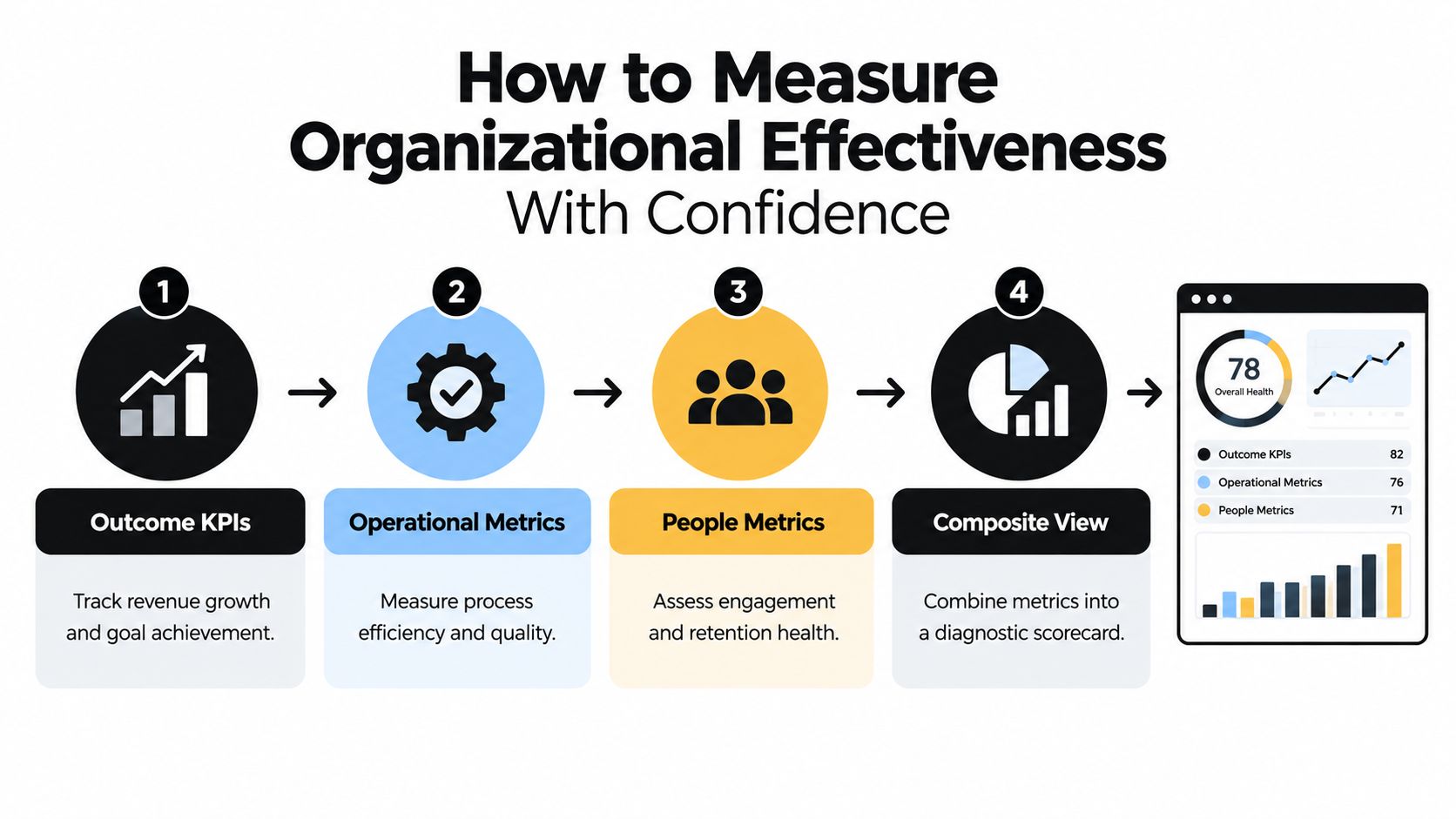
Measurement should work like a medical diagnosis. A clinician doesn't rely on one reading to understand a patient's health. They combine symptoms, vital signs, history, and tests to determine what requires attention. People leaders need the same discipline. A dashboard is useful only when it helps someone make a better decision.
Start with outcomes
Begin with the results the organization exists to produce. Depending on the business, these may include revenue growth, customer outcomes, quality, safety, retention, mission achievement, or progress against strategic goals. Don't select indicators because they're easy to export. Select them because a leadership team would change a decision if the indicator moved.
Next, add operational measures that explain how the outcome is produced. Process quality, cycle time, rework, handoff friction, and goal completion can reveal where execution breaks down. Pairing outcome and operational measures reduces the risk of celebrating activity that doesn't create value.
Add people signals, then interpret relationships
People measures provide context. Engagement, retention, absenteeism, internal mobility, manager feedback patterns, and capability coverage can show whether the organization has the conditions to sustain performance. Use them to ask better questions, not to label individual employees.
Assessment tools require similar scrutiny. Predictive validity measures how well a selection method predicts future job performance, job-related learning, or other work criteria. [Personnel assessment research](https://home.ubalt.edu/tmitch/645/session%204/Schmidt%20&%20Oh%20validity%20and%20util%20100%20yrs%20of%20research%20Wk%20PPR%202016.pdf) explains that criterion-related validity is typically demonstrated through the relationship between predictor scores and work outcomes.
A practical benchmark describes predictive-validity coefficients above 0.30 as useful, above 0.40 as strong, and above 0.50 as exceptional, with 1 indicating perfect prediction. [This assessment validity overview](https://scovai.com/blog/predictive-validity-assessments/) offers that benchmark, but leaders should still ask how the evidence was collected, for which roles, and under what conditions.
The Predictive Index behavioral assessment summary reports nearly 500 criterion-related validity studies since September 1976 across almost all jobs and countries, and says two recent meta-analyses found prediction of overall job performance, tenure, sales performance, and counterproductive behavior. [The Predictive Index validity summary](https://humanostics.com/wp-content/uploads/2020/01/The-Science-Behind-PI.pdf) is one example of why buyers should examine a tool's evidence rather than accept a broad claim of accuracy.
Treat trust as a measurement condition
Measurement fails when employees and managers don't believe the system. Deloitte's 2025 Global Human Capital Trends survey found that 61% of managers and 72% of workers couldn't say they trust their organization's performance management process, while WTW's 2025 research found that only 39% of organizations said their process effectively delivers clear goals, regular feedback, fair ratings, and strong reward links. [Deloitte's analysis of performance management](https://www.deloitte.com/global/en/insights/topics/talent/human-capital-trends/2025/employee-performance-management-optimization-effective-strategy.html) frames credibility and manager capability as central implementation issues.
A practical scorecard should therefore include a regular feedback signal, manager coaching quality, and evidence that employees understand how ratings and rewards are decided. Leaders can also consult this guide to [boost productivity with team tools](https://asantebot.com/blog/how-to-measure-team-performance/) when choosing operational ways to make collaboration and performance signals more visible.
For deeper analysis, connect these measures with [people analytics in HR](https://synopsix.ai/blog/people-analytics-in-hr), while protecting privacy and avoiding conclusions that the data can't support.
From Insight to Action Interventions That Improve Results
Measurement only creates value when it changes behavior or decisions. If engagement falls because employees lack role clarity, a social event won't solve the problem. If hiring produces technically capable people who struggle in a collaborative environment, adding more interview questions may not be enough. The intervention must match the diagnosed constraint.

Make hiring more behaviorally specific
Start with the role, not the assessment. Define the outcomes the person must produce, the decisions they'll own, the pressures they'll face, and the behaviors that support success. Then use structured interviews, work samples, simulations, references, and validated behavioral assessments as complementary evidence.
Behavioral fit doesn't mean hiring identical personalities. A team may need complementarity, such as a detail-focused operator working with an exploratory problem solver. The useful question is whether the candidate's behavioral pattern supports the role and fills a real team need.
Synopsix, for example, combines behavioral assessments and comparable profiles with role-focused intelligence reports, predictive simulations, compatibility analysis, and development plans. Used responsibly, a platform like this can help hiring and talent teams translate psychometric information into business-language signals rather than relying on intuition alone.
Design teams around complementarity
Team design should account for decision speed, conflict patterns, communication preferences, and coverage of critical capabilities. A leader can use team data to identify where responsibilities overlap, where one person carries too much coordination work, or where the group lacks a constructive challenger.
The objective isn't to remove all friction. Productive disagreement improves decisions when people have permission to challenge assumptions and a clear process for resolving conflict. Leaders should distinguish task conflict, which can improve thinking, from personal distrust, which usually makes information less reliable.
For a broader perspective on converting team insight into operating changes, see this resource on [team performance improvement](https://synopsix.ai/blog/team-performance-improvement).
Build a phased implementation
A practical rollout can follow four stages:
1. Define the business problem. Select one decision area, such as a hard-to-fill role, recurring team conflict, or weak leadership pipeline. 2. Collect comparable evidence. Combine performance outcomes, manager observations, employee feedback, and assessment data. Use consistent criteria across people and teams. 3. Test the intervention. Pilot a revised selection process, team working agreement, manager coaching routine, or development plan. Document what changed. 4. Review and scale. Compare the new evidence with the original diagnostic, gather user feedback, and expand only when managers can apply the approach consistently.
AI adds value when it improves decision quality, not when it hides judgment behind a score. LHH's 2026 C-suite research identifies AI and emerging technology as the top perceived leadership development gap, cited by 49% of leaders as a top priority. The same research reports that more than a quarter of leaders see a lack of strategic clarity as a major limiter of effectiveness, and one in four senior leaders believe their decision-making processes don't adequately support organizational needs. [LHH's C-suite research](https://www.lhh.com/en-us/insights/pressroom/lhh-2026-c-suite-research) points toward a clear design requirement: leaders must define decision rights, preserve human accountability, and teach managers how to use AI-generated insight critically.
Putting Effectiveness to Work for Your Role and Next Steps
Organizational effectiveness becomes actionable when each leadership group owns a different part of the people system.
CHROs should connect engagement, culture, workforce capability, and business outcomes in one operating conversation. Their role is to challenge disconnected initiatives and ensure that leadership behavior, performance management, and talent decisions reinforce the strategy.
Talent acquisition leaders should translate strategic capabilities into structured hiring criteria. They need evidence that assessment methods predict relevant work outcomes, along with governance that protects fairness and consistent use.
Hiring managers should define success behaviorally, use structured evidence, and discuss team complementarity before opening a requisition. A technically impressive candidate can still create execution risk if the role and team require a different working pattern.
People analytics leaders should build diagnostic scorecards rather than metric libraries. Their strongest contribution is helping leaders distinguish correlation from causation, identify the next decision, and monitor whether an intervention changed the underlying condition.
Use this checklist to keep progress practical:
The durable lever is not a prettier org chart. It's the consistent alignment of people, roles, behaviors, decisions, and strategy, supported by evidence leaders can understand and use.
---
Synopsix helps HR teams turn validated behavioral assessments into practical guidance for hiring, team design, and talent development. Visit [Synopsix](https://synopsix.ai) to explore assessment profiles, role intelligence, predictive simulations, compatibility analysis, and development plans for stronger people decisions.