HR Performance Prediction: Smart Decisions 2026
By Synopsix · July 13, 2026 · 17 min read
A lot of CHROs are in the same spot right now. A hiring team fills roles quickly, the resumes look strong, interviews feel positive, and six months later the problem shows up somewhere else. A manager is spending extra time coaching one person who isn't landing. A top performer is frustrated by a new teammate. A promotion that looked obvious on paper starts to create drag across the whole team.
That's where performance prediction becomes useful. Not as a buzzword, and not as a black-box promise from AI vendors, but as a practical way to make people decisions with better evidence. This shift is simple: stop treating hiring, promotion, and team design as isolated judgment calls, and start treating them as forecastable decisions.
This matters even more in the context of predict-human-behavior-synopsix-smarter-people-decisions. Skills are only part of the story. The bigger question is whether someone's behavior, pace, communication style, and risk profile fit the role and the team they're entering.
The High Cost of Guesswork in Talent Decisions
A familiar scenario plays out in executive meetings. The business needs a sales leader fast. The candidate has the right pedigree, speaks confidently in interviews, and checks every experience box. Everyone signs off. Three quarters later, the team is fragmented, peers avoid collaboration, and the leader's style is creating tension across functions.
The problem often isn't capability alone. It's fit.
Existing talent forecasting often misses what [TMI calls the Behavioral-Performance Gap](https://www.tmi.org/blogs/predictive-workforce-planning-with-ai-analytics-and-talent-intelligence). That blind spot matters because 60% of mis-hires stem from behavioral incompatibility rather than skill deficits, and these behavioral dynamics drive 40% of team performance failures. For CHROs, that changes the conversation. A resume may tell you whether someone can do the work. It won't reliably tell you how they'll affect the people around them.
Where traditional hiring breaks down
Most organizations still rely on a stack of methods that feel rigorous but are often inconsistent in practice:
None of those methods are useless. They're just incomplete.
> The hidden cost of a bad people decision usually shows up after the requisition is closed. It appears in friction, rework, slower execution, and preventable turnover.
What better looks like
Performance prediction gives leaders a more disciplined way to answer questions they're already asking:
This is why the topic has moved from academic discussion into practical HR strategy. When people leaders can translate behavioral science into business decisions, they stop reacting to talent issues after the damage is done and start reducing avoidable risk before it lands.
What Is Performance Prediction in People Analytics
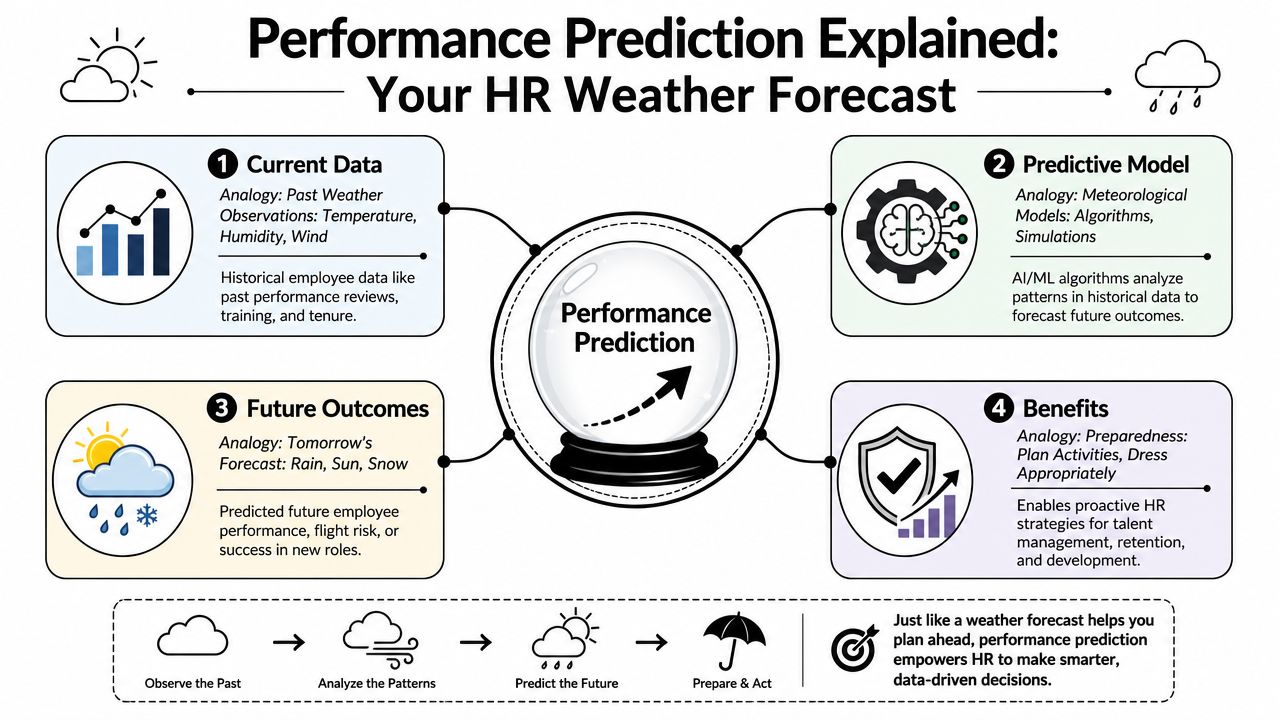
Think of performance prediction as a weather forecast for talent decisions. A weather forecast doesn't claim certainty. It combines past patterns, current conditions, and predictive models to estimate what's most likely to happen next. People analytics works the same way.
In HR, performance prediction uses historical data, behavioral signals, and structured evaluation methods to estimate future outcomes such as role success, team fit, promotion readiness, or retention risk. The goal isn't to replace judgment. It's to improve it.
What goes into a prediction
A useful model usually combines several inputs instead of relying on one signal alone.
1. Historical evidence Prior performance reviews, tenure patterns, training history, mobility data, and manager assessments can all provide context.
2. Behavioral indicators These help estimate how a person is likely to communicate, make decisions, respond to pressure, or work with others.
3. Role context The same person can thrive in one environment and struggle in another. Prediction improves when the model is tied to a specific job, team, and operating environment.
4. A statistical method This can be a validated assessment framework, a simulation, or a machine learning model trained to identify relevant patterns.
Why this isn't a fad
The scientific foundation is older than most HR tech categories. A landmark 1998 meta-analysis by Schmidt and Hunter, summarized in [this performance prediction overview](https://www.studysmarter.co.uk/explanations/business-studies/project-planning-management/performance-prediction/), analyzed 100 years of data and found that general cognitive ability tests had a validity of 0.51, structured interviews also reached 0.51, and combining predictors produced a composite validity of 0.63. That matters because it showed job performance can be forecast with meaningful statistical rigor.
For HR leaders building a broader analytics strategy, this sits naturally alongside work on [leveraging HR analytics for business](https://paradigmie.com/post/Unlocking-the-Potential-of-HR-Analytics-for-Strategic-Business-Decisions). It also connects with a practical overview of [people analytics fundamentals](https://synopsix.ai/blog/what-is-people-analytics), especially if your team is still moving from descriptive reporting to forward-looking decisions.
> Practical rule: Don't think of performance prediction as one tool. Think of it as a decision system that combines evidence about skills, behavior, and context.
What often confuses HR teams
The biggest confusion is the difference between reporting and predicting.
A dashboard tells you what happened. A predictive system estimates what's likely to happen next. Reporting might show that high performers in a role tend to have faster ramp time and strong manager ratings. Prediction asks whether a new candidate or employee shows the combination of signals associated with future success in that same role.
That distinction is what makes performance prediction strategically useful. It shifts HR from hindsight to foresight.
Comparing Key Performance Prediction Approaches
Not every organization needs the same prediction method. The right choice depends on your data maturity, the type of decision you're making, and how much explainability your leaders need. In practice, most approaches fall into three buckets.
Three ways to predict performance
Some methods focus on who a person is likely to be at work. Others focus on what they do in realistic job situations. Others look for patterns across large sets of historical data.
Here's a side-by-side view.
| Approach | Core Principle | Pros | Cons | Best For | |---|---|---|---|---| | Psychometric Assessments | Measures behavioral traits, work style, and sometimes cognitive factors to estimate role fit and likely workplace behavior | Easy to scale, consistent across candidates, useful for hiring and development, often easier for managers to interpret | Can be misused if results aren't tied to role requirements, may feel abstract without business translation | Hiring, leadership pipelines, internal mobility, team fit decisions | | Predictive Simulations | Observes how a person responds in job-relevant scenarios or virtual tasks | Closer to real work, strong face validity with hiring managers, helps test judgment under pressure | Takes more design effort, can be resource-intensive, requires clear scenario quality | Sales, leadership, customer-facing roles, high-stakes promotion decisions | | Supervised Machine Learning Models | Uses historical employee data to identify patterns associated with future outcomes | Powerful when many variables interact, useful for large talent populations, can uncover patterns humans miss | Harder to explain, depends heavily on data quality, can inherit historical bias | Retention risk, workforce planning, large-scale talent segmentation |
Psychometric assessments
This is the “what are they like at work?” method. It's designed to surface recurring tendencies such as pace, assertiveness, sociability, patience, and preference for structure.
The strength here is consistency. Everyone gets measured through the same lens. In the case of the PI Behavioral Assessment, [Predictive Index states](https://www.predictiveindex.com/assessments/behavioral-assessment/) that the assessment takes 6 minutes and measures four key behavioral drives. That kind of efficiency matters when HR teams want something practical, not just scientifically interesting.
A related technical summary from ClearRock reports that the PI Behavioral Assessment [predicted job performance in 94% of 350 studies comprising 4,800 measures of job performance](https://clearrock.com/wp-content/uploads/2022/03/Science-Behind-the-PI-Technical-Summary-1.pdf). For CHROs, the appeal is clear: you get structured behavioral data that can support selection and development conversations.
Predictive simulations
This is the “what would they do?” method. Instead of inferring fit from traits alone, you place someone in realistic situations and evaluate choices, tradeoffs, and responses.
A simulation can be more persuasive to hiring managers because it feels concrete. If you're hiring a people leader, for example, a simulation might reveal whether the candidate addresses conflict directly, escalates too early, or avoids difficult conversations altogether. Those observations are often easier to act on than abstract labels.
Supervised machine learning models
This is the “what patterns show up in our data?” method. Models look across variables such as progression, prior ratings, engagement indicators, workload history, or movement across teams and estimate likely outcomes.
The upside is scale. The caution is interpretation.
> A model can find a pattern without telling you whether the pattern reflects real potential, a biased process, or a temporary local condition.
That's why machine learning works best when paired with domain judgment and clear governance, not when treated as an automatic answer engine.
How to Evaluate Predictive Model Performance
Once a model is in play, the key question isn't whether it sounds impressive. The key question is whether it predicts well enough to support a real business decision.
A lot of vendors lean on “accuracy” because it's familiar. But in people decisions, one number rarely tells the whole story. A model can look accurate overall and still fail where it matters most, such as distinguishing likely high performers from likely low performers.
The metric CHROs should know
The most useful business-friendly metric to ask about is AUC, also called the c-statistic. It tells you how well a model discriminates between outcomes.
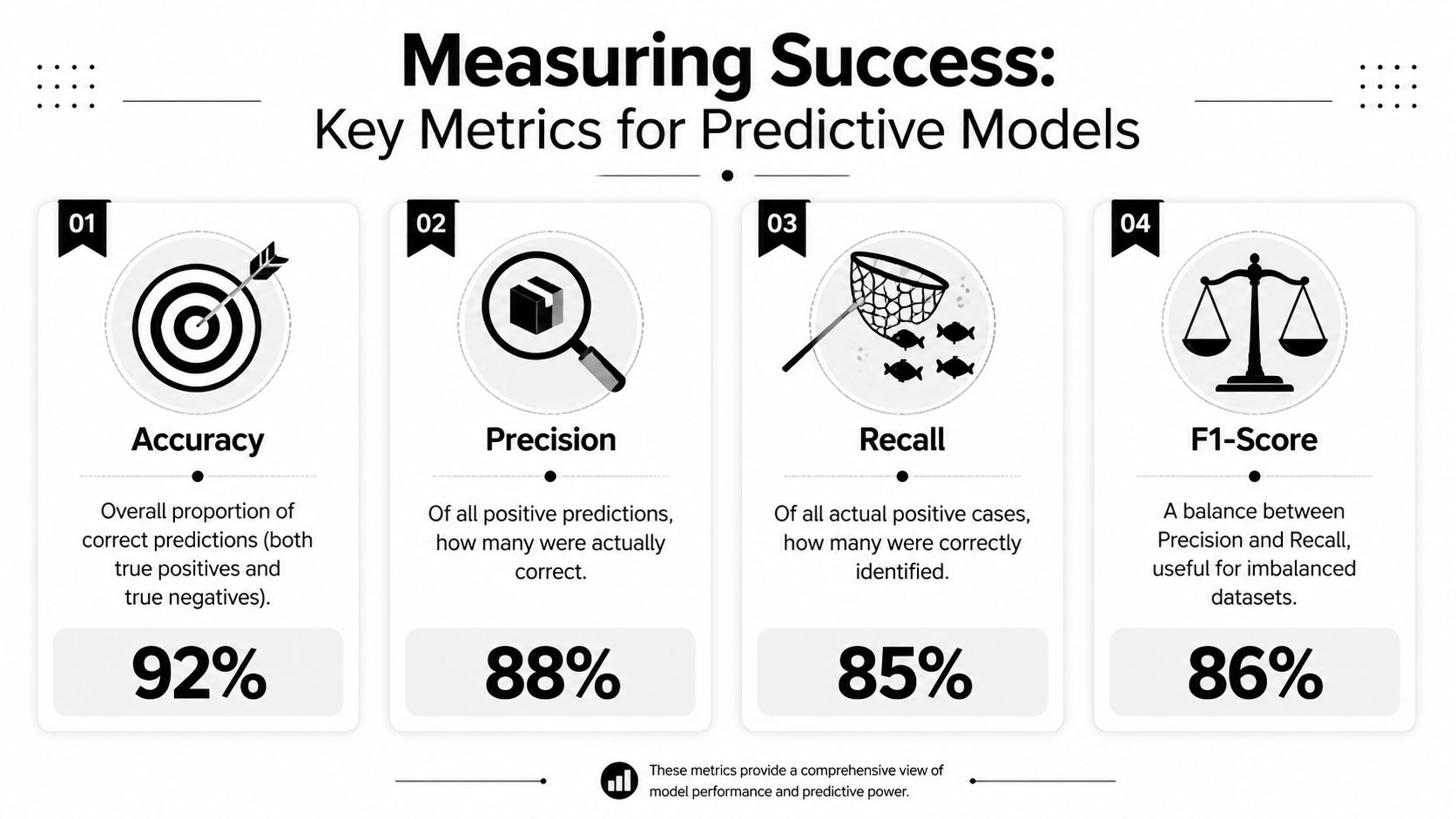
According to [Steyerberg's overview of performance metrics](https://pmc.ncbi.nlm.nih.gov/articles/PMC3575184/), a c-statistic of 0.75 is considered “good,” and a score above 0.90 is considered “excellent.” In plain English, AUC is the model's ability to correctly rank who is more likely to succeed.
If you're working with an internal analytics team, a hands-on guide to [predictive modeling with Python](https://synopsix.ai/blog/predictive-modeling-with-python) can help bridge the gap between HR questions and technical implementation.
Metrics that matter in business language
Here's how to translate model evaluation into practical terms:
Questions worth asking a vendor
A strong vendor should be able to answer these clearly:
> Good evaluation doesn't stop with the model. It continues into operating results such as quality of hire, manager confidence, internal mobility decisions, and avoidable turnover.
That's the standard to use. A model earns trust when technical quality and business outcomes line up.
An HR Leader's Roadmap to Implementation
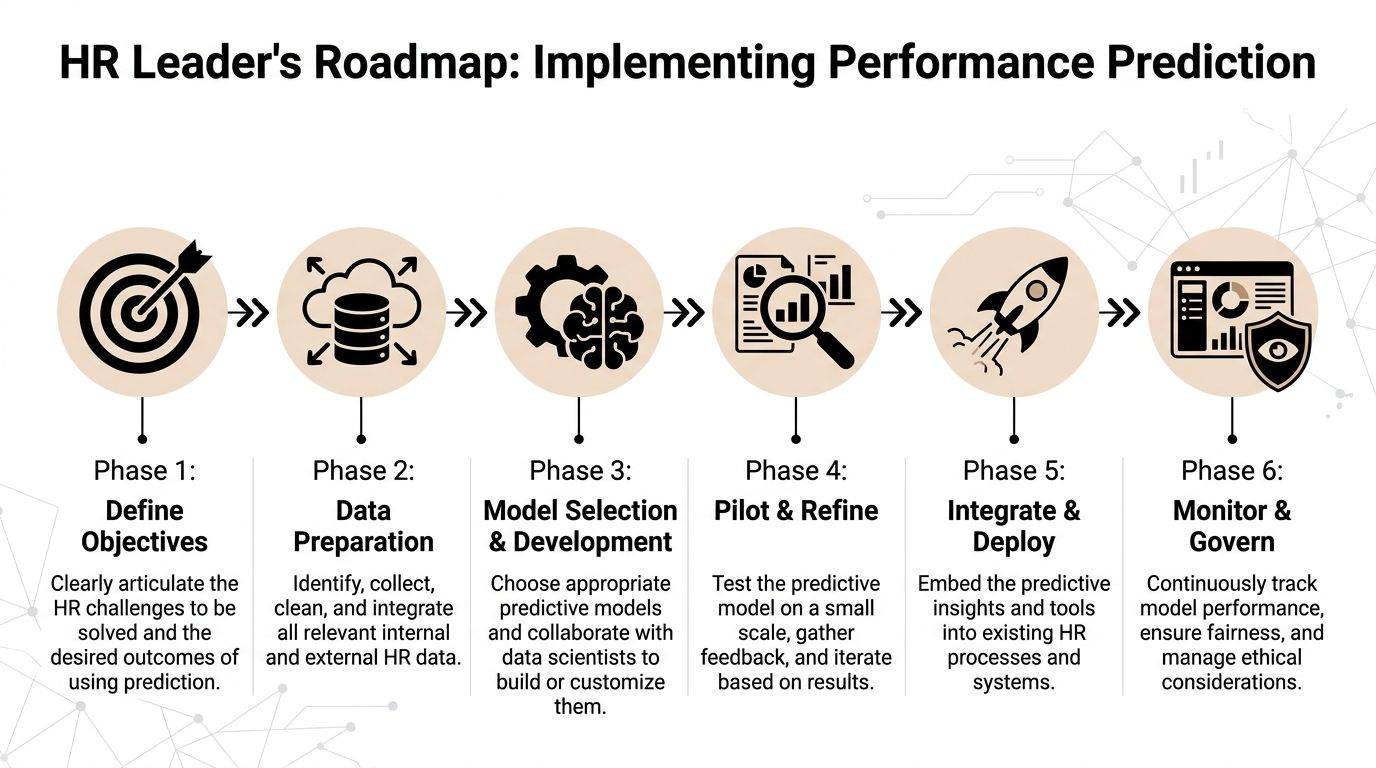
Most performance prediction efforts don't fail because the math is weak. They fail because the organization starts with vague goals, inconsistent data, or no governance. The strongest implementations are disciplined from the beginning.
A practical rollout looks more like change management than software installation.
Start with the decision, not the model
Before discussing algorithms, define the business problem in operational terms.
The question shapes the data, the model, and the governance. It also helps you explain why the program exists.
A useful outside perspective for smaller organizations comes from [ELECTE's AI in HR analysis](https://newsletter.electe.net/ai-in-hr-isn-t-just-for-unilever-it-s-for-smes-too/), which is a helpful reminder that disciplined AI use in HR isn't limited to global enterprises.
Build the operating sequence
After the objective is clear, the implementation usually follows a sequence like this:
1. Prepare the data Pull together the signals that are relevant to the decision. For hiring, that may include structured interview data, assessment results, and early performance indicators. For internal mobility, it may include tenure, prior role transitions, manager evaluations, and development history.
2. Choose the method Use the simplest approach that can answer the question well. If the decision is highly behavioral and manager-facing, an assessment plus simulation may be easier to use than a complex model.
3. Pilot before scale Test in one role family or business unit. Watch adoption, user understanding, and decision quality before expanding.
This short explainer is useful to share with stakeholders during rollout:
<iframe width="100%" style="aspect-ratio: 16 / 9;" src="https://www.youtube.com/embed/ouP0mfT0oo4" frameborder="0" allow="autoplay; encrypted-media" allowfullscreen></iframe>
Govern it like a people decision system
A prediction tool shouldn't sit outside HR governance. It should be managed with the same seriousness as any structured selection or promotion process.
Use guardrails such as:
> The best implementation pattern is boring on purpose. Clear objective, clean data, small pilot, tight governance, repeat.
That's usually what separates a useful people analytics capability from an expensive pilot that never becomes operational.
Use Case: Predicting Behavior with Synopsix
A CHRO approves a promotion because the candidate has delivered strong results for three years. Six months later, the team is stalled. The person can execute, but struggles with delegation, conflict, and shifting priorities across a wider span of control. That gap is where behavior prediction becomes useful. It helps leaders test likely fit for the work ahead, not just reward success in the work already done.
For many HR teams, the challenge is not access to more data. It is turning behavioral science into decisions a manager can use. The strongest tools in this category translate assessment results into plain business language, then connect those patterns to role demands, team dynamics, and likely pressure points on the job.
What this looks like in operation
In hiring, a team might start with an assessment that builds a structured behavioral profile. The value is not the profile by itself. The value is the better conversation it creates. Can this person stay effective in ambiguity? Are they likely to challenge ideas in a productive way, or create friction that slows the team down? Does the role call for persuasion, consistency, urgency, or careful follow-through?
The same principle applies to internal mobility. Past performance often answers one question well: could this person succeed in their current scope? It does not always answer the next one: how will they behave when the scope changes? Predictive behavior signals can help separate reliable execution from readiness for leadership demands such as delegation, conflict management, faster decision cycles, or influence across functions.
Why behavior improves prediction
Skills are easier to see on a resume or in a review cycle. Behavior often shows up later, once the person is already under pressure in the role.
That is why behavioral assessment matters in people analytics. [ProducifyX's explanation of behavior prediction in hiring](https://producifyx.com/what-is-behavior-prediction-in-hiring-does-it-bring-value/) describes how assessments use past behaviors and situational responses to predict future job performance, while also helping address unconscious bias through more objective evaluation.
Personalization matters too. A study on idiographic, or N=1, prediction found that [personalized models outperformed nomothetic models in forecasting procrastination, loneliness, and studying behavior by combining psychological variables, situational features, and time-based patterns](https://pmc.ncbi.nlm.nih.gov/articles/PMC9793429/). The workplace lesson is practical. Population-level averages are useful, but individual context often improves judgment.
Where a platform helps
[Synopsix behavior prediction software](https://synopsix.ai) is useful when it turns assessment output into action managers can understand. In practice, that means readable reports, role-specific fit guidance, simulations that surface likely friction, and team views that show where people may complement or clash with one another.
For CHROs, the business case is straightforward. Better prediction improves selection, promotion, succession, and team design. It also reduces the cost of avoidable misalignment, which is often far more expensive than the assessment process itself.
Navigating Limitations and Ethical Considerations
A CHRO approves a hiring model after seeing strong pilot results. Six months later, turnover is still high in one business unit, managers say top candidates feel misread, and legal asks a simple question: how was this tool validated for our workforce?
That is the ultimate test of performance prediction. The model may look strong on paper and still fall short if the data was narrow, the use case was poorly defined, or the rollout lacked clear decision rules.
The validation rule that matters most
The biggest risk is the gap between test performance and on-the-job performance. A model trained in one environment can lose accuracy when it meets a different labor market, role design, manager population, or culture. Stanford HAI notes that a 37% performance deficit can exist between benchmark scores and real-world results in technical systems, which is a useful caution for HR leaders evaluating predictive tools ([Stanford HAI technical performance discussion](https://hai.stanford.edu/ai-index/2025-ai-index-report/technical-performance)).
For people decisions, the lesson is practical. Validate against your own held-out data before treating predictions as decision-ready.
That sounds technical, but the business idea is simple. A weather forecast built for Phoenix will not help much in Seattle. Performance prediction works the same way. Local conditions matter.
Ethics is an operating discipline
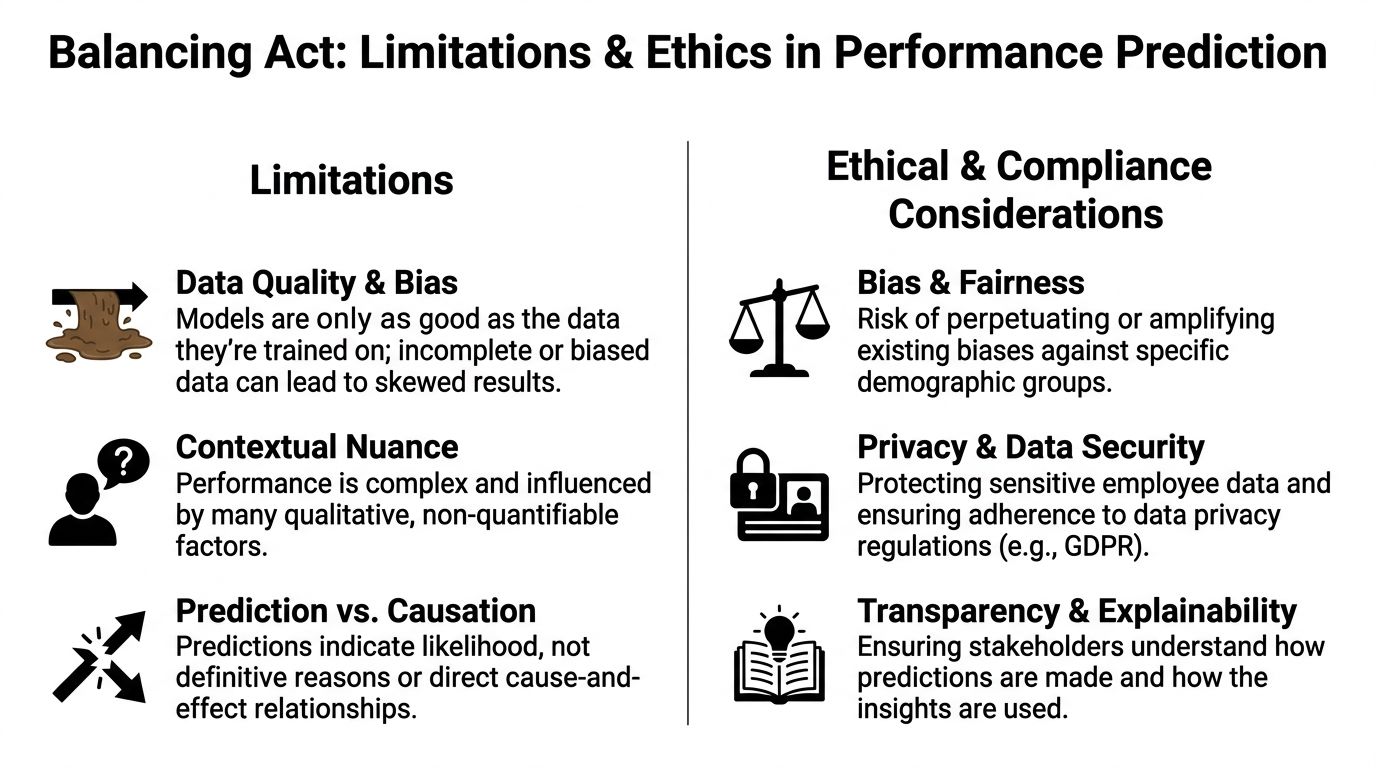
Ethics in people analytics is less about slogans and more about process design. Leaders need a clear structure for how predictions enter a decision, who can review them, what data is off-limits, and how exceptions are handled.
A sound governance approach usually includes:
Behavioral science can improve consistency, which matters because unstructured judgment often shifts from manager to manager. But consistency alone is not enough. The process also needs documentation, review, and accountability.
> A fair process is defined by its structure: the evidence is structured, limits are understood, and leaders remain accountable for the decision.
What mature organizations do differently
Mature teams treat prediction the way finance treats forecasting. They do not expect certainty. They expect a better starting point for judgment.
That mindset changes behavior. Instead of asking whether a tool is good in general, they ask narrower questions. Is it valid for this role family? Does it hold up across locations? Does it improve selection quality, promotion accuracy, or team fit enough to justify the cost?
It is essential for the academic and the practical to meet. Behavioral science gives you the logic. Good implementation turns that logic into business outcomes you can measure, such as reduced misalignment, better manager confidence, and fewer expensive talent mistakes. As noted earlier, the value of platforms like Synopsix is not the prediction alone. It is the translation of human behavior into guidance leaders can use.