Personality Assessment for Work: Smarter People Decisions
By Synopsix · June 24, 2026 · 16 min read
Approximately 80% of Fortune 500 companies use personality assessments for coaching, team building, and hiring. That fact alone changes the conversation. A personality assessment for work isn't a niche HR experiment anymore. It's part of how large organizations reduce guesswork in people decisions.
The shift isn't from paper resumes to online tools. It's from subjective judgment to structured behavioral evidence. Most hiring mistakes don't start with bad intent. They start with overconfidence in interviews, inconsistent manager instincts, and vague definitions of “fit.” Assessments help correct that by turning behavior into comparable data, then translating that data into decisions leaders can defend.
The Shift to Data-Driven People Strategy
A decade ago, many leadership teams treated personality assessment as a nice-to-have. Today, approximately 80% of Fortune 500 companies currently utilize personality assessments to evaluate employees for coaching, team building, and hiring purposes, which makes them a standard part of corporate talent strategy. That level of adoption matters because it shows that behavioral data has moved from the margins into operating practice.
Why gut-feel hiring breaks at scale
Interviewing feels rigorous because it is personal. It isn't always rigorous because it is measurable.
Managers often overweight confidence, similarity, communication style, or a strong first impression. None of those are useless. All of them can distort judgment when there's no structured benchmark behind them. The result is familiar: one leader calls a candidate “high potential,” another sees the same person as “not enough presence,” and no one can explain the difference in a way that survives scrutiny.
A personality assessment for work gives HR and hiring leaders a shared language. It doesn't replace judgment. It disciplines it.
> Practical rule: If two interviewers can reach opposite conclusions from the same interview and neither can show why, your process isn't evidence-based yet.
What data-driven people strategy actually looks like
The strongest assessment programs don't sit in a corner of HR. They shape decisions across the talent lifecycle:
This matters just as much in specialist hiring as it does in enterprise recruiting. Firms that advise candidates on competitive searches, including resources like [latest legal career advice](https://www.fivestarplacements.com/blog), often reflect the same market reality from the candidate side. Employers are increasingly formalizing evaluation criteria, and candidates are being judged on more than resumes and rapport.
The strategic payoff is simple. When organizations define role fit behaviorally, they make fewer subjective bets. They also create a more consistent system for talent decisions across functions, geographies, and managers.
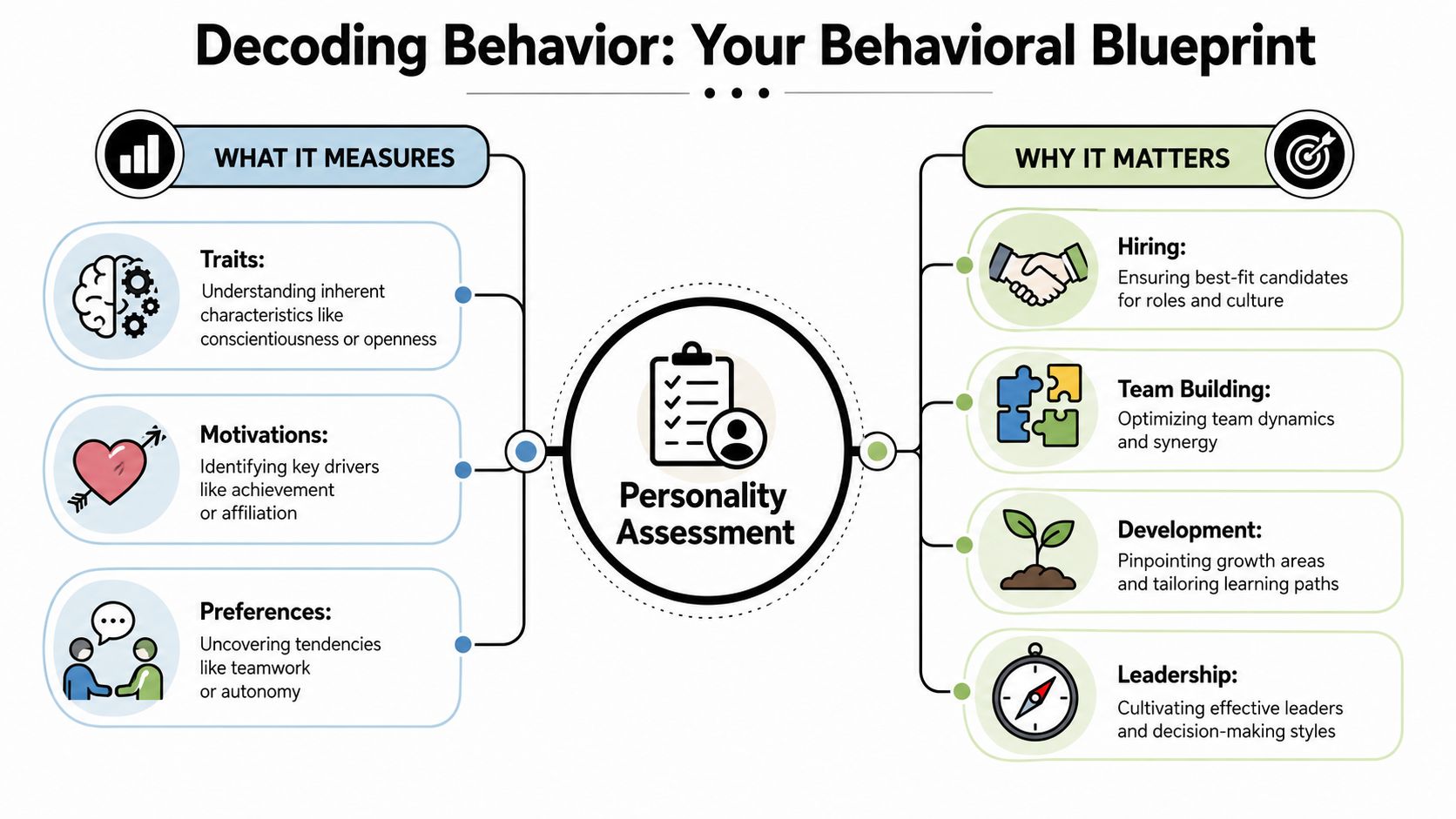
Decoding Behavior What Assessments Measure and Why It Matters
A strong personality assessment for work acts like a behavioral blueprint. It doesn't tell you everything a person will do in every circumstance. It does show their likely default patterns: how they approach responsibility, react to pressure, engage with others, and prefer to work.
Personality, behavior, and performance are not the same thing
Many teams often get sloppy at this point.
Personality refers to relatively stable tendencies. Behavior is how those tendencies show up in context. Performance is the business result. Good assessment practice connects the three without pretending they're identical.
Someone may score high on conscientiousness. That doesn't guarantee top performance. It does suggest a stronger likelihood of reliability, follow-through, and organization. In a role that rewards those behaviors, that pattern becomes useful evidence. In a role that depends more on persuasion or rapid experimentation, other traits may matter more.
That distinction is why psychometrics matters. The point isn't labeling people. The point is translating measured tendencies into job-relevant risk and fit signals.
What validity and reliability mean in plain English
CHROs don't need a lecture in test theory. They need to know whether an assessment is dependable enough to influence a decision.
A practical buying standard looks like this:
Used well, these tools improve decision quality. The integration of personality assessment into hiring pipelines reduces mis-hires by approximately 30% to 40% because assessments create objective benchmarks before the interview stage, according to [meta-analytic evidence on personality and job performance](https://pmc.ncbi.nlm.nih.gov/articles/PMC6480750/).
That's the business case. Better signal before interviews means fewer late-stage surprises.
For teams that want a clearer primer on the mechanics behind these tools, Synopsix offers a straightforward explanation of [psychometric testing in hiring and talent decisions](https://synopsix.ai/blog/what-is-psychometric-testing).
> Assessments are most useful when they narrow uncertainty, not when they promise certainty.
Translating scores into action
Scores alone don't help managers. Interpretation does.
That interpretation should connect results to concrete decisions such as interview focus, onboarding support, manager pairing, and role fit. Even classic interview training still matters here. Behavioral data should complement, not replace, observation. A practical example is this guide to [nonverbal cues for data professionals](https://www.datateams.ai/blog/body-language-during-interview), which reminds teams that candidate evaluation still happens through multiple channels. The mistake is letting unstructured observation override validated evidence.
A useful assessment process leaves a hiring manager able to answer four questions clearly:
| Question | What good assessment practice provides | | --- | --- | | What does this person likely bring? | Observable strengths linked to role demands | | Where are the likely risks? | Pressure points, derailers, or mismatch indicators | | What should we test in interview? | Targeted follow-up questions, not generic probing | | What support will improve success? | Coaching, onboarding, or team-fit actions |
That's when psychometrics stops being abstract science and starts acting like operating infrastructure.
Choosing Your Toolkit Valid vs Popular Assessment Models
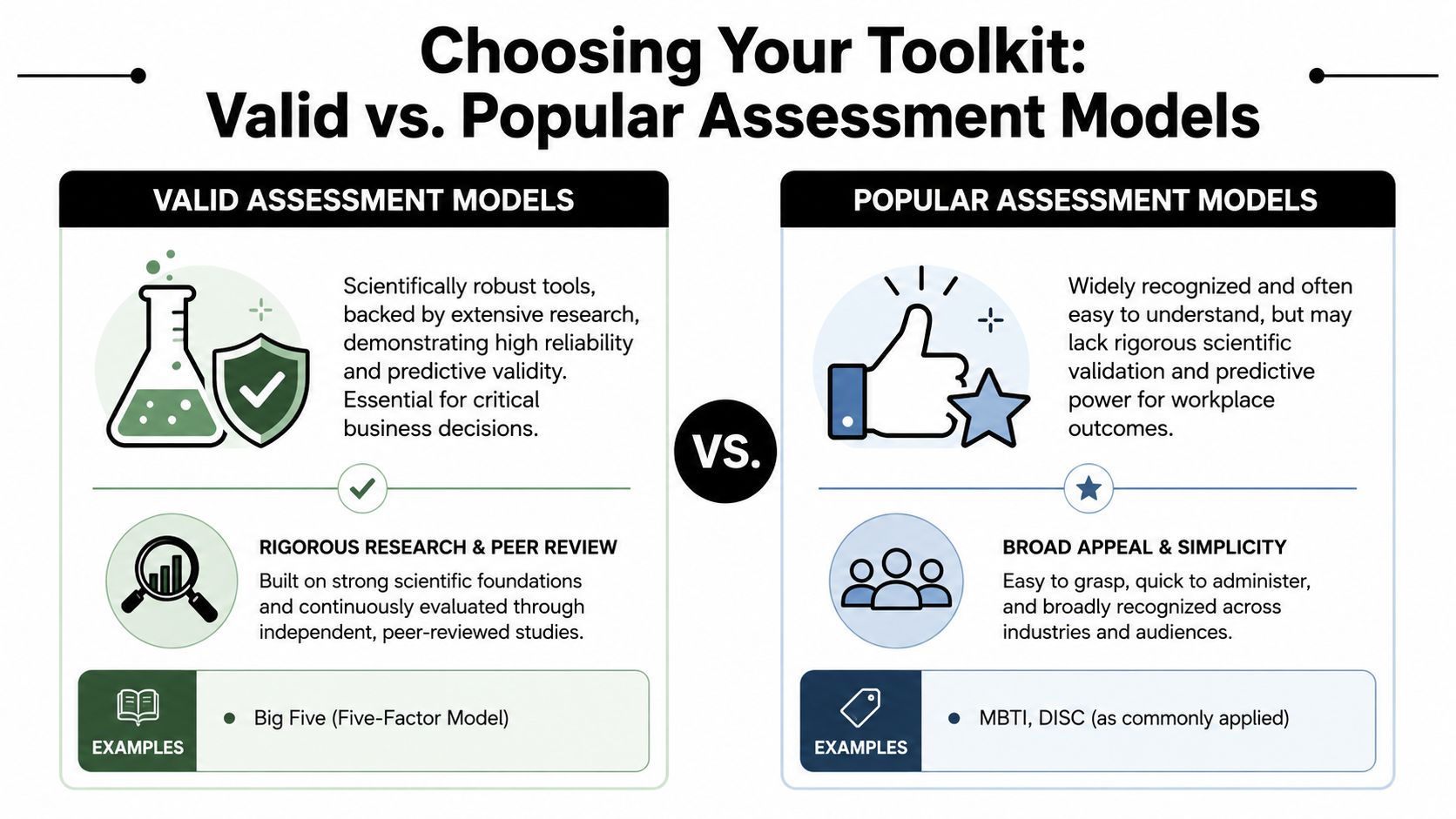
The market is crowded with instruments that look similar from the outside and behave very differently in practice. That's the central buying problem. A pleasant report, colorful labels, and a familiar brand do not make an assessment suitable for hiring or promotion.
Why the Big Five holds up in high-stakes decisions
The Big Five framework remains the scientific reference point for workplace personality measurement. It covers Openness, Conscientiousness, Extraversion, Agreeableness, and Neuroticism, and it is widely recognized as the most valid and reliable taxonomy for describing personality differences and predicting workplace performance, as outlined in this overview of [Big Five psychometric testing](https://www.graduatesfirst.com/psychometrics/personality-tests).
That matters because trait-based models are built on continuums. A person isn't shoved into a box. They fall somewhere along a range. That gives employers more precision.
Conscientiousness is the clearest example. In most work settings, knowing whether someone tends toward disciplined execution or toward lower structure gives hiring teams a usable signal. It doesn't answer every question, but it does answer a real one.
If your team needs a practical walk-through of how the model works in business terms, this guide to the [Five Factor personality test](https://synopsix.ai/blog/five-factor-personality-test) is useful.
Where MBTI and DISC fit, and where they don't
MBTI and DISC are popular because they're intuitive. Managers remember the labels. Workshop participants enjoy the shorthand. Team offsites often go smoother when people get a simple language for differences.
That doesn't make these tools the right choice for selection.
The core limitation is structural. Type-based models sort people into categories. Workplace behavior rarely behaves that neatly. Two people with the same “type” can still differ sharply on important job-relevant tendencies. That weakens precision where decisions carry risk.
Use typology carefully:
> A popular model can be useful for discussion and still be the wrong model for employment decisions.
A buyer's checklist for CHROs
When evaluating assessment vendors, I look for signs that the tool can survive operational reality, not just a demo.
One example of a more detailed workplace inventory is the Employee Personality Profile (EPP) from Criteria. It includes 140 items, measures 12 distinct traits, takes approximately 10 minutes to complete, and has internal consistency reliability exceeding 0.85 for most scales, according to the [Employee Personality Profile overview](https://www.criteriacorp.com/assess/personality/employee-personality-profile-epp). That's the kind of specificity buyers should look for. Not just “insightful,” but measurable design, clear constructs, and stated reliability.
The wrong toolkit creates confidence without clarity. The right one creates defensible signal.
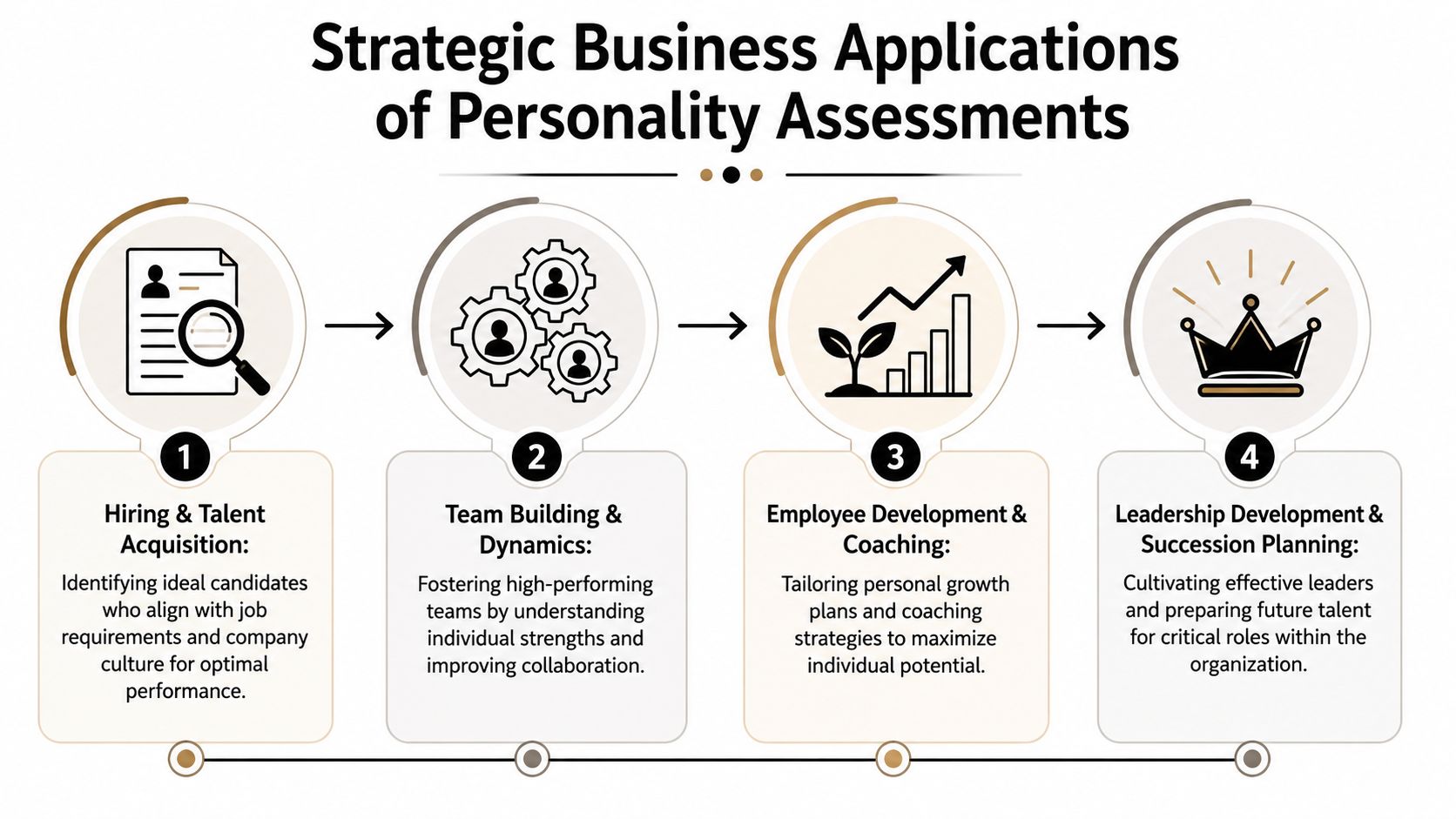
Putting Assessments to Work Strategic Business Applications
The primary test of a personality assessment for work isn't whether the report feels insightful. It's whether leaders can use it to make a better decision on Monday.
Hiring with sharper interview targets
A sales leader is deciding between two finalists. Both have the résumé. Both interview well. One candidate's assessment suggests high drive and strong assertiveness, but also lower stress tolerance. That doesn't mean “reject.” It means probe.
The follow-up interview changes. Instead of asking broad questions about resilience, the hiring team asks for examples of quota pressure, conflict recovery, and response to ambiguous territory planning. The assessment improves the interview by narrowing where risk may sit.
Building teams with complementary patterns
A product team launches with strong analytical firepower and low tolerance for messy collaboration. Meetings become efficient but brittle. Disagreement turns personal because nobody on the team naturally slows down to absorb competing viewpoints.
Assessment data helps the leader rebalance. Not by chasing personality diversity as a slogan, but by identifying missing behavioral coverage. In this case, that may mean adding someone with stronger cooperativeness, steadier interpersonal pacing, or comfort with cross-functional ambiguity.
A compatibility lens matters here. Some platforms, including Synopsix, translate behavioral assessments into team-fit analysis, simulations, and development guidance so managers can see likely friction points before they harden into performance issues.
Here's a practical overview of those applications in action:
<iframe width="100%" style="aspect-ratio: 16 / 9;" src="https://www.youtube.com/embed/HLkJgAx6sBI" frameborder="0" allow="autoplay; encrypted-media" allowfullscreen></iframe>
Development that is specific enough to coach
A generic development plan says, “Improve leadership presence.” That usually goes nowhere.
Assessment-informed development gets more precise. A high-potential manager may need to strengthen assertiveness in upward communication. Another may need better emotional control under pressure. A third may need to delegate rather than over-own execution. Those are coachable patterns because they're behaviorally defined.
Strong instruments outperform vague frameworks. Empirical evidence shows that well-designed personality assessments can predict workplace variables such as leadership potential and performance, especially when they are psychometrically rigorous and validated on relevant samples, as discussed by [Sigma Assessment Systems on workplace assessment quality](https://www.sigmaassessmentsystems.com/blog/personality-and-workplace-assessments/).
> Field note: Development plans fail when the recommendation is abstract. They work when a manager knows what to start doing, stop doing, and watch for under pressure.
Succession decisions with more than performance history
Many succession mistakes come from a simple error. Organizations promote the highest performer in the current job into a more ambiguous, social, and politically complex one.
Assessment data adds another lens. It helps leaders distinguish execution strength from broader readiness. For instance, the person who thrives through individual control and technical depth may struggle when success depends on influence, ambiguity tolerance, and cross-team leadership.
Four business uses show up repeatedly:
Used this way, assessments stop being one-off HR artifacts and become part of management operating rhythm.
Implementation Roadmap From Selection to Rollout
Most assessment failures aren't caused by bad science alone. They fail because the organization treats implementation as procurement instead of change management.
A workable rollout needs governance, manager training, and decision rules before the first candidate ever sees a questionnaire.
Step one is vendor scrutiny
Start with the instrument itself, then move outward.
The first screen should include:
A vendor that can't explain those points clearly will create downstream confusion for recruiters, managers, and legal teams.
Step two is auditability, especially if AI is involved
The market is moving faster than many internal policies.
The 2025 OECD Guidelines on AI in Human Resources highlight that 58% of organizations lack a clear audit trail for why an AI flagged a candidate as “low fit,” leading to a 30% increase in legal challenges related to discriminatory hiring. Even if your current process hasn't been challenged, that is a warning sign for every CHRO using algorithmic interpretation in employment decisions.
The operational question is simple: can your team explain, in business language, what drove the recommendation?
If the answer is no, pause the rollout.
> AI can accelerate interpretation. It cannot become a black box for employment judgment.
Step three is controlled rollout, not enterprise-wide enthusiasm
The best launch pattern is narrow and disciplined.
1. Choose one role family first. Pick a hiring stream with enough volume to generate learning and enough consistency to benchmark. 2. Train hiring managers on use and non-use. They need to know what scores can inform, what they can't decide alone, and how interview guides should change. 3. Define decision thresholds early. Decide where the assessment sits in the funnel, what counts as a concern, and who reviews exceptions. 4. Track outcomes qualitatively and quantitatively where your internal data allows. Review quality of hire, interview consistency, candidate feedback, and manager adoption.
For teams comparing platforms, this roundup of [talent assessment tools for hiring and development](https://synopsix.ai/blog/talent-assessment-tools) is a useful starting point because it frames selection in operational terms rather than just feature lists.
Step four is internal trust-building
No platform works if managers think it is replacing them. No employee trusts it if they think it is reducing them to a score.
That means communication needs to be direct:
| Stakeholder | What they need to hear | | --- | --- | | Hiring managers | The tool structures judgment. It doesn't eliminate managerial accountability. | | Candidates | The process is one input in a broader evaluation, not a hidden pass-fail mechanism. | | Executives | The program improves consistency, fairness, and decision quality. | | Legal and compliance | The process is documented, reviewable, and tied to job relevance. |
Rollout succeeds when the organization treats assessment as a decision system, not a software purchase.
Common Pitfalls and Next-Generation Solutions
The biggest mistake in personality assessment for work is assuming a static profile is enough. It isn't.
A person can look like a strong fit on paper and still struggle in a hybrid team where the job shifts daily between independent execution, asynchronous communication, and high-collaboration problem solving. That gap is becoming harder to ignore. A 2025 study by the Global Management Association found that 68% of remote workers struggle with role ambiguity not because they lack skill, but because they struggle to shift between collaborative and autonomous modes based on context.
Where legacy use breaks down
Most legacy programs fail in one of three ways:
That third failure matters most in hybrid work. Static profiles tell you how someone tends to operate. They don't always tell you how well they can switch gears when team rhythm, manager expectations, or communication channels change.
What next-generation systems need to solve
The next wave of assessment technology has to do two things well.
First, it needs to estimate behavioral adaptation, not just baseline traits. HR leaders need better ways to judge whether someone can flex between autonomy and coordination, pace and patience, initiative and alignment.
Second, it must make AI interpretation transparent and bias-aware. If a model recommends low fit, decision-makers need to see the behavioral logic behind that signal and examine whether that logic is fair across candidate groups. That is also why broader hiring leaders should stay close to practical guidance on fairness, including [strategies for an equitable workforce](https://www.talentpronto.ai/blog-posts/fair-hiring-practices), not just vendor promises about accuracy.
> The future of assessment isn't another personality label. It's a clearer forecast of how a person will operate when the environment changes.
The organizations getting ahead aren't collecting more personality data for its own sake. They're demanding tools that connect behavior, context, and explainability.
Conclusion Making Smarter People Decisions Starts Now
A strong personality assessment for work gives leaders something most hiring systems lack. A consistent way to predict behavior before it becomes performance, conflict, burnout, or a failed promotion.
The change isn't cosmetic. It's operational. Organizations move from subjective interviews and uneven manager instinct to a more disciplined model built on validated measures, role-relevant interpretation, and clearer decision rules. The return shows up in fewer avoidable hiring errors, stronger development plans, better team design, and more defensible promotion choices.
No assessment is a crystal ball. That's not the standard.
The standard is whether your people decisions are more accurate, more explainable, and less dependent on who happened to conduct the interview. For most organizations, that's where measurable improvement begins.
---
If you're evaluating how to bring behavioral science into hiring, team design, or leadership development, [Synopsix](https://synopsix.ai) offers a practical way to turn validated assessment data into usable business guidance. That includes behavioral profiles, fit interpretation, simulations, and development planning built for managers who need clearer people decisions, not more psychometric jargon.