Personality of Leadership: What Science Actually Shows
By Synopsix · October 20, 2026 · 14 min read
A review of 56 studies found that several Big Five traits jointly predicted who would emerge as a leader, with a multiple correlation of 0.48. But the outcome was recognition as a leader in a previously leaderless group, not sustained performance after appointment, a notable limitation of the [review of personality and leadership emergence](https://www.sciencedirect.com/science/article/abs/pii/S0191886911002479). If you're hiring an executive, that distinction changes what a personality assessment needs to answer.
The personality of leadership isn't a universal combination of confidence, sociability, discipline, and composure. A more defensible approach asks which tendencies fit the work, which behaviors substantiate them, and which conditions could turn an apparent strength into a liability.
The Two Questions Hidden Inside Leadership Personality
When an executive search committee asks whether someone has leadership potential, members may be asking different questions. Some mean whether the candidate can command attention and gain support. Others mean whether that person can make sound decisions and help a team deliver.
Those are related outcomes, but they aren't interchangeable.
Recognition and performance require separate evidence
Leader emergence concerns who becomes recognized or selected as a leader. Leader effectiveness concerns how well someone performs in the leadership role.
A [multinational meta-analysis of personality and leadership](https://experts.illinois.edu/en/publications/personality-and-leadership-meta-analytic-review-of-cross-cultural/) examined 120 samples involving 32,579 participants for emergence and 116 samples involving 42,487 participants for effectiveness; it also found that Extraversion and Agreeableness were stronger predictors of effectiveness in collectivist societies than in individualist societies. That evidence supports examining both outcomes and interpreting trait relationships within cultural context.
The distinction can be represented as separate branches of the same assessment question.
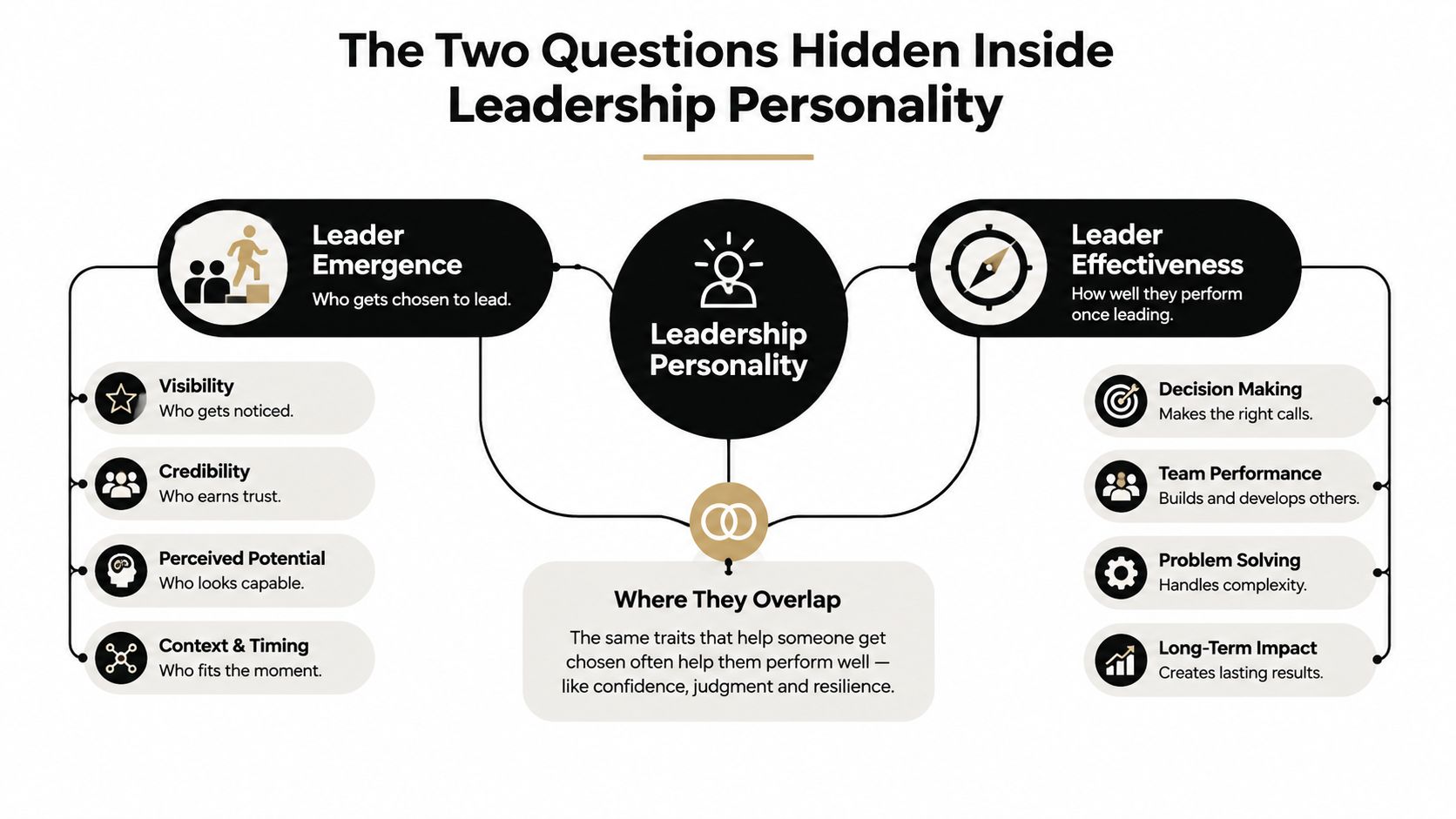
For a hiring committee, the practical implication is to separate evidence of influence from evidence of execution. A persuasive interview can demonstrate communication in that setting. It doesn't, by itself, establish how the candidate handles competing priorities, accountability, or disagreement.
> Practical rule: Decide what successful leadership means before deciding what a successful leadership candidate looks like.
Build separate evaluation criteria:
Don't interpret the cultural finding as permission to stereotype individuals by nationality. Use it to challenge the assumption that your organization's preferred leadership style is universally effective. The better question isn't whether a candidate looks sufficiently leader-like, but whether the evidence addresses the responsibilities you're assigning.
Why Universal Lists of Leadership Traits Fall Short
A checklist that rewards confidence, assertiveness, conscientiousness, and emotional stability looks straightforward. Its weakness is that it leaves the operating conditions unspecified. Confidence about what, assertiveness toward whom, and discipline under which constraints?
A [meta-analysis of 203 datasets examining personality facets and leadership](https://pubmed.ncbi.nlm.nih.gov/41941148/) found that narrow facets varied substantially in their relationships with emergence and effectiveness, with differences across hierarchical levels and organization types. That finding doesn't establish a single ideal configuration. It makes a universal ranking harder to defend.
The visual below organizes the comparison between broad traits and leadership outcomes.
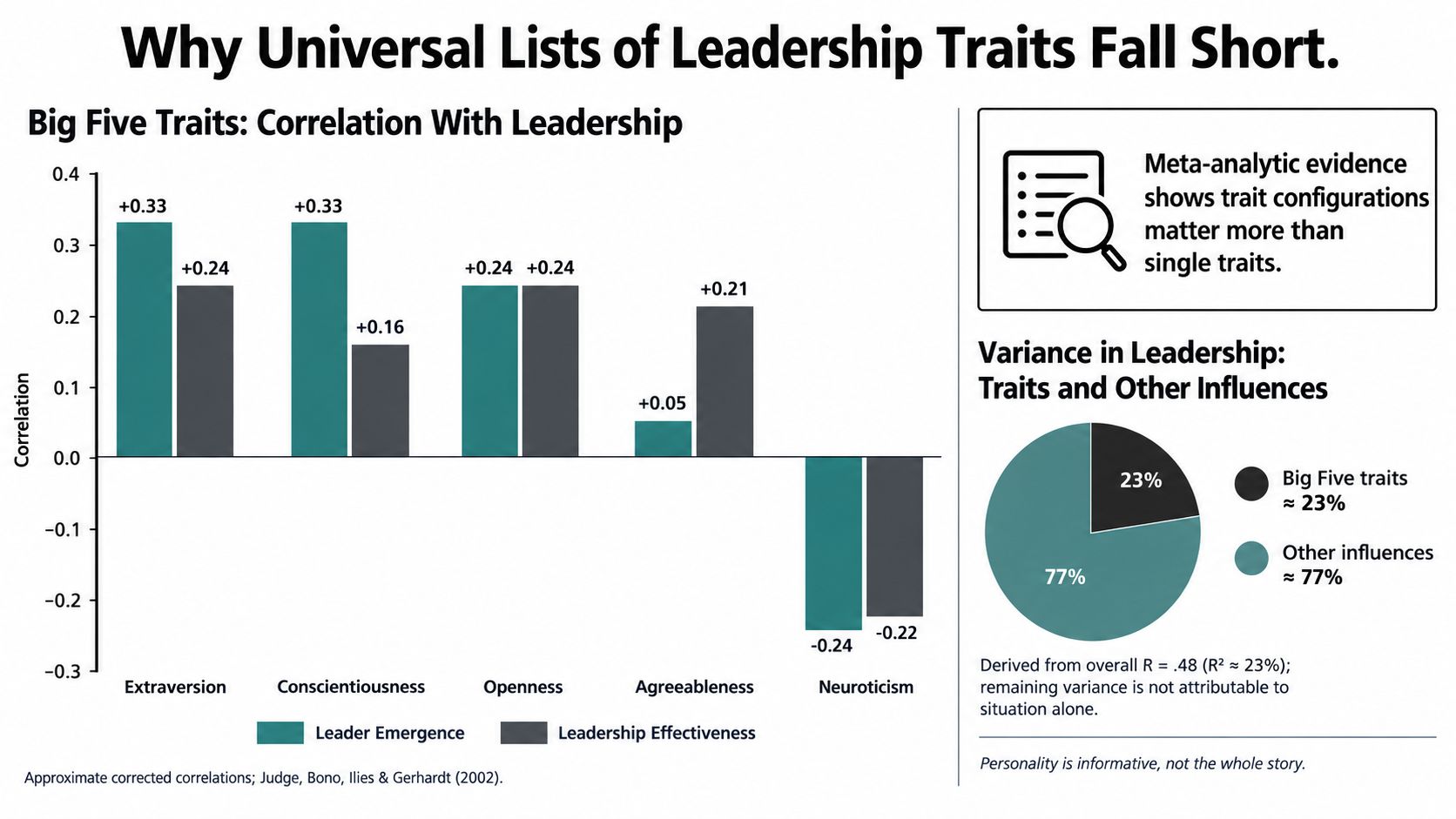
Treat the chart as an orientation aid, not a basis for numerical selection thresholds. The research summarized here doesn't establish a universal allocation of leadership outcomes between personality and situational factors.
Test the boundary of an apparent strength
Consider assertiveness as an assessment hypothesis. A candidate might advocate a position clearly, yet fail to invite objections before committing resources. Another might be quieter in a group but ask the question that exposes a flawed assumption.
Neither example establishes a general trait effect. They illustrate why assessors should examine how a tendency is expressed, rather than awarding points for its presence.
Openness creates a similar design question. For an innovation mandate, an assessor might test how a candidate explores unfamiliar possibilities. For a tightly standardized operating role, the assessor might instead examine whether that exploration remains compatible with required procedures.
The accompanying video provides another prompt for discussing leadership personality.
<iframe width="100%" style="aspect-ratio: 16 / 9;" src="https://www.youtube.com/embed/vUMtq1IVwbQ" frameborder="0" allow="autoplay; encrypted-media" allowfullscreen></iframe>
The analytical shift is from trait possession to conditional behavior. Don't assume that someone who scores highly on an apparently desirable characteristic will apply it with appropriate judgment.
A configuration-based assessment should therefore remain a hypothesis to test, not a more elaborate label. The cited findings support attention to facets and context; they don't prove that any particular combination guarantees leadership success. HR teams still need behavioral evidence that connects the profile to the work.
The Big Five in Practice for HR and Hiring Decisions
Start with the job, not the personality report. Otherwise, a hiring panel can interpret almost any profile as desirable after meeting a candidate it likes.
A [meta-analysis of personality measures and job performance](https://onlinelibrary.wiley.com/doi/abs/10.1111/j.1744-6570.1991.tb00696.x) reviewed 494 studies, identifying usable results from 97 independent samples totaling 13,521 participants; corrected mean validity was 0.12 in exploratory research, 0.29 in confirmatory research, and 0.38 when job analysis guided dimension selection, with trait-level corrected mean validities ranging from 0.16 for Extraversion to 0.33 for Agreeableness.
These are job-performance findings, not a leadership-specific league table. The evidence supports role-anchored measurement, but it doesn't justify claiming that Agreeableness universally matters more than Extraversion for executives.
Big Five Corrected Mean Validities for Job Performance
The full trait-by-research-design breakdown isn't established by the reported findings. Unspecified cells below remain unfilled rather than being estimated.
| Big Five Trait | Validity (Exploratory) | Validity (Confirmatory) | Validity with Job Analysis | |---|---|---|---| | Extraversion | Not separately specified | Not separately specified | Not separately specified | | Agreeableness | Not separately specified | Not separately specified | Not separately specified | | Conscientiousness | Not separately specified | Not separately specified | Not separately specified | | Openness to Experience | Not separately specified | Not separately specified | Not separately specified | | Neuroticism | Not separately specified | Not separately specified | Not separately specified |
The pooled results shouldn't be copied into individual trait rows. Doing so would imply a precision the evidence presented here doesn't provide.
Translate dimensions into interview hypotheses
Use a [Five-Factor personality test](https://synopsix.ai/blog/five-factor-personality-test) to organize questions, then require examples and role-relevant demonstrations. The following are proposed assessment prompts, not claims that a given trait causes a particular outcome.
These prompts prevent a broad trait name from substituting for a work requirement. They also allow candidates to demonstrate learned practices that may differ from their natural preferences.
The hiring recommendation should name the evidence and its limits: what the candidate demonstrated, what remains uncertain, and what additional observation would change the decision. A personality score can inform that recommendation; it shouldn't become the recommendation itself.
Dark Triad Traits Are Context, Not Disqualification
Narcissism, Machiavellianism, and psychopathy require careful interpretation in workplace assessment. Treating them as automatic verdicts confuses personality tendencies with observed misconduct. Treating them as harmless variations would be equally unwarranted.
A [2025 systematic review of 15 empirical studies on Dark Triad traits and leadership](https://pmc.ncbi.nlm.nih.gov/articles/PMC11939815/) linked narcissism and Machiavellianism with work addiction, psychopathy with lower responsibility and self-control, and raised Dark Triad traits with reduced leader performance particularly in lower hierarchical roles. The findings indicate contextual differences, not a blanket assurance that seniority neutralizes risk.
The comparison below provides a framework for discussing those distinctions.
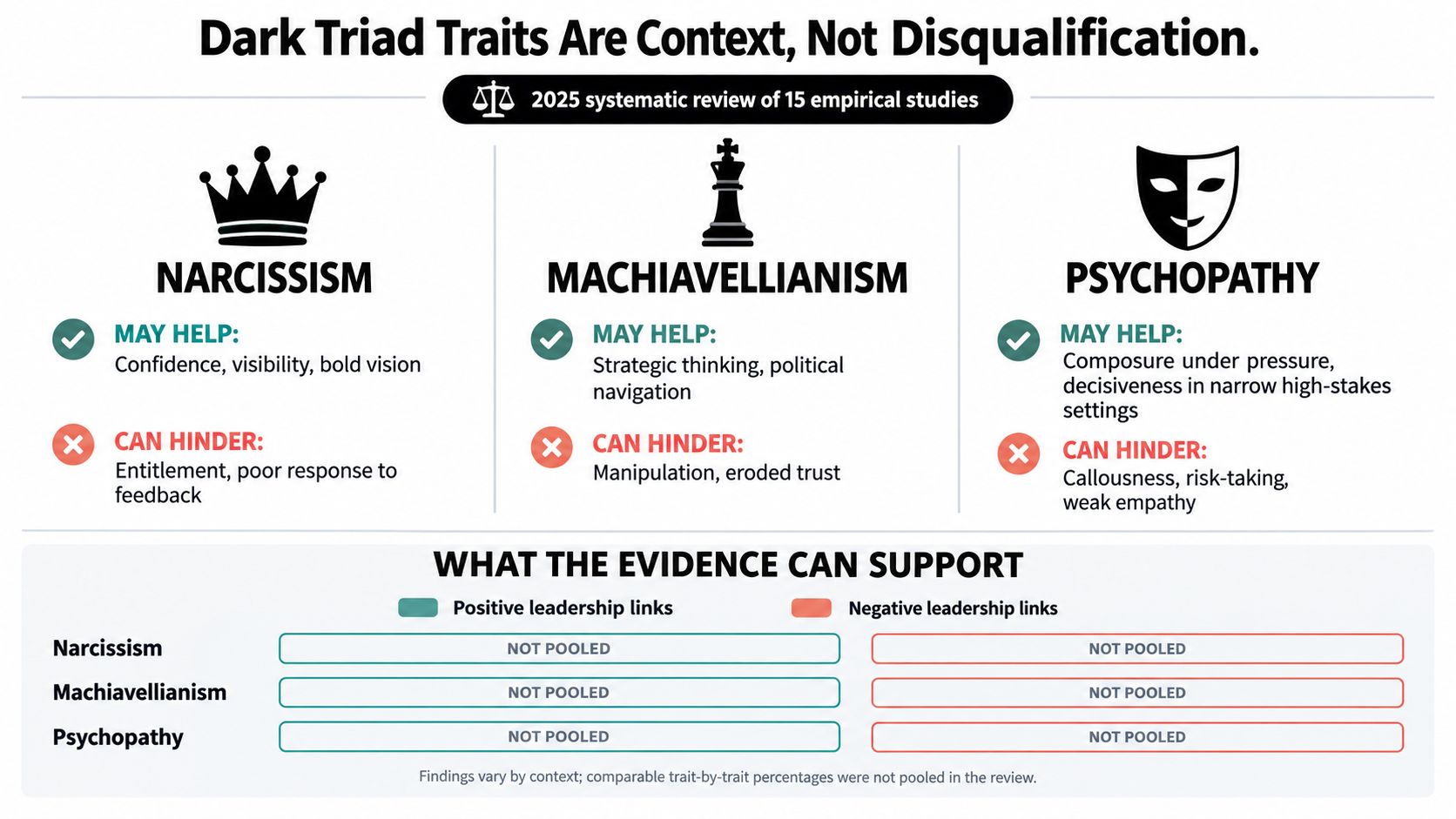
The findings cited here don't establish percentages of positive versus negative effects for each trait. Nor do they justify assuming that charisma, competitiveness, or emotional detachment is evidence of a Dark Triad characteristic.
Assess consequences rather than applying labels
For a CHRO, the useful question is whether the candidate's behavior creates an unacceptable risk under the authority the role provides. A risk review should examine conduct, opportunity, incentives, and the organization's ability to challenge decisions.
Proposed behavioral indicators include:
These aren't diagnostic criteria or validated stand-alone predictors. They're concrete lines of inquiry that a panel can investigate without speculating about a disorder.
> A risk assessment should explain the concerning behavior, the conditions that permit it, and the evidence that would confirm or weaken the concern.
Use [psychometric risk profiling](https://synopsix.ai/blog/psychometric-risk-profiling) as an input to that inquiry, not as permission to label a candidate. A concerning score should trigger proportionate follow-up and an opportunity to examine contradictory evidence.
Make power part of the evaluation
A proposed promotion changes more than someone's title. Before approving it, ask what discretion the person will gain over information, resources, evaluation, and dissent.
Then test accountability explicitly. In a conflict exercise, ask the candidate to explain an unpopular decision, respond to evidence of their own error, and distribute responsibility fairly. Evaluate what they do in the exercise, while recognizing that a simulation remains a sample of behavior rather than proof of future conduct.
Self-Report Versus Observer Ratings in Leadership Decisions
Self-report and observer ratings answer different practical questions. Self-description records how a person represents their own tendencies. Observer input provides another perspective on behavior that others have had an opportunity to see.
A [University of Iowa account of a meta-analysis of observer-rated personality](https://now.uiowa.edu/news/2013/04/study-finds-good-use-personality-tests-job) reports that observer ratings were twice as strong as self-reported ratings in predicting overall employee performance. That finding supports adding external evidence, but it isn't a leadership-only result or proof that every observer is accurate.

Investigate disagreement between perspectives
Suppose a candidate describes themselves as highly receptive to challenge, while colleagues describe discussions that close quickly. Don't automatically average the accounts or decide that one party is dishonest.
Ask whether the observers encountered the same situations. A direct report, peer, and manager may have seen different behavior under different demands.
| Evidence type | Useful question | Interpretation safeguard | |---|---|---| | Self-report | How does the person describe their default approach? | Request a concrete example | | Manager or peer input | What did the observer directly witness? | Separate observation from inference | | Assessor observation | What happened in the same structured task? | Avoid generalizing beyond the task | | Development feedback | Which behaviors recur across working relationships? | Consider exposure and context |
A [360 assessment for leadership](https://synopsix.ai/blog/360-assessment-for-leadership) can organize these perspectives. Its value for a decision depends on the relevance and specificity of the input, not the presence of multiple raters.
Ask observers what happened, when it happened, what the person did, and what followed. Avoid questions that merely invite a general endorsement of someone's leadership qualities.
For a selection panel, unresolved disagreement is useful information. Record whether the discrepancy concerns context, opportunity to observe, or incompatible accounts. Then identify the next piece of evidence needed, rather than concealing uncertainty inside a composite score.
Matching Personality Configurations to Roles and Contexts
A sales leadership vacancy and an R&D leadership vacancy may share a title level while requiring different demonstrations of judgment. Don't infer the required profile from the function name alone. Begin with the decisions the incoming leader must make and the constraints they must respect.
The job-analysis finding discussed earlier supports this starting point. The emergence evidence at the opening supplies a separate caution: recognition in a group isn't a substitute for evidence against those requirements.
Compare mandates rather than stereotypes
Use contrasting roles to expose assumptions. These are proposed matching questions, not empirically established personality prescriptions.
Team composition also belongs in the role definition. If the incoming executive will work with a colleague who challenges assumptions aggressively, observe whether the candidate can maintain substantive disagreement without withdrawing or escalating.
> Decision standard: Describe fit as a relationship between a person and a mandate, not as a permanent property of the person.
Document the expected behavior, evidence supporting the match, foreseeable tension, and available safeguards. Avoid declaring a profile suitable for an entire industry or career stage.
A useful outcome is conditional: the candidate appears suited to the specified mandate, with named uncertainties and development needs. That conclusion is less absolute than a leadership-potential label, but more actionable for the executive who must support the appointment.
From Trait Data to Leadership Decisions You Can Defend
A defensible decision needs a traceable argument. The record should connect the role requirement to the assessment evidence, explain competing interpretations, and show why the panel accepted the remaining uncertainty.
Comparable behavioral profiles and business-language intelligence reports can help organize that record. Predictive simulations and compatibility tools should be treated as decision aids whose outputs require scrutiny, not independent proof of future performance.
Require an auditable assessment workflow
Use predict-human-behavior-synopsix-smarter-people-decisions as a working decision-record identifier, with the emphasis on better-supported judgments rather than certainty about human behavior.
The record should contain a short checklist:
When comparing compatibility approaches, [browse team dynamics assessment tools](https://textlauren.com/resources/personality-assessments-for-team-building) from Acheloa Wellness, Inc. as a starting resource, then evaluate each option against your own role requirements and evidence standards.
Separate product capability from demonstrated validity
Ask vendors to explain which assessments support their reports, what outcomes their models address, and what evidence applies to the population you're assessing. A concise report is useful only if decision-makers can understand the basis and limits of its recommendations.
The strongest conclusion isn't that a tool has identified a born leader. It's that the organization has assembled a reasoned, reviewable case for a particular appointment, with explicit safeguards and a development plan.
---
Synopsix offers behavioral assessments, role-specific intelligence reports, predictive simulations, and team compatibility analysis for hiring and development. Visit [Synopsix](https://synopsix.ai) to explore how those tools can help your team evaluate leadership personality against a specific mandate, then bring a live role description to frame the assessment around the decisions that matter.