Predictive Behavior Modeling: A Practical Guide
By Synopsix · October 6, 2026 · 17 min read
A CHRO loses two senior hires in one quarter. Exit interviews cite workload, managers describe commitment problems, and assessment scores show strong potential. Nothing is obviously false, yet no single source explains why the hires failed. That is the operating problem predictive behavior modeling is meant to address: turning scattered signals into a disciplined estimate of what may happen next.
The technology can help with hiring, team design, retention, and leadership pipelines. It can also produce confident-looking errors, encode historical bias, and deny people a meaningful way to challenge a decision. The difference between a useful program and an expensive governance failure is not the sophistication of the algorithm. It's the quality of the outcome definition, validation process, human review, and contestability layer.
Why Leaders Are Turning to Predictive Behavior Modeling
Traditional people analytics is strongest at describing what already happened. It can show where turnover occurred, which teams missed targets, or how long employees stayed in a role. Leaders now need a more difficult answer: which candidate is likely to succeed in this role, which team may struggle under pressure, and which employee is ready for a broader leadership mandate?
The pressure comes from three directions. Bad hiring decisions consume manager attention and disrupt delivery. CEOs want workforce planning supported by evidence rather than anecdotes. Meanwhile, HR teams have more structured assessments, performance records, collaboration data, and employee-system history than they had in the past. More data doesn't automatically create better decisions, but it creates the possibility of testing them.
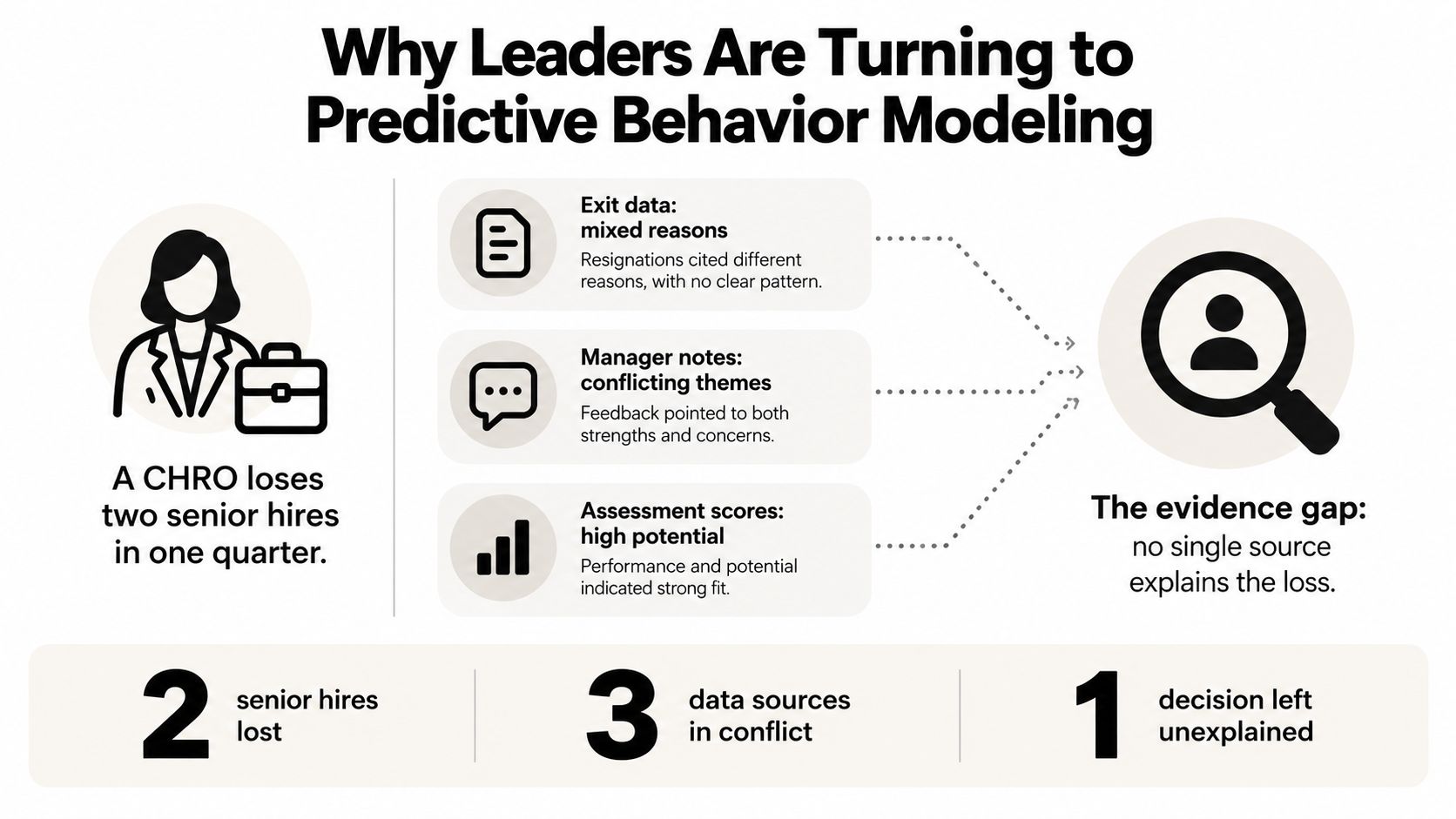
The shift from hindsight to conditional foresight
Predictive behavior modeling extends established statistical prediction rather than appearing from nowhere. Actuaries used statistical models for life expectancy and insurance risk in the 1800s, while formal statistical prediction of human behavior and health outcomes became more common during the latter half of the twentieth century. The important transition was from aggregate risk tables to individualized estimates, as described in this [history of prediction in psychological assessment](https://www.apa.org/pubs/books/prediction-statistics-psychological-assessment-sample-chapter.pdf).
That history gives CHROs a useful standard. A model doesn't determine that someone is reliable, difficult, or promotable. It estimates the probability of a defined outcome under specified conditions. A leadership simulation might estimate the risk of conflict escalation under ambiguity. A retention model might flag a pattern associated with departure. Neither output is a verdict.
> Practical rule: If leaders can't state the outcome, time horizon, and decision owner in one sentence, they aren't ready to build the model.
The right expectation is sharper judgment, not automated judgment. Leaders should use predictive behavior modeling to identify questions worth investigating, compare candidates against job-relevant criteria, and anticipate team interaction risks. They shouldn't use it to outsource accountability.
What Predictive Behavior Modeling Actually Is
Think of predictive behavior modeling as a credit score for work behavior, with an important limitation. A credit score summarizes patterns from financial behavior to estimate repayment risk. A behavior model combines assessment patterns, role outcomes, performance signals, and context to estimate a future work-related outcome. It doesn't measure a person's worth, and it can't turn a probability into certainty.
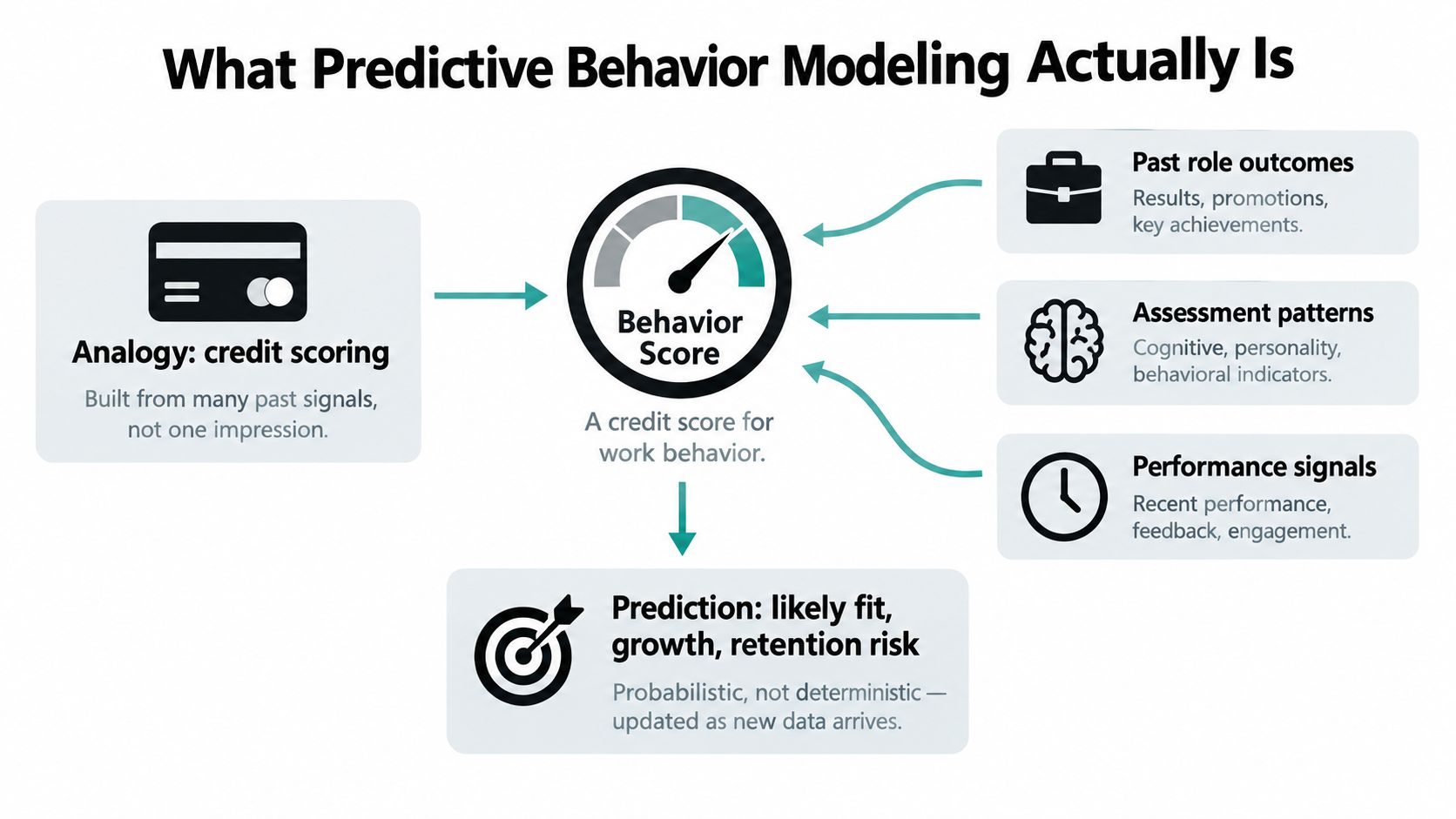
Three layers make the system
Inputs are the evidence. They may include structured assessments, performance records, work samples, interview ratings, project history, manager observations, or collaboration patterns. Every input needs a purpose. If a feature doesn't have a defensible relationship to the job decision, exclude it.
The model layer transforms those inputs into a forecast. That layer may use statistical regression, machine learning, or a combination of methods. The model finds patterns in historical examples, then applies those patterns to a new candidate, employee, or team configuration.
The output is a probability, risk tier, fit estimate, or ranking. It should answer a narrow question, such as whether a person is likely to remain effective in a role with high ambiguity. It shouldn't produce a vague universal label such as “great hire” or “poor culture fit.”
This differs from several adjacent practices:
The evidence supports a realistic level of confidence. A meta-analytic review of digital footprints and Big Five traits found predictive correlations ranging from 0.29 for Agreeableness to 0.40 for Extraversion, with an overall Facebook-related estimate of approximately 0.34 across 16 independent studies in a separate overview. The [reviewed evidence on digital footprints and personality prediction](http://www.cs.columbia.edu/~julia/papers/azucaretal2017.pdf) shows meaningful structure, not individual-level certainty.
For a broader explanation of how predictive analytics differs from related analytical approaches, this [analytics comparison guide](https://querio.ai/articles/augmented-analytics-vs-predictive-analytics-difference) provides useful terminology. The working definition here is simple: predictive behavior modeling uses validated behavioral and contextual evidence to estimate a job-relevant future outcome, while keeping a human accountable for the decision.
<iframe width="100%" style="aspect-ratio: 16 / 9;" src="https://www.youtube.com/embed/cVibCHRSxB0" frameborder="0" allow="autoplay; encrypted-media" allowfullscreen></iframe>
How the Models Work From Data to Decision
A people model usually fails before the algorithm enters the picture. Teams choose a weak label, combine inconsistent records, or train on historical decisions that reflect manager preference rather than capability. A model then gives those problems a more polished presentation.
Start with the decision and the evidence
Structured data is usually the easiest to audit. It can include assessments, HRIS fields, standardized interview scores, work-sample results, and performance ratings. Semi-structured data, such as manager notes and interview transcripts, may contain useful context but also introduces inconsistent language and subjective interpretation. Behavioral telemetry, including collaboration graph signals and task-completion patterns, can reveal work dynamics, yet it raises sharper questions about consent, relevance, and surveillance.
Feature engineering converts raw records into usable variables. A team might transform project history into experience with a particular role demand, or convert repeated collaboration patterns into a measure of cross-functional interaction. Don't confuse availability with validity. A feature can be easy to collect and still be irrelevant, unfair, or unstable.
Choose the simplest model that can answer the question
Logistic regression works well for interpretable risk scoring when the outcome is defined as a category. Gradient-boosted trees can capture nonlinear relationships in tabular performance signals. Sequence or graph models may be appropriate for changing behavioral patterns or collaboration networks, but their complexity increases the burden of explanation and monitoring.
| Technique | Interpretability | Typical Use Case | Validation Burden | |---|---|---|---| | Logistic regression | High, with clear feature direction and contribution | Retention risk or defined readiness categories | Moderate, with careful calibration and subgroup checks | | Gradient-boosted trees | Medium, requiring explanation tools and feature review | Role performance or structured hiring signals | High, especially for leakage, calibration, and drift | | Sequence models | Lower, because timing and interaction effects are harder to explain | Changing behavior across projects or time | Very high, with temporal holdouts and stability testing | | Graph models | Variable, depending on graph construction and explanation method | Team collaboration and network complementarity | Very high, because network data can encode access and hierarchy |
Model selection should follow the business question, not the team's enthusiasm for a particular technique. The practical mechanics resemble other applications of predictive scoring, including [predictive models for sales teams](https://emailscout.io/predictive-lead-scoring/), where the output only matters if the organization defines the action that follows it.
Validation is the real quality gate
Use out-of-sample testing to determine whether historical information predicts later behavior. Cross-validation across holdout cohorts helps expose a model that works only for one hiring class, manager group, or time period. Rolling-origin forecasting is especially relevant when the model uses changing context. In one intensive longitudinal study, researchers collected 5,971 repeated assessments from 104 adults and tested future loneliness, procrastination, and studying using rolling-origin forecasts across personality, affective states, situations, time, and behavioral trends. The [longitudinal prediction study](https://pmc.ncbi.nlm.nih.gov/articles/PMC9793429/) found that the most informative features varied substantially between individuals.
For HR, that means a baseline conscientiousness measure may matter, but current workload, team context, recent stress, and role demands can change the forecast. Test fairness across protected groups, inspect calibration, backtest historical turnover without leaking future information, and monitor whether input distributions drift after deployment. The algorithm is only one part of the system. Data quality, label definition, and validation discipline determine whether the output deserves attention.
Use [predictive risk modeling at Synopsix](https://synopsix.ai/blog/predictive-risk-modeling) as a conceptual reference for connecting forecast outputs to people decisions, not as a substitute for your own criterion validation.
Where It Delivers Value in Hiring and Team Design
The same model shouldn't govern every talent decision. Candidate screening, internal mobility, succession, and team composition have different horizons, data maturity, and consequences. Treating them as one generic “fit” problem is a fast route to construct overreach.
Three decisions, three operating designs
For hiring, use predictive behavior modeling to augment structured interviews and work samples. The model can organize evidence around persistence, responsiveness to feedback, decision ownership, or cooperation under pressure. It shouldn't replace the recruiter who checks job requirements, the hiring manager who evaluates work quality, or the candidate who deserves a clear explanation of the process.
Internal mobility requires a different lens. Past project outcomes, peer feedback, skill adjacencies, and exposure to role demands can help surface employees who may be ready for an adjacent role. The output should identify development questions and evidence gaps, not assume who receives an opportunity.
Team design is more relational. Clustering and compatibility analysis can help managers avoid building a group from one existing network or selecting people who all approach conflict and ambiguity in the same way. A team meta-analysis found that average agreeableness related positively to performance at ρ = 0.24, while average conscientiousness related at ρ = 0.20. Greater within-team variability showed negative relationships for agreeableness at ρ = -0.12 and conscientiousness at ρ = -0.24, according to this [meta-analysis of personality and team performance](https://research.utwente.nl/en/publications/personality-and-team-performance-a-meta-analysis/). Those results support examining both team-level patterns and dispersion, rather than ranking individuals in isolation.
| Use Case | Primary Data Inputs | Predicted Outcome | Required Human Oversight | |---|---|---|---| | Candidate hiring | Structured interviews, work samples, assessments, relevant experience | Role-specific performance or integration risk | Recruiter and hiring-manager review, candidate explanation, documented override | | Internal mobility | Project outcomes, skill adjacencies, peer feedback, development history | Readiness for an adjacent role or development need | Employee discussion, manager evidence review, fair access check | | Leadership pipeline | Role outcomes, pressure responses, coaching behavior, simulations | Likely effectiveness under defined leadership demands | Panel review, development plan, succession calibration | | Team composition | Behavioral profiles, role demands, collaboration requirements | Complementarity, friction risk, or coverage gaps | Manager review, team context, voluntary reassessment | | Project staffing | Current availability, relevant experience, working-style signals | Likely delivery fit under project conditions | Project owner review and explicit context check |
High-volume graduate hiring may justify consistent scoring and automated triage with strict human checkpoints. A niche executive search needs richer evidence and a much lower tolerance for opaque ranking. Cross-functional project staffing may need rapidly refreshed context rather than a stable personality profile. Structured interviews provide a useful benchmark. One review estimated operational validity at 0.44 for structured interviews across 106 studies and 12,847 applicants or observations, compared with 0.33 for unstructured interviews across 39 studies and 9,330 observations, as reported in this [academic review of interview validity](https://www.biz.uiowa.edu/faculty/fschmidt/meta-analysis/Oh_Postlethwaite_Schmidt_2012.pdf).
Roleplay can add evidence when it mirrors the work. Teams exploring [AI roleplay hiring simulations](https://www.overvue.ai/post/pre-hire-assessment-a-complete-hiring-guide-for-2026) should validate the scenario against an actual job criterion, not treat realism or novelty as proof of predictive value.
Benefits and Risks Every CHRO Should Weigh
The business case is attractive because predictive behavior modeling can connect people signals to operational decisions. It may support shorter time-to-productivity, higher quality-of-hire, reduced regrettable turnover, and faster identification of leadership readiness. Those benefits remain hypothetical until the organization defines how it will measure them and protects the process from predictable failure modes.
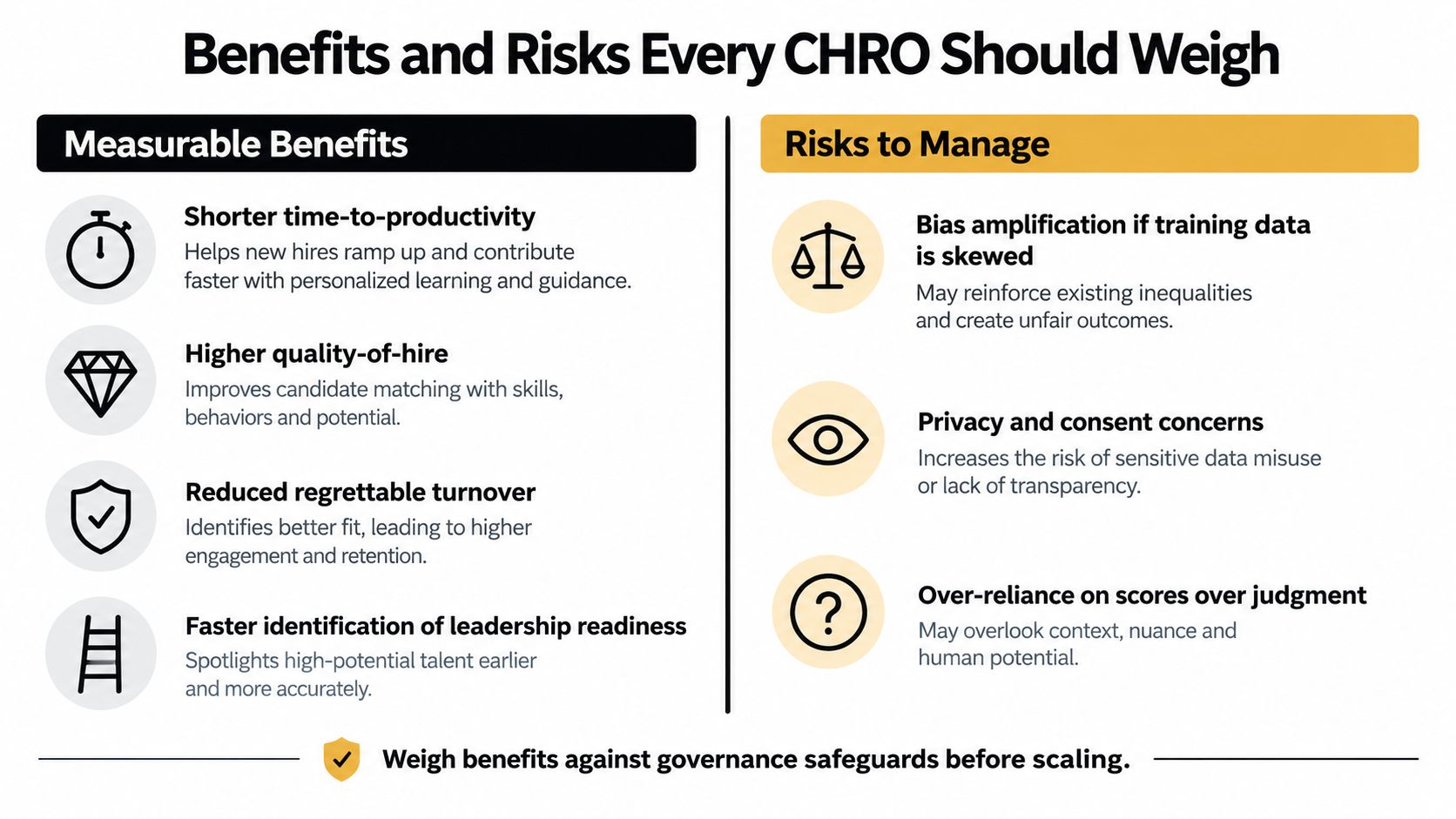
Match each benefit with a control
Shorter time-to-productivity is valuable only if faster hiring doesn't lower quality. Track the model against later role performance and use structured work evidence before approval. Higher quality-of-hire requires a predefined criterion, not post-hoc manager satisfaction. Reduced regrettable turnover requires checking whether the model identifies actionable risk rather than labeling employees who lack access to support.
Leadership readiness needs the strongest discipline. A score should trigger targeted simulations, feedback, and development conversations. It shouldn't become a hidden promotion filter.
> The safeguard is part of the product. A forecast without an explanation, owner, and appeal route is not a mature people decision.
The principal risks are concrete:
Recent governance reviews identify privacy, opaque vendor systems, proxy variables, weak contestability, and automation bias as persistent risks, while a [review of governance challenges in predictive behavior systems](https://rajournals.com/index.php/raj/article/view/633) emphasizes the need for consent, feature relevance, subgroup validation, human review, appeal routes, and prediction expiration. Explainability is not a compliance ornament. It helps managers make better decisions and gives candidates a fair chance to challenge bad evidence.
For a practical framework on assessment governance, see [ethics in assessment](https://synopsix.ai/blog/ethics-in-assessment). The standard should be simple: no high-stakes people decision should depend on a score that the affected person cannot meaningfully question.
Implementing and Measuring a Predictive Behavior Program
Treat implementation as a controlled operating program, not a software launch. The first deployment should be narrow enough to fail safely and specific enough to produce a useful learning signal.
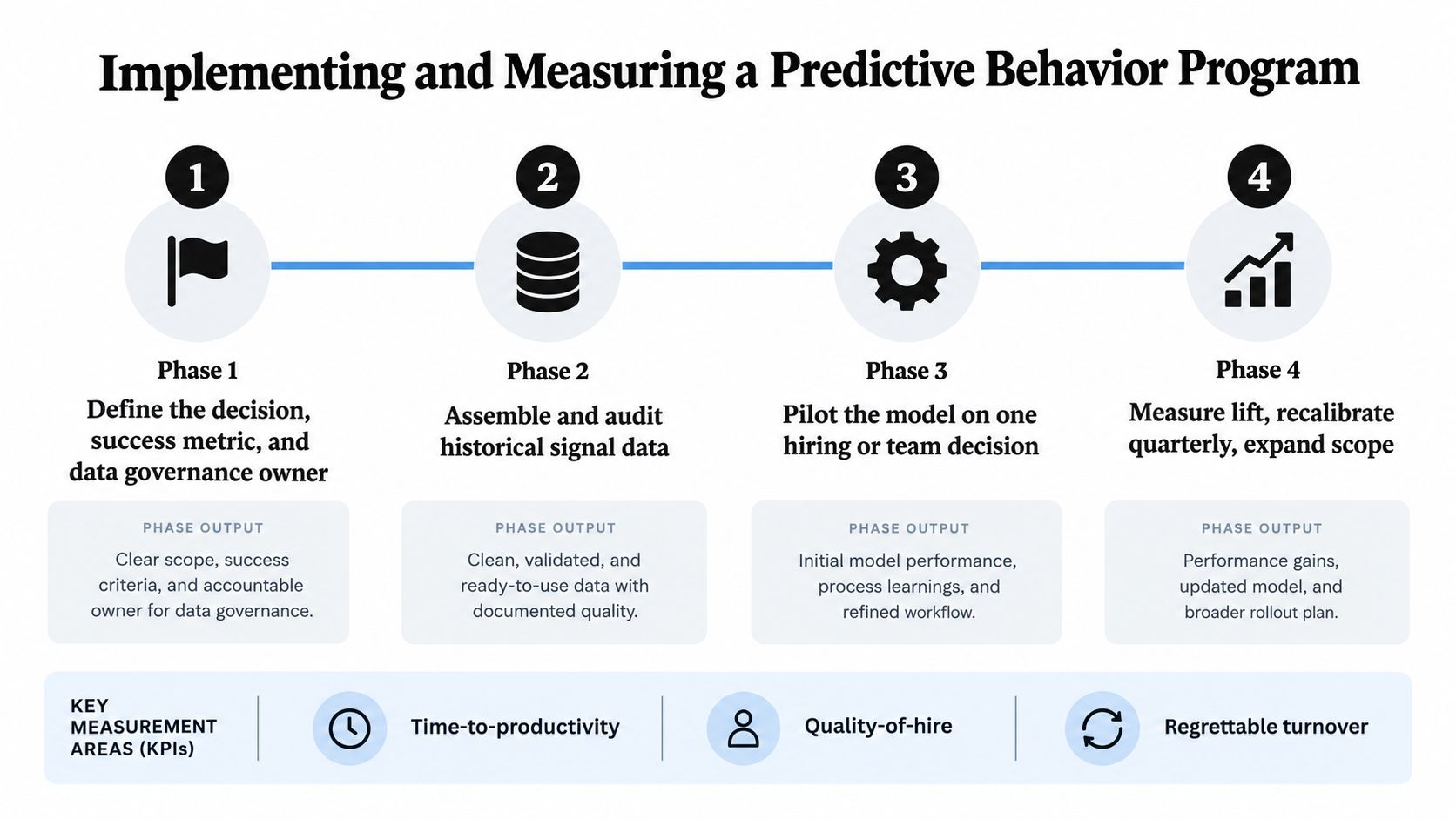
Phase one defines the decision
Write down the decision, predicted outcome, time horizon, success metric, and accountable owner. “Improve hiring” is too broad. “Estimate probability of meeting the role's defined performance standard during the first performance cycle” is testable. Assign a data governance owner before any model is trained, and document what data is excluded.
Phase two audits the evidence
Inspect historical data for missingness, inconsistent ratings, changing job definitions, and underrepresented groups. Identify proxy variables that could encode protected characteristics or access to opportunity. Establish a baseline using existing structured interviews, work samples, or manager decisions. A model should have to beat a credible baseline, not an imaginary one.
Phase three runs in shadow mode
Score candidates or employees without allowing the output to influence decisions. Compare recommendations with later outcomes, inspect disagreements, and ask whether the model is learning genuine capability or merely reproducing prior selection patterns. Shadow mode also gives recruiters and managers a chance to identify explanations they can't use in practice.
Phase four introduces decision support
Move into live use only with mandatory human review, a clear override path, candidate-facing explanations, and an escalation process. Record overrides and their reasons. An override isn't automatically a failure. It may reveal missing context, a flawed feature, or a legitimate exception that the model cannot observe.
| Measurement Area | What to Test | Management Question | |---|---|---| | Calibration | Whether predicted probabilities match observed outcomes | Does a stated risk level mean the same thing across groups? | | Criterion validity | Relationship with later job-relevant performance | Does the model forecast the outcome that matters? | | Fairness | Error and selection patterns across protected groups | Who bears the cost of false positives and false negatives? | | Drift | Changes in feature distributions and outcome relationships | Has the role, workforce, manager, or labor market changed? | | Business impact | Time-to-productivity, quality-of-hire, regrettable turnover, employee experience | Did the decision improve, not merely the score? | | Contestability | Explanations, corrections, appeals, and resolution records | Can affected people challenge the output effectively? |
Monitor calibration against post-hire performance, test disparate impact, and conduct quarterly drift reviews. External validity matters because a model trained in one company, role, country, manager system, or labor market may not remain valid after conditions change. A [review of generalizability and model validation](https://cdn.eprapublishing.org/article/202509-07-024247.pdf) notes that even a reported 89% accuracy and F1 score of 0.87 for a Random Forest job-performance model don't establish transportability, calibration, causal impact, or usefulness for another employer.
Read [assessment validity and reliability](https://synopsix.ai/blog/assessment-validity-and-reliability) alongside the measurement plan. Monitoring isn't a launch task. Retire or retrain a model when calibration degrades, the criterion changes, the data becomes unrepresentative, or managers can no longer explain how the output supports a decision.
Smart Rules for Putting Predictive Behavior Modeling to Work
Use these rules as operating conditions, not slogans.
Predictive behavior modeling earns its place when the decision is consequential, the evidence is relevant, the outcome can be measured, and leaders are prepared to govern the system continuously. It is drifting into overreach when the organization sells certainty, hides features, treats personality as destiny, or uses a generic score to settle a decision that should require direct job evidence.
---
Synopsix helps organizations turn behavioral assessments into practical profiles, simulations, compatibility analysis, and development guidance for hiring, team design, and talent development. Visit [Synopsix](https://synopsix.ai) to evaluate how predictive behavior modeling can support your people decisions with clearer evidence, human review, and role-specific context.