Predictive Risk Modeling for People Decisions
By Synopsix · October 4, 2026 · 17 min read
A senior hire can look excellent on paper, impress an interview panel, and still become a serious performance problem within months. A high-performing team can lose two valued people in a quarter without producing a clear warning in the usual HR dashboard. By the time the pattern becomes obvious, the organization is already dealing with delayed work, replacement costs, and a drop in trust among the people who stayed.
Predictive risk modeling offers a way to move that conversation earlier. It doesn't promise certainty, and it shouldn't replace managerial judgment. Used properly, it helps CHROs and HR leaders identify meaningful signals, test whether those signals hold across groups, and decide what action is justified before a soft warning becomes an expensive outcome.
When a Hire Quietly Becomes a Problem
A new executive misses a difficult decision in one-on-ones. Collaboration signals soften. Milestones slip, yet every delay has a reasonable explanation. Months later, colleagues call the hire a poor fit, and HR is left asking which earlier signals were visible, which were reliable, and why nobody acted.
Attrition can follow the same quiet pattern. Two strong contributors leave within a short period, so leaders treat the departures as separate events. A closer review may show that both had stopped volunteering for cross-functional work, participated less in team discussions, or raised concerns that never reached a decision-maker.
The business cost is not only the vacancy. It also reflects how late signals were recognized and whether the organization had a fair response prepared:
> Practical rule: If a risk signal cannot change a decision or intervention, it is not yet useful analytics.
Traditional dashboards still matter. They summarize turnover, performance ratings, absences, and engagement after those outcomes enter the record. A [retention-risk assessment](https://synopsix.ai/blog/retention-risk-assessment) can help leaders organize earlier signals, but the result depends on a clearly defined outcome and a proportionate response.
Behavioral assessment platforms such as Synopsix can help translate psychometric patterns into business-readable risk signals rather than presenting an opaque score. Leaders can then examine what a signal may mean, what evidence supports it, and what action is justified. Candidates should also have a way to question inaccurate screening information. The [correct background check errors guide](https://peoplefinder.app/blog/should-i-be-worried-about-a-background-check) provides practical context for that adjacent hiring concern.
Predictive risk modeling changes the question from “What happened?” to “Which future outcome appears more likely, given what we know now?” The goal is disciplined investigation and accountable action, not certainty or a label that determines someone's career.
What Predictive Risk Modeling Actually Means in HR
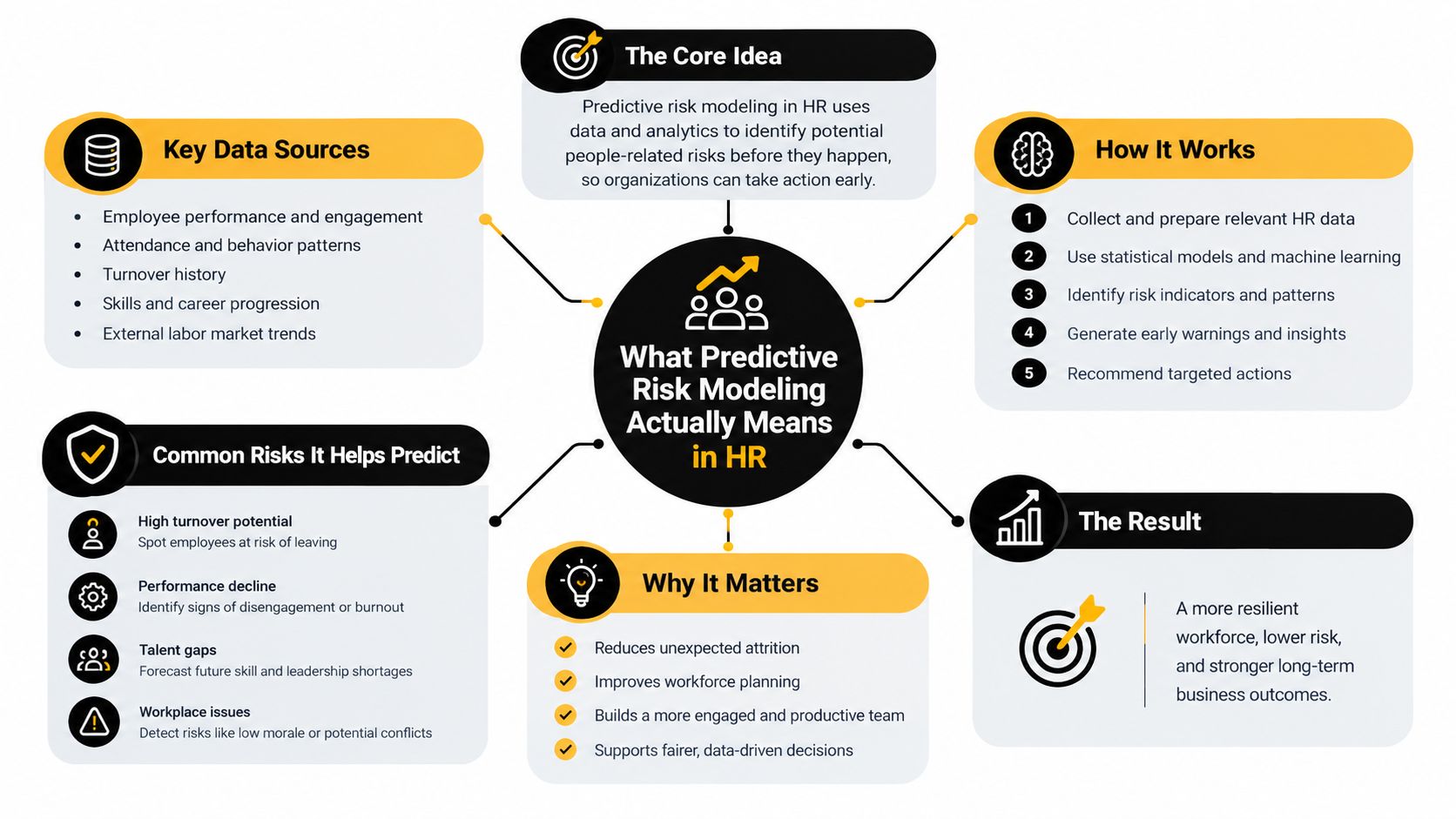
Predictive risk modeling is a structured approach for using historical workforce data, behavioral signals, and statistical or machine learning methods to estimate the likelihood of a future talent outcome. The outcome might be unsuccessful ramp-up, voluntary attrition, a regrettable departure, or persistent team friction.
A backward-looking dashboard reports that turnover rose, performance declined, or a team missed its goals. A predictive model estimates whether a similar result is more likely for a particular candidate, employee, team, or situation. The model isn't reading the future. It's comparing current signals with patterns found in earlier data and expressing an informed estimate under uncertainty.
A weather forecast is a useful analogy. A forecast that says rain is likely doesn't guarantee rain, but it can change whether you carry an umbrella, protect an outdoor event, or adjust travel plans. A people-risk score should work the same way. It should prompt a proportionate action, such as a deeper interview, a structured stay conversation, or a review of role expectations. It shouldn't become a label that determines someone's career.
Two common prediction formats
A classification model answers a category question. For example, it might estimate whether a candidate is likely to reach an agreed ramp-up standard or whether an employee faces high risk of voluntary departure during a defined period.
A continuous risk score places cases along a scale. It may distinguish low, moderate, and high risk, or provide a probability estimate that managers use alongside other evidence. The scale is helpful when leaders need to prioritize attention, but it can create false precision if the underlying data is weak.
Every HR model needs four basic ingredients:
The key question isn't whether a model can produce a score. It's whether the organization can explain what the score means, test whether it works for different groups, and use it without turning uncertainty into an irreversible judgment.
The Two Modeling Families Leaders Should Know
HR leaders don't need to become data scientists, but they do need to understand why a team chose one modeling family over another. The choice affects interpretability, data requirements, validation, and how confidently managers can act on an output.
Classical statistical models include logistic regression, survival analysis, and proportional hazards models. Logistic regression can estimate the relationship between inputs and a categorical outcome. Survival and proportional hazards approaches focus on timing, such as how long an employee remains before an event occurs. These methods are often strong baselines because workforce data can be small, sparse, inconsistent, and noisy.
Classical models make it easier to inspect the direction and contribution of variables. That transparency helps when HR, legal, compliance, and business leaders need to challenge a result. It doesn't make the model automatically fair or correct. An interpretable model can still learn biased labels or rely on poorly defined features.
Modern machine learning methods include random forests, gradient-boosted trees, and neural approaches. They can identify nonlinear relationships and interactions that a simple model may miss. They may also combine structured HRIS fields with richer behavioral or text-based signals, provided the organization has a lawful, well-documented reason to use those inputs.
The tradeoff is operational. Machine learning often requires more data, more careful tuning, stronger documentation, and closer monitoring after deployment. A model can perform well in development and then degrade when hiring practices, manager behavior, labor conditions, or the composition of the workforce changes. A practical [data modeling guide from Eztrackr](https://www.eztrackr.app/blog/data-modeling-interview-questions) can help teams clarify how source data should be structured before selecting an algorithm.
| Dimension | Classical statistical models | Modern machine learning | |---|---|---| | Primary strength | Interpretability and clear baselines | Complex patterns and feature interactions | | Typical fit | Smaller or sparse workforce datasets | Richer datasets with varied signals | | Manager explanation | Usually easier to explain | May require additional interpretation | | Governance need | Still requires validation and fairness review | Requires validation, fairness review, and drift monitoring | | Best decision criterion | Transparency and defensibility | Pattern complexity and predictive utility |
The right decision isn't “old method versus new method.” It's a fit question. A hybrid approach may use a transparent statistical baseline, then test whether a more flexible model adds meaningful value without creating an unacceptable governance burden.
Data Requirements and What Is Worth Collecting
More data doesn't automatically produce better predictive risk modeling. HR teams often possess large volumes of records, but many fields are inconsistently coded, missing for particular groups, or shaped by the biases of earlier managers. A clean-looking database can still represent a distorted history.
A useful starting point is to separate inputs into three categories. Behavioral and psychometric signals may include cognitive ability, personality, motivation, and work-style indicators. These can help describe how someone is likely to approach a role, but they must be connected to actual job demands rather than treated as universal measures of quality.
Historical workforce records may include tenure, performance ratings, manager changes, and exit reasons. These fields can be useful, yet each requires scrutiny. Performance ratings may reflect manager standards more than employee contribution. Exit reasons may be incomplete or rewritten after the departure. A model trained on those labels can reproduce the organization's explanations without discovering the underlying cause.
Contextual and operational data can include team composition, role requirements, compensation position, and shift patterns. Context often determines whether a behavior becomes a risk. A communication style that works in a stable specialist team may create friction in a high-change customer environment.
| Data Source | Predictive Value | Collection Effort | Bias Risk | |---|---|---|---| | Role-specific behavioral assessment | Can connect tendencies to actual demands | Moderate | Moderate if not validated for the role | | Performance ratings | Useful when rating standards are consistent | Low because records already exist | High when managers apply different standards | | Tenure and manager changes | Helpful as context for timing and transitions | Low | Moderate if interpreted without team context | | Exit reasons | Potentially useful for outcome definition | Low to moderate | High when labels are incomplete or post-hoc | | Team composition and work patterns | Helps model fit and operating context | Moderate | Moderate when small teams create unstable samples |
Data quality traps
Survivorship bias appears when the dataset overrepresents people who stayed long enough to receive strong reviews. Small subgroup samples make estimates unstable and can hide systematic errors. Label leakage occurs when the model receives information that became available only after the outcome was already developing, such as a manager's post-hoc explanation for a resignation.
The practical answer isn't to collect every possible personal identifier. It's to document provenance, define the outcome before modeling, minimize unnecessary personal data, and test whether each feature improves decisions without creating avoidable fairness risk. Analytics teams can find useful perspectives on the relationship between data, reporting, and business decisions in [Digital Souls Studios LTD analytics](https://www.thedigitalsouls.com/blog/ai-data-analytics-business-intelligence), but HR leaders still need to apply their own governance standards to people data.
How to Evaluate a Risk Model Beyond Accuracy
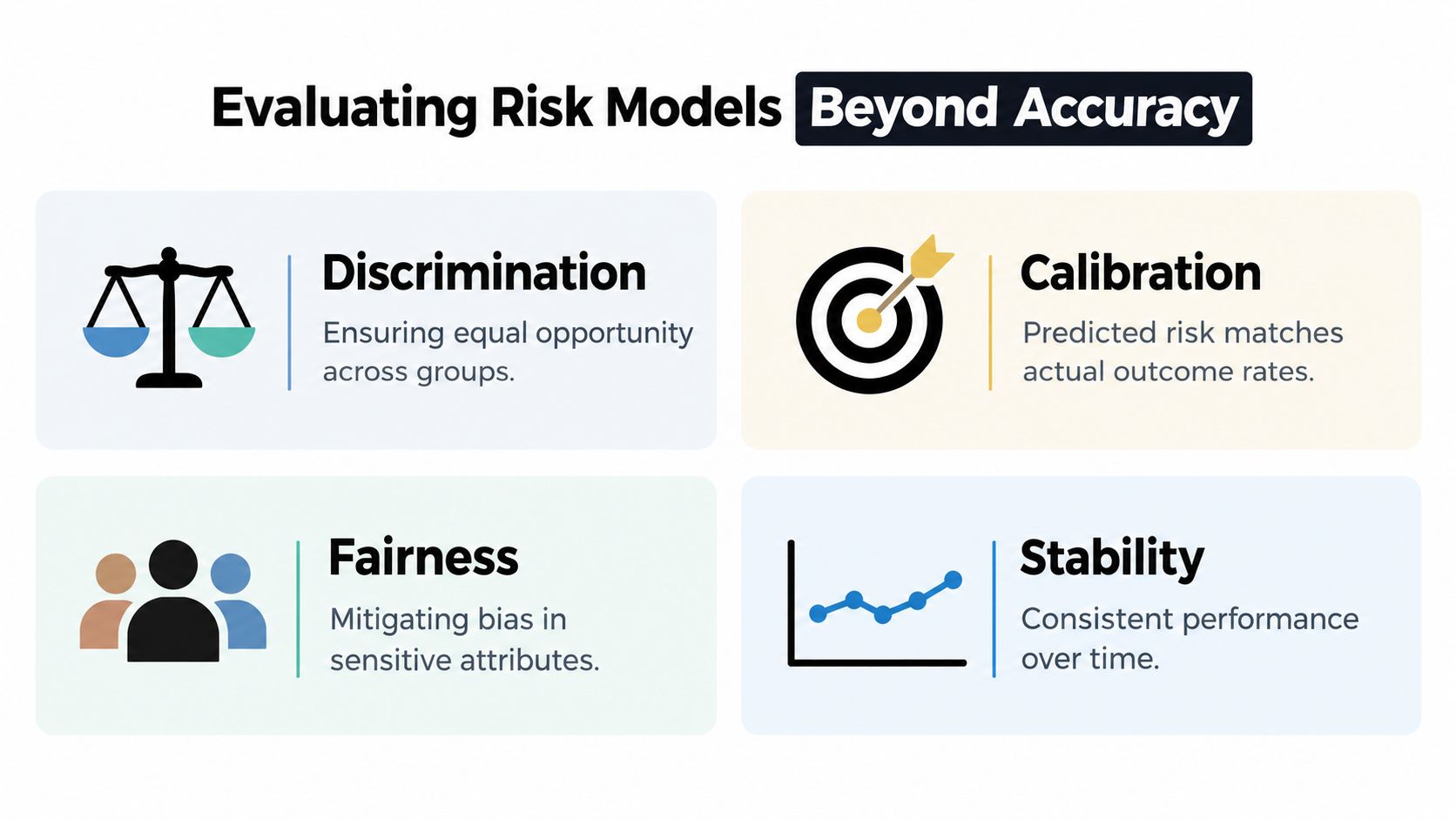
A risk model can rank cases well and still be unsafe or impractical to deploy. Leaders should evaluate discrimination, calibration, fairness, and stability as separate questions, because each tests a different failure mode.
Discrimination asks whether the model separates higher-risk cases from lower-risk cases. Analysts may use AUC, precision-recall, and lift to assess that separation. A high AUC on an imbalanced attrition dataset can appear impressive while producing too many false alerts or missing the employees leaders most need to support.
Calibration asks whether predicted probabilities match observed outcome frequencies. If 100 employees receive a 30% attrition-risk prediction, about 30 should leave within the defined window. If 55 leave, the model is miscalibrated, and its thresholds may misdirect stay conversations and retention resources. Platforms such as Synopsix can make psychometric outputs easier for business leaders to interpret by translating them into understandable risk signals, but those signals still require validation.
Fairness requires subgroup testing across protected and adjacent categories. Teams may examine equalized odds, demographic parity, and disparate impact ratios. No single metric fits every use case. The decision context, legal requirements, outcome definition, and potential harm determine which tests belong in the review.
Stability tests whether scores remain dependable across cohorts, time windows, and small changes in inputs. A model used in January should not become inexplicable by July because hiring patterns or manager behavior changed.
An external review of risk models reinforces the need to test both ranking and calibration. [The review's findings](https://wjarr.com/sites/default/files/fulltext_pdf/WJARR-2025-4207.pdf) show why a model can distinguish cases effectively while still overstating or understating absolute risk. For HR leaders, the practical lesson is direct: a useful score must support sound decisions at the threshold where managers act.
> A validation report should show whether the model separates cases, who bears the errors, and whether the output remains usable over time.
Evaluation continues after launch. See [assessment validity and reliability](https://synopsix.ai/blog/assessment-validity-and-reliability) for how to document calibration and subgroup testing. The organization also needs a monitoring cadence, clear owners, documented thresholds, and a process for pausing or revising the model when data quality, fairness, or stability deteriorates.
Where Predictive Risk Modeling Changes the Game
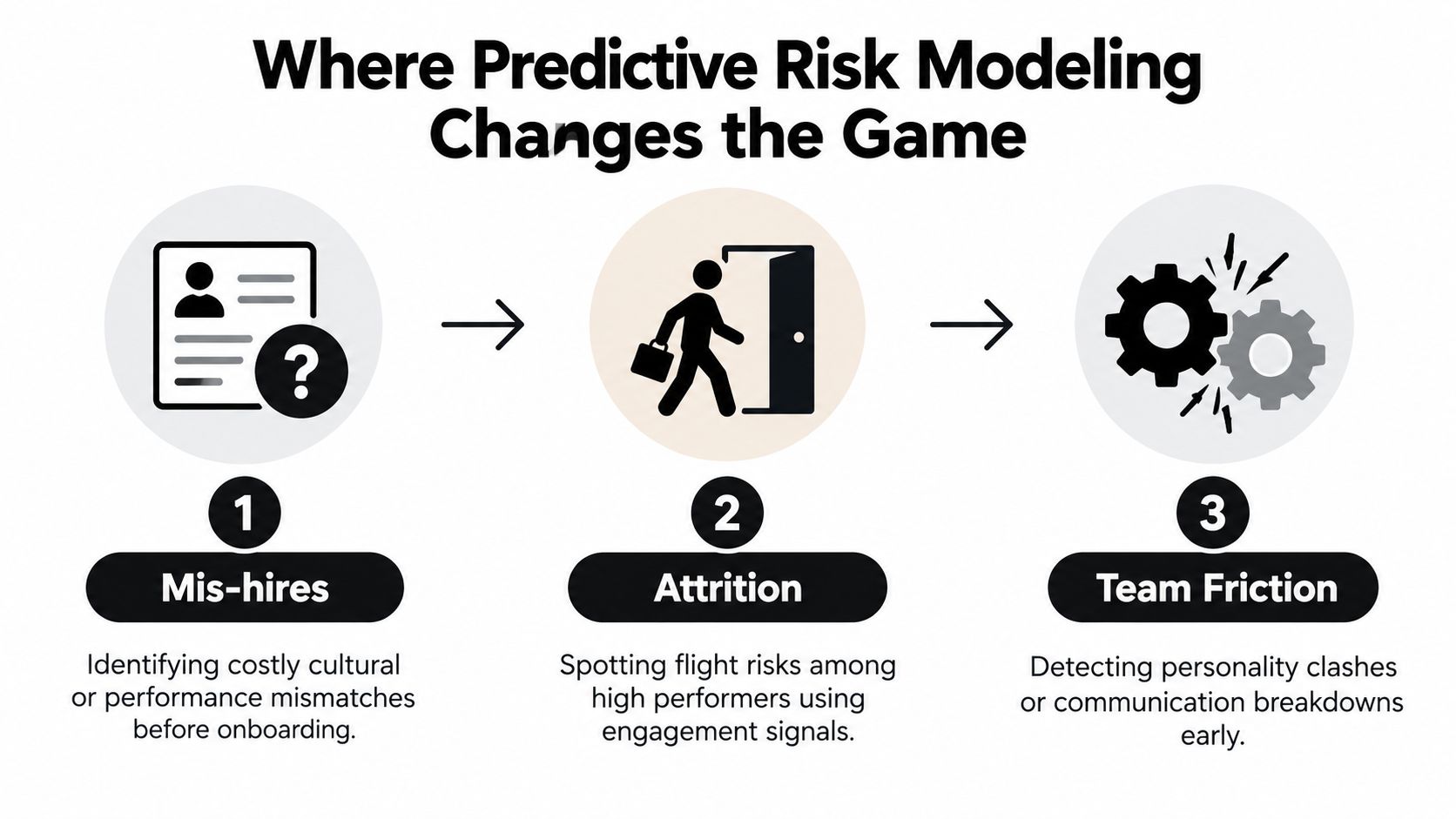
A hiring team receives a strong candidate profile for a role that requires independent judgment, rapid collaboration, and sustained customer contact. The interview panel likes the candidate, but the evidence around role fit is mixed. A useful model doesn't issue a pass or fail verdict. It places the candidate in a probability band and shows which job demands deserve deeper questioning.
That output could lead to a structured work sample, a more focused reference conversation, or a revised onboarding plan. This is especially important because a 2022 meta-analysis found that structured interviews, work sample tests, job knowledge tests, and empirically keyed biodata were the strongest job-specific predictors in its review, while cognitive ability and unstructured interviews showed lower operational validity than earlier estimates. The review reported declines of 0.20 for cognitive ability, 0.21 for work samples, and 0.19 for unstructured interviews, while structured interviews had the highest mean validity among widely used predictors. [The meta-analysis](https://www.cambridge.org/core/journals/industrial-and-organizational-psychology/article/revisiting-the-design-of-selection-systems-in-light-of-new-findings-regarding-the-validity-of-widely-used-predictors/A20984B138319E3D432E643978BF026D) supports a practical principle: predictive signals should strengthen job-relevant assessment, not replace it.
Attrition needs a more precise question
Overall turnover isn't the same as regrettable attrition. A model should help leaders distinguish routine movement from the loss of people whose skills, relationships, or future potential are difficult to replace. The intervention might be a stay conversation, a manager change, clearer progression, or a review of workload and role expectations.
Personality data alone shouldn't carry that burden. A 2022 meta-analysis of personnel selection found an overall personality-test validity of 0.22 across 38 years of research, while earlier work reported a validity coefficient of 0.15 for personality-based predictors. The review indicates that personality measures can contribute, but job-specific evidence is generally stronger.
Team friction is a system problem
Individual scores can miss the interaction that creates trouble. Managers may need signals about compatibility, communication patterns, role overlap, and isolated subgroups. Behavioral research has shown that observed behavior can support prediction of decision trajectories, including work using psychological task data and another study using data from 1,000 humans in a three-armed bandit task. [The IBM research summary](https://research.ibm.com/publications/predicting-human-decision-making-with-lstm) offers relevant background for understanding why behavioral signals can inform prediction, while also underscoring the need to connect any signal to a defined workplace outcome.
The score is never the intervention. The value comes from the action it enables, such as reassessing an offer, allocating retention support, or redesigning team responsibilities.
Ethics, Fairness, and the Feedback Loop Problem
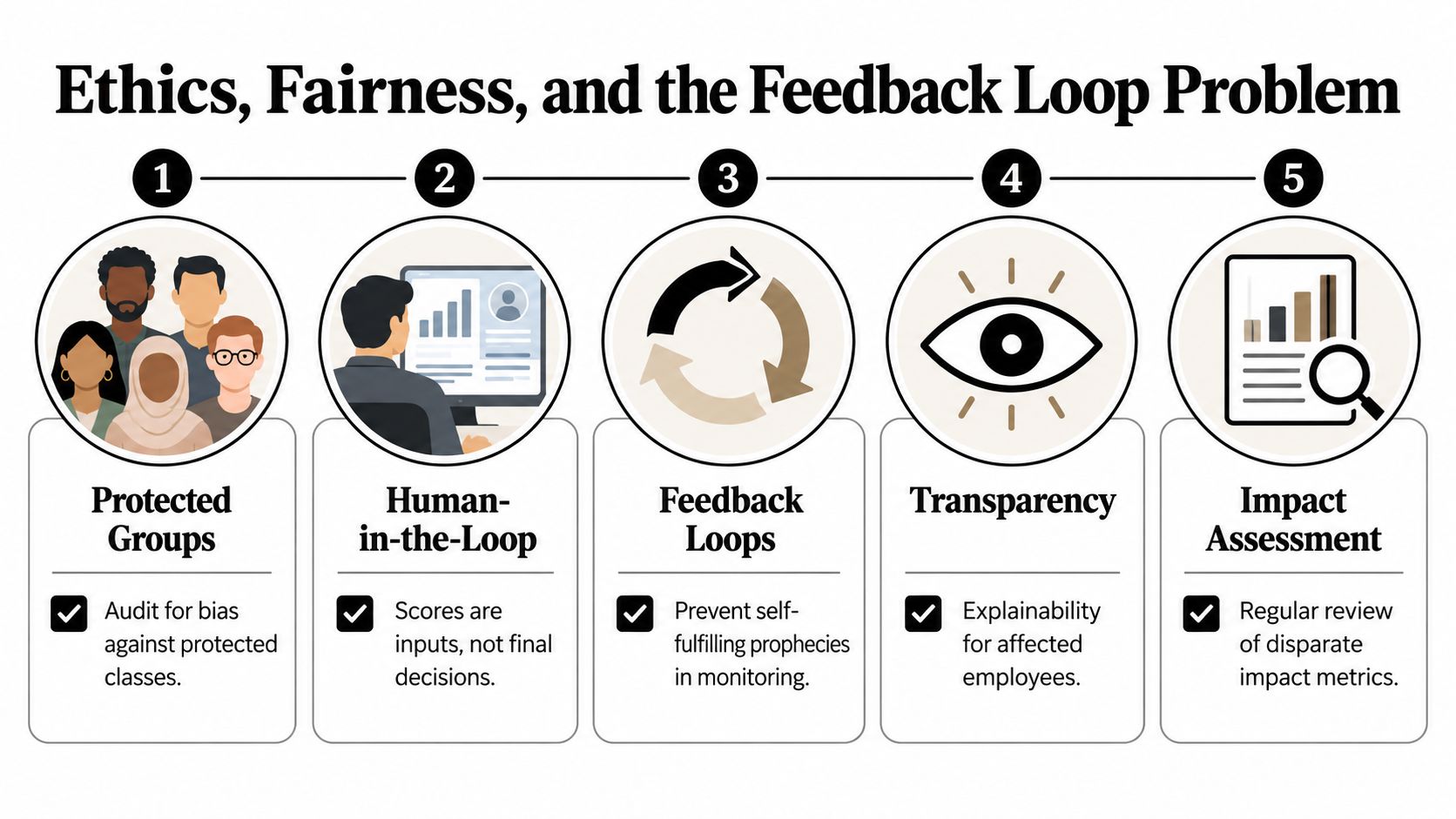
A risk score is an input to a people decision, not the decision itself. See [ethics in assessment](https://synopsix.ai/blog/ethics-in-assessment) for governance principles. The distinction matters because a precise-looking score can enter a manager's workflow and appear to explain a complicated human outcome.
Begin with the model's possible failure points. Protected groups may receive different error rates. Small teams can produce unstable estimates because comparable evidence is limited. Tenured cohorts may appear risky because they experienced different reorganizations, managers, or promotion paths. Strong overall performance can still hide overestimated or underestimated risk for women, racial minorities, lower-income workers, or other subgroups.
A 2025 review of clinical risk prediction models found that fairness metrics were used infrequently, applied inconsistently, and supported by training data that were largely racially and ethnically homogeneous. The setting was healthcare, but the governance lesson transfers to talent decisions. The review reinforces why subgroup calibration and error parity require attention alongside aggregate accuracy. For a hiring model, HR should check equalized odds for gender and race, including false-positive rates at the selected threshold, and suppress scores for any subgroup with n<50 until more data is collected.
The self-fulfilling prediction
An attrition model repeatedly flags the same employees. Managers may then withhold visible work, reduce development investment, or assume a promotion would be wasted. Those employees can disengage or leave, and the next training cycle records the departure as confirmation. The intervention helped create the outcome that the model appeared to predict.
That pattern is a feedback loop, not proof of predictive power. Recent work on interpretable risk prediction emphasizes prospective validation, fairness auditing, and causal soundness. A review of predictive occupational-risk AI also points to long-term governance and monitoring, rather than detection alone. [The evidence on real-world reliability](https://ojphi.jmir.org/2025/1/e66598/PDF) supports treating post-deployment effects as part of model design.
Operational guardrails should include:
Transparency means explaining the signal's purpose, limits, supporting evidence, and actions managers must not take. A behavioral assessment platform such as Synopsix should translate psychometric inputs into business-readable risk signals, while leaving interpretation, review, and accountability with people.
Putting It Into Practice with Synopsix
A credible program starts with a business question, not a platform demo. “Can we predict talent risk?” is too broad to govern. “Can we identify candidates who need a deeper assessment of role fit before an offer?” gives the team a defined outcome, decision point, and review process.
Build the workflow in sequence
1. Define the outcome: Specify what unsuccessful ramp-up, regrettable attrition, or team friction means in observable terms. Decide what action the organization can take when risk is heightened. 2. Choose relevant signals: Combine job requirements with behavioral and psychometric inputs, workforce history, and context. Exclude fields that are convenient but weakly defined or unnecessarily sensitive. 3. Create a baseline: Start with a transparent risk signal and document the assumptions. Test whether a more complex approach adds useful information without making review impossible. 4. Validate against outcomes: Compare predictions with later results, then examine calibration, subgroup performance, and stability across cohorts. Don't approve a model solely because its aggregate score looks strong. 5. Deploy decision support: Give managers a recommended next step, not just a number. A hiring alert might suggest a structured work sample. A team-risk alert might prompt a facilitated conversation rather than a personnel action. 6. Monitor and retire: Track drift, feedback effects, data quality, and fairness. Remove features that fail review, even if they improve a narrow performance metric.
Synopsix translates behavioral assessment and psychometric data into business-readable signals through assessment profiles, role-oriented reports, predictive simulations, and team compatibility analysis. In a governed workflow, those outputs can support scenarios involving mis-hire risk, attrition, and team fit without requiring managers to interpret technical psychometric language.
The implementation conditions matter as much as the model. Executive sponsorship gives the program authority to challenge established practices. Manager training prevents scores from becoming shortcuts. A regular governance cadence creates a place to review drift and fairness. Above all, leaders must be willing to retire a feature, threshold, or workflow when the evidence no longer supports it.
A successful people-analytics program doesn't prove that a model is clever. It proves that leaders can use an uncertain signal carefully, consistently, and fairly.
---
Synopsix offers behavioral assessments, comparable profiles, predictive simulations, and team-fit guidance that can turn psychometric evidence into practical decision support for hiring and talent planning. Visit [Synopsix](https://synopsix.ai) to explore how your team can evaluate risk signals while keeping validation, human judgment, and governance at the center.