Private Equity Compensation: The Complete 2026 Guide
By Synopsix · August 13, 2026 · 17 min read
You're probably looking at a compensation offer that sounds generous on paper and awkward in practice. The base is easy to read, the bonus sounds negotiable, and the carry line item feels important without being obvious. That's exactly where people get it wrong. In private equity, the question isn't “what's the salary,” it's “who gets paid first, when, and for what outcome.”
A good private equity compensation package is an economic agreement, not a standard HR offer. The firm gets paid through fees and profit share, LPs get paid before the GP does, and the individual professional gets rewarded only if the fund clears its hurdles and the timing works in their favor. If you're a CHRO, a fund operations leader, or a VP-level candidate, you need to read the package the way a partner would. A useful outside benchmark for that mindset is the broader [cfo community](https://www.forumspace.com/information-hub/finance-community) at ForumSpace, where finance leaders often compare the mechanics behind pay rather than just the headline number.
Why Private Equity Compensation Looks Different From Every Other Paycheck
A portfolio-company CHRO can look at a PE-backed offer and think the cash looks competitive, then miss the underlying issue entirely. A fund operations lead can make the same mistake from the other side, assuming a bigger base fixes a weak long-term deal. It doesn't. In this world, pay is shaped by fund-cycle risk, illiquid economics, and the rule that limited partners get paid back before the GP collects carry.
The cleanest mental model is simple. The firm itself usually earns money through a fee-and-carry structure, while the individual professional's upside depends on how that structure turns into realized value over time. That means a compensation package in PE behaves less like a normal paycheck and more like a layered ownership plan with gates, delays, and performance tests. If you benchmark it like a corporate role, you'll misread almost everything.
The right comparison is not just against another offer, but against the firm's economics and the role's place in the fund. A $400K all-in package can be a better outcome than a $600K corporate package if the upside is real, the vesting is fair, and the fund has enough runway to realize value. The reverse is also true when carry is thin, vesting is slow, or the fund is too early in its life to matter.
For people who want a broader finance lens, the operating logic is similar to what you'd discuss with a strong advisory group, not a simple payroll vendor. That's why compensation conversations in private equity need the same rigor you'd bring to capital allocation.
The Core Building Blocks of a PE Pay Package
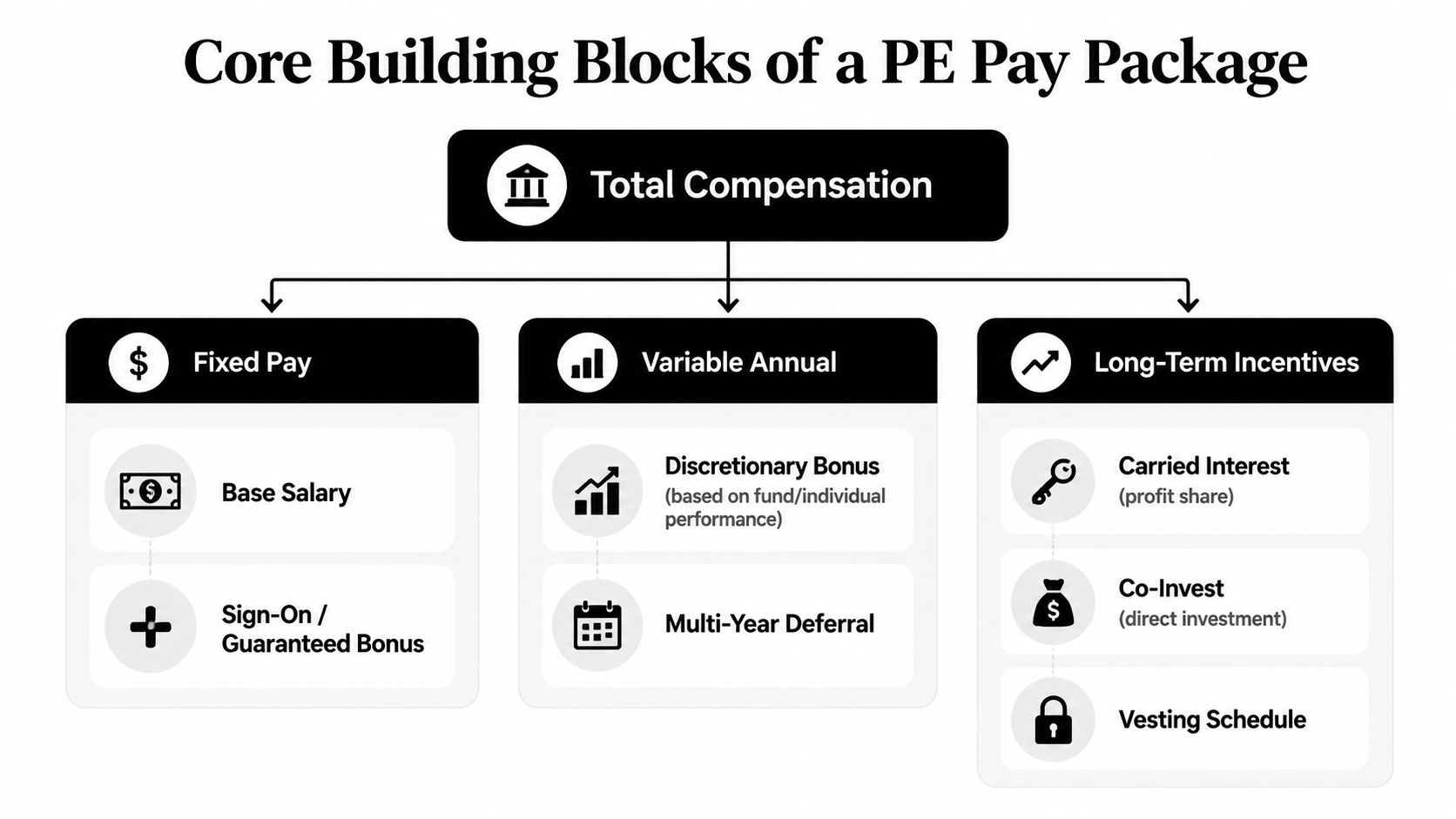
The firm's own economics start with the familiar 2 and 20 model, a 2% annual management fee and 20% carried interest on profits, as described in NBER research on private equity fees and incentives ([NBER research on private equity fees and incentives](https://www.nber.org/system/files/working_papers/w17942/w17942.pdf)). Think of the management fee as the engine keeping the machine running, while carry is the upside gear that only engages once investors are made whole. That is why the comp architecture inside PE mirrors the fund architecture itself.
Fixed pay and variable annual pay
Base salary is the floor, not the story. It's the rent payment in the package, the guaranteed cash that keeps the lights on. At junior levels, that's still cash-heavy, because people are being paid to learn, execute, and absorb risk before they get meaningful ownership economics.
Discretionary bonus is the first variable layer. I'd compare it to a yearly scorecard that the firm can tilt based on individual output, fund performance, and market conditions. It isn't mechanical in the way a corporate bonus grid often is, and that flexibility cuts both ways. If the fund underperforms or the firm misses internal expectations, that “target” bonus can shrink fast.
Long-term incentives and ownership-like economics
Carried interest is the profit share, the long-dated piece that matters most once someone is senior enough to benefit from it. A useful analogy is a ticket to the upside of the fund, but the ticket only pays after LPs are repaid and hurdle terms are cleared. That's why carry feels powerful on paper and frustrating in practice.
Co-investment is different. It's when professionals write a personal check alongside the fund, so they're buying exposure rather than just receiving it. It's the most direct way to align a senior professional with the deal, but it also creates concentration risk and real cash outlay.
Deferred compensation and vesting schedules are the guardrails. Deferred comp spreads cash over time, while vesting says when the economics belong to the recipient. A vesting schedule is basically the firm's way of saying, “you earn this only if you stay and deliver.”
For a practical HR lens on reward design, I'd also look at the way other compensation frameworks break out fixed, variable, and long-term value in a broader total rewards design. A useful reference point is this [pay yourself as a business owner](https://everglow.au/how-to-pay-yourself-as-a-business-owner/) discussion from Everglow Prosperity, because the logic of balancing current cash with long-term upside is more similar than people think.
A simple way to read any offer letter is this, map the cash, then map the control, then map the exit. If a line item can't be tied to one of those three, it's probably fluff.
> Practical rule: If the long-term piece can't be explained in plain English, it probably isn't valuable enough to anchor a decision.
For teams structuring total rewards internally, the same logic applies when translating ownership, incentives, and retention into one coherent package. See the broader [total rewards HR](https://synopsix.ai/blog/total-rewards-hr) perspective if you need the mechanics beyond PE.
Compensation Benchmarks by Role and Firm Size
A compensation conversation in private equity starts with role, then firm size, then where the economics sit in the stack. A first-year associate is paid for execution, speed, and judgment under pressure. A partner is paid for sourcing, capital raising, decision quality, and the ability to turn unrealized economics into actual carry. Title matters less than where someone sits in that chain.
The best benchmark data is still strongest at the junior end, where market pricing is most visible. Industry compensation guides show first-year associates at about $135K to $155K base salary and 100% to 150% bonuses, which puts typical all-in pay around $275K to $390K at top firms, according to the 2025 North America benchmark survey and related compensation guidance ([Heidrick 2025 North America private equity investment professional compensation survey](https://www.heidrick.com/en/insights/private-equity/2025-north-america-private-equity-investment-professional-compensation-survey), [Wall Street Prep private equity salary guide](https://www.wallstreetprep.com/knowledge/private-equity-salary/)). Senior and partner-level compensation moves into a different category, because carried interest becomes a meaningful part of the package and total compensation can exceed $1M.
The table below is useful only if you read it the right way. It is a decision lens, not a promise. Bigger funds usually bring broader carry, a stronger brand premium, and heavier competition for talent. Smaller firms often pay less cash up front and offer a more concentrated upside, but that upside holds less value if the fund platform is thin or the realization path is weak.
| Typical PE Compensation Ranges by Role | Base Salary | Target Bonus | Typical All-In | Mega-Fund Uplift | |---|---:|---:|---:|---| | Associate | $135K to $155K | 100% to 150% of base | $275K to $390K | Higher bonus consistency and stronger long-term access | | Senior Associate | Qualitatively higher than associate | Variable and performance-linked | Higher than associate level | Broader carry visibility | | VP | Higher cash, more responsibility | More discretionary, more tied to team output | Meaningfully above associate band | Better chance of meaningful carry participation | | Principal | Senior cash plus stronger long-term economics | More tied to deal and fund outcomes | Often steps into ownership-like pay | Larger carry share and better co-invest access | | Partner | Senior cash plus carry dominance | Less about annual bonus, more about realized economics | Can exceed $1M ([Heidrick survey](https://www.heidrick.com/en/insights/private-equity/2025-north-america-private-equity-investment-professional-compensation-survey)) | Largest impact from carry, fund scale, and realization |
One point CHROs should not miss, the same title can describe very different economic realities. A mega-fund associate and a mid-market associate may both have strong brand value, but the balance between cash, carry, and access to real upside is not the same. The firm's size changes the package more than commonly admitted.
For HR teams that want a broader compensation calibration point, the internal [compensation salary survey](https://synopsix.ai/blog/compensation-salary-survey) framework is a useful companion to PE-specific benchmarking. It helps separate base pay, annual incentive, and long-term value before you start comparing offers across firms.
> Bottom line: do not compare PE compensation without asking how much is cash, how much is actual long-term value, and how much is just theoretical upside.
Carried Interest, Co-Invest, and Vesting Mechanics
A lot of candidates talk about carry as if it were a bonus with a long wait. That is the wrong frame. Carry is a claim on future fund profits, and it only turns into meaningful money if the fund performs, exits clear the hurdle, and the timing works out. That is why it is the part of private equity compensation that gets misunderstood most often.
How Carry Works
The mechanics are simple on paper and unforgiving in real life. The fund returns contributed capital to LPs first, then pays the preferred return hurdle, then the carry pool starts sharing in profits. As noted by [Not Very Private Equity on PE compensation](https://www.notveryprivateequity.com/private-equity-compensation/), carry is the payoff at the end of the chain, which is exactly why it usually comes after investors are made whole.
Take a $1B fund with a 2 and 20 structure. The management fee keeps the platform running, but the upside for a professional sits in the carry pool, not the fee stream. A 1% carry allocation can be highly valuable or underwhelming depending on fund profits, the hurdle, and how quickly exits happen. Vintage, realization pace, and fund performance drive the outcome more than the headline grant size.
> The hard truth is simple, carry pays for patience under uncertainty.
Vesting, Leavers, and Co-Invest
Vesting exists for one reason, to keep people from taking economics off the table before the value shows up. In private equity, that usually means multi-year vesting with cliffs, plus good-leaver and bad-leaver terms that determine what happens if someone leaves under different circumstances. The exact terms matter because they decide whether the person owns the economics or only has a promise on paper.
Co-investment changes the equation again. Instead of receiving an abstract share of profits, the executive puts personal capital into the fund or transaction and takes direct exposure to the deal outcome. That can raise realized comp in a meaningful way, but it also ties personal wealth to the same fund cycle that already governs carry. For a senior hire, that is either a strong alignment signal or a concentration problem, depending on net worth and liquidity.
The wait is part of the bargain. Multiple sources describe carry as a long-duration incentive, often taking 5 to 10 years from grant to realization (Guru Startups report on compensation in private equity). The same point is reinforced by the Not Very Private Equity guide, which makes clear that the money sits behind fund performance and exit timing. That is what makes PE comp structurally illiquid, heavily back-ended, and suited to people who can tolerate a long wait for terminal value.
If you are designing or accepting a package, do not ask whether carry sounds generous. Ask whether the hurdle is realistic, whether vesting matches the fund cycle, and whether the co-invest amount creates conviction or concentration risk. Those are the questions that separate a serious offer from a shallow one.
Tax Treatment and the Illiquidity Trade-Off
Carry is attractive partly because it's not salary. In the US, it's generally treated differently from ordinary compensation, which is why people obsess over it and why finance professionals keep asking whether they're holding a cash bonus or a tax-efficient long-term stake. The details matter because a paper grant can look big while still being unusable for years.
The first thing to understand is the timing rule. Section 1061 in the US tax code pushes many carry holders to care about the holding period, and a lot of carry structures are designed to clear the three-year test. That's the practical reason firms and recipients care so much about when an award is granted, when it vests, and when the underlying investment can be sold. If the clock doesn't line up, the economics don't either.
The second issue is liquidity. Carry isn't public stock. You can't sell it into the market, hedge it cleanly, or diversify it the way you could with a listed equity award. That creates a real illiquidity discount, even when the headline number looks impressive. A vested grant that can't be monetized is not the same as vested cash, and it shouldn't be valued like one.
State taxes and deferred compensation plans can change the outcome, but they don't change the basic trade-off. The recipient is taking on timing risk, fund-performance risk, and concentration risk in exchange for a potentially better tax outcome and a larger share of future profits. That's a real bargain only if the person can absorb the wait and the volatility.
For senior candidates, the right question isn't “how much carry did they give me.” It's “what is the present-value reality after taxes, timing, and fund uncertainty are all priced in.” That's how you avoid fooling yourself with a number that looks richer than it is.
Designing Compensation for Portfolio-Company Executives
The most underrated part of PE compensation is the package you build for the people running the portfolio company. If the executive team is misaligned, the fund's operating plan slows down, the board gets frustrated, and retention risk spikes. A sponsor can talk about value creation all day, but the business still needs a CEO, CFO, and functional leaders who will execute.
A standard portfolio-company executive package usually has four parts. First is base salary, which should be stable enough to avoid nonsense. Second is an annual cash bonus tied to company performance, often with EBITDA or cash generation at the center. Third is equity in the NewCo, usually structured so management shares in the exit. Fourth is a sponsor-defined waterfall that determines how proceeds get split at sale.
How to structure the package
Use the KPI stack to keep people honest. Revenue growth matters when the business is scaling. Gross margin matters when pricing or mix is the lever. EBITDA and cash conversion matter when discipline matters more than top-line optics. Retention of key talent matters because a sponsor doesn't want a great model undone by avoidable turnover.
The cleanest comparison template looks like this:
| Portfolio-Company Executive Compensation Template | Typical Structure | KPI / Vesting Trigger | Notes | |---|---|---|---| | Base Salary | Fixed cash pay | Role scope and market level | Keep it competitive, not inflated | | Annual Bonus | Discretionary or formula-based cash bonus | EBITDA, revenue, cash conversion, or board-approved goals | Pay for outcomes, not activity | | Equity in NewCo | Management equity, options, or profits interest | Time vesting plus exit event | Tie value to enterprise growth | | Exit Waterfall | Sponsor-defined distribution at sale | Liquidity event | Clarify rank, dilution, and leaver terms | | Retention Award | Deferred equity or cash | Continued employment through a defined period | Use it for fragile transitions, not as a crutch |
For a more legal and advisor-oriented lens on these designs, the [compensation insights for advisors](https://konslaw.com/tag/executive-compensation/) resource from Kons Law is useful because it puts executive pay into the governance context, not just the reward context.
> Good portfolio-company pay plans don't just reward growth, they reduce the odds of a bad hire becoming expensive.
That's where people-decision quality enters the picture. The best package still fails if the hire can't operate in a sponsor-driven environment. If you're making a succession or replacement call, behavioral fit, pressure tolerance, and decision style matter as much as compensation design. The broader [CEO succession planning](https://synopsix.ai/blog/ceo-succession-planning) mindset belongs in the room before the offer goes out, not after the board starts regretting it.
A smart CHRO will use the package to shape behavior, not just to close the candidate.
Negotiation Tactics and Retention Levers That Actually Work
Most candidates waste energy negotiating the wrong line items. They fight over a small salary delta, then ignore the parts that create real value, like carry percentage, vesting acceleration, and leaver treatment. That's backwards. In PE, the highest-value negotiation points are the ones that change long-term economics or protect them when the firm changes.
Push hardest on carry percentage, good-leaver provisions, and vesting acceleration on change of control. Those are the levers that can materially change your outcome. Don't spend the same effort trying to squeeze a marginal bonus tweak if the carry pool is weak or the vesting cliff is brutal. You'll win a small battle and lose the war.
For retention, headline pay increases are overrated. Better tools are title clarity, board-seat visibility, second-vintage carry, and genuine access to fund allocation conversations. Those signals tell a senior person they're trusted. They're also cheaper for the firm than constantly ratcheting cash.
If you're structuring deferred comp, keep the tax story clean. Don't create a plan that looks smart on paper and punishes the recipient on realization. Badly designed deferral is one of the fastest ways to turn a retention tool into a resentment generator.
A few short answers come up in almost every negotiation:
My advice is simple. If the role is senior, negotiate for control, clarity, and upside protection first. Cash matters, but in PE it's rarely the whole story.
A Decision Framework You Can Apply to Any PE Package
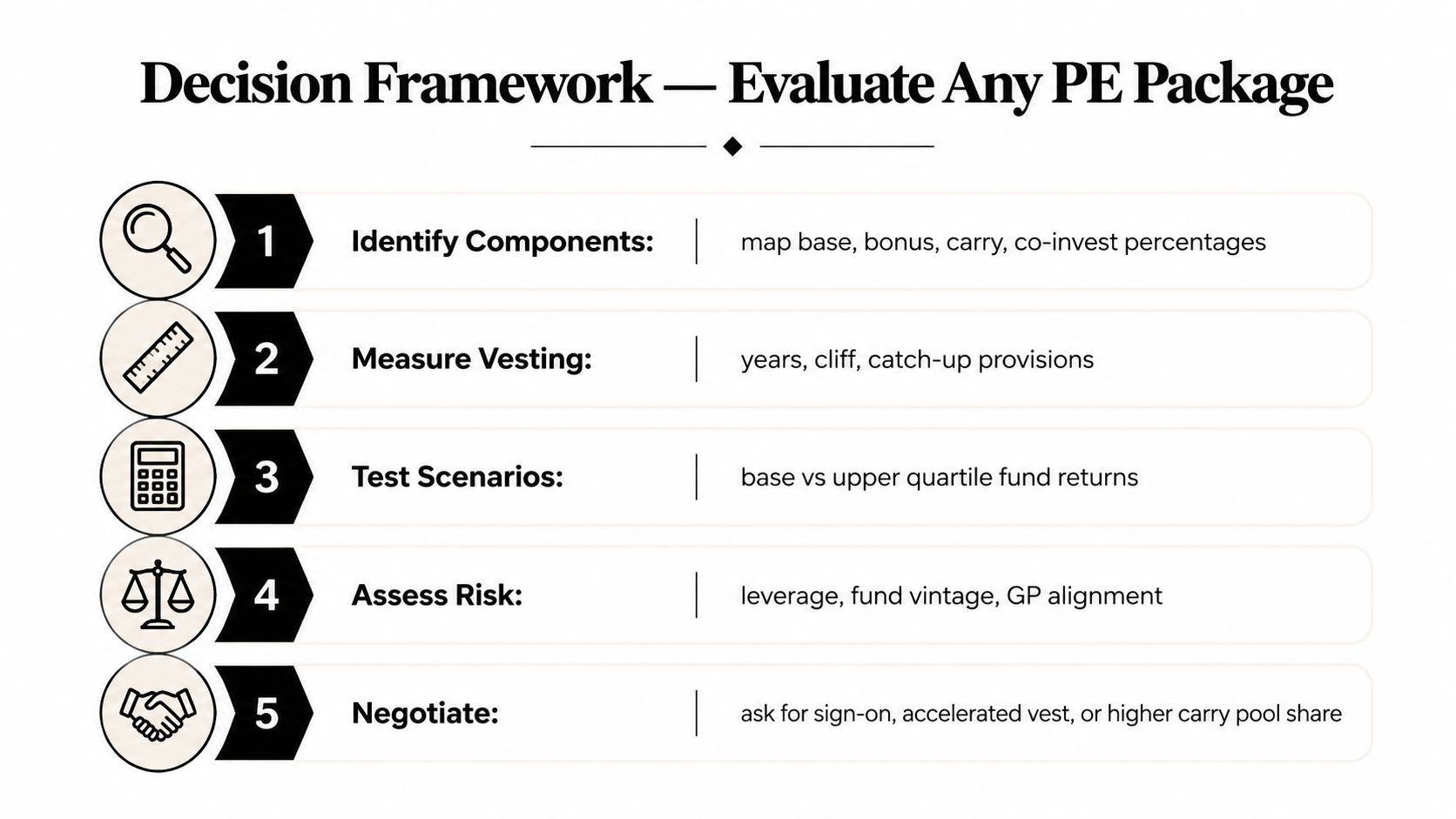
You can evaluate almost any package with four questions. First, what's the cash floor? Second, what's the realistic carry outcome, not the fantasy case? Third, what's the liquidity timeline? Fourth, does the structure align the person with the LPs and the operating team, or does it create friction?
Using that lens, poor decisions become obvious. People overemphasize base salary because it's easy to compare. They ignore vesting cliffs because the language is tedious. They assume hurdle rates are deadweight when they are the gate that determines whether the upside ever shows up. They also underestimate people fit, which is how firms end up with technically strong hires who cannot operate inside the decision environment.
> Short checklist: cash floor, upside realism, vesting terms, liquidity timing, role fit.
If you're a candidate, bring those five questions to the offer conversation. If you're a CHRO or PE-backed operator, use them before the hire is finalized. If you do that, you'll stop treating private equity compensation like a salary chart and start treating it like what it really is, a key factor for behavior, retention, and value creation.
---
If you want a sharper way to evaluate people, roles, and reward structures in private equity, visit [Synopsix](https://synopsix.ai). It helps teams turn behavioral assessment into practical hiring and talent decisions, which is exactly what you need when compensation alone won't tell you whether a senior hire will perform.