Psychometric Assessment Tools: A Practical HR Guide
By Synopsix · July 24, 2026 · 15 min read
You're probably in the middle of the same mess I see in too many CHRO inboxes. The panel felt confident, the finalist interviewed well, the hiring manager pushed hard, and the person still didn't last. Or worse, they stayed just long enough to do real damage before everyone admitted the fit was wrong.
That's where psychometric assessment tools earn a place in the business. Not as HR theater. Not as a shiny test battery. They're structured instruments for measuring traits, abilities, and behavior in a way that can survive scrutiny, which matters because sound assessment depends on reliability and validity, consistent administration, and a clear job-analysis-based purpose ([occupational-health guidance](https://www.som.org.uk/sites/som.org.uk/files/Psychometric_Assessments_in_OH_January2025.pdf)). Used well, they become a signal layer that helps you make defensible decisions about hiring, team design, and development instead of pretending interviews can do all the work alone.
If you've been burned by a bad rollout, don't buy another test before you've read the evidence with a colder eye. And if you need a quick way to pull tables or text out of vendor PDFs before a buying call, this practical guide on [how to pull PDF text tables images](https://pdf.ai/extract-pdf) is worth having open.
Why Psychometric Assessment Tools Matter for Modern People Decisions
A senior hiring panel can talk itself into almost anything. I've seen teams fall in love with a polished candidate because the references sounded good, the chemistry felt easy, and everyone wanted the search to end. Four months later, the new hire is gone, the team is rattled, and the exec sponsor wants to know why nobody saw it coming.
That's exactly why structured measurement exists. Psychometric assessment tools are not generic quizzes, and they're not a replacement for judgment. They're standardized instruments designed to measure traits, abilities, motivations, and behavior in a way that helps predict workplace outcomes, especially when selection decisions are critical ([UNSW guidance on psychometric tools](https://www.science.unsw.edu.au/sites/default/files/documents/Psychometric_Guide.pdf)).
What they are, in business terms
Think of them as a way to move from “I liked the candidate” to “I can defend why this person fits the role better than the other finalist.” In high-stakes selection, the main categories are usually ability tests and personality tests, and validated cognitive measures are often paired with personality inventories rather than used in isolation ([UNSW guidance on psychometric tools](https://www.science.unsw.edu.au/sites/default/files/documents/Psychometric_Guide.pdf)). That pairing matters because no single interview or gut call reliably captures how someone will reason, collaborate, or derail under pressure.
The point isn't to mechanize hiring. It's to create a business signal layer strong enough to support decisions that people can challenge without collapsing the process. That includes whether you should buy a tool at all, which type fits the role, and how to roll it out without damaging trust.
Who this is for
This is for the CHRO who needs a cleaner hiring engine, the talent leader trying to reduce manager-by-manager chaos, and the people analytics lead who's tired of explaining why one panelist's favorite candidate wasn't the best bet. It also matters in development, because a well-constructed assessment can help you spot derailers early instead of waiting for performance reviews to turn into therapy sessions.
If you want a fast, honest decision rule, use this one: if the assessment can't survive a job analysis conversation, it's decorative.
The Four Main Families of Psychometric Assessment Tools
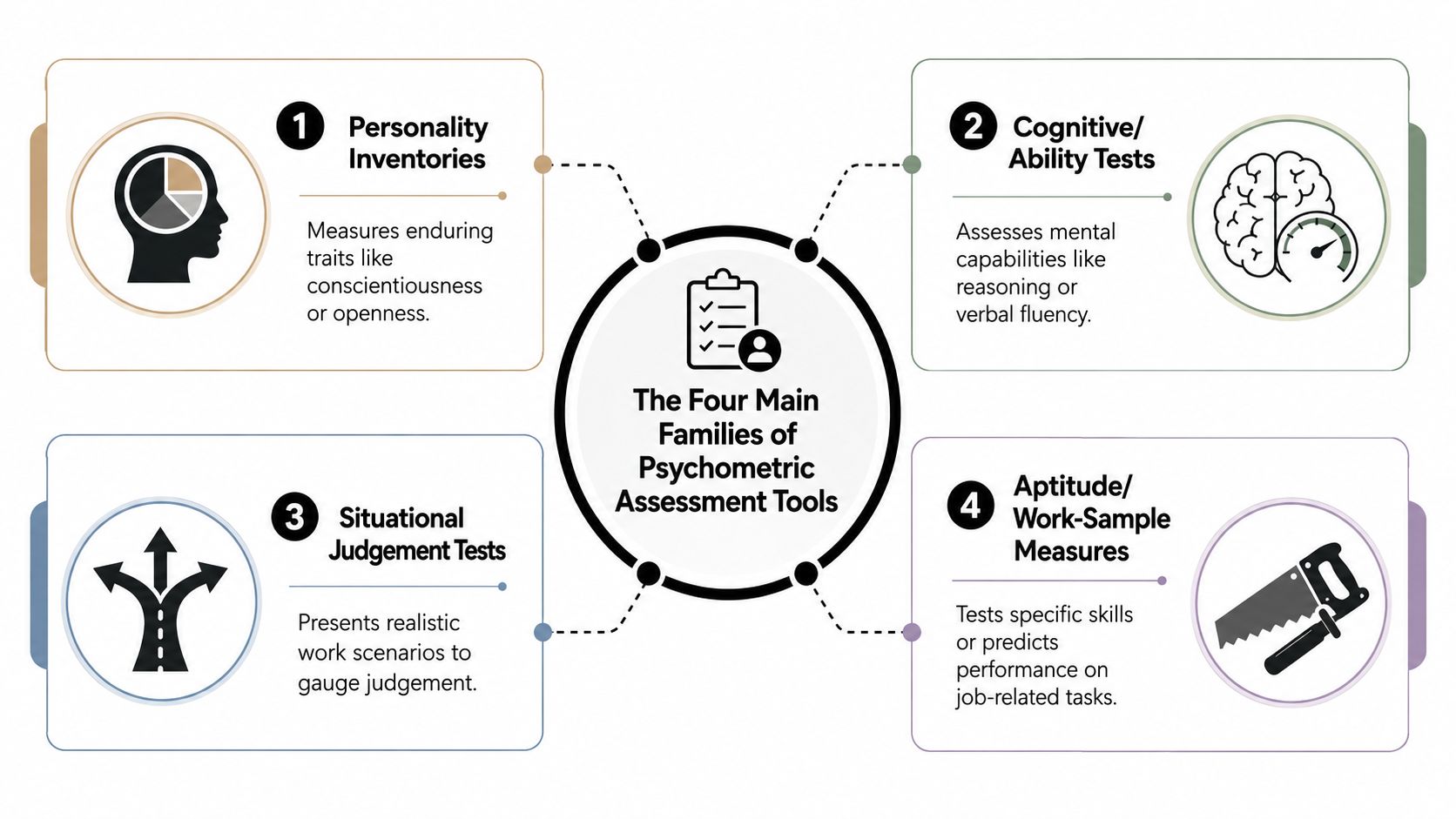
Many vendor decks blur everything together. Don't let them. It is easier to manage when you separate tools into four families, because each one answers a different business question and belongs at a different point in the funnel.
1. Personality inventories
A personality inventory is a weather map for how someone tends to behave over time. It doesn't tell you whether a person is “good,” it tells you the pattern they're likely to bring into a team, such as steadiness, openness, persistence, or risk tolerance. A familiar example question might ask how strongly someone agrees that they prefer finishing work early rather than improvising at the last minute.
Use these when the issue is collaboration, management style, or role fit under normal pressure. They're especially useful in leadership hiring and development, where behavior patterns matter more than technical knowledge alone.
2. Cognitive or ability tests
A cognitive test is a calibration tool. It measures how someone reasons, learns, and processes information, which is why these tools are often used where speed and analytical judgment matter. A representative question might ask a candidate to identify the next item in a pattern or interpret a short data set.
These tests tend to add the most value when learning agility, problem-solving, or information processing are core to the role. They're often strongest early in the funnel because they give you a cleaner read than an unstructured interview transcript.
3. Situational judgement tests
A situational judgement test is a flight simulator. It presents a realistic work scenario and asks the candidate to choose or rank responses, so you can see how they think in context. A sample item might describe a conflict between a manager and a client and ask what the candidate would do first.
These tools are especially useful when judgment, prioritization, and people handling are central to the job. They let you test applied reasoning, not just abstract ability.
4. Aptitude or work-sample measures
An aptitude or work-sample measure is a dress rehearsal. It checks whether the person can do the task, or at least perform a close approximation of it. A simple example could be asking a candidate to draft a response, analyze a spreadsheet, or troubleshoot a workflow.
These are usually the most intuitive tools for hiring managers because the link to performance is obvious. The catch is that they need to be tightly tied to the job, or they turn into busywork.
If you want to see how tools fit together in a broader people stack, the [curated AI tools for founders](https://www.iwoszapar.com/p/best-ai-tools-for-founders) list is a useful example of how buyers compare categories rather than worshiping brands. The same discipline applies here.
Reliability, Validity, and the Evidence Buyers Should Demand
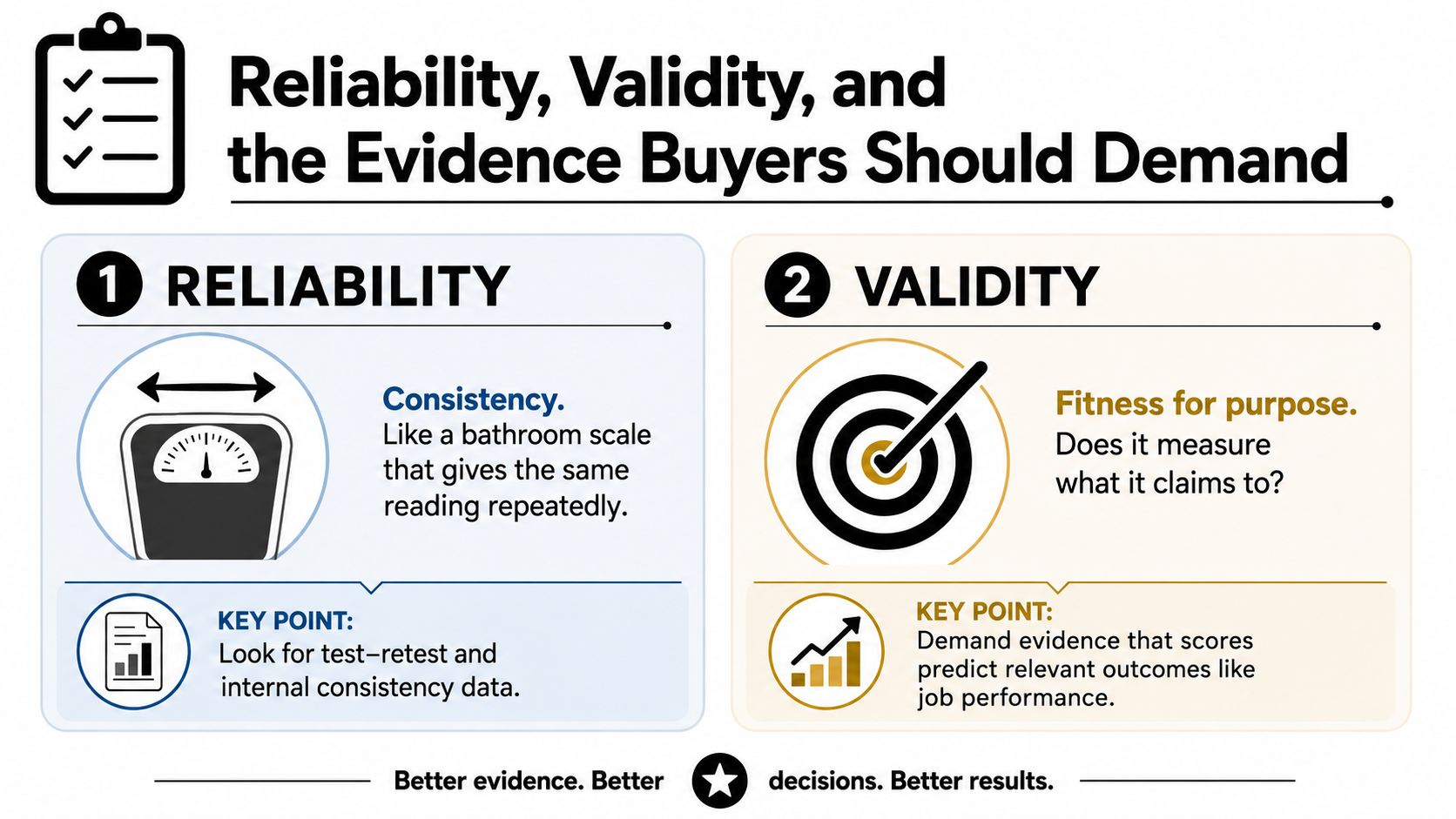
Vendors love the word “validated.” Buyers should stop rewarding that word unless it's backed by the right evidence. Reliability is consistency, the bathroom scale that gives the same reading when you step on it twice. Validity is fit for purpose, whether that same scale is useful for weighing luggage or body fat, which are not the same job at all.
A tool can be consistent and still be wrong for your use case. That's the trap.
Ask the right validity question
The core question isn't whether a test is valid in the abstract. It's whether it's valid for your role, your population, and your language context. Guidance from the APA stresses job analysis, cultural adaptation, translation/back-translation, and local validation, because a famous assessment doesn't become suitable just because the vendor has a recognizable logo ([APA guidance](https://www.apa.org/gradpsych/2007/01/tools)).
That matters more than buyers want to admit. A tool can be perfectly fine in one market and weak in another if the language, norms, or job context don't match. If the vendor can't show how the tool was adapted and checked locally, you're buying a story, not evidence.
> Practical rule: ask for the validation file tied to the exact role family you're hiring for, not the glossy brochure version.
Your three-question vendor script
Use these questions in every demo:
If you want a deeper grounding on validity concepts, keep this internal explainer on [validity in psychology](https://synopsix.ai/blog/validity-in-psychology) handy before you approve any rollout. You'll sound sharper in the next vendor call, and you'll ask for the evidence that matters.
Where Psychometric Tools Earn Their Keep in Hiring, Team Design, and Development
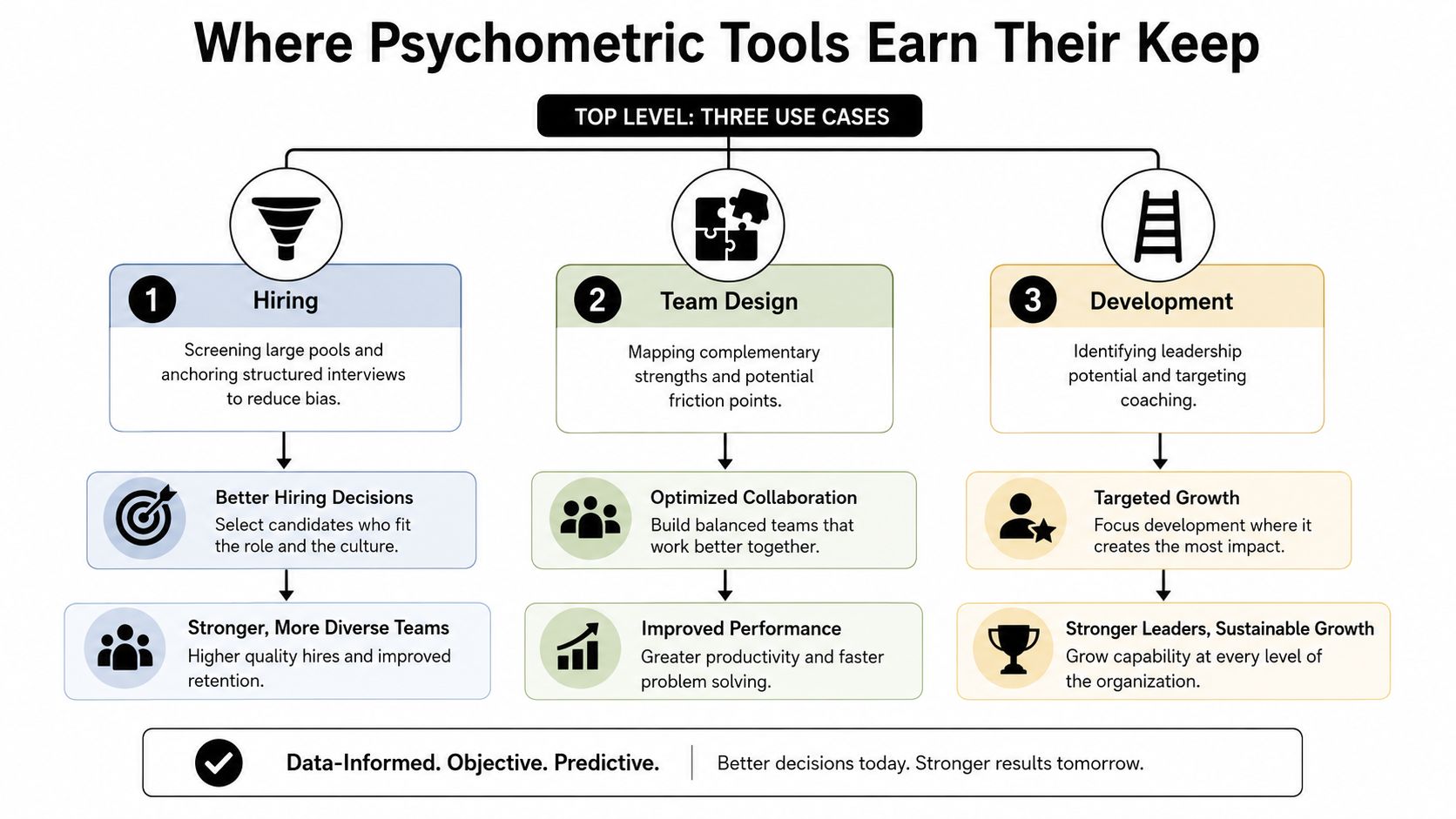
The fastest way to waste an assessment budget is to pretend every use case needs the same tool. Hiring, team design, and development are different decisions, and each one needs a different output. If you don't separate them, you end up with pretty reports nobody acts on.
Hiring
In hiring, the point is to screen large pools and anchor interviews to evidence instead of vibe. Ability tests help you compare how candidates reason, personality tools help you understand likely working style, and situational judgement tests help you test decision-making in realistic contexts. The decision output should be simple, whether to advance, probe further, or reject.
The metric that matters is not “people liked the process.” It's whether the assessment improved consistency in selection and made the final hiring decision easier to defend. If managers still default to whoever felt strongest in the room, the rollout failed.
Team design
Team design is where most HR teams underuse psychometrics. The value is seeing complementarity and tension points before a team starts arguing through a project plan. Some people bring speed, others bring caution, and some bring clean execution but little tolerance for ambiguity.
Use personality and behavioral profiles here, then translate them into working rules. You're not trying to label people. You're trying to compose a team with fewer blind spots and fewer predictable collision points.
Development
Development is about baseline profiles, derailers, and growth targets. You use the assessment to show an emerging leader where they overplay a strength, where pressure changes their behavior, and where coaching should start. A tool can become a leadership pipeline instrument instead of a one-time hiring artifact.
A useful rule: if the report doesn't give managers a language for coaching, it's not a development tool. It's a file.
A Buyer's Checklist for Evaluating Psychometric Assessment Vendors
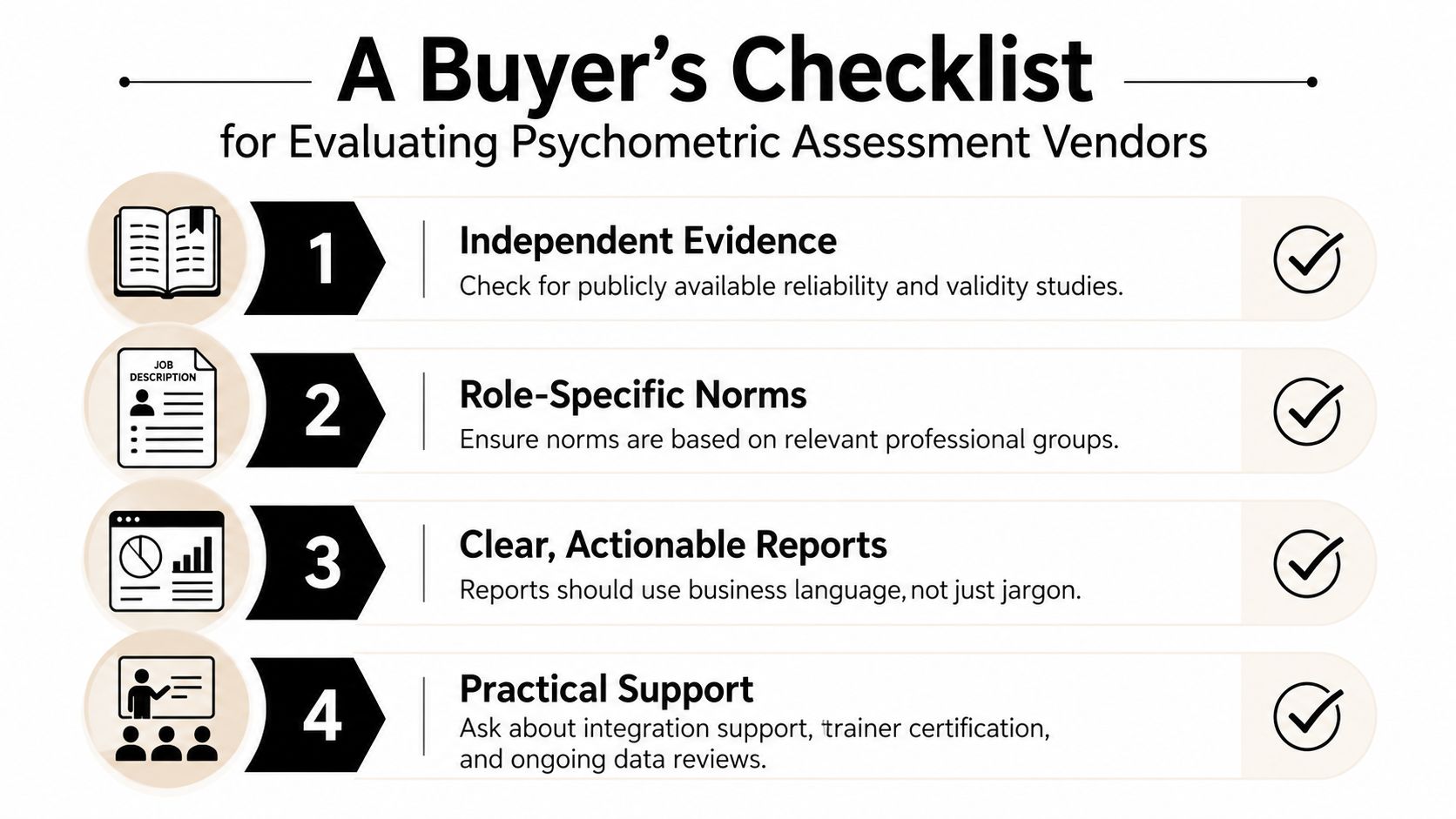
Most vendor demos are designed to impress, not to inform. Your job is to force the conversation back to evidence, fit, and operational reality. If the vendor can't answer these questions clearly, you're not ready to buy.
The checklist that actually matters
> Don't let a demo become a product tour. Make it a proof session.
One more issue belongs in the room, even if vendors get nervous about it. Ask how they handle adverse-impact review and what data they'll share when outcomes vary across groups. That question separates serious partners from sales teams that hope nobody looks too closely.
If you want a clear comparison point for interpretation quality, the internal guide on [assessment interpretation](https://synopsix.ai/blog/assessment-interpretation) is useful because it keeps the focus on how results become decisions. For teams comparing broader talent tools, [talent assessment tools](https://synopsix.ai/blog/talent-assessment-tools) can help frame the bigger stack without reducing everything to a single score.
And if your buying process involves automation leaders, the practical lens in [essential AI automation roles](https://www.datalunix.com/post/ai-automation-jobs) is a good reminder that process design matters as much as product design. Assessments fail when nobody owns the workflow.
Implementing Psychometric Tools Without Breaking the Business
Rollout is where good tools go to die. The assessment can be technically sound and still blow up trust if data handling is sloppy, managers cherry-pick results, or candidates think you're hiding the ball. The safest implementation is boring, specific, and controlled.
Build the operating model first
Start with data ownership. Decide what gets stored, who can see it, how long it lives, and how consent is captured. If legal, HR, and the hiring manager all have different assumptions, the program will drift fast.
Then decide how results are communicated. Managers need guidance on what the scores mean and, just as important, what they don't mean. Candidates need a clear explanation of why they're being assessed and how it supports the decision process.
Finally, set your measurement plan before launch. In the first 90 days, track the leading indicators that tell you whether the process is being used correctly. After a full cycle, report the lagging indicators that show whether the tool changed outcomes in a way leadership cares about.
| Phase | Data | Change Management | ROI Measurement | |---|---|---|---| | Pre-launch | Define ownership, retention, consent, and access rules | Brief hiring managers on purpose and limits | Set baseline hiring and onboarding measures | | First 30 days | Confirm what's stored and who reviews it | Explain the tool to candidates and recruiters | Monitor completion, drop-off, and manager adherence | | Days 31 to 90 | Audit access and data handling | Reinforce interpretation discipline | Review early signal quality and process consistency | | Full cycle | Revisit retention and governance | Refresh manager training | Report mis-hire rate and time-to-productivity against baseline |
Keep the rollout honest
Do not let score worship take over. A profile is evidence, not a verdict. Managers who cherry-pick one flattering dimension and ignore the rest will destroy the integrity of the program faster than any bad vendor can.
For organizations that want to connect assessments to broader talent actions, one option is Synopsix, which turns behavioral assessment results into business-readable reports, compatibility analysis, and development guidance. Use that kind of product only if you're ready to govern the data and the interpretation properly.
The broader point is simple. Selection quality depends on consistent administration tied to a clear purpose ([occupational-health guidance](https://www.som.org.uk/sites/som.org.uk/files/Psychometric_Assessments_in_OH_January2025.pdf)). If your operating model is loose, even a strong tool will produce noisy decisions.
Five Pitfalls That Quietly Sink Psychometric Programs
The failures are usually predictable. They just show up late, after the vendor is signed and the exec sponsor assumes the hard part is done. If you've ever watched a program stall, one of these was probably involved.
The five that matter
What it costs
The cost is not just a messy dashboard. It's lost credibility. Candidates notice when the process feels arbitrary, executives notice when assessment results don't predict performance, and legal teams notice when the story behind the score gets thin.
If you want a program that lasts, make the assessment part of the operating rhythm. Don't let it become a black box that only talent acquisition understands.
What HR Leaders Still Ask Before Signing a Contract
The final questions are typically the ones people ask in the corridor after the demo, or in a separate call with legal and finance.
Four answers worth getting straight
Is this legally defensible? You need a tool with role-based evidence, consistent administration, and a documented process for checking outcomes. In the US and EU, that's not a nice-to-have, it's the baseline for a serious selection program.
How much time will it take? Ask about candidate time and hiring manager time separately. A tool that is fast for candidates but hard for managers to interpret can still sink the process.
What does mature look like? Mature means the tool is tied to job analysis, managers are trained, reports are readable, and the data is reviewed after rollout. Immature means the vendor owns the conversation and HR owns the fallout.
How should we phase rollout? Start with one critical role family, prove the process, then expand. If you try to launch across the whole company at once, you'll create noise before you create trust.
The next conversation should be with your CFO, legal partner, or CHRO peer. Bring the evidence questions, the implementation plan, and the willingness to walk away if the vendor can't defend fit. Then choose a tool that helps you make better people decisions, not just more of them.
---
A CTA for [Synopsix](https://synopsix.ai).