Psychometric Risk Profiling: A Practical Guide for HR
By Synopsix · October 8, 2026 · 15 min read
A CHRO is asked a deceptively simple question: can the latest assessment vendor predict who'll fail in a sales role? The honest answer isn't yes or no. A profile can highlight behavioral conditions that deserve attention, but it can't replace job analysis, structured evidence, human review, or outcome monitoring.
That distinction separates psychometric risk profiling from a personality quiz. The useful output isn't a label such as “high risk.” It's a role-specific signal that helps a recruiter decide what to test next, helps a manager prepare better interview questions, and helps an HR leader evaluate whether the whole system is producing defensible decisions.
What Psychometric Risk Profiling Actually Means for HR Teams
Psychometric risk profiling translates assessment responses into behavioral hypotheses connected to work outcomes. The process starts with measurable traits, competencies, cognitive capabilities, or values. It then asks a more practical question: where might this pattern create friction, inconsistency, or exposure in a particular role?
A generic personality result might describe someone as sociable or detail-oriented. A role-specific risk profile goes further. It might indicate that a customer-facing employee could struggle when account expectations change quickly, or that a manager may need support balancing decisiveness with consultation. Those are not diagnoses. They're prompts for additional evidence.
> Practical rule: A risk indicator should always answer, “Risk of what, in which role, under which conditions?”
Trait measurement describes a person's reported or observed tendencies. Role-fit scoring compares those tendencies with a defined job model. A risk indicator connects the comparison to a potential business consequence, such as missed follow-through, escalation difficulty, poor adaptation, or weak judgment under pressure. The distinction matters because risk isn't universal. A preference for autonomy may help an experienced consultant and create problems in a tightly supervised operations role.
Recruiters usually need concise screening cues. Hiring managers need context, including which behaviors to probe and which strengths may offset a concern. HR and people-analytics leaders need program-level evidence, such as whether the indicators predict outcomes consistently across teams and whether the process treats candidates fairly.
For a plain-language introduction to the underlying assessment process, see [what psychometric testing measures and how organizations use it](https://synopsix.ai/blog/what-is-psychometric-testing). The practical sequence is straightforward:
1. Define the role in observable behaviors. 2. Choose an assessment with relevant evidence. 3. Translate scores into role-specific indicators. 4. Combine those indicators with structured selection evidence. 5. Monitor outcomes, fairness, and calibration over time.
The objective isn't to turn HR into a research lab. It's to make each decision traceable, proportionate, and useful.
Selecting Assessments That Hold Up Under Scrutiny
A vendor demo often starts with attractive dashboards. A defensible program starts with evidence. Before adding an instrument to a psychometric risk profiling stack, ask what it predicts, for which roles, using which criteria, and under what conditions.
Three filters are particularly useful:
The historical evidence supports this cautious approach. Schmidt and Hunter's 1998 synthesis reported a criterion-related validity of 0.51 for general cognitive ability as a predictor of job performance. A 1991 meta-analysis by Tett, Jackson, and Rothstein found personality assessment validity of 0.325 with a job analysis versus 0.252 without one. These findings are summarized in [research on assessment validity and reliability](https://synopsix.ai/blog/assessment-validity-and-reliability), and the underlying figures are available in the [meta-analytic review of personality assessment and job performance](https://www.tandfonline.com/doi/full/10.1080/09585190903363821).
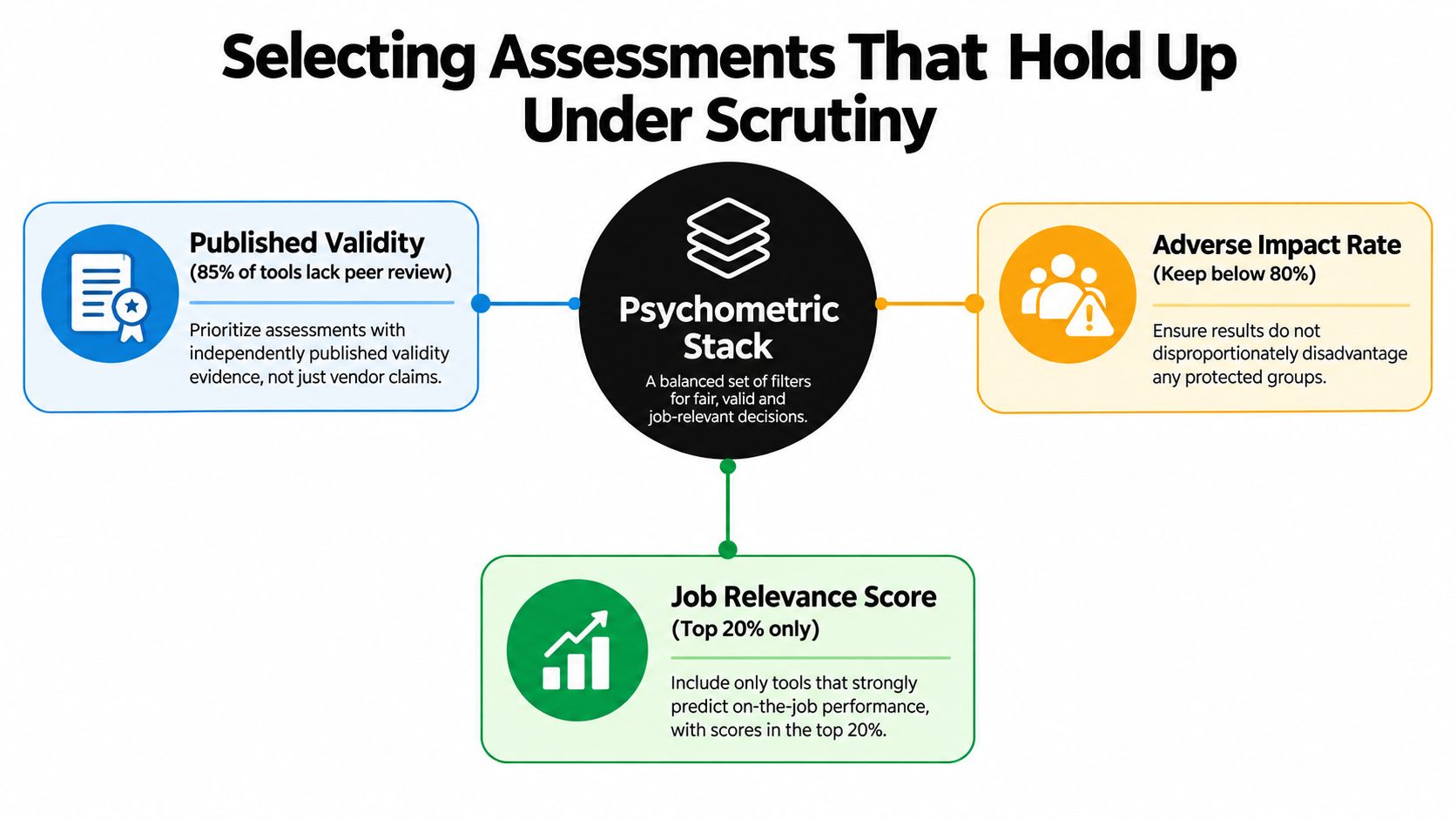
The point isn't that cognitive tests should replace personality measures. It's that predictive value depends on the construct, the criterion, and the job context. A role with complex problem-solving demands may justify cognitive assessment. A role requiring sustained collaboration may need carefully selected behavioral measures. Many roles need a combination, but every added component creates more interpretation and governance work.
Timed assessments can be operationally useful when speed, prioritization, or applied reasoning are genuinely part of the role. Teams evaluating that format can review [use cases for timed hiring](https://form-timer.com/use-cases/hiring-tests), then check whether the timing condition reflects the job rather than merely creating artificial pressure.
Scoring Assessments Into Role-Specific Risk Indicators
Raw scores rarely tell a hiring manager what to do. A useful scoring model converts them into bands, combinations, and actions tied to the role.
Start with the job analysis. Identify the behaviors that matter, the situations that trigger failure, and the evidence already available from interviews, work samples, or performance records. Then decide whether a risk indicator should be based on a single threshold, a weighted composite, or an interaction between dimensions.
A cutoff can flag an unusually low or high result, but it shouldn't automatically reject someone. A weighted composite can reflect the fact that some behaviors matter more than others. A combination rule can identify patterns that are more meaningful together than separately. For example, low follow-through paired with weak control around sensitive information may deserve closer review in a role handling regulated data. The profile should prompt a targeted check, not determine the outcome by itself.
Map the same traits to different jobs
The same dimension can mean different things depending on the work. The table below illustrates how a team might frame indicators without treating the labels as universal judgments.
| Trait Dimension | Customer Success Risk Indicator | People-Leadership Risk Indicator | |---|---|---| | Conscientiousness | Inconsistent renewal follow-up or weak case ownership when workload rises | Difficulty sustaining commitments across multiple direct reports | | Emotional stability | Escalation responses may become reactive during service failures | Pressure may narrow listening and reduce coaching quality | | Sociability | Strong relationship initiation but possible overpromising to customers | High visibility without enough attention to quieter team members | | Openness to change | May resist altering established account plans | May introduce change faster than the team can absorb | | Integrity-related controls | Needs structured review where customer commitments or confidential data are involved | Needs evidence of consistent standards in performance and promotion decisions |
Set thresholds with the hiring manager, not for the hiring manager. Document why a band matters, what evidence can confirm or challenge it, and what support would reduce the risk after hire. [Psychometric data analysis guidance](https://synopsix.ai/blog/psychometric-data-analysis) can help teams examine distributions and combinations, but the business interpretation still belongs with people who understand the work.
A strong indicator has four parts: the observed pattern, the role condition, the possible consequence, and the next validation step. “Low score, reject” has none of that structure.
Turning a Profile Into a Hiring Decision You Can Defend
Two finalists reach the last stage for a high-pressure sales role. Candidate A has a polished profile with strong self-reported resilience and influence. Candidate B presents a more moderate pattern, including a possible concern around sustained follow-through. The recruiter's first instinct is to favor Candidate A.
That instinct needs testing. The recruiter asks both candidates to complete the same work sample, requiring them to prioritize a pipeline, respond to a dissatisfied customer, and document next steps. The structured interview then probes the behaviors linked to the profile. References focus on how each candidate handled missed commitments, changing targets, and pressure from senior stakeholders.
The profile sits beside those signals, not above them. A hiring panel might record the conclusion this way:
This language informs judgment without pretending to provide certainty. It also gives the candidate a fairer opportunity to demonstrate behavior that a questionnaire alone may not capture.
Treat polished responses with caution
Independent research reports that personality-test validity is consistently higher in low-stakes settings than in high-stakes selection contexts, providing empirical evidence that faking can materially reduce predictive validity. The [discussion of legal risks in screening and selection](https://www.adp.com/tools-and-resources/case-studies-white-papers/~/media/White%20Papers/NAS/legalrisks_screening_selection.ashx) supports treating response context as part of the interpretation.
That means a highly idealized profile may deserve a consistency check rather than automatic praise. A moderate profile obtained under conditions that reduce impression management may be more informative than a uniformly perfect one. Teams exploring how predictive models should support business decisions can also review [ways to implement predictive analytics for business](https://www.plotstudio.ai/articles/predictive-analytics-for-business), while keeping the same discipline around validation and human review.
The video below offers another format for discussing how assessment insights can be presented to decision-makers without turning them into verdicts.
<iframe width="100%" style="aspect-ratio: 16 / 9;" src="https://www.youtube.com/embed/HpqUf52i4_s" frameborder="0" allow="autoplay; encrypted-media" allowfullscreen></iframe>
Integrating Risk Profiles Into Your Hiring and People Workflow
A profile becomes useful only when someone knows when to read it, what to do with it, and who owns the next decision. Without those assignments, the report becomes another attachment in the applicant-tracking system.
A workable operating sequence looks like this:
1. Recruiter triggers the assessment. Send it at a defined stage, preferably when the candidate has enough role context to understand the exercise. Record consent, purpose, and the decision stage in the recruiting system. 2. People analytics calibrates the model. Review thresholds, scoring rules, and role relevance before the assessment reaches a hiring panel. Keep a versioned record of changes. 3. Recruiter reviews the initial flags. The recruiter should identify which indicators need structured follow-up, not decide that a candidate is suitable or unsuitable from the report. 4. Hiring manager uses the profile in the interview plan. Convert each material flag into a behavioral question or work-sample criterion. The manager should also record evidence that challenges the indicator. 5. HR business partner handles borderline cases. A borderline result needs a documented review, consistent treatment, and an explanation of whether additional evidence or a reasonable adjustment is appropriate. 6. Panel logs the final rationale. Record the assessment signal, corroborating evidence, dissenting views, and the reason for the final decision.
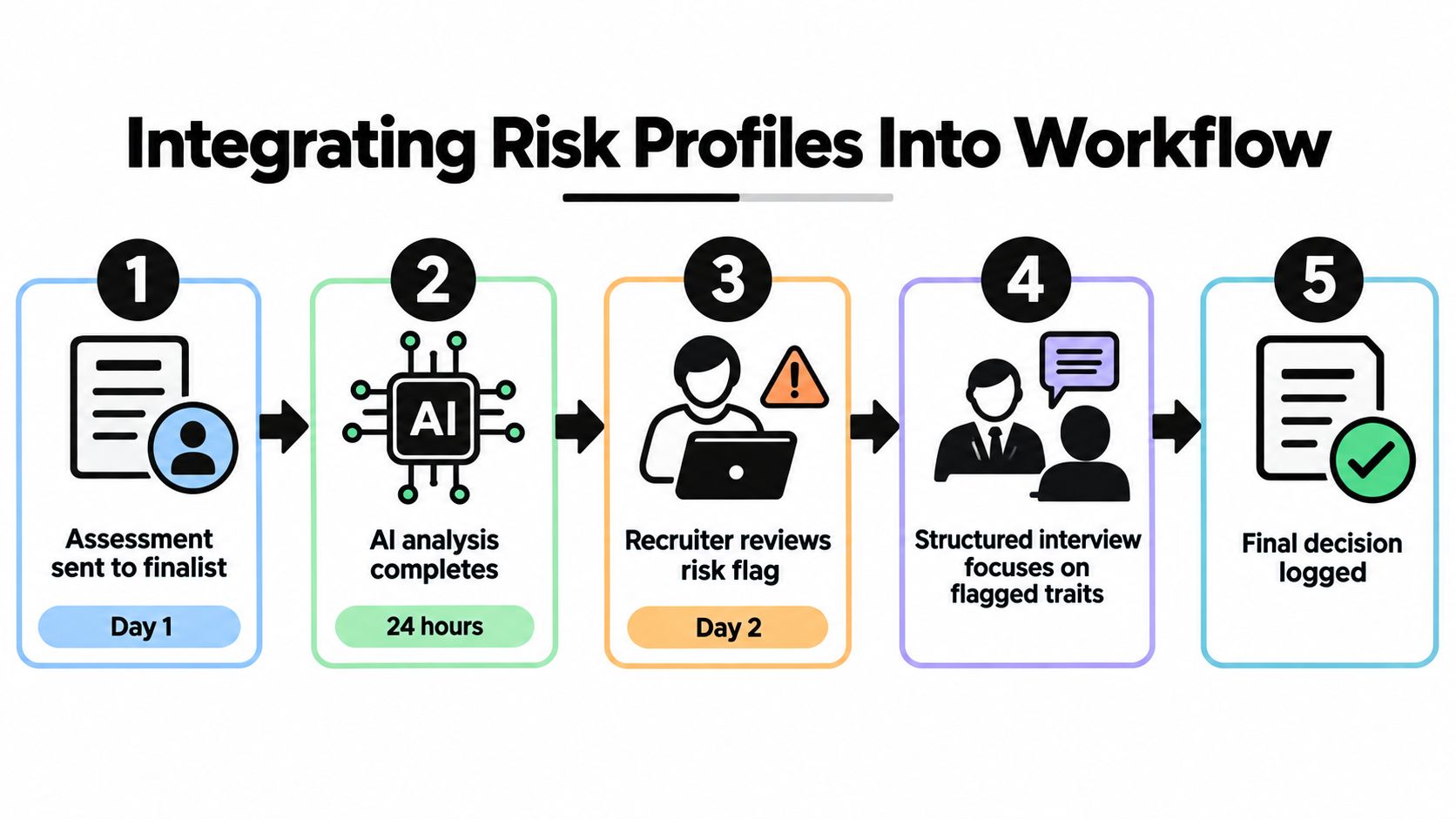
The same profile can support onboarding if the team uses it carefully. A flagged need for structure might become a manager check-in plan. A collaboration concern might shape team norms or stakeholder introductions. For internal mobility, the profile can guide development questions, but a previous result shouldn't be treated as permanently transferable to a new role.
The process should have a clear exception path. If a candidate disputes an interpretation, requests an accessible format, or presents contradictory evidence, the recruiter should know who pauses the decision and who reviews the case. Workflow design is part of validity, because a sound instrument can still create poor decisions when people use it inconsistently.
Treating Risk as a Hypothesis, Not a Verdict
Risk scores often become misleading when teams treat them as fixed attributes. People behave differently across incentives, managers, team climates, levels of autonomy, and periods of pressure. An assessment captures a response pattern in a particular context. It doesn't establish a permanent identity.
The high-stakes evidence makes this more than a philosophical concern. When candidates have strong reasons to present themselves favorably, a polished result may reflect assessment-context behavior rather than low workplace risk. The practical response is to measure response consistency where appropriate, use forced-choice formats when they fit the construct, and treat unusually idealized patterns as a separate interpretive signal.
Use language that preserves uncertainty
Managers don't need vague disclaimers. They need precise wording that distinguishes evidence from inference:
> “This result suggests a possible risk under sustained deadline pressure. We'll test that behavior through the work sample and revisit it using early performance evidence.”
Candidates deserve equally direct communication. Explain what the assessment is intended to measure, how the organization uses the result, what other evidence contributes to the decision, and how they can raise a concern. Avoid telling someone that they “are” risky, unmotivated, or incompatible with the team.
Re-evaluation should be triggered by meaningful context changes. A probation review can test whether the original hypothesis held. A promotion into people leadership may require a new role model. A major change in responsibilities, manager, or working environment may alter which behaviors matter most. That doesn't mean retesting casually or collecting endless personal data. It means using the profile as a working hypothesis with a defined review point.
The right operating posture is “over time,” not “for a lifetime.” If a risk indicator repeatedly fails to predict the outcome it was designed to flag, adjust or retire it. If it proves useful only under a specific condition, narrow the claim rather than expanding it.
Monitoring Outcomes, Fairness, and Decision Quality
A profiling program that isn't audited will drift. Thresholds change, roles evolve, managers interpret reports differently, and candidate populations shift. The monitoring plan should therefore track not only whether the assessment predicts an outcome, but also whether the organization uses it fairly and consistently.
The EEOC identifies personality, aptitude, and cognitive testing software among algorithmic decision tools that can create disparate impact. Its practical rule of thumb is that adverse impact may be indicated when a protected group's selection rate is below 80% of the highest group's selection rate, as described in the [guidance on employer use of AI and other algorithmic decision tools](https://www.mayerbrown.com/en/pdf/insights/publications/2023/07/eeoc-issues-title-vii-guidance-on-employer-use-of-ai-other-algorithmic-decisionmaking-tools).
That benchmark is a screening signal, not a complete legal conclusion. A tool can have credible validity evidence and still produce inequitable outcomes because of role-specific thresholds, population differences, inaccessible formats, or the way an AI system explains the score. Scientific validation and lawful, fair deployment are separate claims.
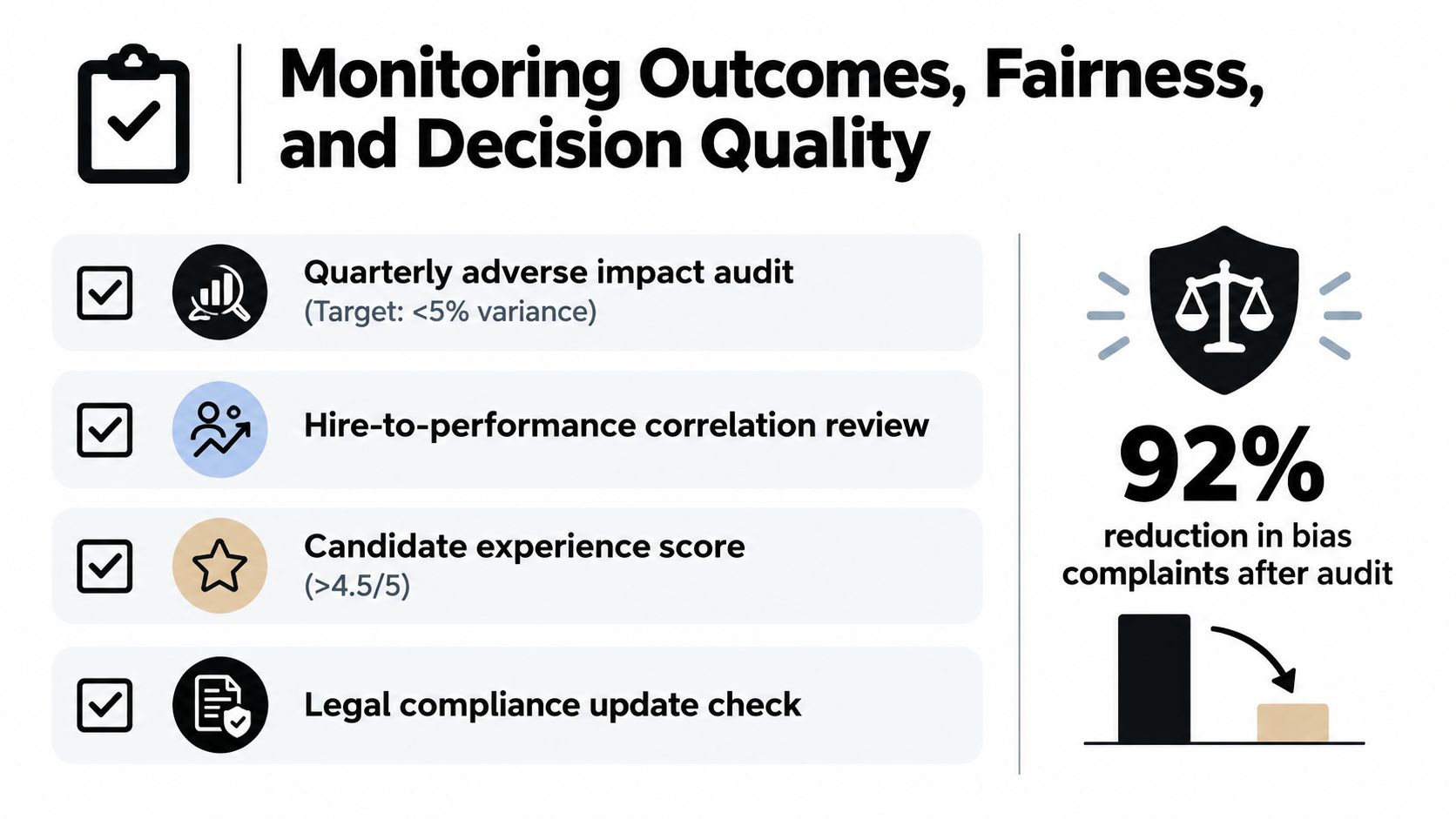
A practical monitoring checklist
At each hiring cycle, confirm that recruiters used the current role model, candidates received the same assessment instructions, accessibility requests were handled, and panel members documented human review. Look for unexplained overrides in both directions. A system where managers routinely ignore flags may be poorly calibrated. A system where managers accept every flag may be functioning as an automated rejection tool.
At a regular program review, examine:
A manager feedback loop is essential. Ask whether the indicator identified a real pattern, whether the flagged behavior appeared only in a particular context, and whether the report changed the interview in a useful way. Record false positives and false negatives rather than only celebrating successful predictions.
Start with a controlled operating scope
An HR leader can make meaningful progress without launching an enterprise-wide system. Choose one priority role, define its risk indicators with the hiring manager, and run the model through one existing workflow. Set the review owner before the first candidate completes the assessment. Establish how the organization will handle borderline results, accessibility needs, appeals, and unexpected subgroup differences.
Then calibrate against real outcomes. Retire indicators that don't help. Narrow claims that apply only under certain conditions. Keep the components that improve the quality of structured conversations and decision records.
Psychometric risk profiling works best as an operating system connecting validity, business judgment, and governance. Remove validity and the program becomes opinion dressed as data. Remove business context and the score becomes irrelevant. Remove governance and a technically credible tool can still create unfair or indefensible decisions.
The principle to carry into the next vendor conversation is simple: never ask whether an assessment predicts people in general. Ask which role-specific decision it improves, what evidence can challenge it, and how the organization will know when it stops working.
---
Synopsix turns behavioral assessment responses into role-specific profiles, risk indicators, and practical guidance for hiring, team design, and talent development. If you're building a more defensible psychometric risk profiling workflow, visit [Synopsix](https://synopsix.ai) to see how the platform connects assessment data with structured people decisions.