Psychometric Testing Business: 2026 Guide
By Synopsix · August 3, 2026 · 14 min read
$3.1 billion in 2024 and $5.4 billion by 2030 are the numbers that matter because they show psychometric testing is already a mainstream buying category, not a side project. The risk is simpler, and more expensive, most psychometric programs fail not because the science is weak, but because they aren't calibrated to the role, geography, and applicant pool a business hires from.
You're probably looking at a hire that looked strong on paper and then drifted, or at a team redesign that never quite clicked. That's where psychometric testing stops being an HR curiosity and becomes a business operating decision, because it changes how you price hiring risk, how you compare candidates, and how you defend decisions when someone asks why a pick made sense.
Why Psychometric Testing Matters for Your Business
The problem usually shows up the same way. A candidate interviews well, the panel feels confident, the manager wants a fast offer, and six months later the role is still underpowered. I've seen that pattern across three organizations, and the fix was never more interview rounds. It was better signal, used earlier, with less faith in gut feel.
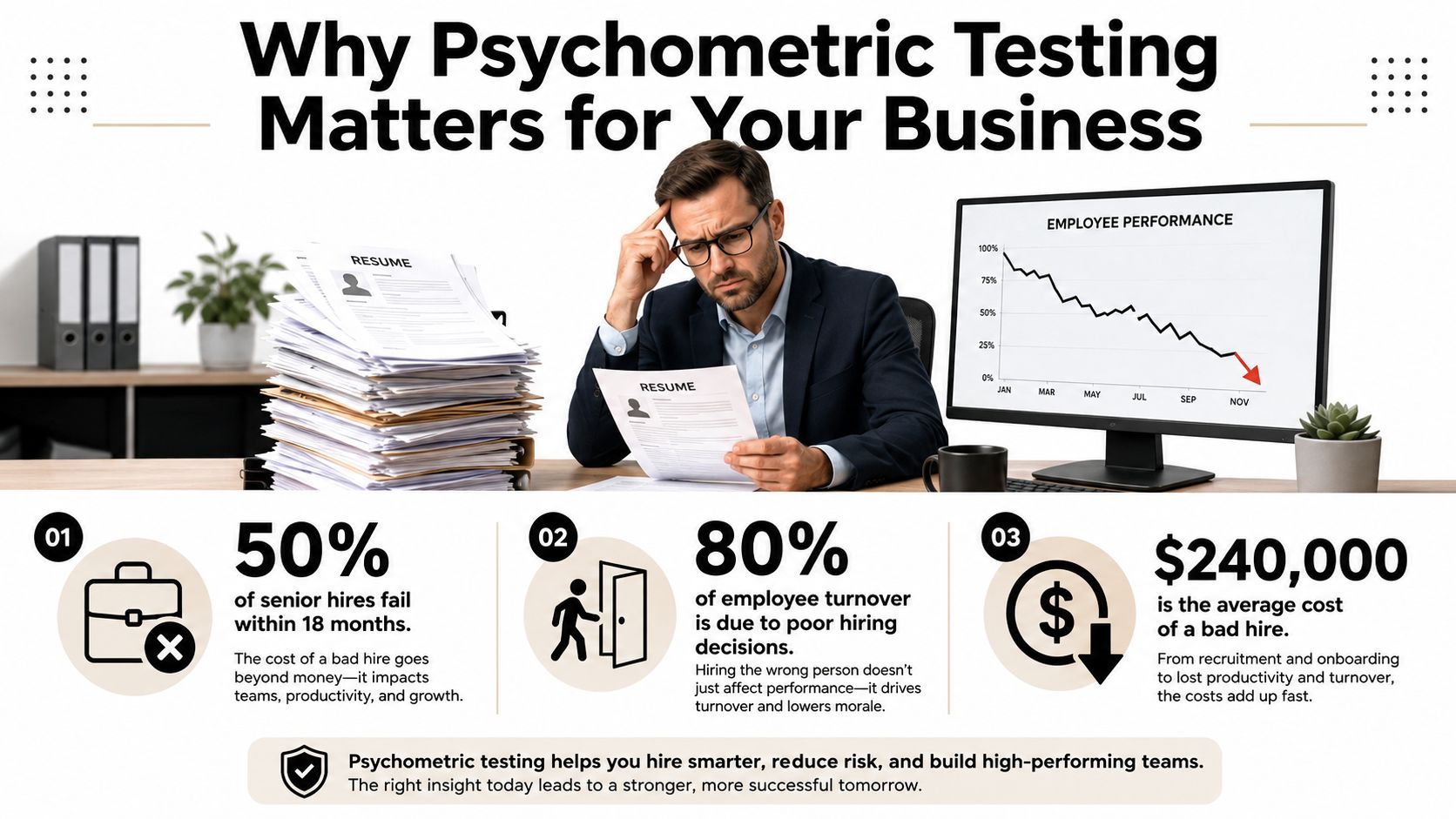
Why leaders are revisiting assessments now
Psychometric testing has moved from niche HR tooling to recurring enterprise spend because the buying environment changed. A market estimate puts the global psychometric tests market at $3.1 billion in 2024 and $5.4 billion by 2030 at a 9.8% CAGR [Strategic Market Research](https://www.strategicmarketresearch.com/market-report/psychometric-tests-market). That scale tells you organizations are paying for better decisions, not novelty.
The pressure behind that spend is obvious. Skills shift faster, hiring is more remote, and candidates show up with more polished CVs and interview coaching than they used to. If your process still rewards whoever tells the best story, you are buying avoidable risk.
Assessment strategy should sit inside people data, not in a vacuum. [People analytics fundamentals](https://synopsix.ai/blog/what-is-people-analytics) gives you the basic link between assessments and the metrics your business already tracks, so you can judge whether the tool is improving hiring quality. If you are experimenting with screening and follow-up workflows, [launch AI agents with Donely](https://donely.ai/) can help teams automate repetitive steps without turning the process into a black box.
> Practical rule: use psychometrics where the cost of a bad hire is high enough that “pretty good judgment” is too weak a standard.
The point here is simple. Psychometric testing matters when you treat it as a business operating decision, one that changes how you price hiring risk, compare candidates, and defend decisions when someone asks why a pick made sense. It works best when the test family matches the role, the validation is done on a small enough population to be credible, and the vendor can explain the gap between psychometrics and the business signals you already trust.
What Psychometric Testing Actually Measures
Psychometric testing isn't one thing. It's a family of structured assessments that usually measure cognitive ability, personality traits, aptitude, and related behavioral characteristics. Cornell's executive summary frames pre-employment psychometric assessments as tools that evaluate candidates' knowledge, skills, abilities, and other characteristics to judge suitability for a role Cornell executive summary. That's the cleanest definition to keep in your head.
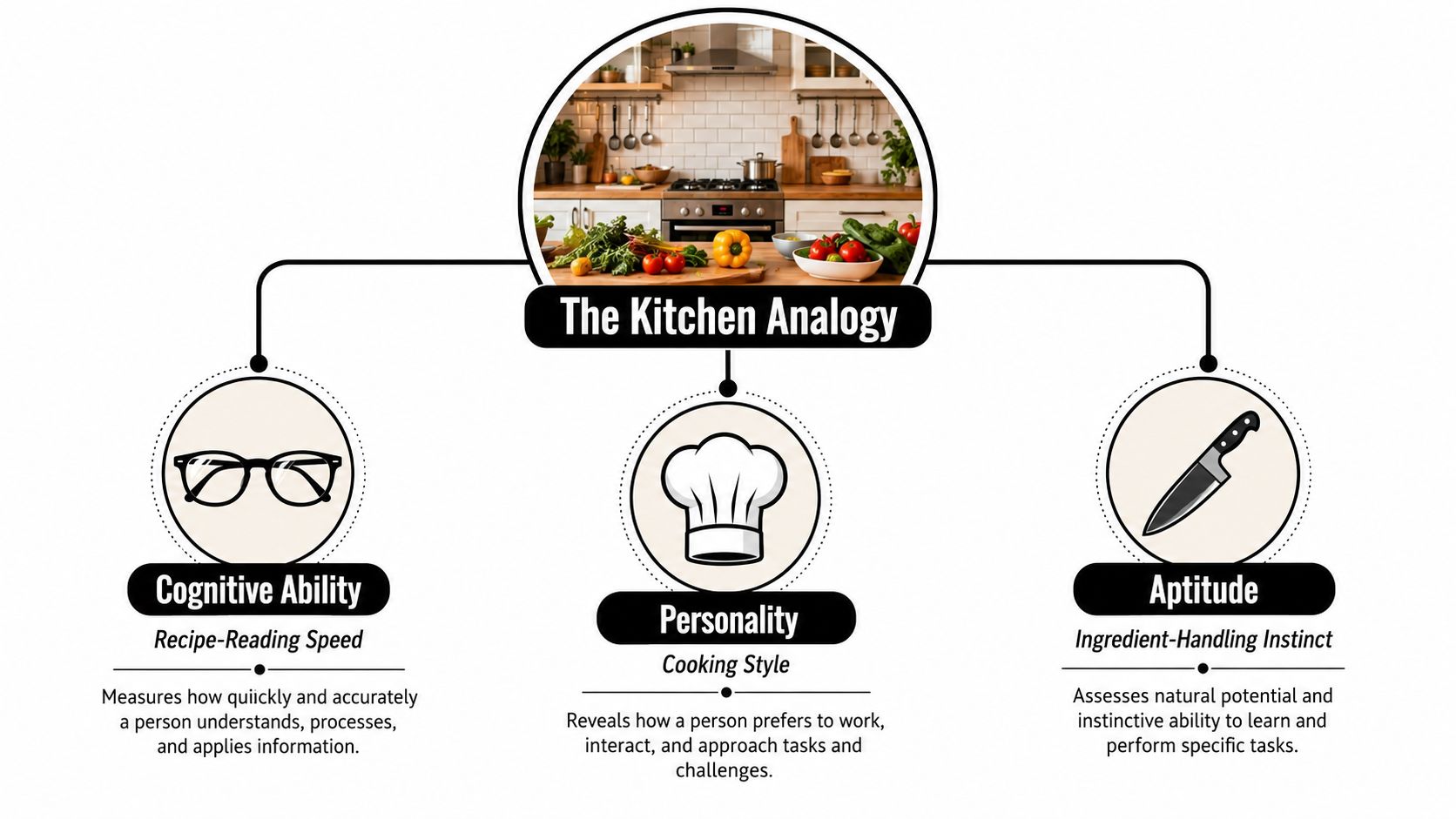
Think like a kitchen manager
Use the kitchen analogy. Cognitive ability is recipe-reading speed, how fast someone takes in information and turns it into action. Personality is cooking style, whether they move fast, stay steady, improvise, or prefer structure. Aptitude is ingredient-handling instinct, how naturally they solve problems in the moment.
That distinction matters because hiring teams confuse them all the time. A fast thinker can still be abrasive. A calm personality can still learn quickly. A person with strong aptitude in one context can struggle in another if the environment is unfamiliar.
Match the test to the business question
If you want to know whether someone can process complex information, lean on cognitive measures. If you're worried about collaboration, pressure response, or leadership style, personality and behavioral assessments matter more. If the job requires rapid pattern recognition or task-specific learning, aptitude belongs in the mix.
SHL's hiring guidance puts the evaluation lens in business terms, not test jargon. It points leaders to reliability, validity, adverse impact, cost-benefit, and user reactions as the criteria that matter [Cornell executive summary](https://ecommons.cornell.edu/server/api/core/bitstreams/3fba9a88-1d30-4441-b20a-1bf02f6cbe91/content). That's the right lens for any buyer, because a test that sounds rigorous but can't survive manager scrutiny is just expensive noise.
| Assessment type | Business question it answers | Typical use | |---|---|---| | Cognitive ability | Can this person process and apply information fast enough? | Analytical, technical, and graduate roles | | Personality | How will this person likely work, communicate, and respond under pressure? | Leadership, collaboration, and team-fit decisions | | Aptitude | Does this person show natural ease with the kind of problem this role requires? | Early-career, specialist, and high-volume screening | | Behavioral or situational | How will this person probably act in specific work scenarios? | Customer-facing, management, and leadership hiring |
> The wrong test doesn't just waste time, it creates false confidence.
One shorthand for buyers
If you're buying for a niche role, don't ask “Which assessment is most scientific?” Ask “Which assessment is most likely to explain the performance difference I care about?” That framing keeps you out of personality-typing trivia and closer to a useful business decision.
Business Outcomes and ROI You Can Measure
Psychometric testing earns its budget when it changes decisions a CFO already tracks. Focus on time-to-hire, quality-of-hire, mis-hire rate, and retention. If a vendor cannot show how the assessment moves one of those measures, the program is buying comfort, not value.
The adoption pattern is not random. Employers kept using psychometric tests because they saw them move real hiring outcomes and development decisions, not because the category sounded clever. The Brookes review describes long-running use in both public and private sector hiring, plus substantial commercial demand for recruitment and development tools [Brookes PDF](https://radar.brookes.ac.uk/radar/file/401ae6b6-e123-4b6d-a73f-5318a558888c/1/special02-paper-04.pdf). That is what continued buying looks like when the tool has business utility.
What to track first
Start with time-to-hire. If managers spend less time arguing over weak signals, the process should move faster. Quality-of-hire should improve when assessment data filters out avoidable mismatch before the offer goes out. Mis-hire rate should fall when the test reflects the actual work, not a generic idea of a good candidate.
Retention usually exposes the truth fastest. If first-year turnover stays high after rollout, the assessment is out of sync with the job, or managers are ignoring it without discipline. The tool is not the problem on its own. The operating model is.
The cost case gets sharper when you compare assessment spend with the cost of avoidable turnover and replacement effort. Before you buy another interview-only process, [review the cost of a bad hire](https://synopsix.ai/blog/cost-of-a-bad-hire) and compare that to what your current process is leaking.
| Metric | What it measures | Expected direction of change | |---|---|---| | Time-to-hire | Speed from requisition to accepted offer | Down | | Quality-of-hire | How well the hire performs against role expectations | Up | | Mis-hire rate | How often the wrong person gets through | Down | | 12-month retention | Whether new hires stay long enough to matter | Up |
> The only ROI claim that matters is the one you can trace to revenue gained or cost avoided.
My recommendation
Use psychometrics as a decision accelerator, not a standalone score. If the assessment does not help hiring managers choose faster, defend decisions better, or retain people longer, cut it. A slow, polished process still wastes money.
Implementation Roadmap from Pilot to Scale
Start small or you'll end up with a noisy rollout and a frustrated HR team. The best programs I've seen began with one high-volume role, one hiring manager group, and one clean definition of success. That kept the politics low and the learning fast.
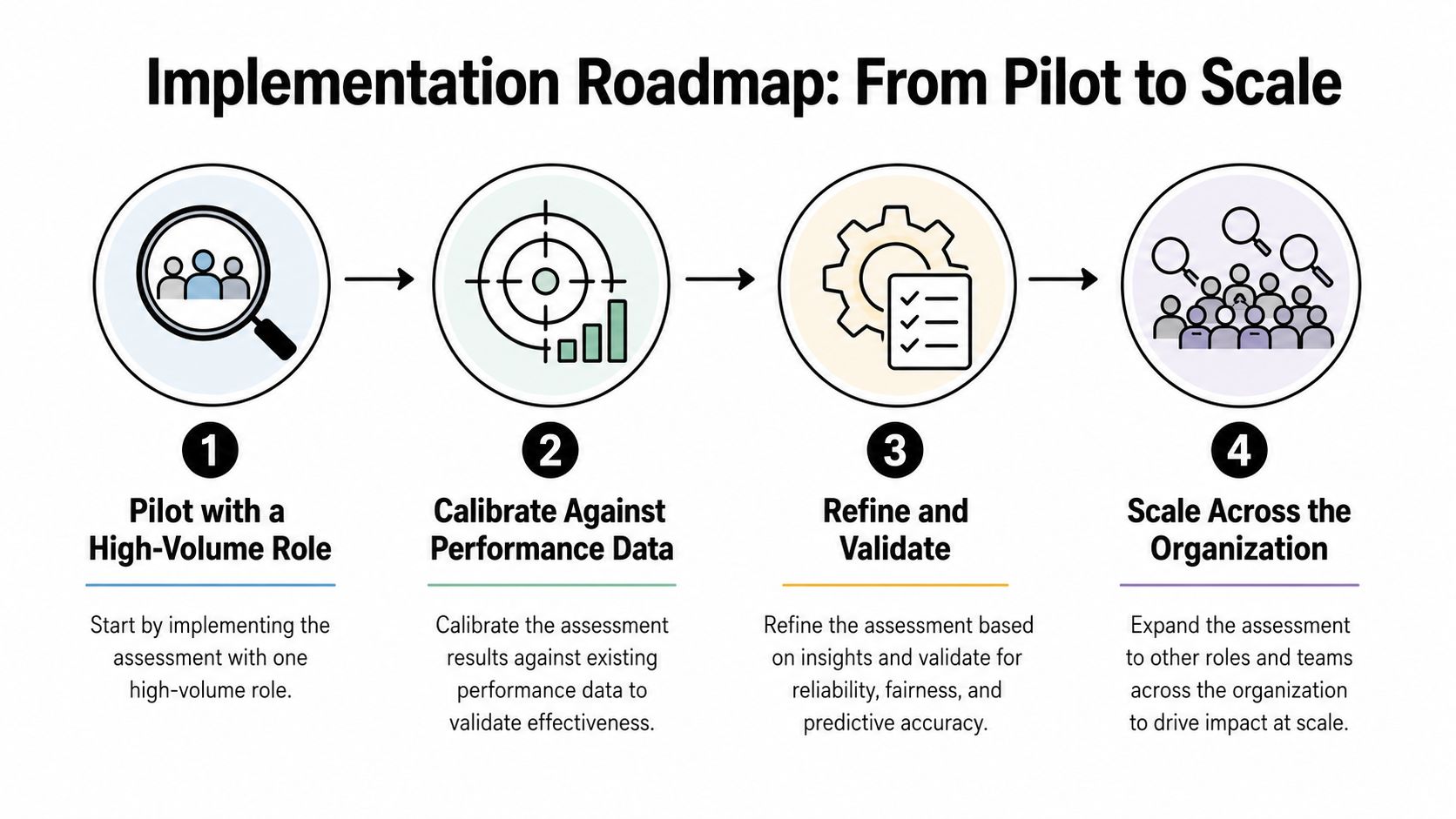
Pilot first, then prove it
Your pilot should answer a narrow question. Does this assessment help predict performance better than the current process in one role family? If you can't answer that, you don't have a pilot, you have a demo.
Build the baseline from existing performance data, then compare assessed candidates against it. Use the pilot to pressure-test candidate experience too, because a technically sound assessment that irritates applicants will still damage your funnel.
Use decision gates, not hope
Don't expand until three things are true. The role has enough volume to produce usable signal, managers are using the tool, and the data shows some relationship to the outcomes you care about. If those conditions aren't there, stop and fix the model instead of scaling confusion.
A good sequencing pattern looks like this.
Make integration non-negotiable
Psychometrics that sit outside the HRIS, ATS, and people analytics stack die during the next org change. If hiring managers have to log into a separate system, chase reports manually, or copy-paste summaries into scorecards, adoption will sag. Integration doesn't need to be fancy, it needs to be durable.
> If the program can't survive a manager change, it wasn't built as an operating process.
The rollout needs one owner, one scorecard, and one cadence with the business. Everything else is theater.
How to Evaluate a Psychometric Testing Vendor
Vendors love to sell science. Buyers need to buy decisions. That difference changes the selection process completely, because you're not choosing a test library, you're choosing a business signal layer.
Score the vendor, don't sit through the demo
Use seven criteria and weight them hard.
1. Scientific foundation. Ask what's validated, for whom, and in what context. 2. Role-specific validation. General claims mean very little if your roles are narrow or niche. 3. Business-language reporting. Hiring managers need risk indicators and fit recommendations, not psychometric jargon. 4. Integration with existing HR systems. If it doesn't work with your ATS and downstream reporting, adoption will stall. 5. Candidate experience. Long, awkward, or opaque assessments drive drop-off and resentment. 6. Data security and compliance. This is a contract issue, not a footnote. 7. Total cost of ownership. Look beyond license price to implementation, training, and ongoing support.
Some platforms still hand managers a dense technical profile and expect them to translate it. That's fine if you have in-house assessment specialists and a calm hiring environment. A platform like Synopsix goes a different route, translating psychometrics into business signals, risk indicators, and fit recommendations, which is far more usable for front-line managers. If your organization needs people data that reads like business guidance instead of test output, that matters.
When to keep the old vendor
Stay with a legacy assessment vendor if your use case is narrow, your HR team already knows how to interpret the output, and your hiring managers trust the current format. Switch if the reports are technically sound but operationally useless, or if you need psychometrics to connect to broader people decisions instead of living in a separate silo.
> Disqualify a vendor if they won't explain validation plainly, won't discuss adverse impact, or hide implementation details behind “proprietary methodology.”
Red flags that should end the conversation
If a vendor can't explain how their output helps a manager make a better decision on Tuesday morning, don't buy it.
Validation, Ethics, and Legal Considerations
Many business-facing guides get lazy here. They talk about fairness in the abstract, then skip the hard part: validating a test when the role is niche, the pool is small, or the candidate group is too similar for easy signal separation. That's the core problem, and it's the one that breaks trust.
The LSE review on companies' use of psychometric testing and the changing demand for skills makes the point clearly, the buying risk isn't whether psychometrics work in theory, it's whether they're calibrated to the role, geography, and applicant volume in a way that produces dependable decisions [LSE review](https://eprints.lse.ac.uk/19541/1/Companies_use_of_psychometric_testing_and_the_changing_demand_for_skills_A_review_of_the_literature.pdf). That's the question every serious buyer should ask before rollout.
What good validation actually looks like
Local norming matters when your population is specialized. Adverse-impact monitoring matters when the tool could affect group fairness. Candidate consent, clear notice, and sensible data retention matter because assessment data is people data, not just process data.
If you already require tight screening in other areas, such as [background checks for nonprofits](https://www.volunteerbadge.com/background-check-companies-for-nonprofits), you already know the principle. Due diligence is not about suspicion, it's about reducing exposure and documenting why a choice was made.
The common shortcuts to avoid
Free personality quizzes are not a hiring system. One-shot tests for tiny pools are usually a vanity exercise. And any vendor that treats fairness as a marketing claim instead of an auditable process should be treated with caution.
An internal link on [validity in psychology](https://synopsix.ai/blog/validity-in-psychology) is useful only if your team reads it before approving a tool. Otherwise, you're just decorating a weak decision with academic language.
Build compliance into the contract
Put validation support, data handling, retention terms, and audit access into the vendor agreement. Don't leave it to implementation notes. If the vendor can't support review, explain scoring, or adapt to local requirements, that's a signal to keep looking.
> Compliance isn't a tax on the program. It's what makes the program usable in the real world.
The better your validation story, the easier it is to defend the tool to legal, works councils, managers, and candidates. That's not overhead, that's durability.
Putting It Together as a People-Intelligence Operating Model
A psychometric program earns its keep when it runs as one operating loop, not as a one-off hiring gadget. Hiring feeds team design, team design shapes leadership pipelines, and the same assessment signal keeps working after the offer is signed through development and succession planning.
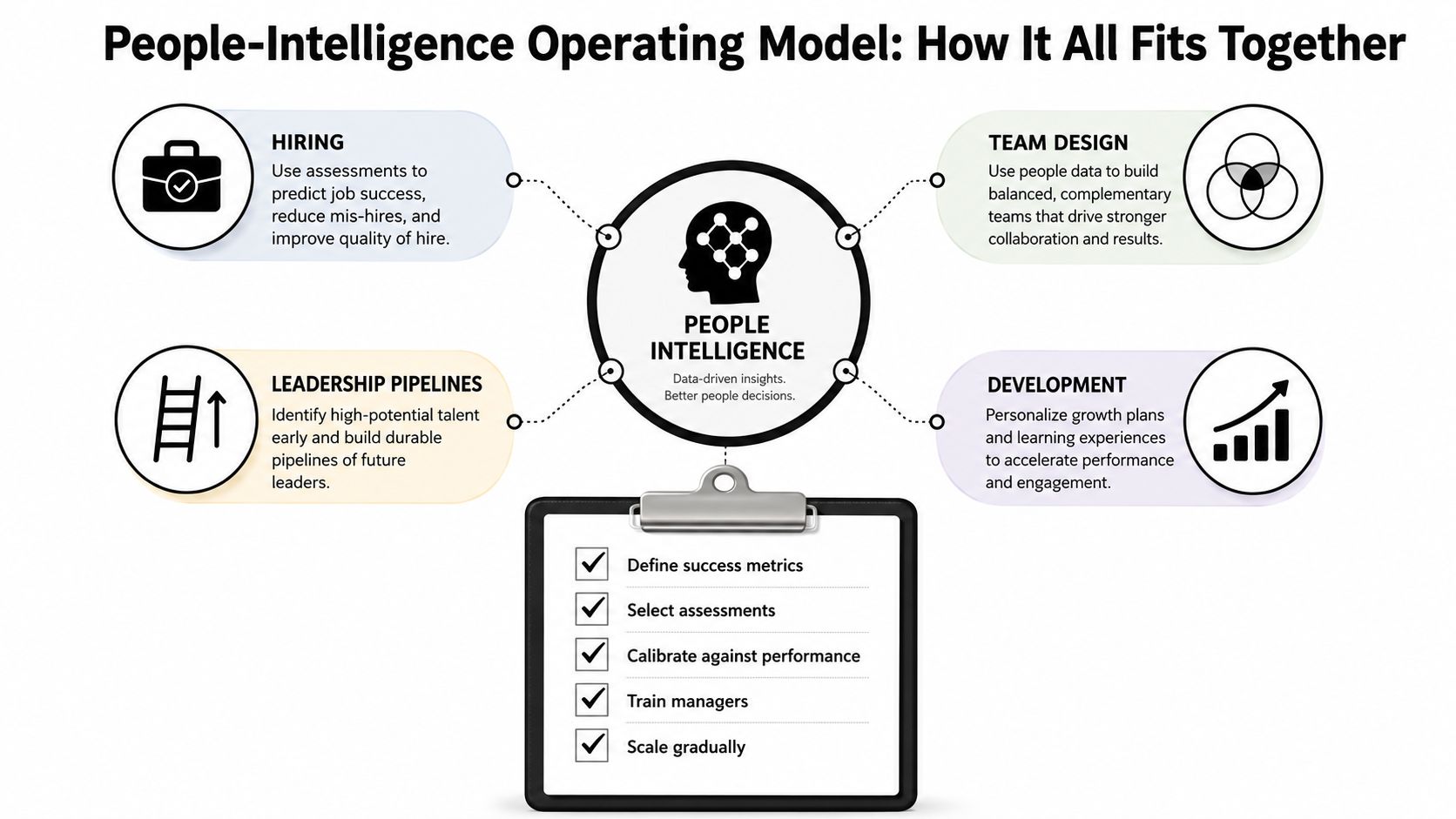
What the operating model should do
In hiring, psychometrics cut uncertainty. In team design, they show where skills complement each other and where friction will show up before it lands in performance reviews. In leadership pipelines, they tell you whether someone can carry broader scope, not just whether they performed well in the last role.
The operating model should also close the gap between psychometrics and business signals. If assessment results never connect to tenure, manager quality, promotion readiness, or team output, you have purchased risk without buying insight. That is a poor trade.
If your team needs a lightweight way to structure role-aligned assessments and follow-up, a [quiz and survey builder](https://kiwiform.com/) can help organize intake and feedback around the questions that matter. Use it to make the process more deliberate. Do not use it to pile on extra questionnaires.
The 30, 60, 90-day checklist
The first sales call with any vendor should answer three questions. How do you validate for my role type, how do you translate results for managers, and how do you handle compliance and data retention? If those answers are vague, move on.
The one metric a CEO will care about in the quarterly review is whether the program reduced avoidable hiring risk. Everything else supports that.
Synopsix turns behavioral assessments into business-readable hiring, team, and development signals, which is exactly what most psychometric programs are missing. If you want a people-intelligence layer that helps managers act on assessment data instead of decoding it, visit [Synopsix](https://synopsix.ai) and see how it fits your hiring and development process.