10 Recruitment Assessment Tools for Smarter Hiring
By Synopsix · September 19, 2026 · 24 min read
Most advice on recruitment assessment tools gets one thing backwards. It assumes the platform with the largest library wins. That sounds sensible until you ask a more useful question. Which hiring decision are you trying to improve?
A broad catalog can help, but it can also hide the trade-off. A team hiring entry-level support reps at volume needs fast screening and tight ATS flow. A software hiring team needs technical proof, not a generic fit score. Executive hiring needs deeper behavioral interpretation, stronger evidence, and often a more defensible process. Internal mobility adds another layer because the question shifts from “should we hire this person?” to “where will this person add the most value over time?”
That's why this roundup compares tools by the decision they sharpen: high-volume screening, technical validation, leadership selection, structured interviewing, internal mobility, and predictive team fit. For each platform, I'm looking at assessment type, psychometric depth, integration readiness, pricing visibility, implementation effort, and where vendor claims need verification rather than trust.
That last point matters. The market for recruiting assessment tools was estimated at $3.41 billion in 2025 and projected to reach $7.5 billion by 2034, with a projected 9.2% CAGR, according to Dataintelo's recruiting assessment tools market report. Growth alone doesn't make a tool good. It just means more buyers are sorting through bigger promises.
If your hiring challenge is team fit rather than test volume, this [team building guide from Acheloa Wellness](https://textlauren.com/resources/personality-assessments-for-team-building) is a useful companion read.
1. Synopsix
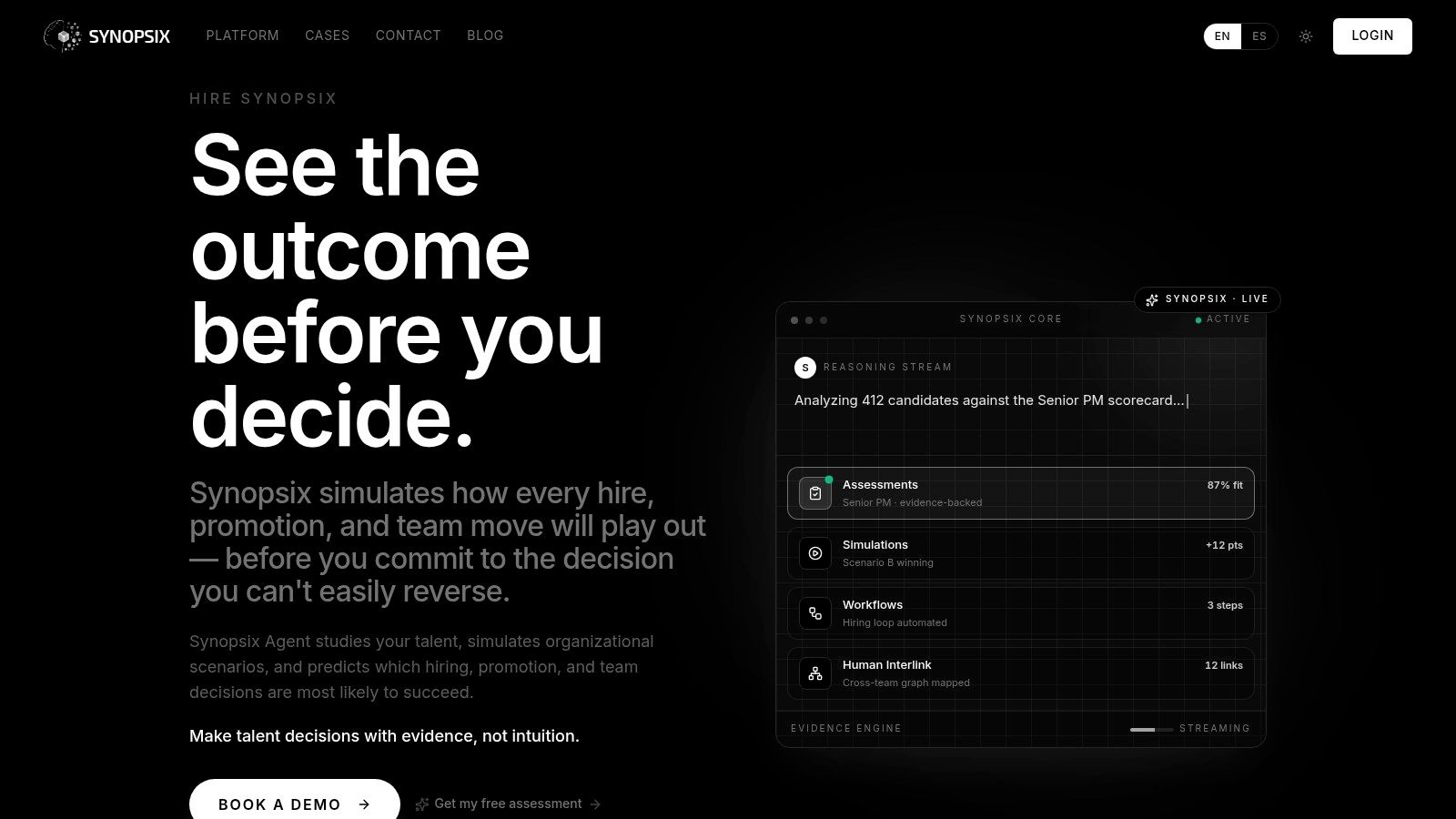
More assessment features do not automatically produce better hiring decisions. Synopsix is worth examining because it focuses on a narrower question than many platforms in this category: how a person is likely to perform in a specific role, inside a specific team, after the hiring decision is made.
That framing changes the buying case. Instead of competing on test-library breadth, Synopsix centers on psychometric profiling, role interpretation, and team-design analysis for hiring, promotion, and internal mobility decisions. For CHROs and talent leaders, the practical implication is clear. This is less a first-pass screening tool and more a platform for reducing ambiguity in higher-stakes people decisions.
Where Synopsix becomes relevant
Synopsix fits best when the decision problem is interpretive rather than administrative. Examples include leadership hiring, succession planning, internal transfers, and finalist comparisons where both candidates appear qualified but carry different team and management implications.
Its published product framing includes Org DNA baselining, role intelligence reports, predictive simulations, and Human Interlink team mapping. Those details suggest a broader operating model than simple candidate scoring. The platform appears designed to connect individual assessment results to role context and team composition, which is the point where standard screening tools often stop.
A practical screen helps here. If your hiring process depends on high-volume throughput, strict ATS routing, and low-friction screening, Synopsix may require more implementation effort than the use case justifies. If the cost of a wrong call is high because of leadership impact, team friction, or promotion risk, the platform becomes more relevant.
Synopsix also says candidates or employees can complete assessments in roughly 10 to 30 minutes, and it offers a free personal assessment plus demos and early-access trials. Buyers should confirm completion rates, drop-off points, and role-by-role workflow fit during evaluation rather than assuming candidate experience will hold across functions.
What buyers should validate
The main diligence issue is evidence. Synopsix publishes outcome and accuracy claims, including faster hiring decisions, fewer mis-hires, profile volume, decision volume, and specific accuracy percentages. In the materials cited here, those figures appear to be vendor-reported rather than independently verified, so they should be treated as claims to test in a pilot, not proof to import into a business case.
That does not make the platform weak. It changes the standard of review.
The stronger case for Synopsix is structural. It connects assessments to explainable reports, team-level interpretation, and post-hire use cases such as promotion and deployment decisions. That approach aligns with a broader shift toward using assessment data across the employee lifecycle, not only at the selection stage, as outlined in [PIN's skills assessment guide](https://www.pin.com/blog/skills-assessment-guide/).
2. SHL
If you want breadth with enterprise discipline, SHL is still one of the reference points in this category. Its value isn't the size of the library. It's the fact that a global employer can run cognitive, behavioral, skills, situational judgment, and simulation-based assessments inside one mature operating environment.
That matters for multinational teams that care about localization, compliance support, and repeatable workflows across business units. Smaller employers often underestimate how much administrative overhead appears once assessments spread across countries, languages, and role families.
Best decision fit
SHL is a strong fit when the problem is standardization at scale. If your hiring organization wants a common framework across frontline, professional, and leadership roles, a broad portfolio becomes an advantage rather than a distraction.
There's also a deeper historical reason SHL-style assessment portfolios matter. One of the foundational evidence bases in personnel selection came from work sample testing. A landmark meta-analysis found an observed mean correlation of 0.26 with job performance, rising to 0.33 after correcting for attenuation, reinforcing the value of structured, job-related exercises in predicting work outcomes, as summarized in the Journal of Applied Psychology meta-analytic line of research.
> Broad test coverage only helps if the buyer maps each assessment to a real job requirement. Otherwise, a large library becomes a large distraction.
Trade-offs
SHL tends to make more sense for organizations that already have process maturity. TalentCentral and SHL Online can support self-serve delivery and reporting, but the platform's depth can feel heavy for lean teams that just need a fast screening layer.
Use the [SHL website](https://www.shl.com) to review product lines and request current commercial details.
3. The Predictive Index (PI)
Feature count can obscure the buying question. PI is more useful if the hiring decision you want to improve is manager judgment about fit, communication style, and likely team interaction, rather than proof of technical capability or high-fidelity job simulation.
That distinction matters.
PI has long stood out by translating behavioral assessment into language non-specialists can use quickly. For a CHRO or TA leader, that lowers one of the hidden costs in assessment adoption: interpretation burden. A tool that produces valid signal but requires heavy specialist mediation often stalls after pilot. PI's reports and role-profiling workflow are built to keep hiring managers involved, which can improve consistency if the organization is trying to make selection and post-hire management use the same talent framework.
The trade-off is assessment depth. Buyers looking for narrow, role-specific evidence may find PI better at structuring conversations than at replacing specialized testing. Its cognitive component can add a general problem-solving signal, but teams comparing it with broader aptitude suites should verify score interpretation, adverse impact documentation, and recommended use cases directly with the vendor. This overview of [what makes PI Cognitive Assessment different](https://www.orangeneurosciences.ca/guide/pi-cognitive-assessment) is useful context for that comparison.
A practical way to evaluate PI is to ask what decision it improves on day one and what decision it improves six months later. On day one, it can help a hiring team define the target profile for a role and discuss candidate fit in a shared language. Six months later, the same system can support coaching, manager-candidate alignment, and team composition. That lifecycle value is real, but only if the business intends to use PI beyond screening.
This is also the point where comparison with Synopsix becomes more specific. If the need is better individual selection conversations with low interpretation friction, PI is often the cleaner fit. If the need shifts toward predicting how combinations of people perform together, and using hiring data to design teams rather than only fill seats, Synopsix becomes more relevant.
Commercially, PI requires the usual caution around vendor-led demos. Public pricing is limited, and total cost depends on platform scope, user count, and whether the buyer wants recruiting alone or the broader talent optimization stack. Implementation effort is usually lighter than enterprise testing libraries, but leaders should still validate ATS integration depth, reporting access, and the evidence available for the exact assessments they plan to deploy.
The current product overview is available on [The Predictive Index website](https://www.predictiveindex.com).
4. Criteria
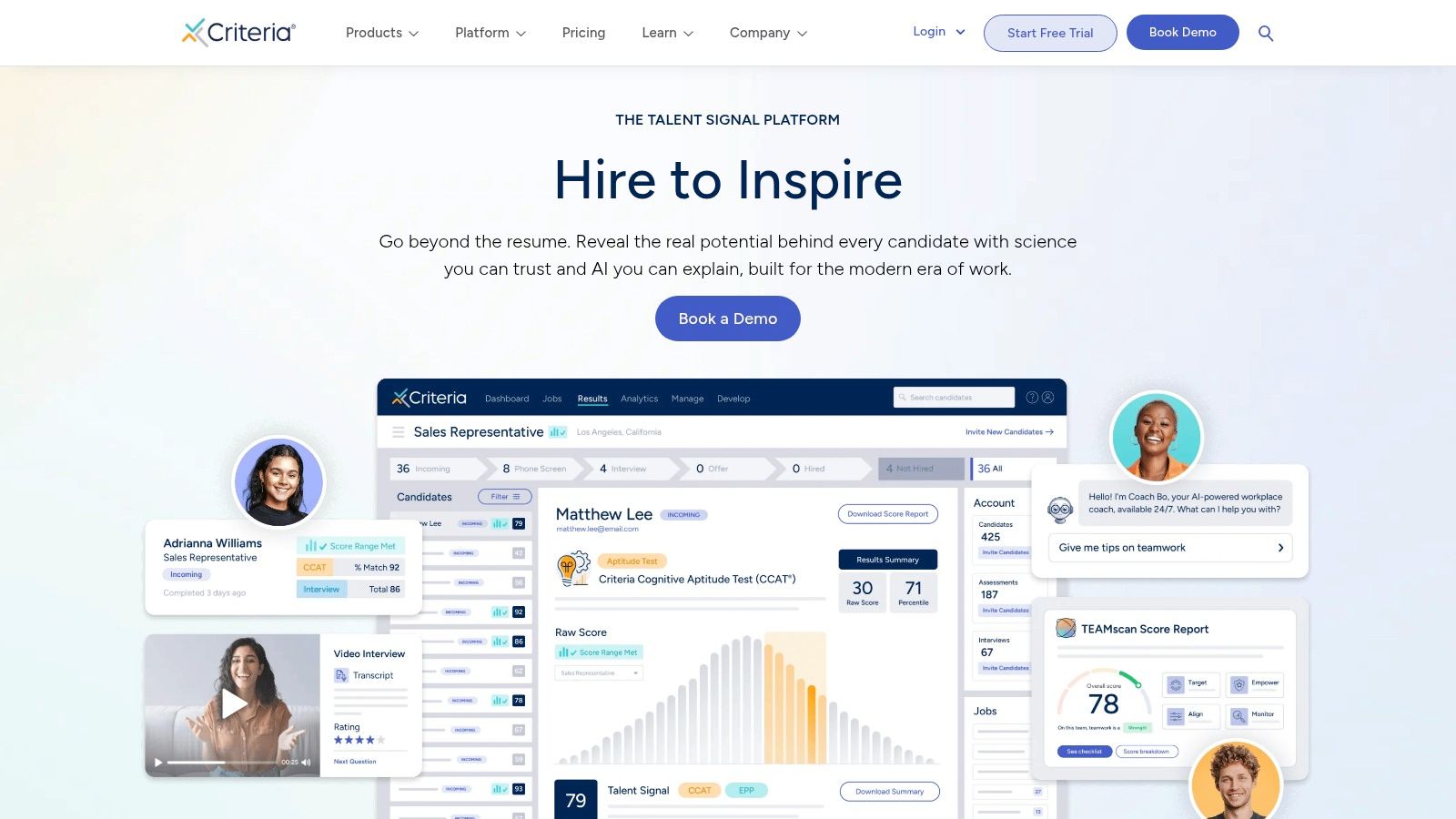
Criteria is easiest to judge by the hiring decision it improves, not by the size of its test catalog. Its practical value is early-stage triage: reducing noise in broad applicant pools and helping teams decide which candidates should move to interview across several job families.
That makes it a useful option for mid-market employers that need more assessment range than a basic skills-testing tool, but do not want the complexity, validation workload, or buying motion that often comes with enterprise testing programs.
A better procurement question is narrower. Does Criteria give your team enough signal for the roles you hire most often, without pushing candidates through a battery that is longer than the job justifies?
For many teams, the answer will depend less on feature breadth than on workflow fit. Criteria offers cognitive, personality, emotional intelligence, and skills-based assessments, which can support hiring across hourly, professional, and general business roles. The trade-off is predictable: a broad library increases flexibility, but it also shifts more responsibility to the employer to choose role-relevant combinations and document why those assessments belong in the process.
That distinction matters in practice. A TA leader hiring for customer support, operations, and entry-level analyst roles may benefit from one platform that covers several screening needs reasonably well. A leader hiring for tightly regulated roles, specialist technical work, or executive succession may need deeper evidence review, stronger customization, or a different assessment philosophy altogether.
Criteria also sits at an interesting point in the market between simple screening tools and more interpretation-heavy platforms. If the immediate need is consistent interview gating at manageable implementation effort, it can be a sensible fit. If the organization wants hiring data to inform team design, cross-person interaction risk, or broader workforce planning, that is usually the point where Synopsix becomes more relevant.
Before buying, CHROs should press on four operational questions: how well the assessments map to priority roles, how much candidate friction the workflow creates, what ATS integrations support in production, and what validation documentation is available for the specific instruments under consideration. Public pricing is limited, so cost comparison usually requires a sales conversation and careful attention to packaging, user limits, and support scope.
Current product details are on the [Criteria website](https://www.criteriacorp.com).
5. Harver (including pymetrics)
Feature count is the wrong lens for Harver. The more useful question is which hiring decision it improves.
Harver is strongest when the decision is early funnel triage at scale: who should move forward, who may fit a different role, and how to apply the same screen across large candidate pools without asking recruiters to review every application manually. That is a different buying case from executive assessment, specialist technical evaluation, or team design.
The pymetrics layer matters mostly on candidate experience and assessment format. Game-style tasks can feel lighter than a conventional test battery, which may help completion rates in high-volume programs. Buyers should still separate format from evidence. An engaging experience is helpful, but the procurement standard remains job relevance, score interpretability, and documentation that supports use by role and geography.
A practical way to assess Harver is to map it against three decisions.
First, does it improve frontline and early-career screening enough to justify the implementation effort? In many organizations, that answer can be yes, especially where hiring teams need consistency more than highly individualized interpretation.
Second, does it improve redeployment decisions, not just rejection decisions? Harver has long been associated with workflow designs that route candidates toward adjacent openings when they miss on one role but may fit another. That can matter more than test breadth if the business hires in clusters across customer service, retail, logistics, or operations.
Third, can the employer defend the process internally and externally? That requires more than vendor language about AI. Teams should ask how scoring works in practice, what validation support is available for the assessments being used, and what local compliance review may still be required. The broader procurement concern is well summarized in this [comparison of automated skills assessment recruiting tools](https://ustechautomations.com/resources/blog/automated-skills-assessment-recruiting-comparison-2026).
For CHROs and TA leaders, the trade-off is fairly clear. Harver can reduce screening variance and recruiter workload in high-throughput hiring, but it is usually a sales-led purchase with limited public pricing detail, and the business case depends on volume. If your main problem is screening thousands of applicants into a smaller, more consistent shortlist, Harver is easier to justify. If your goal is to understand how hires will complement existing teams, or to use assessment data beyond candidate filtering, that is usually the point where Synopsix becomes more relevant.
Before buying, validate five specifics with the vendor: which assessments are included by package, which ATS integrations are live in production rather than planned, how candidate drop-off is measured, what evidence is available for the roles you care about, and how much configuration is required to launch across multiple job families.
Explore the current suite on the [Harver website](https://harver.com).
6. HireVue
HireVue is most useful when the hiring decision is being weakened by interview inconsistency, not just by a lack of tests. That distinction matters. Many assessment tools help rank applicants, but fewer also help standardize the human part of selection across recruiters and hiring managers.
The practical appeal is process control. A team can use one platform for structured interviews, assessments, and parts of workflow orchestration, which may reduce tool switching and make review trails easier to maintain. For large employers, that can matter as much as measurement quality.
The trade-off is assessment depth versus workflow fit. If the priority is a better first-round decision across high volumes of manager-led interviews, HireVue can be easier to justify than a point solution. If the priority is deep psychometric analysis, role-specific validation detail, or broader team-design questions after selection, buyers should examine how far the available assessments go and what evidence the vendor can provide for the roles in scope.
Bias claims also need careful scrutiny. Structure usually improves fairness more reliably than broad AI messaging because consistent prompts and scoring criteria are easier to audit. Teams reviewing HireVue on that basis should pair product demos with a clear review of structured process design and [practical ways to reduce hiring bias](https://synopsix.ai/blog/how-to-reduce-hiring-bias).
A simpler way to assess fit is to ask one procurement question: which decision gets better after implementation? If the answer is "we can run more consistent early interviews at scale," HireVue has a strong case. If the answer is "we need to understand how a candidate will complement an existing team and use that insight beyond screening," that is usually the point where Synopsix becomes more relevant.
Before purchase, confirm four items directly with the vendor: which modules are included versus sold separately, what ATS integrations are fully deployed, what validation documentation is available for your job families, and how much internal change management is needed to get hiring managers to use structured scoring consistently.
Current platform information is available on the [HireVue website](https://www.hirevue.com).
7. TestGorilla
TestGorilla wins on practicality. It's one of the easier recruitment assessment tools to trial because pricing is visible, setup is fast, and the library is broad enough for many common hiring scenarios.
That transparency matters. A lot of assessment buying gets slowed down before the first pilot because teams can't determine whether a platform is financially realistic without a sales process. TestGorilla lowers that barrier.
Where it fits
This is a strong option when your hiring team needs to add structure quickly. SMBs, lean internal recruiting teams, and department heads running ad hoc hiring often care less about deep enterprise architecture and more about speed to deployment.
The trade-off is that breadth doesn't guarantee depth. For specialized technical or highly nuanced role evaluation, buyers should review content quality firsthand before scaling the tool across critical hiring streams.
You can review plans and product details on the [TestGorilla website](https://www.testgorilla.com).
8. HackerRank
For engineering hiring, HackerRank is not really competing with general assessment suites. It's solving a narrower problem. Can this person code at the level the role requires?
That focus is why it remains one of the default names in technical assessment. Candidates know the environment, hiring teams know the workflow, and the platform supports screening, live coding, and take-home formats in one technical funnel.
Why specialization matters here
Technical hiring is where generic “fit” tools often overreach. Engineering leaders usually need direct evidence of work, not just proxy signals. That makes work-sample logic especially important in this category.
If your team wants a deeper framework for that evidence standard, this explanation of [work sample testing in recruitment](https://synopsix.ai/blog/work-sample-testing) is worth reviewing alongside technical platform demos.
What it doesn't solve
HackerRank is excellent for technical verification. It is not a complete talent decision platform. It won't tell you much about leadership potential, team complementarity, or internal mobility unless you pair it with other tools.
The latest product information is on the [HackerRank website](https://www.hackerrank.com).
9. Plum
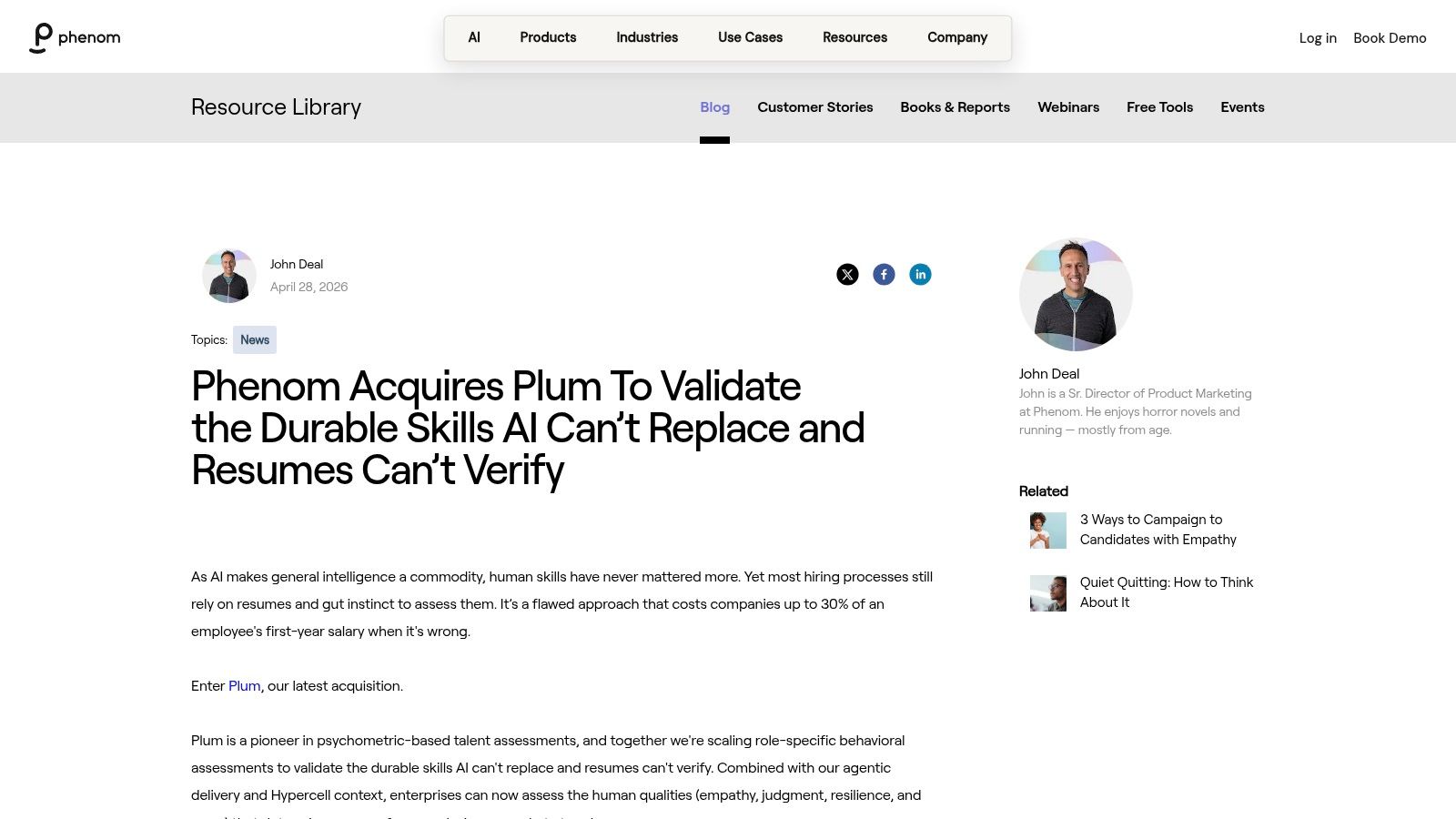
Plum takes a different angle from platforms that begin with role-specific test batteries. It emphasizes durable skills and generates a reusable profile that can support both hiring and internal movement.
That framing can be especially useful for employers trying to avoid overfitting to the exact wording of one open requisition. If your workforce strategy depends on adaptability, redeployment, and skill transfer, a reusable profile model has real appeal.
Where Plum is strongest
Plum works best when the hiring decision is tied closely to internal mobility or long-term talent matching. A reusable profile can reduce the friction of making every candidate or employee start from scratch each time a role changes.
The platform's candidate-friendly framing is also notable. Positioning the result as a profile of strengths, rather than a pass-fail hurdle, can support employer brand and change management.
> A durable-skills platform is most useful when the company is prepared to act on the data after hiring, not just score people at the front door.
Constraints
The durable-skills model requires organizational buy-in. Leaders who still want narrow requisition-by-requisition matching may struggle to extract the full value from Plum's approach.
Explore the platform on the [Plum website](https://www.plum.io).
10. Hogan Assessments
Hogan is rarely the first tool you buy for high-volume screening. It becomes relevant when the cost of a wrong decision is high and the role has leadership, influence, or derailment risk attached to it.
That's why Hogan remains so prominent in executive assessment, succession, and development work. The value is depth. Its framework covers everyday tendencies, risk factors under pressure, and motives and values, which gives organizations a richer picture than a basic personality screen.
When Hogan is the right call
Use Hogan when the question is not merely “can this person do the job?” but “how will this person lead, respond to pressure, and affect the system around them?” That's a different decision from frontline screening, and it deserves different tooling.
For organizations evaluating psychometrics more generally, this overview of [psychometric testing in recruitment](https://synopsix.ai/blog/psychometric-testing-in-recruitment) is a useful companion to Hogan-specific diligence.
Trade-offs
Depth comes with cost, interpretation demands, and often certification expectations. That's appropriate for senior selection, but usually excessive for high-volume hourly recruiting.
Current product and partner details are available on the [Hogan Assessments website](https://www.hoganassessments.com).
Top 10 Recruitment Assessment Tools Comparison
| Product | Core features ✨ | Performance & quality ★ | Pricing & value 💰 | Target audience 👥 | USP / Why choose ✨ | |---|---:|---|---|---|---| | 🏆 Synopsix | ✨ Fast 10–30m assessments, Org DNA, Predictive Simulations, Human Interlink, AI agent | ★ Vendor-cited: 98% accuracy; ~40% faster hires; ~60% fewer mis-hires; 50K+ profiles | 💰 Demo/pilot & enterprise pricing; free personal assessment | 👥 Enterprise HR, exec search, staffing, talent leaders | ✨ End‑to‑end, explainable “Head of Talent”, simulate hires/promotions before acting | | SHL | ✨ Large validated test library, job simulations, TalentCentral reporting | ★ Enterprise-grade validation & localization; compliance resources | 💰 Quote-based; some per-assessment prices visible in portal | 👥 Global enterprises, high-volume recruiters | ✨ Broad coverage + deep compliance & localization | | The Predictive Index (PI) | ✨ Quick behavioral + cognitive assessments, job modeling, team analytics | ★ Actionable, manager-friendly reports; widely adopted in US mid‑market | 💰 License tiers that scale with headcount | 👥 Mid‑market & enterprise people ops, managers | ✨ Behavioral-first talent optimization with coaching tools | | Criteria (formerly Criteria Corp) | ✨ Aptitude, personality, EI, game‑based measures + on‑demand video | ★ Science-backed library; SMB-friendly usability | 💰 Tiered/quote pricing; negotiable for volume | 👥 SMBs to mid‑market hiring teams | ✨ Versatile test mix for hourly → professional roles | | Harver (incl. pymetrics) | ✨ Gamified pymetrics + behavioral, cognitive, values measures | ★ Engaging, game-like UX with high completion rates | 💰 Sales-led quotes; no public list pricing | 👥 High-volume hiring, campus & early-career pipelines | ✨ Neuroscience-informed game assessments for pipelines | | HireVue | ✨ On‑demand & live video interviewing + validated assessments + automation | ★ Consolidates interview + assessment; enterprise integrations | 💰 Enterprise contracts; quote-based | 👥 Large employers needing interview+assessment stack | ✨ Unified interview → assessment workflow with automation | | TestGorilla | ✨ Large skills/cognitive catalog; self-serve setup & credits | ★ Fast rollout; SMB-centric UX for quick screening | 💰 Transparent tiered pricing + free option/trial | 👥 SMBs and fast-moving hiring teams | ✨ Self-serve platform with published pricing & flexible credits | | HackerRank | ✨ Technical question bank, CodePair (live), take‑homes, proctoring | ★ Developer-familiar UX; end‑to‑end tech hiring funnel | 💰 Plan-based for Work; sales contact for details | 👥 Engineering & technical hiring teams | ✨ Deep technical assessments + live coding tools | | Plum | ✨ Durable-skills assessment producing a reusable Plum Profile | ★ Candidate-friendly profile framing; bias-audit materials | 💰 Sales-led pricing; enterprise contracts | 👥 Organizations focused on internal mobility & bias reduction | ✨ Role-matching via durable-skills profiles and fairness resources | | Hogan Assessments | ✨ HPI / HDS / MVPI suite, traits, derailers, motives; certification options | ★ Gold‑standard for leadership selection & development | 💰 Variable pricing; certification may be required | 👥 Leadership selection, succession, high‑stakes development | ✨ Deep validation research and trusted for leadership risk assessment |
Turn the Shortlist Into a Defensible Pilot
The best procurement process for recruitment assessment tools is less glamorous than most vendor demos. It starts by naming the decision you need to improve. Not “we want better hiring.” Something narrower. “We need to shortlist high-volume applicants faster.” “We need stronger evidence for engineering hires.” “We need a more defensible way to assess leadership fit across regions.” Until that's clear, every platform can look impressive for the wrong reason.
Next, map the assessment type to the decision. If the problem is technical verification, favor work samples and coding environments. If the problem is leadership selection, deeper behavioral and personality interpretation may matter more. If the problem is internal mobility, the shortlist should include platforms that can reuse assessment data after hire instead of forcing one-time screening logic onto long-term workforce planning.
Then get practical. Request current pricing, packaging, ATS integrations, implementation requirements, accommodation process details, and data-handling documentation. Many buying mistakes happen because leaders compare product categories without comparing operating models. A tool can look strong in a demo and still fail because results don't write back cleanly to the ATS, hiring managers don't understand the reports, or candidates abandon the assessment experience.
After that, review evidence and fairness materials with discipline. Ask vendors to show how assessments connect to job requirements, how scoring stays consistent across roles, and what documentation supports defensibility. Don't treat AI language as evidence. Treat it as a prompt for deeper questions.
A strong pilot should test five things at once:
Choose the platform whose evidence and operating model match your use case, not the one with the widest brand recognition or the longest feature list.
Synopsix deserves a place on that shortlist when your challenge goes beyond screening into interpretation. It is especially relevant for teams that need behavioral profiles translated into role signals, predictive simulations, and team-design guidance. But the right buying posture is still the same as with any other platform. Validate vendor-reported outcomes, confirm security posture and integration details, and test the product against agreed business outcomes before committing broadly.
If you do that well, your final choice will be much easier. The best tool won't be the one that promises the most. It'll be the one that helps your team make a better decision, consistently, with evidence you can defend.
---
Synopsix is built for teams that want more than a score. It turns validated behavioral assessments into hiring, promotion, and team-design guidance, then adds predictive simulations and organizational context so leaders can act on the result. If that's the gap in your current stack, visit [Synopsix](https://synopsix.ai) and evaluate it through a controlled pilot.