Recruitment Efficiency Metrics: Optimize Your Hiring in 2026
By Synopsix · June 20, 2026 · 15 min read
A role opens. Everyone says it's urgent. The hiring manager wants resumes by Friday, finance wants the spend contained, and your recruiters are already juggling too many searches. Weeks pass. Good candidates stall in scheduling. Someone drops out after the panel. The eventual hire accepts, starts, and then it becomes obvious within a short stretch that the match wasn't right.
That's the moment recruiting teams realize they weren't short on effort. They were short on visibility.
Recruiting gets labeled inefficient when what's really happening is that nobody can see where the friction lives. Approval delays get mixed together with sourcing problems. Interview drag gets confused with market scarcity. A high applicant count gets mistaken for pipeline health. Then the team reacts with more activity, more agencies, more job ads, more interviews. Cost goes up. Confidence goes down.
Why Your Hiring Feels Inefficient and Costly
Most hiring pain doesn't arrive as one dramatic failure. It shows up as a series of small misses that stack up.
A requisition sits in limbo because approvals aren't clean. A recruiter finally launches the search, but the job description attracts the wrong people. Screening takes longer than it should because the hiring manager keeps revising the brief. By the time the team reaches final interviews, the strongest candidates are already deep in another process. The role stays open, the team absorbs the work, and everyone starts saying the market is impossible.
Sometimes the market is hard. Often the process is harder than leaders want to admit.
What the mess usually looks like
In practice, inefficient hiring often has a familiar pattern:
For HR and finance leaders trying to pressure-test hiring costs against operating reality, this [staffing guide for HR and CFOs](https://www.peometrics.com/professional-services-staffing/) is useful because it frames hiring as a business capacity problem, not just a recruiting task.
The expensive part isn't only the open role. It's the wasted motion around it. That's also why the downstream impact of a bad decision matters so much. If you're trying to quantify that side of the equation, the breakdown in this [analysis of the cost of a bad hire](https://synopsix.ai/blog/cost-of-a-bad-hire) is worth reviewing.
> Practical rule: When leaders say hiring feels slow, ask where time is actually being spent. Most teams can't answer that cleanly.
Recruitment efficiency metrics are the first layer of control. They won't solve every hiring problem, but they will show you whether the issue is process design, channel mix, team throughput, or decision discipline. Without that baseline, hiring stays stuck in opinion.
The Foundational Recruitment Efficiency Metrics
The core set of recruitment efficiency metrics is well established in modern ATS and HR analytics dashboards: time to fill, time to hire, cost per hire, source of hire, offer acceptance rate, and application completion rate. Those measures became standard because they turned recruiting from a judgment-heavy function into a measurable process that can expose bottlenecks, improve candidate experience, and reduce wasted spend, as outlined in [AIHR's recruiting metrics guide](https://www.aihr.com/blog/recruiting-metrics/).
That matters because operational recruiting needs a common language. If your team can't define the funnel the same way, you can't improve it.
Core recruitment efficiency metrics explained
| Metric | What It Measures | Standard Formula | |---|---|---| | Time to Fill | The total vacancy period from approved opening to accepted offer | Requisition approval date to offer acceptance date | | Time to Hire | How quickly a candidate moves through the active process | Application date to offer acceptance date | | Cost per Hire | The total investment required to make one hire | Total recruiting costs / total hires | | Source of Hire | Which channels produce completed hires | Hires by source / total hires | | Offer Acceptance Rate | How often extended offers turn into accepted offers | Accepted offers / total offers | | Application Completion Rate | How many starters actually finish the application | (Completed applications / total starters) × 100 |
What each metric actually tells you
Time to fill is the broadest operational measure. It captures the whole vacancy interval, including all the delay nobody wants to own. If a role sits open because approvals drag or interview panels take too long to align, this metric surfaces that burden.
Time to hire is narrower and more useful for examining execution once a candidate is in motion. It tells you whether the team can move decisively after application, outreach, or sourcing.
Cost per hire forces honesty. Teams often underestimate what hiring really consumes because they count invoice spend but ignore recruiter time, manager time, tooling, and process waste. Even if you don't build a perfectly loaded model, tracking this metric creates discipline around channel choice and process complexity.
Metrics that expose funnel quality signals
Source of hire is one of the most underused metrics in practice. Many teams track applicant source and stop there. That creates noise. The pertinent question is which channels produce hires and whether those hires justify the effort required to get them through the funnel.
Offer acceptance rate tells you whether your final pitch is competitive and credible. If candidates walk late, the issue may be compensation, process fatigue, role ambiguity, or weak closing from the hiring team.
Application completion rate is a simple but revealing measure. If people start the application and don't finish it, your funnel may be creating unnecessary friction. The standard formula is (completed applications / total starters) × 100.
> A mature recruiting team doesn't just count activity. It measures where effort converts and where it leaks.
What works and what doesn't
What works is pulling these fields directly from your ATS, defining them once, and reviewing them consistently with recruiting leads and hiring managers.
What doesn't work is debating definitions in every meeting, exporting spreadsheets with different date logic, or judging recruiter performance on one isolated metric. These are foundational metrics. They are table stakes. They tell you whether the machine is moving, not whether it is hiring the right people.
Interpreting Numbers to Diagnose Your Funnel
A dashboard full of metrics can still leave you blind if you read each number in isolation. The value comes from pattern recognition.
Start with the distinction that matters most operationally. Time to fill tracks the total vacancy period from requisition to accepted offer, while time to hire tracks candidate processing speed from application to acceptance. Teams that monitor both can separate upstream planning issues from bottlenecks inside the active funnel, as explained in [X0PA's recruitment metrics glossary](https://x0pa.com/glossary/recruitment-metrics/).
To make that easier to visualize, use the funnel as a diagnostic map.
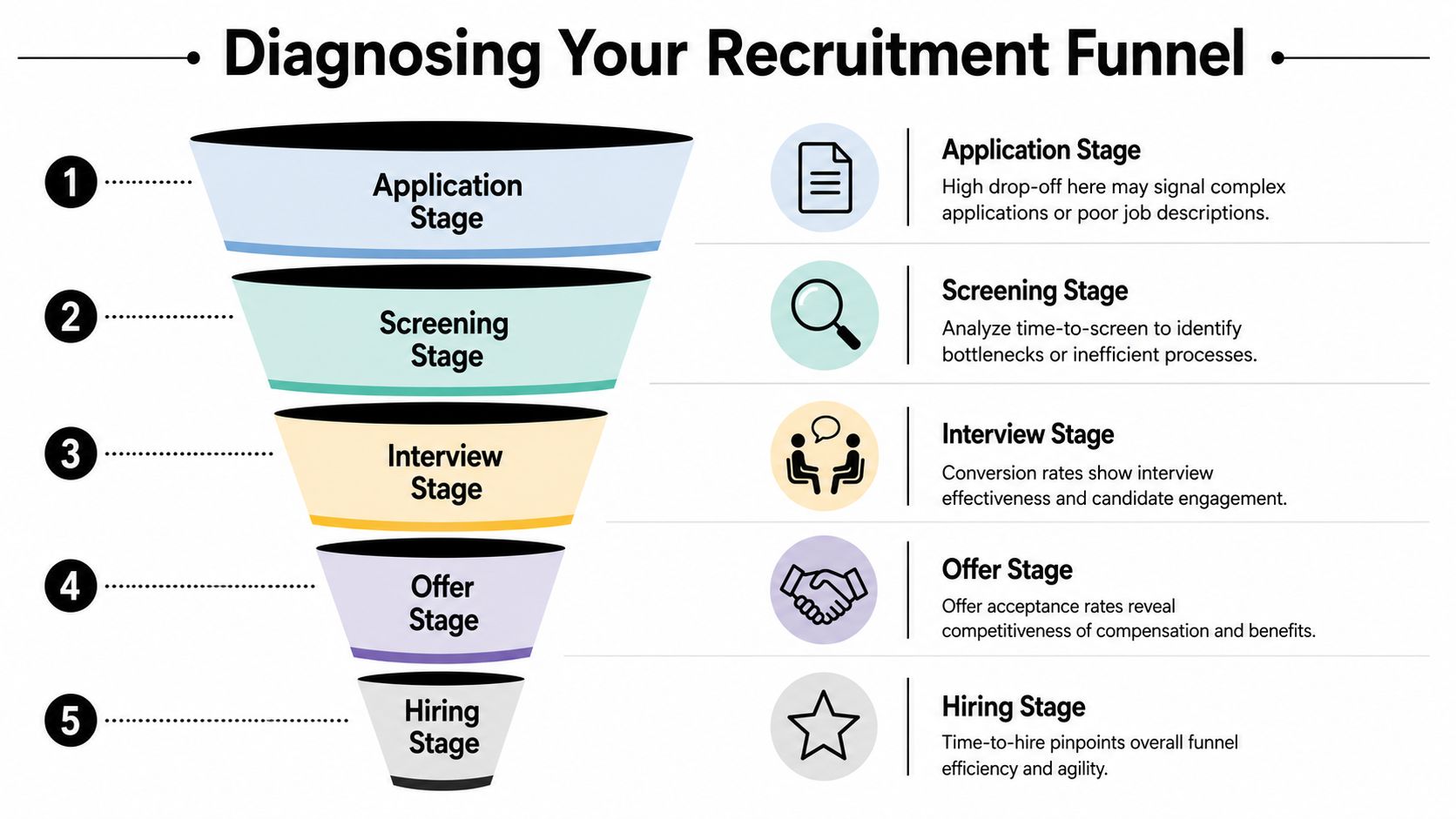
Read combinations, not single metrics
A long time to fill with a relatively short time to hire usually points to trouble before candidate engagement gets moving. That often means slow approvals, unclear intake, weak demand planning, or sourcing delays at the front of the search.
A short time to fill paired with weak offer acceptance rate usually means the team is moving fast but not selling well. In those cases, recruiters often compensate with urgency while candidates are losing trust in the role, manager, or package.
A strong application completion rate but poor downstream conversions can indicate that the top of funnel is healthy while screening or interview design is weak. A lot of teams respond by buying more traffic. That's usually the wrong move.
Common diagnostic patterns
The walkthrough below gives a useful visual explanation of how recruiting funnels break down in practice.
<iframe width="100%" style="aspect-ratio: 16 / 9;" src="https://www.youtube.com/embed/QWfr8H0V7Ck" frameborder="0" allow="autoplay; encrypted-media" allowfullscreen></iframe>
Diagnose the handoffs
Most recruiting inefficiency lives in handoffs. Recruiter to hiring manager. Hiring manager to panel. Panel to decision-maker. Decision-maker to compensation approval.
> When a funnel stalls, don't ask who is working hard. Ask which handoff lacks an owner.
That framing changes the conversation. You stop blaming the labor market for every miss and start identifying the exact stage where momentum breaks.
Common Pitfalls and Misinterpretations to Avoid
The first mistake teams make with recruitment efficiency metrics is treating them like a scoreboard instead of a diagnostic tool. Metrics should guide action. They shouldn't become targets detached from hiring reality.
If a recruiting leader pushes hard on time to hire alone, recruiters may rush candidates into interviews before the hiring team is aligned. If finance squeezes cost per hire without context, the company may cut the channels or tools that reach stronger candidates. You can improve a metric and still worsen the hiring outcome.
Where teams get fooled
Source attribution gets messy. A candidate might first see your brand through social media, return later through a referral, and apply through a job board link. Declaring one clean source of hire can hide the true path.
Benchmarks get abused. Comparing your metrics to generic industry numbers is one of the least useful habits in hiring. A niche technical search in one market doesn't behave like high-volume frontline hiring in another. Role type, geography, seniority, brand strength, and compensation strategy all matter.
Volume gets mistaken for health. More applicants can make a dashboard look strong while the team is spending more time screening poor-fit profiles.
Signals that deserve a second look
When a metric changes suddenly, pause before reacting. Ask:
> Reality check: A cleaner dashboard doesn't mean a healthier recruiting operation. Sometimes it only means the reporting got tidier.
The best operators stay suspicious of easy explanations. They use metrics to ask better questions, not to confirm what they already want to believe.
Beyond Efficiency The Missing Metric of Hire Quality
Here, most hiring analytics hit a wall.
Efficiency metrics tell you how quickly the funnel moves and what it costs to get someone across the line. They do not tell you whether you hired someone who will perform, stay, collaborate well, and justify the investment. That's the blind spot.
One reason the gap persists is that most recruitment metrics content still centers on funnel volume. It says far less about channel efficiency for hard-to-fill roles or how to distinguish sources that generate qualified candidates from those that create more applications, as noted in [NetSuite's recruitment metrics overview](https://www.netsuite.com/portal/resource/articles/human-resources/recruitment-metrics.shtml).
Fast hiring can still be bad hiring
I've seen teams celebrate a reduced time to fill right before dealing with the fallout of a poor match. The recruiter hit the target. The hiring manager got the seat filled. Then the new hire struggled with the pace, clashed with the team, or couldn't execute in the actual role environment.
None of that risk showed up in the efficiency dashboard.
That's why quality of hire matters so much, even though many organizations still struggle to define it cleanly. The hidden cost of a bad hire isn't just replacement effort. It shows up in lost trust, team disruption, slower execution, manager distraction, and a second recruiting cycle nobody budgeted for.
The blind spot in interviews
Traditional interviews don't solve this on their own. Many organizations still overrate polish, confidence, and familiarity, under-detecting decision style, stress behavior, role-specific friction, and team compatibility.
If your interview process needs tightening, these [practical steps for better interviews](https://www.hypescribe.com/blog/how-to-conduct-effective-interviews) are a useful complement to metric tracking because they focus on how to get more signal from the conversation itself. And if you're rethinking how structured evaluation supports stronger talent decisions, this perspective on [employee assessment approaches](https://synopsix.ai/blog/assessment-for-employees) adds another layer.
What quality really asks
Hire quality forces tougher questions:
> Efficiency gets people hired. Quality determines whether hiring was a good decision.
Once a team sees that distinction clearly, recruitment efficiency metrics stop being the destination. They become the operating layer underneath a more serious hiring system.
Augmenting Metrics with People Intelligence
The missing layer is people intelligence.
Operational metrics tell you what happened in the process. People intelligence helps you estimate what is likely to happen after the hire. That includes behavior under pressure, likely communication patterns, alignment with role demands, and the kind of friction a candidate may create or reduce inside a team.
What this layer adds
Scientifically validated behavioral assessment becomes useful. Not as a replacement for recruiter judgment, and not as a gimmick layered on top of weak process, but as a structured way to translate human complexity into decision-ready signals.
Good people intelligence helps teams answer questions resumes and interviews often miss:
That's a different category of insight than funnel efficiency. It deals with probable outcomes, not just completed process steps.
From process data to predictive judgment
Most TA teams already have enough process data to know where the funnel is slow. What they usually lack is a reliable way to distinguish a candidate who can do the job from a candidate who can excel at hiring theater.
People intelligence closes part of that gap by converting behavioral data into language hiring managers can use. Instead of handing over abstract psychometric jargon, the best systems translate findings into business signals. Who is likely to thrive in a role that needs influence, resilience, structure, or ambiguity tolerance. Who may struggle in a highly interdependent environment. Who looks strong on paper but may create avoidable friction after joining.
For teams exploring how behavioral data connects to broader workforce decisions, this overview of [people analytics in practice](https://synopsix.ai/blog/what-is-people-analytics) is a useful anchor.
> The strongest hiring decisions combine two kinds of evidence. Process evidence shows how the search is running. People evidence shows what kind of hire you're about to make.
Used well, this doesn't slow recruiting down. It sharpens it. Recruiters spend less time defending instincts. Hiring managers spend less time projecting confidence onto candidates who perform well in interviews. The organization makes fewer avoidable bets on incomplete information.
Your Action Plan for Smarter Hiring Outcomes
If your recruiting operation feels expensive, slow, or unpredictable, don't try to fix everything at once. Build the system in layers.
Start with operational discipline
First, get the basics under control. Track the core recruitment efficiency metrics consistently in your ATS. Clean definitions matter more than fancy dashboards. If your team can't agree on when a requisition starts or what counts as a completed application, your reporting won't help.
Then review the metrics with the people who influence them. Recruiters alone can't fix approval lag, interview sprawl, or weak closing.
Learn to diagnose, not just report
Next, move from measurement to diagnosis. Read metrics in combination. Study handoffs. Look for repeated stall points by role family, manager, and channel. The goal isn't more reporting. It's clearer intervention.
For teams that need to [streamline technical talent acquisition](https://nexusitgroup.com/how-to-improve-hiring-process/), this kind of practical process tightening is especially important because specialized searches expose weak funnel design fast.
Add a quality layer
Finally, stop treating efficiency as the finish line. Add a method for evaluating likely performance, fit, and team impact before the hire is made.
The roadmap looks like this:
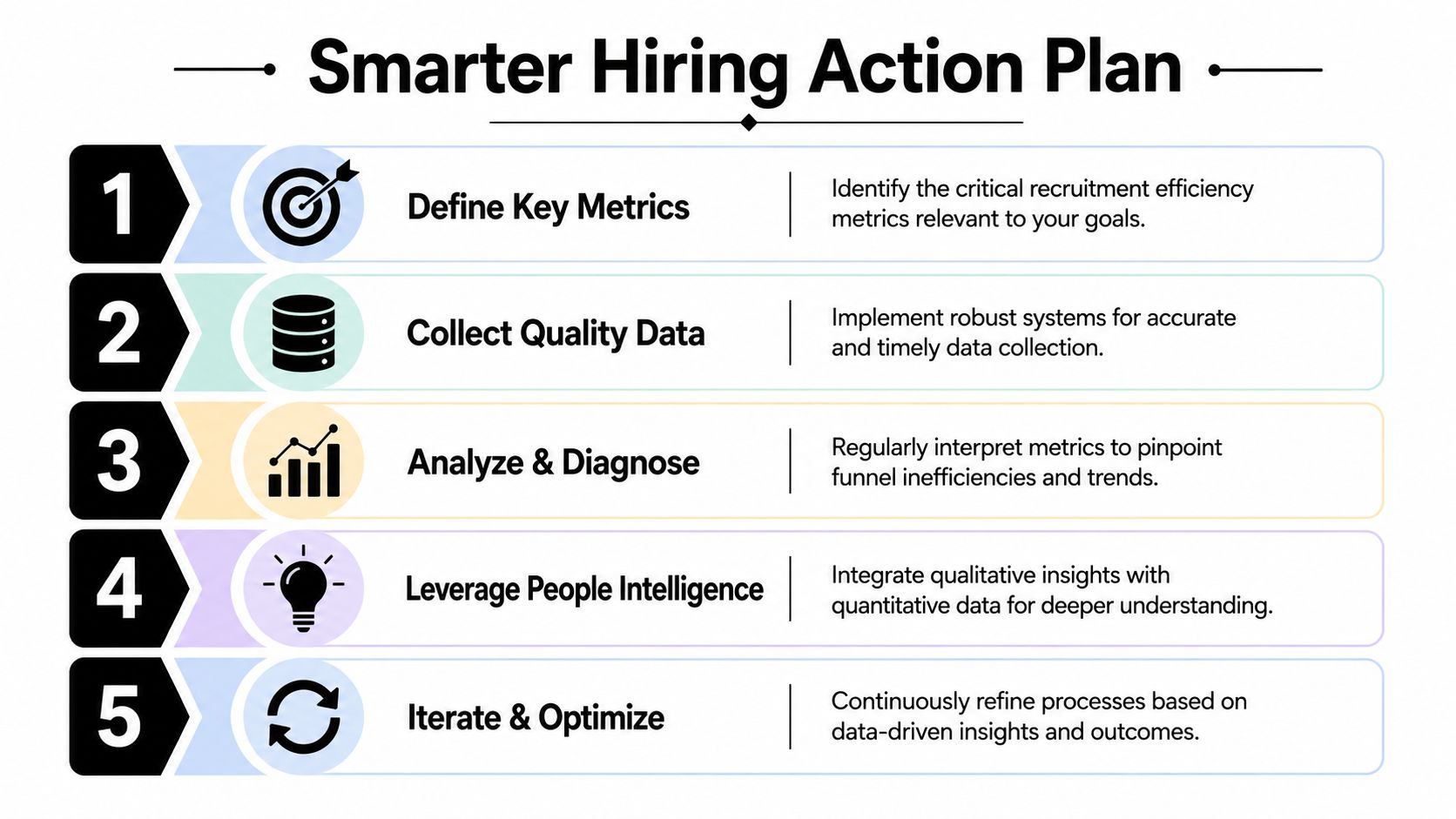
The teams that hire well don't just move faster. They understand what they are optimizing for.
---
If you want to add the missing layer between recruiting efficiency and actual hiring success, explore [Synopsix](https://synopsix.ai). It helps teams turn behavioral assessment data into practical hiring guidance so decisions are based on more than resumes, interviews, and funnel speed alone.