Recruitment Risk Management: A Practical Framework
By Synopsix · August 26, 2026 · 17 min read
74% of employers admit hiring the wrong person, and CareerBuilder reported an average cost of $14,900 per bad hire. Recruitment risk management is the discipline that prevents those individual errors from compounding into operational, financial, compliance, and leadership exposure.
Hiring teams often treat a failed appointment as an isolated people problem. That view is outdated. A hiring decision is a prediction about future behavior, performance, judgment, reliability, and collaboration. If the prediction fails, the organization pays through replacement work, delayed projects, manager time, customer disruption, and the next hiring decision made under pressure.
Recruitment risk management gives CHROs a more defensible operating model. It combines behavioral intelligence, role-specific scoring, structured assessment, identity controls, and post-hire monitoring. The objective isn't to eliminate uncertainty. It's to make uncertainty visible, measurable, and governable before the organization commits more capital to the wrong person.
Why Hiring Risk Is Now an Enterprise-Level Exposure
Marsh McLennan's 2023 Global Risk Management Survey polled nearly 3,000 risk managers, C-suite leaders, and other executives across 61 countries and territories. Recruitment and retention problems ranked fourth among the top global risks, according to [coverage of the Marsh McLennan survey](https://www.hcamag.com/asia/specialisation/leadership/recruitment-retention-problems-among-top-5-business-risks-globally/466632). That ranking changes the conversation. Hiring risk isn't confined to HR administration when executives place it alongside broader operational and strategic threats.
The financial signal is equally direct. CareerBuilder reported that 74% of employers admitted hiring the wrong person, with an average cost of $14,900 per bad hire, as documented by [HR Dive's coverage of the CareerBuilder findings](https://www.hrdive.com/news/careerbuilder-74-of-employers-admit-hiring-the-wrong-candidate/512577/). That historical benchmark doesn't capture every downstream consequence, but it demonstrates why a single failed appointment deserves more than a post-mortem after termination.
Where one failed appointment spreads
A weak hire in a routine role can slow a team. A weak hire in a regulated function can create compliance exposure. A weak hire in a revenue-critical role can affect customer confidence, pipeline execution, and renewal conversations. A weak leader can distort priorities, suppress dissent, and cause capable employees to leave.
The second-order effects matter because the replacement process consumes the same managers and recruiters who made the original decision. Teams then rush, lower evidence standards, and accept another avoidable risk.
> Practical rule: Treat every role as a risk position, then assign more controls to roles with greater customer, regulatory, revenue, or succession impact.
Credit teams don't approve lending based on one persuasive conversation. Cybersecurity teams don't protect systems through a single annual checklist. Supply-chain leaders don't assess a critical supplier only after delivery fails. Hiring needs the same proactive posture: define exposure, collect evidence, set decision rights, and monitor outcomes.
Use the [cost of a bad hire](https://synopsix.ai/blog/cost-of-a-bad-hire) to build the business case with finance and the executive committee. The point isn't to dramatize every vacancy. It's to stop treating repeated hiring errors as unavoidable noise in the workforce plan.
What Recruitment Risk Management Actually Means
A CHRO can explain recruitment risk management to a CFO using the language of a lending portfolio. The analogy is useful because it forces the organization to distinguish between probability, impact, concentration, controls, and residual exposure.
In hiring, the probability of default becomes the likelihood that a candidate will fail the role's defined success criteria. Expected loss becomes the projected cost of failed performance, replacement, disruption, and vacancy. Portfolio concentration appears when a small number of critical roles carry disproportionate operational dependency. Stress testing means modeling what happens if a key leader exits, a scarce skill proves unavailable, or a new hire fails during a major delivery cycle.
Recruitment risk management is therefore the disciplined practice of identifying, measuring, mitigating, and monitoring adverse outcomes across the hiring lifecycle. It begins before a requisition opens and continues after the employee starts.
Four control layers
1. Identify risk at intake. Define the outcomes the person must deliver, the behaviors that could cause failure, and the consequences of a miss. A vague job description creates vague evidence.
2. Measure risk through structured assessment. Use role-linked criteria, comparable scoring, realistic work samples, behavioral evidence, and relevant verification. The decision should show how evidence maps to the job.
3. Mitigate before commitment. Combine selection methods, calibrate interviewers, verify identity and credentials, document exceptions, and design onboarding around early performance signals.
4. Monitor residual risk after hiring. Track early delivery, manager feedback, retention, role fit, and performance outcomes. A selection process that never checks its predictions cannot improve its predictions.
Data quality supports every layer. Inaccurate candidate records, inconsistent scorecards, incomplete references, and untraceable assessment inputs weaken the entire control environment. Teams building a broader data-control program can use this practical resource to [reduce data quality risk](https://www.digna.ai/data-quality-risk-management) without separating people decisions from the information systems that support them.
Why a checklist isn't enough
A checklist can confirm that an interview happened. It can't tell you whether the interview measured the right competency, whether the panel applied the rubric consistently, or whether the evidence predicted later performance. Each control reduces only part of the exposure. Without ownership and review, residual risk accumulates unseen.
The right question isn't, “Did we complete the process?” It's, “What adverse outcome were we trying to prevent, and what evidence shows that our controls addressed it?”
The Main Sources of Hiring Risk You Need to Control
Hiring risk is a portfolio of exposures, not a single “quality of hire” problem. Each source needs its own evidence, owner, and control.
| Risk Source | Typical Cost Vector | Most Common Control Failure | |---|---|---| | Mis-hire | Rework, replacement expense, lost productivity, team disruption | Selecting against a broad impression instead of role outcomes | | Bias and discrimination | Legal exposure, reputational damage, reduced validity, exclusion of capable candidates | Unstructured interviews and inconsistent evidence standards | | Cultural or team mismatch | Friction, manager load, disengagement, avoidable attrition | Confusing similarity with collaboration or role compatibility | | Attrition | Replacement cost, vacancy disruption, lost institutional knowledge | Selling the role inaccurately or ignoring behavioral demands | | Fraud and credential risk | Invalid employment decision, security exposure, damaged customer trust | Assuming remote identity and application data are authentic | | Process risk | Slow decisions, inconsistent selection, false confidence | Relying on one method, halo effects, and uncalibrated panels |
Mis-hire and process failure
Mis-hire risk starts with a skills-performance mismatch. A candidate may meet the listed qualifications yet lack the judgment, pace, persistence, or collaboration pattern the job demands. Hiring managers often describe responsibilities without defining observable behaviors that indicate success.
That gap makes role-specific scoring difficult. Build criteria around decisions the employee must make, work they must deliver, and behaviors managers can verify. Generic fit labels conceal exposure. Behavioral evidence makes it visible.
Process risk then magnifies the weakness. Unstructured interviews invite recency and halo effects. A persuasive candidate can dominate the decision while the panel collects no comparable evidence from other finalists. Use the same prompts, scoring anchors, and evidence standards for every finalist.
Bias, fit, and attrition
Bias creates fairness exposure and weakens prediction. Interviewers who reward similarity, familiarity, or unrelated communication style discard useful evidence before it reaches the decision.
“Culture fit” becomes unsafe when nobody defines it behaviorally. It can turn into a preference for people who resemble the current team. Use contribution to the team environment instead, assessed through constructive disagreement, dependable follow-through, and comfort with ambiguity.
Attrition often exposes the same design failure. If candidates receive an incomplete account of the work, predictable frustration later looks like a personal defect. The organization pays through replacement effort, lost momentum, and another cycle of selection risk. Show the behavioral demands of the role before commitment, then test whether the candidate can meet them.
Fraud has become a baseline control question
Remote and AI-assisted hiring funnels require a direct identity control: Is the person assessed the person who will perform the job? Verify identity, credentials, employment history, and assessment ownership according to the role's security and compliance requirements. Treat application data as an input to verify, not as proof.
Fraud risk is also operational. Weak identity checks can produce an invalid employment decision, expose systems or customers, and undermine confidence in the hiring process. Controls should cover the point where evidence is collected, not only the final background check.
Risks interact. A weak assessment process makes fraud harder to detect. A bias-heavy process can increase attrition. Over-cautious screening can exclude non-linear talent while leaving the organization exposed to the skills shortage it intended to solve. CHROs should review these risks together, then assign each control to a process owner and test whether it improves prediction for the specific role.
How to Measure and Quantify Recruitment Risk
Measurement starts with the role, not the vendor. Define the outcomes that distinguish acceptable, strong, and failed performance. Then assign evidence requirements to each outcome.
For example, a revenue role might require opportunity judgment, disciplined follow-through, and objection handling. A compliance role might prioritize conscientious execution, escalation judgment, and resistance to pressure. The assessment should reflect those demands instead of producing a generic fit label.
Build a role-specific prediction model
Create a weighted scorecard with observable criteria. Use behavioral anchors, work samples, cognitive measures, structured interview evidence, and verification inputs where they relate to the role. Weight criteria by business impact, not by which interviewer speaks most confidently.
Conscientiousness offers a useful example of evidence-based specificity. A meta-analysis reported a corrected mean validity of .22 for conscientiousness as a predictor of job performance, and the trait remained a consistent positive predictor across performance measures and jobs in a separate synthesis, according to the [available meta-analytic research summary](https://colab.ws/articles/10.1111%2Fj.1744-6570.1991.tb00696.x). The signal is meaningful but not sufficient on its own. Extraversion is more relevant in socially intensive roles such as sales and management, while openness and extraversion are more useful for some training-proficiency criteria.
Theory-driven matching improves the model. A meta-analytic review estimated true validities of .43 for emotional stability, .36 for conscientiousness, .35 for extraversion-ambition, .34 for agreeableness, and .34 for intellect-openness when predictors were aligned with more specific performance criteria, as reported in [the PubMed review](https://pubmed.ncbi.nlm.nih.gov/12675398/).
Combine methods instead of worshipping one score
A professional review reported about .51 predictive validity for carefully devised structured interviews, while no single hiring practice exceeded roughly .54, as summarized in [this review of structured behavioral interviews](https://www.linkedin.com/pulse/20140731165044-12165384-why-your-company-should-adopt-structured-behavioral-interviews). That ceiling is why a hiring manager's interview judgment can't carry the entire decision.
| Method | Validity Coefficient | Risk Implication | |---|---:|---| | Structured interview | About .51 | Strong conventional signal, but incomplete alone | | Cognitive ability plus integrity test | Highest multivariate combination in the cited review | Covers different sources of future performance variance | | Cognitive ability plus structured interview | Highest multivariate combination in the cited review | Combines problem-solving evidence with behavioral evidence | | Role-specific personality assessment | Depends on trait, criterion, and role match | Useful when tied to a defined competency, not generic fit |
The cited review of selection methods supports combining general mental ability with integrity testing or a structured interview because these combinations offer the strongest multivariate validity and utility for job performance. Use the [assessment validity and reliability framework](https://synopsix.ai/blog/assessment-validity-and-reliability) to distinguish a reliable measure from a measure that merely feels professional.
Avoid pretending that a candidate Risk Score is an objective truth. Treat it as a decision aid built from assessment outputs, structured evidence, references, and relevant tenure signals. Document missing evidence, confidence level, and override rationale alongside the score.
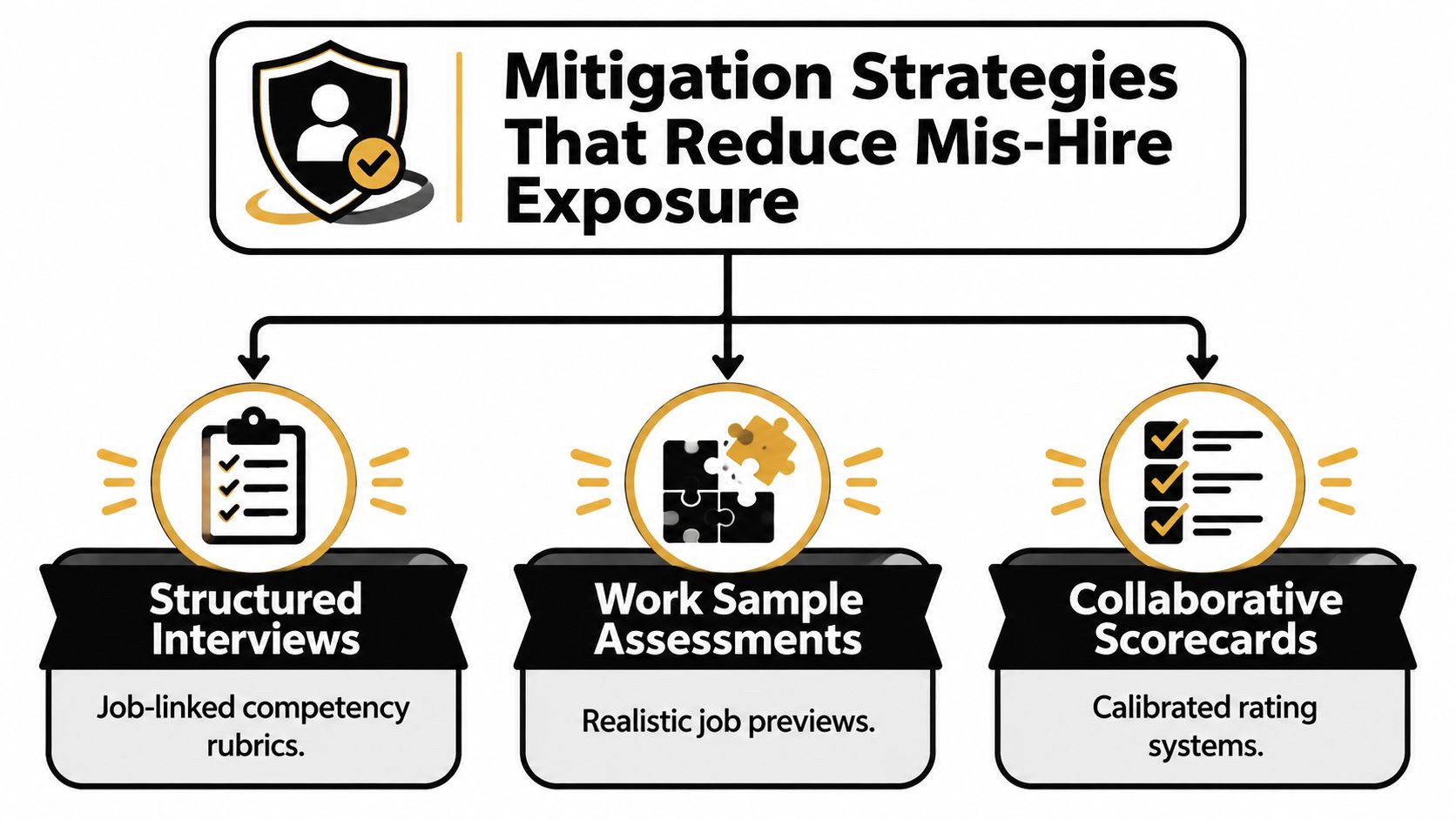
Mitigation Strategies That Reduce Mis-Hire Exposure
The safest hiring process doesn't search for a magical test. It builds an assessment stack in which each method answers a different question.
Start with a structured interview. Give every finalist the same core questions, define what a strong answer demonstrates, and score evidence against job-linked competencies. Interviewers should record evidence before discussing impressions. That simple sequence reduces the risk that the most senior panel member's first reaction becomes the decision.
Next, use a realistic work sample or predictive simulation. Ask candidates to perform a task that resembles the work, with enough context to reveal prioritization, reasoning, communication, and trade-offs. A simulation won't predict every future event, but it exposes behavior that polished career narratives can hide.
Use complementary evidence
Cognitive ability measures can help assess learning and problem-solving capacity. Personality assessments can add behavioral information when the chosen traits map to the role criterion. The evidence supports specificity: conscientiousness is broadly useful, while other traits become more informative for particular jobs or outcomes.
A collaborative scorecard should not mean averaging opinions without discipline. It should mean independent ratings, evidence notes, calibration, and an explicit record of disagreement. Panel members need permission to challenge a score without turning the process into a hierarchy contest.
References should become structured evidence collection. Ask former managers about defined behaviors, context, reliability, response to feedback, and conditions under which the person performed best. Record what the reference can verify, rather than converting enthusiasm into an unexamined endorsement.
Extend the controls after acceptance
A 30-60-90 onboarding plan should test the original hiring assumptions. Define early deliverables, decision checkpoints, manager observations, and support requirements. If the employee struggles, intervene while coaching, role clarification, or reassignment can still reduce loss.
> Decision standard: Combine independent evidence sources, then verify the prediction during early tenure.
For HR teams introducing artificial intelligence into assessment workflows, a practical [AI guide for HR](https://www.electe.net/post/ai-per-hr) can help frame adoption around use cases, human judgment, and process controls. Tools such as Synopsix can also turn behavioral assessments into comparable profiles, role-oriented reports, predictive simulations, and team compatibility analysis. Use any platform as part of a governed stack, not as a substitute for accountable hiring judgment.
The video below offers another visual perspective on structured hiring design.
<iframe width="100%" style="aspect-ratio: 16 / 9;" src="https://www.youtube.com/embed/OPQM-_kzJVE" frameborder="0" allow="autoplay; encrypted-media" allowfullscreen></iframe>
Hidden Risk Layers Most Frameworks Overlook
Hiring controls fail when they verify skills but overlook identity, decision logic, and the assumptions embedded in screening tools. Treat these issues as enterprise controls, not recruiter preferences.
Candidate identity fraud changes how evidence should be collected. Deepfake video interviews, synthetic references, and AI-assisted applications can make a funnel appear more informative than it is. The organization may assess a polished performance without confirming who produced it. Tie identity checks to meaningful decision points, particularly for remote roles, sensitive data access, and positions with material authority.
AI assessment also creates a trust and accountability obligation. Applicants need to know when automation influences evaluation, what information the system uses, and how a person can challenge an inaccurate result. Provide clear notices, retain traceable inputs, require human review for consequential decisions, and document the reason for advancing or rejecting a candidate.
AI creates decision-level accountability
AI-assisted screening can expose an employer to disparate-impact, reputational, and explainability risk. A ranking tool without a documented rationale leaves the hiring team unable to defend an adverse decision consistently. Test outcomes across funnel stages and candidate groups, rather than accepting a vendor's technical description as proof of fairness. Pause or recalibrate a workflow when its pattern cannot be explained by job-related evidence.
Recruiter caution creates another hidden risk. The Wiley study of Asian skilled migrants and Australian recruiters found a tendency toward short-term, loss-framed judgments and excessive weight on immediate fit. Candidates viewed career moves as longer-term investments, and some accepted underemployment as a strategic step, as detailed in the [Wiley study](https://onlinelibrary.wiley.com/doi/full/10.1111/ijsa.70071).
Set standards around observable performance, not biography. Separate genuine capability concerns from unfamiliar career paths, migration history, strategic underemployment, or non-linear experience. Require interviewers to state the evidence behind a concern and identify what would disconfirm it. That discipline reduces the chance that “safe” profiles win just because they resemble prior hires.
KPIs and Governance for Ongoing Risk Control
Recruitment risk management becomes real when leaders can see control quality before lagging outcomes arrive. Track both process fidelity and post-hire results. A fast funnel with weak evidence isn't efficient. It's an unmeasured risk transfer.
| KPI | Owner | Review Cadence | Intervention Threshold | |---|---|---|---| | Structured-interview completion and fidelity | Recruiting leader | Weekly funnel review | Investigate sustained decline below 80% | | Scorecard adherence | Hiring manager and talent acquisition | Weekly | Recalibrate when required evidence is missing | | Adverse-impact ratios by stage | Talent analytics and HR compliance | Monthly | Escalate unexplained stage-level disparity | | New-hire retention at 30, 90, and 180 days | HR business partner | Monthly and quarterly | Investigate a 90-day spike above baseline by two standard deviations | | Outcomes for high- and low-risk flagged hires | Talent analytics | Quarterly | Validate whether risk signals distinguish performance | | Cost per vacancy day | Finance partner and recruiting | Monthly | Escalate material movement in critical roles |
The thresholds above are governance triggers, not universal legal standards. Your organization should set role and market baselines, document why a threshold matters, and define the action that follows.
Assign decisions to named owners
Recruiters own funnel discipline. Hiring managers own job definition and evidence quality. Talent analytics owns validation and cohort analysis. A CHRO delegate should own exceptions, escalation, and cross-functional remediation.
Review the funnel in weekly standups. Hold a monthly governance forum with recruiting, HR, legal, analytics, and business leaders. Provide a quarterly talent-risk report to the executive team or board when roles carry major succession, revenue, or regulatory exposure.
A lightweight dashboard should show four views: current funnel controls, candidate risk distribution, post-hire outcomes, and open exceptions. Include an audit trail for AI-assisted recommendations. The hiring manager can override a recommendation, but must record the evidence and accept accountability for the decision.
Use [talent acquisition metrics](https://synopsix.ai/blog/talent-acquisition-metrics) to connect activity measures with business outcomes. A dashboard that reports only time to fill will reward speed even when speed produces avoidable loss.
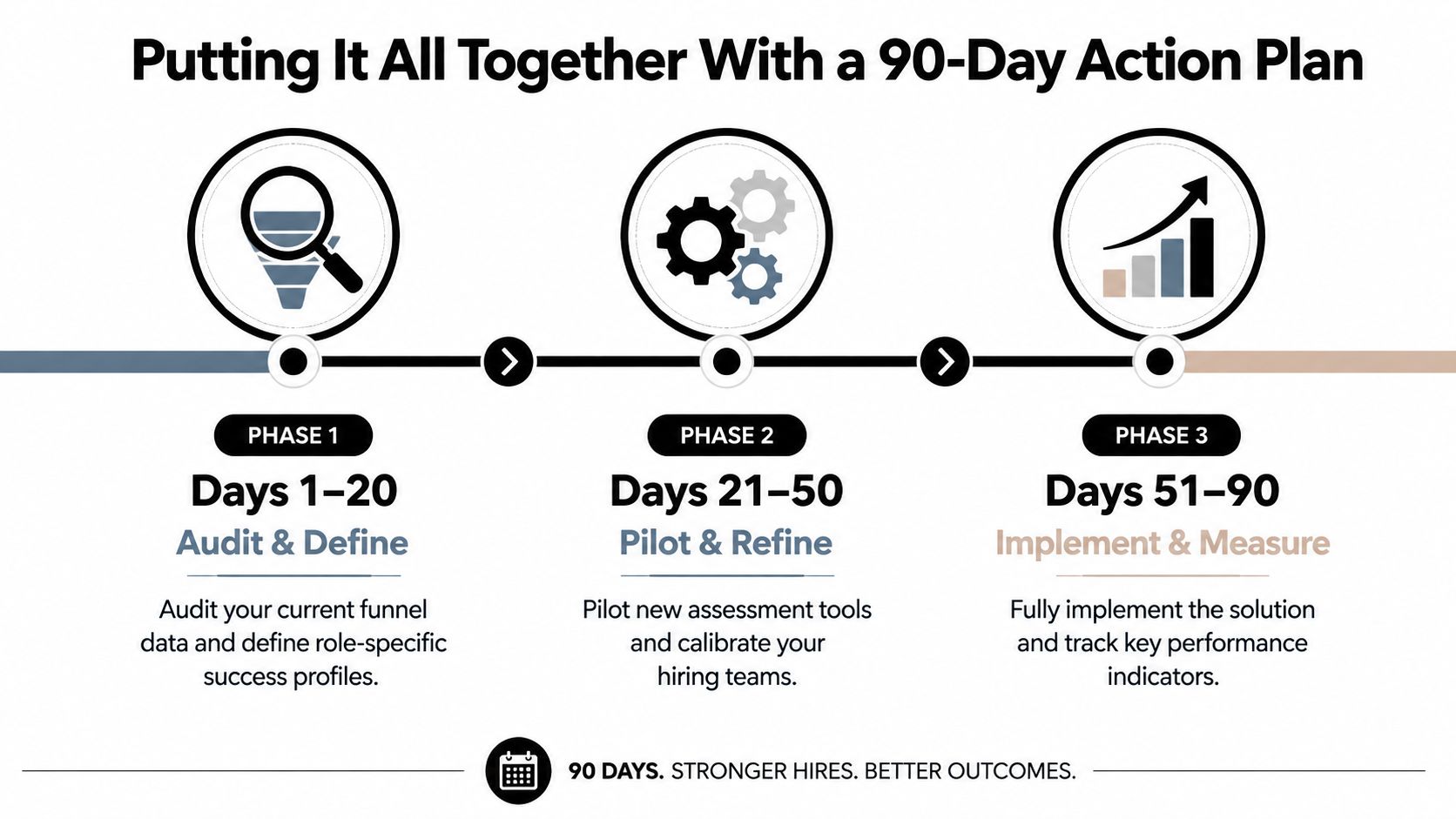
Putting It All Together With a 90-Day Action Plan
A quarter is enough to pilot recruitment risk management in the roles where failure matters most. Don't attempt an enterprise-wide redesign before proving the operating model.
Days 1 to 20, audit and define. Pull current funnel and post-hire data. Identify the two roles with the greatest combined exposure from hiring volume, business criticality, and mis-hire consequences. Build success profiles with observable outcomes, behavioral demands, and disqualifying evidence. Interview hiring managers about where decisions currently rely on intuition.
Days 21 to 45, instrument and train. Add structured interviews, role-specific scorecards, behavioral assessments, and a predictive simulation for the priority roles. Train managers to distinguish evidence from preference. Require independent scoring before panel discussion, then document calibration and overrides.
Days 46 to 70, add governance controls. Integrate identity verification and fairness checks. Establish the dashboard, assign owners, and define who can approve exceptions. Create a review path for candidates who challenge inaccurate data or automated recommendations. Make vendors provide enough information for the organization to understand how their tools influence decisions.
Days 71 to 90, pilot and report. Run the complete stack on priority roles. Baseline structured-interview fidelity, decision speed, candidate experience, early retention, and performance signals. The rollout targets should be explicit: structured-interview fidelity above 85%, time to decision down 20% to 30%, and a measurable reduction in 90-day attrition among pilot new hires. These are implementation targets, not guaranteed outcomes, so compare them with your own baseline and record what changed.
Present the pilot to the executive team as a risk-control experiment. Show which decisions gained stronger evidence, where exceptions occurred, how managers used the scorecards, and whether early outcomes support the model. Then expand only after the organization can explain both the successes and the failures.
---
Synopsix helps organizations turn behavioral assessments into comparable profiles, role-specific intelligence reports, predictive simulations, and team compatibility insights for more defensible hiring decisions. Visit [Synopsix](https://synopsix.ai) to evaluate how its people intelligence platform can support your recruitment risk management pilot.