Resilience Assessment Guide for People-First Leaders
By Synopsix · September 12, 2026 · 16 min read
The most popular advice about resilience assessment is wrong. A score isn't the answer, and resilience isn't a personality badge awarded to people who appear calm under pressure. For a CHRO, the useful question is narrower and more demanding: what decision will change because we measured how someone responds to strain?
A resilience assessment earns its place when it improves a hiring conversation, reveals a development need, changes team design, or exposes a weak operating assumption. Used as a standalone number, it creates false confidence. Used as evidence within a broader people decision, it can help leaders understand who adapts, who needs support, how teams distribute pressure, and where organizational design is making good people look less capable than they are.
Why Resilience Assessment Has Become a People Decision
Resilience is often reduced to grit, stamina, or the ability to “bounce back.” That framing puts too much responsibility on the individual and too little on the work system. People respond to pressure inside roles, teams, incentives, manager relationships, and operating conditions. A strong resilience assessment should therefore help leaders examine both the person and the environment in which that person is expected to perform.
Any company still treating resilience as a feel-good interview question is leaving useful evidence on the table. Asking a candidate to describe a difficult moment produces a story. A structured assessment can provide a comparable signal about how that candidate tends to appraise pressure, adjust behavior, seek support, and recover after disruption. Neither source should decide a hiring outcome alone, but a disciplined combination is far more useful than intuition dressed up as an interview question.
The CHRO's practical question
Older selection processes tend to reward prior achievement, polished communication, and familiarity with similar work. Those signals matter, but they don't fully answer how someone will behave when priorities collide, information is incomplete, or a setback threatens momentum. Resilience data adds a different lens. It helps leaders explore likely behavior under realistic strain rather than assuming past success will transfer automatically.
That matters most in roles with uneven pressure profiles. Customer-facing teams, on-call functions, operational leaders, transformation offices, and managers handling repeated change may need different resilience capabilities from analytical roles with more predictable workloads. The assessment should inform those distinctions, not flatten everyone into a universal “resilient employee” category.
> Practical rule: Measure resilience to improve a specific people decision. If the score won't affect hiring probes, coaching, succession, or team design, don't collect it.
From personal trait to business signal
Resilience assessment became more standardized in the 2000s and 2010s, as researchers moved from broad conceptual definitions toward validated psychometric instruments. A methodological review described resilience as “the process of negotiating, managing and adapting to significant sources of stress or trauma,” while later validation work tested commonly used scales with modern measurement methods across real samples. [The Connor-Davidson Resilience Scale validation study](https://pubmed.ncbi.nlm.nih.gov/28961149/) tested 288 adult education students in Australia and found good psychometric functioning in factor analyses, while Rasch modeling identified item misfit and supported an 8-item version as the stronger form.
The implication for people leaders is straightforward. Resilience assessment isn't a soft add-on for a training brochure. It can become part of a decision system that connects hiring evidence, development planning, retention analysis, succession readiness, and team composition. The score starts the conversation. The operating decision creates the value.
What Resilience Assessment Actually Measures
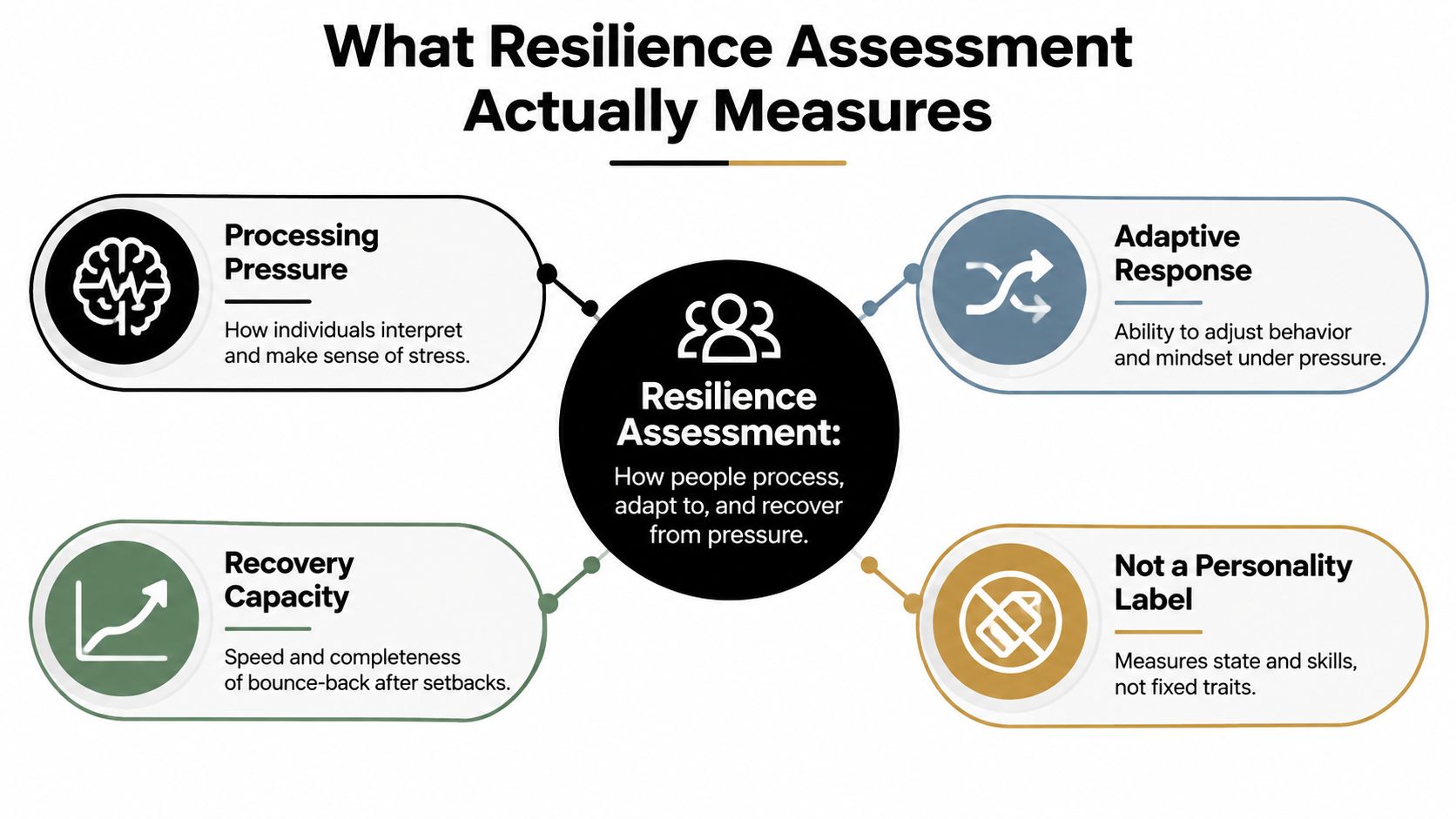
A resilience assessment is a structured way to examine how people process, adapt to, and recover from pressure. It isn't a diagnostic instrument, a moral judgment, or a permanent label. The strongest models treat resilience as a process that changes with circumstances, resources, experience, and support.
Four useful dimensions
Processing pressure concerns how a person interprets a demanding event. Does the individual distinguish an urgent problem from a catastrophic one? Can they identify what they know, what they don't know, and what requires action first?
Adaptive response concerns behavioral flexibility. A resilient employee may change tactics, ask for help, reset priorities, or communicate uncertainty instead of repeating a failing approach.
Recovery capacity concerns what happens after the immediate disruption. Recovery isn't returning to the previous state. It can involve restoring focus, learning from the event, rebuilding trust, and making a better decision the next time.
State-based skills include emotional regulation, coping choices, support-seeking, and the ability to use available resources. These capabilities can vary by role and circumstance, which is why treating the result as a fixed personality label is poor practice.
What the score should not claim
A resilience assessment shouldn't diagnose mental health conditions or determine whether someone has experienced trauma. It shouldn't predict every form of difficulty, replace a reasonable workload review, or excuse a manager who creates avoidable pressure. A low result may reflect a poor role fit, unclear expectations, limited support, or a temporary state rather than an enduring capability gap.
Leaders also need a humane boundary around trauma-related content. If assessment results raise concerns about distress or support needs, direct employees toward qualified care rather than asking managers to act as clinicians. For leaders looking for a specialist resource, [evidence-based trauma care Kelowna](https://interactivecounselling.ca/kelowna-trauma-counselling/) provides context on professional trauma counselling and support.
The right interpretation is behavioral and contextual: what pressure pattern might this person encounter, how might they respond, and what conditions would help them perform well? That framing gives the score a legitimate business use without pretending it can explain the whole person.
The Measurement Models and Psychometrics Behind the Score
A vendor's resilience score is only as credible as the evidence behind it. Don't accept a dashboard with a polished color scale and no explanation of the construct, sample, factor structure, reliability, validity, or intended use. Psychometrics are not academic decoration. They tell you whether the result is stable enough to support the decision you're about to make.
Three model families
Trait-style models, including the Connor-Davidson Resilience Scale framework, describe relatively enduring capabilities such as persistence, tolerance of adversity, and confidence in coping. Process-oriented scale families focus more explicitly on adaptation and recovery across circumstances. Competency-based occupational models translate resilience into workplace behaviors such as prioritization, emotional control, flexibility, communication, and use of support.
These models can all be useful, but they answer different questions. A trait-style tool may support broad development profiling. A process model may better support reflection on changing circumstances. A competency model may fit role-based hiring, provided its competencies are connected to actual job demands.
| Model | Theoretical basis | Factor structure | Typical reliability | Best-fit use case | |---|---|---|---|---| | CD-RISC framework | Personal resources associated with coping and adaptation | May require validation of the proposed structure in the target population | Must be checked in the target sample | Broad research, development, and comparative profiling | | Resilience scale family | Resilience as adaptation and recovery across adversity | Structure can vary by population and version | Varies by instrument and sample | Employee development and longitudinal reflection | | Occupational competency model | Observable behaviors linked to work demands | Often organized into job-relevant competencies | Requires evidence for internal consistency and external validity | Role-specific hiring, coaching, and succession |
What the evidence tells you
A comparative study of resilience scales in a Chinese context reported Cronbach's alpha of 0.71 for the Brief Resilience Scale and 0.59 for the Brief Resilient Coping Scale. Confirmatory factor analysis found that the Brief Resilience Scale fit better than the BRCS. [The COSMIN resilience measurement database](https://database.cosmin.nl/catalog/889) also summarizes an older-adult systematic review that screened 5,509 studies, identified 426 using resilience psychometrics, and included 6 psychometric analysis studies. It concluded that the RS, RS-5, RS-11, CD-RISC, CD-RISC10, and BRCS had psychometric adequacy for continued use.
Internal consistency isn't the same as predictive validity. A workplace review found internal consistency evidence in 21 studies, content validity in 24, structural validity in 21, construct validity in 24, test-retest reliability in only 6, and criterion validity in 15. The systematic review of workplace resilience measures shows why a high alpha shouldn't end the vendor review. A tool can produce internally consistent responses without demonstrating stable prediction of external outcomes.
Use [this practical evaluation and assessment guide](https://www.medial.com/post/evaluation-and-assessment) when structuring vendor questions, then ask for the technical manual, target-population evidence, subgroup analysis, scoring rules, missing-data policy, and validation against relevant performance outcomes. You can also review [assessment validity and reliability](https://synopsix.ai/blog/assessment-validity-and-reliability) for a plain-language explanation of why reliability and validity must be considered together.
Choosing the Right Assessment Format for Each Use Case
The right format depends on the decision, not the vendor's preferred product. Surveys, situational judgement tests, and simulations expose different kinds of evidence. A self-report survey tells you how someone describes their typical responses. A situational judgement test asks them to choose among competing responses. A simulation shows what they do while pressure is unfolding.
Match the format to the decision
Use a standardized survey when you need comparable results across a large hiring pool or development cohort. Surveys are efficient and consistent, and they can support baseline measurement when the purpose is reflection, coaching, or broad role comparison. Their weakness is obvious: candidates may manage impressions, especially when they believe the result affects selection.
Use a situational judgement test when the role depends on choices under constraint. Present a realistic disruption, incomplete information, competing priorities, or a difficult stakeholder interaction, then evaluate the quality of the response. This format is especially useful for mid-level roles where judgment and communication matter more than endurance.
Use a simulation or work-sample stress task when the cost of a poor decision is high. Simulations can reveal recovery, prioritization, escalation, and adaptive thinking in real time. They require more design work, trained raters, and candidate time, so reserve them for senior hiring, leadership pipelines, or roles where pressure behavior is central to success.
| Format | Cost per Candidate | Scalability | What It Captures | Best Use Case | |---|---|---|---|---| | Survey | Lower relative burden | High | Self-described coping patterns and resources | High-volume hiring and cohort development | | Situational judgement test | Moderate design and administration burden | Moderate to high | Choices under realistic constraints | Mid-level hiring and role-specific judgment | | Simulation | Higher operational burden | Lower | Live adaptation, recovery, communication, and prioritization | Senior hires and leadership pipelines |
The choice shouldn't be ideological. Pair the format with the role's actual pressure profile. [A guide to psychometric test types](https://synopsix.ai/blog/psychometric-test-types) can help teams distinguish what different assessment formats are designed to capture before they build a process around one score.
> Decision rule: Surveys create comparability, judgement tests create behavioral specificity, and simulations create observable evidence. Use the least expensive format that answers the decision you actually need to make.
Implementing Resilience Assessment in Hiring and Development
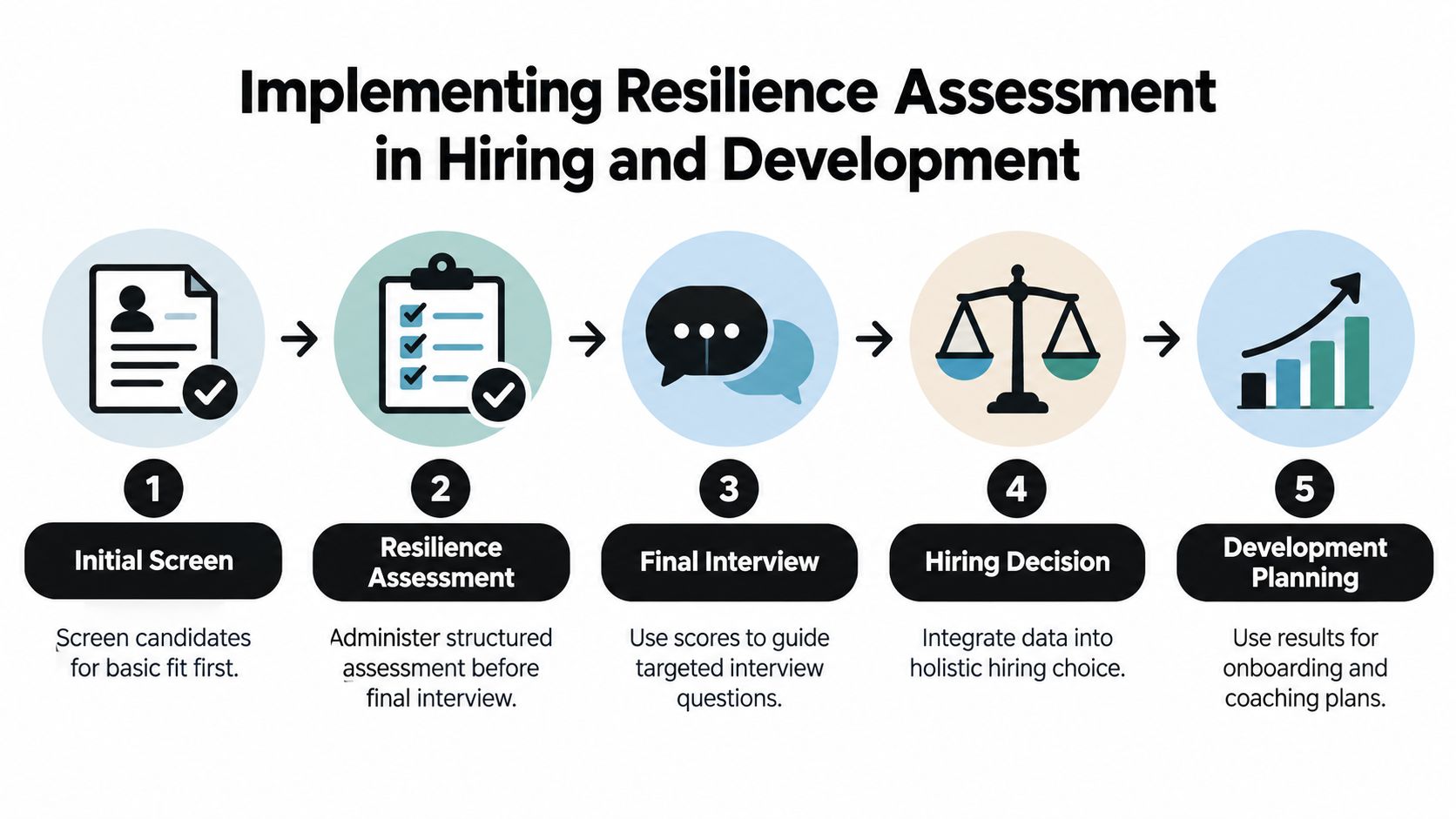
A resilience score matters only when it changes workflow. The practical design is simple: assess after basic qualification, use the result to improve the final interview, make a decision, and connect development findings to real work conditions.
Build the hiring sequence
1. Screen for basic fit first. Confirm experience, eligibility, and role requirements before asking resilience data to carry the process.
2. Assess before the final interview. Place the instrument early enough for the result to shape questions, but not so early that it becomes an automatic filter.
3. Probe specific patterns. If the result suggests a development area, ask about recovery, changing priorities, support-seeking, and lessons from setbacks. Don't turn a low score into a generic rejection.
4. Integrate evidence. Combine the assessment with structured interviews, work samples, relevant experience, and role requirements. The decision should be explainable without citing one number.
5. Create a development plan. Use the output for onboarding, coaching, workload review, and targeted practice.
A useful interview process also teaches candidates how to answer behavioral questions with concrete context, actions, and outcomes. [This guide to answering behavioral questions](https://www.interviewpilot.app/blog/behavioral-interview-questions-and-answers) can help hiring teams improve the quality of follow-up conversations without turning them into rehearsed performance contests.
Treat development as longitudinal
For employees, establish a baseline and review movement at six and twelve months, then connect changes to coaching plans, stretch assignments, manager behavior, and workload conditions. Those intervals are useful only if the organization acts between them. Retesting without intervention produces a record of movement, not development.
Calibrate interpretation by role family. Customer-facing and on-call roles may require different resilience patterns from back-office analytical work. Document adverse impact analyses for every cohort, train managers on what the score doesn't measure, and store results alongside performance and tenure data so people analytics can examine patterns over time.
A broader [behavioral assessment approach for hiring](https://synopsix.ai/blog/behavioral-assessments-for-hiring) can help teams connect resilience evidence with other role-relevant behaviors rather than creating a siloed process.
The video below offers additional context for teams designing behavioral interview workflows.
<iframe width="100%" style="aspect-ratio: 16 / 9;" src="https://www.youtube.com/embed/7VU7hLGOkjM" frameborder="0" allow="autoplay; encrypted-media" allowfullscreen></iframe>
Turning Individual Scores into Team and People Intelligence
Individual scores become strategically useful when leaders read them against team context. A group of uniformly high scorers can still struggle during sustained pressure if everyone uses the same coping strategy. The team may show confidence while missing escalation signals, challenging assumptions, or distributing recovery work fairly.
Look for complementarity, not a perfect average
Team-level analysis should examine the variety of resilience responses. One person may stabilize a meeting, another may detect emerging risk, and another may recover quickly after a failed approach. Those differences can strengthen a team when leaders make them visible and assign work deliberately.
People intelligence platforms such as Synopsix combine behavioral assessment data with collaboration, cognitive, and team information to help surface patterns such as recovery diversity, escalation fatigue risk, and load-balancing gaps. The practical use isn't to label an employee as “the resilient one.” It is to ask whether the team has enough range in how it processes pressure, communicates risk, learns from failure, and restores capacity.

Turn patterns into operating choices
Use aggregated insight to inform team design, project staffing, leadership succession, and intervention targeting. A team dashboard might prompt an HR business partner to review whether one manager receives every escalation, whether a project lacks challenge-oriented voices, or whether a succession candidate needs exposure to ambiguity before taking a larger role.
Don't retest individuals every time a team question arises. Review team patterns quarterly, examine workload and performance context, and intervene at the system level where the evidence points to design problems. Resilience measurement at scale is a system diagnostic, not a personal verdict.
The maturity gap makes this especially important. A 2026 study of 203 assessments reported an average resilience maturity score of 56/100, with 61.6% of organizations at Ad Hoc or Reactive stages and only 8.9% at Proactive or Dynamically Adaptive maturity. [The Everbridge 2026 resilience study](https://www.everbridge.com/newsroom/article/everbridge-2026-best-in-resilience-study-finds-faster-response-alone-is-not-enough-to-build-organizational-resilience/) suggests that faster reaction doesn't automatically create learning or systemic resilience. Leaders should therefore ask not only how quickly a team responds, but whether it converts response into better design.
ROI, Risk Reduction, and What the Numbers Actually Show
The business case for resilience assessment should be framed as risk reduction, not guaranteed savings. A score doesn't cause retention, faster ramp-up, or better management. It can help leaders make more informed decisions when they connect the result to hiring quality, workload design, coaching, and subsequent outcomes.
Start with three measurable pathways:
The evidence base also argues against overselling self-report tools. A 2009 meta-analysis of 122 research reports, covering 184 independent samples and 14,900 subjects, found an average correlation of r = .274 between Implicit Association Test measures and behavioral, judgment, and physiological outcomes. Parallel self-report measures across 156 samples and 13,068 subjects averaged r = .361, but varied more widely and were less reliable for socially sensitive topics where impression management could distort responses. [The 2009 meta-analysis](https://pubmed.ncbi.nlm.nih.gov/19586237/) supports a blended approach rather than blind confidence in any single format.
| Metric | Conservative Assumption | Why It Matters | |---|---|---| | Regrettable attrition | Establish a role and team baseline before intervention | Shows where pressure may be linked to avoidable exits | | Absence and support patterns | Compare trends with privacy controls and appropriate aggregation | Tests whether workload or support gaps create operational risk | | Ramp quality | Track role-relevant contribution and manager evaluations | Connects assessment evidence to onboarding decisions | | Replacement exposure | Use your finance-approved replacement cost model | Creates a defensible investment case without invented savings | | Payback timing | Model against actual tenure and program cost | Makes uncertainty visible to finance and the board |
Layer resilience results with engagement, performance, tenure, and manager data. That creates a longitudinal evidence base instead of a one-off report, while keeping the limits of causality visible.
Reporting Best Practices and Common Pitfalls to Avoid
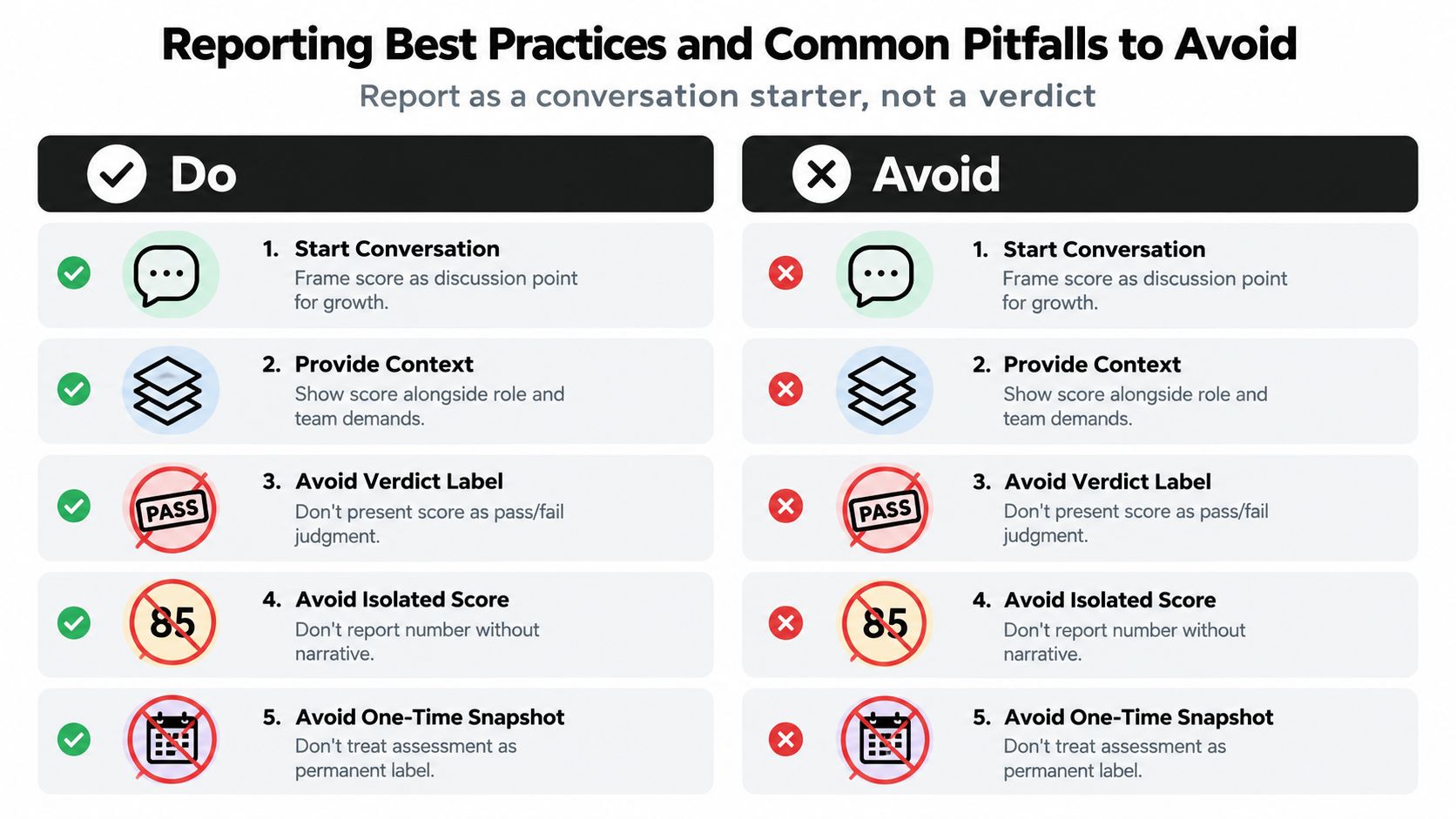
Most resilience programs fail at the reporting stage. Leaders publish a score, managers treat it as a verdict, and employees learn to perform for the instrument instead of using the result for development.
Avoid these mistakes:
Make reporting useful
Report scores with narrative, role context, and practical development actions. Use banded language rather than false precision for high-stakes decisions, establish review cadences, and integrate outputs into existing people-intelligence workflows.
Before launch, confirm that you have:
---
Synopsix turns scientifically validated behavioral assessments into comparable profiles, role-specific intelligence, compatibility analysis, simulations, and development guidance for hiring and team decisions. Visit [Synopsix](https://synopsix.ai) to see how its people intelligence platform can help translate resilience assessment data into practical action.