Role Fit Explained: How to Assess It Responsibly
By Synopsix · November 23, 2026 · 15 min read
Two candidates arrive with nearly identical experience, nearly identical skills, and nearly identical interview scores. A year later, one is thriving and the other has disengaged. What separated them?
The usual answer, "fit", explains almost nothing on its own. Fit isn't a quality a person carries around. It's a relationship between a person and a specific job, a specific team, a specific manager, at a specific moment in a business's life. Change the manager, restructure the team, or move the company from scrappy growth into tight process, and the same person's fit changes with it.
That distinction matters, because a hiring decision built on a vague sense of fit is hard to defend, hard to teach, and easy to bias. A decision built on named, observable fit types, validated against real outcomes, is something a panel can examine. What follows is a step-by-step walk through what role fit is, what the research can and cannot prove about it, and how to assess it without turning your screening into another black box.
What Role Fit Means and Its Four Forms
Role fit is how well a person's abilities, interests and behavior match what a specific job requires, and the organization around it. Read the shape of that sentence carefully. The job is the reference point. There is no such thing as a person who fits in general.
A key fits a lock because the two shapes match at one door. Carry the same key to a different door and it opens nothing. Role fit works identically: someone who transforms a six-person startup can stall in a 4,000-person matrixed business, not because they changed, but because the lock did.
Everyday hiring language collapses four comparisons into one verdict of "good fit" or "no fit". Researchers keep them apart. Work on [job matching as the key to performance](https://www.academia.edu/30553081/Job_Matching_The_Key_to_Performance) separates person-job fit, the alignment between someone's capabilities, needs and job demands, from person-organization fit, the alignment between personal and organizational values. Both matter, they predict different things, and they fail in different ways.
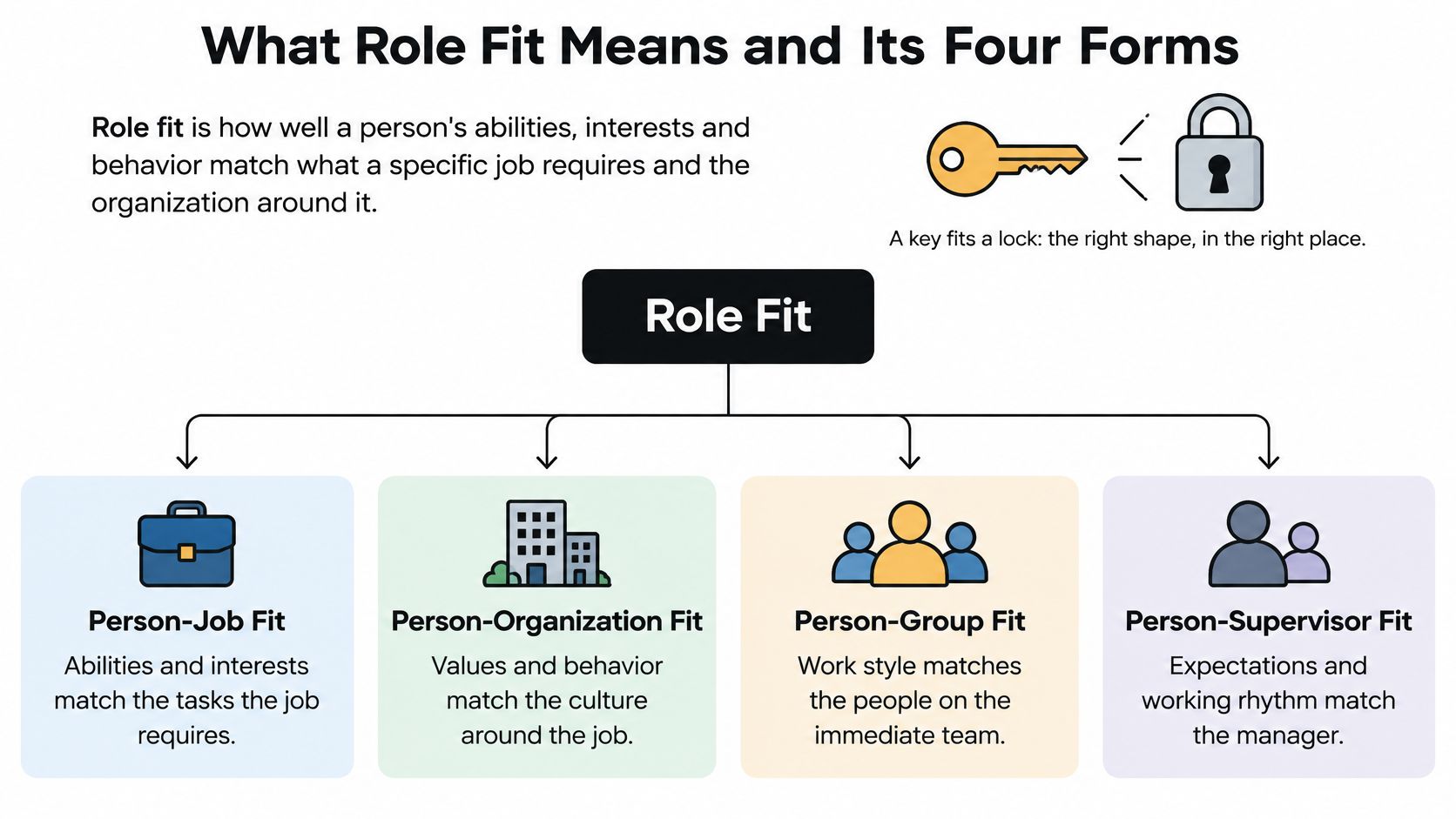
The four comparisons hiding inside the word fit
The same analysis of role fit notes that fit relationships are broadly generalizable across settings, while the specific outcome depends on the fit type and how it was measured. That's the practical argument for keeping the four apart.
| Fit type | What is compared | Example question | Outcomes linked to it | |---|---|---|---| | Person-job | Abilities, interests and behavior against job demands | Can this analyst handle the weekly reporting load? | Performance, tenure, turnover | | Person-organization | Personal values against organizational values | Does this person value the company's pace and ethics? | Commitment, intent to quit | | Person-group | Individual against team norms and working style | Does this hire complement a team that already works fast? | Team cohesion, collaboration | | Person-supervisor | Individual's work style against the manager's style | Can this employee work well with a directive manager? | Satisfaction, engagement |
The split earns its keep in the awkward cases. A candidate can be strong on task fit and weak on value fit. That isn't a rejection, it's a different set of actions: a targeted reference check on how they handled an ethical trade-off, a customized onboarding plan for the capability gap, or a redesign of the role so the task load matches the person you can hire.
Name the fit type you're assessing before you judge anyone. Most "no fit" verdicts dissolve the moment someone asks which of the four you meant.
Holland's Six Work Environments and Role Fit
Role-fit thinking has a longer history than most hiring teams realize. Vocational psychologist John L. Holland introduced his theory of vocational personalities and work environments in 1959, following an earlier 1958 article, and consolidated it in the 1973 book Making Vocational Choices; the [history of Holland's RIASEC codes](https://jobcannon.io/blog/history-of-riasec-holland-codes) also records a meta-analytic correlation of roughly 0.19 between interest-environment congruence and job satisfaction across 105 studies.
The framework classifies people and environments into six RIASEC categories: Realistic, Investigative, Artistic, Social, Enterprising and Conventional. Its central claim is that career satisfaction and stability are more likely when a person's interests match the characteristics of the work environment.
That gives you a vocabulary for the half of fit nobody writes down. Most job descriptions describe tasks. Almost none describe the environment the tasks happen inside.
Reading a role's environment
| Holland type | Typical work environment | Example roles | |---|---|---| | Realistic | Hands-on work with tools and physical systems | Electrician, mechanic | | Investigative | Analysis, research and problem-solving | Data scientist, lab analyst | | Artistic | Creative, unstructured and expressive work | Designer, writer | | Social | Helping, teaching and coaching others | Teacher, nurse, HR partner | | Enterprising | Persuasion, leadership and business goals | Sales manager, entrepreneur | | Conventional | Structured data, rules and precision | Accountant, payroll administrator |
Use it as a filter, not a verdict. Identify the two or three categories that dominate a job's actual daily work, then check which categories a candidate's profile emphasizes. A customer success lead in a technical product may look Social and Investigative on paper while spending most of the week in Enterprising renewal conversations and Conventional CRM hygiene. The title lies; the calendar doesn't.
> Practical rule: describe the environment in the job description, not just the duties. Candidates self-select out when the environment is stated plainly, which saves everyone a round of interviews.
Then mind the ceiling. A congruence correlation of about 0.19 improves the odds of satisfaction. It doesn't decide the outcome. Skills, experience, motivation, job design, leadership and organizational conditions all shape performance on top of it. Treat a RIASEC profile as a hypothesis about where someone will be comfortable, never as a forecast of how well they'll perform.
What Research Says About Fit and Workforce Outcomes
The evidence base for role fit is larger than most hiring teams assume, and narrower in what it promises. The table below collects approximate correlations from [the person-job fit meta-analysis](http://www.psychologie.uni-mannheim.de/cip/tut/seminare_wittmann/meta_fribourg/sources/Metaanalyse_PersonJobfit.pdf), which pooled 172 usable studies and 836 unique effect sizes across person-job, person-organization, person-group and person-supervisor fit, and from a [related review of fit and workforce outcomes](https://www.psychologie.uni-mannheim.de/cip/tut/seminare_wittmann/meta_fribourg/sources/Meta_person_job_fit.pdf).
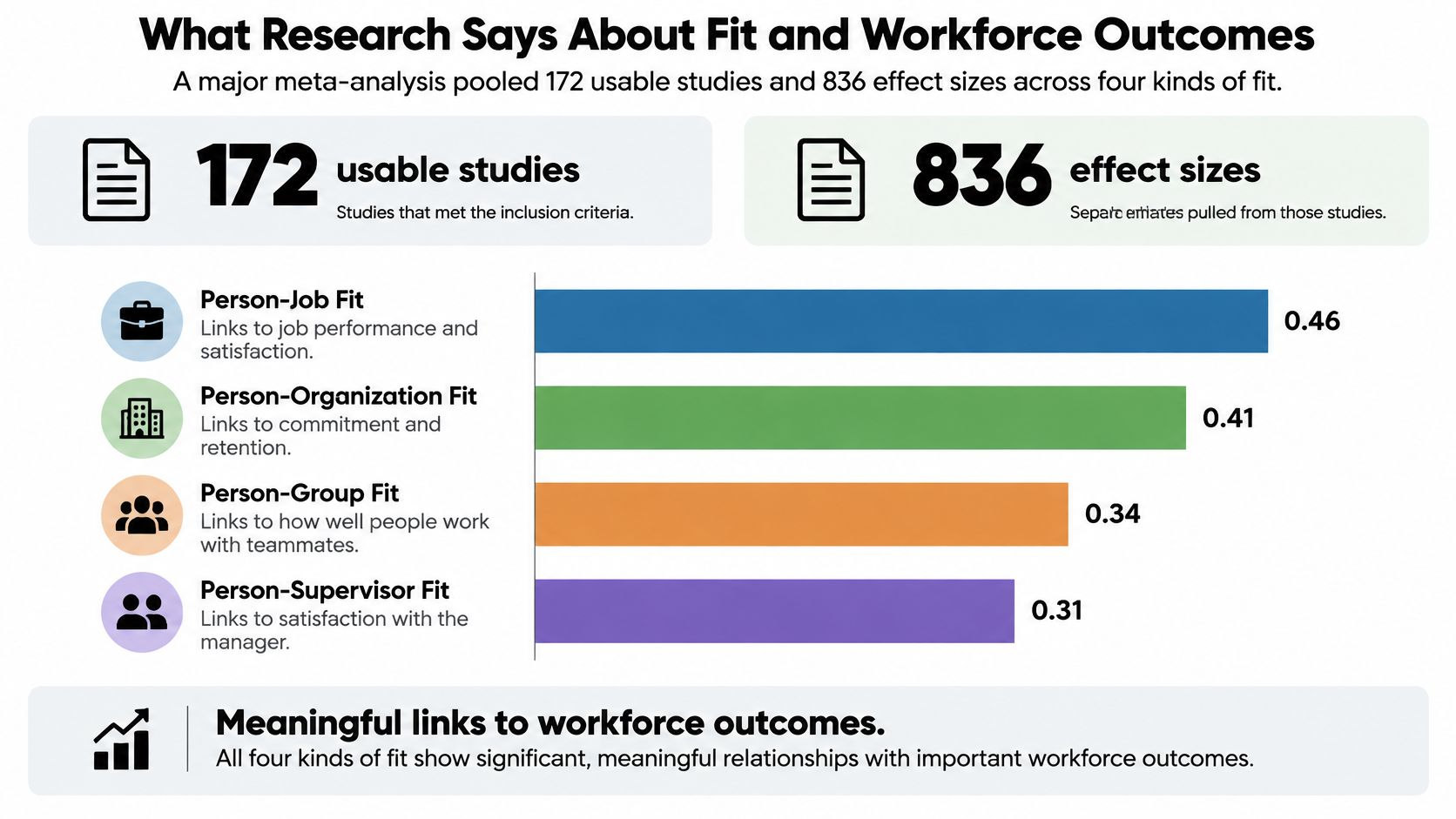
| Fit measure | Outcome | Approximate correlation | How to read it | |---|---|---|---| | Person-job fit | Tenure | 0.18 | Stronger alignment, slightly longer stays | | Person-job fit | Turnover | -0.08 | Modest reduction in actual exits | | Person-job fit | Intent to quit | -0.46 | Much weaker urge to leave | | Person-organization fit | Job satisfaction | 0.44 | Moderate link to satisfaction | | Person-organization fit | Organizational commitment | 0.51 | Strongest link among these outcomes | | Person-organization fit | Intention to quit | -0.35 | Lower intent to leave |
Reading a correlation without overreading it
Look at the gap between -0.46 for intent to quit and -0.08 for actual turnover. Both describe the same person-job fit, and they tell different stories. Fit shapes how people feel about staying long before it changes whether they leave. Someone whose work suits them thinks about quitting far less often, but the decision to hand in notice still runs through pay, commute, manager, and what else is on the market.
That gap is the honest way to present fit to a hiring panel. Fit predicts intention and attitude more reliably than it predicts behavior.
The research covered pre-employment outcomes too, including applicant attraction, job acceptance, hiring intentions and job offers, so fit starts shaping the relationship at first contact rather than on the first day. Nearly all credibility intervals excluded zero, which supports generalizing these relationships across settings.
> A plain way to say it to a panel: "This profile raises the risk of early exit and lowers the risk of onboarding friction. Here's what we'd monitor in the first ninety days."
Meanwhile, leadership quality, workload, compensation and labor-market conditions all push on the same outcomes. Use low-fit signals as risk indicators to check against early performance and engagement data. Use value alignment when you're investigating a retention problem, and job-demand alignment when you're planning onboarding and coaching. Fit scores earn their place only when the [predictive validity](https://synopsix.ai/blog/what-is-predictive-validity) behind them has been demonstrated, not assumed.
Why the Same Trait Succeeds in One Role and Fails in Another
Fit for which context, which manager, and which stage of the work?
That question exposes the weakest assumption in most role-fit conversations. Personality traits on their own are poor predictors of performance. Capabilities such as learning agility and adaptability, plus job design, leadership climate and organizational culture, determine how a trait turns into results, as [recent research on role fit and context](https://pmc.ncbi.nlm.nih.gov/articles/PMC13053277/) sets out.

Two sales hires, one trait, opposite outcomes
Say a software company hires two account executives with the same profile. The first joins a structured enterprise team with a defined playbook and a manager who reviews pipeline weekly. Process discipline wins there, and the trait gets rewarded.
The second joins an early-stage product with no pricing, no clear buyer and no reference customers. The same process discipline becomes a liability: the person keeps running a playbook that doesn't exist yet instead of testing ten approaches in a month.
Conscientiousness shows the pattern cleanly. It supports careful execution in a regulated environment and turns into over-caution in a role that demands rapid experimentation. Neither version of the person is broken. The work system around them is different.
Which leads to a contrarian conclusion worth stating out loud: the best fit is not the candidate who most resembles your current high performer. That resemblance is a snapshot of a context that may already be shifting. Restructure a team, move to hybrid, or grow headcount quickly, and historical fit becomes a poor proxy for future performance.
What to ask before you compare anyone
That last question does most of the work. A disqualifying gap is one the role's daily conditions will expose immediately. A developable gap is one coaching can close before it damages anything.
Assessing Fit Fairly Without Hidden Screening Bias
Skills-based hiring has gone mainstream, and fast. [TestGorilla's 2025 study](https://www.testgorilla.com/skills-based-hiring/state-of-skills-based-hiring-2025/) reports that 85% of employers used skills-based hiring in 2025, up from 81% in 2024. Demand sits behind it: LinkedIn's Work Change research, [reported by HR Dive](https://www.hrdive.com/news/skills-mismatch-employers-jobseekers-linkedin/737409), found that 73% of HR professionals in 2024 said fewer than half of the applications they received met all listed criteria.
So the shift makes sense. The problem is what teams assume it delivers automatically.
Where the bias moves when you drop the degree filter
Replacing degrees with assessments does not remove judgment. It relocates judgment into new tests and behavioral screens, where it can be just as opaque and harder to inspect. A bad test with a clean dashboard is still a bad test.
The evidence on how this plays out is mixed. In Australia and New Zealand, 85% of surveyed hiring managers reported skills gaps harming team or organizational performance, and 86% said they were adopting skills-based hiring, yet only 64% said those practices met expectations, according to [Express Employment Professionals' summary of the 2025 workforce research](https://www.expresspros.com/newsroom/news-releases/news-releases/2025/05/rethinking-the-resume-87-of-job-seekers-want-skills-to-matter-more-than-degrees). Identifying a skill and knowing whether someone will perform sustainably in a particular role are two different jobs.
> Fairness test: for every screen that eliminated a candidate, ask what evidence would have changed the outcome. If nothing would, the screen is a filter on familiarity, not on capability.
Cover the parts that assessments alone don't. Review false negatives, meaning the people you rejected who later succeed elsewhere. Build accommodation into the process rather than treating it as a special request. Separate a genuine capability gap from an unfamiliar career path, because a hire from an adjacent industry often looks weaker on a narrow test while outperforming on the job.
The candidate side counts too. 78% of surveyed workers preferred organizations that encourage upskilling, and 55% considered employer-provided learning resources very or extremely important, per the same Express Employment Professionals research. That reframes role fit as a two-way match with learning built in, not a one-sided filter applied to an applicant.
And check the tooling the way you'd check a reference. Ask what each score measures, how it was validated, and which interview questions it recommends. Those safeguards sit on top of the requirement review, which is where the work on [reducing hiring bias](https://synopsix.ai/blog/how-to-reduce-hiring-bias) begins.
Build Role Requirements and Run the Review
A fit review works only when each requirement can be seen in behavior and checked against results. The review below runs in eight steps, from writing the first 90 days as outcomes to auditing what happened once the hire started.
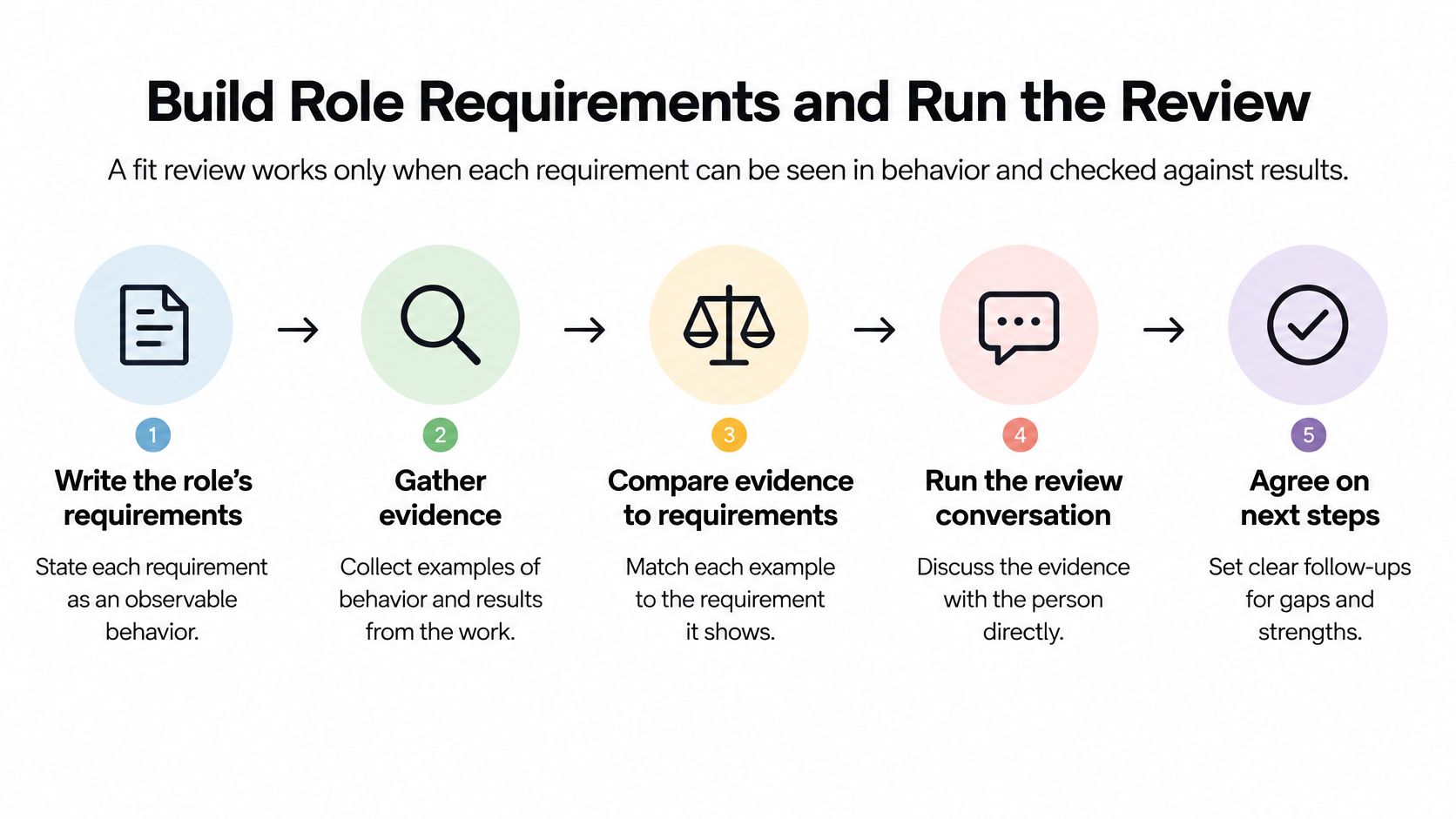
1. Write the first 90 days as outcomes. Instead of listing duties, write what the person must have achieved by day 90: a clean month-end close, a documented onboarding flow, a pipeline at three times quota. Outcomes expose the core demands of a job better than its title does. If you want a worked version of scored requirements before the first interview, [a VP of Sales hiring scorecard](https://fetchin.io/blog/job-description-for-vp-sales) shows the shape. 2. Split task demands from value demands. Task demands cover skills, experience, pace and decision load. Value demands cover ethics, collaboration style and tolerance for ambiguity. Judge them separately, because one blended score hides a weak value read behind a strong task score. The discipline that produces this split is a structured [job analysis](https://synopsix.ai/blog/how-to-do-a-job-analysis), not a brainstorm. 3. Label each requirement must-have or trainable. Must-haves are needed on day one for the work to happen at all. Trainable gaps can close with coaching inside the first quarter. Writing the label down forces a debate that panels otherwise avoid until they disagree about a candidate, and by then the argument is about the person instead of the role. 4. Rewrite every requirement as an observable behavior. "Resolves customer escalations without manager input" beats "strong ownership". If two interviewers can't agree on what would count as evidence, the requirement isn't finished. 5. Record the conditions around the role. Note the team's working style, the manager's feedback habits and the stage of the business. Context enters the requirement list at this point. High urgency tolerance reads as drive on a turnaround team and as recklessness on a compliance-bound one, so a requirement that ignores these conditions gets satisfied by someone who then struggles with everything else. 6. Validate against performance data. Ask people who have done the role what separated the strong performers. Drop any requirement that doesn't predict results, even if it's been on the job description for years. 7. Assess finalists and map the gaps. Compare results against the requirement list, then write down, for each gap, the integration risk and the interview question that would test it. This turns a score into a plan. 8. Review at 90 days and update. Check whether the people you hired cleared the must-haves and whether the gaps closed as predicted. Requirements that fail this review get rewritten, and the next cycle starts from better evidence.
For teams who want to see the sequence rather than read it, the walkthrough below runs through the review.
<iframe width="100%" style="aspect-ratio: 16 / 9;" src="https://www.youtube.com/embed/Oj8HOq6aFD0" frameborder="0" allow="autoplay; encrypted-media" allowfullscreen></iframe>
Apply the same test to any vendor score, ours included. Synopsix selection and hiring analysis evaluates a candidate against the role, team, leader and culture, predicts integration risk and proposes the questions worth asking in the final interview, and those outputs still deserve the same check: what does this measure, how was it validated, and did it hold up against our own 90-day results?
Three things you now hold. The fit type you're assessing, named before anyone scores a candidate. A validated requirement list where every item is observable, labeled must-have or trainable, and checked against how past performers did. And a plan for each gap, whether that's a reference check, an onboarding step or a coaching conversation, instead of a pass or fail.
---
Synopsix exists for the part after the requirements are written. The free assessment shows your traits, leadership style and professional fit, and our AI personality and competency assessments read each person against the role rather than a generic profile. Visit [Synopsix](https://synopsix.ai) to run a role-fit analysis on a real candidate and see the integration risks and interview questions it returns.