Sales Associate Hiring: A Practical Selection Guide
By Synopsix · November 20, 2026 · 15 min read
Approximately 555,800 annual openings for U.S. retail salespersons were projected for 2024 through 2034 despite a slight decline in total employment, according to the [Bureau of Labor Statistics](https://www.bls.gov/careeroutlook/2025/article/education-level-and-openings-2024-34.htm). That's the central challenge in sales associate hiring: employers must repeatedly replace people who leave, not recruit only when stores expand.
Treat hiring as an operating process, not a series of urgent interviews. Define the behaviors the job requires, collect comparable evidence, and check whether each hiring cohort stays and performs. A persuasive interview shouldn't outweigh a poor selling exercise, and a familiar retail brand on a résumé shouldn't substitute for demonstrated judgment.
The Sales Associate Hiring Process from Posting to Offer
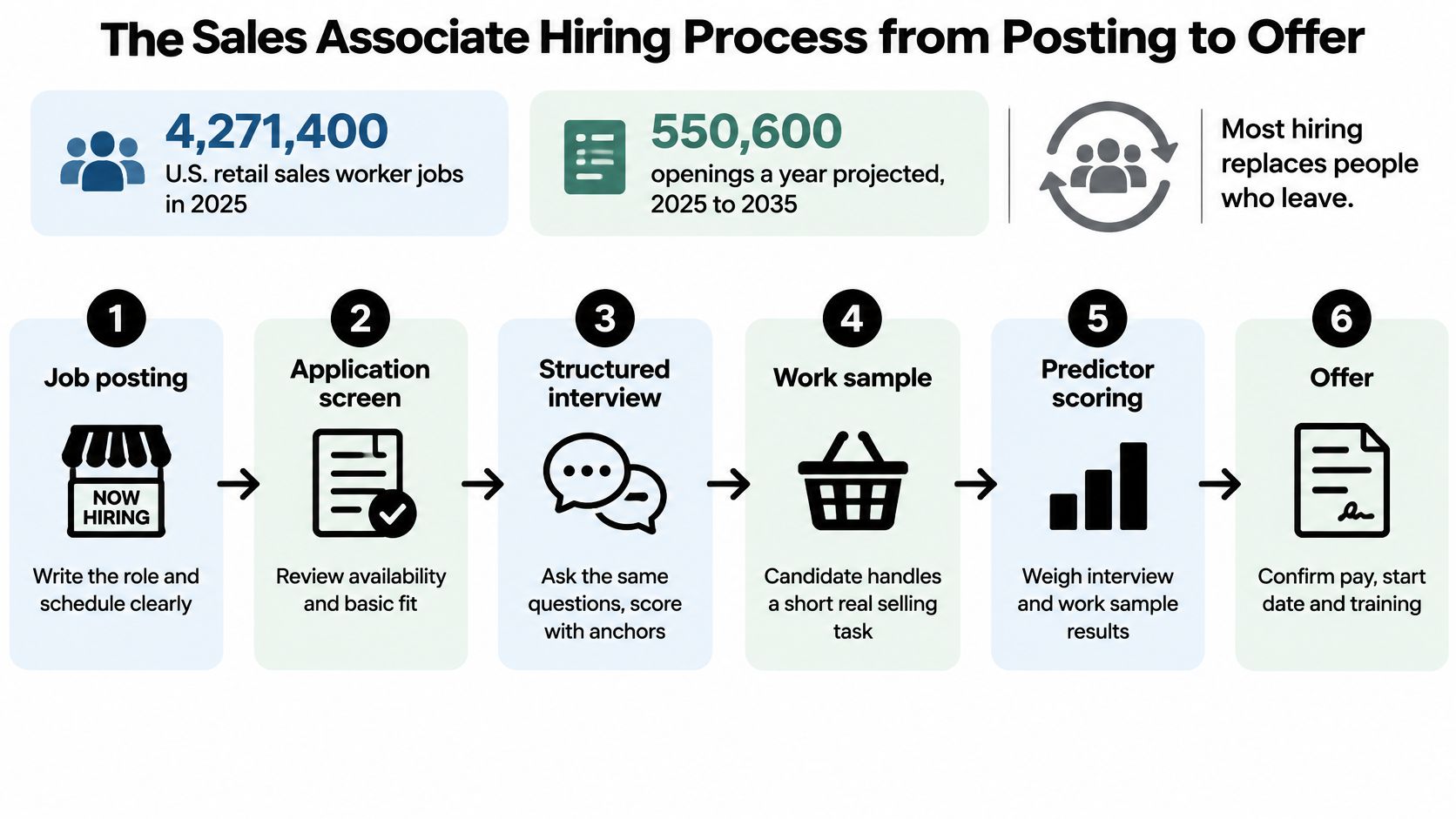
A sales associate requisition rarely arrives with lead time. U.S. retail sales workers held 4,271,400 jobs in 2025, with approximately 550,600 openings projected each year from 2025 through 2035, according to the [Bureau of Labor Statistics occupational outlook](https://www.bls.gov/ooh/sales/retail-sales-workers.htm). With little or no overall employment growth projected, that volume is the case for a process the store can run on repeat without redesigning it each time.
Keep the sequence visible to recruiters and store managers. Each stage should produce evidence the next decision-maker can inspect, and the seven steps below hold whether you hire one associate a year or one a month.
1. Write the role profile from observed sales behaviors. Describe what associates must do with customers, products, payments, and colleagues. Copying a generic job description leaves interviewers assessing different jobs. 2. Screen against the posted schedule and minimum requirements. Establish whether the candidate can meet the actual operating conditions before moving them forward. A vague preference for "flexible" candidates usually masks a scheduling problem the screen was supposed to catch. 3. Run a structured interview. Ask identical core questions so candidates get comparable opportunities to demonstrate capability. Free-form conversation rewards confidence more than it reveals it. 4. Score a short work sample on the same dimensions. Check whether the candidate can apply what they described. Letting a strong résumé bypass the exercise defeats its purpose. 5. Check references for job-related evidence. Ask about responsibilities, follow-through, and specific examples. General enthusiasm from a former supervisor tells you little. 6. Have two interviewers score independently before discussing. Preserve each evaluator's judgment before the most senior person speaks. Scores written after consensus conceal disagreement. 7. Make the offer and track 90-day outcomes. Confirm the employment terms, assign onboarding ownership, and retain the selection evidence. Closing the requisition without checking outcomes leaves the process untested.
The visual workflow groups those activities into operational stages.
Keep the handoffs explicit
The recruiter owns eligibility and schedule clarity. Interviewers own behavioral evidence, while the hiring manager owns the decision and the conditions promised to the candidate.
> Process check: If a hiring manager can't name the evidence behind a decision, the interview or work-sample stage was effectively skipped.
Keep one shared scorecard rather than separate email impressions. The offer discussion should resolve documented concerns rather than surface a preference nobody assessed. Then close the loop: at the 90-day mark, compare each cohort's retention and early performance against the interview and work-sample scores that got them hired. Associates who struggle despite strong scores point to a scoring anchor that needs revision. Associates who succeed despite weak ones point to a predictor carrying too little weight. That comparison is what turns a hiring sequence into a repeatable operating process.
Define the Role With Observable Sales Behaviors
Friendly, hardworking, and good with customers are descriptions, not usable selection criteria. Interviewers can agree on those words while imagining entirely different behavior.
Replace them with actions a manager could observe on the sales floor. A [sales competency framework](https://synopsix.ai/blog/sales-competency-framework) gives recruiters and managers a common vocabulary, but each behavior still needs a question and a scoring anchor tied to this particular store.
Core sales associate behaviors and what to listen for
| Behavior | Strong answer shows | Sample question | |---|---|---| | Needs discovery | Asks two or three open questions before recommending | Tell me about a time a customer walked in unsure what they needed. What did you ask first? | | Product explanation | Connects features to the customer's stated use, not a script | Describe how you explained a product you knew little about to a customer. | | Objection handling | Acknowledges the concern, then offers a specific alternative | What did you do when a customer said the price was too high? What happened next? | | Transaction accuracy | Names checks used to avoid pricing, payment, or return errors | Walk me through how you avoid mistakes when a register or order system is busy. | | Service recovery | Owns the problem, fixes it within policy, and follows up | Tell me about an upset customer you turned around. What did you say and do? | | Ethical judgment | Declines pressure tactics and stays within discount or return policy | When has a manager asked you to push something a customer did not need? How did you respond? |
Allow an equivalent example when a candidate hasn't encountered the exact situation. A person who resolved a scheduling dispute in hospitality may demonstrate more useful customer judgment than an experienced retailer who can only recite a service script.
Separate experience from capability
Prior retail experience can establish familiarity with the setting. It doesn't establish what the person did, how independently they acted, or whether their choices helped the customer.
A [meta-analysis of sales-performance predictors](https://psycnet.apa.org/record/1998-10357-007) found that achievement, a component of conscientiousness, correlated 0.41 with objective sales results, while general cognitive ability correlated 0.40 with supervisor ratings but 0.04 with objective sales. Those differences matter: manager approval and sales results aren't interchangeable outcomes, and neither should become shorthand for a universal sales personality.
Ask candidates what they noticed, what they chose, and what happened afterward. Don't award points merely for tenure or an impressive employer name.
Adjacent sales roles also need distinct criteria. If you also [hire cold callers](https://hiresdrs.com/cold-callers/), hireSDR.com's role-specific resource can support that separate hiring effort, but outbound prospecting requirements shouldn't automatically become retail selection criteria.
Before scheduling interviews, map every behavior to a question and a score anchor. Remove any trait that nobody can translate into observable evidence.
Screen Availability and Pay Expectations Early
Open availability is a blunt filter. A candidate with fixed caregiving, education, transportation, or second-job commitments may be dependable within a clearly agreed schedule.
The useful question isn't whether someone can work whenever a manager asks. It's whether the candidate can reliably meet the conditions the store needs, and whether the employer can honor the conditions it advertises.
Publish the operating conditions
Give applicants enough detail to make a realistic decision before investing in interviews.
Ask which weekend and holiday shifts the applicant can cover in a typical month and what could change that availability. Keep the discussion on coverage, not personal explanations about family arrangements or other private circumstances.
A fixed constraint is different from an unresolved arrangement. Someone who consistently accepts closing shifts may fit better than someone who claims unrestricted availability but can't confirm how they'll reach the store.
Establish pay alignment before assessment
In 2025, U.S. retail salespersons accounted for 3,897,860 jobs and had a mean annual wage of $37,310, according to [BLS Occupational Employment and Wage Statistics](https://data.bls.gov/oesprofile/?year=2025&major_group=410000&occupation=412031&measure=01&areas=INDUSTRY,STATE,MSA). That national mean isn't a local pay recommendation or a promised salary for a part-time role.
State the actual posted pay range early. Explain any commission or incentive terms without implying that uncertain earnings are guaranteed.
Screen uses knock-out questions on your own job board to filter applicants. Limit those exclusions to legal work eligibility, the required shift pattern, and the minimum-hours expectation; use behavioral assessment for the remaining judgment.
> Decline against a stated job requirement, not against an impression that someone's life looks complicated.
Record the reason for every screen-stage rejection. Reviewing those reasons helps managers identify inconsistent interpretations of the same requirement and exposes postings that promise conditions the store can't deliver.
Build a Structured Interview With Anchored Scores
A [U.S. Merit Systems Protection Board review](https://www.mspb.gov/studies/studies/The_Federal_Selection_Interview_Unrealized_Potential_253635.pdf) reported average validity of 0.51 for structured interviews, compared with 0.38 for unstructured interviews. These figures describe the relationship between interview scores and later performance across studies, not the proportion of an individual's outcome that an interview predicts.
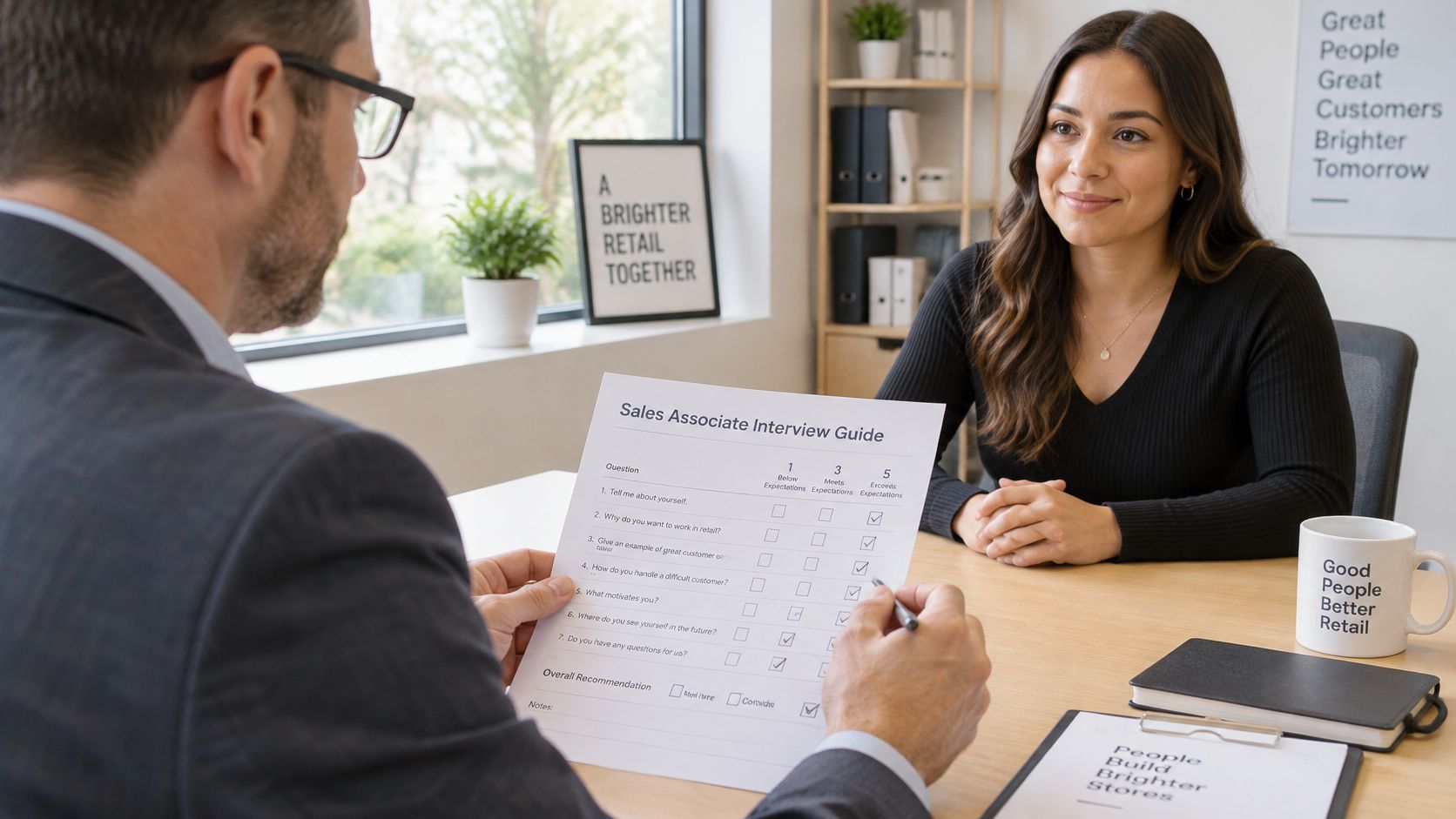
Standardization gives interviewers a better basis for comparison than conversational chemistry. The physical setup can stay welcoming while the evaluation remains disciplined.
Ask consistently and probe for evidence
Ask every candidate the same core questions in the same sequence. Require a specific past example, while allowing examples from other settings when they demonstrate the relevant behavior.
Use neutral follow-ups: what the candidate did first, what the customer said, what alternatives they considered, and what they would change. These probes help distinguish a detailed account from a rehearsed principle, but don't turn hesitation into an automatic negative.
Have two interviewers score each answer independently on a 1-to-5 scale before comparing notes. Record short excerpts in the candidate's own words, clearly separated from the interviewer's interpretation.
The distinction between [structured and unstructured interviews](https://synopsix.ai/blog/structured-vs-unstructured-interviews) is operational: the former requires common evidence standards, not merely a prepared question list.
Anchored scoring rubric for sales interview answers
The examples below illustrate answer patterns rather than statements from actual candidates.
| Score | Answer pattern | Example | |---|---|---| | 1 | Vague or hypothetical answer with no real situation | I would probably ask the customer what they need. | | 3 | Specific past example with adequate actions and a reasonable outcome | I asked about their budget and showed two options; the customer bought the mid-range one. | | 5 | Quantified result plus clear judgment about the customer and the sale | I found the customer needed a return-safe option, offered it, and their repeat purchases rose over the next quarter. |
The top-row example still needs a probe: ask how much repeat purchasing increased and how the candidate knows. Don't infer a quantified result from a vague claim of improvement, and don't penalize candidates for lacking access to employer reporting.
For teams considering automated scoring, Dassh AI's [AI interview evaluation methodology](https://dassh.ai/whitepapers/ai-interviewer-grading) is a resource for examining grading approaches. Require any evaluation method to preserve the connection between evidence, rubric, and judgment.
Use the accompanying video as a discussion aid during interviewer calibration.
<iframe width="100%" style="aspect-ratio: 16 / 9;" src="https://www.youtube.com/embed/XQdQDDU66jM" frameborder="0" allow="autoplay; encrypted-media" allowfullscreen></iframe>
Our selection and hiring analysis evaluates a candidate against the role, team, leader, and culture, predicts integration risk, and proposes questions for the final interview. Treat those questions as targeted checks, not permission to abandon the common scorecard.
If interviewer scores differ by more than one point, discuss the evidence before accepting either score. Keep the original ratings so disagreement remains visible.
Add a Work Sample and Weigh Each Predictor
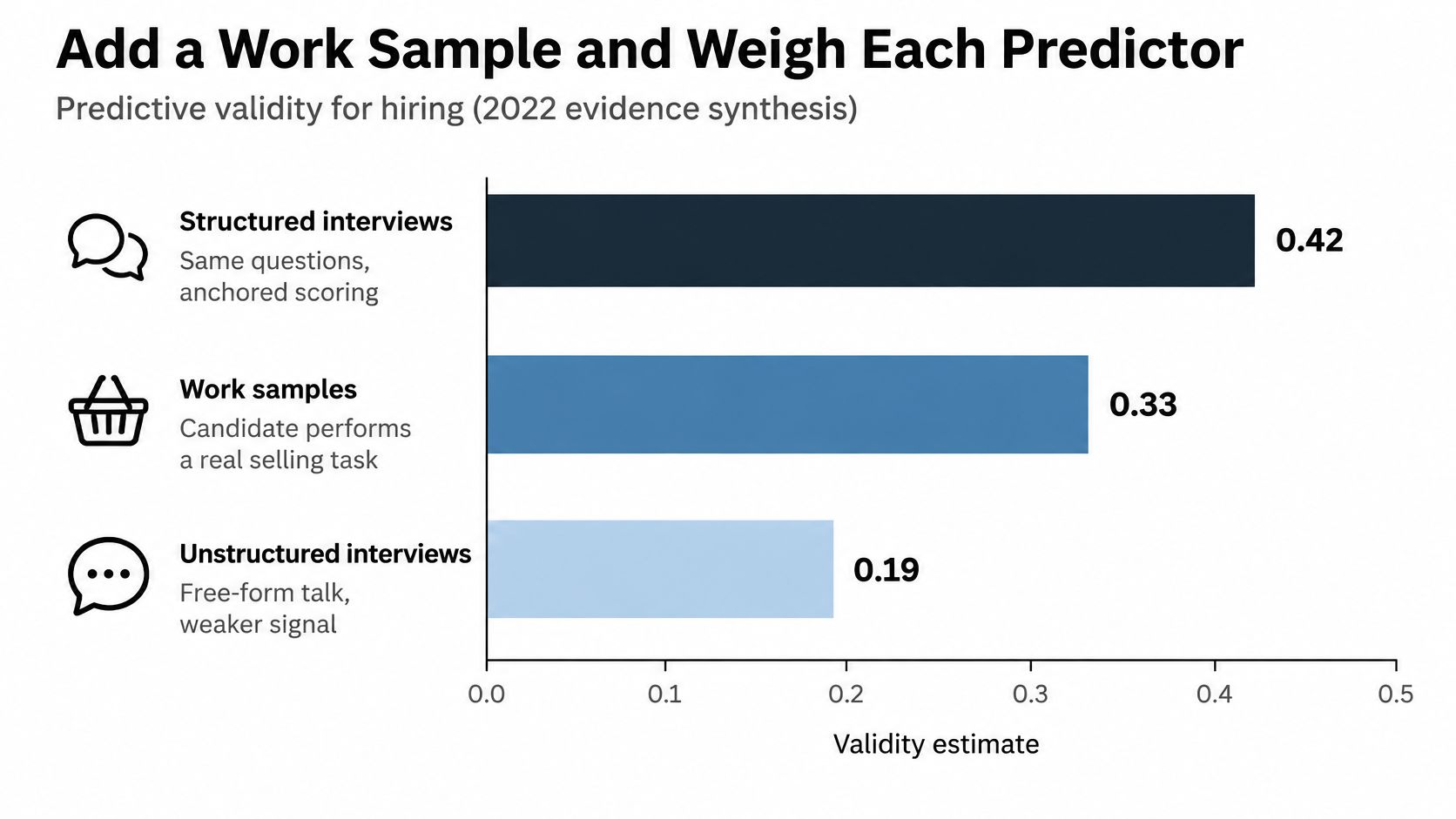
The 2022 re-analysis of selection evidence summarized in this [selection-methods analysis](https://icaroiasbeck.com/en/conteudos/contratacao-de-vendedores/) reported revised validity estimates of 0.42 for structured interviews, 0.33 for work samples, and 0.19 for unstructured interviews, with years of experience at 0.07. Experience alone is therefore a weak ranking signal, even when job-specific experience is a legitimate minimum requirement.
Older estimates were higher because researchers used different statistical corrections. Don't blend estimates from different reviews into an apparently precise formula; use the comparison to choose stronger methods, then test their usefulness against your own outcomes.
Revised validity of common sales associate selection methods
The estimates below are from that same re-analysis.
| Selection method | Revised validity (2022) | How to use it | |---|---|---| | Structured interview | 0.42 | Core decision method with identical questions and anchored scores | | Work sample | 0.33 | Short role-play or written customer response scored on the same dimensions | | Unstructured interview | 0.19 | Rapport check only, never the basis for a hire |
The visual comparison makes the relative differences easier to discuss with hiring managers.
Build a task that resembles the job
After minimum-qualification screening, give the candidate a short product brief, a customer profile, and a policy constraint. For example, a customer wants a gift but is uncertain about suitability, while the store restricts returns on opened merchandise.
Run a 5-to-10-minute role-play or written customer response. Score questioning, listening, recommendation quality, accuracy, ethical judgment, and closing behavior, using predefined anchors.
A role-play makes sense when live conversation is central to the job. A written response is more appropriate when the actual role includes written customer support; convenience alone isn't a reason to test a different skill.
Use the same scenario, preparation materials, and permitted assistance for every candidate. Train raters to distinguish a useful question from polished delivery, and record specific actions rather than labels such as confident or natural seller.
For implementation planning, [Capstone Workforce's skills testing explainer](https://capstoneworkforce.com/blog/skills-assessment-tests) provides context on assessment formats. Keep the exercise focused through a role-specific [work-sample testing](https://synopsix.ai/blog/work-sample-testing) design rather than assembling an unnecessarily broad testing battery.
> Calibration rule: Don't reward pressure selling when the job requires accurate advice and customer trust.
Avoid coaching one candidate through the objection while leaving another unsupported. Don't change product difficulty between applicants or award extra points for terminology the supplied brief never explained.
Combine independently scored interview and work-sample results so neither automatically dominates. When the results diverge sharply, inspect the underlying evidence and resolve the discrepancy before making an offer.
Set Your Hiring Decision Rule and 90-Day Checks
Replacement demand is what makes sales associate hiring a repeatable process rather than a one-time event. NACS figures summarized in [Strategic Human Resource Management's selection-methods chapter](https://ecampusontario.pressbooks.pub/strategichrmgt/chapter/5-4-selection-methods-and-evidence-based-hiring/) report average turnover of 125.3% for full-time sales associates and 169.6% for part-time associates, alongside average hiring and training costs of $1,294 and $1,119 per full-time hourly associate. Those figures come from convenience retail, so apply them as a reference point rather than a benchmark that fits every store format.
Turnover and hiring cost for full-time and part-time sales associates
The published data break out hiring and training costs only for full-time hourly associates; part-time staff appear in the turnover figures alone.
| Associate type | Average turnover | Hiring cost | Training cost | |---|---|---|---| | Full-time sales associate | 125.3% | $1,294 | $1,119 | | Part-time sales associate | 169.6% | Not reported | Not reported |
When an associate leaves inside the first months, the employer recruits and trains a replacement before recovering the original spend. Raising the interview threshold alone doesn't fix that pattern. Managers also need to separate genuine selection mistakes from broken scheduling promises, unclear expectations, and thin onboarding, because each cause points to a different correction.
Close the loop by hiring cohort
1. Confirm the combined scores. Check that both assessment records are complete and that unresolved concerns carry an explicit disposition. Hold the weighting steady even when it points away from the preferred applicant. 2. Record every offer or rejection reason. Name the evidence and the requirement it supports. Keep unsupported impressions out of the decision record. 3. Track 90-day outcomes by cohort. Monitor retention, training completion, sales productivity, customer-service measures, and return or error rates. Compare employees with similar selling opportunities rather than treating different shift assignments as equivalent. 4. Review cohorts each quarter. Inspect where selection scores and outcomes disagree, then adjust one scoring anchor at a time. Changing the questions, training, thresholds, and weighting together makes the result difficult to interpret.
Add ethical judgment as a sixth behavior when discounts, returns, or upselling carry policy limits. Treat a material policy violation as a documented concern rather than letting strong commercial scores absorb it.
A documented decision rule is also where tooling earns its place. Synopsix handles that sequence in five steps: define the vacancy, publish it on your own job board, have AI rank every applicant, run full analysis only on finalists, and close with an AI Decision. That produces a defensible hiring call in under 48 hours, while managers keep responsibility for the employment decision and the rationale written into the record.
Pick one role, write its five core behaviors, and run one structured cohort before changing anything else.
---
Synopsix offers role-specific behavioral assessment and hiring analysis to help managers evaluate candidate fit and integration risk alongside interview and work-sample evidence. Visit [Synopsix](https://synopsix.ai) to build a more consistent sales associate hiring process, from applicant screening to a documented final decision.