Sales Candidate Assessment: A Guide to Smarter Hiring
By Synopsix · July 8, 2026 · 16 min read
A sales leader opens a role, reviews a stack of polished resumes, runs a few confident interviews, and feels good about the shortlist. Three months later, the new rep still isn't building pipeline, still isn't handling pushback well, and still looks far better in meetings than in the field. Often, teams don't have a people problem when this happens. They have a decision system problem.
That's why a good sales candidate assessment matters. Used well, it doesn't just score a person on generic traits or test whether they can talk through a mock pitch. It helps predict how they're likely to behave once the job gets hard, repetitive, and exposed to real pressure. That shift matters if you want to make smarter people decisions instead of faster guesses.
The best hiring systems combine behavioral science, predictive analytics, and disciplined interpretation. They don't replace judgment. They make judgment less subjective.
Beyond the Resume Why Sales Hiring Needs a Better System
The most expensive sales hires usually don't look risky at the start.
They look polished. They know the language of discovery, objection handling, and closing. Their resume reads well. If you need help tightening that resume review step, [StoryCV's sales resume bullet points](https://story.cv/blog/articles/resume-bullet-points-for-sales) is a useful reference because it shows how candidates frame impact, and that framing often shapes first impressions more than it should.
The problem is simple. Resumes tell you what a candidate says they did. Interviews often tell you how well they can perform in an interview. Neither reliably tells you what they'll do every week when quota pressure rises, deals stall, and follow-up discipline starts to separate real sellers from strong storytellers.
What resumes miss
A candidate may have carried a known logo. They may have worked in a respected category. They may even have strong tenure and clean progression. None of that tells you enough about how they prospect, recover from rejection, respond to coaching, or operate inside your sales motion.
That's where a sales candidate assessment changes the conversation. As [SmartMoves](https://www.smartmovesinc.com/sales-candidate-assessments) defines it, a sales candidate assessment is a data-driven tool that specifically measures whether a person can sell, will sell, and fits a unique selling environment, distinguishing it from generic evaluations that focus merely on experience or qualifications.
That distinction matters more than most hiring teams realize.
> The hiring mistake usually isn't choosing the wrong person from a good system. It's asking a weak system to predict future performance.
From evaluation to prediction
Traditional hiring tends to overvalue evidence of the past and undervalue signals about future behavior. That's a bad trade if the target role requires grit, coachability, autonomy, and consistency over time.
A better system asks different questions:
When teams skip those questions, they often end up hiring confidence instead of capability.
The real failure point
Most weak sales hires don't fail because nobody cared. They fail because the process rewarded the wrong signals. An unstructured interview favors charisma. A generic scorecard favors speed. A rushed shortlist favors familiarity.
A strong assessment process does something far more useful. It creates a repeatable way to predict likely on-the-job behavior before the offer goes out.
That doesn't make hiring perfect. It makes it smarter.
Define Success Before You Search for It
Many hiring processes begin with a job description. That's the wrong document to anchor a hiring decision.
A job description usually lists duties, nice-to-haves, and broad requirements. It rarely captures the behavioral profile that separates a rep who survives from a rep who performs. If the role itself isn't clearly defined, the assessment won't rescue you. It will only make the confusion look more scientific.
Start with business reality
Before you choose any test or interview sequence, define what success looks like in your environment. Research cited in this [discussion of role alignment](https://www.youtube.com/watch?v=TQ3FzXPh0hQ) indicates that 60% of sales role failures stem from poor profile-job alignment, yet current tools rarely require detailed, metrics-driven job profiles before assessment, creating a critical blind spot in hiring accuracy.
That matches what many talent leaders see in practice. Teams often benchmark candidates against a vague idea of a "good salesperson" instead of a precise version of success for a specific seat.
Build the profile from the top down
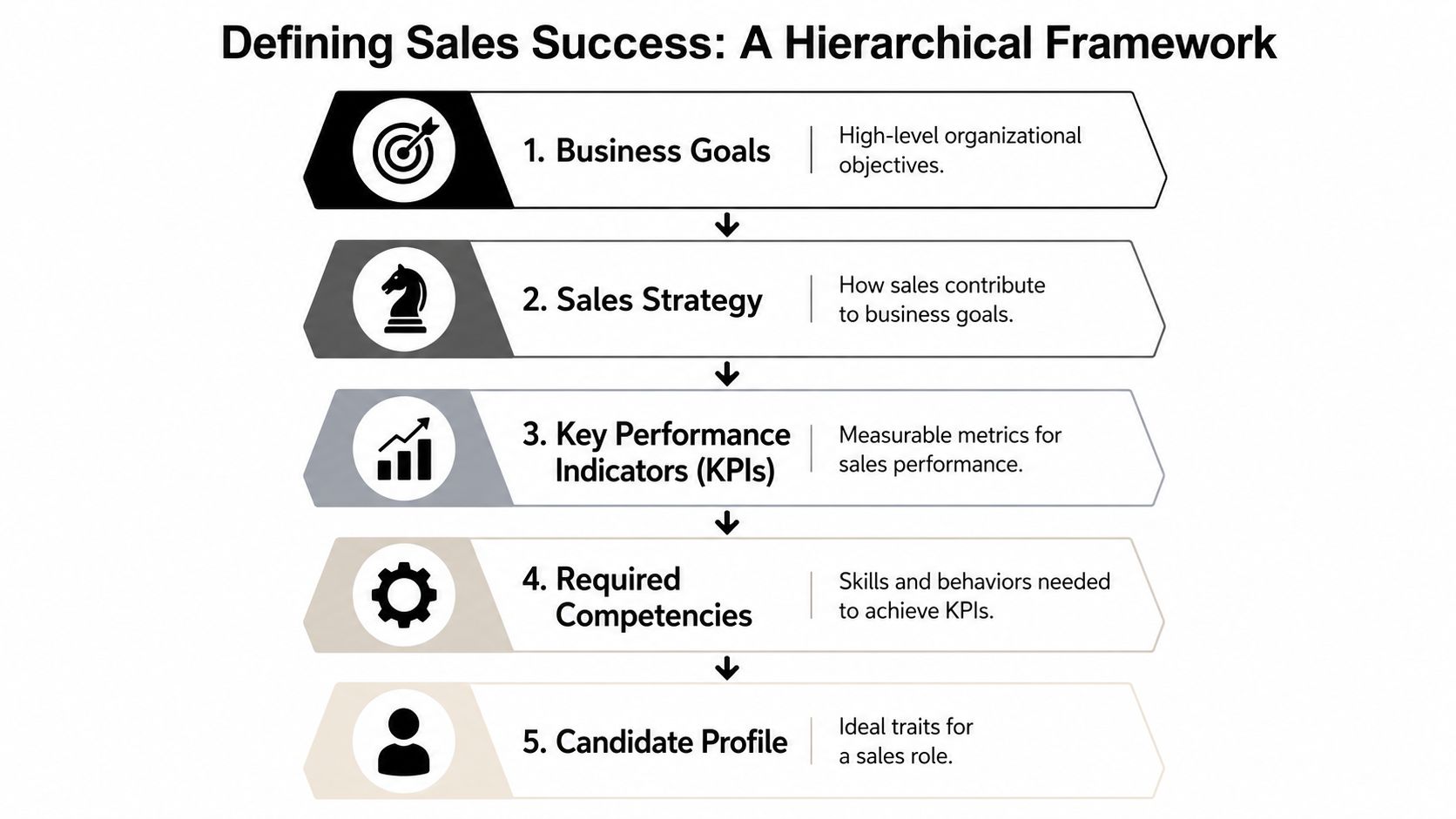
Use a simple hierarchy.
1. Business goals Start with what the business needs. New logo growth, expansion revenue, channel development, or shorter sales cycles all imply different success profiles.
2. Sales strategy Clarify how the team wins. Is this outbound-heavy? Partner-led? Enterprise consultative selling? High-volume inside sales? Strategy drives behavior requirements.
3. KPIs Look at the metrics that matter in the role. Pipeline creation, conversion quality, cycle progression, retention, expansion, or multi-threading all point to different strengths.
4. Required competencies Translate those KPIs into observable capabilities and behaviors. In this context, resilience, coachability, questioning depth, commercial judgment, and follow-through become concrete.
5. Candidate profile Document the success pattern you want to hire against.
If your team is also working on broader execution issues, this guide on [improving sales team performance](https://synopsix.ai/blog/how-to-improve-sales-team-performance) is a useful companion because role design and team performance are tightly linked.
Pick the few traits that really matter
Most hiring profiles are bloated. They include too many traits and too much generic language. Keep it disciplined. Focus on the handful of competencies that distinguish average from strong performance in your environment.
Useful categories often include:
> Practical rule: If a competency won't change your final decision, don't score it.
Pressure-test the profile with operators
Don't define the role in a vacuum. Bring in the hiring manager, a top performer, and someone who sees rep performance after hire, often enablement or second-line leadership.
Ask them where hires succeed, where they break, and what "good" looks like in observable terms. Not "executive presence." Not "hunter mentality." Say what a strong rep does.
For example:
That's the bedrock of a useful sales candidate assessment. Without it, every later step gets noisier.
Selecting the Right Sales Assessment Methods
Once the success profile is clear, the next decision is methodological. Often, the error is trying to find one tool that does everything.
No single method can do that. Good assessment design layers methods that answer different questions. One tool may identify behavioral tendencies. Another may reveal current selling skill. A structured interview may test how the candidate thinks through real examples.
What each method is actually good at
The first thing to avoid is generic testing. According to [Sales Assessment Testing](https://salesassessmenttesting.com/blog/the-impact-of-sales-assessments-on-hiring-success-and-performance/), superior sales assessments demonstrate predictive validity by forecasting job success with 70–80% accuracy when specifically validated for sales roles, whereas generic personality tests only achieve 40–50% accuracy.
That's the gap between a purpose-built hiring input and a team exercise disguised as selection science.
If you're comparing broader approaches, this piece on [understanding team profiling options](https://www.corporatechallenge.com.au/psychometric-testing-vs-behavioural-profiling-which-one-is-for-your-team/) is worth reading because it helps clarify where psychometrics, profiling, and behavior-based methods serve different purposes.
Sales Assessment Method Comparison
| Method | What It Measures | Predictive Accuracy | Best For | |---|---|---|---| | Behavioral sales assessment | Will sell factors, role fit, sales-specific behavioral patterns | 70–80% accuracy when validated for sales roles | Early-stage screening and prediction | | Generic personality test | Broad preferences and interpersonal style | 40–50% accuracy | Team development, not primary sales selection | | Work sample or simulation | Can sell skills in realistic selling tasks | Qualitative unless validated for the role | Late-stage skill confirmation | | Structured behavioral interview | Evidence of past behavior and judgment | Qualitative unless tied to a scoring rubric | Probing risks, context, and consistency |
A layered method works better than a single score
A practical stack usually looks like this:
Teams that want stronger exercise design often benefit from reviewing examples of [work sample testing](https://synopsix.ai/blog/work-sample-testing), especially when they need to move beyond generic mock pitches.
What not to do
Some common mistakes keep showing up:
> Use methods that complement each other. Behavioral tools predict likely patterns. Simulations show execution. Interviews explain context.
When those methods line up, your decisions get cleaner. When they conflict, you get a sharper question set for final interviews.
Designing a Fair and Predictive Assessment Process
Choosing tools is only half the job. The true gain comes from turning those tools into a process that hiring managers can run consistently.
Without a defined workflow, even strong assessments get diluted. One interviewer improvises. Another overweights gut feel. A third ignores the rubric because they "know talent when they see it." That inconsistency is where bias and noise enter the system.
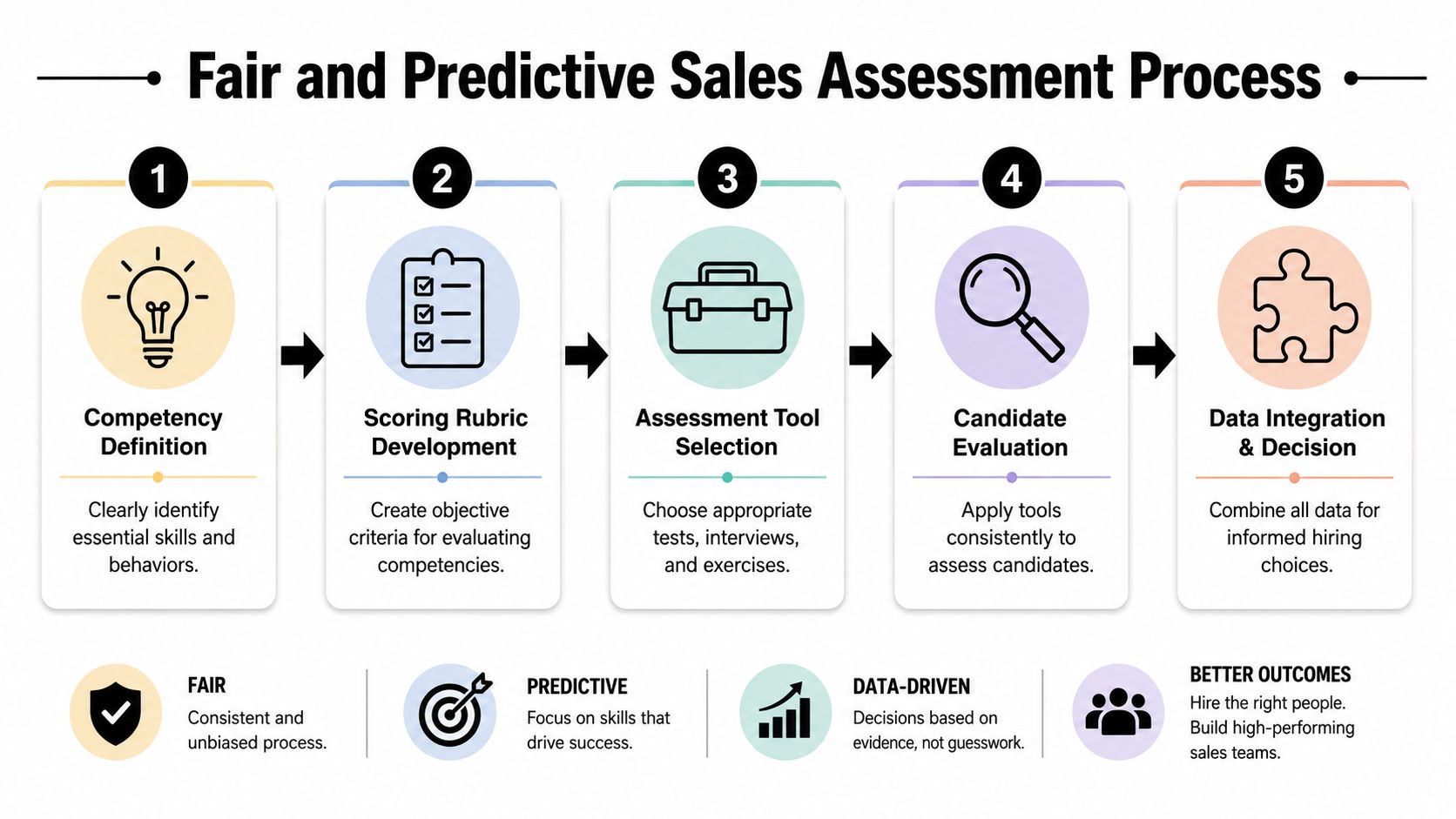
As of 2026, [sales assessment tools](https://www.wecreateproblems.com/blog/sales-assessment-tools) are described as providing objective data that predicts job performance, transforming hiring from subjective interviews to evidence-based decision-making, with measurable outcomes such as 40% faster hiring decisions and 60% fewer mis-hires.
Build a rubric before you meet candidates
A scoring rubric should tie directly to the success profile. If the role demands prospecting persistence, coachability, discovery quality, and process discipline, then every stage of the process should feed evidence into those dimensions.
A simple approach works well:
Example of a usable rubric
| Competency | 1 | 3 | 5 | |---|---|---|---| | Coachability | Deflects feedback | Acknowledges feedback but applies unevenly | Seeks feedback and adapts quickly | | Pipeline discipline | Reactive follow-up | Inconsistent process ownership | Maintains steady, structured follow-through | | Discovery skill | Surface-level questions | Covers basics with limited depth | Uncovers needs, stakes, and buying dynamics | | Resilience | Energy drops after setbacks | Recovers with support | Sustains effort and focus after rejection |
Put assessments in the right order
Sequence matters.
Start with resume review and basic qualification. Then introduce the assessment early enough to filter intelligently, but not so early that candidates feel they're entering a black box before any human contact. For many teams, a brief recruiter screen followed by a sales-specific assessment is a good balance.
Then move into structured interviews and work samples. Save executive time for candidates whose evidence justifies it.
> Candidates will tolerate rigor if the process feels relevant, clear, and fair.
Train evaluators like evaluators
Most hiring managers have never been trained to interpret assessment data. They've been trained to interview. Those are not the same skill.
Calibration matters. Interviewers should know:
Strong process design protects both quality and fairness. It also gives candidates a better experience because they can see that the company is using a standard, not improvising a judgment.
Translating Assessment Data into Hiring Decisions
The hardest part of a sales candidate assessment isn't collecting data. It's deciding what the data means when the signals are mixed.
One candidate may show strong behavioral fit and average simulation results. Another may crush the exercise but raise concerns around consistency, autonomy, or response to coaching. The wrong move is to turn that complexity into a pass-fail shortcut.

Read the result in context
A major pitfall, as noted in this [discussion on assessment interpretation](https://www.youtube.com/watch?v=H9vyuaodcoc), is ignoring context. Assessments must be interpreted within the specific role's context, considering factors like autonomy level and team dynamics, rather than using one-size-fits-all tools that fail to capture sales performance nuances.
That means the same score can imply different levels of risk depending on the role. Moderate structure dependence may be manageable for a tightly led inside sales role. It may be a serious concern for a remote territory rep expected to self-generate activity.
Having a clean set of [candidate evaluation criteria](https://synopsix.ai/blog/candidate-evaluation-criteria) becomes useful. Teams make better decisions when they agree in advance on how to weigh evidence across fit, skill, and risk.
Weigh evidence instead of averaging it
Don't reduce every input into a flat composite just because the spreadsheet allows it.
Use a hierarchy:
1. Screen for disqualifying risk Look for serious concerns tied to role-critical behavior.
2. Confirm must-have fit Can this person succeed in the actual environment, not an abstract one?
3. Compare strengths among viable finalists Once risk is manageable and fit is present, then compare upside.
4. Use interview time to explain conflicts If assessment and simulation disagree, investigate the mismatch.
Good decision meetings sound different
Weak debriefs sound like this:
Stronger debriefs sound like this:
> Data should sharpen judgment, not replace it.
A useful final interview often becomes an evidence-checking session. If the assessment suggests a risk around persistence, ask for detailed examples of how the candidate handled long sales cycles, repeated rejection, or stalled deals. If the results indicate strong coachability, pressure-test that by giving live feedback and seeing how they adapt.
A short explainer on this idea is worth watching before you finalize your process:
<iframe width="100%" style="aspect-ratio: 16 / 9;" src="https://www.youtube.com/embed/9zi79P6UZz8" frameborder="0" allow="autoplay; encrypted-media" allowfullscreen></iframe>
Avoid the three most common interpretation mistakes
When teams get this right, they stop using assessments as gates and start using them as decision intelligence.
Refining Your Process and Mitigating Risk
A sales candidate assessment program isn't finished when you launch it. That's when the actual work starts.
The only assessment model that matters is the one that predicts success in your company, under your managers, in your market. If you don't track outcomes after hire, you won't know whether your model is identifying the right signals or merely producing tidy reports.
Validate against real performance
Build a feedback loop between hiring and on-the-job results. Compare assessment patterns with ramp behavior, manager feedback, early pipeline quality, and longer-term performance markers that matter in your environment.
That discipline is what separates a recruiting tool from a strategic system.
One reason teams keep investing in specialized tools is the performance ceiling they can reach when the process is configured well. The [Objective Management Group Sales Candidate Assessment](https://www.linkedin.com/pulse/candidate-assessments-structured-onboarding-0vd5c) has achieved a 92% predictive validity rate, a 95% accuracy rate in hiring top performers, and a 17% average increase in sales growth when hiring aligns with role benchmarks.
Those results don't mean every organization should copy one vendor's model blindly. They do show what's possible when assessment is tied to role benchmarks and validated over time.
Fairness is not a side issue
Legal and ethical discipline belongs inside the process, not in a policy document nobody reads.
Review for consistency. Check whether all candidates receive the same instructions, the same scoring framework, and the same opportunity to demonstrate role-relevant ability. Watch for adverse impact. Make sure tools are appropriate for the decision you're making. Document how hiring teams interpret and use results.
If you're modernizing interviews alongside assessment, [ParakeetAI's interview assistant blog](https://blog.parakeet-ai.com/) is a useful resource for thinking through interview structure, note quality, and process consistency.
> A fair process is usually a better predictive process because it reduces noise, improvisation, and unsupported judgment.
Keep tuning the model
Markets change. Sales motions change. Managers change. What predicts success in one stage of a company may weaken later.
Refine the benchmark, retrain interviewers, revisit simulations, and update your competency model when the role changes. That's how a sales candidate assessment becomes a durable asset instead of a hiring fad.
--- Synopsix helps teams turn behavioral assessments into practical hiring decisions, team design insight, and development guidance without forcing leaders to interpret technical psychometric jargon on their own. If you're building a more predictive sales hiring process, [Synopsix](https://synopsix.ai) is worth exploring for its ability to connect assessment data to real business decisions.