Sales Competency Assessment: Build Elite Teams in 2026
By Synopsix · July 21, 2026 · 16 min read
Only 6% of all salespeople possess the complete skill set required for elite performance, based on a benchmark of 2.5 million sellers. The other 94% have at least one critical gap in their competency profile, according to [RevHeat's sales assessment research](https://revheat.com/sales-assessment-21-competencies/). That single fact should change how any VP of Sales thinks about hiring.
Most sales organizations still hire as if elite talent is common and easy to spot in an interview. It isn't. Strong resumes, polished answers, and prior logos often create false confidence. A seller can sound experienced and still lack the behavioral pattern needed for your market, your deal cycle, and your buyers.
That's why a sales competency assessment matters. Done well, it doesn't just label candidates. It helps leaders connect behavior to performance, hiring decisions to revenue outcomes, and development plans to actual gaps instead of guesswork. That's the logic behind predict-human-behavior-synopsix-smarter-people-decisions. You stop treating talent decisions as intuition calls and start treating them as operating decisions.
Why Most Sales Hiring Fails and How to Fix It
The core problem is simple. Most sales hiring processes overvalue visible signals and undervalue predictive signals.
A resume tells you where someone worked. An interview tells you how well they present themselves. Neither tells you enough about how they'll handle resistance, qualify deals, adapt to buying groups, or stay effective when the pipeline tightens. Those are the behaviors that decide whether a rep produces consistently or stalls out after a strong first impression.
The resume and interview trap
Sales leaders often make two assumptions that break the process.
The issue gets expensive quickly. Mis-hiring in sales doesn't just create recruiting waste. It damages forecast quality, manager time, customer experience, and team morale. The hidden financial drag becomes much clearer when you break down the [cost of a bad hire](https://synopsix.ai/blog/cost-of-a-bad-hire) across ramp time, missed quota, and replacement effort.
> Practical rule: If your hiring process depends mainly on interviews, you're selecting for interviewing skill.
What a better model looks like
A strong sales competency assessment shifts the question from “Who impressed us?” to “Who has the behavioral architecture to succeed in this role?”
That means evaluating the candidate against the actual demands of the job:
This approach is more useful because it turns hiring into diagnosis. Instead of making vague judgments like “good communicator” or “seems driven,” you examine whether the person shows the patterns your team needs.
The fix isn't more interviews. It's better evidence. Use structured assessment data to identify likely strengths, likely risks, and the conditions under which a candidate is most likely to perform. Then use interviews to validate those findings, not replace them.
Unpacking the Core Sales Competencies for 2026
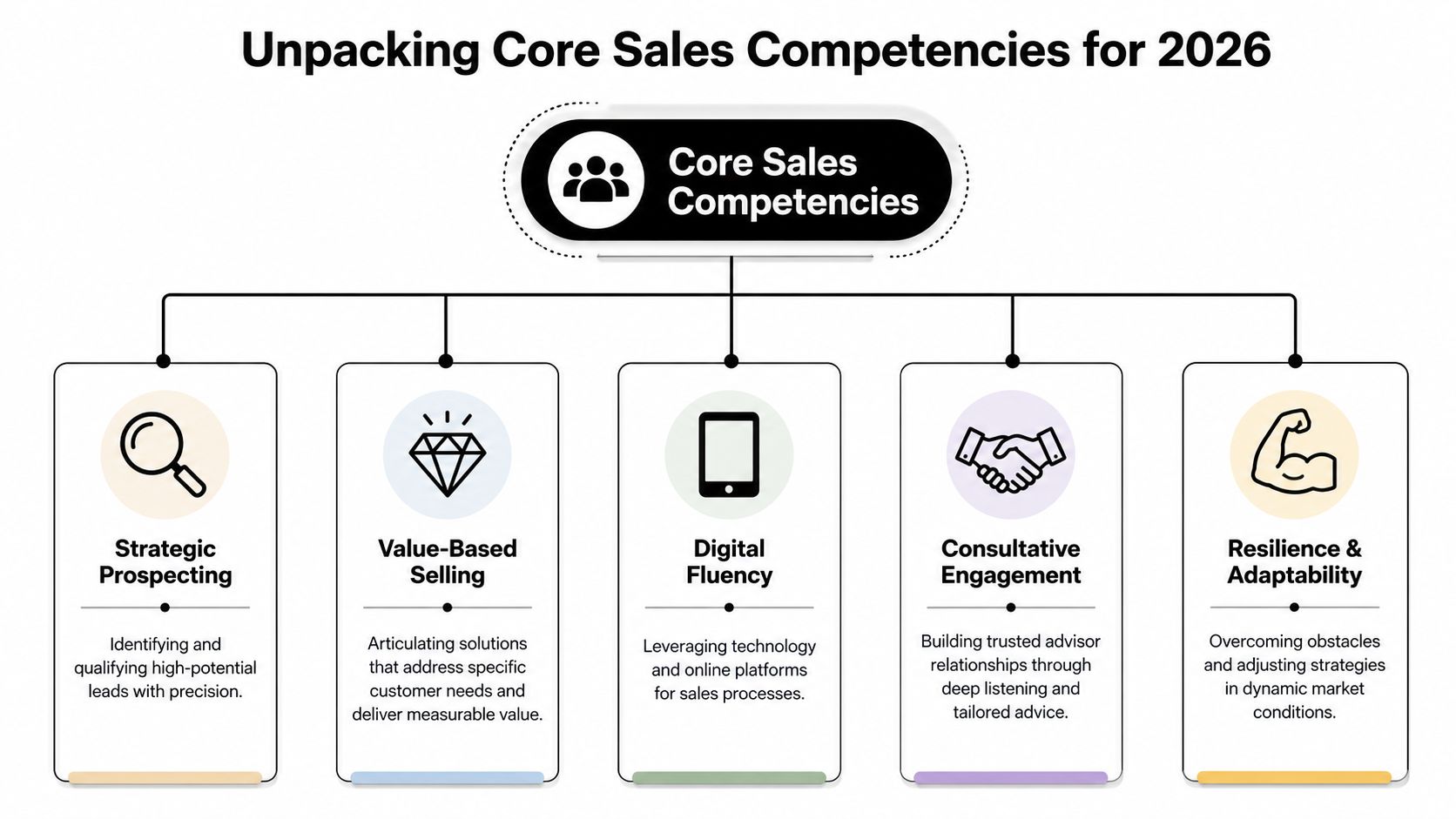
Sales leaders rarely miss because they cannot name a few desirable traits. They miss because those traits are too broad to predict performance in a specific role. A competency is more useful than a skill for that reason. It captures how a seller tends to think, respond, and execute when the pressure rises, the buyer pushes back, and the deal becomes ambiguous.
Modern sales assessment models try to measure those repeatable patterns instead of relying on vague labels like “strong closer” or “good with people.” Some frameworks break sales performance into multiple dimensions such as execution, motivation, and sales-specific behavioral tendencies, then assess them in a structured format. That approach is far more useful for hiring and promotion because it ties evaluation to how revenue work gets done.
What matters now
The competency profile for a strong seller has changed. Product knowledge still matters. So does work ethic. But those alone do not explain why one rep consistently creates momentum in complex deals while another fills the pipeline and still misses quota.
The difference usually shows up in observable behavior. Strong performers plan accounts with intent, run sharper discovery, connect product capabilities to business outcomes, and handle stakeholder complexity without losing control of the process. Those are measurable patterns. They also map directly to business outcomes such as conversion rate, sales cycle length, average deal size, and margin retention.
That is the shift many guides miss. Defining competencies is only step one. True value comes when those competencies are connected to commercial results and assessed in a way that helps leaders predict likely performance before a hiring mistake hits the number.
For teams building that definition from scratch, this [guide to building a competency framework](https://www.dynamicshub.co.uk/2026/06/24/competency-framework/) is a useful companion because it shows how to formalize competencies into a practical operating model. It pairs well with a clearer understanding of [behavioral competencies in organizational performance](https://synopsix.ai/blog/behavioral-competencies), especially when hiring managers struggle to translate abstract traits into role-specific criteria.
Sales competencies that actually affect results
| Competency | Definition (Behavior in Action) | Business Impact | |---|---|---| | Strategic prospecting | Identifies high-potential accounts, prioritizes intelligently, and tailors outreach instead of sending generic messages | Improves pipeline quality and cuts wasted effort | | Consultative discovery | Asks layered questions, surfaces business pain, and clarifies buying criteria before pitching | Improves qualification and increases deal control | | Value-based selling | Connects solution capabilities to the customer's priorities and expected business outcomes | Supports stronger positioning and protects price | | Multi-stakeholder engagement | Manages decision-makers, influencers, and blockers with deliberate communication | Increases momentum in complex deals | | Technical fluency | Understands the product, adjacent systems, and customer environment well enough to speak credibly | Builds trust and reduces avoidable friction | | Objection handling | Responds to concerns without becoming defensive or relying on discounts | Preserves margin and keeps deals progressing | | Resilience | Maintains execution quality after rejection, delay, or a lost deal | Sustains activity and consistency over time | | Adaptability | Adjusts approach by buyer type, sales cycle, and market conditions | Prevents rigid selling behavior that hurts conversion | | Account planning | Maps whitespace, risks, stakeholders, and expansion paths inside target accounts | Improves territory productivity and expansion potential |
A practical assessment should make these patterns visible in language managers can use. If the output does not change interview questions, onboarding priorities, coaching plans, or promotion decisions, it is not helping the business.
That is also where modern platforms such as Synopsix change the conversation. Static assessments give you a snapshot. Dynamic people intelligence models use behavioral data to estimate how a person is likely to perform in a given context, which is far more useful when the goal is better hiring, stronger coaching, and more accurate talent decisions.
Designing an Effective Assessment Framework
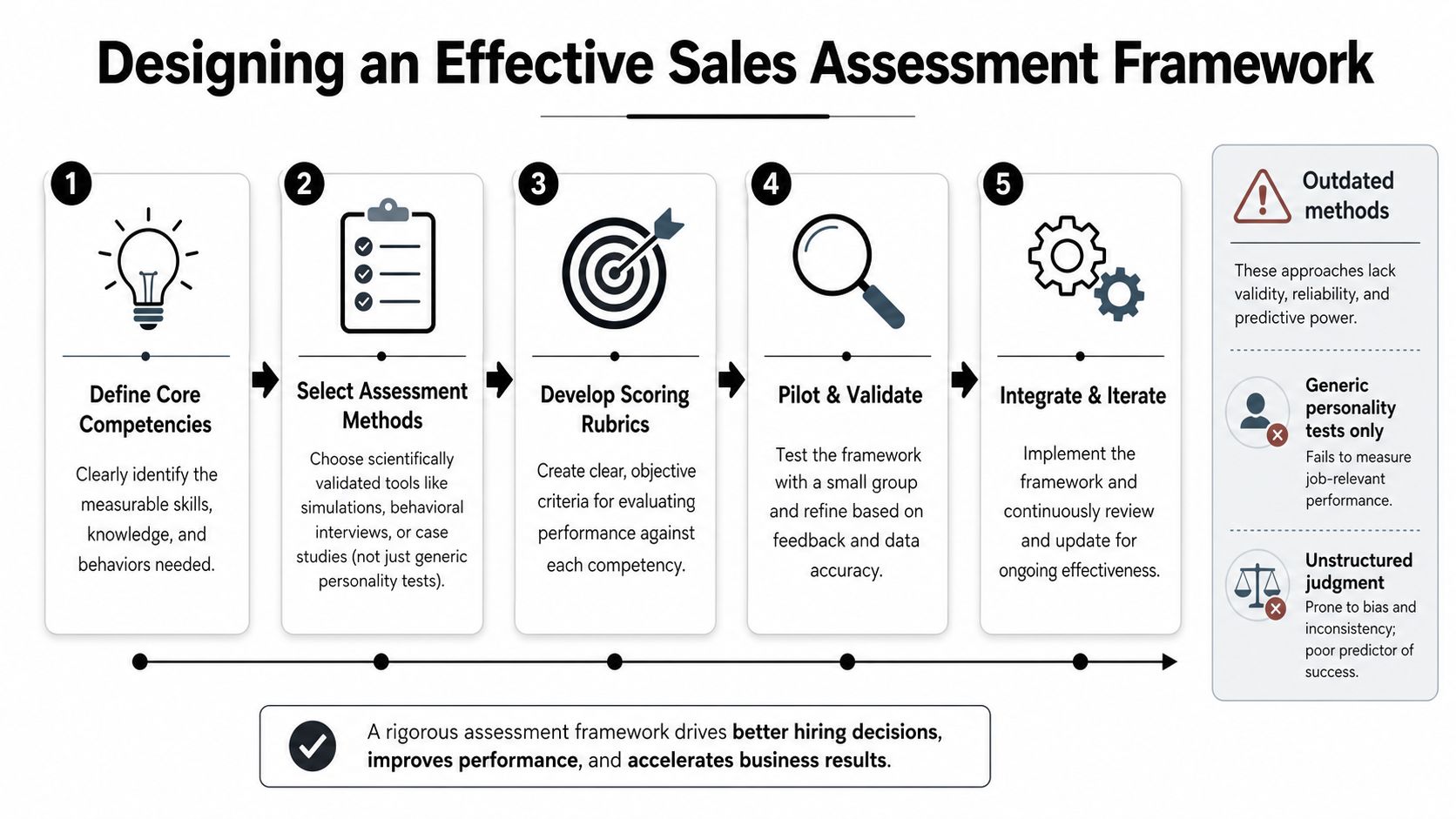
Companies that treat sales assessment as a vendor purchase usually get polished reports and weak hiring decisions. The framework has to start with the work itself. An SDR role that depends on volume, message discipline, and fast recovery after rejection should be measured differently from an enterprise AE role that depends on discovery depth, stakeholder management, and deal control over a long cycle.
That sounds obvious. It still gets missed in practice.
Build around evidence, not personality labels
A useful framework starts with business outcomes and works backward. Review the patterns behind missed pipeline targets, late-stage losses, slow ramp time, discount-heavy wins, and poor retention in role. Then identify the behaviors that show up consistently around those outcomes.
For example, if deals regularly stall after a first meeting, the issue may not be lead quality. It may be weak discovery, poor next-step control, or an inability to surface urgency. If top performers expand accounts while average performers stay reactive, account planning and stakeholder judgment likely deserve heavier weighting in the model.
This is the practical shift many teams miss. They assess for broad traits because traits are easy to package. They should assess for behaviors that predict performance in a specific selling context.
Conversation intelligence, CRM stage progression, win-loss reviews, and manager observations all help here. None of those inputs should stand alone. Together, they give enough evidence to build a scoring model that reflects how your sales motion works.
Use multiple methods, each with a clear job
One method will not give you a reliable picture. Self-report tools capture tendencies. Simulations show execution under pressure. Structured interviews test judgment and consistency. Scorecards create rater discipline.
A strong framework usually includes four parts:
1. Behavioral assessment Use this to identify patterns such as persistence, comfort with challenge, planning discipline, and response to ambiguity.
2. Role-relevant simulations Test the moments that matter in the job. For an SDR, that may be objection handling and call structure. For an AE, it may be discovery, commercial reasoning, and stakeholder alignment.
3. Structured interviews Interviewers should probe specific risks and strengths surfaced by the assessment instead of repeating the resume review in conversational form.
4. Scoring rubrics Define what good looks like for each competency. Without scoring criteria, interviewer confidence gets mistaken for interviewer accuracy.
If you are hiring front-line pipeline talent, this [guide to hiring top SDRs](https://hiresdr.io/sdr-interview-questions/) is useful because it focuses on role-specific interview evidence rather than generic prompts. If you are evaluating platforms, these [competency assessment tools for sales and hiring teams](https://synopsix.ai/blog/competency-assessment-tools) show the differences between static screening and more decision-oriented assessment models.
Benchmark against performance that already exists in your business
External competency libraries are a starting point. Internal validation is what makes the framework credible.
Look at your strongest sellers by role, segment, and sales cycle. Then compare them with solid middle performers and consistent underperformers. The goal is not to clone the top rep's personality. The goal is to isolate the behaviors that show the clearest relationship to quota attainment, deal quality, cycle efficiency, and manager confidence in execution.
I have seen teams overweight charisma because it is easy to notice in an interview. Their actual top performers won for different reasons. They asked harder discovery questions, managed buying groups better, and held price more consistently. A framework that misses those distinctions will keep selecting impressive candidates instead of productive ones.
That is also where modern platforms such as Synopsix improve the process. Static assessments describe a person at one point in time. Dynamic people intelligence models connect behavioral signals to likely performance in a defined role, which is far more useful when the business needs better hiring accuracy, faster ramp, and more reliable promotion decisions.
A good framework changes decisions. If your model does not alter who gets hired, how interviews are run, what onboarding focuses on, and which risks managers coach first, it is still academic.
Putting Assessments into Action Across the Talent Lifecycle
The ultimate value of a sales competency assessment shows up after hiring. The same data that sharpens selection can also improve onboarding, coaching, promotion, and succession decisions.

Hiring with a predictive shortlist
A hiring team reviews two finalists for an account executive role. Candidate A has a stronger resume. Candidate B has less recognizable experience but shows stronger consultative discipline, better stakeholder judgment, and more resilience under pressure in the assessment output.
A weak process picks Candidate A because the background feels safer. A disciplined process uses the assessment to structure the final interview. The panel probes where each candidate is likely to succeed, where they may break down, and whether those risks fit the role. The shortlist becomes more predictive because the team isn't deciding blind.
Onboarding with a targeted plan
A new hire starts with solid prospecting instincts but weaker discovery depth. That should change the first weeks of onboarding immediately.
Instead of putting every rep through the same enablement sequence, the manager builds a development path around specific behaviors:
That kind of onboarding is tighter because it starts with evidence, not assumptions.
> The best onboarding plans don't begin with the training calendar. They begin with the rep's risk profile.
Coaching that managers can sustain
Many assessment programs often fail when leaders run the assessment once, discuss it during onboarding, and never operationalize it in weekly coaching.
Managers need a simple rhythm. If a rep struggles to convert late-stage opportunities, the manager should connect that outcome to observable behaviors. Is the rep failing to build urgency? Are they avoiding hard questions with economic buyers? Are they defaulting to product explanation when the customer needs business justification?
A sales competency assessment gives the manager a starting hypothesis. CRM activity, call reviews, and deal inspection either confirm it or challenge it.
Here's a useful way to reinforce that practice over time:
<iframe width="100%" style="aspect-ratio: 16 / 9;" src="https://www.youtube.com/embed/uVJBU6eUe8o" frameborder="0" allow="autoplay; encrypted-media" allowfullscreen></iframe>
Internal mobility and succession choices
The lifecycle value expands further when leaders stop treating quota attainment as the only input for promotion.
A top seller isn't automatically ready for leadership. A strong closer isn't automatically a fit for strategic account growth. Assessment data helps leaders examine whether the person's behavioral pattern matches the target role before making an expensive move.
That's where organizations start making smarter people decisions. They don't just ask who performed. They ask why the person performed, under what conditions, and whether that pattern transfers to the next role.
Measuring ROI and Avoiding Common Implementation Pitfalls
If a VP of Sales can't connect assessment to revenue outcomes, the program won't survive budget scrutiny. The business case needs to be direct.
According to [research on validated behavioral assessments in sales hiring](https://www.linkedin.com/pulse/science-sales-hiring-why-assessments-your-secret-weapon-dennis-mccall-oasgc), companies using them report a 31% increase in sales productivity and up to a 50% reduction in staff turnover. The same source reports that recommended candidates are 3.6x more likely to become top performers.
Those numbers matter because they hit the three places executives care about most. Revenue productivity, retention, and hiring accuracy.
Where the return actually comes from
The return doesn't come from “having an assessment.” It comes from changing decisions at the right points.
If you need a practical way to track those effects inside the business, these [downloadable templates for team performance](https://www.icypeas.com/blog/performance-scorecard-templates) can help managers build a consistent scorecard around rep progress, coaching focus, and performance indicators.
Common mistakes that undermine the rollout
Most failed implementations break for operational reasons, not theoretical ones.
#### Using generic tools
Many teams use broad personality assessments that may be interesting but don't isolate selling behavior. Those tools can spark discussion. They rarely improve hiring precision for revenue roles.
#### Treating the report as the end product
A PDF report isn't a system. If the output never reaches interview design, manager coaching, and onboarding plans, the organization bought insight and failed to convert it into action.
#### Keeping assessment data separate from CRM reality
This is the most damaging mistake. Leaders often assess competencies once and then manage pipeline performance in a separate universe. When those two datasets never meet, nobody learns which behaviors influence wins, losses, slippage, or stalled deals.
> Key takeaway: ROI comes from integration, not administration.
#### Over-standardizing every role
A strong framework should create consistency without flattening meaningful role differences. The competencies for an SDR, an enterprise AE, and a customer growth seller overlap, but they aren't identical. Treating them as identical weakens predictive value.
The implementation question isn't whether to assess. It's whether the assessment becomes part of how the sales organization hires, coaches, and evaluates performance.
From Static Data to Dynamic People Intelligence
Most assessments produce a snapshot. That's useful, but limited. A snapshot tells you what a person's profile looks like at one point in time. It doesn't automatically tell you how that profile will interact with a specific manager, a specific team, or a specific selling environment.
That's the industry gap. As [Corporate Visions notes, there is a lack of validated frameworks that link specific behavioral competency gaps to real-time CRM win/loss data](https://corporatevisions.com/blog/sales-skills-assessments/), which leaves leaders unable to pinpoint which skills drive revenue. This is why so many assessment programs feel intelligent at the top and weak in execution.
Why static assessment isn't enough
A static report can identify likely strengths and likely risks. It can't, by itself, create dynamic people intelligence.
Leaders need a system that helps them answer live questions such as:
Those are behavior prediction problems, not just assessment problems.
What smarter people decisions require
Organizations need a way to translate validated behavioral data into decision-ready guidance. That means turning psychometrics into business signals managers can use without needing to interpret technical language.
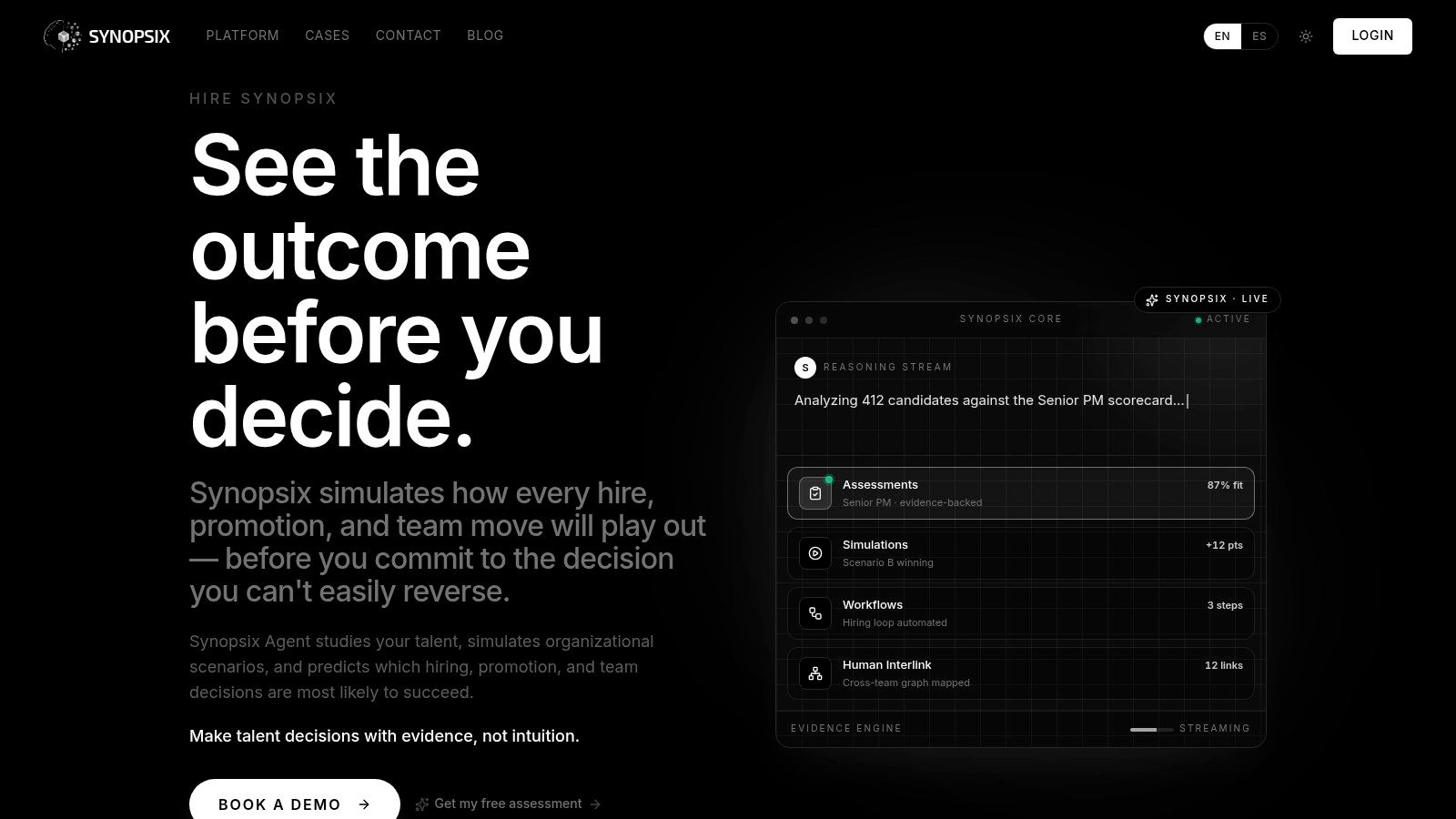
People intelligence platforms change the model. Instead of stopping at assessment, they connect profile data to hiring recommendations, role fit analysis, simulation, team design, and targeted development actions. That's a materially better operating system for talent than a one-time test.
A modern sales competency assessment should do more than classify people. It should help leaders predict human behavior, reduce avoidable hiring mistakes, and make smarter decisions across the talent lifecycle. That's the fundamental shift. Not more data. Better decisions from the data you already have.
---
If you want to turn behavioral assessment data into practical guidance for hiring, team design, and development, explore [Synopsix](https://synopsix.ai). It's built to help leaders predict human behavior and make smarter people decisions without getting buried in psychometric jargon.