Sales Competency Framework: The Complete Guide for 2026
By Synopsix · October 7, 2026 · 16 min read
A top salesperson can be the wrong person to promote. Research across 214 firms found that strong performance in an individual sales role could negatively predict later performance as a manager, even though high-performing sales employees were more likely to receive promotions. The lesson is uncomfortable but useful: historical output doesn't prove readiness for the next role. ([NBER research on promotions and managerial performance](https://www.nber.org/system/files/working_papers/w24343/w24343.pdf))
That's why a sales competency framework shouldn't be a polished list of desirable traits. It should be a diagnostic system that tells leaders whether a rep lacks a skill, lacks motivation, operates inside a badly designed role, or isn't receiving effective coaching. Built properly, it improves hiring consistency, performance diagnosis, coaching specificity, and protection against bias and legal risk.
Why Most Sales Teams Are Flying Without a Map
A VP of Sales once promoted the best demo-giver on the team into a senior AE role. The rep knew the product cold, handled common questions smoothly, and created excitement in every presentation. Then the larger deals reached negotiation. The rep conceded too early, missed stakeholder dynamics, and couldn't protect value when procurement applied pressure.
The problem wasn't just a bad promotion. Nobody had defined what “good” meant for a senior AE beyond delivering strong demos and hitting an individual number. The team had a job description, a quota, and plenty of manager opinions. It didn't have observable standards for negotiation, deal judgment, multi-threading, or commercial control.
That pattern repeats because sales organizations often run on rep intuition and manager lore. One manager rewards assertiveness. Another rewards activity. A third promotes the person who sounds confident in forecast calls. Without shared behavioral anchors, the same seller can receive very different evaluations from different leaders.
> Practical rule: If two experienced managers can't score the same sales behavior in roughly the same way, the framework isn't ready for hiring or promotion.
A useful framework has four jobs:
The gap carries a commercial cost. Ramp periods can stretch beyond nine months, and mis-hires can exceed 35% of headcount, but those figures should only be used when an organization has reliable internal evidence. The more durable point is simpler: when leaders don't define observable competency levels, coaching defaults to effort and personality, while promotion decisions reward the role someone is leaving.
Teams with calibrated competencies operate differently. They define what a developing, proficient, and advanced seller does in real calls and deal reviews. They then use the same language in interviews, onboarding, one-to-ones, performance reviews, and succession planning.
What a Sales Competency Framework Actually Is
A sales competency framework is a structured system that connects four layers:
1. Competencies, the capabilities a role requires. 2. Proficiency levels, the standard expected at each career stage. 3. Behavioral indicators, the evidence a manager or interviewer can observe. 4. Outcome metrics, the business results that show whether the capability matters.
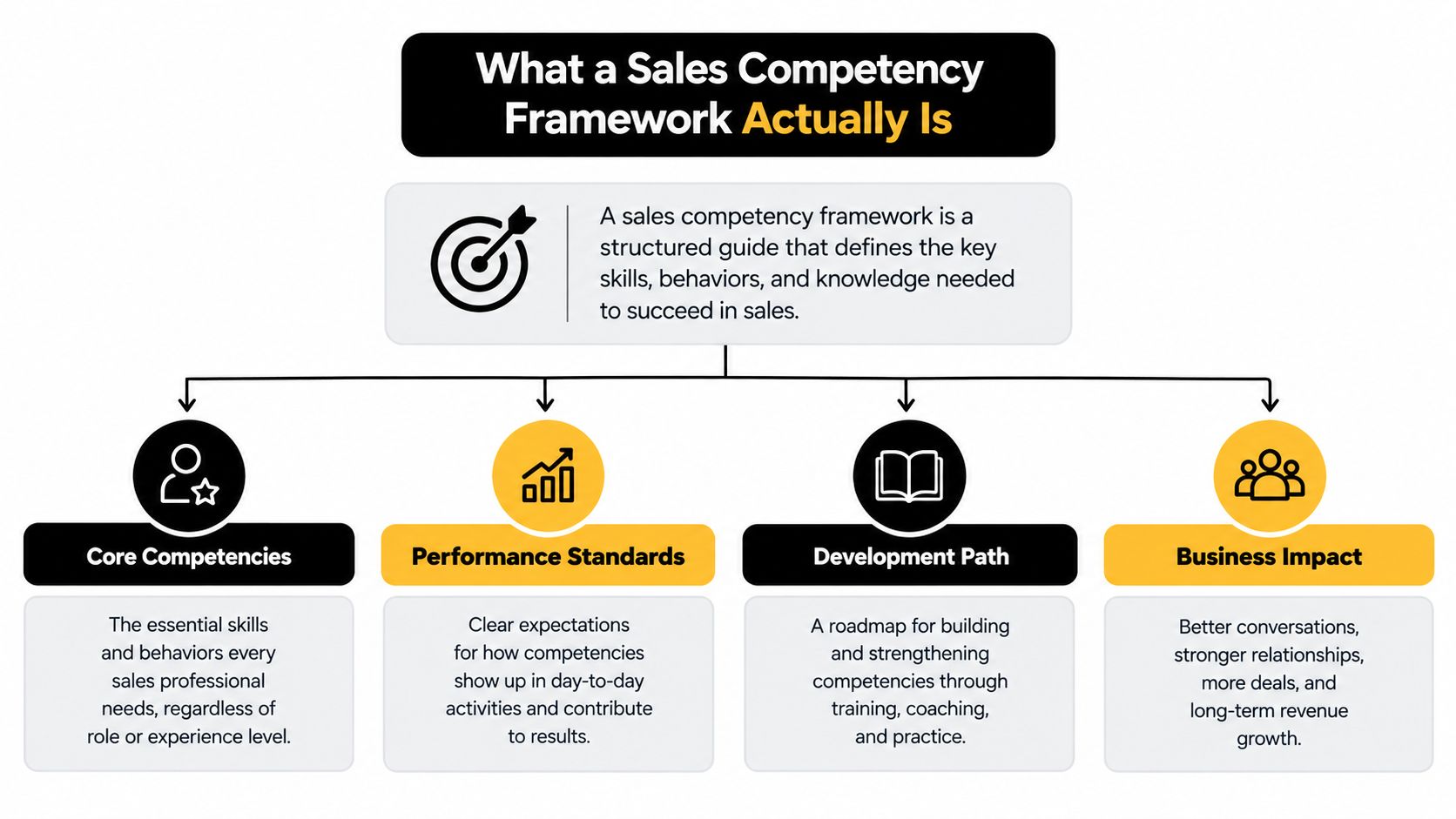
A flat checklist is structurally weak because it treats every problem as a missing skill. A rep who struggles to qualify opportunities may lack questioning technique. They may also have an unrealistic territory, unclear qualification rules, weak manager coaching, or little motivation to disqualify low-probability deals. A checklist can't distinguish those causes.
Evidence supports a multidimensional model. A contemporary meta-analysis identified five independently significant drivers of salesperson performance: selling-related knowledge, adaptive selling, cognitive aptitude, work engagement, and role ambiguity, with role ambiguity showing a negative relationship to performance. Its model explained approximately 32% of the variance in sales performance. ([Meta-analysis of salesperson performance](https://link.springer.com/article/10.1007/s11747-010-0211-8?error=cookies_not_supported&code=fdd10576-2902-44ca-8d96-6339efbf64f3))
That finding changes the design. Product knowledge belongs in the framework, but it shouldn't swallow adaptive execution, judgment, motivation, or role clarity. A strong seller can still underperform when decision rights, territory ownership, success measures, or operating expectations remain unclear.
The four layers in practice
Competencies name the capability, such as discovery, commercial judgment, negotiation, or forecast management.
Levels define the bar for an SDR, AE, CSM, or manager. A senior AE shouldn't be judged against the same depth of deal strategy expected from a new seller.
Behaviors make the capability observable. “Strategic thinker” is vague. “Identifies economic impact, maps decision influence, and changes the deal plan when new stakeholders enter” is scorable.
Metrics connect behavior to outcomes. A discovery score might relate to opportunity progression, while forecast discipline might relate to forecast reliability and stage hygiene.
The framework isn't a job description. It isn't a personality assessment, and it isn't a static training catalog. It also shouldn't replace thoughtful [candidate profiling with AI](https://www.cyndra.ai/blog/profile-of-candidates). It is an operating rubric for making and improving people decisions.
The Four Building Blocks Every Framework Needs
Design the four building blocks together. If you define competencies without behaviors, managers improvise. If you define behaviors without levels, every role receives the same standard. If you define metrics without diagnosing behavior, leaders punish outcomes without understanding causes.
Start with the capability, not the personality label
Name the work the seller must perform. Useful competencies might include discovery, objection handling, qualification, deal strategy, pipeline hygiene, forecast accuracy, customer insight, and negotiation. Each needs a clear behavioral owner.
For example, “discovery” owns the quality of questions, listening, pain diagnosis, and business-impact exploration. “Pipeline hygiene” owns stage accuracy, next-step discipline, and timely CRM updates. “Forecast accuracy” owns evidence-based judgment about deal timing and risk.
Set levels that reflect role scope
Use a simple progression such as developing, proficient, and advanced, or add a mastering level when the role includes coaching others. Anchor each level to evidence from call recordings, deal reviews, written account plans, and relevant attainment patterns.
A developing seller may ask surface questions and need prompts to connect pain to impact. A proficient seller independently uncovers business consequences, maps stakeholders, and adjusts the conversation. An advanced seller does that consistently, handles ambiguity, and teaches the approach to peers.
Write indicators people can actually hear
For discovery, a proficient indicator might be: “The seller asks follow-up questions that uncover business impact, identifies who is affected, and confirms the buyer's language before presenting a solution.” A developing indicator might be: “The seller moves to presentation after surface-level questions and relies on prepared prompts when the buyer gives an unexpected answer.”
Avoid false precision. A question ratio can be useful in a specific call-review design, but it shouldn't become a universal proxy for discovery quality. A seller can ask many questions and still miss the commercial issue.
Pair leading and lagging measures
Leading metrics show whether behavior is changing. Lagging metrics show whether the change matters commercially.
| Proficiency Level | Behavioral Indicator | Leading Metric | Lagging Metric | |---|---|---|---| | Developing | Needs prompting to connect buyer pain to business impact | Discovery review identifies incomplete impact questions | Opportunities stall after initial discovery | | Proficient | Quantifies impact, maps stakeholders, and confirms next steps | Qualified opportunities include documented pain, authority, and next action | Improved opportunity progression | | Advanced | Reframes the deal when evidence changes and coaches peers | Consistent deal-review quality across complex opportunities | Stronger win quality and forecast reliability |
The blocks are useless in isolation. A metric can reveal a problem, but the behavioral indicator should explain what to inspect. A behavior can guide coaching, but the outcome metric should test whether coaching produced commercial value.
Research also supports including interpersonal and affective capabilities, including empathy and emotional intelligence, alongside technical selling skills. An extended meta-analysis identified 19 determinants of salesperson performance and found that interpersonal skills and personal concerns had become significant predictors in the current decade. (Extended meta-analysis of salesperson performance)
Assess those capabilities through simulations, structured deal reviews, and customer-situation exercises. Don't let confidence or sociability stand in for judgment, ethical conduct, empathy, or adaptability.
How the Framework Changes Across Sales Roles
“Opportunity qualification” sounds like one competency. It isn't one behavior.
An SDR qualifies whether an outbound conversation merits a next meeting. An AE qualifies whether an active opportunity has enough pain, authority, urgency, and access to justify continued investment. A CSM qualifies whether an account shows expansion potential or churn risk. A sales manager qualifies the health of the team's pipeline and determines which deals require intervention.
Using one generic indicator across all four roles is a reliable way to make scores stop predicting outcomes as scope increases. The capability name can remain stable, but the evidence must change with deal complexity, customer lifecycle, decision rights, and level of influence.
| Role | Proficiency Level | Key Behaviors | Core Metrics | |---|---|---|---| | SDR | Proficient | Tests fit, relevance, timing, and the reason for a conversation before booking a meeting | Qualified meetings and accepted handoffs | | AE | Proficient | Validates pain, business impact, authority, urgency, and access to the buying group | Opportunity progression and win quality | | CSM | Proficient | Interprets usage, stakeholder sentiment, adoption barriers, and expansion signals | Retention risk and customer value realization | | Sales manager | Advanced | Reviews qualification patterns across the team, identifies inspection gaps, and coaches deal judgment | Pipeline health and forecast reliability |
The same rating word can therefore mean different evidence. “Advanced” for an SDR might mean consistently filtering poor-fit conversations and improving handoff quality. “Advanced” for an AE means orchestrating qualification across a complex buying group. For a manager, it means diagnosing qualification failure across multiple reps and changing coaching or process conditions.
That distinction matters for career progression. A rep who excels at personal qualification isn't automatically ready to evaluate a team's qualification system. The destination role requires broader judgment, delegation, coaching, and pattern recognition.
Use role-specific rubrics in hiring and promotion, then connect them to [sales candidate assessment](https://synopsix.ai/blog/sales-candidate-assessment) practices that evaluate the destination role rather than recycling the current role's scorecard.
Designing, Validating, and Rolling Out Your Framework
Build the framework from evidence, not from a workshop where leaders brainstorm impressive-sounding competencies. Start with top-performer behavior, examine failure patterns, and inspect actual calls, deal reviews, and pipeline records. The output should describe what successful sellers do in your sales motion, not what sales advice sounds good in the abstract.
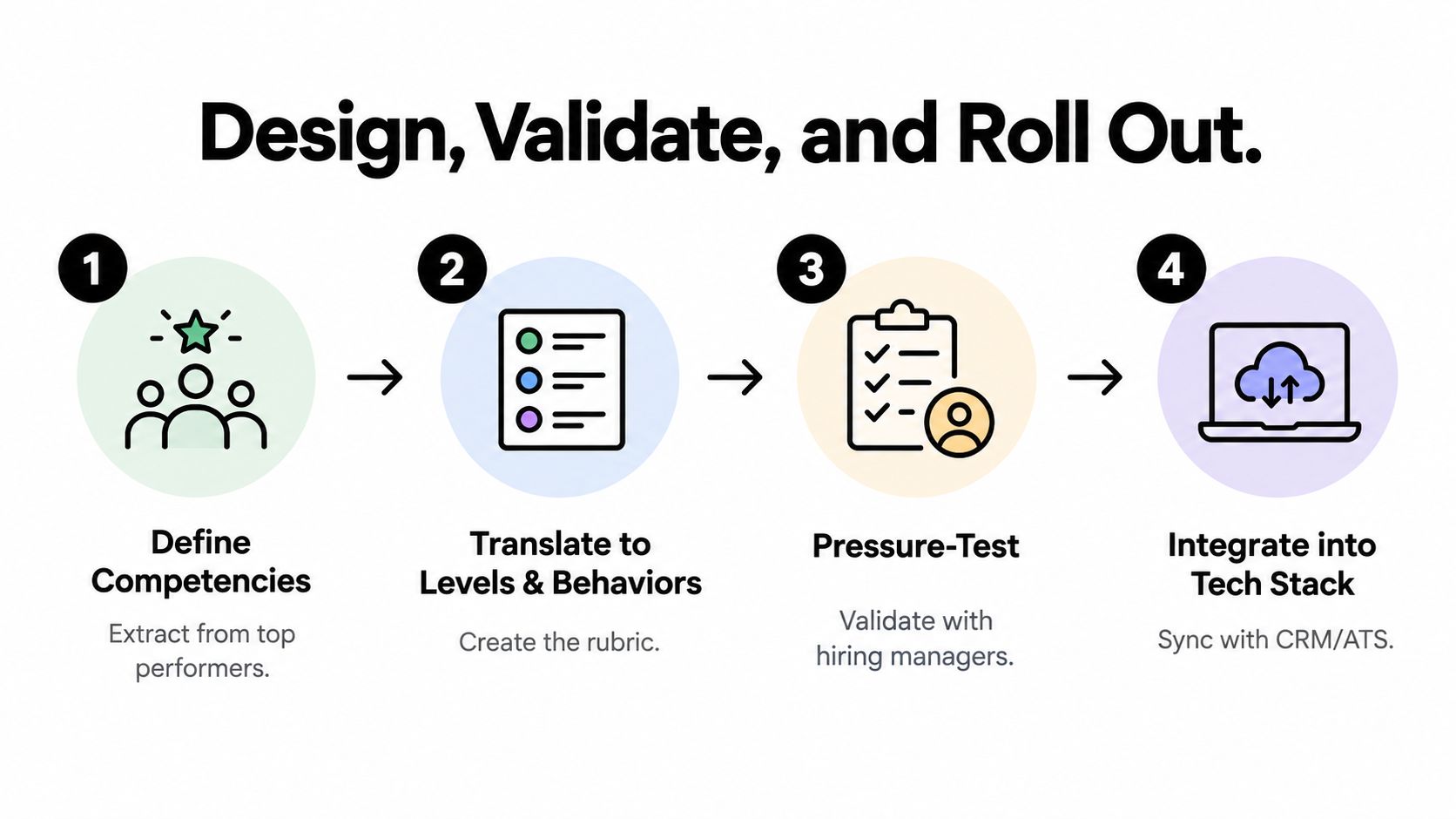
Move through four decision gates
Gate one, behavioral clarity. Replace “excellent communicator” with observable actions. Can an interviewer hear the behavior in an answer? Can a manager identify it in a call? If not, rewrite it.
Gate two, role validity. Ask frontline managers and reps whether the rubric reflects the actual job. Test it against different segments, deal motions, and customer situations. A framework that only describes the idealized enterprise motion will mis-score transactional roles.
Gate three, outcome validation. Compare competency scores with real performance outcomes, including opportunity progression, retention, forecast reliability, and margin quality where those measures are relevant. Manager agreement is useful, but it isn't validation. A score that feels credible can still fail to predict anything important.
Gate four, fairness and operating readiness. Before using the framework in hiring or promotion, monitor selection rates across protected groups and document the job relevance of each assessment. The EEOC describes the 80% rule of thumb for identifying potential adverse impact. Calculate each group's selection rate, compare it with the highest group rate, and investigate results below that threshold. The guideline also requires evidence that a procedure relates to successful job performance when adverse impact exists. ([EEOC Uniform Guidelines clarification](https://www.eeoc.gov/laws/guidance/questions-and-answers-clarify-and-provide-common-interpretation-uniform-guidelines))
Don't launch by distributing a large document. Train managers on the scoring logic, run calibration sessions, and give them practical examples of developing, proficient, and advanced work. Then embed the rubric in hiring interviews, onboarding plans, call reviews, one-to-ones, and promotion panels.
A pilot in one role usually reveals more than a broad rollout. Watch for vague indicators, inconsistent scoring, missing CRM evidence, and conversations that return to personality judgments. Fix those faults before extending the model.
> Validation standard: A manager's signature proves participation. A relationship between competency evidence and job-relevant outcomes proves usefulness.
The AI Judgment Gap Nobody Is Scoring For
Most organizations add “AI literacy” to a competency list and move on. That's the wrong unit of measurement. The competency that matters is AI-assisted judgment, which combines the ability to use AI with the judgment to validate, challenge, disclose, escalate, or override its recommendations.
A 2025 study based on interviews with 32 senior B2B sales managers found that successful AI integration depends on data skills, knowledge-sharing cultures, and a transformation-oriented mindset. A 2026 academic review further argues that sales professionals need explicit filters for interpreting and challenging AI recommendations. ([Research on AI integration in B2B sales management](https://ideas.repec.org/a/eee/jbrese/v194y2025ics014829632500219x.html))
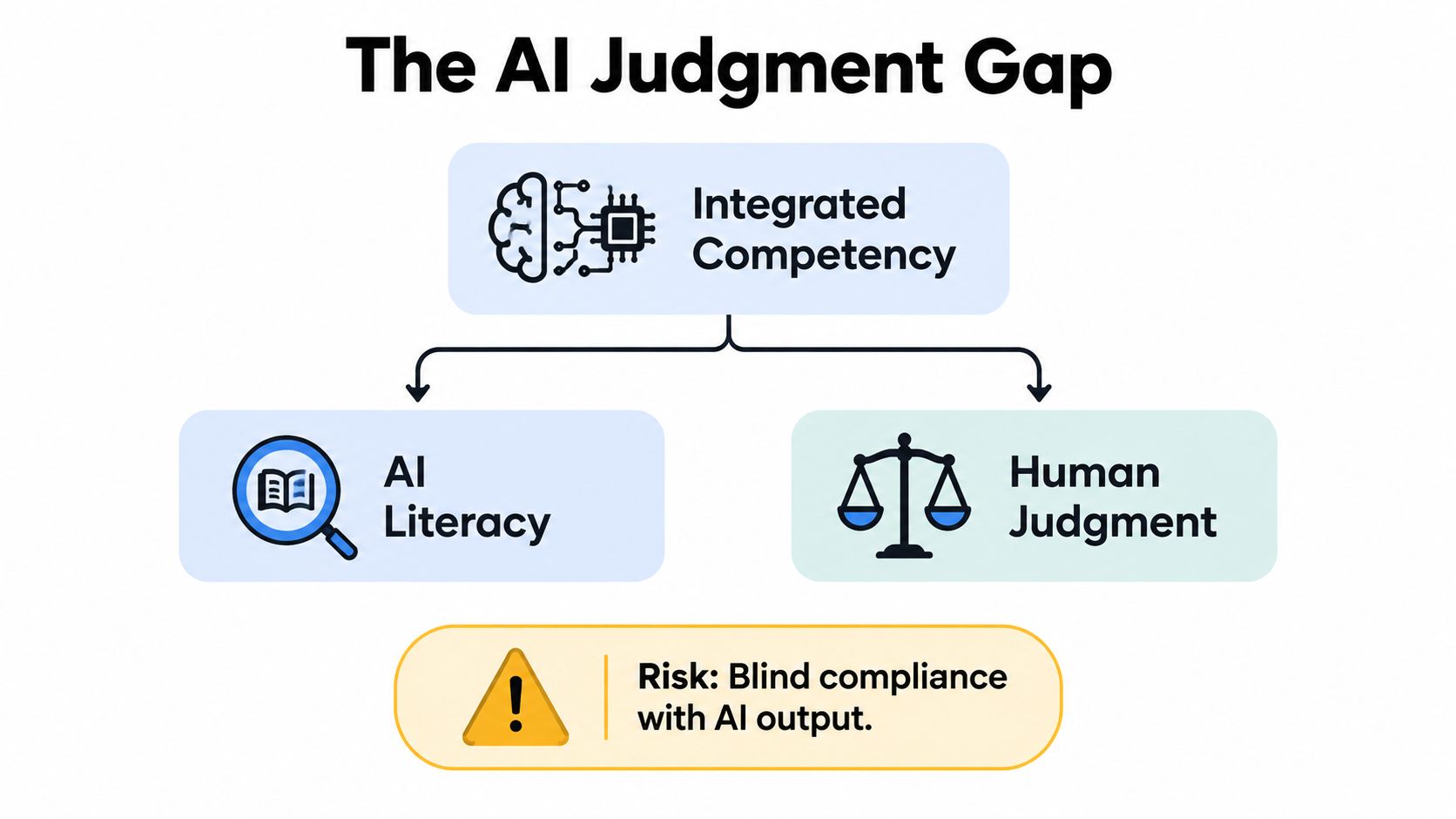
Score the integrated competency through three forms of evidence:
The governance questions must be explicit. Who reviews AI-generated outreach? Who catches an unsupported product claim? Who owns the override when an algorithm recommends pursuing an account that the seller knows is a poor fit? If nobody owns those decisions, the organization hasn't adopted AI responsibly. It has distributed risk.
This matters across markets because data quality, privacy expectations, buyer norms, and regulatory requirements vary. Managers should create psychological safety for questioning algorithmic advice. A rep who spots a weak recommendation and raises it is demonstrating judgment, not resistance.
For the broader role of intelligence in sales workflows, see this practical explanation of [sales intelligence](https://synopsix.ai/blog/what-is-sales-intelligence).
<iframe width="100%" style="aspect-ratio: 16 / 9;" src="https://www.youtube.com/embed/2hibmjFOwVM" frameborder="0" allow="autoplay; encrypted-media" allowfullscreen></iframe>
Turning Competency Data Into OKRs and KPIs
A competency score matters only when it changes work. If a rep shows developing performance in commercial discovery, the OKR should name the behavior, practice routine, and evidence that will demonstrate progress. “Improve discovery” is too vague to coach or evaluate.
A stronger objective is to run discovery conversations that confirm business impact, stakeholder relevance, and a mutually agreed next step. Weekly key results might include reviewed calls, documented impact statements, and manager-scored evidence of follow-up questions. The manager's KPI can track improvement in qualified opportunity progression, drawing on structured [sales performance assessment practices](https://synopsix.ai/blog/sales-performance-assessment) that connect behavioral scores to commercial outcomes.
Competency data also works as a diagnostic system. A low score may indicate a skill gap, but it can also expose weak coaching, poor role design, unclear process, or low motivation. The response should match the cause. Sending every low scorer to training wastes time and hides management problems.
Use different cadences for different decisions
Weekly reviews should examine observable behavior. Monthly calibration should test scoring consistency and connect coaching activity to pipeline movement. Quarterly reviews should examine revenue relationships, promotion decisions, and adverse-impact patterns.
The EEOC's adverse-impact approach requires mechanical selection-rate comparisons rather than intuition. Teams can compare pass rates, promotion velocity, and ratings across protected groups, then investigate disparities instead of assuming the rubric is neutral.
The 27% of sales professionals surveyed by Mercuri International who felt equipped to deliver actionable customer insights shows why customer insight belongs in behavioral measurement, not only in a capability list. ([Sales skills and customer insight findings](https://www.apollo.io/insights/skills-for-sales))
Set intervention triggers that managers can explain and defend. Two consecutive review periods at low proficiency on a role-critical competency should trigger a diagnostic conversation. A hiring pass-rate gap above 5% can trigger additional review, while internal thresholds should complement, not replace, the EEOC's 80% rule-of-thumb screen.
| Competency | Leading Indicator (Weekly) | Lagging Indicator (Quarterly) | Owner | |---|---|---|---| | Discovery quality | Call-review score for impact and follow-up questions | Opportunity progression and win quality | Frontline manager | | Qualification | Evidence of fit, pain, authority, and next action | Pipeline conversion and forecast reliability | AE and RevOps | | Multi-threading | New stakeholder access and account-plan activity | Deal progression and retention | AE or CSM | | Coaching judgment | Completed coaching actions tied to observed behavior | Rep improvement and coaching ROI | Sales manager | | AI-assisted judgment | Audited outputs and documented overrides | Risk incidents and quality of AI-supported opportunities | Sales leader and RevOps |
AI-assisted judgment belongs in the same operating rhythm. Audit outputs and overrides weekly, then review quality, risk incidents, and opportunity outcomes quarterly. Adverse-impact screening follows the same discipline. It is a competency and a management control, not a compliance appendix.
RevOps should own three reporting views: pipeline health by competency cluster, coaching ROI, and promotion readiness. These views stop leaders from treating a low score as a verdict. They show whether to coach the rep, redesign the role, improve managerial practice, or change the hiring profile.
From Framework to Operating System With Synopsix
A framework changes behavior only after it leaves the slide deck. In a people-intelligence workflow, competency profiles can connect candidate screening, interview rubrics, onboarding paths, one-to-one agendas, and promotion reviews. The same behavioral language follows the person through the employee lifecycle instead of resetting at every decision point.
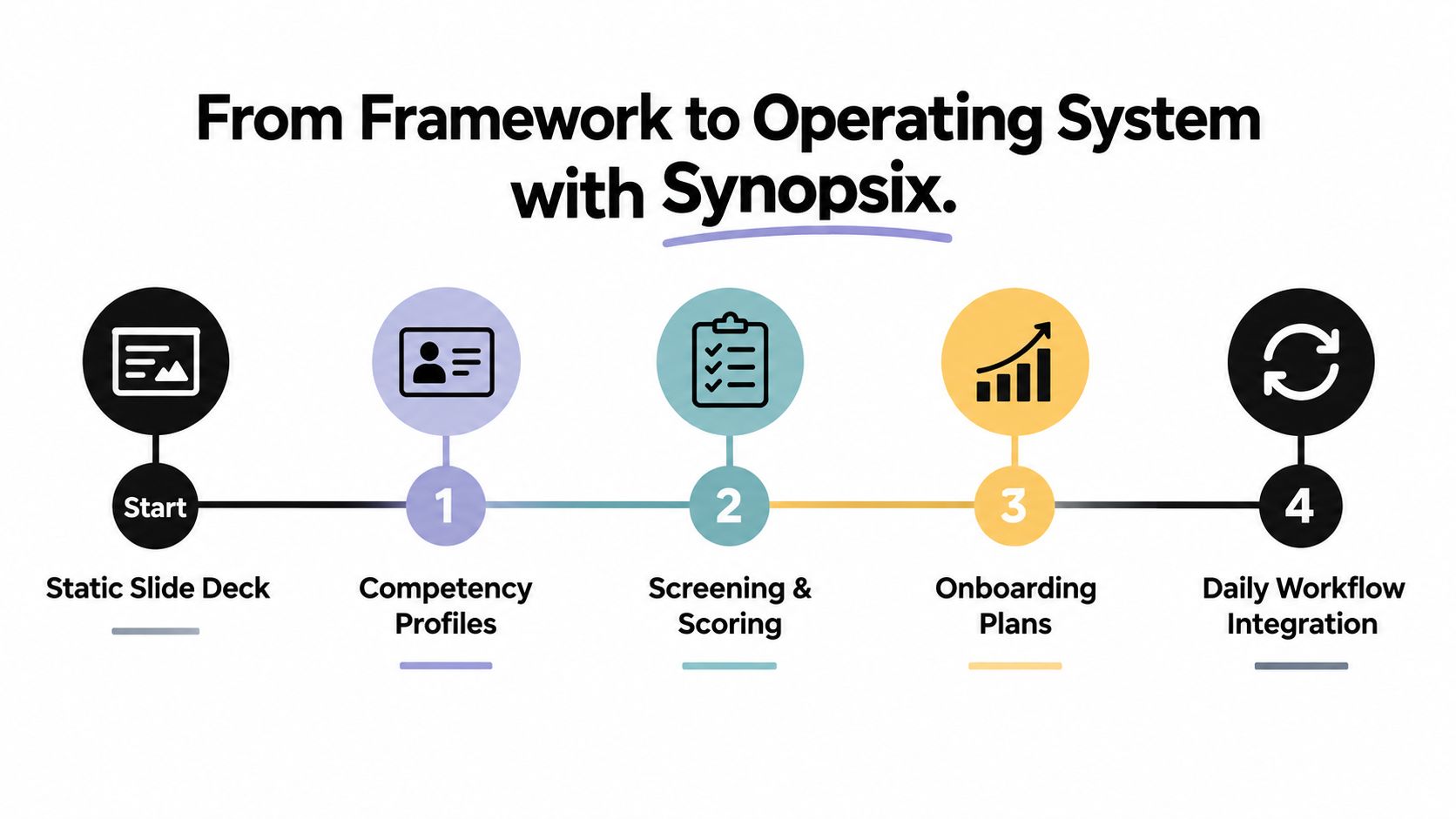
The integration should work in both directions. Candidate and employee assessments inform role fit and development priorities, while performance and pipeline evidence tests whether the original competency model predicts meaningful outcomes. If a behavior doesn't relate to deal progression, retention, forecast quality, or customer value, leaders should revise the model rather than preserve it because it sounds impressive.
A practical rollout follows a 30-60-90 plan:
Retire three misconceptions. A framework isn't a one-time project. More competencies don't automatically create better hiring. AI scoring doesn't replace manager judgment, especially when the decision involves context, ethics, role design, or changing market conditions.
---
Synopsix helps teams turn behavioral assessments into comparable profiles, role-specific sales intelligence, predictive simulations, and practical development plans. Use it to connect competency evidence with hiring, coaching, team design, and promotion decisions, then visit [Synopsix](https://synopsix.ai) to see how the platform can support your sales competency framework.