Sales Leadership Assessment Guide for Hiring Better Leaders
By Synopsix · September 20, 2026 · 16 min read
A CHRO knows this scene too well. The company promotes its top seller into a frontline manager role, everyone feels good about it, and the interviews reinforce the decision. The new manager is confident, persuasive, and respected by peers. Six months later, pipeline discipline is worse, coaching is inconsistent, and the team still depends on a few self-directed reps.
Nothing looks obviously broken. That's what makes the problem expensive.
Most sales leadership failures don't come from a lack of effort. They come from using the wrong lens. Companies often judge managers the way they judge strong individual contributors: presence, energy, communication, and past results. But a sales leader's real job is operational. Can they plan coverage, coach consistently, and control execution? If you don't assess those things directly, you're guessing.
That's where a sales leadership assessment becomes useful. Used well, it isn't a personality label or an HR ritual. It's a practical scorecard for how a leader is likely to run the business through other people.
The clearest systems in this category work a lot like the idea behind predict-human-behavior-synopsix-smarter-people-decisions. They convert behavioral patterns into role-relevant signals that hiring managers can use: who's ready to lead, where risk is hiding, and what support a team will need after the decision.
Introduction Why Sales Leadership Quality Decides Revenue
A regional sales director leaves. You need a replacement quickly. Two internal candidates emerge.
The first is a top rep. She's credible with customers, sharp in interviews, and knows the product cold. The second has lower personal numbers but has a track record of onboarding new hires, running clean deal reviews, and helping weaker reps improve. In many companies, the first candidate gets the role because her performance is easier to see.
Then the team stalls.
The cost of choosing the wrong signal
This is why sales leadership assessment matters. It helps leaders separate selling ability from leadership ability. Those are connected, but they aren't the same thing.
A strong manager has to create repeatability through other people. That means clearer territory planning, better role definition, steadier coaching, stronger forecast discipline, and more consistent accountability. If you only assess charisma or interview polish, you'll miss the mechanics that drive team output.
> Better assessment should separate leaders who merely sound capable from leaders who can actually run a sales system.
There's also evidence that sales leadership quality maps to meaningful business differences. A widely cited 2019 Zenger Folkman analysis of 200,000 assessors and 20,000 leaders found a sharp sales gap by leadership quality, with leaders in the bottom 10% generating less than $100 million in sales and stronger leaders producing substantially higher results. That same work showed overall effectiveness ratings ranging from 2.89 to 4.55, which matters because it shows that structured leadership assessment can distinguish materially different performance tiers, not just stylistic preferences ([Zenger Folkman analysis summary](https://www.linkedin.com/pulse/sales-leadership-accountability-benchmark-report-q1-2026-elken-ri1ve)).
What good assessment changes
When CHROs treat sales leadership assessment as a business control, several decisions get cleaner:
A useful assessment should help you answer plain questions. Can this person build structure? Will they coach in a way reps experience? Can they maintain control without becoming rigid? If the report can't help with those questions, it probably isn't built for the job.
What a Sales Leadership Assessment Really Measures
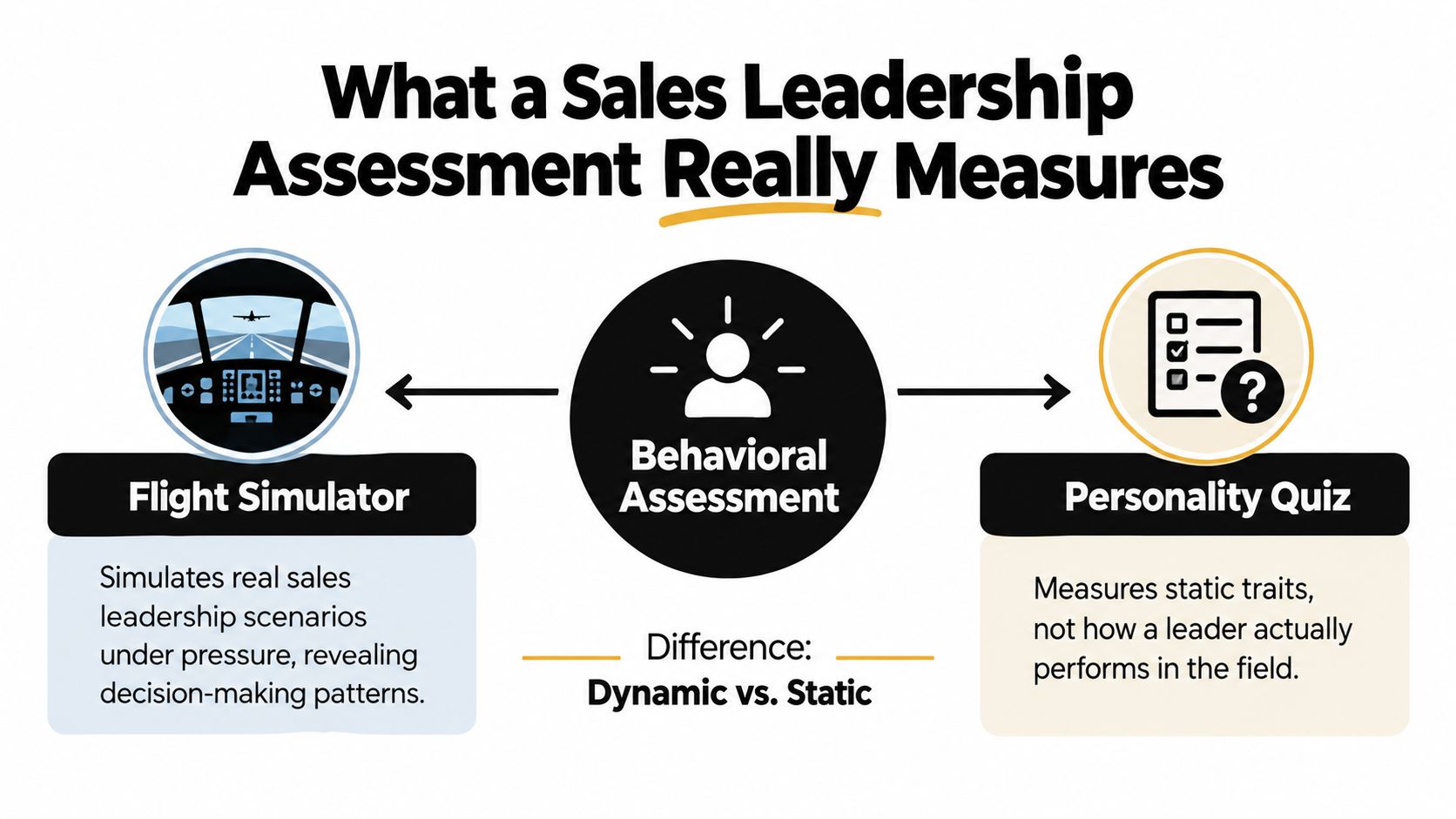
A good sales leadership assessment is closer to a flight simulator than a personality quiz.
A personality quiz tells you something static about a person's tendencies. A behavioral leadership assessment asks a more useful business question: how does this person tend to operate when they have to direct work, set expectations, make tradeoffs, and respond to pressure?
Competencies, behaviors, and motivations
Many buyers get confused. They hear terms like competency, behavior, and motivation and assume they all mean the same thing. They don't.
The reason this matters is simple. Companies don't hire sales leaders to have traits. They hire them to run a team well.
What strong measurement looks like
If you're evaluating tools, look for evidence that the assessment captures behavior from more than one angle. The strongest leadership assessment models rely on multi-rater behavioral data and broad benchmarks rather than self-report alone. One large database cited in sales-leadership research included more than 200,000 assessors, 20,000 leaders, and 1,800 behavior items, then identified 49 behaviors that separated stronger leaders from weaker ones. In one telecom example, each sales leader received feedback from an average of 14 raters ([Zenger Folkman white paper](https://zengerfolkman.com/wp-content/uploads/2019/11/Better-Sales-Leaders-Better-Results_WP-2019.pdf)).
That matters for three practical reasons:
1. Reliability. If many observers see the same pattern, the signal is steadier. 2. Bias reduction. A single enthusiastic executive can overrate a polished candidate. 3. Benchmark calibration. Raw scores mean little unless you can compare them against a meaningful reference group.
> Practical rule: Don't confuse self-description with leadership evidence. The more the tool depends on “how I see myself,” the less useful it becomes for high-stakes promotion or hiring decisions.
What it does not measure well on its own
No assessment should stand alone. It won't replace structured interviews, work samples, or references. It also shouldn't be asked to answer questions it wasn't built for, like product knowledge or market expertise.
What it can do well is narrow uncertainty. It can show whether a candidate is likely to lead through planning, coaching, and control, or whether they mainly project leadership in conversation.
Core Dimensions That Predict Sales Leadership Success
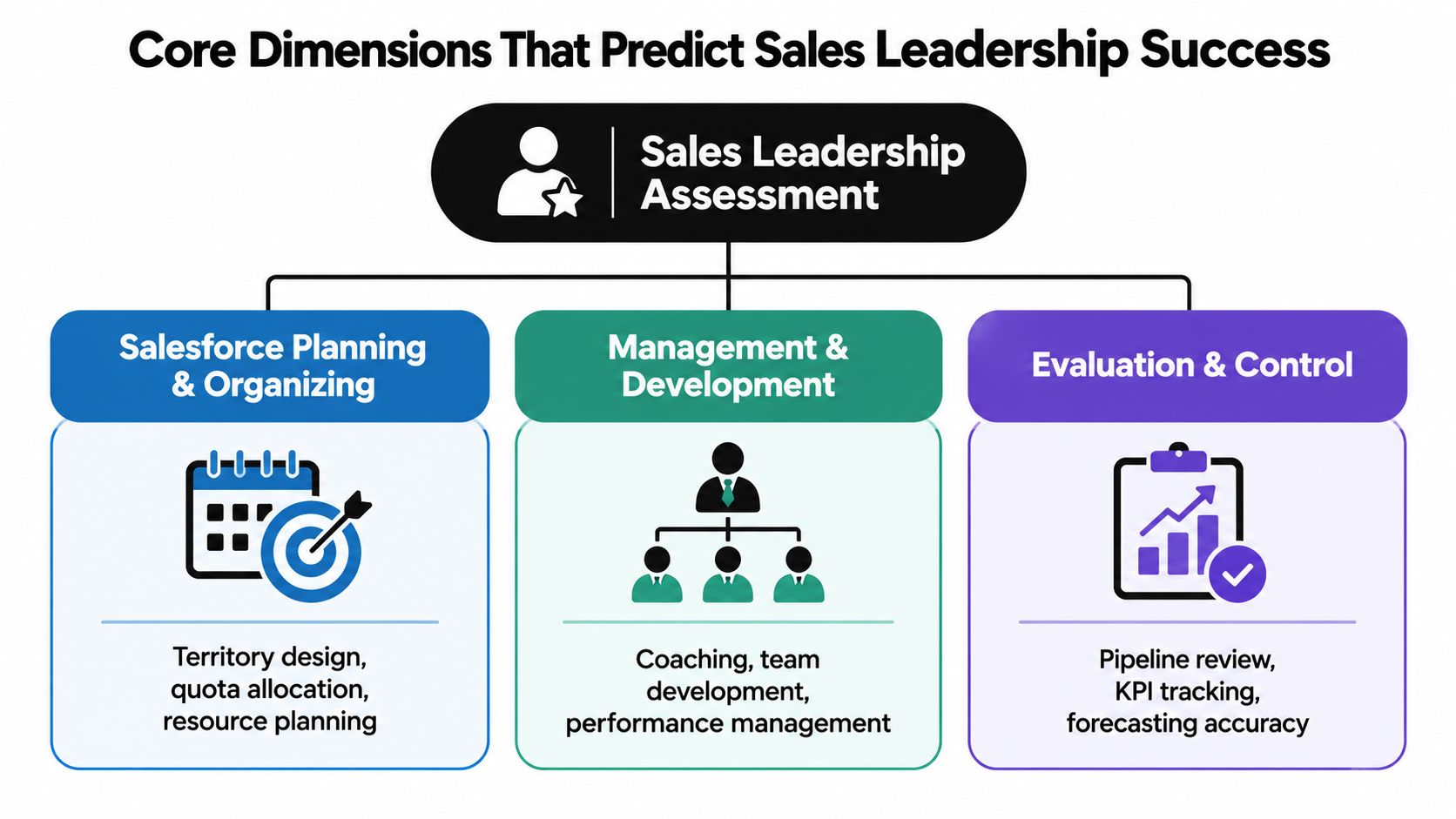
The most useful frame for sales leadership assessment isn't personality type. It's an operational scorecard across planning, development, and control.
That view aligns with a practical framework used by senior sales executives. In a survey of 74 senior sales executives, performance evaluation emphasis was weighted toward management and development at 36% and planning and organizing at 30%, which tells you practitioners judge sales leaders heavily on execution disciplines, not abstract leadership style ([sales leadership framework research](https://www.wku.edu/jos/documents/issues/v18n1/aa1.pdf)).
Salesforce planning and organizing
This domain asks whether the leader can build the structure that sales execution depends on. That includes territory coverage, role clarity, resource allocation, recruitment and selection, and compensation design.
When a manager is weak here, the symptoms often show up elsewhere first. Reps chase the wrong accounts. Quotas feel arbitrary. Coverage is uneven. Forecast calls become debates about definitions rather than decisions.
Look for assessment signals tied to:
A generic personality screen won't tell you much about this. A strong scorecard will.
To see how this same logic applies at the rep level, it helps to compare with a [sales competency assessment model](https://synopsix.ai/blog/sales-competency-assessment) that maps behavior to role demands instead of relying on broad labels.
A short walkthrough can make this easier to picture.
<iframe width="100%" style="aspect-ratio: 16 / 9;" src="https://www.youtube.com/embed/q9gGtQ8hCZg" frameborder="0" allow="autoplay; encrypted-media" allowfullscreen></iframe>
Management and development
This is usually where promotion mistakes show up fastest.
A former top rep may still close business personally, but management and development asks a different question. Can this person improve the output of others? That includes motivating, training, coaching, supervising, and setting performance expectations in a repeatable way.
Weakness here has a direct business effect. Reps take longer to become productive. Underperformance lingers. Coaching turns into encouragement instead of skill-building.
Observable evidence matters more than confidence. You want signs such as coaching cadence, quality of feedback, follow-through on development plans, and whether team members improve over time.
Evaluation and control
This domain covers inspection, discipline, and course correction. Leaders need to review pipeline quality, spot slippage early, maintain standards, and make accurate calls about what's really happening in the field.
Many leaders sound strategic but operate loosely. They talk about accountability but don't inspect enough to sustain it.
> Strong sales leaders don't just inspire effort. They create control points that keep the team honest about execution.
A practical scorecard in this area looks at forecast rigor, review quality, KPI use, and how consistently the manager converts information into action. That's what turns leadership from a vague promise into something a company can hire for, promote on, and improve.
Where Sales Leadership Assessments Create Business Value
The same assessment profile can support very different decisions. That's why many teams get disappointed with assessment tools. They buy one expecting a single “fit” answer, but value comes from using the data differently depending on the decision job.
Four business uses that aren't the same
For hiring, the point is to reduce false positives. You want help spotting candidates who interview well but haven't shown the behavioral pattern needed to run a team.
For promotion, the assessment protects against the classic star-rep trap. It helps separate personal sales success from actual management readiness.
For development, the profile becomes a coaching map. A leader who struggles with control needs a different plan than one who struggles with team development.
For succession, the value is bench visibility. You're not just asking who looks senior. You're asking who has enough evidence across the right dimensions to step into a larger scope role.
Choosing the Right Use Case for Your Assessment
| Use Case | Decision Question | What to Measure Most | | --- | --- | --- | | Hiring | Can this candidate run the sales system, not just present well? | Behavioral evidence tied to planning, coaching, and control | | Promotion | Is this top rep actually ready to lead through others? | Coaching consistency, accountability habits, role-clarity thinking | | Development | Where will targeted support improve manager effectiveness fastest? | Specific gaps in operational leadership behaviors | | Succession | Who can move into larger leadership scope with the least hidden risk? | Breadth across core leadership domains and decision patterns |
Why context changes the action
A hiring team might see low coaching strength as a major warning sign. A development team might see that same result as manageable if the leader already has strong planning discipline and a supportive second-line manager.
That's why interpretation should always connect to context. The report doesn't make the decision for you. It sharpens what you're deciding.
Used this way, a sales leadership assessment creates value beyond selection. It improves how leaders are placed, supported, and combined into teams.
How to Select and Implement the Right Assessment
The selection mistake I see most often is simple. A company chooses a tool because the report looks polished, not because the measurement model fits the decision.
A better approach starts with the role and works backward.
What to check before you buy
Start with four questions.
1. Is it behaviorally grounded? You want evidence tied to how leaders operate, not broad type descriptions. 2. Is there benchmark depth? A score only helps if you can compare it against a meaningful reference set. 3. Can decision-makers read it in business language? If only a psychologist can explain the output, adoption will stall. 4. Does it reduce single-rater distortion? Broader input usually improves reliability.
Be cautious with generic personality screens used as primary leadership filters. They can be useful for communication awareness, but they often miss the difference between a manager who appears strong and one who creates repeatable team execution.
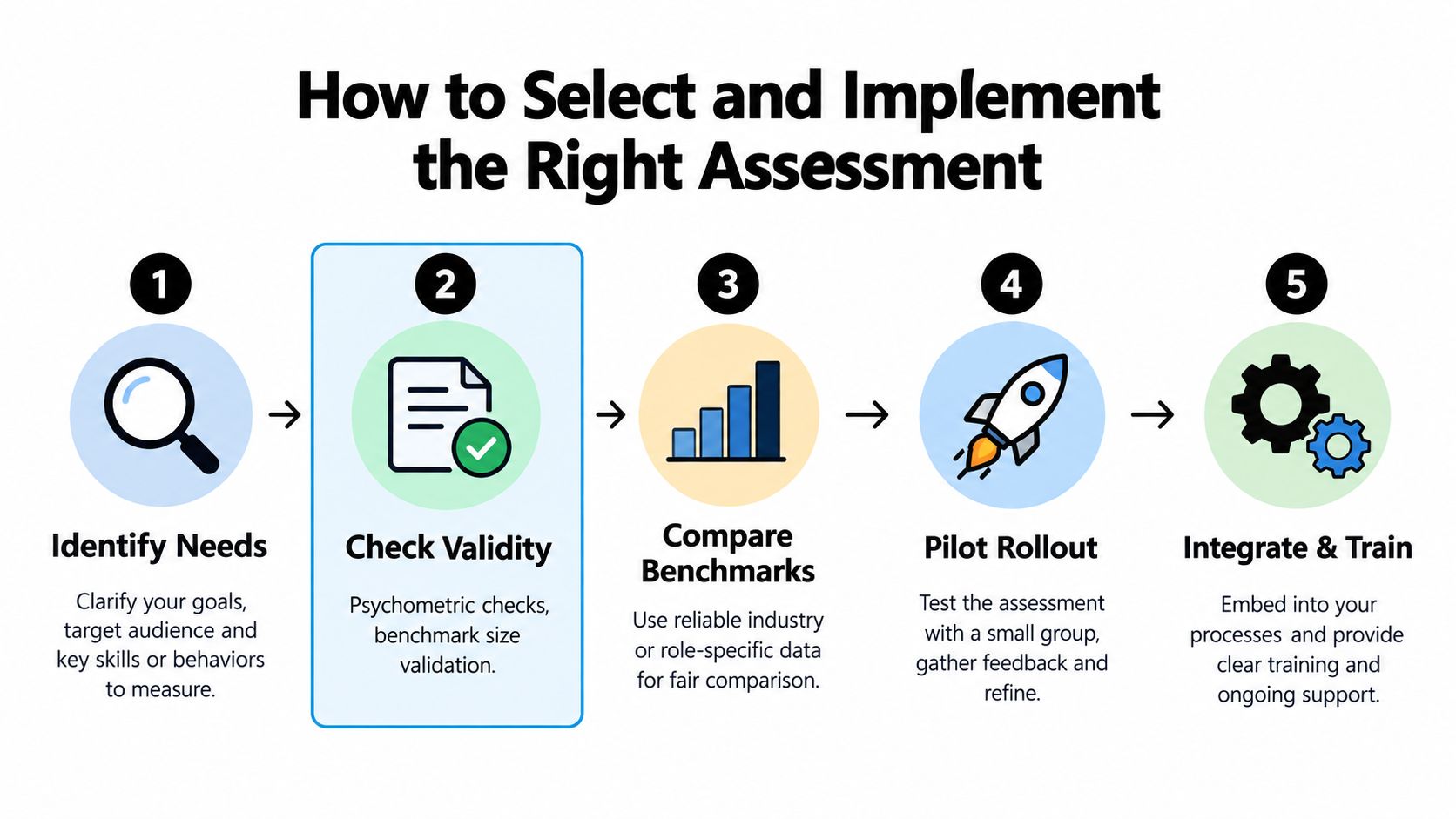
A practical rollout model
Implementation should feel lighter than most HR systems make it.
One workable sequence is:
That's the logic behind tools designed to move from assessment to action. One example is [leadership assessment tools built for business-language reporting](https://synopsix.ai/blog/leadership-assessment-tools), where the output is meant to support hiring, team design, and follow-on development rather than just produce a psychometric label.
Implementation details that matter later
Rollout quality usually depends on small operational choices.
If you're pairing behavioral assessment with interview process design, this guide to [designing a culture fit interview](https://www.theokrhub.com/insights/cultural-fit-assessment) is useful because it helps distinguish role-relevant fit from impression-based fit.
The goal isn't more testing. The goal is better decisions with less noise.
Interpreting Results Risk Indicators and ROI in Practice
Most sales leaders don't need a lesson in psychometrics. They need help reading a report without getting lost in jargon.
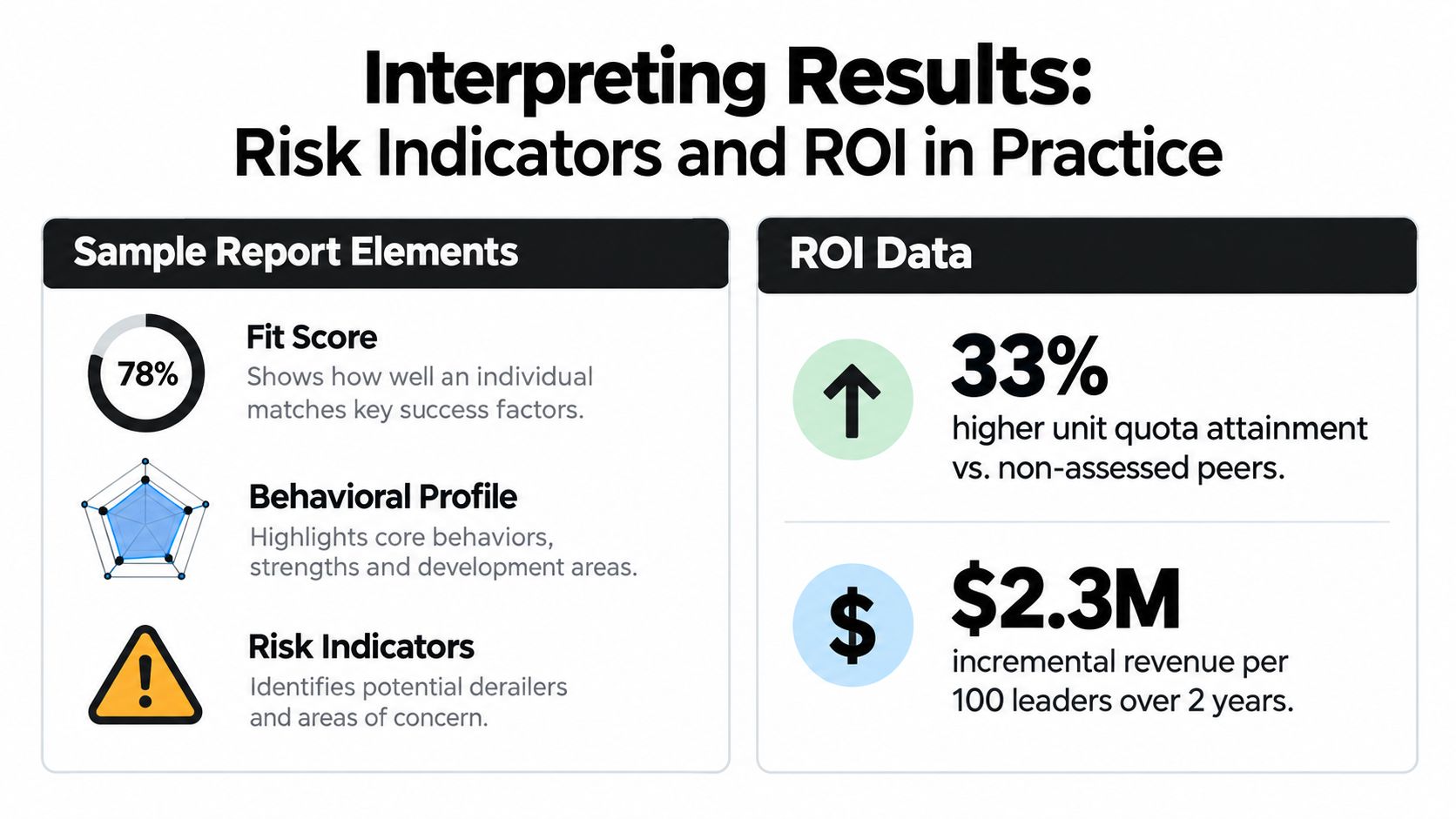
A useful report should translate complex measurement into four plain outputs: overall fit, behavioral profile, risk indicators, and role-specific implications.
What to read first
Start with the risk indicators, not the summary label.
A “good fit” recommendation can still hide practical issues. A candidate may look strong overall but show a likely pattern of weak inspection, low developmental follow-through, or overconfidence in coaching quality. Those are the details that shape the decision.
One of the most useful reminders here comes from coaching research. In 2025 research, 94% of managers said regular coaching was part of their process, yet 53% of sellers said they received coaching quarterly or less and 37% said they rarely or never got personalized feedback. That gap suggests many organizations overrate leader presence and under-measure coaching consistency ([Salesloft research on coaching gaps](https://www.salesloft.com/company/newsroom/new-salesloft-research-uncovers-the-most-critical-sales-skill-gaps-in-2025)).
> Read the report as a pattern of operating risk, not a verdict on personality.
How to turn interpretation into action
Once the risk is visible, the next question is operational. What should change?
A report is most useful when it doesn't stop at description. That's why interpretation frameworks such as [assessment interpretation in business language](https://synopsix.ai/blog/assessment-interpretation) matter. They help managers move from “interesting profile” to “here's what we should do next.”
What ROI looks like in practice
You don't need a complicated finance model to justify this work. The value often shows up in fewer promotion mistakes, cleaner finalist decisions, better early support for new leaders, and more credible succession conversations.
The mistake is expecting one report to “predict revenue” on its own. A better expectation is that strong interpretation improves the quality and consistency of people decisions that affect revenue execution later.
Pitfalls to Avoid and Best Practices That Scale
Many assessment programs fail for ordinary reasons. The tool may be fine, but the operating discipline around it is weak.
The biggest pitfall is treating sales leadership assessment like a one-time gate. A candidate passes or fails, the organization moves on, and nobody uses the data again. That wastes most of the value.
The mistakes that create avoidable noise
Three errors show up repeatedly.
A historical indicator reinforces why differentiation matters. A 2020 Forbes summary of Zenger Folkman data reported five leadership bands from the lowest 10% to the highest 10%, with the top 10% achieving a 7.4% increase in results while the least effective leaders saw only a 0.7 increase ([Forbes summary cited here](https://www.preemploymentassessments.com/blog/sales-leadership-test/)). The exact takeaway for CHROs isn't about any single number. It's that structured differentiation between stronger and weaker leaders can connect to measurable business outcomes.
The habits that scale better
Good programs are usually boring in the best way. They are consistent, interpretable, and tied to decisions managers already make.
Use this checklist:
> The assessment should be one part of a decision system. If it can't influence hiring, promotion, development, and team design, it isn't set up to scale.
A disciplined sales leadership assessment process won't eliminate judgment. It improves judgment by giving leaders a better view of the behaviors that run the revenue engine.
---
Synopsix helps teams turn behavioral assessment data into practical hiring and leadership decisions, including comparable profiles, role-specific intelligence reports, simulations, and development planning. If you're trying to reduce promotion mistakes, improve manager selection, or design stronger leadership teams, visit [Synopsix](https://synopsix.ai) to see how the platform supports assessment-to-action workflows.