Sales Performance Assessment: A Practical Guide
By Synopsix · September 24, 2026 · 15 min read
Only 43.14% average quota attainment was reported in one recent sales productivity summary, while 69% of reps missed quota. At the same time, sales cycles were reported as 38% longer than in 2021, and win rates had declined 18% from 2022 levels. [The underlying industry summary](https://www.everstage.com/sales-productivity/sales-productivity-statistics) makes the problem clear: a quarter-end scorecard can tell you who missed, but it can't reliably tell you why.
Sales performance assessment now needs to function as a revenue-operations decision system. HR, Talent Acquisition, RevOps, sales managers, and the CRO should be able to read the same evidence when they hire, assign territories, set quotas, coach reps, and review promotion readiness. This guide shows how to combine commercial outcomes with pipeline signals and behavioral evidence without turning assessment into another vanity dashboard.
Why Sales Performance Assessment Matters More in 2026
A sales scorecard that arrives after quarter close has limited operational value. Sales performance assessment should show whether current behavior can produce future revenue, then give leaders time to act on that evidence.
The missed-quota figures cited earlier establish the pressure. The more useful question is what leaders could have seen before the result was final. Weak pipeline coverage can expose insufficient opportunity creation. Falling stage-to-stage conversion can point to poor qualification or weak messaging. Forecast variance can reveal inconsistent deal inspection, while a lengthening sales cycle may signal stalled buying groups, territory friction, or an enablement gap.
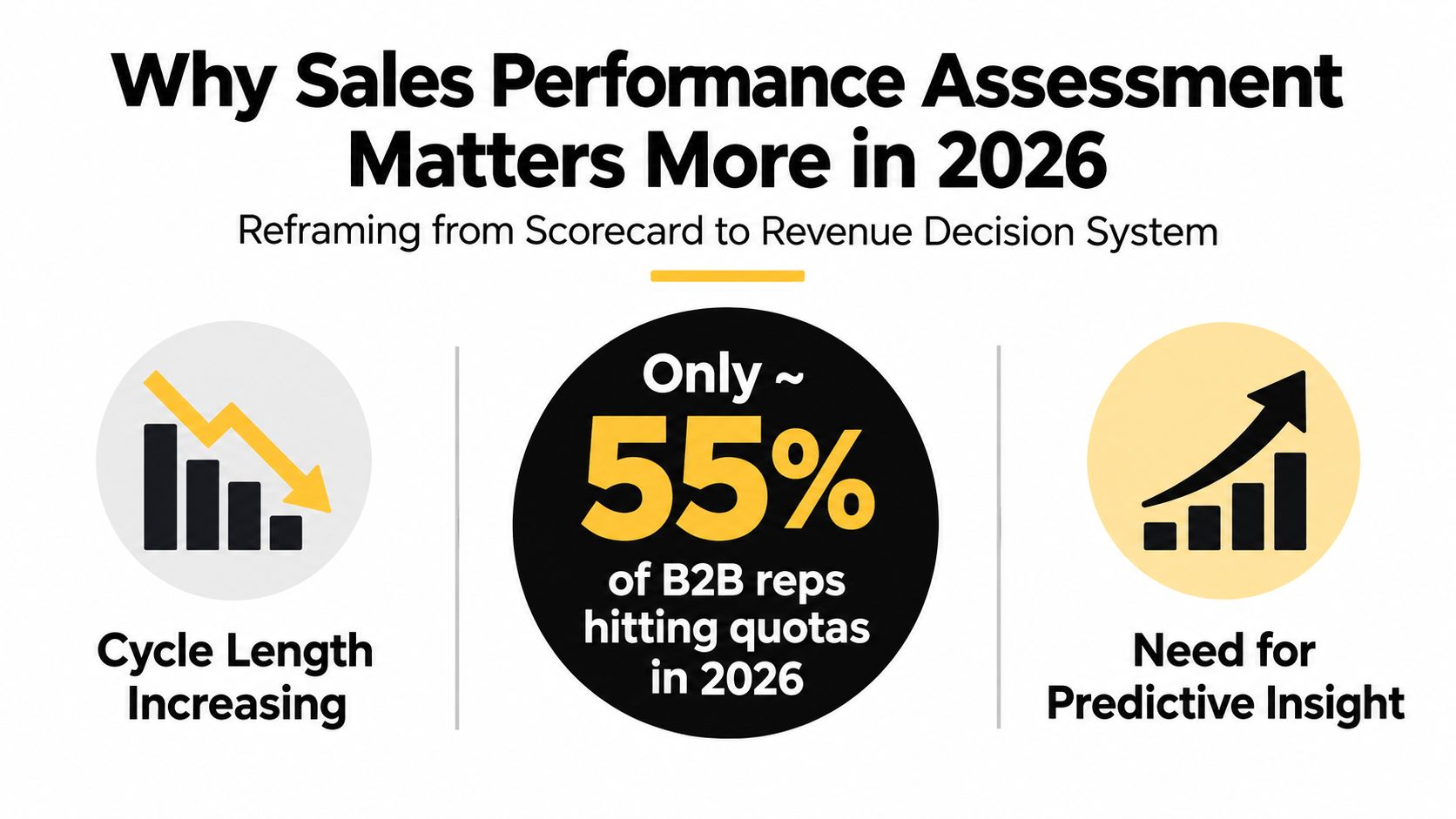
Scorecards arrive too late
Closed revenue, attainment, and activity remain useful evidence, yet they describe a period leaders can no longer change. A revenue-operations assessment pairs those outcomes with leading indicators, including coverage, conversion, forecast accuracy, cycle movement, retention, and rep productivity. That combination supports decisions about coaching, territories, qualification standards, and hiring before a weak quarter becomes a pattern.
Behavioral science improves the interpretation. A rep who creates activity spikes near deadline may be responding to incentives rather than demonstrating a repeatable process. A seller with fewer meetings but stronger discovery, stakeholder mapping, and follow-up may have higher future value. Assessment should therefore examine observable behaviors in context, not reward volume without considering decision quality.
AI-guided interpretation can help teams detect these patterns across CRM records, call notes, forecast changes, and outcomes. It should surface evidence and explain likely drivers, while managers and HR retain responsibility for judgment, validation, and fair use. HR can test assessment validity, RevOps can maintain data definitions, sales leaders can interpret role-specific execution, and the CRO can approve benchmarks tied to business economics.
> Practical rule: Treat a low score as a signal for investigation. Check territory conditions, lead quality, deal mix, enablement, and quota design before labeling execution as the cause.
Teams connecting prospecting behavior to commercial outcomes can use this [guide to win lift for B2B prospecting](https://www.capyscout.com/help/signal-performance-win-lift) as a practical reference. Moving assessment upstream lets leaders change territory coverage, qualification, coaching, and hiring criteria before the quarter closes.
The Core Metrics That Drive Modern Sales Evaluation
A useful sales performance assessment starts with four metric buckets: productivity, efficiency, quality, and quantity. These categories prevent leaders from confusing busy activity with effective selling, or strong revenue with a repeatable process.
The categories come from contemporary guidance that treats sales performance as multidimensional rather than as a single number. [Exec's sales performance evaluation guidance](https://www.exec.com/learn/sales-performance-evaluation) describes the broader framework, while [Prometheus Agency's resource on building a revenue-driving dashboard](https://prometheusagency.co/insights/sales-performance-metrics-dashboard) is useful when translating the model into operational reporting.
Four Metric Buckets in Sales Performance Assessment
| Metric Bucket | Lagging Outcome KPI | Leading Input KPI | SaaS AE Example Weight | |---|---|---|---| | Productivity | Quota attainment, revenue per rep | Qualified opportunities created | High | | Efficiency | Sales cycle length, deal velocity | Time to first meeting, stage progression | Medium | | Quality | Win rate, forecast accuracy | Pipeline coverage, qualification completeness | High | | Quantity | Bookings volume, opportunity volume | Calls, emails, demos, meetings | Low to medium |
The table is a starting point, not a universal template. A SaaS AE handling a repeatable segment may carry substantial weight on quota attainment, win rate, and pipeline coverage. A strategic AE managing complex buying groups needs more emphasis on forecast accuracy, deal progression, margin, product mix, retention, and the quality of multi-stakeholder engagement.
Pair causes with outcomes
Quota attainment tells you what happened. Pipeline coverage and qualification discipline help explain why it happened. A high activity count with weak conversion may indicate poor targeting or weak messaging. A healthy pipeline with inaccurate forecasts may indicate stage inflation or insufficient deal control.
For each role, choose at least one leading and one lagging signal in every relevant bucket. Then document the logic. If the team can't explain how a metric connects to revenue, customer value, or controllable behavior, remove it from the scorecard.
Teams building a role-specific framework can use the [sales competency assessment resource](https://synopsix.ai/blog/sales-competency-assessment) to connect commercial indicators with the capabilities behind them. The right weighting makes the scorecard useful for coaching, hiring, and compensation. The wrong weighting creates mis-hires and rewards behavior that looks productive but doesn't create durable revenue.
Behavioral Indicators That Outcome Metrics Miss
Revenue metrics describe results. They don't fully explain the behavior that produced those results, and they don't always predict how a person will perform in a new territory, segment, product motion, or buying environment.
A meta-analysis in personnel selection found that the general factor of personality predicts sales performance, while narrower job-aligned traits predict specific sales criteria beyond the Big Five. [The personnel selection literature](https://repub.eur.nl/pub/51139/Sitser-Thomas_PROEFSCHRIFT.pdf) supports a practical conclusion: behavioral evidence is most valuable when it connects a trait to a defined sales behavior, not when it produces a generic personality label.
Three families of useful signals
Personality traits can illuminate persistence, conscientious execution, assertiveness, and achievement orientation. These signals help explain why two reps with similar pipeline coverage may differ in follow-through, preparation, or willingness to create new opportunities.
Motivational drivers show what sustains effort. One seller may respond to financial rewards, another to autonomy, and another to purpose or mastery. Motivation doesn't replace quota data, but it can shape how managers design coaching, incentives, and role environments.
Social competencies matter most in complex conversations. Empathy, active listening, objection handling, consultative questioning, and adaptive communication can affect how a seller manages multiple stakeholders and responds to resistance.
Research on assessment-center style selection found that motivation for sales success combined with social competence predicted field sales performance one year later, with the interaction explaining additional variance beyond exercise scores and overall assessment ratings. [The published study](https://www.tandfonline.com/doi/full/10.1080/08853134.2022.2037436) points toward a better design principle: measure combinations of behavior that reflect the actual job.
Don't confuse self-description with evidence
Self-report has a place, but candidates and employees can present an idealized version of themselves. Independent hiring-behavior research found that stated behavioral intentions didn't reliably predict actual hiring behavior, reinforcing the need to validate assessments against observed outcomes rather than self-report alone. [The factorial survey experiment](https://sociologicalscience.com/download/vol_11/september/SocSci_v11_886to906.pdf) supports using simulations, structured interviews, manager observations, and CRM evidence together.
<iframe width="100%" style="aspect-ratio: 16 / 9;" src="https://www.youtube.com/embed/B2MJgwioqxg" frameborder="0" allow="autoplay; encrypted-media" allowfullscreen></iframe>
The practical standard is triangulation. Use behavioral indicators to generate hypotheses, then test those hypotheses against observed selling behavior, conversion quality, coaching response, and customer outcomes.
Assessment Methodologies for Hiring and Development
No single assessment method answers every talent question. Psychometric inventories, structured interviews, simulations, and AI-assisted analysis each capture a different layer of performance.
Psychometric inventories can surface stable tendencies such as conscientiousness, achievement motivation, and social competence. Use them as structured inputs for role fit and development, not as standalone hiring verdicts. The [personnel analytics research](https://onlinelibrary.wiley.com/doi/10.1111/peps.12608) describes how machine-learning approaches can improve pre-employment assessment scoring for turnover and in-role performance, provided prediction generalizes across outcomes and candidate samples.
Competency-based interviews test how candidates handled prospecting, qualification, negotiation, prioritization, and learning in actual situations. Use anchored rating rubrics. A score of “strong” should describe observable evidence, not a manager's general impression.
Assessment-center simulations expose behavior under realistic pressure. A discovery-call role-play can reveal questioning, listening, and objection handling. An in-basket exercise can show prioritization. A presentation drill can test clarity, commercial judgment, and adaptation to the audience.
AI-augmented tools can support conversation analytics, resume parsing, structured scorecards, and comparative reporting. They should reduce inconsistent interpretation, not remove human accountability. Leaders still need to inspect the assessment design, monitor disparate outcomes, and review evidence before making consequential decisions.
Assessment Methods Mapped for Each Lifecycle Stage
| Method | Hiring | Onboarding | Development | Promotion | |---|---|---|---|---| | Psychometric inventory | Role-fit input | Baseline profile | Coaching hypotheses | Readiness context | | Competency interview | Structured selection | Success-profile review | Targeted reflection | Evidence-based review | | Simulation | High-value finalist stage | Practice baseline | Skill diagnosis | Scope and complexity test | | AI-augmented analysis | Consistent scoring support | Pattern identification | Conversation coaching | Cross-source comparison |
A sensible stack uses multiple methods for important decisions. Combine a role-relevant inventory with a structured interview and a simulation, then compare the results with later CRM and manager data. For development, repeat the behavioral assessment only when the business question changes. Don't create assessment fatigue by measuring the same construct without a clear decision attached to it.
For a deeper look at applying evidence to candidates, see this [sales candidate assessment framework](https://synopsix.ai/blog/sales-candidate-assessment).
Implementing Assessments Across the Sales Lifecycle
Implementation fails when assessment lives in HR while performance data lives in Salesforce, HubSpot, or a separate RevOps warehouse. Build one operating model with clear ownership, a defined sequence, and a shared language for evidence.
Start with the role, not the instrument
Translate the job description into a success profile. Define the sales motion, customer complexity, buying committee, expected behaviors, commercial outcomes, and likely failure modes. Then assign weightings to the measures that the role can directly influence.
Ownership should be explicit:
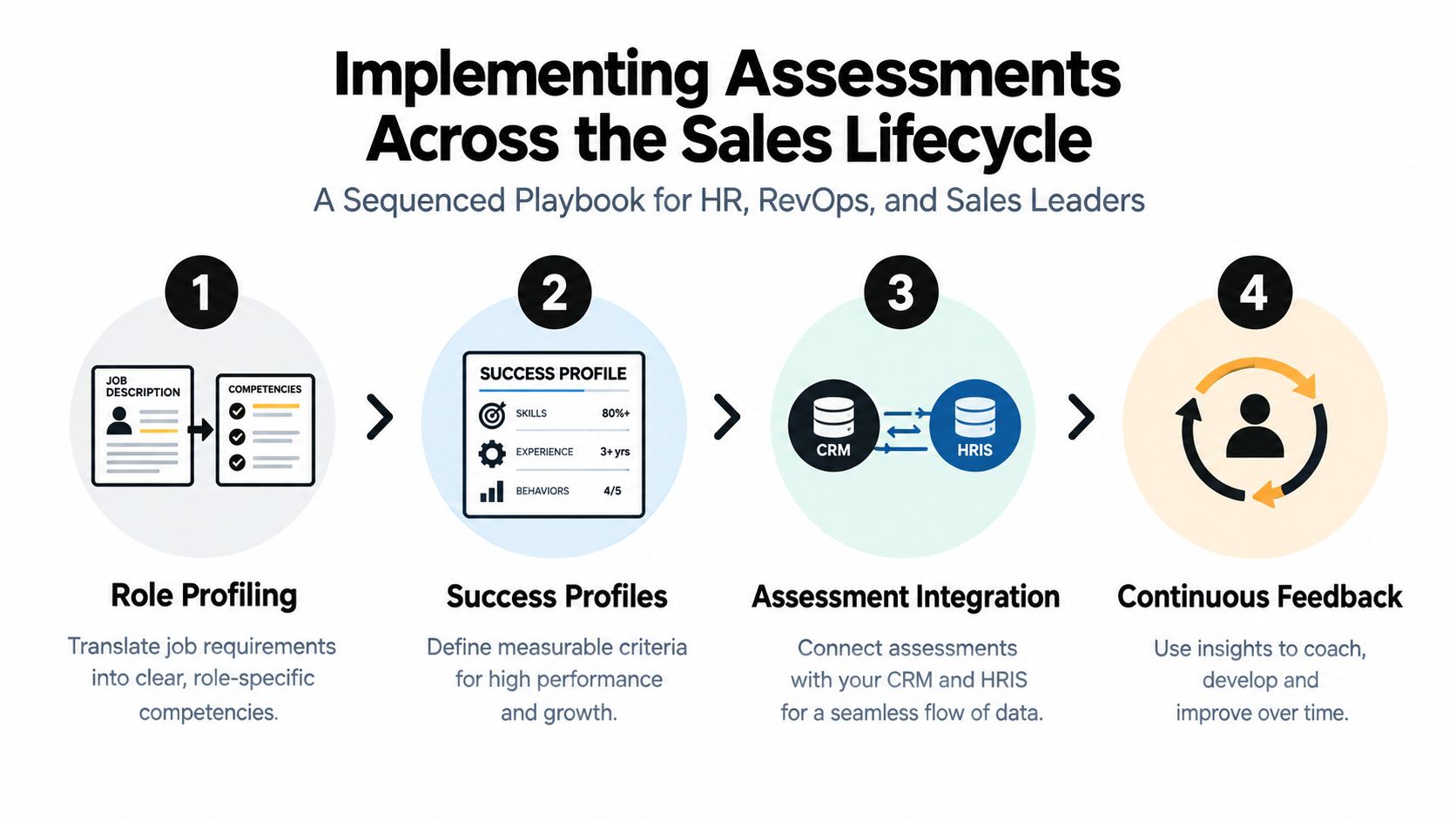
Sequence the operating process
Use a repeatable flow:
1. Profile design: Define competencies, metrics, and role-specific success criteria. 2. Instrument selection: Choose the smallest assessment stack that answers the decision. 3. Candidate or rep experience: Explain the purpose, timing, accessibility, and data use. 4. Scoring rubric: Set behavioral anchors before reviewing individual results. 5. Debrief protocol: Compare evidence across interviewers and data sources. 6. Follow-up cadence: Convert findings into onboarding, coaching, or development actions.
Read score distributions carefully. Flag unusual patterns, inconsistent rater behavior, and adverse-impact signals. Don't over-interpret a small sample, and don't treat a high assessment score as proof of future quota attainment. Assessments are decision inputs. Calibration meetings keep the program honest by forcing HR, RevOps, and sales leaders to explain what the evidence means and what action follows.
Integration Examples and ROI in Practice
A hiring assessment becomes commercially useful only when the business connects it to later performance. The strongest programs don't stop at a candidate score. They compare the score with ramp progress, pipeline creation, conversion quality, manager observations, retention, and quota outcomes.
Consider a B2B SaaS company screening 120 SDR candidates with a structured competency interview and a simulated discovery call. The company narrows the group to 12 hires, whose 12-month quota attainment runs 18 points higher than the previous cohort. Their six-month attrition falls from 38% to 21%. This example is part of the operating scenario, not a universal benchmark, and it works because the selection process tests prospecting discipline, social competence, achievement motivation, and learning agility in behaviorally relevant contexts.
A second scenario involves an account management team. Behavioral assessment identifies a cluster of reps with low coachability and adaptive selling. Managers pair those findings with targeted enablement, then observe competitive-deal win rates rising 11% within two quarters. The commercial value comes from linking the intervention to a specific behavioral gap instead of assigning generic training to the whole team.
Measure hard and soft returns
Hard ROI can include incremental ARR, lower ramp cost, improved retention, stronger forecast accuracy, and higher win rates. Soft ROI includes manager time saved, clearer promotion decisions, better coaching conversations, and less disagreement between HR and sales leadership.
The operating view should combine:
Teams looking to connect these layers can use this guide on [how to improve sales team performance](https://synopsix.ai/blog/how-to-improve-sales-team-performance). The goal isn't to claim that one score caused a revenue result. The goal is to build a traceable decision view that shows what was measured, what changed, and which conditions shaped the outcome.
Pitfalls, Compliance, and Fair Benchmarking
The most common assessment error is blaming the rep for a system problem. A downturn, weak territory, poor lead quality, stretched sales cycle, or misaligned incentive can depress results even when the seller's execution is sound.
A fair benchmark combines historical internal baselines, top-performer standards, industry averages, and target thresholds. [Monday.com's sales analysis guidance](https://monday.com/blog/crm-and-sales/sales-analysis/) explains why this calibrated approach matters. Quota attainment below target may indicate quota design trouble. Low conversion may point to lead quality, qualification, or closing effectiveness.
Pitfalls vs. Compliance Controls
| Pitfall | Compliance or Fairness Control | |---|---| | Judging reps only on lagging revenue | Add pipeline, conversion, cycle, and territory context | | Treating coverage gaps as rep weakness | Compare lead supply, segment conditions, and peer baselines | | Using self-report as objective proof | Validate with interviews, simulations, manager evidence, and outcomes | | Applying one scorecard to every role | Build role-specific competencies and weightings | | Ignoring disparate outcomes | Monitor selection and promotion results by relevant subgroup | | Letting AI make the final decision | Keep human review, documentation, and appeal routes |
EEOC, GDPR, and emerging AI-act requirements make governance part of the assessment design. Each instrument needs a documented job connection, an accessibility review, adverse-impact monitoring, secure data handling, and a clear explanation of how results influence decisions. Validate selection tools with at least 30 hires per subgroup before promotion decisions, as a practical minimum for interpreting subgroup patterns rather than relying on isolated outcomes.
When disparities surface, use a four-step remediation loop: pause the decision, inspect the instrument and data, test a revised process, and document the result. Don't hide a weak tool behind manager discretion. Replace it or narrow its use.
Action Checklist and Synopsix Use Cases
A workable sales performance assessment program can be launched with a focused sequence:
1. Metric selection: Choose outcome and leading indicators for each role. 2. Behavioral indicator mapping: Connect traits, motivation, and social competencies to sales behaviors. 3. Methodology choice: Select interviews, inventories, simulations, or AI-assisted analysis by decision. 4. Stakeholder alignment: Assign responsibilities to HR, RevOps, managers, and the CRO. 5. CRM integration: Connect performance evidence to pipeline and forecast data. 6. HRIS integration: Preserve assessment history and lifecycle context. 7. Compliance check: Review validity, accessibility, privacy, and adverse impact. 8. Pilot testing: Test scoring consistency and decision usefulness before broad deployment. 9. Scale deployment: Standardize candidate, rep, manager, and debrief experiences. 10. Review cycle: Recalibrate benchmarks and weightings as roles and markets change.
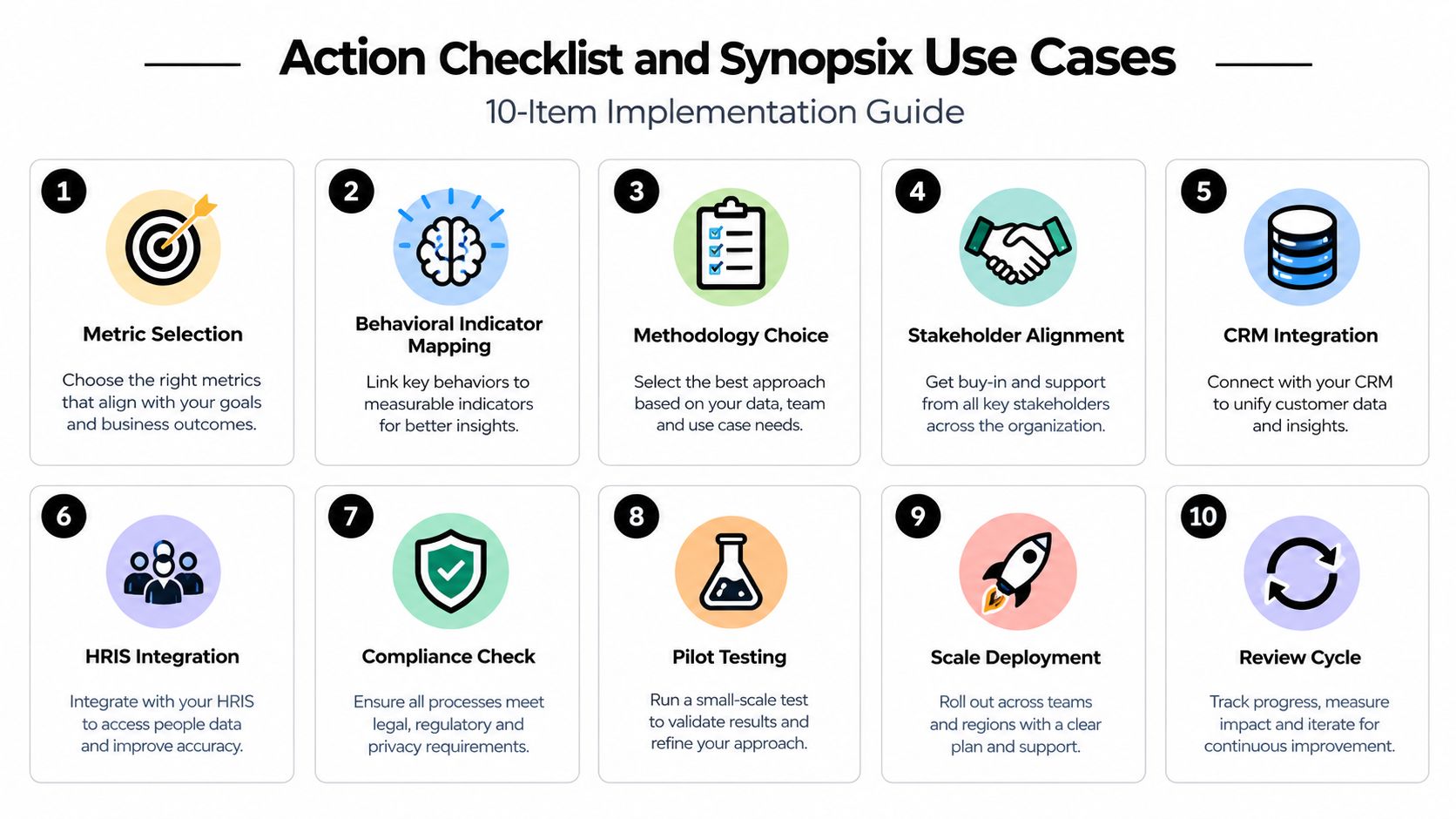
Two practical operating scenarios
A mid-market SaaS firm rebuilding its AE hiring funnel after a 42% ramp-time miss can use a competency blueprint to define the role, an AI-assisted interview interpretation workflow to compare evidence consistently, and a cohort dashboard to track ramp time, forecast accuracy, and early pipeline quality. The measurable question is whether the revised process improves ramp performance without creating unfair selection patterns.
A RevOps team working with an underperforming cohort can use behavioral diagnostics to isolate coachability, adaptive selling, qualification, or execution gaps. The team then pairs the findings with targeted coaching and monitors win rate, sales cycle, and forecast accuracy rather than relying on activity volume alone.
The publisher's platform, Synopsix, combines behavioral assessments, comparable profiles, role-specific intelligence reports, predictive simulations, and team compatibility analysis for hiring, promotion, and development decisions. Use it as one component of a governed assessment stack, with CRM outcomes and human review providing the commercial context.
---
Use [Synopsix](https://synopsix.ai) to turn behavioral assessment results into role-specific hiring, coaching, and team-development signals. Start by defining one sales role, connect its assessment evidence to CRM outcomes, and review the first calibration cycle with HR, RevOps, and sales leadership before expanding the program.