Sales Personality Assessment: What It Predicts and Why
By Synopsix · November 27, 2026 · 20 min read
Most hiring advice in sales still clings to a single archetype: find the loudest, most charismatic extrovert in the applicant pool and hand them a quota. That habit costs revenue teams millions in missed targets and avoidable turnover. A sales personality assessment doesn't detect a universal "born seller" gene, because no such trait exists across every selling motion.
Employers already lean heavily on testing. According to [SHRM data cited in a recent assessment-industry report](https://disctest.org/disc-assessment-statistics/), 56% of employers used pre-employment assessments in 2025 to evaluate applicants' knowledge, skills, or abilities. Yet broad testing hasn't magically produced full floors of quota-beating reps. From 2023 to 2025, only 27% of salespeople demonstrated strong Sales DNA in [Objective Management Group's assessment data](https://www.objectivemanagement.com/research-blog/research/your-company-already-has-an-assessment-sales-still-needs-its-own/).
The gap comes from treating personality as a pass-or-fail label instead of a role-dependent combination of traits. Different sales jobs reward very different behavioral patterns, and any single trait score predicts far less than vendors promise. When hiring teams want to predict human behavior for smarter people decisions, they pair validated behavioral profiles with structured interviews and job-relevant work samples rather than outsourcing judgment to a standalone score.
How Assessments Turn Answers Into a Profile
Think of a sales personality assessment as a weather forecast for workplace behavior, not a verdict on a candidate's worth. A forecast tells you the probability of rain under specific conditions so you can pack accordingly. An assessment estimates how a rep is likely to respond to rejection, loose oversight, or complex negotiations so you know where to probe before making an offer.
Inputs From Questionnaires to Free Text
Modern psychometric tools build that forecast from three types of candidate input, usually collected in a fixed sequence:
Forced-choice and rating items: Candidates select which of two workplace statements describes them better or rate how strongly they agree with behavioral prompts. Tools built on the Big Five model, such as the Hogan Personality Inventory or SHL's Occupational Personality Questionnaire, rely heavily on standardized item sets to limit social-desirability bias. Situational judgment prompts: Applicants read a short workplace scenario, such as a procurement delay on a stalled deal, and choose or rank their preferred response. These items capture practical judgment in context rather than abstract self-descriptions. Free-text response analysis: Newer assessment platforms also evaluate written answers to open-ended prompts, looking for consistent behavioral signals alongside structured choices.
Outputs That Hiring Managers Actually See
Once scored, raw answers turn into three distinct outputs. First come trait scores, typically displayed as percentiles against a reference norm group. Second is a competency view mapping tendencies to applied sales skills like prospecting discipline or commercial negotiation. Third is a behavioral profile summarizing how the candidate tends to operate when targets tighten or a quarter runs behind pace.
Those three layers aren't interchangeable, and each requires different confirmation evidence:
Personality measures stable behavioral tendencies, such as drive or composure, which change slowly over time. Competency reflects learned skills, like running a discovery call or building a mutual action plan, which you verify through role-plays and past deal reviews. Emotional intelligence indicators estimate how accurately someone reads social cues and regulates frustration, which show up best in live customer simulations and manager references.
Percentiles trip up more hiring teams than any other number on a report. Say a finalist lands at the 70th percentile for Achievement. That doesn't mean the candidate answered 70% of the questions right; it means they scored higher on that trait than 70% of the people in the comparison norm group.
Consider a common hiring scenario. A candidate scores high on Potency (assertive social energy) and low on Achievement (sustained drive toward structured goals). In the field, that person opens dozens of warm conversations every week and then lets CRM updates and follow-up sequences slip through the cracks. That pattern isn't an automatic rejection. It's a targeted development and management question: does the team have the operating cadence to keep that rep organized, or does the role demand self-directed pipeline rigor?
> Report audit checklist: Before drawing any conclusion from an assessment, confirm three facts on the cover sheet or technical manual: which norm group the percentiles compare against, whether a specific role benchmark was applied, and how much measurement confidence the provider reports for each scale.
Sales Traits and the Results They Predict
A charismatic seller isn't automatically a productive one. Hiring managers routinely equate talkativeness and room presence with quota attainment, yet occupational psychology separates stable tendencies like social energy, goal drive, cooperativeness, and composure because each predicts a different part of the sales day.
A [meta-analytic review of predictors of job performance for salespeople](https://members.bestbusinesscoach.ca/wp-content/uploads/2022/11/A-Meta-Analytic-Review-of-Predictors-of-Job-Performance-for-Salespeople.pdf) makes that distinction sharp. Potency, the energetic and assertive subdimension of extraversion, predicted supervisor-rated performance at approximately r = .28 and objective sales at r = .26. Achievement, a facet tied to conscientiousness, predicted objective sales substantially more strongly at r = .41. Another contemporary meta-analysis cited in the same review found that broad personality effects on sales performance are inconsistent in both direction and magnitude, confirming that lumping traits into a single "sales personality" blurs the signal.
Trait to Behavior Map With Reported Validity
The table below links six commonly measured traits to the day-to-day buyer behaviors they shape, the sales motion where they carry the most weight, and the validity figures reported in occupational meta-analyses.
| Trait | Sales behavior it shapes | Most relevant sales motion | Reported validity | | :--- | :--- | :--- | :--- | | Potency (extraversion) | Opening conversations and recovering from rejection | Hunter and new-business prospecting | r = .28 supervisor-rated; r = .26 objective sales | | Achievement (conscientiousness) | Pipeline follow-through and target focus | Quota-driven and transactional selling | r = .41 objective sales | | Agreeableness | Building rapport and cooperating with buyers | Account management and expansion | Corrected job-performance validity .33 | | Emotional stability | Staying steady after lost deals and high call volume | High-volume outbound and inside sales | No sales-specific value reported | | Openness | Adapting the pitch to new industries and buyer types | Consultative and complex B2B selling | No sales-specific value reported | | Extraversion, all facets | Energy in group settings and public presentations | Field and event-based selling | Corrected job-performance validity .16 |
Notice the gap between broad Extraversion (all facets combined) and specific Achievement. Broad extraversion captures sociability at trade shows and ease in group rooms, which helps in field and event-driven selling, yet it explains far less variance in closed revenue than steady execution. Achievement shows up on Tuesday afternoon when a rep cleans up stale opportunities, follows through on promised pricing sheets, and works a structured call block without waiting for a manager to check in.
Why Unmeasured Gaps Still Matter
Emotional stability and Openness don't carry a settled sales-specific validity coefficient in these meta-analyses, and pretending otherwise would be guesswork. Still, their behavioral footprint is easy to recognize on a sales floor. Low emotional stability shows up when one brutal rejection derails a rep's next two hours of outbound dialing. Low openness surfaces when a legacy product specialist struggles to reframe value for a brand-new vertical or a skeptical technical buyer.
The practical takeaway cuts against generic scorecards. A trait only predicts performance when the job genuinely demands the behavior it reflects. Scoring an outbound hunter and a strategic account manager against the same ideal profile guarantees you'll misfire on at least one of them.
> Find the behavior the job needs first, then check the trait that predicts it.
How Much Predictive Power to Expect
Validity coefficients look abstract until you translate them into hiring accuracy. A corrected validity around .30 doesn't mean a test is right 30% of the time, nor does it mean personality dominates who hits quota. It means the trait explains a modest, real slice of performance differences across a large group, leaving most of the outcome to skill, territory quality, product fit, and coaching.
How you select the traits changes that signal dramatically. In a classic [meta-analytic review of personality measures](https://onlinelibrary.wiley.com/doi/abs/10.1111/j.1744-6570.1991.tb00696.x) covering 494 studies, 97 independent samples, and 13,521 participants, the corrected mean validity for predicting job performance was only .12 in exploratory studies where researchers fished through traits without a prior hypothesis. In confirmatory studies, corrected mean validity more than doubled to .29. When researchers explicitly used job analysis to choose which traits to measure, corrected mean validity climbed to .38, with Big Five validities spanning from .16 for extraversion to .33 for agreeableness.
Where Personality Sits Among Selection Methods
To judge whether a personality test is pulling its weight, compare it directly against structured behavioral methods and multi-tool combinations. Understanding [what predictive validity measures in hiring](https://synopsix.ai/blog/what-is-predictive-validity) keeps teams from over-weighting weak single scores.
| Selection method | Reported validity | What the number describes | Evidence base | | :--- | :--- | :--- | :--- | | Personality measures, exploratory studies | .12 | Corrected mean validity for job performance | Meta-analysis of 97 independent samples | | Personality measures, confirmatory studies | .29 | Corrected mean validity for job performance | Same meta-analysis | | Personality measures chosen through job analysis | .38 | Corrected mean validity when traits matched the job | Same meta-analysis | | Structured interview ratings | .56 | Corrected predictive validity for later performance | Study of 149 entry-level production employees | | Composite selection assessment | R = .59 | Multiple R for salesperson performance | Sales meta-analytic review | | Single-domain assessment | Below composite (no single R reported) | Substantially weaker than composite assessments | Sales meta-analytic review |
Look at how sharply structured behavioral evidence outperforms any isolated trait score. In a validation study of 149 entry-level production employees, structured interview ratings using standardized questions, predefined job-relevant criteria, and consistent scoring achieved an interrater reliability of r = .88, an uncorrected predictive validity of r = .34, and a corrected predictive validity of r = .56, along with documented evidence of fairness and practical utility. In sales selection specifically, combining tools into a composite selection assessment reached a multiple R = .59, whereas single-domain tools lagged well behind.
That gap explains why off-the-shelf style quizzes such as DISC or the Myers-Briggs Type Indicator belong in team workshops, not candidate screening. Even validated Big Five instruments lose force when treated as standalone gates.
Putting Composite Evidence Into Practice
Picture a revenue team hiring a mid-market account executive. They score every finalist across three inputs: a job-matched personality profile, a rubric-scored structured interview covering past deal execution, and a 20-minute mock discovery call. Two finalists perform nearly identically on the mock call and interview, yet one shows noticeably lower Achievement tendencies. The hiring manager doesn't reject that candidate outright; they check former-manager references specifically on pipeline hygiene and forecast accuracy, using the personality signal to refine the decision at the margins.
Even well-designed personality measures hit clear boundaries depending on the selling task. A 2024 peer-reviewed study of 430 salespeople across countries and industries, summarized in [Apollo's review of salesperson personality findings](https://www.apollo.io/insights/salesperson-personality), found no statistically significant direct effect from any Big Five personality trait on cross-selling or adaptive selling. Validity is always a conditional range shaped by method, role, and local evidence, never a guarantee for one applicant.
Matching Traits to Sales Roles
Build your screening profile around an outbound hunter, and you'll routinely reject disciplined account managers who expand renewals year after year. Flip the benchmark around an account manager, and you'll filter out high-tempo prospectors who thrive on cold outreach. Role mismatch is the fastest way to turn a valid psychometric tool into a hiring liability.
Cross-cultural evidence reinforces why one template never fits every desk. A [cross-cultural meta-analysis of 33 studies and 6,782 individuals](https://onlinelibrary.wiley.com/doi/abs/10.1111/ijsa.12175) confirmed that Big Five traits maintain comparable job-performance validity across cultural settings, with conscientiousness standing out as the strongest overall predictor across criteria, while the predictive power of every other trait shifted depending on the exact performance criterion or subgroup measured. In other words, traits matter only when tied to concrete behaviors inside a clearly defined [sales competency framework](https://synopsix.ai/blog/sales-competency-framework).
Trait Weighting by Sales Role
Use the comparison below as a starting hypothesis to test against your own closed-won data, not as an immutable law.
| Sales role | Weight most heavily | Weight lightly | Watch for | | :--- | :--- | :--- | :--- | | Hunter or new-business prospecting | Potency and Emotional stability | Agreeableness | Screening out steady closers with lower energy who convert well | | Account management and expansion | Agreeableness and Achievement | Potency | Accommodating sellers who avoid asking for upsell | | Transactional or inside sales | Achievement and Emotional stability | Openness | Burnout from high call volume | | Consultative or complex B2B | Openness and Achievement | Potency | Long cycles that test persistence, so check work-sample evidence | | Field or territory sales | Achievement and Potency | Emotional stability | Judging territory results on traits instead of territory potential |
Each sales motion pulls on a distinct behavioral lever. Hunters face constant cold rejection and need social initiative plus fast emotional recovery, whereas weighting Agreeableness too heavily can backfire if a rep backs down at the first brush-off. Account managers sit on the opposite side: they win through sustained rapport and reliable execution, though an overly accommodating profile needs interview probing to make sure the rep asks for multi-year expansions and price increases.
In consultative or emerging markets, role demands diverge even faster. Browse active [crypto sales job listings](https://blockchain-jobs.com/jobs/sales) on Blockchain Jobs and you'll see the split immediately: an institutional custody director navigating six-month compliance reviews requires high Openness and sustained Achievement, while a high-velocity ecosystem partnerships rep needs rapid prospecting stamina across shifting buyer personas. Territory and field roles add another trap. A manager can easily blame a rep's personality profile for soft numbers when the actual culprit is an under-penetrated geographic patch.
Validating Weights Against Real Floor Behavior
Consider a hypothetical inside sales team selling a standardized SaaS product on short cycles. When the sales operations lead compares rep profiles against actual quarterly bookings, Achievement tracks quota attainment closely while Potency adds almost no incremental lift. Rather than chasing louder candidates, the team weights Achievement heavily, monitors Emotional stability to spot early burnout risk under heavy daily call volume, and evaluates live objection handling in a timed role-play.
Before configuring any assessment scorecard, write down the three most critical observable behaviors that separate top performers from average reps in that exact seat. Then map each proposed trait to one of those three behaviors. Drop any trait that can't show a direct behavioral link.
> A trait earns its place on a hiring scorecard only by predicting a behavior the job actually requires.
Building a Team Mix Instead of Copying Top Performers
Most hiring managers evaluate candidates in a vacuum, comparing one person's profile against an idealized single-rep template. Real sales teams don't operate in isolation. They share inbound queues, split outbound territories, collaborate on enterprise accounts, and set daily behavioral norms for one another.
Group-level research shows that these team patterns directly shape individual output. In [research on team personality composition](https://journals.sagepub.com/doi/10.1177/1059601116668633), greater team extraversion and team openness showed consistent main effects on performance, while the effects of team conscientiousness and agreeableness depended on analytical controls. Just as telling, higher team conscientiousness strengthened the positive link between an individual's own conscientiousness and their performance, and lower variation in emotional stability across the group strengthened individual-level performance relationships.
Designing for Complementary Strengths
That evidence shifts the hiring question from "Who looks best on paper?" to "What behavioral balance is this pod missing?" Looking at [team profile examples](https://synopsix.ai/blog/team-profile-examples) before drafting a requisition helps leaders spot structural gaps early.
Suppose a regional sales pod already has five high-Potency hunters who generate massive top-of-funnel momentum, yet nobody on the roster scores high on Achievement. Deals stall in legal review, handoffs to implementation stay messy, and quarterly forecasts swing wildly. Adding a sixth high-Potency hunter will likely spark territory friction as strong closers compete for the same hot accounts. Hiring a high-Achievement rep who thrives on structured deal progression lifts the group's discipline and stabilizes conversion rates across the entire pod.
The Hidden Risk of Cloning Your Best Reps
Benchmarking against proven performers is a practical place to start. As Synopsix customer Juan C. puts it: "The biggest benefit is being able to identify the behaviors and competencies of our high-performance team, which become our reference for hiring future talent with a high probability of an excellent fit with the organization and its company DNA."
The danger appears when a reference benchmark hardens into a cloning machine. Every high-performing team carries quiet blind spots alongside its strengths, whether that's impatience with long-cycle discovery, reluctance to document CRM notes, or groupthink during pricing negotiations. Copy the current roster's profile without auditing those weak spots, and you amplify the exact vulnerabilities that will hurt you when the market shifts.
Map your existing team's behavioral distribution first. Only after you see where traits cluster and where gaps sit should you decide whether your next sales hire needs similarity to protect team stability or deliberate variety to cover a missing strength.
How to Read and Act on Results Responsibly
An accurate personality profile still causes harm when hiring teams misread percentiles, skip candidate transparency, or let automated scores reject qualified sellers without human review. Candidate trust isn't a soft HR preference; it shapes offer acceptance, employer brand, and legal defensibility under Equal Employment Opportunity Commission guidelines.
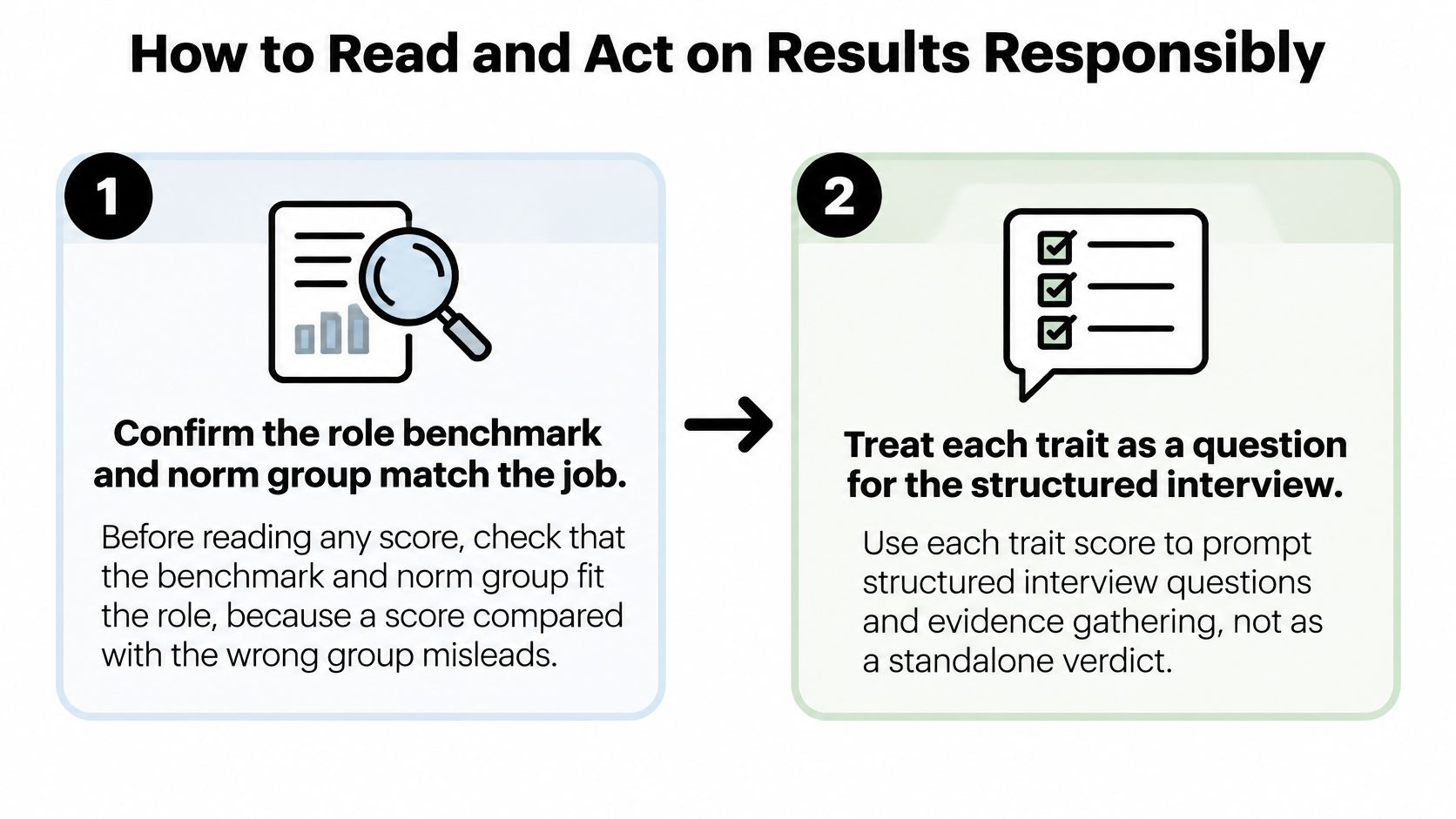
Before diving into individual traits, every hiring manager needs a repeatable sequence that anchors scores in job context and structured inquiry.
Seven Safeguards for Defensible Hiring Decisions
Follow these seven operating steps on every hiring cycle where a sales personality assessment is used:
1. Verify the role benchmark and norm group before reading a single score. A candidate's percentile shifts dramatically depending on whether they're compared against general working adults, enterprise software reps, or retail associates. Reading a score against the wrong comparison group sends interviewers chasing false flags. 2. Convert every notable trait score into a structured interview question, never a verdict. If a finalist shows low Achievement, ask how they tracked multi-quarter pipeline stages and avoided missed follow-ups in their last role. Behavioral evidence from real past deals carries far more weight than a self-report scale. 3. Weigh the profile alongside work samples, rubric-scored interviews, and verified results. Personality data should adjust confidence at the margins rather than override a standout mock discovery call or verified quota history. For technical and presales evaluations where cognitive shortcuts easily distort deal reviews, PreSales Unleashed GmbH's guide on [reducing bias in technical wins](https://www.serockstars.com/blog/heuristics-and-biases) outlines practical ways to separate observable evidence from gut impressions. 4. Disclose what is measured, how scores affect hiring, and who sees the report. Candidate expectations around transparency are unambiguous. A 2025 worldwide survey of more than 3,100 job seekers, reported in [HireVue's analysis on building candidate trust in AI hiring](https://www.hirevue.com/blog/hiring/build-trust-with-candidates-ai-hiring), found that 79% wanted to know when AI was used in hiring decisions. At Synopsix, our automated processing creates scores and narratives for each user's personal report, and this information is shared with the user and their employer so expectations stay clear from the start. 5. Keep a human accountable for every final call and ban automated personality rejections. In that same 2025 global survey, 66% of job seekers opposed AI making the final hiring decision. Automated cutoffs on inferred personality traits risk both unfair adverse impact and screening out high-converting sellers who don't fit a rigid stereotype. 6. Audit subgroup outcomes after every hiring cycle. Experimental research cited in the same HireVue report found that applicants perceived AI-supported hiring as less trustworthy, less fair, and less attractive. Reviewing pass-through rates across demographic groups catches disparate impact early, before a biased benchmark scales across dozens of requisitions. 7. Give candidates a clear path to understand key drivers and challenge errors. Because inferred personality traits feel more personal and less job-related than a live sales presentation, candidates deserve straight answers when they ask what shaped their profile. Explanations of the key factors behind a user's results are available from Synopsix on request, giving candidates and hiring leaders concrete footing for follow-up conversations.
For a deeper look at how structured questioning and transparent review reinforce fair hiring practices, watch the short walkthrough below.
<iframe width="100%" style="aspect-ratio: 16 / 9;" src="https://www.youtube.com/embed/q7nAvsfpob0" frameborder="0" allow="autoplay; encrypted-media" allowfullscreen></iframe>
Documenting the Human Decision
End every finalist review with one habit that cannot be skipped: write a short decision rationale citing observable evidence beyond the personality profile, and attach a named decision-maker who owns the call. When a hiring manager has to justify an offer or rejection using interview notes, work-sample scores, and reference checks, personality reports stay in their proper role as decision support.
Confirm the Assessment Fits Your Next Hire
Vendor pitch decks love broad validity headlines, yet general industry averages can't prove an assessment works for your territory model, average contract value, or buyer persona. Before rolling any tool into live recruiting, check three foundational requirements: confirm your target role has a documented job analysis, verify the provider maps specific traits to measurable workplace outcomes, and demand evidence showing what each trait predicts for your specific sales motion rather than "sales" as an undifferentiated bucket.
Run a 90 Day Internal Pilot
Once a tool passes those baseline checks, validate it on your own floor before letting it influence a single offer. A disciplined 90-day pilot keeps the test honest and cheap to run:
1. Pick one high-volume or critical sales role and administer the assessment to current reps already sitting in that exact seat. If you want to inspect how modern reporting reads before designing a formal study, our personal professional assessment is free, takes about 10 minutes, includes a full downloadable PDF report, and stays private and confidential. 2. Lock in every trait profile before sharing results with sales managers. Blind recording prevents managers from subconsciously adjusting performance ratings to match the report's predictions. 3. Track objective sales results and supervisor ratings across a full quarter. Measure concrete metrics such as qualified pipeline generated, win rate, or quota attainment alongside structured manager evaluations. 4. Test incremental validity against your existing structured interview. Compare how accurately interview scores alone predict quarterly performance versus interview scores combined with the personality profile. 5. Write one pre-committed adoption rule before day one. For example, keep the assessment only if it adds measurable predictive accuracy beyond your structured interview and produces no subgroup gap that job requirements cannot explain.
Let your pilot's data decide whether the assessment earns a permanent seat in your hiring process, never the vendor's marketing claims.
---
Synopsix turns scientifically validated behavioral assessments into plain-language intelligence reports, compatibility analysis, and predictive simulations so hiring leaders can predict human behavior for smarter people decisions across sales roles and teams. Instead of scoring candidates against a generic extrovert template, our platform evaluates fit against your specific role, team composition, and leadership context while keeping humans in control of every hiring call. Explore role-specific behavioral profiles and test the assessment experience yourself at [Synopsix](https://synopsix.ai).