Scenario Based Assessment: Formats, Scoring, Real Value
By Synopsix · November 28, 2026 · 17 min read
You have four people on a shortlist for a team leader role. Two interview beautifully. One has the strongest record on paper. The fourth was quiet, but she gave the most specific answer anyone has heard about how she'd handle a supplier who keeps missing deadlines. When the panel compares notes, nobody can explain why the quiet one isn't the safest bet.
So someone suggests a scenario based assessment. The candidate reads or watches a realistic work situation, decides what to do, and the response gets scored. It sounds like a direct look at how someone will behave on the job.
A score is never a direct look at anything. It's the output of a chain of design choices: which format you picked, how the scenario was written, what the scoring key rewards, and whether anyone checked how different groups perform on it. Understanding that chain is what separates a defensible hiring decision from a confident guess.
Four Formats Behind Every Scenario Based Assessment
A scenario based assessment places a candidate inside a realistic work situation and scores how they respond, instead of asking what they believe about themselves.
| Format | What the candidate does | What it mainly measures | Typical stage | | --- | --- | --- | --- | | Situational judgment test | Reads a short work scenario and chooses or ranks possible responses | Judgment about actions and priorities | Early screening | | Work sample | Completes a task that mirrors the job, such as drafting a customer reply | Job knowledge and applied skill | Shortlist | | Structured scenario interview | Answers the same situation and follow-up questions as every other candidate | Behavioral indicators such as conflict handling | Mid-stage interview | | Assessment-center simulation | Takes part in role-play, in-tray or group exercises observed by trained raters | Several behavioral dimensions at once | Final selection or promotion |
The trade-off between the first row and the last is mostly about volume and cost. A written situational judgment test can run across hundreds of applicants in an afternoon with automated scoring. An assessment center costs far more per person because trained raters watch each exercise, but it shows you several behaviors in one session rather than a single response.
Where a format sits in the funnel matters as much as what it measures. Put a situational judgment test at the top and you filter on judgment cheaply. Put an assessment center at the top and you'll exhaust your budget before you reach the candidates who matter. A practical pattern for many hiring groups is a work sample at shortlist, scored against a fixed rubric, with an assessment center reserved for the final two or three people or for promotion decisions where the cost of a wrong call is high.
Formats also get combined rather than chosen one at a time. A situational judgment test narrows the pool, a [work sample testing step](https://synopsix.ai/blog/work-sample-testing) confirms the skill, and a structured interview checks how the person handles follow-up pressure.
> Practical rule: Match the format to the decision, not to your budget. Screening volume points to a written test, a job-skill check points to a work sample, and final selection or promotion points to a simulation with trained raters.
How a Scenario Response Turns Into a Score
Between the scenario on the screen and the number in the report, a candidate passes through four stages. Each one can change the score, and none of them is a direct readout of behavior.
1. Comprehension. The candidate reads the scenario and works out what's being asked. A misreading here changes every step that follows, which is why a scenario that depends on subtle phrasing measures reading as much as judgment. 2. Retrieval. The candidate pulls relevant knowledge or past experience from memory. Someone with the right instinct but no exposure to the situation has less to retrieve, and the score reflects that gap rather than their ability. 3. Judgment. The candidate weighs which actions are possible and which is better. This is the step most designers assume they're measuring, though the first two stages decide how much of it they see. 4. Response selection. The candidate commits to an option, a ranking, or a spoken answer. Format shapes this too, since picking the best of five options is a different act from defending a choice out loud.
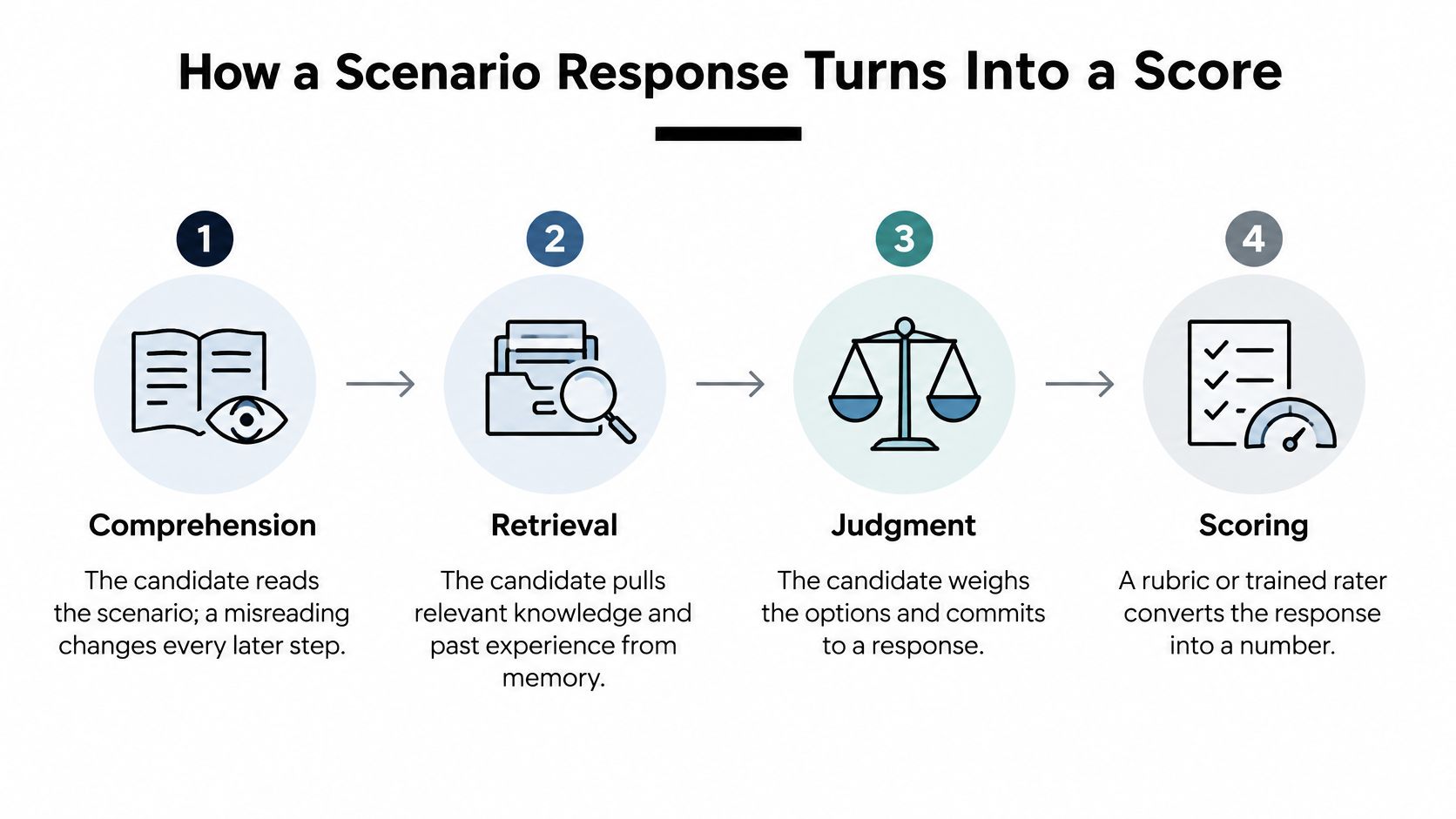
Think of a scenario score the way you'd think about a judge rating a dish in a cooking competition. The rating reflects the cook's skill, the ingredients available that day, and the judge's own palate, all at once. You can't read the number as a clean measure of skill without knowing what else went into it.
What a defensible scoring key looks like
A sound key names a target competency for every item, writes the scoring rules before any candidate data arrives, and keeps behavioral scoring separate from knowledge the job doesn't require. That last point is where many programs drift, because a scenario about handling an angry client starts rewarding recall of a refund policy nobody needs to memorize.
Validation is how you find out whether the items measure what you intended. As a [study of scenario-based assessment design in health-sciences education](https://link.springer.com/article/10.1186/s12909-020-02410-z) sets out, the response process runs through comprehension, retrieval, judgment and response selection, so a score is the combined result of scenario interpretation, domain knowledge, decision rules and the chosen response. That study's cognitive-process evidence supported the assessment's reliability and validity for empathy, and it recommends cognitive interviews or think-aloud protocols to confirm that items elicit the intended construct rather than reading ability, test-taking strategies or irrelevant prior experience.
Practical controls follow from that: pilot scenarios with representative users, test alternative wording and information density, and document the target competency for every item. Before you trust any score, ask the provider which competency sits behind it. If nobody can answer, the number is measuring something, just not the thing you're hiring for.
Validity Evidence Behind Each Format
A validity figure is a correlation between an assessment score and later job performance. Zero means the score says nothing about performance. One would mean perfect prediction. Useful tools land in between, and a few hundredths can separate a workable filter from an expensive coin toss. A realistic scenario does not settle that question by itself. You still have to test whether the score predicts the job, and for whom.
| Format | Reported validity | Basis | What it means for use | | --- | --- | --- | --- | | Work samples | .26 observed; about .33 corrected | Meta-analysis of work-sample research | Corrected validity is moderate for the exercises studied; it is not the same signal for every skill the exercise rates | | Structured interviews | .26 observed; about .47 corrected | Meta-analysis of employment interviews | After correction, structured interviews in this analysis reached about .47 | | Assessment-center simulations | about .28 corrected overall | 26 studies, 5,850 participants | The overall rating's link to supervisory ratings is modest, with a 95% interval from .24 to .32 | | Cognitive ability plus a work sample, or plus a structured interview | about .63 combined | Selection meta-analysis (Sackett and colleagues) | These two pairings each reached about .63; that result is not a claim about every mix of formats |
Work samples earn attention because the person does a job-like task. Doing the task is a design choice, not proof the score is fair or highly predictive. A [meta-analysis of work-sample research](https://onlinelibrary.wiley.com/doi/10.1111/j.1744-6570.2008.00125.x) reported an overall observed validity of about .26, rising to about .33 after correcting for unreliability in job-performance criteria, and it reported a mean observed standardized difference of .80 for ratings of cognitive and job-knowledge skills against .21 to .27 for social-skill ratings. Read those as different facts. The .33 is how well the score tracked performance in the studies. The standardized differences show that the size of the group gap depends on which skill the exercise rates, so the same label, "work sample," does not mean the same thing for people skills as for job knowledge.
Structured interviews show what design changes inside one method. A [meta-analysis of employment interviews](http://www.psychologie.uni-mannheim.de/cip/tut/seminare_wittmann/meta_fribourg/sources/Wiesner+Cronshaw_1988_MA+structure_of_interview.pdf) found structured interviews produced mean validity coefficients about twice as high as unstructured ones, with combined validity of .26 before correction and .47 after.
Reading the assessment-center numbers
A [meta-analysis of assessment-center validity](https://bpspsychub.onlinelibrary.wiley.com/doi/full/10.1111/j.1468-2389.2007.00399.x) covering 26 studies and 27 validity coefficients, with 5,850 participants, found a corrected correlation of .28 between the overall assessment rating and supervisory job-performance ratings (95% confidence interval .24 to .32); six broad dimensions (awareness of others, communication, drive, influencing others, organizing and planning, and problem solving) showed true criterion-related validities from .25 to .39, and a regression composite of four of those dimensions explained 20% of performance variance against 14% for the overall rating.
How you add the scores changes the result inside that one body of evidence. It does not prove that every dimension system will beat an overall rating on your jobs.
Two specific pairings, not "any combination," are what the selection literature puts near .63. General cognitive ability plus a work sample reached about .63, and cognitive ability plus a structured interview landed at the same level ([Sackett and colleagues' selection meta-analysis](https://gwern.net/doc/statistics/meta-analysis/2021-sackett.pdf)). Prompt wording and the subgroup or skill behind a score can move what that number means, so a coefficient from supervisory roles in one country does not transfer to another role or market on its own. That is why [assessment validity and reliability](https://synopsix.ai/blog/assessment-validity-and-reliability) has to be re-established rather than borrowed.
Prompt Wording Decides What the Assessment Predicts
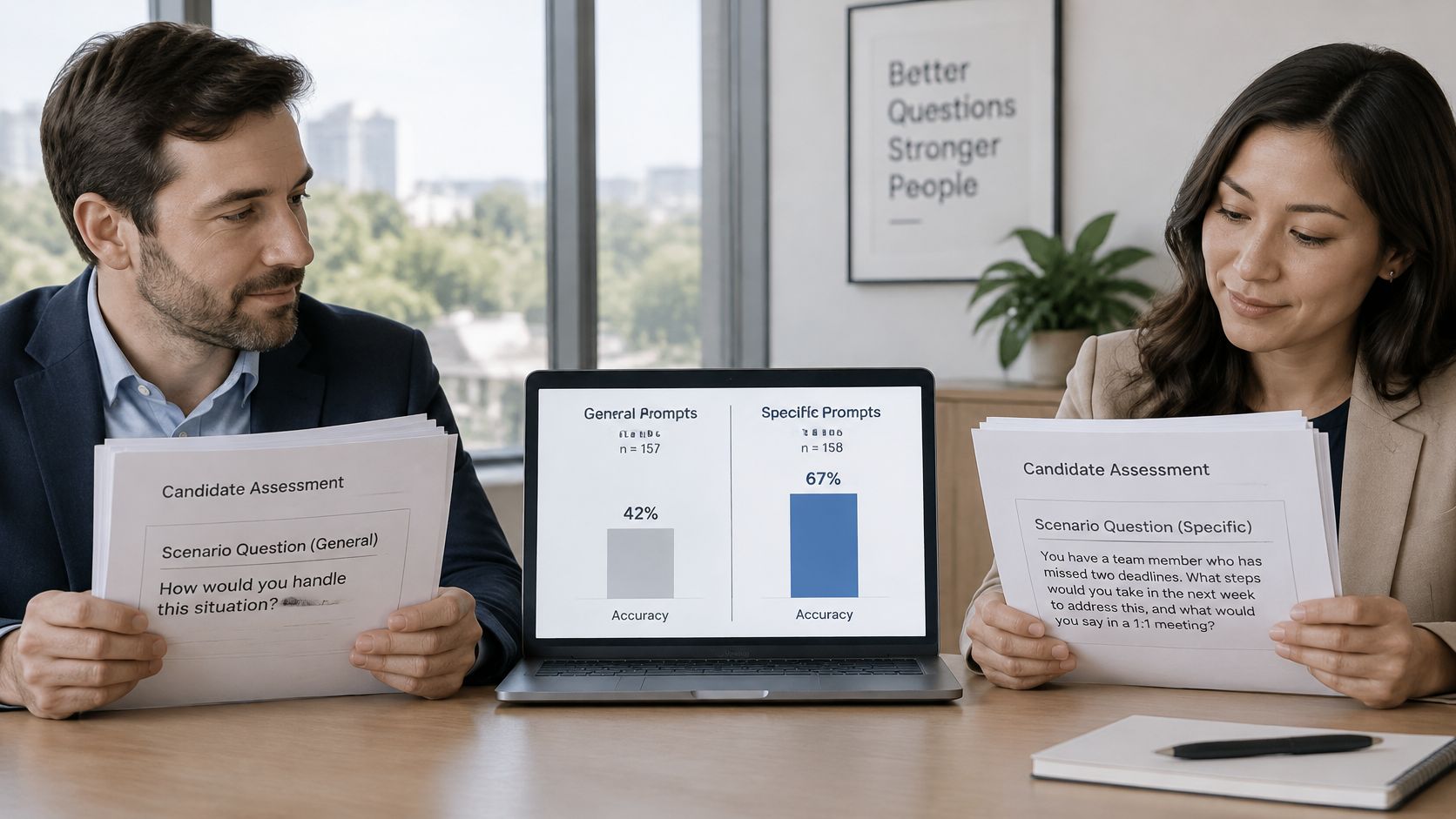
Two candidates can face the same scenario and effectively take two different tests, because the prompt around the scenario tells them what kind of answer is wanted. Wording is a design lever, not a formatting detail.
A randomized predictive-validation study of intercultural scenarios tested exactly this. Participants were assigned either general prompts (N=157) or specific prompts (N=158). Less-specific prompts increased the influence of perspective taking and openness to experience and improved validity for predicting effectiveness in multicultural teams. More-specific prompts increased the role of knowledge and improved validity for predicting in-role performance, as the [study from Singapore Management University's research library](https://ink.library.smu.edu.sg/cgi/viewcontent.cgi?article=7629&context=lkcsb_research) reports.
That looks like this in practice. Take a delayed-order complaint and write it two ways:
> General prompt: "A customer is unhappy about a delayed order. What do you do?" > > Specific prompt: "A customer's order is four days late against a promised Friday delivery. Policy allows a full refund within 14 days or a 20% credit. The customer wants the item by Monday. What do you do?"
The first version leaves the ambiguity in place, so you see how the candidate reads a situation and prioritizes. The second hands over the rules, so you see whether they apply policy correctly under a deadline. Neither is better in the abstract. They predict different things.
The rule that follows is mechanical. Use broad, ambiguity-preserving prompts when you're evaluating adaptability, perspective taking or conflict navigation. Use explicit performance cues when you're evaluating standardized role knowledge or compliance. The scenario can stay identical while the prompt shifts the assessment from adaptive interpersonal judgment toward procedural knowledge.
<iframe width="100%" style="aspect-ratio: 16 / 9;" src="https://www.youtube.com/embed/qBlX6FhDm2E" frameborder="0" allow="autoplay; encrypted-media" allowfullscreen></iframe>
Before any production rollout, compare prompt variants on criterion-related validity, check subgroup results, measure inter-rater reliability wherever humans score responses, and monitor adverse impact in each major market. A [job analysis](https://synopsix.ai/blog/how-to-do-a-job-analysis) comes first, because you can't decide whether a prompt should preserve ambiguity until you know which competency the role depends on.
Where Scenario Based Assessments Work in Practice
High-hazard safety roles
A 2025 study on safety-minded leadership in high-hazard industries built a final 15-item situational judgment test around real safety decisions, and scores predicted self-reported safety behaviors in a second measurement wave ([the study indexed on PubMed](https://pubmed.ncbi.nlm.nih.gov/41786439/)). The design detail worth copying is the second wave: the researchers checked behavior later rather than trusting the score alone. Lesson: anchor items in decisions the role faces, then verify against later conduct.
Pharmacy education
A 2025 pharmacy education study reported a mean situational judgment test score of 14.13 with a standard deviation of 6.07, and 20.6% of the 2023 to 2024 sample scored below the norm-referenced cutoff ([the study in PMC](https://pmc.ncbi.nlm.nih.gov/articles/PMC11948762/)). That cutoff is doing real work. It converts a spread of scores into pass-or-review decisions, so the method used to set it belongs in the published documentation, not in a footnote. Lesson: publish how the cut score was set before anyone sees a result.
Frontline customer service, an illustrative design
Say a retail chain gives every applicant for a service desk role the same complaint scenario and scores the response against a written rubric covering acknowledgment, resolution options and escalation judgment. Comparisons across candidates hold only because the task and the scoring rules were fixed in advance. Change the rubric between interviewers and you're back to comparing impressions. Lesson: fix the scoring rules before the first candidate walks in, and score every candidate on the same three or four indicators.
Fairness, Access and Adverse Impact Checks
A realistic scenario can still produce unfair outcomes. Consider a job simulation built with a good script but a bad camera angle. The task may look like the work, yet the scoring can reward one way of speaking, reading or reasoning more than another. Scenario realism is therefore a claim to test, not a guarantee of fairness or prediction.
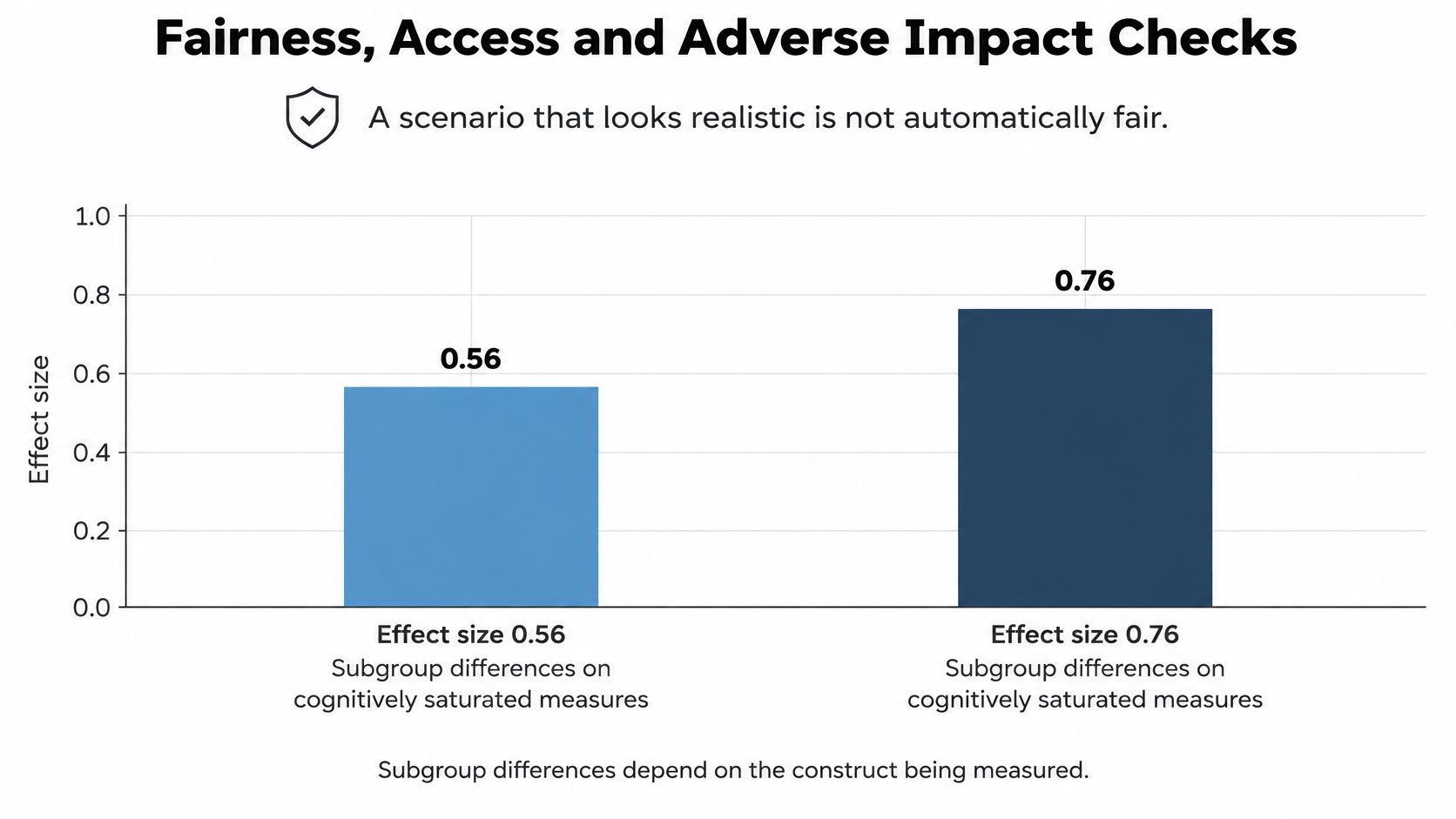
Subgroup differences depend heavily on the construct being measured and the cognitive demands of the items. One study found effect sizes of 0.56 and 0.76 for cognitively saturated scales, against 0.07, 0.20 and 0.50 for interpersonal scales ([the Journal of Occupational and Organizational Psychology study](https://onlinelibrary.wiley.com/doi/pdf/10.1111/joop.12013)). That pattern matters. It shows why “scenario-based” is not a fairness guarantee by itself. A prompt that leans on dense reading, abstract reasoning or unfamiliar wording may shift what the score means, even when the surface story looks job-like.
| Scale type | Reported effect sizes | What it signals | | --- | --- | --- | | Cognitively saturated scales | 0.56 and 0.76 | Larger subgroup gaps | | Interpersonal scales | 0.07, 0.20 and 0.50 | Smaller gaps, varying by scale |
Prompt wording is part of the assessment design, not decoration. Change the wording from a broad judgment prompt to a technical compliance prompt, and you change the construct being sampled. Applicant experience also shapes outcomes. A review of 145 studies found that perceptions of fairness, anxiety and motivation influence organizational attractiveness, intentions, behavior and even test performance ([the review of applicant reactions research](https://doi.org/10.1111/1468-2389.00235)). In practical terms, candidates may enter the same scenario with different levels of trust, access and pressure, so the score can reflect more than the competency you intended to measure.
Five audit steps before a score touches a decision
1. Job analysis. Confirm every scenario reflects a real demand of the role rather than a plausible-sounding one. 2. Language complexity review. Check readability, idiom and cultural references for candidates who work in a second language. 3. Accessibility testing. Test screen readers, timing, device requirements and any recording step. 4. Applicant-level adverse impact analysis. Analyze outcomes by subgroup, not just an overall validity coefficient. 5. Separate validation by construct and market. Interpersonal judgment and procedural knowledge need their own evidence.
Reducing cognitive load can improve access, but simplifying too far can strip away job relevance and predictive value. The balance is closer to tuning an instrument than shortening a test. You remove avoidable friction while keeping the signal tied to the role. Scenarios also encode local norms about assertiveness, hierarchy, conflict and emotional expression, so content should adapt culturally while keeping the behavioral demands equivalent.
> Ask one question before any score influences a hire: which subgroup outcomes were checked, and for which construct? A single overall validity figure can't answer that.
Check Five Criteria Before Using One in Hiring
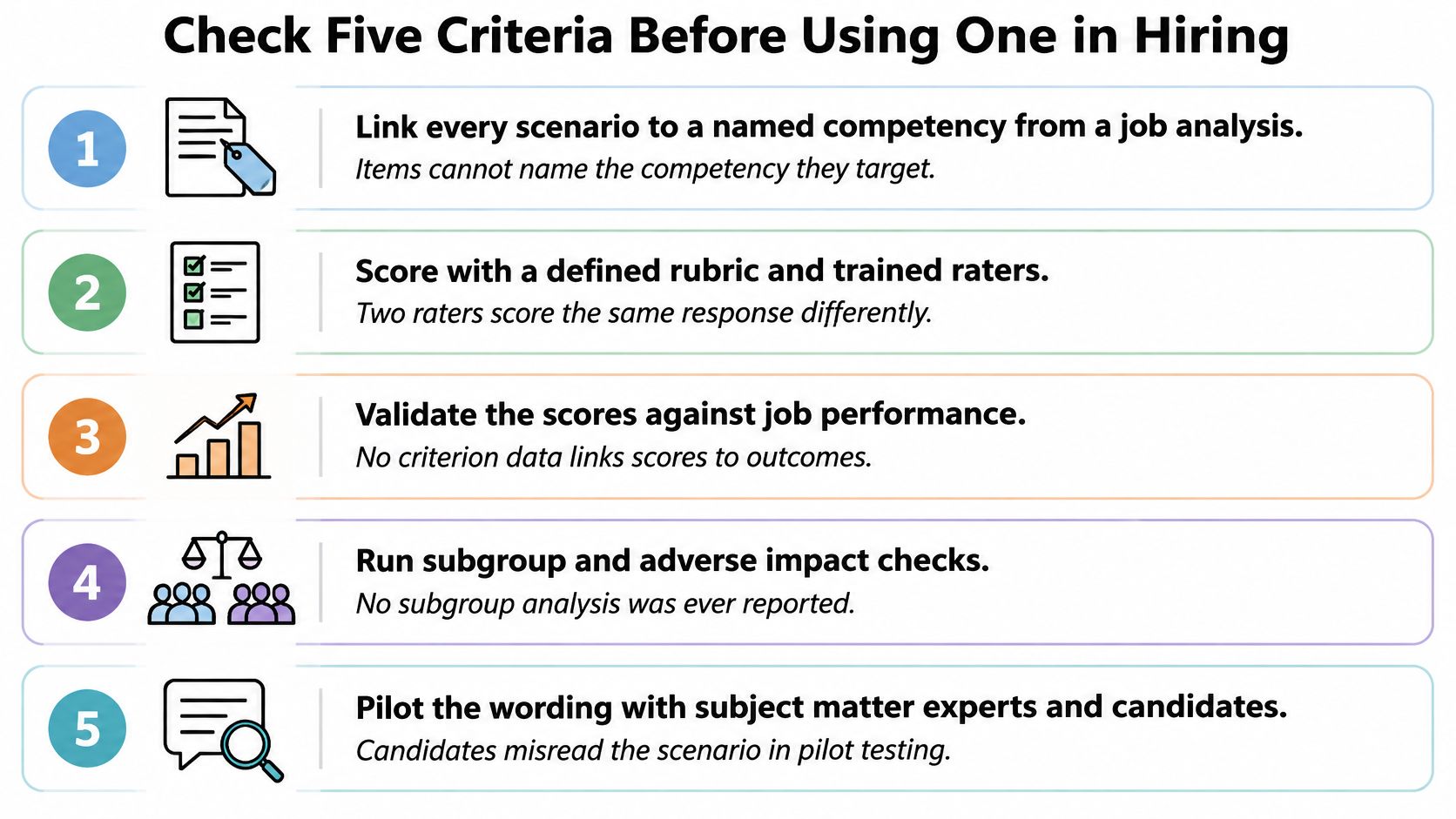
Run these five checks against any scenario based assessment you're considering, including the one you build in-house. Each comes with the signal that should stop you.
1. Every scenario links to a named competency from a job analysis. If the people running the assessment can't name the competency an item scores, the item is measuring something incidental. Failure signal: nobody can say what an item is for. 2. Prompt specificity matches the decision. Broad prompts for adaptability and conflict navigation, explicit prompts for role knowledge and compliance. Failure signal: prompt variants were never compared on criterion validity. 3. Reliability is reported for the exact version you'll use. A 2025 meta-analysis in the International Journal of Selection and Assessment examined 3,685 participants across situational judgment test studies and found reliability estimates ranging from 0.37 to 0.93, with a mean of 0.82 ([the 2025 IJSA meta-analysis](https://onlinelibrary.wiley.com/doi/full/10.1111/ijsa.70025)). That spread is wide enough that a generic figure tells you nothing about your version. Failure signal: the reliability quoted belongs to a different form or a different population. 4. The scenario is paired with another predictor. Combine the exercise with a structured interview or a job-relevant ability measure rather than deciding on one score. The combination evidence supports this. Failure signal: the hiring decision rests on a single number. 5. Outcomes are monitored after launch. Track completion rates, technical failures, subgroup results and downstream hiring outcomes. Failure signal: a subgroup gap appears and nobody reviews it.
Technical hiring teams often need a scenario task that reflects the actual stack rather than a generic puzzle, and [Hire Developers](https://hiredevelopers.com/) is a resource worth knowing when you're building that kind of work sample.
The recommended next step is small. Pick one role, run one pilot, and treat the five checks as a go or no-go gate before you scale to every hire. Judge any platform you use to build or run scenarios by the same five checks, including whether its outputs are documented well enough to audit. Synopsix is one option to evaluate on those terms: its AI personality and competency assessments read each person against the role rather than a generic profile, and its selection and hiring analysis evaluates a candidate against the role, team, leader and culture, predicts integration risk and proposes questions for the final interview.
---
If you want to see what that looks like before committing to a pilot, Synopsix can model a hiring, promotion or team-move scenario and show you the likely outcome before you make the call. Start with the free assessment to see how role-referenced scoring reads a real profile, then bring one live decision and test it against the five checks above. Visit [Synopsix](https://synopsix.ai) to begin.