Self-Assessment Tools for Hiring and Teams
By Synopsix · November 1, 2026 · 16 min read
Two candidates can look identical on paper and perform very differently once they're in the role. Resumes show history, interviews show presentation, and neither reliably shows how someone will learn, follow through, handle pressure, or work with a particular leader. That's the gap self-assessment tools are meant to fill, but only when you treat validity evidence and decision boundaries as buying criteria, not marketing claims. A score should sharpen a human decision. It should never replace one.
What Self-Assessment Tools Measure and Where They Fit
Measuring general cognitive ability and conscientiousness alone can explain approximately 20% to 30% of the variance in job performance, with higher predictability in more complex jobs, according to [the American Psychological Association summary of industrial-organizational psychology research](https://www.apa.org/topics/healthy-workplaces/job-performance). That doesn't mean two scores predict a career. It means resumes, education, and intuition leave most of the useful signal unused.
A self-assessment tool is a structured self-report whose answers are converted into comparable scores on traits, ability, integrity, leadership, or values, with published norms and reliability data. It's not an entertainment quiz. Think of it as a mirror. A mirror shows a face but doesn't decide who gets the role.
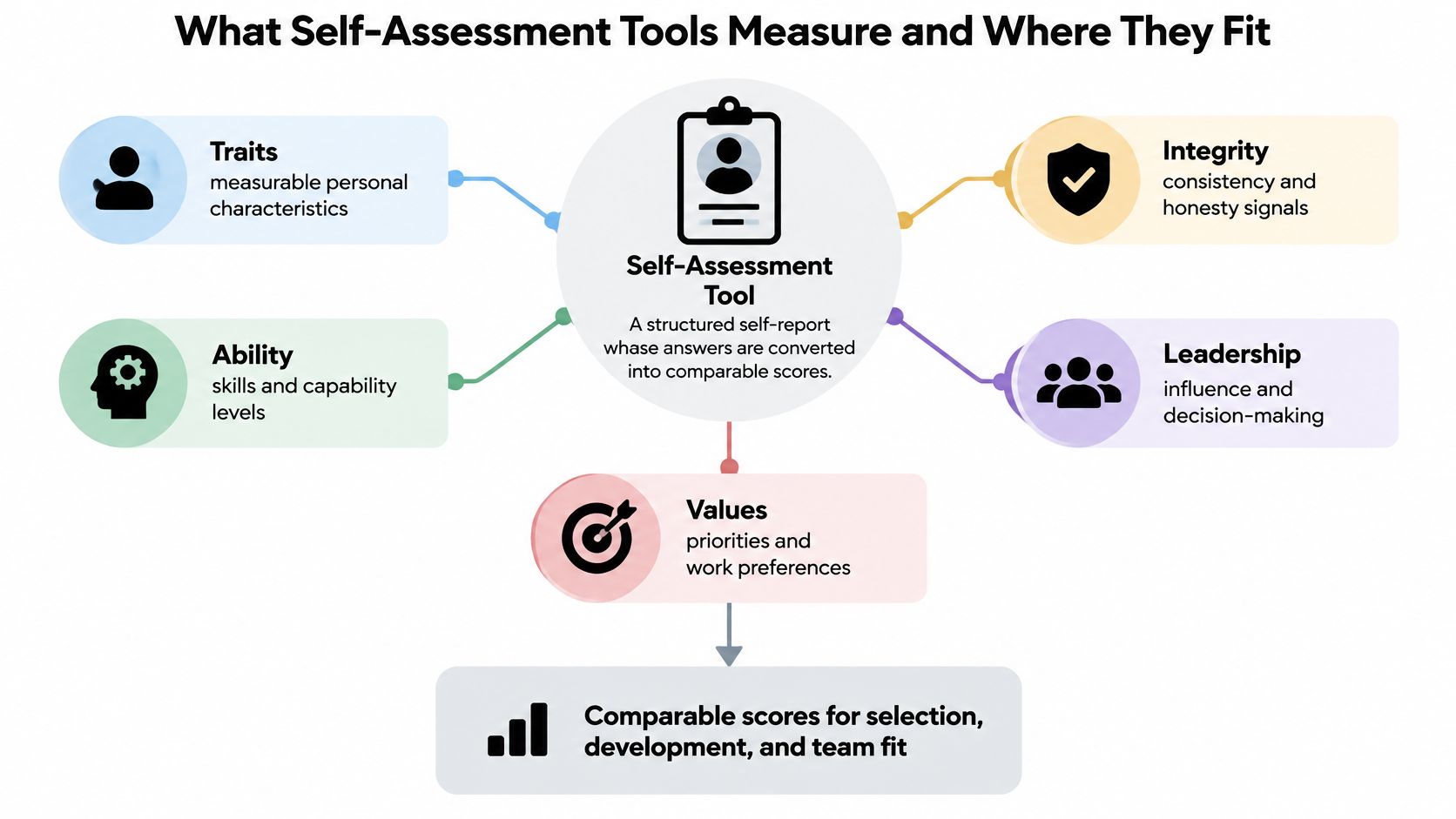
Reading Tool Families by Their Limits
Say you're hiring a technical lead. A trait inventory might show steady follow-through but low appetite for conflict. A cognitive test might suggest fast learning. Neither tells you whether the person can debug your stack today. You still need a work sample and a structured interview.
| Tool type | What it measures | Typical time | Useful for | Main limit | |---|---|---|---|---| | Big Five or trait inventory | Work style and conscientiousness | 10 to 30 minutes | Development and supplemental hiring signals | Not a full performance predictor alone | | Cognitive ability | Learning speed and problem solving | 15 to 30 minutes | Complex and technical roles | Adverse-impact risk if used as a cutoff without a job analysis | | Integrity | Counterproductive-work risk | 10 to 20 minutes | Roles with trust, cash or compliance exposure | Validity varies sharply by instrument | | Skills self-rating | Claimed proficiency | 5 to 10 minutes | Training-needs triage | Self-inflation and unclear anchors | | Values and culture preference | Fit with stated norms | 10 to 20 minutes | Team design conversation | Preference is not performance |
Big Five and similar inventories describe stable work style, so they suit development and supplemental hiring signals. Cognitive tests estimate learning speed and suit complex roles, but they need a job analysis before any cutoff. You can compare formats in [this guide to psychometric test types](https://synopsix.ai/blog/psychometric-test-types) before you commit to one family.
Integrity measures target counterproductive-work risk, yet they vary sharply by instrument. Leadership and self-plus-other tools suit succession only when they're grounded in a stated leadership model. Skills self-ratings are fast but inflated, because people rate themselves against different anchors. Values items show preference, not performance.
No row describes a fixed identity. Mood, impression management, administration conditions, and cultural context can shift answers. Treat every profile as a dated, context-sensitive estimate, and you'll use it well.
Proof That Separates Science from a Quiz
Many vendors say "validated" and stop there. They don't show reliability, construct validity, criterion-related validity, subgroup fairness, test-retest stability, or how you should read a score. That gap matters because self-assessment has expanded rapidly in education and organizational training while both areas still lack validated tools for many intended uses, and one research team had to create and test 19 assessments against construct-validity, reliability, and convergent-validity criteria, as reported in [a peer-reviewed study in Business and Professional Communication Quarterly](https://journals.sagepub.com/doi/abs/10.1177/23294906231203369?mi=ehikzz).
Six Evidence Requests to Make Before You Buy
| Evidence | Ask for | Red flag | Do not use the score to | |---|---|---|---| | Reliability | Scale consistency and sample size | Only a marketing accuracy percentage | Rank people on a noisy scale | | Construct validity | Trait definitions and item mapping | A new label with no theory | Treat the profile as identity | | Criterion validity | Correlation with job or training outcomes | Validity claimed with no job sample | Auto-reject without other evidence | | Subgroup fairness | Score gaps and adverse-impact checks | No demographic monitoring | Set a single cutoff for every group | | Test-retest stability | Retest interval and coefficient | One sitting treated as permanent | Lock a development plan for years | | Interpretation limits | Comparison group, error and banned uses | Scores with no narrative of uncertainty | Decide hire, fire or promotion alone |
Reliability means internal consistency. For a scale used in decisions, ask whether the coefficient is around 0.70 or higher and how large the sample was. Construct validity means items map to the named trait, not to a clever label invented for a sales page.
Criterion validity means scores relate to job or training performance in a real job sample, with stronger prediction in complex work. Fairness means subgroup score gaps and adverse impact are monitored, not assumed away. If a vendor won't show pass rates by group, you can't defend a cutoff.
Test-retest stability shows whether scores hold over weeks or merely capture mood on the day. Interpretation guidance names the comparison group, the margin of uncertainty, and the decisions the score must never make alone. Our explainer on [assessment validity and reliability](https://synopsix.ai/blog/assessment-validity-and-reliability) translates these checks into buyer language.
> A slightly longer tool with a technical manual beats a three-minute quiz with no manual, because length you can see is cheaper than error you can't.
That point surprises buyers who prize completion rates. A short, engaging quiz can feel candidate-friendly while giving you too few items per trait to separate people reliably. You'll get polished profiles, confident language, and no defensible basis for choosing between two finalists.
Ask for the technical manual before the demo ends. Ask who was in the norm group, which jobs supplied the criterion data, and what happens to scores when candidates retake the test. Refuse any instrument that won't share this evidence in business language. If the vendor can't explain uncertainty to a hiring manager, the hiring manager will invent certainty on their own.
Hiring Development and Team Design Uses
Personality assessment, particularly measures based on the Big Five, can predict job performance and has practical utility in personnel selection, and integrity measures can predict counterproductive work behavior although validity varies by measure, according to [the American Psychological Association record on personality assessment in personnel selection](https://psycnet.apa.org/record/1999-00446-001). Leadership assessments help when they're grounded in their stated theories. The lesson isn't that personality predicts everything. It's that constructs must match the job.
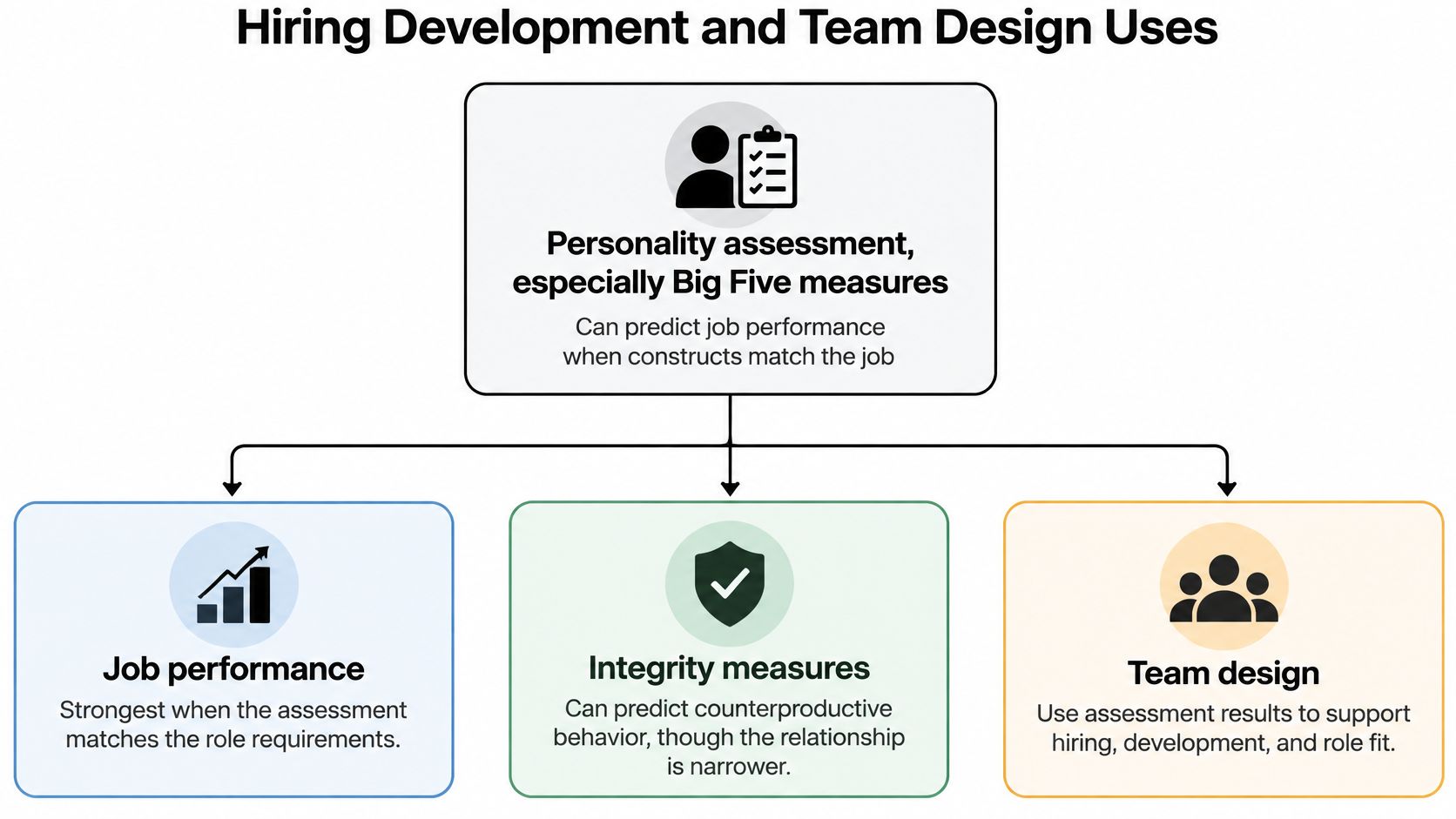
Three Scenes, Three Different Jobs for the Same Profile
Hiring. Say you're filling a sales role. You might weight conscientiousness, resilience, and interaction style, then compare the person against the role, team, leader, and culture. Our selection and hiring analysis evaluates a candidate against the role, team, leader and culture, predicts integration risk and proposes questions for the final interview. It drafts questions rather than issuing a yes or no.
A research role weights learning agility more heavily, and the interview probes change accordingly. If you're building the wider funnel around the assessment, [how hiring works for technology roles](https://mojolin.com/technical-hiring-process) from Mojolin is a useful companion on sequencing screens and technical evaluation.
Development. After hire, the same profile becomes a coaching input. Our internal mobility analysis identifies high-potential employees, recommends individual and team coaching, and simulates how each person would react to change. A manager can name coaching themes, test a move into a bigger scope, and watch for strain before it becomes attrition.
Team design. Place complementary styles together and surface tension before a reorganization, not after it. Our leadership and succession analysis models succession scenarios, simulates conflicts and detects dysfunctional-leadership risk, which helps you test a promotion on paper first. You can explore the mechanics further in [our article on team dynamics and performance](https://synopsix.ai/blog/team-dynamics-and-performance).
We package this as role-specific assessments that read the person against the role, not against a generic ideal. That's one way to organize the work, not the only way. Whatever stack you choose, keep the boundary fixed. The profile informs the conversation. A human still owns the decision, documents the reasoning, and answers for the outcome.
How to Choose, Pair and Integrate the Tool
A meta-analysis found that predictive validity depends on both interview content and administration, that situational, job-related, and psychological questions perform differently, and that structured interviews are more valid than unstructured interviews, with similar validity for job and training performance but lower validity for employee tenure, according to [the meta-analysis of employment interviews in the Journal of Applied Psychology](https://psycnet.apa.org/doi/10.1037/0021-9010.79.4.599). Neither an assessment nor an interview should act as a retention oracle.
Structure has a plain meaning. Every candidate gets the same questions in the same order, scored against anchors describing good, acceptable, and poor answers built from job analysis.
Pair Methods so They Corroborate, Not Duplicate
| Method | Stronger at | Weaker at | Pair it with | |---|---|---|---| | Trait or cognitive self-assessment | Performance potential in complex jobs | Tenure and day-one skill | Structured interview and a work sample | | Integrity self-report | Counterproductive-work risk | Leadership potential | Reference and compliance checks | | Unstructured interview | Rapport | Comparable scores | Do not use as the predictor | | Structured situational interview | Job and training performance | Tenure | Same questions and scoring anchors for every candidate | | Work sample | Demonstrated skill | Broad traits and culture | A short validated trait screen |
Five Buying Checks That Aren't Coefficients
Candidates also judge you by burden and clarity. Our free assessment shows your traits, leadership style and professional fit, it's free and takes about 10 minutes, and it includes a full downloadable PDF report that is private and confidential. That kind of short, transparent experience works for early self-discovery. Finalist decisions still need the fuller stack.
Before go-live, run an integration checklist. Capture and log consent, set the retention period, apply role-based access, and test the ATS or HRIS connection. Make factor explanations exportable on request and keep an audit trail of who reviewed each recommendation.
Don't use a profile where no job analysis exists, for tenure forecasts, or as a fixed verdict. The stack that holds up is simple. Run a knock-out screen, give a validated self-assessment to finalists, conduct a structured interview with anchors, and let a human decide.
A Ninety Day Rollout with Owners and KPIs
A rollout fails when everyone owns it in general and no one owns it in particular. Assign the work in five steps, record baselines early, and measure outcomes that a CHRO would defend in a budget review.
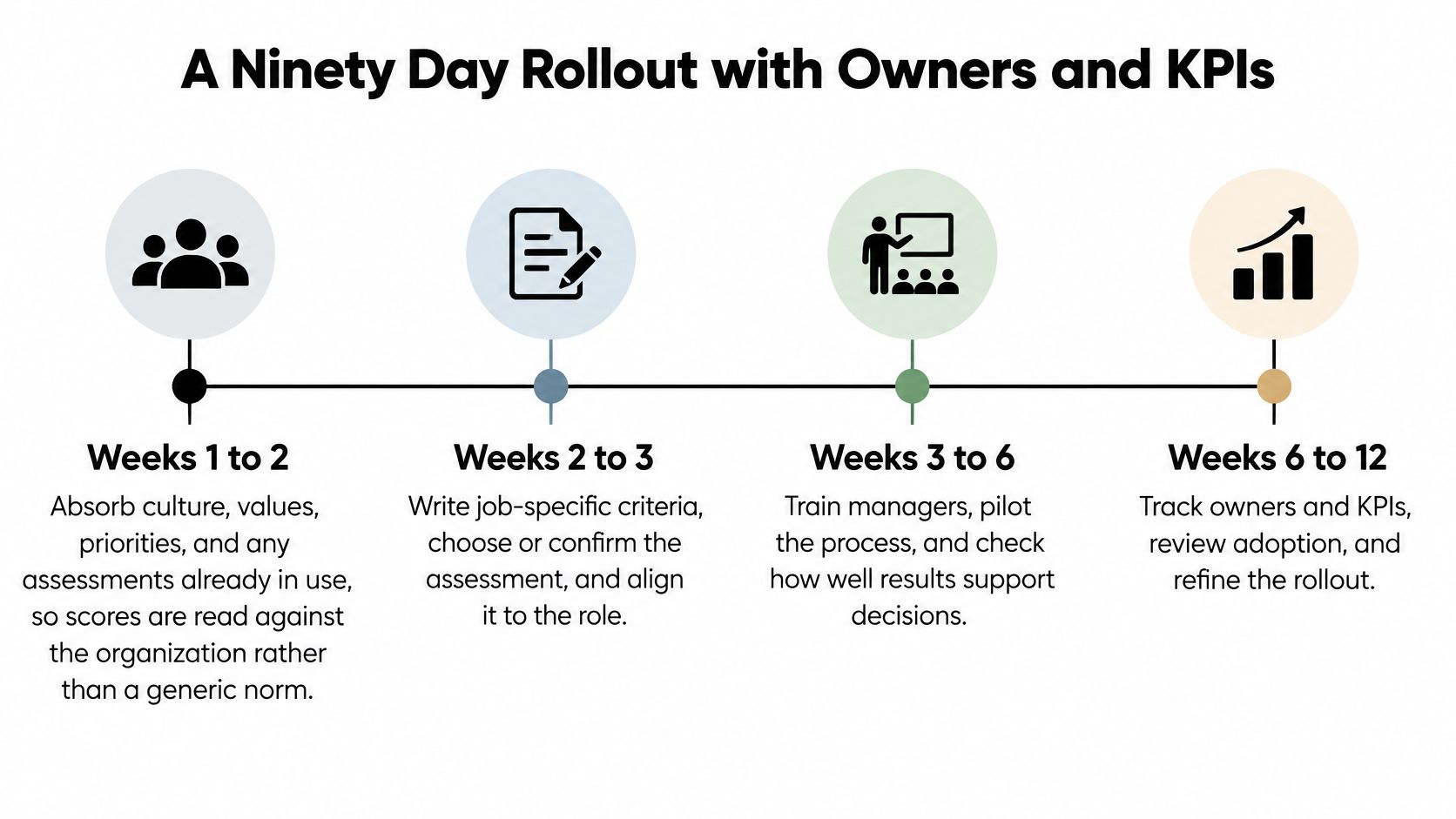
Five Steps with Week Ranges
1. Weeks 1 to 2, absorb context: We start by absorbing your organization's Org DNA, including culture, values and business priorities, together with the assessments already run, so scores are read against your organization rather than a generic norm. 2. Weeks 2 to 3, define scope: Write job competencies, name decisions in scope such as finalist ranking, and name decisions out of scope such as termination. 3. Weeks 3 to 5, pilot one role family: Use informed consent, a named human reviewer, and at least one diverse slate checked for subgroup pass rates. 4. Weeks 5 to 8, add structure: Build structured interview anchors and run simulations only for finalists, a promotion, or a proposed reorganization. Our simulations run multi-participant team simulations to test a hire, a promotion or a reorg before it happens in real life. 5. Weeks 8 to 12, connect and publish: Connect approvals to the ATS or HRIS and publish a dashboard the hiring team can read without a psychologist. Our Workflows is a visual editor for automating talent processes, with AI decisions, approvals and webhooks into existing tools.
Record a baseline for every KPI before week 3. A claimed improvement means little without the prior-year or prior-quarter figure beside it.
| KPI | How to measure | Owner | Target direction | |---|---|---|---| | Time from finalist slate to decision | Days from slate to signed decision versus prior-quarter baseline | Hiring managers | Shorter, with no drop in reviewer checks | | Mis-hire or early-exit rate | Share of hires leaving or failing probation within 12 months versus prior year | Talent | Lower than baseline | | Quality of hire | Share of hires rated strong at the 6 or 12 month performance review versus baseline cohort | People analytics | Higher share rated strong | | Subgroup pass rates | Pass rate at each stage by group | Legal or privacy with people analytics | No unexplained gaps | | Human-review compliance | Share of decisions with documented human review | Talent | 100 percent |
Talent owns the pilot, hiring managers own interview anchors, legal or privacy owns consent, and people analytics owns the dashboard. Skip vanity metrics such as raw completion rate. A fast process that produces mis-hires isn't progress, and a slower process with documented review may be the cheaper one.
Short Cases and the Return They Show
A case is useful when it shows how assessment evidence enters a decision, without implying that the tool guarantees an outcome. These three examples illustrate different hiring uses. In each, the profile informs human judgment rather than replacing it.
Case one, hiring validation. A hiring team can use a candidate's assessment alongside role and team fit, then draw on the analysis to prepare questions for the final interview. This makes the profile one input to a decision, not an automated verdict.
> "Synopsix is a comprehensive assessment tool to help companies validate their hiring decision.", Pedro G.
Case two, high-performer benchmark. A company can identify the behaviors and competencies present in its high-performing team and use those patterns as a reference when assessing future candidates. The benchmark describes relevant strengths, not a template for identical personalities.
> "The biggest benefit is being able to identify the behaviors and competencies of our high-performance team, which become our reference for hiring future talent with a high probability of an excellent fit with the organization and its company DNA.", Juan C.
Case three, standard process. An employer can make benchmarking against top performers part of its regular hiring process. That gives recruiters a shared reference point for evaluating candidates, while leaving the hiring decision with people.
> "We now use Synopsix as a standard part of our hiring process, benchmarking every new candidate against our top performers.", Byrne L.
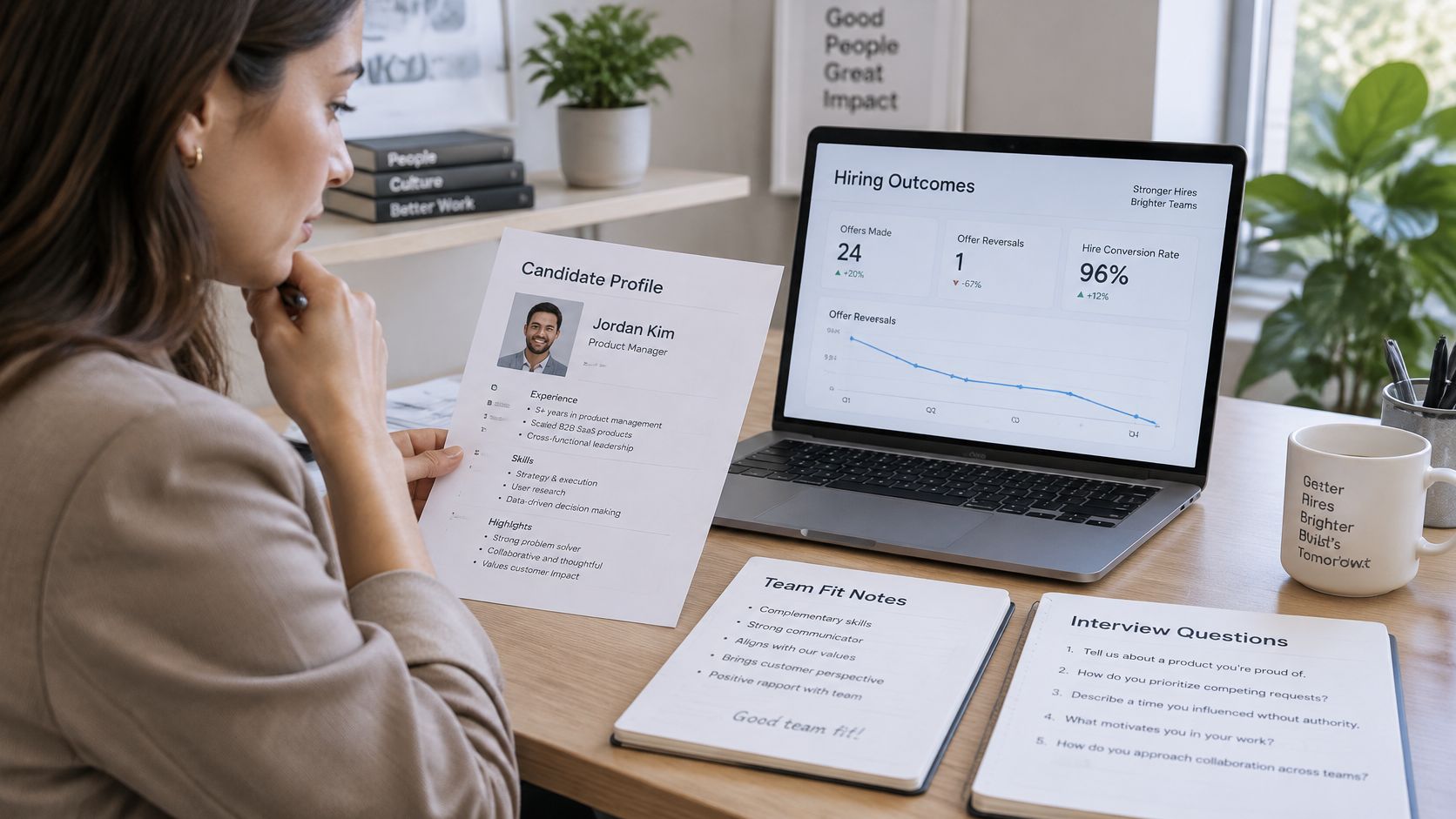
Treat vendor scale and accuracy claims as claims to examine against the evidence for the role at hand. A platform's overall profile volume or stated accuracy does not, by itself, show that a particular assessment supports a particular hiring decision. Apply the same standard to Synopsix as to any other provider.
A practical return test starts with a specific case. Estimate the cost of an avoidable mis-hire and the time spent on the process, then compare those potential benefits with the licence cost and reviewer hours. The result is an estimate to test, not a customer outcome to assume.
To apply the pattern, choose one role, define the relevant high-performer behaviors from job analysis, and assess finalists against that role. Then review the resulting hiring evidence against a baseline. Synopsix can bundle assessment findings into reports covering traits, leadership, succession, professional profile, and interaction style. Simulations can also test how people may respond to a proposed hire, promotion, or reorganization. These tools can make evidence easier to use, but each recommendation still needs human review.
Decide What the Score May Support
A useful assessment gives people results they can understand, question, and use within clear limits. Accuracy alone does not create trust. Privacy, transparency, and the right to challenge a recommendation matter too.
The KPMG global research gathered responses from at least 1,000 people per country across multiple countries between November 2024 and January 2025. It notes that anonymous surveys may understate inappropriate workplace AI use because respondents may give socially acceptable answers. The report also warns that AI used to monitor employee performance and behavior can threaten privacy and data-protection rights. For buyers, these concerns belong beside validity evidence: ask whether a tool tests reproducibility, internal consistency, consequences, and subgroup differences, not only agreement with human judgments. Automated feedback tools can also penalize certain language patterns, so ask how their outputs are checked.
Give employees a clear checklist before assessment begins. Explain the purpose and limit use to it. Obtain informed consent, name a human reviewer, and monitor results across subgroups. Make recommendations understandable enough for employees to explain back, allow corrections, and set a retention limit and deletion date. If guidance conflicts with observed work, document how the conflict will be escalated. Treat observed work as the basis for a decision until the discrepancy is examined.
Transparency should be practical. Synopsix automated processing creates scores and narratives in each user's personal report, and shares this information with the user and their employer. Users can request explanations of the key factors behind their results. Ask any provider how employees can understand and question the basis of a result.
Write down what a score may support. Allowed: shaping shortlists, drafting interview questions, planning coaching, and running team simulations. Banned: making a hiring, promotion, disciplinary, or rejection decision on the assessment alone. Check that these boundaries appear in the report and that a manager retains the final decision. A useful test for any provider, including Synopsix, is whether its results use risk, fit, and role-specific language that a hiring panel can discuss.
Start with the evidence in your own hands. Synopsix offers a free professional assessment that takes about 10 minutes and shows traits, leadership style, and professional fit in a downloadable PDF report. Review whether the results include clear limits and explanations you could defend to a candidate. Visit [Synopsix](https://synopsix.ai) to take the assessment and examine how role-specific profiles and simulations can inform a hiring or team decision.