Situational Judgment Tests: A Complete Guide
By Synopsix · August 23, 2026 · 15 min read
A candidate gives a polished interview answer about handling conflict, prioritizing urgent work, and protecting customers. A few months later, the manager discovers that the new hire avoids difficult conversations, escalates routine decisions, or treats competing deadlines as someone else's problem. The interview captured confidence and storytelling. It didn't reliably capture workplace judgment.
Situational judgment tests address that gap by presenting candidates with realistic work dilemmas and asking them to choose, rate, or rank possible responses. Used carefully, they give hiring teams a structured view of how people may apply job knowledge, weigh consequences, and act under contextual pressure. Used carelessly, they become opaque quizzes that reward test familiarity rather than job-relevant decision-making.
The distinction matters. An SJT should sit inside a broader people intelligence workflow, alongside role requirements, structured interviews, work samples, and other validated predictors. It shouldn't be treated as a magic filter or a replacement for human judgment.
What Situational Judgment Tests Are and Why They Matter
A customer support candidate faces three problems at once: an upset customer, incomplete information from a colleague, and a system issue slowing resolution. A standard interview question about handling a difficult customer invites a polished story. An SJT presents those competing demands directly and asks the candidate to select the most effective action. The response shows how the person verifies facts, prioritizes service recovery, communicates internally, and manages urgency.
That is the practical value of situational judgment tests. They measure how candidates choose and act in job-like scenarios, rather than asking them to describe desirable traits. The [U.S. Office of Personnel Management's guidance on situational judgment tests](https://www.opm.gov/policy-data-oversight/assessment-and-selection/other-assessment-methods/situational-judgment-tests/) recommends scenarios that represent actual job tasks and activities. A clear connection to the role supports content validity and gives hiring managers a defensible explanation for what the assessment measures.

What an SJT can reveal
Scenario design determines which forms of workplace judgment the assessment can examine:
Strong items avoid abstract personality labels. They create a decision context where several responses appear plausible, while one better fits the role's standards, constraints, and likely consequences.
SJTs still measure only part of performance. A candidate may show sound judgment in a scenario yet lack technical skill, motivation, or the communication ability required for the job. A classic meta-analysis synthesizing 102 validity coefficients from 10,640 people estimated an overall population validity of ρ = .34 for predicting job performance ([McDaniel and colleagues' meta-analysis](https://pubmed.ncbi.nlm.nih.gov/11519656/)). That evidence supports using SJTs as behavioral predictors, not standalone verdicts.
> Practical rule: Use an SJT to answer a defined job question, then combine its signal with evidence measuring different requirements.
Interpretation also depends on the wider talent assessment process. These [talent assessment insights from GENTY recruitment](https://gentyrecruitment.io/insights/what-is-talent-assessment-a-guide-for-hr-teams) explain how assessments can inform selection decisions. A guide to [psychometric testing](https://synopsix.ai/blog/what-is-psychometric-testing) helps distinguish standardized tools by purpose and interpretation. In a people intelligence workflow, the SJT result should sit alongside role requirements, structured interviews, work samples, and other validated predictors. That combination makes the decision more useful and easier to defend than a single score.
The Anatomy of a Situational Judgment Test Item
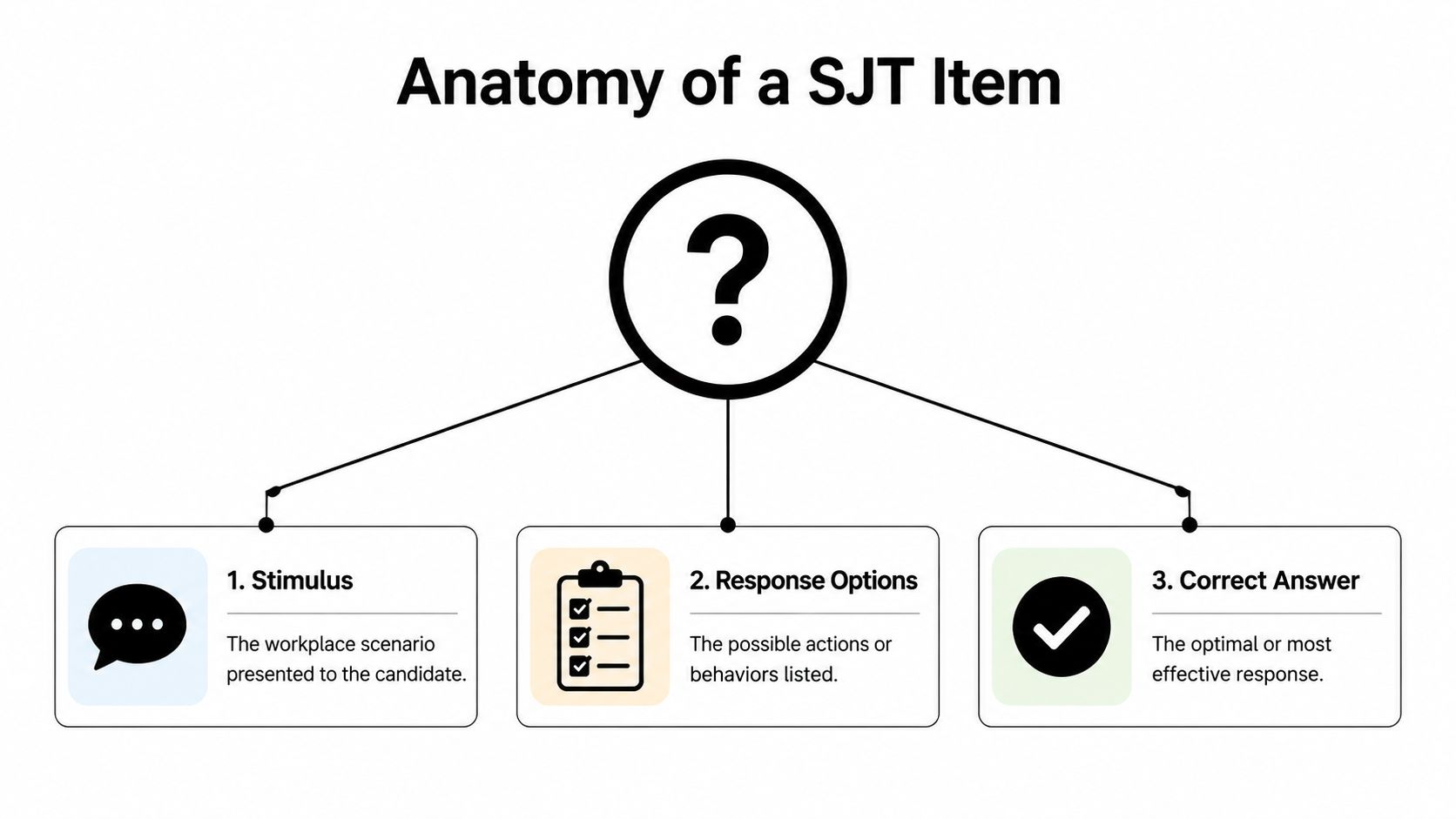
Every SJT item has three functional parts: the stimulus, the response options, and the scoring key. Each part affects the quality of the behavioral signal. A realistic scenario cannot compensate for vague options, and well-written options cannot produce a defensible result if the scoring rationale has no clear connection to the job.
The stimulus creates the decision
The stimulus presents a workplace situation and the decision the candidate must make. It needs enough context to support sound judgment, without allowing reading ability or irrelevant detail to dominate the result. A useful stimulus identifies the role, immediate challenge, relevant constraints, and outcome that matters.
For a team lead, the scenario might involve a high-performing employee who repeatedly interrupts colleagues. The item could assess whether the candidate addresses the behavior privately, gathers examples, protects team norms, and avoids humiliating the employee. For an accounts payable role, the scenario might involve an invoice that appears legitimate but lacks required approval. That item could assess process knowledge and ethical caution.
The situation should resemble actual work without copying a confidential incident or relying on obscure organizational customs. Representative job tasks help support content validity, as outlined in [OPM's SJT guidance](https://www.opm.gov/policy-data-oversight/assessment-and-selection/other-assessment-methods/situational-judgment-tests/). In practice, job analysis should establish the context before an item writer drafts the scenario.
The options expose the judgment
Response options should describe distinct actions, not minor wording changes. Each option must be plausible enough to require a candidate to weigh consequences. If one choice is clearly considerate and professional while the others are reckless or insulting, the item measures test-taking common sense rather than workplace judgment.
The preferred response may not be the fastest one. Immediate escalation can suit a role with serious safety or compliance risk. Another role may call for verifying information, speaking with the relevant person, or checking policy first. The scoring rationale should reflect the role's authority, risk profile, and operating environment.
The key explains preference
The scoring key records why one response is preferred or how responses should be ordered. Subject-matter experts, job analysis, policy requirements, or a structured consensus process should support that rationale. It should name the competency involved and explain the consequence behind the preference, giving the hiring team an interpretable signal rather than an unexplained score.
Use this review before adding an item to a scored assessment:
1. Does the scenario reflect a real job demand? 2. Do the options test different actions rather than writing style? 3. Can experts explain how the preferred response supports performance, ethics, safety, or service? 4. Would candidates from different backgrounds understand the item in the same practical way?
If reviewers disagree, do not conceal the ambiguity inside a numerical score. Revise the context, clarify the options, or remove the item. A people intelligence workflow can then preserve the item-level rationale alongside the candidate result, making later interpretation and audit review more useful.
Design Choices That Shape What SJTs Measure
Not all situational judgment tests measure the same construct. The wording of the instructions can shift the assessment toward job knowledge, reasoning, or behavioral preference, even when the scenario itself remains unchanged.
A knowledge-based instruction might ask, “Which response is most effective in this situation?” The candidate is being asked to identify the action that best fits professional standards or role requirements. A behavioral-tendency instruction might ask, “Which response are you most likely to take?” That version focuses more on the person's preferred way of behaving.
The distinction has empirical support. A meta-analysis found that knowledge-based response instructions increase correlations with cognitive ability, while behavioral-tendency instructions increase correlations with personality constructs (the response-instruction meta-analysis). The choice should therefore follow the hiring question, not a vendor's default format.
Compare the design options
| Design choice | What it emphasizes | Where it fits | |---|---|---| | Most-effective response | Applied judgment and job knowledge | Roles with defined standards, procedures, or customer obligations | | Most-likely response | Behavioral preference and self-consistency | Roles where recurring interpersonal tendencies matter | | Rank all responses | Relative prioritization across plausible actions | Jobs requiring trade-offs among competing demands | | Select one response | Clear decision preference | High-volume screening with tightly defined competencies |
The evidence doesn't support treating one instruction format as universally superior. The same meta-analysis found that these formats had little moderating effect on criterion-related validity. In practical terms, changing the instruction can alter what the test captures without necessarily destroying its ability to predict performance.
That's why design documentation matters. A hiring team should state whether it wants to know what candidates believe is effective, what they're likely to do, or how they compare several imperfect options. Those are different questions.
Avoid construct confusion
A scenario about giving feedback can measure role knowledge if the instructions ask for the most effective managerial response. It can measure behavioral tendency if candidates select what they'd personally do. It may measure verbal comprehension if the scenario uses dense language and unfamiliar terminology.
Build the assessment around the job analysis. Define the competencies first, then decide which instruction format best represents them. The SJT can add value over cognitive ability, the Big Five, and their combination, but only if the test's content and scoring remain aligned with the selection purpose.
How to Score Situational Judgment Tests Effectively
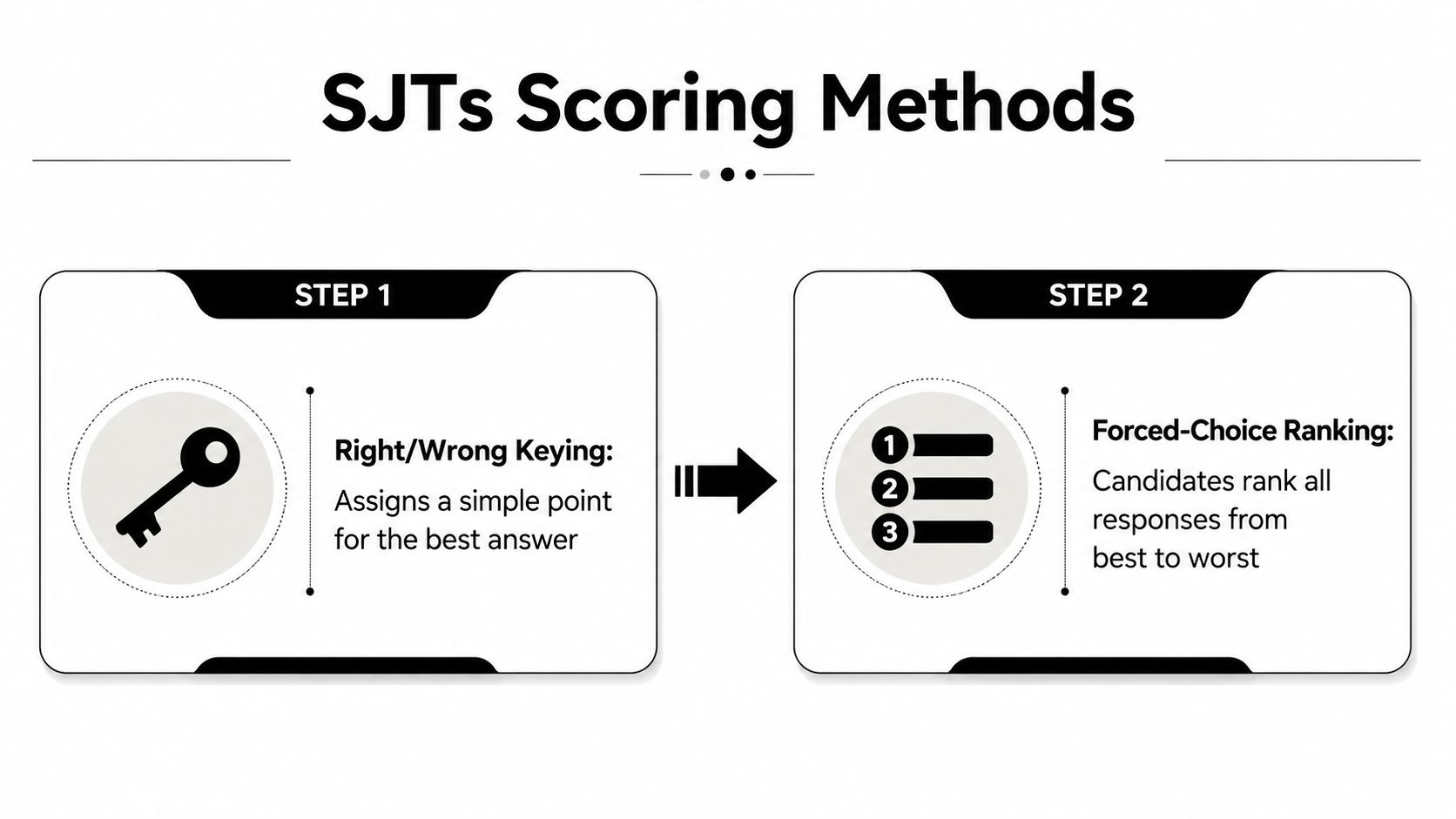
Scoring determines whether an SJT produces a usable hiring signal or a misleading number. Two common approaches are right/wrong keying and forced-choice ranking. Neither method is automatically better. The right choice depends on whether the job has a clearly preferred action or requires candidates to weigh several defensible responses.
Right or wrong keying
This method assigns credit when a candidate selects the keyed best response. It's appropriate when policy, safety, ethics, or role standards make one action clearly preferable.
Use it carefully:
1. Define the competency. State whether the item measures escalation, prioritization, confidentiality, or another job requirement. 2. Collect expert judgments. Ask qualified practitioners to identify the best response and explain the rationale. 3. Review disagreement. If experts split across options, clarify the scenario or avoid presenting a false single answer. 4. Set the scoring rule in advance. Don't change the key after reviewing candidate results. 5. Audit item performance. Look for options that attract candidates because of confusing language rather than poor judgment.
This method is easy to explain and administer. Its weakness is that it can oversimplify complex work. A candidate who chooses the second-best response may demonstrate sound reasoning, while a candidate who guesses the key may receive identical credit.
Forced-choice ranking
Forced-choice scoring asks candidates to rank responses from most effective to least effective, or from most likely to least likely. It captures more information about trade-offs and can distinguish candidates who recognize several reasonable actions but prioritize them differently.
The method also creates more interpretive work. Ranking requires a defensible order, and small wording changes can influence choices. Subject-matter experts must explain why one action precedes another, especially when the scenario involves competing values such as speed, accuracy, autonomy, and relationship management.
> Scoring should reflect the decision structure of the job. If the work allows several sound paths, a single keyed answer may create artificial precision.
Consensus scoring and expert keying carry different trade-offs. Expert keying ties the score to role standards and business requirements. Consensus scoring reflects what a relevant reference group tends to view as effective, but it can reproduce prevailing preferences without proving that those preferences predict performance. Whichever approach you use, document the rationale and test whether the scoring method supports the intended construct.
For interpretation practices that connect assessment results to decisions, consult this guide to [assessment interpretation](https://synopsix.ai/blog/assessment-interpretation). The goal isn't to produce a beautiful score report. It's to make a consistent, job-related decision while preserving enough transparency for candidates, managers, and reviewers.
<iframe width="100%" style="aspect-ratio: 16 / 9;" src="https://www.youtube.com/embed/MtFEfNV1DdQ" frameborder="0" allow="autoplay; encrypted-media" allowfullscreen></iframe>
Validity, Fairness, and Legal Considerations in Hiring
A defensible SJT starts with a clear selection question. The organization should explain what the assessment measures, why that construct matters for the role, how the scenarios reflect actual work, and how the score informs the final decision.
Research supports SJTs as useful predictors, but results vary by role, setting, and design. Earlier evidence found a meaningful relationship between SJT performance and job performance. A separate systematic review of medical selection examined 30 eligible studies, using 26 validity coefficients, and reported a pooled predictive validity of 0.32, with a 95% confidence interval from 0.26 to 0.39 ([the 2020 systematic review](https://pubmed.ncbi.nlm.nih.gov/32353895/)). The review also found substantial heterogeneity, I² = 96.5%, with larger effects in postgraduate than undergraduate selection settings.
These findings support careful use, not blanket adoption. The evidence for one role does not establish that the same scenarios, scoring key, or cutoff will work elsewhere. Teams should review both the construct and the decision context through [assessment validity and reliability](https://synopsix.ai/blog/assessment-validity-and-reliability).
Validity is contextual
A retail supervisor assessment should reflect customer service, staffing, safety, and operational decisions. A software engineering assessment might focus on incident response, code review conflict, and communicating technical risk. A generic “work style” quiz may look polished while missing the decisions that distinguish strong performance.
Validation should also examine how the SJT is used in the broader people intelligence workflow. It can provide behavioral evidence, but it should be interpreted alongside job requirements, structured interviews, and other relevant measures. A strong score does not erase contradictory evidence, and a lower score should prompt a focused review rather than an automatic rejection.
Fairness requires active controls
Fairness comes from consistent design, administration, review, and governance. Hiring teams should:
Legal defensibility depends on the entire process, including manager behavior after scoring. A tool with validity evidence can still create risk if managers override scores inconsistently, use the assessment for an unplanned purpose, or apply different thresholds to candidates.
Treat validity as an ongoing governance responsibility. Reassess the SJT when the role or performance criteria change, and investigate results that suggest the assessment is not functioning as intended. Clear records, consistent rules, and human review make the assessment easier to defend and more useful for decisions.
Integrating SJTs with a People Intelligence Platform
An SJT becomes more useful when it connects to the decisions surrounding it. Recruiting teams rarely need another isolated score. They need to know how a candidate's judgment profile fits the role, where additional evidence is required, and what risks a hiring manager should explore in a structured interview.
A people intelligence platform can organize that workflow by linking assessments, behavioral profiles, role requirements, and decision guidance. The advantage isn't automation for its own sake. It's consistency. Instead of leaving a recruiter to interpret technical psychometric output, the system can translate results into business-relevant questions such as whether a candidate tends to escalate too quickly, delay difficult conversations, or prioritize immediate service recovery over process controls.
From score to decision
A practical workflow should connect four activities:
1. Assess: Combine the SJT with other relevant measures rather than treating it as a pass-or-fail identity test. 2. Compare: Generate comparable profiles for candidates or employees using consistent constructs and reporting rules. 3. Interpret: Convert psychometric findings into clear role-related signals, with risk indicators and questions for human review. 4. Act: Use simulations, compatibility analysis, and development planning to test likely friction points and support the person after selection.
This approach also supports team decisions. A candidate's judgment style may look appropriate in isolation but create tension with a manager who expects independent escalation, or with a team that already lacks deliberate prioritization. A platform can help leaders examine complementarity and potential conflict before a hiring decision becomes an expensive organizational problem.
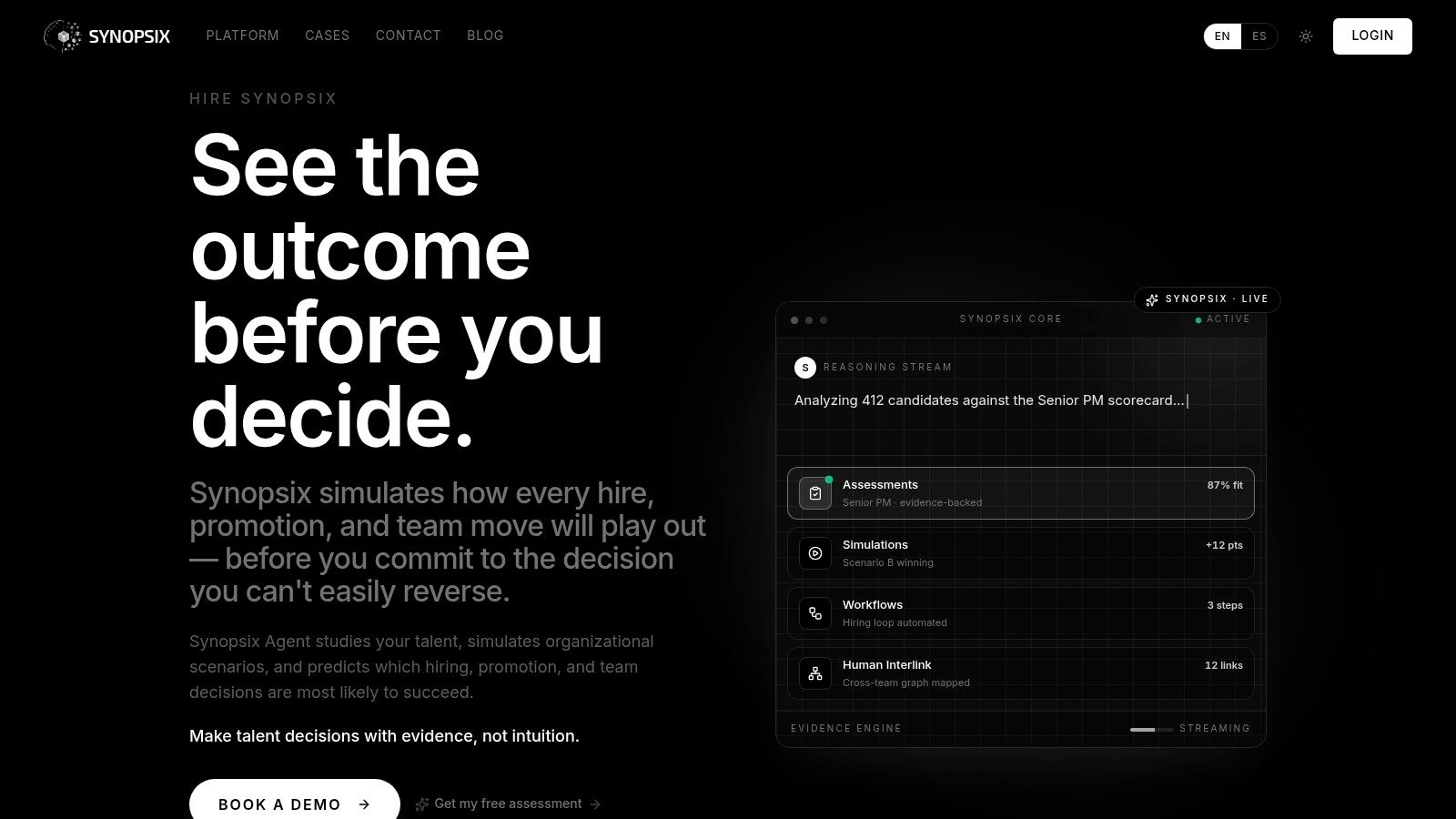
The practitioner's standard remains simple: use technology to improve interpretation, not to conceal weak assessment design. The scenarios still need job relevance, the scoring still needs a documented rationale, and the final decision still needs accountable human review. Integrated properly, situational judgment tests move from isolated screening exercises to one evidence stream in a disciplined people decision.
---
Synopsix turns scientifically validated behavioral assessments into practical guidance for hiring, team design, and talent development, including comparable profiles, role-specific intelligence reports, predictive simulations, and compatibility analysis. Visit [Synopsix](https://synopsix.ai) to see how your team can connect SJT results to clearer, more evidence-based people decisions.