Mastering Skills Inventory Management
By Synopsix · July 9, 2026 · 16 min read
The most common advice on skills inventory management sounds sensible and fails in practice: build a master list, ask employees to rate themselves, review it once or twice a year, and call it talent intelligence. That process creates neat spreadsheets and bad decisions.
A useful skills inventory doesn't just catalog what people claim they can do. It helps leaders judge actual capability, spot risk before it shows up in execution, and predict-human-behavior-synopsix-smarter-people-decisions in the places that matter most: hiring, promotion, succession, and team design.
Why Most Skills Inventories Fail and How Yours Will Succeed
Most skills inventories fail for one reason. They confuse data collection with decision quality.
Leaders launch the effort with good intentions. HR builds a taxonomy. Managers ask employees to update profiles. Someone exports the results into a dashboard. Six months later, nobody trusts the output enough to use it for staffing, promotion, or succession. The inventory becomes a reference document instead of an operating system.
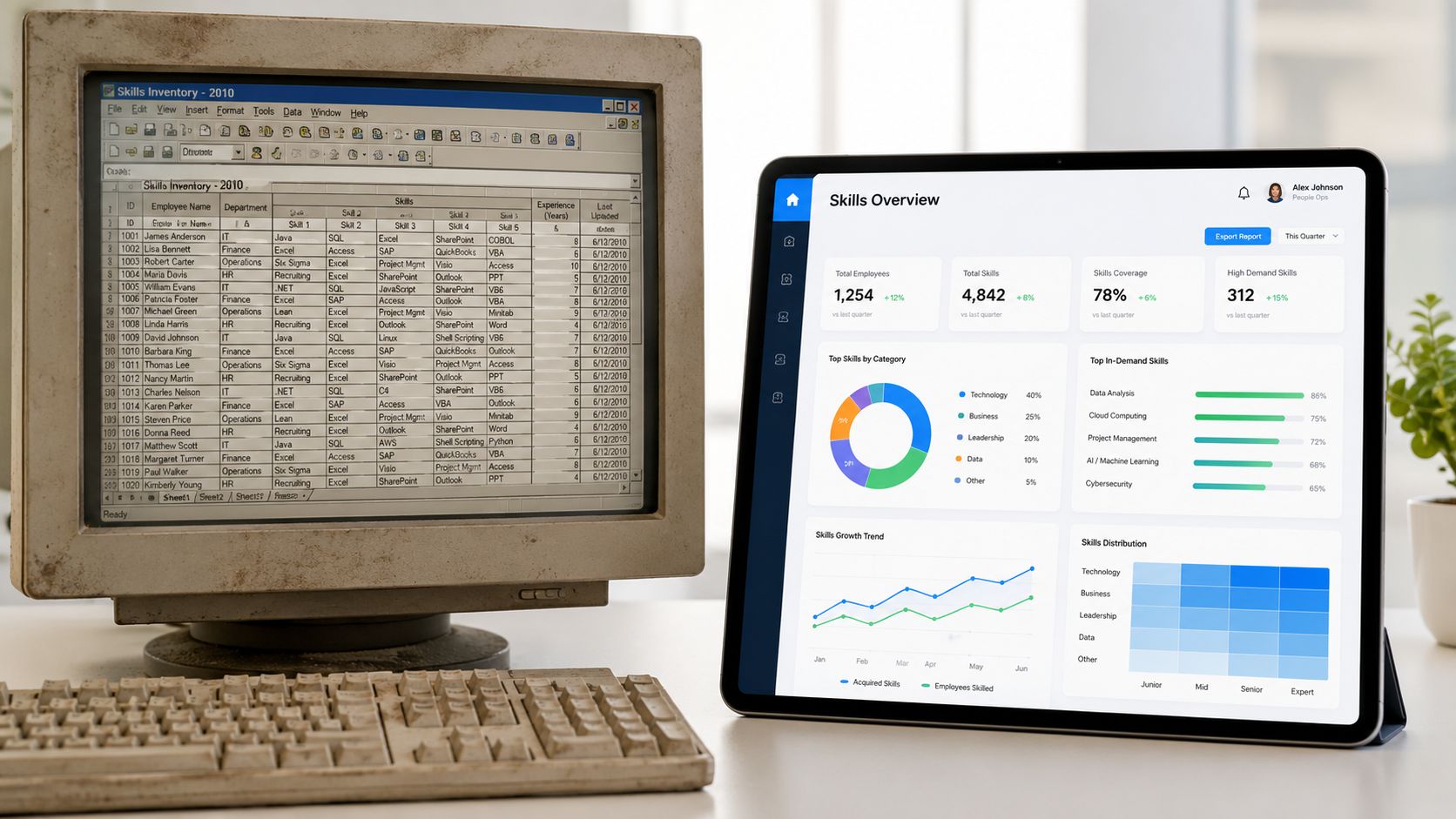
The old model creates false confidence
The classic model breaks in predictable ways:
That combination is dangerous because it creates a false sense of coverage. A polished skills database can make an executive team feel informed while they are still making judgment calls from resumes, manager intuition, and incomplete performance history.
> Practical rule: If a skills inventory isn't trusted for real staffing and promotion decisions, it isn't a management system. It's an archive.
There's a reason this matters beyond HR administration. Inventory management is recognized as the most critical technical skill by 58% of supply chain professionals, highlighting that the ability to manage and inventory workforce skills is itself a foundational business capability required for operational efficiency and strategic planning ([Supply Chain Dive on inventory management as a top skill](https://www.supplychaindive.com/news/inventory-management-top-skill-supply-chain/579475/)).
The better model is dynamic and validated
Strong skills inventory management works differently. It treats the inventory as a living capability map, not a one-time audit. It asks a harder question: not “What does this person say they can do?” but “What evidence suggests this person can perform in the environments we care about?”
That shift changes everything. You stop chasing exhaustive lists and start building a system that combines role-critical skills, observed performance, behavioral signals, and governance discipline. The output becomes more practical. Better project staffing. Cleaner succession discussions. Fewer promotions based on confidence alone.
The winning inventory is narrower, sharper, and more credible. That's what makes it useful.
Laying the Foundation Your Skills Taxonomy and Strategy
A good taxonomy starts with a business problem, not a software implementation. If you can't state the decision the inventory should improve, don't collect the data yet.
An effective skills inventory assessment requires defining clear, concretely measurable objectives, such as identifying leadership skill gaps across a specific segment of the workforce, to ensure the resulting data can effectively guide training and succession planning ([AG5 on skills inventory assessment objectives](https://www.ag5.com/skills-inventory-assessment/)).
Start with the decision, not the dictionary
I've seen companies waste months debating labels while overlooking the core issue. They don't need a universal map of all human capability. They need a usable structure for decisions such as:
| Decision area | What the inventory needs to answer | |---|---| | Hiring | Which capabilities are non-negotiable for success in role | | Internal mobility | Which adjacent roles a person can realistically move into | | Leadership pipeline | Which gaps block promotion readiness | | Project staffing | Which people have the required mix of technical and behavioral strengths |
That framing keeps the taxonomy lean. It also helps leaders avoid a common trap: collecting interesting data that nobody uses.
Build a taxonomy people can actually maintain
The strongest frameworks are usually simple. Start with four categories:
This is also where role context matters. A product manager doesn't just need “strategy” in the abstract. The role often demands prioritization, stakeholder management, discovery discipline, and decision-making under ambiguity. If you're refining role-specific criteria, [Underdog.io's product manager insights](https://underdog.io/blog/product-manager-skills-required) offer a useful reality check on what hiring teams evaluate.
A related step is clarifying the difference between skills, competencies, and proficiency signals. If your leaders blur those concepts, this explainer on [competency mapping](https://synopsix.ai/blog/what-is-competency-mapping) is worth using as a shared reference before the taxonomy goes live.
Keep the inventory intentionally minimal
Most organizations should collect the minimum viable information needed to drive the target decisions. That means resisting the urge to create thousands of entries that nobody can rate consistently.
Use a cross-functional governance group from Resource Management, Project Management, Delivery, Sales, and HR to shape the taxonomy and role definitions. That kind of group helps prevent two common failures: HR designing a model that line leaders ignore, and business units creating incompatible skill labels that can't be compared across teams.
> A simple taxonomy that leaders trust will outperform a sophisticated one that nobody can maintain.
If a skill can't influence a real people decision, it probably doesn't belong in the first version of your inventory.
Beyond Self Reports Assessing True Behavioral Capability
The biggest flaw in most skills inventory management programs is also the most socially acceptable one. They treat self-reporting as if it were evidence.
It isn't. Self-assessment can be a useful starting point for conversation, but it should never be the final word on capability. The trouble is that many organizations stop there because it's easy, cheap, and familiar.
Why self-reports distort the picture
Research shows that self-assessments are systematically inflated by 30-40% in non-technical domains, and organizations relying solely on this data see a 60% higher rate of tactical failure in project execution compared to those using validated behavioral assessments ([TalentLMS on skills inventory assessment risk](https://www.talentlms.com/blog/skills-inventory/)).
That finding aligns with what experienced people leaders already know. Employees often rate confidence, effort, or aspiration instead of actual performance. Managers aren't a perfect corrective either. Some overrate visible, articulate employees. Others underrate quieter operators whose strengths show up in delivery rather than presence.
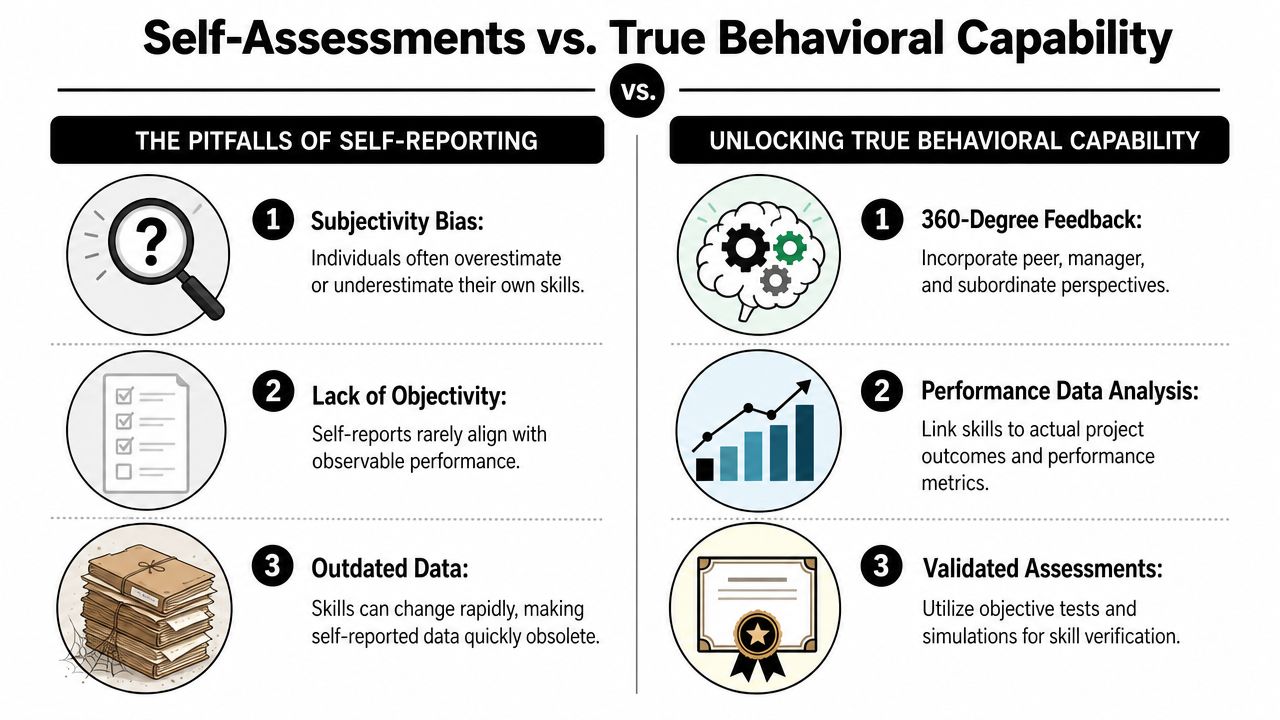
What to use instead
A stronger model layers multiple evidence types. Not all evidence carries the same weight, and that's the point.
1. Self-input for context Employees should still describe their experience, interests, and perceived strengths. This gives you directional data and opens productive discussion.
2. Manager and project-lead validation Validation should happen against observed work, not general impressions. Ask for examples tied to outcomes, complexity, and role demands.
3. Work-sample or simulation evidence When the role matters enough, test it. A candidate or employee can tell you they're strategic. A work sample shows how they think under constraints. This guide to [work sample testing](https://synopsix.ai/blog/work-sample-testing) is a useful reference when you need evidence stronger than interview confidence.
4. Behavioral and psychometric assessment Skills aren't just learned routines. Many depend on patterns of judgment, resilience, drive, cooperation, and learning agility. If you want to understand underlying capability, validated behavioral assessment belongs in the stack.
The clearest example is the Behavioral, Emotional, and Social Skills Inventory, a validated 20-minute assessment tool that measures 32 specific skill facets across five major domains: Self-Management, Social Engagement, Cooperation, Emotional Resilience, and Innovation ([BESSI overview](http://www.sebskills.com/the-bessi.html)). That kind of tool doesn't replace role-specific evaluation, but it adds a layer most inventories lack: evidence about how a person is likely to operate across contexts.
Capability beats confidence
A self-reported inventory tells you what people believe about themselves. A validated inventory gets closer to what they can sustain in role.
> Stop using self-ratings as a proxy for readiness. Confidence is relevant. Capability is decisive.
That distinction matters most in promotion decisions. The people who speak most fluently about leadership aren't always the ones who handle ambiguity, tension, and accountability best. Skills inventory management becomes strategic when it captures that difference instead of hiding it.
Integrating Technology for a Living Skills Inventory
A spreadsheet can store a skills list. It can't maintain a living inventory.
If you want useful skills inventory management, the data has to move through the systems where people already work: your HRIS, ATS, LMS, performance tools, and project records. Otherwise the inventory becomes another side database that requires manual upkeep and loses credibility.
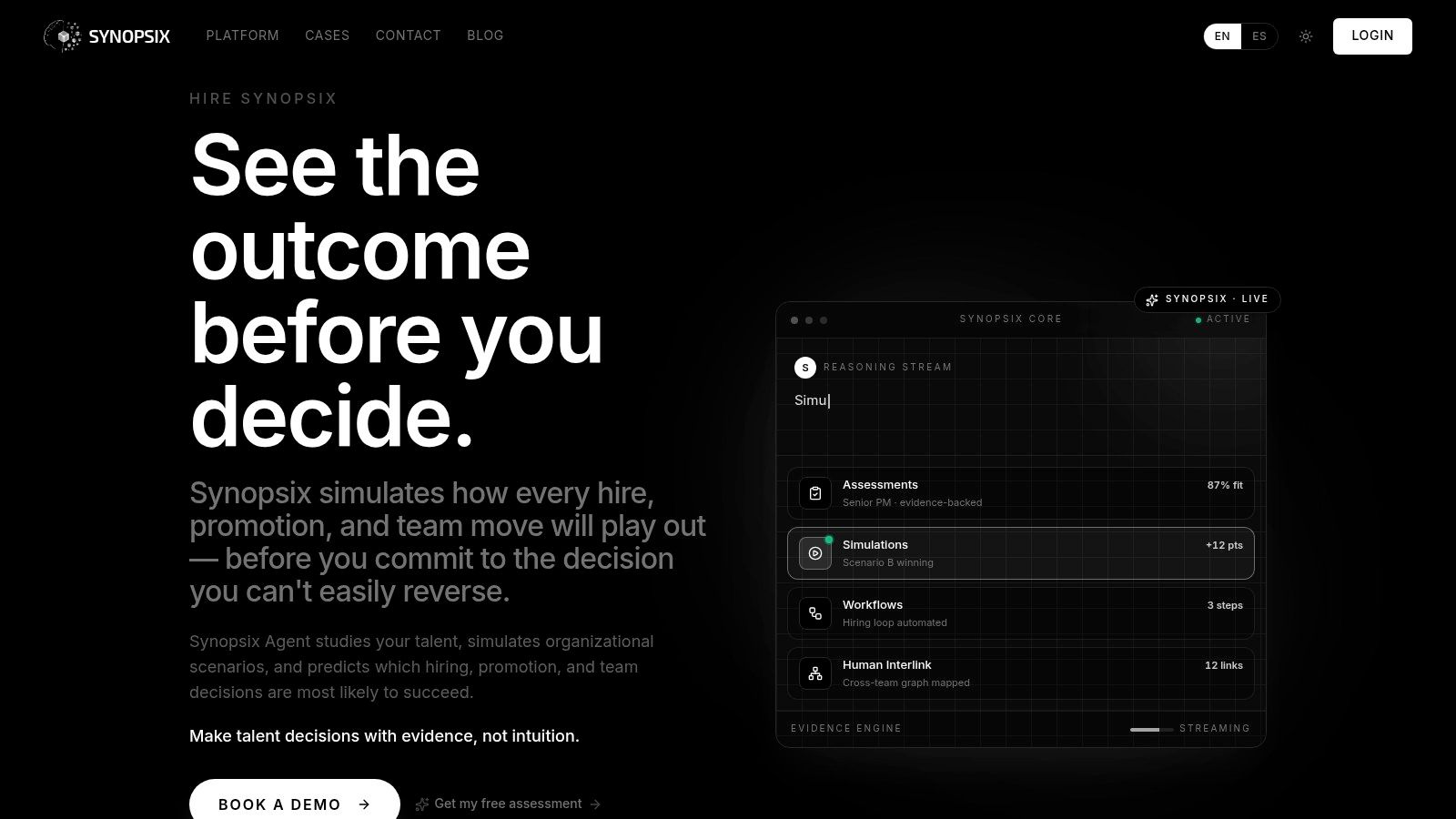
Connect the inventory to operational systems
The technical pattern is straightforward. Keep one skills model, then feed it with signals from the systems that already capture workforce activity.
This creates a usable talent intelligence layer instead of scattered records. For teams evaluating what that architecture looks like in practice, a modern [talent intelligence platform](https://synopsix.ai/blog/talent-intelligence-platform) typically sits between assessment data and the systems managers use every day.
Manual refreshes aren't enough anymore
Static reviews are now a strategic liability in many roles. Industry data reveals that 72% of skills in knowledge-intensive roles evolve or become obsolete within 3-6 months, making static quarterly inventory reviews strategically dangerous and highlighting the need for AI-driven, continuous skill signal extraction from work artifacts ([iMocha on skills inventory change velocity](https://www.imocha.io/blog/skills-inventory-all-you-need-to-know)).
That doesn't mean every skill needs constant human review. It means the system should absorb signals continuously and surface exceptions for validation. Think of the workflow this way:
| Signal source | What it updates | |---|---| | Completed projects | Applied capability and recent experience | | Learning records | New knowledge or certification signals | | Internal moves | Role adjacency and emerging strengths | | Assessment events | Behavioral and role-fit evidence |
A practical walkthrough helps here:
<iframe width="100%" style="aspect-ratio: 16 / 9;" src="https://www.youtube.com/embed/dK80FoYJG-Q" frameborder="0" allow="autoplay; encrypted-media" allowfullscreen></iframe>
The key trade-off is governance versus automation. If everything is manual, data goes stale. If everything is inferred, leaders won't trust it. The right design automates signal collection, then routes material changes to managers or trained reviewers for confirmation.
Governance and Upkeep Keeping Your Data Fresh and Relevant
Technology doesn't fix ownership. It only makes weak governance fail faster.
The best skills inventory management programs assign responsibility at three levels. HR owns the framework. Business leaders own role relevance. Employees and managers share responsibility for keeping individual profiles current and grounded in real work.
Use a council, not a committee on paper
A cross-functional skills council works when it has a real operating cadence and a narrow charter. Resource Management, Project Management, Delivery, Sales, and HR should review role priorities, approve additions to the taxonomy, retire outdated skills, and settle disputes about definitions.
That governance model matters because market behavior is already moving toward automation. With 43% of small businesses still using manual inventory tracking, the market is rapidly moving toward automated solutions; businesses that adopt AI-driven inventory tools report a 24% inventory reduction and a 70% improvement in turnover, demonstrating the clear ROI of moving to a modern system ([Swell on inventory management automation trends](https://www.swell.is/content/wholesale-inventory-management-statistics)).
Validate in two layers
Data quality improves when the update process mirrors how work happens. A practical model looks like this:
> Good governance doesn't mean more forms. It means fewer judgment errors.
Freshness is a workflow problem
Quarterly reviews still have value for formal checkpoints, but they shouldn't carry the full burden of upkeep. A healthier model blends automated signal capture with lightweight human verification. When someone completes a critical project, changes roles, finishes a major learning path, or demonstrates capability in a live setting, the inventory should reflect it without waiting for the next calendar cycle.
The organizations that keep this data useful don't ask employees to “update everything.” They ask them to confirm meaningful changes, then route those changes through clear validators. That lowers friction and improves trust at the same time.
Activating Your Insights Four High-Impact Use Cases
A validated inventory earns its keep when leaders use it in consequential decisions. That's where skills inventory management stops being an HR artifact and becomes a business tool.
The strongest applications usually show up in four areas. Each one improves when the inventory includes evidence of actual capability, not just declared proficiency.
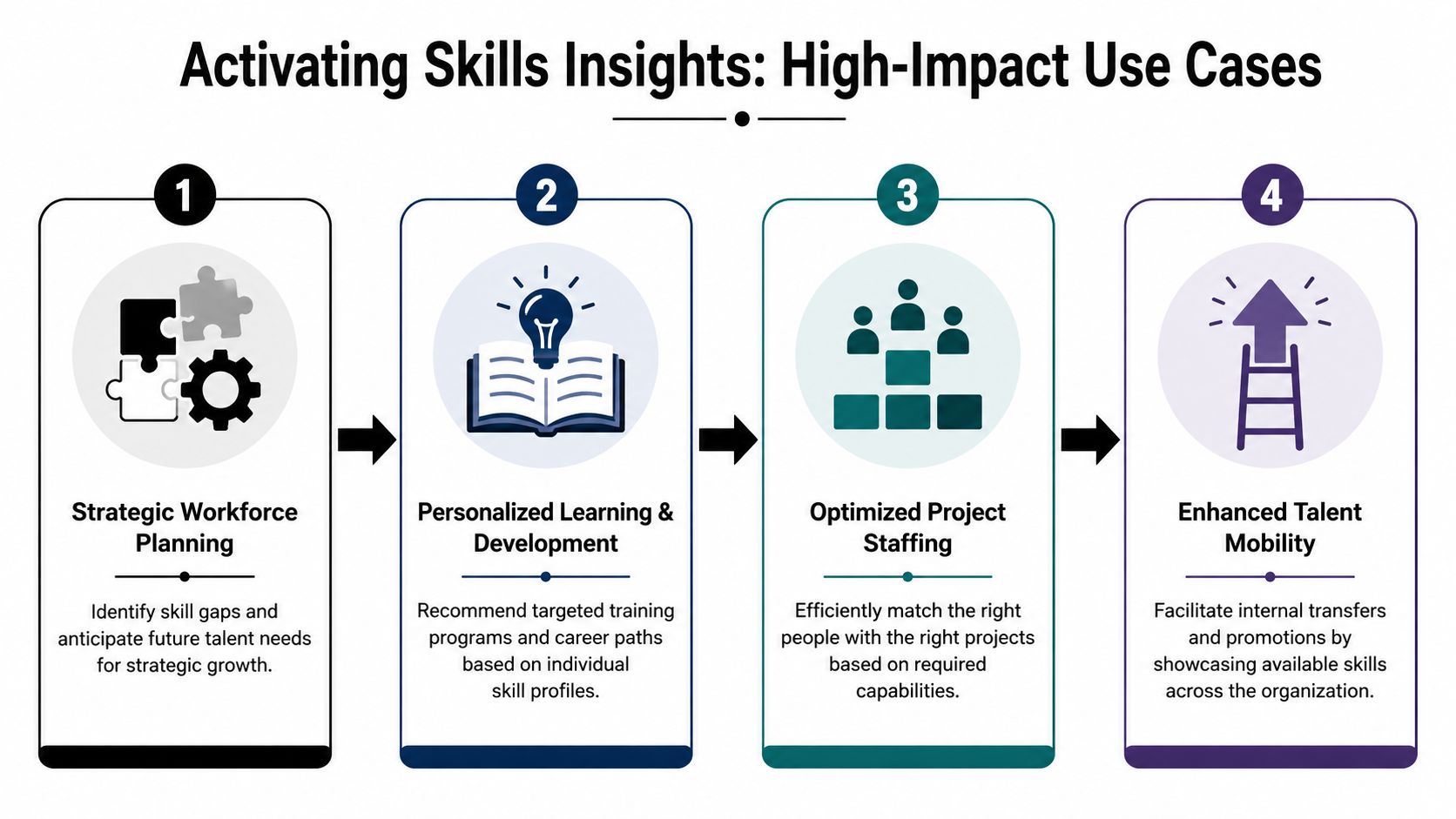
Hiring for fit, not keyword overlap
A resume tells you where someone has been. A validated inventory helps you judge whether their strengths fit the conditions of the role.
Consider a hiring team filling a cross-functional leadership role. Two candidates may share similar credentials. One has strong evidence of resilience, judgment under ambiguity, and stakeholder navigation. The other presents well but has thin evidence outside structured environments. Without validated capability signals, both can look equally strong on paper.
That same logic sharpens skill gap work inside the organization. If your team is building a more disciplined process for identifying real readiness gaps, [LatHire's skill gap analysis guide](https://lathire.com/skill-gap-analysis/) is a helpful companion to a validated inventory approach.
Personalizing development with evidence
Most development plans fail because they are generic. Employees get broad advice like “improve executive presence” or “be more strategic” with no grounded view of the behaviors that need work.
A validated inventory changes the conversation. A high-potential manager may need stretch work that builds decision speed under uncertainty. Another may need coaching on cooperation or conflict handling before taking on a broader leadership role. Same title. Different development path.
Building a credible succession bench
Succession planning often breaks when leaders confuse current performance with future readiness. A top individual contributor isn't automatically a strong people leader. A visible manager isn't automatically ready for an enterprise role.
A better succession pipeline uses the inventory to test for three things:
| Succession question | What to examine | |---|---| | Can they do the next job? | Evidence of adjacent capability, not just current output | | Can they handle the environment? | Behavioral fit for ambiguity, scale, and pressure | | What needs to develop first? | Specific gaps tied to experiences, coaching, or exposure |
> Leadership test: Promote on demonstrated readiness for the next context, not comfort with the current one.
Designing teams with complementarity in mind
Many organizations often leave value on the table. They assess individuals but ignore how capability interacts at team level.
A validated inventory can help leaders balance execution styles, decision patterns, communication tendencies, and friction risks across a team. That matters in project squads, leadership teams, and client-facing groups where interpersonal dynamics often determine whether technical capability translates into performance.
When leaders use the inventory this way, they stop asking only, “Who are our strongest people?” They start asking, “Which mix of people gives this team the best chance to deliver?”
That's a much more strategic question.
From Inventory Management to Strategic People Intelligence
The opportunity isn't better recordkeeping. It's better judgment.
Traditional skills inventory management gives leaders static lists, uneven definitions, and too much self-reported data. That may satisfy an administrative need, but it won't reliably improve hiring, promotion, or team design. The cost isn't just inefficiency. It's preventable error.
A stronger model treats the inventory as strategic people intelligence. It starts with a narrow business purpose. It uses a simple taxonomy tied to decisions. It validates capability with evidence instead of relying on confidence. It connects to the systems where work already happens. And it stays useful because governance is built into the workflow, not bolted on after the fact.
What leaders should do first
Don't try to fix the entire enterprise at once. Pick one business problem where better capability data would immediately improve outcomes.
Start there. Build the inventory around that decision. Validate what matters. Then expand.
> The organizations that win with skills inventory management don't collect more data than everyone else. They use better evidence, with better discipline, in higher-stakes decisions.
That is the shift worth making. Once leaders can trust the inventory as a picture of actual capability, it becomes far more than a skills list. It becomes a way to predict performance patterns, reduce avoidable people mistakes, and build a workforce that's more adaptable because decisions are grounded in evidence.
---
If you're ready to move beyond self-reported skills lists and build a more reliable people decision system, [Synopsix](https://synopsix.ai) offers a practical way to turn validated behavioral assessment into hiring, development, and team design guidance that leaders can readily employ.