Structured vs Unstructured Interviews: Which Works Best
By Synopsix · November 16, 2026 · 15 min read
Structured interviews had a mean validity of 0.42 for predicting job performance, with a standard deviation of 0.24, according to a discussion of a 2023 meta-analysis in [Industrial and Organizational Psychology](https://www.cambridge.org/core/journals/industrial-and-organizational-psychology/article/structured-interviews-moving-beyond-mean-validity/7CB1F7C86CB0D15328B3F07AD5F964E2). That spread reframes the debate: choosing a structured format doesn't automatically produce a useful hiring assessment. Employers still have to build a measurement system that captures relevant evidence, produces consistent ratings, and permits justified follow-up without letting personal impressions determine the result.
Structured and Unstructured Interviews at a Glance
Use structured interviews as the default for comparable hiring decisions. Keep conversational flexibility when it helps clarify evidence, not when it changes what candidates must demonstrate.
A structured interview gives every candidate the same job-related core questions, scores answers against predefined behavioral anchors, and records the evidence behind ratings. An unstructured interview lets the interviewer steer the conversation and reach a broader overall judgment.
Structured vs unstructured interviews on core criteria
| Criterion | Structured interview | Unstructured interview | |---|---|---| | Questions asked | Same job-related core questions for every candidate | Interviewer chooses questions as the conversation goes | | Answer scoring | Predefined dimensions with anchored rating scales | Overall impression, often without anchors | | Record keeping | Answers recorded and rated against behavioral examples | Informal notes that differ by interviewer | | Interviewer agreement | Usually high when scoring is anchored and calibrated | Often lower because interviewers apply different standards | | Predictive value | Stronger on average in commonly cited comparisons | Weaker on average in those comparisons | | Adverse impact risk | Lower with more structure, not eliminated | More opportunity for irrelevant cues to influence ratings | | Best fit | High-volume hiring or comparable candidates | Exploration in senior and creative roles that need follow-up, preferably within a structured core |
The commonly cited Schmidt and Hunter benchmark gives structured interviews a correlation of approximately 0.51 with overall job performance, compared with 0.38 for unstructured interviews, as summarized in the [personnel-selection literature](https://onlinelibrary.wiley.com/doi/10.1002/9781118851715.ch10). These are average research estimates, not guarantees that a particular interview will identify the better hire.
Choose the criteria that matter to your decision
For a recruiting team comparing applicants across locations, prioritize comparable evidence and interviewer agreement. For a specialist appointment, examine whether the process can uncover technical depth without letting each interviewer invent a different assessment.
Don't mistake an engaging conversation for a strong measurement instrument. Equally, don't assume that identical questions compensate for vague scoring standards. The decisive distinction is whether the hiring team evaluates candidates against a shared definition of job-relevant performance.
How Each Interview Format Runs in Practice
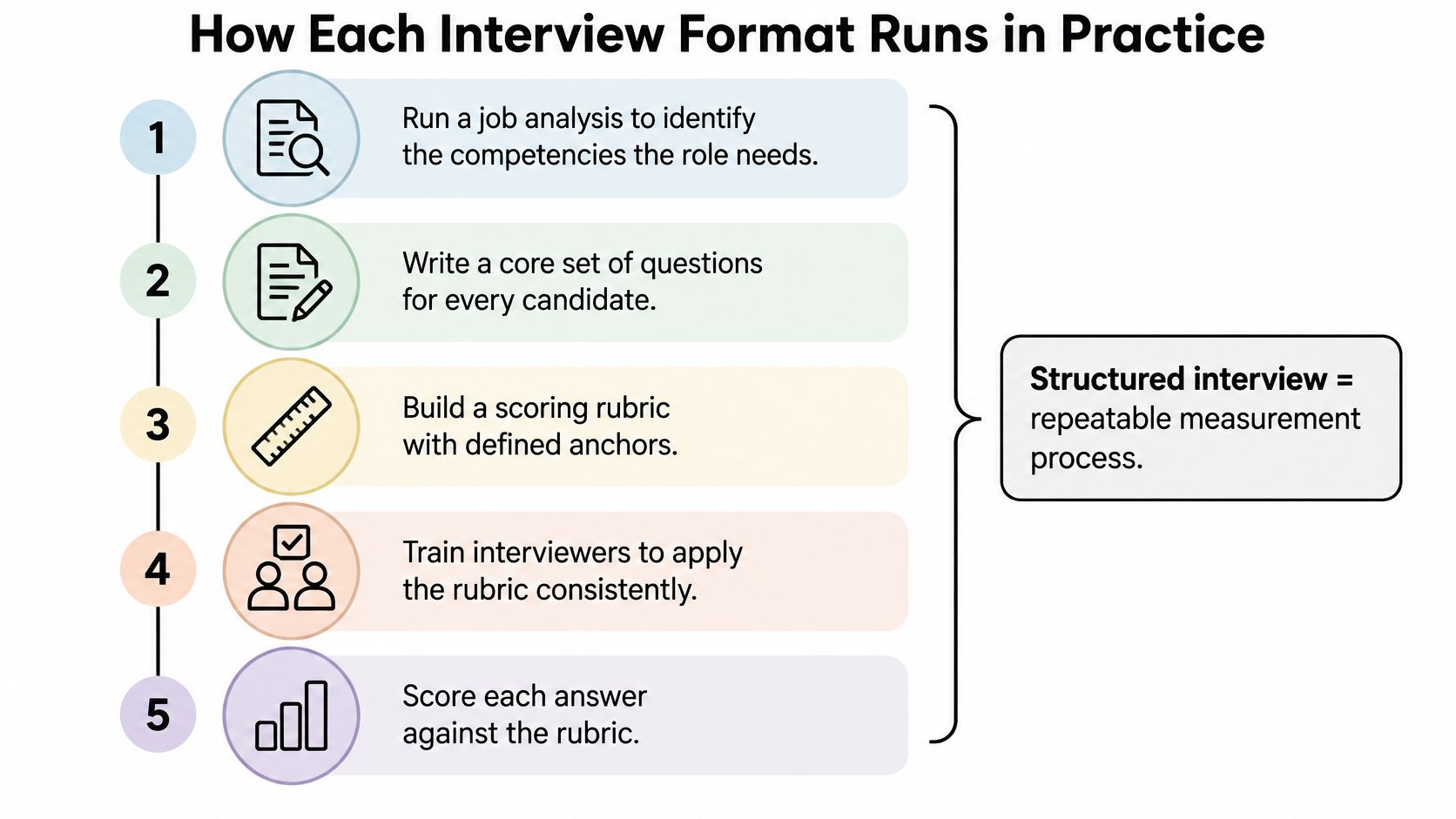
A structured interview begins before the candidate enters the room. The [U.S. Office of Personnel Management's structured-interview guidance](https://www.opm.gov/policy-data-oversight/assessment-and-selection/other-assessment-methods/structured-interviews) specifies job-analysis-based questions, common core questions, anchored rating scales, recorded ratings, and consistent administration with documented job-relatedness and fairness.
Build the process before scheduling candidates
1. Run a job analysis. Ask role holders and their managers which tasks distinguish effective performance from inadequate performance. Translate those tasks into competencies rather than broad personality preferences.
2. Write the common core. Develop behavioral or situational questions that elicit evidence for those competencies. Use the same core for every applicant, so a candidate's opportunity to demonstrate competence doesn't depend on the interviewer's curiosity.
3. Define behavioral anchors. Describe what weak, adequate, and strong evidence looks like for each competency. For problem-solving, distinguish identifying a symptom from testing plausible causes and checking whether the solution worked.
4. Administer the interview consistently. Ask the common questions and use approved clarification prompts. Before interviewing, have assessors practice applying the rubric to sample answers and explain disagreements.
5. Record answers and score independently. Capture the candidate's actions, reasoning, and outcomes, then rate the relevant competencies before panel discussion. Don't reconstruct evidence from memory after hearing another interviewer's opinion.
6. Document job-relatedness and fairness. Retain the rationale connecting questions and scoring criteria to the work. Record substantive departures from the agreed process so someone can review their effect.
The process below summarizes the preparation and scoring workflow.
An unstructured interview usually starts with rapport, follows topics selected during the conversation, and ends with an overall impression. The interviewer may discover useful information, but another candidate may never receive an equivalent opportunity to supply it.
Use this practical test when reviewing your [interview-question design](https://synopsix.ai/blog/interview-question-design): would different candidates receive the same core questions and the same scoring anchors? If not, the process is unstructured in practice, whatever the calendar invitation calls it.
Consistency Across Interviewers and Candidates
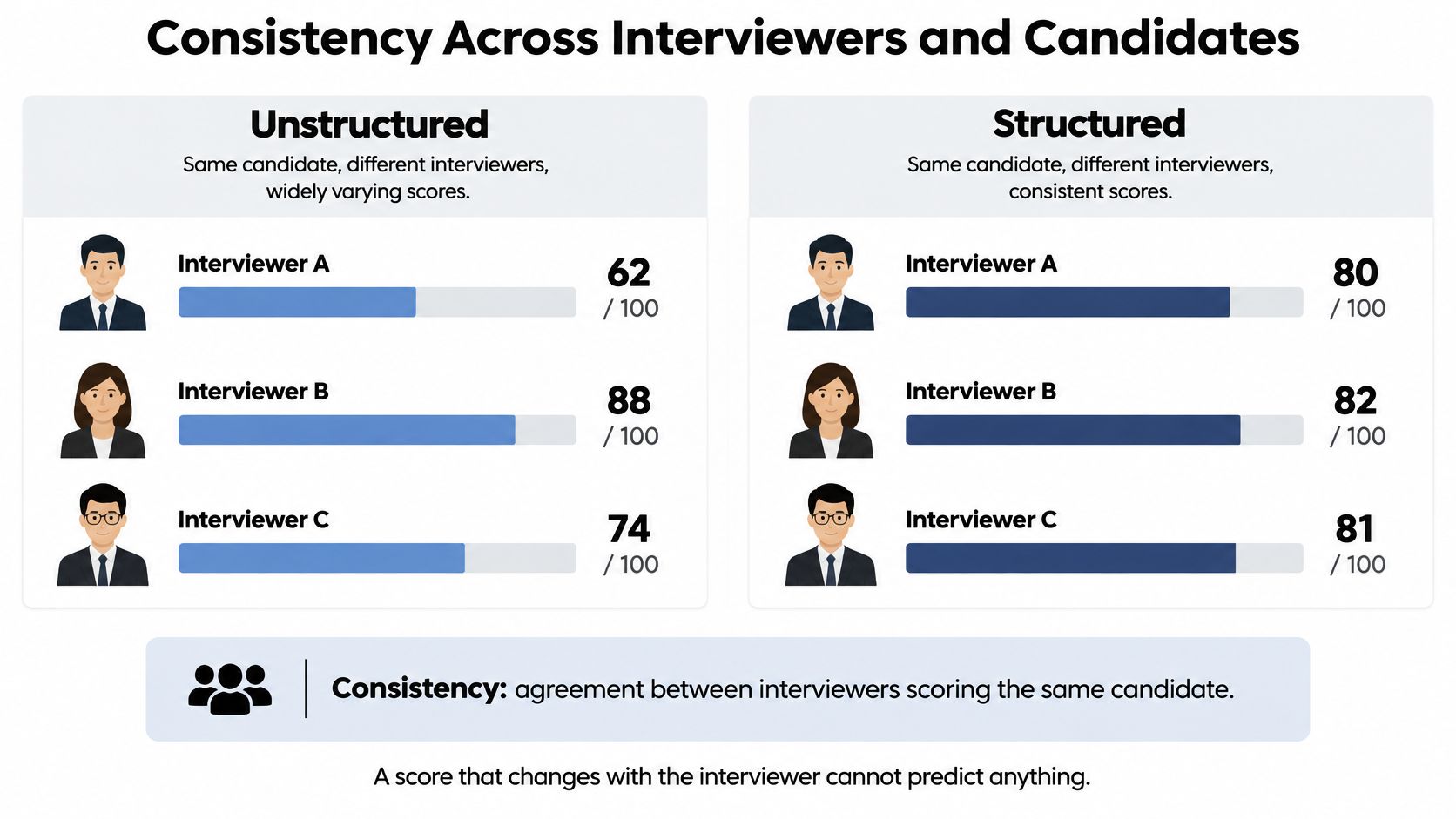
Interrater reliability concerns the consistency of ratings made by different interviewers. Before asking whether interview scores predict performance, check whether assessors can score the same evidence consistently.
A study involving 149 entry-level production employees reported interrater reliability of r = 0.88 for a highly structured interview using job-analysis questions, common questions, behaviorally anchored examples, panel recording, and consistent administration, according to the [Personnel Psychology study](https://onlinelibrary.wiley.com/doi/abs/10.1111/j.1744-6570.1988.tb00630.x?msockid=275498889c4a6b741f5d80999d486aba). That finding illustrates what a carefully designed process can achieve, not what every standardized interview will achieve.
Use disagreement to diagnose the rubric
Say a three-person panel evaluates problem-solving on the same anchored scale. As a practical calibration target, you might expect their ratings to fall within one point of each other; a wider spread should trigger a review of the evidence and anchors.
That one-point flag is a working rule of thumb, not a cutoff reported in the production-employee study. Its usefulness also depends on the scale: a gap on a short scale deserves different attention from the same gap on a much longer scale.
The comparison below illustrates the difference between scattered and closely grouped ratings. Its scores are illustrative, not study results.
For a technical hiring team, nexus IT group's resource on how to [standardize technical interviews with rubrics](https://nexusitgroup.com/interview-scorecard-template/) offers a concrete starting point for documenting shared criteria.
Run a small scoring audit:
> Agreement is necessary for dependable measurement, but agreement alone doesn't establish that you're measuring something useful.
Interviewers can consistently reward the wrong behavior. Reliability makes prediction testable; it doesn't prove predictive value.
Predictive Value Across Interview Formats
The familiar structured-versus-unstructured benchmark favors structure, but it isn't the only estimate worth considering. Predictive validity is the correlation between interview scores and a later criterion, such as job performance, rather than a percentage of successful hires.
A coefficient near half a correlation point represents a substantial relationship for a single hiring instrument, yet still leaves considerable uncertainty. A smaller positive coefficient can be useful without explaining most differences in later performance. The practical question is how much an interview improves the decision, not whether it predicts a person perfectly.
Reported validity figures for interview formats
| Source | Comparison | Reported figure | |---|---|---| | Schmidt and Hunter benchmark | Structured vs unstructured correlation with job performance | 0.51 vs 0.38 | | 1988 worldwide review | Structured vs unstructured validity in one comparison | 0.62 vs 0.31 | | 2023 meta-analysis | Mean structured-interview validity | 0.42, standard deviation 0.24 |
The [1988 worldwide review](https://onlinelibrary.wiley.com/doi/full/10.1111/j.2044-8325.1988.tb00467.x) examined 150 usable validity coefficients and found mean validity approximately twice as high for structured interviews, including the 0.62 versus 0.31 comparison shown above. It attributed substantial differences in validity to structure, while variation among unstructured-interview findings was largely attributable to statistical artifacts.
Read differences between estimates carefully
These figures shouldn't be treated as interchangeable measurements of a universal property. Researchers can examine different interview systems, performance criteria, populations, and statistical corrections. A change in the estimate doesn't necessarily mean employers' interviews improved or deteriorated over time.
The dispersion around the more recent mean matters operationally. It indicates meaningful differences among structured-interview systems, so adopting the label doesn't establish that your questions, assessors, or scoring rules work well.
For a fuller explanation of how to interpret these relationships, use this guide to [predictive validity](https://synopsix.ai/blog/what-is-predictive-validity). Then define your own later outcome before evaluating interview quality: the performance measure should represent the work, rather than merely repeat the hiring manager's initial impression.
> Investment priority: Improve job relevance, scoring anchors, and scoring discipline before spending effort making every sentence of the interview identical.
Structure is a sensible first investment because it improves an assessment step employers already conduct. The cited evidence doesn't establish a universal return per unit of effort, however, or quantify the additional value of every assessment combination. If you add another validated method, check whether it contributes relevant information beyond the interview in your own hiring context.
Fairness and Bias Risks in Each Format
An interviewer can form an impression from information that isn't evidence of the capability being assessed. An unstructured format leaves more room for that impression to influence both the questions asked and the interpretation of answers.
Candidate evaluation should focus on demonstrated behavior rather than the ease of the interaction.

A [systematic review of medical-school admissions interviews](https://link.springer.com/article/10.1007/s40037-022-00726-8) reported significant influences from applicants' gender, age, GPA, and MCAT scores on unstructured ratings; in a cited blinding study, bias toward higher academic scores decreased, while reliability changed only from Cronbach's alpha 0.496 to 0.473. The review characterized unstructured-interview reliability as unacceptable.
Separate relevant evidence from background cues
Admissions evidence doesn't establish the size of the same effect in corporate recruitment. It does illustrate the mechanism: background information can influence an interview rating that is supposed to measure something else.
Say a hiring manager recognizes a familiar university on a résumé. The manager warms to the candidate, asks easier questions, and interprets incomplete answers generously. The problem isn't seeing the university name; it's allowing that cue to alter the assessment.
The following video provides an additional discussion alongside the evaluation practices described here.
<iframe width="100%" style="aspect-ratio: 16 / 9;" src="https://www.youtube.com/embed/9NSNjL-I4ik" frameborder="0" allow="autoplay; encrypted-media" allowfullscreen></iframe>
Common questions and anchored scoring constrain those pathways, but they don't remove every visible cue or every subjective judgment. Treat [reducing hiring bias](https://synopsix.ai/blog/how-to-reduce-hiring-bias) as an evidence-handling problem as well as an interviewer-awareness problem.
Blinding information and improving reliability address different problems. Removing a distracting credential doesn't supply the shared scoring standards the process was missing.
Why Structure Does Not Remove Bias
Formal interviewer training isn't proof that interviewers make less biased judgments. A [2024 study in the International Journal of Selection and Assessment](https://onlinelibrary.wiley.com/doi/abs/10.1111/ijsa.12467) found that training was associated with greater susceptibility to bias in its full model, while the proportion of structured interviews conducted wasn't related to interviewers' perceived influence from potentially biasing characteristics.
That association doesn't establish that training caused bias. It does challenge the assumption that attendance and adoption are adequate measures of implementation quality.
The same source discusses a separate survey of 190 practitioners, in which acceptance of structured interviewing depended on training components rather than participation alone. Those components included rating-error prevention, answer-evaluation practice, role-play, job analysis, legal issues, and explicit instruction on behaviors to avoid.
Check what interviewers actually reward
A rubric can preserve polished bias if assessors consistently reward culturally specific communication styles. Identical questions won't solve a rubric that treats fast, assertive delivery as evidence of leadership without establishing why that delivery matters to the role.
For example, distinguish a candidate's ability to explain a difficult decision from their resemblance to the organization's current leaders. Evaluate whether they described competing interests, made a defensible choice, and handled consequences, not whether their storytelling style felt familiar.
Run a quarterly governance checklist:
> Governance principle: A completed scorecard is evidence that someone followed a form, not proof that they applied the standard fairly.
Use the findings to revise anchors, recalibrate assessors, and inspect question relevance. Structure is a governance system requiring outcome checks, not a one-time setup that removes the need for scrutiny.
When Discretion Improves a Hiring Decision
The strongest challenge to a simple hierarchy comes from a meta-analysis by Oh, Postlethwaite, and Schmidt: after adjustments for interrater reliability, publication bias, and criterion measurement error, estimated validity was 0.556 for unstructured interviews versus 0.450 for structured interviews. The authors concluded that unstructured interviews may be similarly valid when qualified interviewers can deviate appropriately from standardized questions.
These adjusted estimates aren't directly interchangeable with every benchmark reported elsewhere. Nor do they establish that informal interviewing by any manager is superior. They make a narrower, important point: useful expert discretion and uncontrolled impression formation aren't the same thing.
Fix the evaluation and bound the exploration
Standardize the job-related competencies, core questions, scoring anchors, and decision rules. Allow clarification when an answer is ambiguous or reveals unusually relevant evidence, but require a job-related rationale for the departure.
This design is particularly useful when considering senior, creative, technical, or cross-cultural work. A rigid question sequence can fail to distinguish an unfamiliar context from weak capability. An expert follow-up can clarify the candidate's constraints, contribution, or reasoning without changing the performance standard.
Consider this hypothetical product-manager interview guide:
| Element | Fixed or flexible design | |---|---| | Four fixed competencies | Prioritization, customer discovery, analytical judgment, stakeholder alignment | | Core question on priorities | Describe a product decision where you rejected an attractive opportunity | | Core question on discovery | Explain how customer evidence changed your original hypothesis | | Core question on execution | Describe a disputed launch decision and how you evaluated the outcome | | One follow-up rule | Probe only to clarify personal contribution, constraints, evidence, or results; document the reason |
Map each question to its relevant competencies before interviewing. A follow-up about the candidate's personal contribution should clarify ownership, not introduce a new test for one applicant alone.
Apply these guardrails:
The design principle is to maximize structure around evaluation, not necessarily around every word of the conversation. Qualified judgment becomes more useful when the organization can inspect how it was exercised.
Choose the Interview Format for Your Next Hire
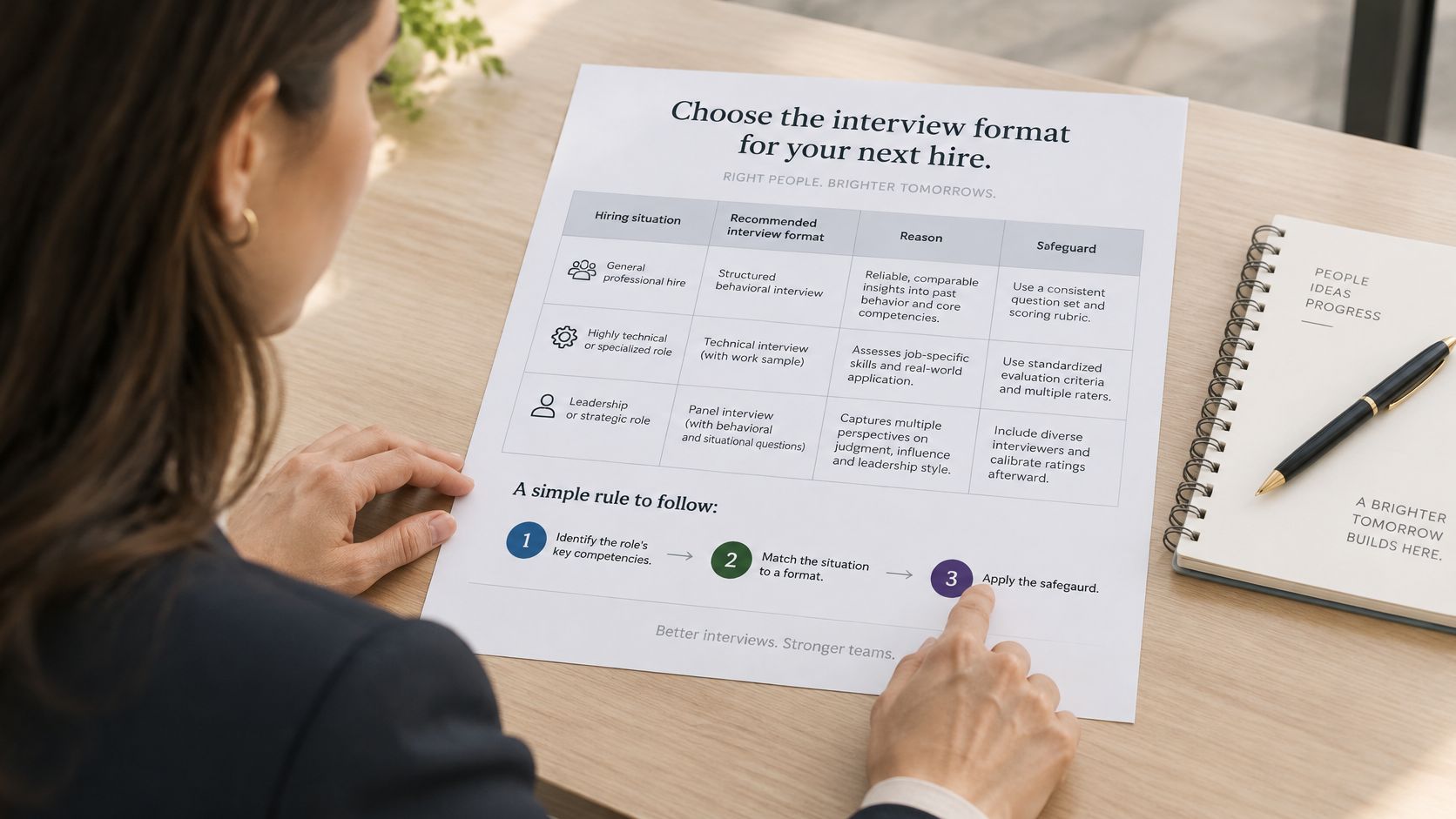
| Hiring situation | Recommended format | Why it fits | Safeguard | |---|---|---|---| | High-volume entry-level screening | Structured | Many comparable candidates need the same evidence | Anchored scoring and interviewer calibration | | Frontline or production roles | Structured | Job-related behaviors can be scored consistently | Recorded answers and periodic score audits | | Senior leadership | Structured core with limited follow-up | Context matters, and discretionary judgments need scrutiny | Predefined follow-up rules and documented rationale | | Creative or specialist roles | Hybrid | Rigid scripts can miss relevant evidence | Standard competencies and auditable deviations | | High-cost final hire | Structured plus validated assessment | Complementary methods can add predictive information | Job-analysis criteria rather than rapport, with local validation |
Use the hiring situation to select the design before interviewing begins.
Apply the decision rule
1. Identify role level and hiring volume. For frontline roles and large pools of comparable applicants, favor a fully structured process that assessors can administer consistently.
2. Check the need for contextual exploration. When creativity, specialist expertise, or cross-cultural judgment matters, retain a structured core and permit auditable follow-up.
3. Consider complementary evidence for consequential decisions. Add a job-relevant, validated assessment when it answers a question the interview can't resolve. Don't assume that adding a method automatically increases predictive value; examine its incremental contribution.
Before the round, confirm the format with the hiring manager, write down competencies and scoring anchors, and distribute the common questions to every assessor. Agree in advance how the panel will handle missing evidence and conflicting ratings.
Schedule the first score audit within the next hiring cycle. Use disagreement of more than one point as a practical review flag where appropriate to your scale, then inspect the underlying answers rather than forcing assessors to agree.
---
Synopsix offers selection and hiring analysis that evaluates a candidate against the role, team, leader, and culture, predicts integration risk, and proposes questions for the final interview. Visit [Synopsix](https://synopsix.ai) to turn those decision-specific signals into focused follow-up questions alongside your structured scoring process.