Succession Planning Process: A Step-by-Step Framework
By Synopsix · August 9, 2026 · 15 min read
Only 14% of organizations believe they do an effective job with leadership succession planning, even though 86% say they have a succession plan in place and just 21% report a strong bench of successors ready now for all critical roles. That gap is the story, because a document on a shared drive doesn't keep a plant running, a revenue team stable, or a C-suite transition from turning messy. A succession planning process has to produce readiness, not paperwork.
That's why the useful question isn't whether a company has a plan. It's whether the plan creates a measurable pipeline of people who can step into work that's changing under pressure, including work reshaped by AI, restructuring, and speed of change. In small firms, a practical view of this same problem shows up in the [fractional CFO on succession planning](https://ambitioncfo.com/blog/succession-planning-for-small-business/) discussion, where continuity depends on preparing replacements before the absence becomes urgent.
Why Most Succession Planning Quietly Fails
The failure usually starts with false comfort. Leaders point to a succession chart, a spreadsheet, or a few names in a talent review and assume the job is done. But a plan on paper is not the same as a ready bench, and that difference is where continuity breaks.
What matters is readiness coverage. If no one can step in, the business still has a gap, even if HR has checked the box. The succession planning process has to move from name-matching to capability-building, because naming a backup doesn't reduce risk unless that person can perform under current conditions.
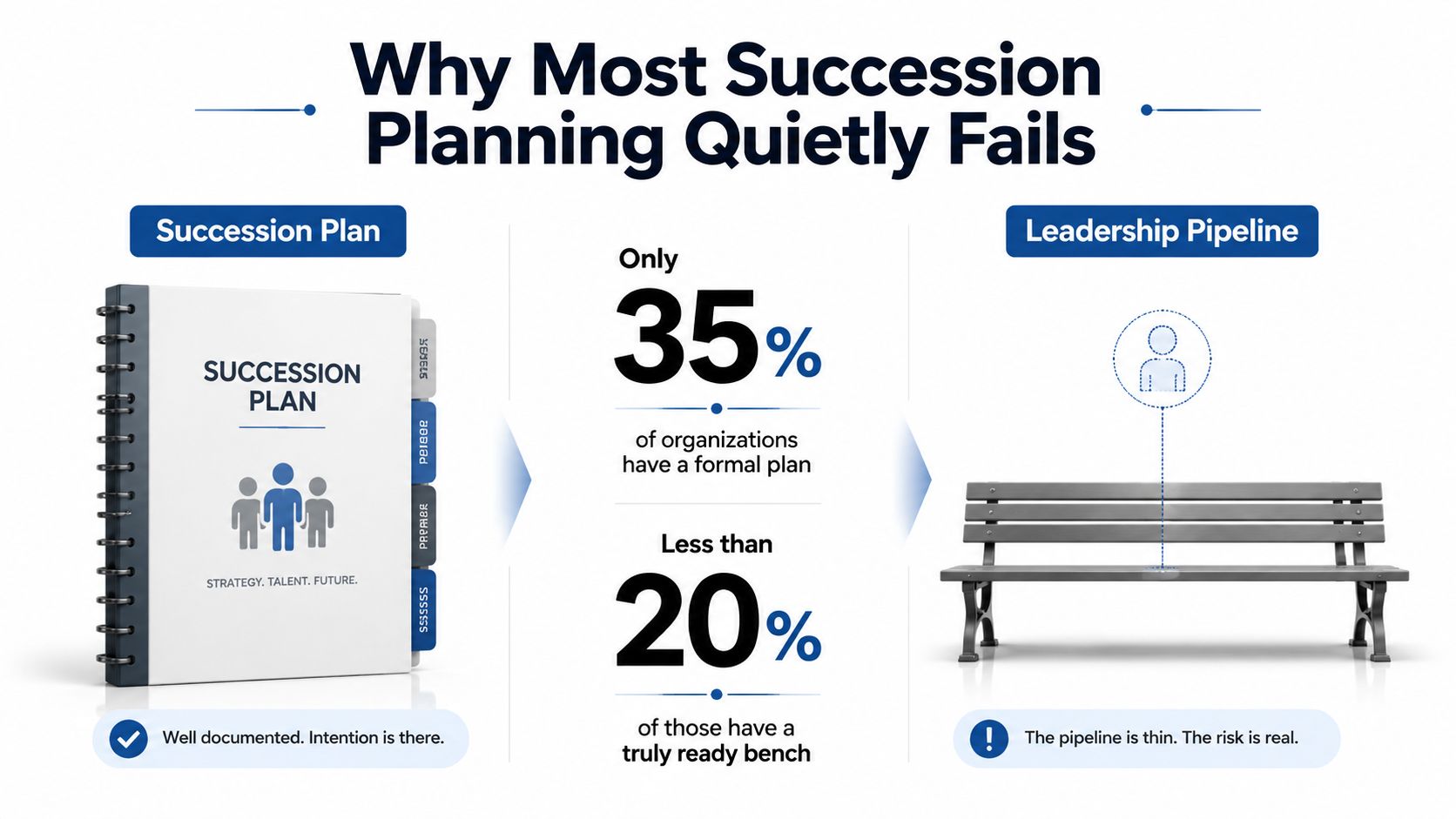
Paper plans fail in the room
A board review exposes the difference fast. If the conversation stays focused on titles, incumbents, and likely retirement timing, the team is still managing replacement lists. If the conversation shifts to who is ready, who needs development, and which roles would hurt most if empty, the process starts to become operational.
> Practical rule: if a successor can't take the role with limited disruption, they're not a successor yet, they're a development candidate.
That distinction matters because succession is a preparation window, not a preselection exercise. SHRM frames it as a future-oriented practice for identifying the knowledge, skills, and abilities needed for critical functions, then preparing people over a 12-to-36-month period rather than naming replacements. That longer runway is what gives development time to work, and it also shows why a last-minute emergency fill rarely succeeds.
For smaller companies, the same logic applies with less ceremony and more urgency. A team can't afford to wait for a resignation to discover there's no bench, which is why the most useful outside perspective often comes from practitioners who look at continuity through cash flow, operating risk, and role dependencies, not just org charts. The point is simple, if a role can sink execution, it belongs in an actual pipeline.
Setting Up Governance and a Real Cadence
A succession process without owners, decision rights, and a fixed rhythm usually slips into a once-a-year HR task. Once that happens, it gets crowded out by whichever issue is loudest in the quarter. Governance keeps the work active when managers are busy and the room wants to move on.
The operating model should start with one executive sponsor who has enough authority to demand follow-through. A succession council should then bring together HR, business leaders, and finance so the discussion reflects strategy, cost, and capability, not just talent sentiment. That mix matters because the process is about business continuity, not a talent exercise.
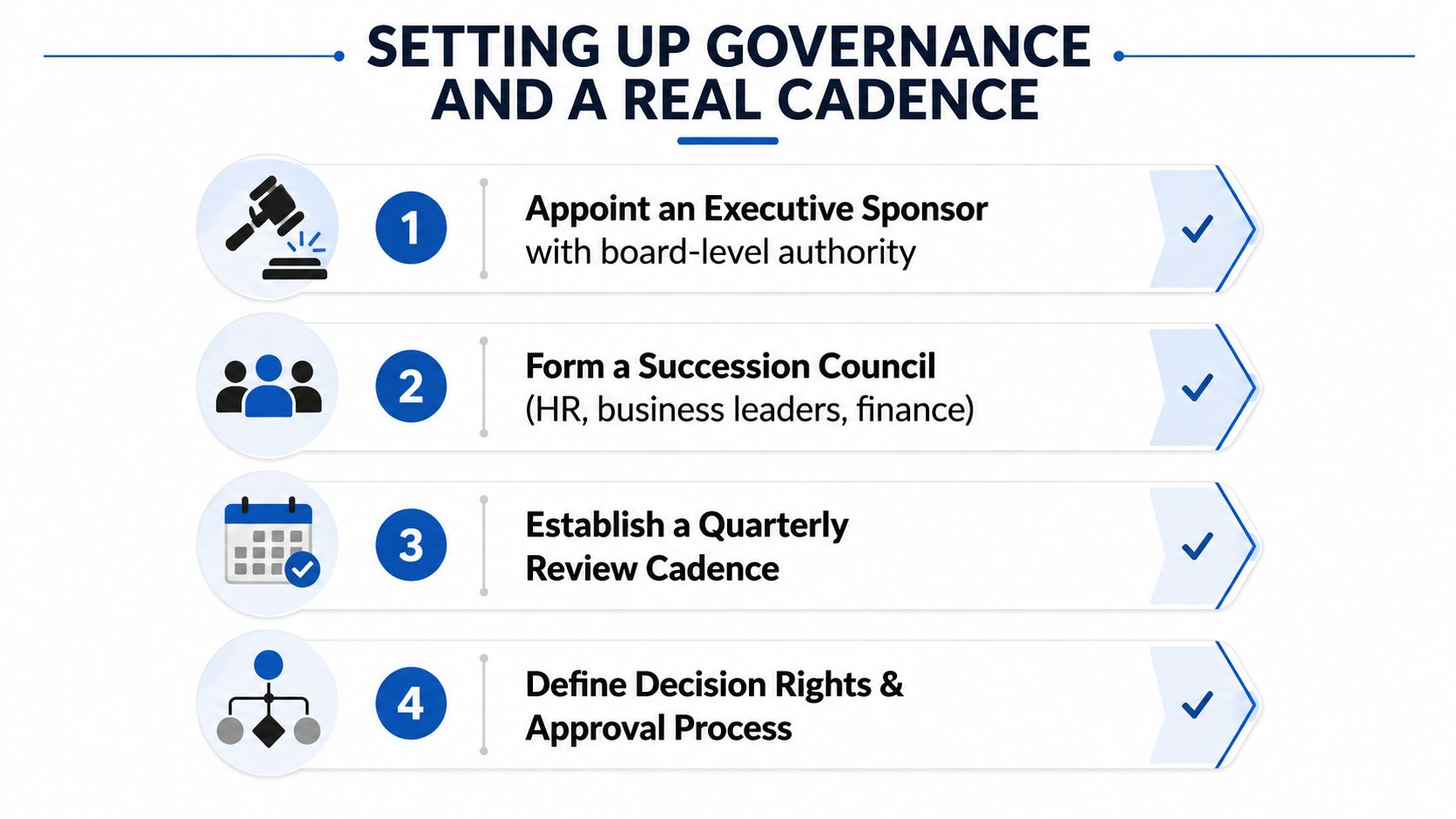
Scope before names
Define the in-scope roles first. Start with the positions that would create disruption if left empty, then rank them by business dependence rather than hierarchy. That keeps the process from turning into a vanity list of executives while critical operational roles go uncovered.
A one-page governance template should make the operating rules obvious:
The hard part is getting the C-suite to own the outcomes. HR can coordinate, document, and push the process forward, but if the executive team treats succession as an HR artifact, the review turns performative fast. SHRM's field data shows why that structure matters, because 87% of organizations report some form of succession planning, yet only 52% have a documented strategy and 11% have no formal plan at all. Governance is usually the first fix.
A useful test is whether the council makes decisions or just records opinions. If the meeting ends with no action on role scope, readiness gaps, or development moves, the cadence exists only on calendar invites. Real governance produces named owners and due dates, not polite agreement.
Scoring Role Criticality Without Politics
Most succession conversations go sideways because people debate status instead of risk. A role with a prestigious title isn't automatically the one that hurts the business most if it goes empty. The better move is to score roles against a consistent framework so the room can argue the inputs instead of the outcome.
I use three factors because they're hard to game and easy to explain: business impact, time to replace, and knowledge concentration. Business impact asks how badly the organization would feel the vacancy. Time to replace asks how long it would take to find or prepare a credible person. Knowledge concentration asks how much of the role depends on tacit know-how, internal relationships, or undocumented process.
| Factor | Weight | Score 1-5 | Weighted Score | |---|---:|---:|---:| | Business Impact | 40% | | | | Time to Replace | 35% | | | | Knowledge Concentration | 25% | | |
How to make the score defensible
Use the same rubric for every role in scope. A VP of Sales might score high on business impact because revenue coverage is visible and immediate, while a Director of IT might score high on knowledge concentration because infrastructure knowledge tends to live in people's heads, not systems. The meeting gets much better when the debate shifts from “my function matters more” to “which score did we assign, and why?”
A mid-market company can work through the scorecard in under an hour if the room stays honest. The CEO, CFO, and functional leaders each rate the role independently, then the council compares notes and explains the spread. If the scores are wildly different, that doesn't mean the framework failed. It usually means the company finally surfaced a risk it had been managing by assumption.
> The point of criticality scoring isn't to crown winners. It's to identify where continuity work has to start first.
This is also where the earlier research on operational succession frameworks matters. The discipline starts with strategic and workforce alignment, then gap analysis, then talent pool identification, not with a title list. That sequence keeps the process tied to business need instead of executive preference, which is the only way a succession planning process survives the next reorg.
Integrating Competency and Behavioral Assessment
A good succession plan falls apart if it relies on manager intuition alone. Managers know how people perform in the current job, but succession requires evidence about how someone behaves under different demands, how fast they learn, and where they're likely to struggle. That's why assessment has to sit inside the process, not outside it.
What to assess and why
Start with role-specific competencies. For a future sales leader, that may mean customer strategy, forecast discipline, coaching, and cross-functional influence. For an IT leader, the mix looks different, because architecture judgment, risk awareness, and vendor management carry more weight. The competency model has to match the role, or the assessment is just noise.
The strongest process is the one described in the public sector framework: align to strategy, analyze gaps, identify talent pools using assessment instruments, develop successors, implement the plan, and monitor outcomes such as selections from talent pools. That sequence works because it turns assessment into a decision tool. It doesn't ask who looks promising in the abstract, it asks who matches the capability need.
A simple way to use the data is to separate three signals:
Those aren't interchangeable. A high performer can still be a poor successor if they've never led through ambiguity or if their style breaks down in a larger system. That's where behavioral data helps, especially when the role has high stakes or the promotion would be expensive to reverse.
Synopsix is one option in this space because it turns scientifically validated behavioral assessments into comparable profiles, role-based reports, and decision support that can be used in succession reviews. The value isn't in replacing human judgment. It's in making the judgment less fuzzy when the room is deciding who is ready, and what kind of support they need before promotion.
Where AI tools help and where they get noisy
AI-powered people-intelligence platforms add value when they give consistent profiles, role-specific simulations, and decision-ready summaries that managers can use quickly. They add noise when they spit out generic traits, overstate certainty, or create reports nobody would act on in a real review. The test is practical, if the output changes the conversation in the room, it's useful. If it just decorates the slide deck, it isn't.
If you want a deeper buildout of the assessment layer, the most useful companion is [how to assess leadership competencies](https://synopsix.ai/blog/how-to-assess-leadership-competencies). Use that thinking to keep the process grounded in observed behavior, not aspirational labels.
Building Talent Pools, Career Paths, and Development Moves
Assessment only matters if it changes what people do next. Once you know who has potential and where the gaps are, the succession planning process has to turn that data into named pools, readiness levels, and development moves that create actual momentum. Otherwise, the process turns into a shelf full of profiles and no one gets materially closer to the role.
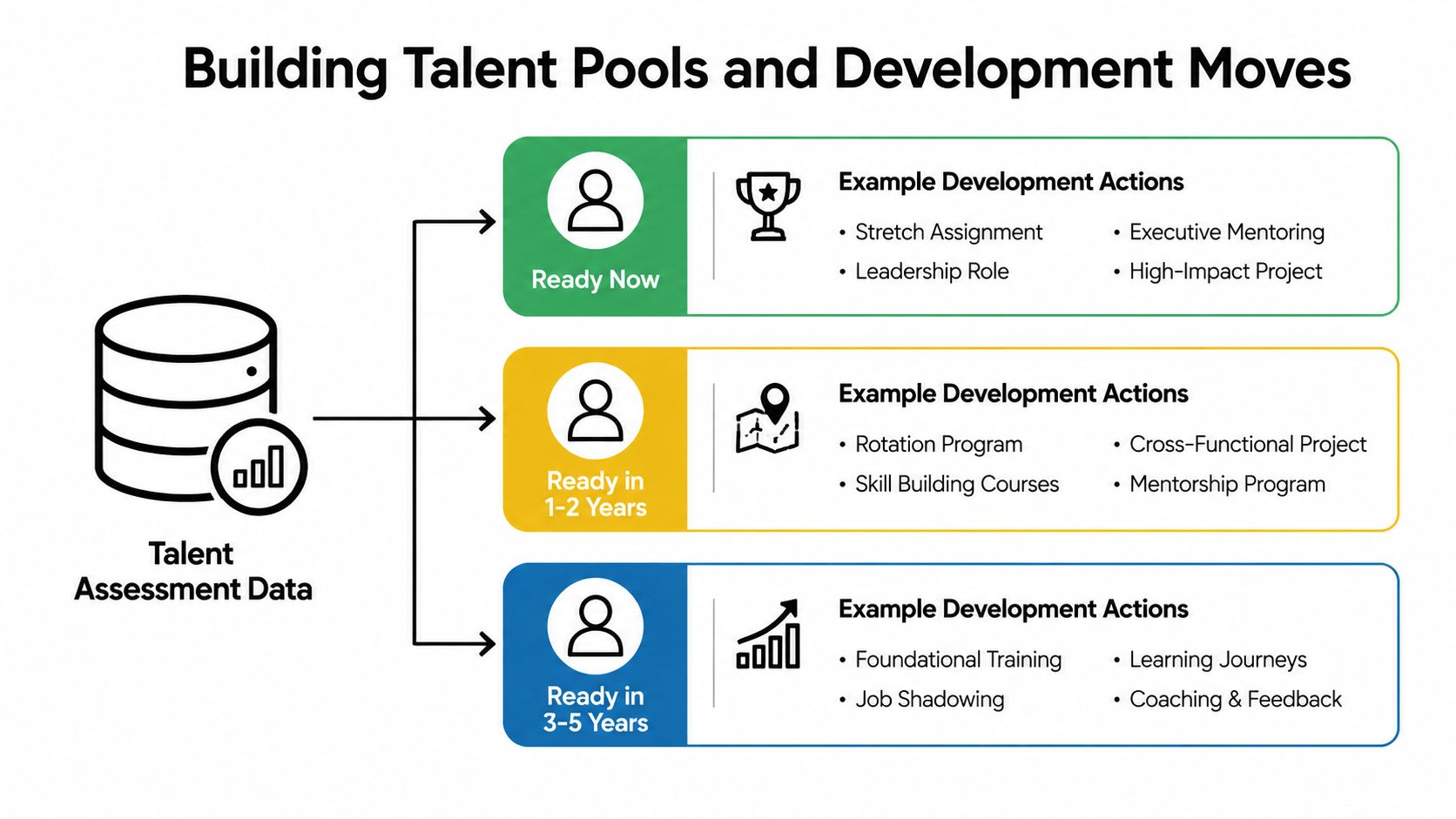
From profiles to readiness buckets
Use three readiness bands, ready now, ready in 1 to 2 years, and ready in 3 to 5 years. Those labels force honest conversations about timing instead of vague confidence. They also help leaders avoid the common mistake of putting someone in a plan because they're strong, even though they still need experience they can't get in their current seat.
The development moves should match the gap. A person who needs broader commercial judgment might need a stretch assignment with cross-functional exposure. Someone who lacks crisis experience might need a simulation or a temporary leadership rotation. Someone with the right capability but low visibility might need sponsorship into a business-critical project.
A simple workflow looks like this:
1. Sort the bench by role family and readiness level. 2. Assign one or two targeted development actions per person. 3. Track movement, not just participation. 4. Refresh the pool when performance, structure, or strategy changes.
When internal readiness is thin, build external pipelines too. That doesn't mean abandoning internal talent, it means acknowledging where the market can fill a gap faster than development can. The strongest leaders I've worked with were willing to use both, because they cared more about continuity than pride.
For practical examples of how growth programs can be built around actual movement rather than vague potential, [real-world innovator programs](https://www.svsb.ai/blog/leadership-development-program-examples) is a useful reference point. The better programs make room for stretch, coaching, and exposure, not just classroom learning.
<iframe width="100%" style="aspect-ratio: 16 / 9;" src="https://www.youtube.com/embed/z22li97yUBE" frameborder="0" allow="autoplay; encrypted-media" allowfullscreen></iframe>
If someone is going to be ready for a hard job, they need practice before the title change. Promotions are not the time to discover whether the person can handle ambiguity, conflict, or a wider span of control.
> Move people before you fully trust them, but only into contained risk with the support they need. That's how readiness gets built instead of guessed.
If you want a structured way to build that bench, [how to build a talent pipeline](https://synopsix.ai/blog/how-to-build-a-talent-pipeline) is a practical companion to the pool-and-move approach.
Metrics, Risk Indicators, and Executive Reporting
A succession review that does not change numbers turns into a polite discussion. The reporting page has to show whether the bench is getting deeper, whether coverage for critical roles is improving, and where the plan is still fragile. Boards need that view, because a list of names says very little about business continuity.
What belongs on the page
Keep the dashboard short and hard to ignore. Put readiness coverage at the top, because it shows how much of the critical role map has a viable successor. Add internal fill rate, since that tells you whether the organization is promoting from within. Track time to readiness, because a bench that exists only in theory does not help when a role opens up.
I would also include retention of high-potentials, diversity of the bench, and a small set of leading indicators such as assessment completion and development plan adherence. Those signals matter because they show whether the pipeline is active, not just whether it looks tidy on paper. If you want the reporting to stay tied to real exposure, [talent risk assessment](https://synopsix.ai/blog/talent-risk-assessment) helps separate vacancy risk from deeper capability risk.
The board should also see why this matters before the vacancy hits. Executive-transition research has found that 60% of executives fail within the first 18 months after being promoted or hired, according to [executive-transition research](https://synopsix.ai/blog/talent-risk-assessment), and the same research says 74% of public and 52% of private companies say maintaining a talent pipeline is the hardest part of CEO succession. That is a blunt reminder that readiness needs attention while there is still time to act.
A practical dashboard answers three questions:
The worst reporting mistake is loading the slide with vanity metrics that look complete but do not change behavior. If a metric does not trigger a decision, a development move, or a staffing change, it does not belong in front of executives. In the room, I want the conversation to end with a concrete action, assign a move, widen a pool, or reclassify a role as more exposed than we thought.
For teams trying to distinguish a weak bench from a true succession risk, [talent risk assessment](https://synopsix.ai/blog/talent-risk-assessment) is a useful companion because it forces leaders to name where the gap sits and what kind of response it needs. That usually gets the discussion out of vague comfort and into actual accountability.
Common Pitfalls and a 90-Day Launch Plan
The biggest mistake is treating succession as a once-a-year review. The second is confusing potential with performance, which leads to overpromoting strong operators who haven't shown leadership depth yet. The third is letting HR own the process alone, because then the line leaders treat it as admin work and the bench never really moves.
AI changes the cadence too. Recent guidance from Robert Half notes that AI is reshaping what leaders need to know, so development programs and succession plans have to refresh on a much shorter cycle than the traditional 1-to-5-year horizon. That means the plan can't sit untouched between annual reviews.
For teams wanting outside help with transition timing, [exit strategy consultant pricing and timelines](https://jumpstartpartners.finance/blog/exit-strategy-consultant) is a useful way to think about how succession readiness connects to ownership, timing, and business continuity. The lesson is the same, waiting until the exit is imminent usually leaves too little room for clean handoff.
A workable 90-day launch looks like this:
1. Days 1 to 30: name the executive sponsor, define in-scope roles, and agree the review cadence. 2. Days 31 to 60: score role criticality, assess the first talent pool, and identify readiness gaps. 3. Days 61 to 90: assign development actions, set reporting metrics, and brief the CEO, board, and affected managers.
Keep the communication tight. CEOs need the risk summary. Boards need coverage and movement. Managers need to know which people are in scope, what development is expected, and how decisions will be made.
---
Synopsix helps teams turn behavioral assessment into practical succession decisions, so the conversation moves from subjective nominations to evidence-based pipeline planning. If you're building a succession planning process that has to survive role redesign and leadership turnover, visit [Synopsix](https://synopsix.ai) and see how it supports clearer talent decisions, role fit, and development planning.