Talent Acquisition Challenges and How to Fix Them
By Synopsix · November 7, 2026 · 16 min read
Few talent acquisition organizations can connect recruitment spending to actual hiring outcomes, and that single gap explains why so many hiring problems persist despite busier pipelines and more tools. Without that link, an effective channel and an expensive source of activity look identical in the dashboard.
The visible symptoms point elsewhere. Requisitions sit open, qualified pipelines thin out, hiring managers escalate. Each looks like a sourcing, speed, or candidate experience problem. Underneath sits the same measurement failure: teams optimize what they can see, which is usually volume and time, not whether new hires perform, ramp, and stay. Fix the measurement first, and the other challenges become diagnosable instead of debatable.
Which Talent Acquisition Challenges Matter Most
Difficulty hiring is now the normal operating condition, not an exception for niche roles. In 2025, 69% of organizations reported difficulty recruiting for full-time positions during the previous 12 months, according to the [Society for Human Resource Management](https://www.shrm.org/topics-tools/news/talent-acquisition/shrm-talent-trends-2025-recruitment-challenges). That scale matters because it changes prioritization. You don't fix seven problems at once. You fix the one where the gap between business need and pipeline delivery costs you most.
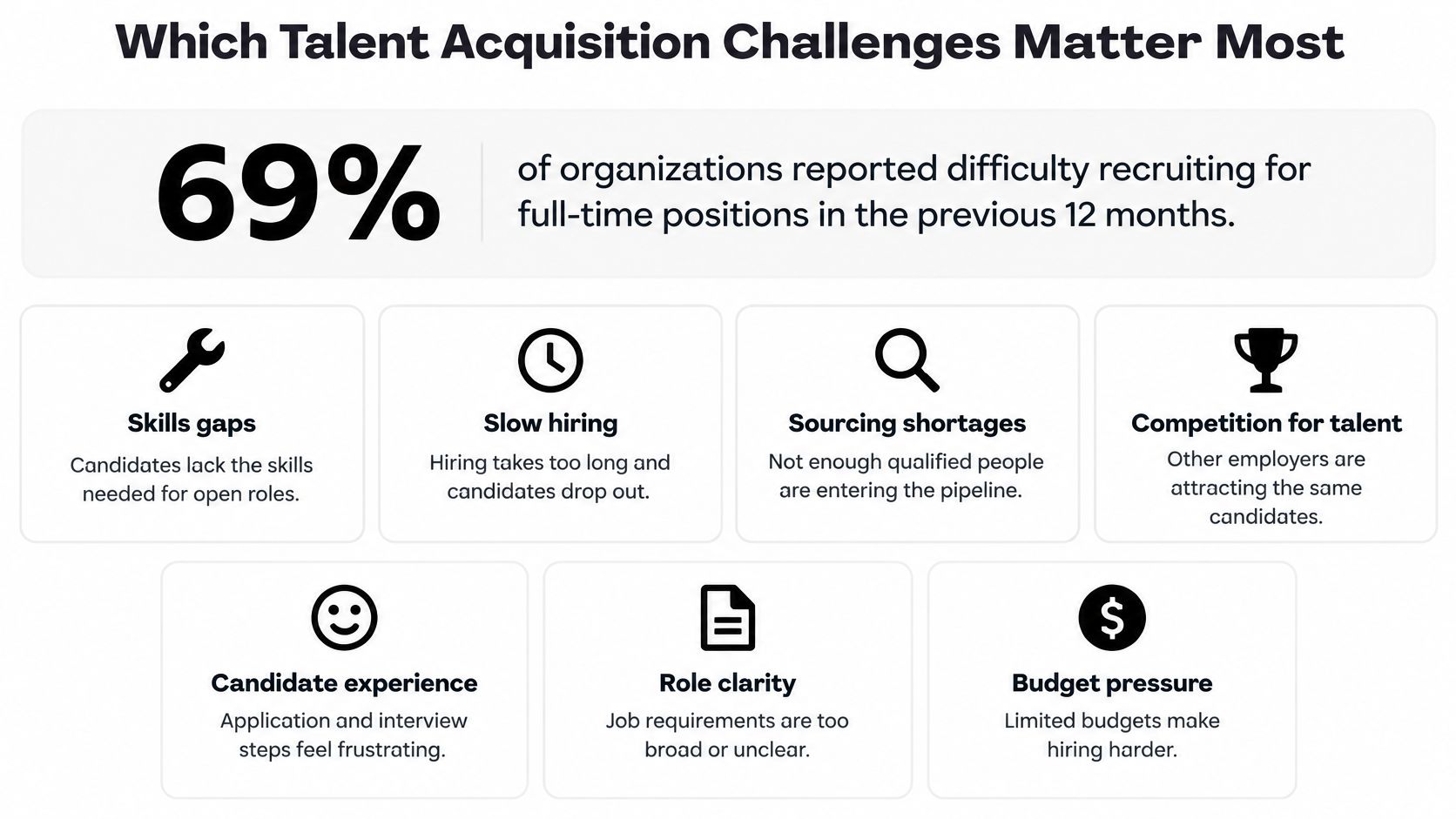
How to Rank the Seven Challenges
Quality of hire ranks first because it's the most expensive when it's wrong. A weak hire consumes salary, manager time, and ramp investment, then often triggers a second search for the same seat. Time-to-fill is second in many organizations, but its cost is different. It mainly delays output and revenue timing, and pushes work onto existing staff. That's serious, but a fast, wrong hire usually costs more than a slower, right one.
Sourcing and employer brand sit upstream of both. If qualified people never enter the pipeline, or arrive uninformed and unconvinced, recruiters compensate by widening filters, extending timelines, or lowering the bar late in the process. Candidate experience, bias, and assessment validity then determine whether the people you do attract stay in the process and get judged on signals that predict performance.
| Challenge | Where it shows up | Business cost | |---|---|---| | Quality of hire | New hires miss ramp targets or leave early | Lost productivity and repeat hiring spend | | Time-to-fill | Open roles stay empty and push work onto teams | Delayed output and lost revenue | | Candidate experience | Strong candidates withdraw or decline offers | Wasted interview effort and a weaker employer reputation | | Sourcing | Large pipelines with few qualified applicants | Recruiter hours spent on unqualified profiles | | Bias | Shortlists narrow toward similar profiles | Missed talent and legal exposure | | Employer brand | Candidates arrive uninformed or uninterested | Higher cost per hire and smaller applicant pools | | Assessment validity | Scores do not predict job performance | Decisions built on noise and wrong hires |
> Practical rule: Decide whether you have a volume, speed, or quality problem before you choose a fix. Each one needs a different intervention, and treating a quality problem with more volume makes it worse.
Start where the symptom in the table matches your last two hiring cycles, not where the complaint is loudest. Managers complain about speed because it's visible. Finance feels quality because it repeats the cost.
Why Hiring Stalls and the Root Causes Behind It
Recruiters can work hard and still stall if the skills they're hunting don't exist in sufficient numbers. The [World Economic Forum's Future of Jobs Report 2025](https://www.weforum.org/publications/the-future-of-jobs-report-2025), based on input from more than 1,000 companies, found that 63% of employers considered skills gaps the biggest barrier to business transformation during 2025 to 2030, and 70% of employers expect to recruit people with new skills. Employers also expect 39% of workers' core skills to change by 2030. You're not hiring into a stable target.
The image below captures the daily version of that mismatch, a role on one side and candidate skill sets that only partly line up on the other.

Three Process Causes That Amplify the Market Problem
Unclear role definitions do the most damage early. A job description that lists tools and years of experience instead of outcomes attracts people who match keywords, not people who can deliver the work. Screening then becomes subjective because nobody agreed what good looks like in the first 90 days.
Misaligned hiring managers compound that. Requirements change mid-search, a must-have becomes negotiable, or a new stakeholder adds criteria after shortlisting. Each change resets the search without resetting the timeline. Recruiters get blamed for delay, but the target moved.
Unstructured evaluation finishes the job. When interviewers ask different questions and score on impression, you can't compare candidates, and you can't learn later which signals predicted success. The process produces opinions, not evidence.
This video walks through how those process failures show up in a live hiring cycle.
<iframe width="100%" style="aspect-ratio: 16 / 9;" src="https://www.youtube.com/embed/NE_vMf3b6BM" frameborder="0" allow="autoplay; encrypted-media" allowfullscreen></iframe>
The Dual Problem You Cannot Solve With Credentials Alone
Employers now need scarce technical capability and adaptable behaviors at the same time. Analytical thinking, resilience, flexibility, leadership, and collaboration don't show up reliably on a resume. A candidate can list the right stack and still struggle in an ambiguous, cross-functional role. Another can lack a credential and ramp fast because they learn, communicate, and persist.
Say a team complains that sourcing delivers weak candidates for a customer success role. Review the brief and you'll often find a list of CRM tools, no definition of retention outcomes, and no mention of difficult conversations with unhappy accounts. That's a role definition problem before it's a sourcing problem.
> For each stalled search, ask whether the cause sits in the market, the process, or the measurement. If you can't answer, you don't have a diagnosis yet.
KPIs That Show Whether Hiring Is Working
Metrics only help if each one answers a distinct question and you review it at the speed the underlying data matures. Speed metrics move weekly. Quality metrics need a quarter, because performance and retention signals arrive after the hire starts. Mixing those cadences creates false alarms and premature changes.
| Metric | How to calculate it | Review cadence | |---|---|---| | Time-to-fill | Days from requisition approval to offer accepted | Weekly | | Time-to-hire | Days from candidate application to offer accepted | Weekly | | Cost-per-hire | Total recruiting cost divided by hires in the period | Monthly | | Quality of hire | Composite of 90-day manager rating, ramp time and 12-month retention | Quarterly | | Offer acceptance rate | Offers accepted divided by offers extended | Monthly | | Candidate drop-off rate | Candidates leaving a stage divided by candidates entering it | Monthly | | Source-level quality | Quality-of-hire score grouped by sourcing channel | Quarterly | | Adverse impact ratio | Selection rate for each group divided by the highest group's rate | Each hiring round |
What Each Metric Can and Cannot Tell You
Time-to-fill starts at requisition approval, so it captures internal delay before sourcing begins, including slow intake and budget sign-off. Time-to-hire starts at application, so it measures the candidate's experience of your speed. If time-to-fill is long but time-to-hire is short, your bottleneck sits inside the business, not with candidates.
Cost-per-hire understates reality unless you include agency fees, job board spend, recruiter time, and tools. A cheap hire who leaves early isn't cheap, which is why cost needs a quality counterpart. Our guide to [talent acquisition metrics](https://synopsix.ai/blog/talent-acquisition-metrics) sets out how to pair cost and quality so one doesn't hide the other.
Quality of hire isn't one number you pull from a system. Build it as a composite of a manager's 90-day rating, ramp time, and 12-month retention, weighted by what the role family values most. A sales team might weight ramp heavily. A care or service team might weight retention.
Experience and Fairness Signals
Set baselines from the last 12 months before you change the process. Without a baseline, every improvement claim is an anecdote, and every dip triggers a rebuild.
Connecting Hiring Sources to Performance Outcomes
Activity is easy to count. Impact takes architecture. Only 23% of TA organizations can connect recruitment spending to actual hiring outcomes, and 89% rate full-funnel talent-data visibility as average or below, according to [SHRM's analysis of talent acquisition](https://www.shrm.org/topics-tools/news/talent-acquisition/rethinking-talent-hr-must-build-not-just-buy). When ATS, HRIS, performance and retention records sit in separate systems, a busy channel and a productive channel look identical in the dashboard.
A Practical Measurement Method
Tag every hire by source and role family at first touch, then carry that tag into performance and retention records. Group hires into cohorts, compare 12-month retention, ramp time and manager ratings across sources, and check cohort size before acting on any gap.
The failure mode this prevents is concrete. A job board that delivers many hires looks strong on volume even while its cohort retains the worst. The decision metric is the rate: the share of each source's hires still performing a year later.
Close the loop with hiring managers. Collect a structured rating at 90 days, return source-level results to recruiters each quarter, and shift spend toward the channels producing retained, performing hires. For remote roles that pull cross-border applicants, job-site usage varies by region, so read source tags accordingly. Resources like [a platform guide for Latin American applicants](https://jobs.virtustant.com/blog/best-sites-to-find-remote-work) list the remote-work boards candidates in that market search, which is useful context when a channel's tag pattern looks unusual.
Two Hypothetical Cases
Case one, hypothetical. A job board supplies most hires for support roles, but that cohort shows the lowest 12-month retention. Shifting spend toward referrals reduces total hires per month, yet cost per retained hire falls. Volume looked like success until quality data arrived.
Case two, hypothetical. A team benchmarks every finalist against the behavioral profiles of its top performers in the same role, then probes mismatches in the final interview. One Synopsix customer describes exactly this practice: "We now use Synopsix as a standard part of our hiring process, benchmarking every new candidate against our top performers." The score matters less than what it forces: a specific conversation about fit and risk before the offer goes out.
> Cohorts must be large enough to compare. Small teams should pool several quarters of hires before drawing conclusions, or random variation will look like a channel effect.
Playbook to Fix Sourcing, Speed and Candidate Experience
Fix these three together in one hiring cycle, because each one leaks into the others. Slow feedback hurts experience, weak sourcing forces extra screening rounds, and poor briefs make every later step slower.
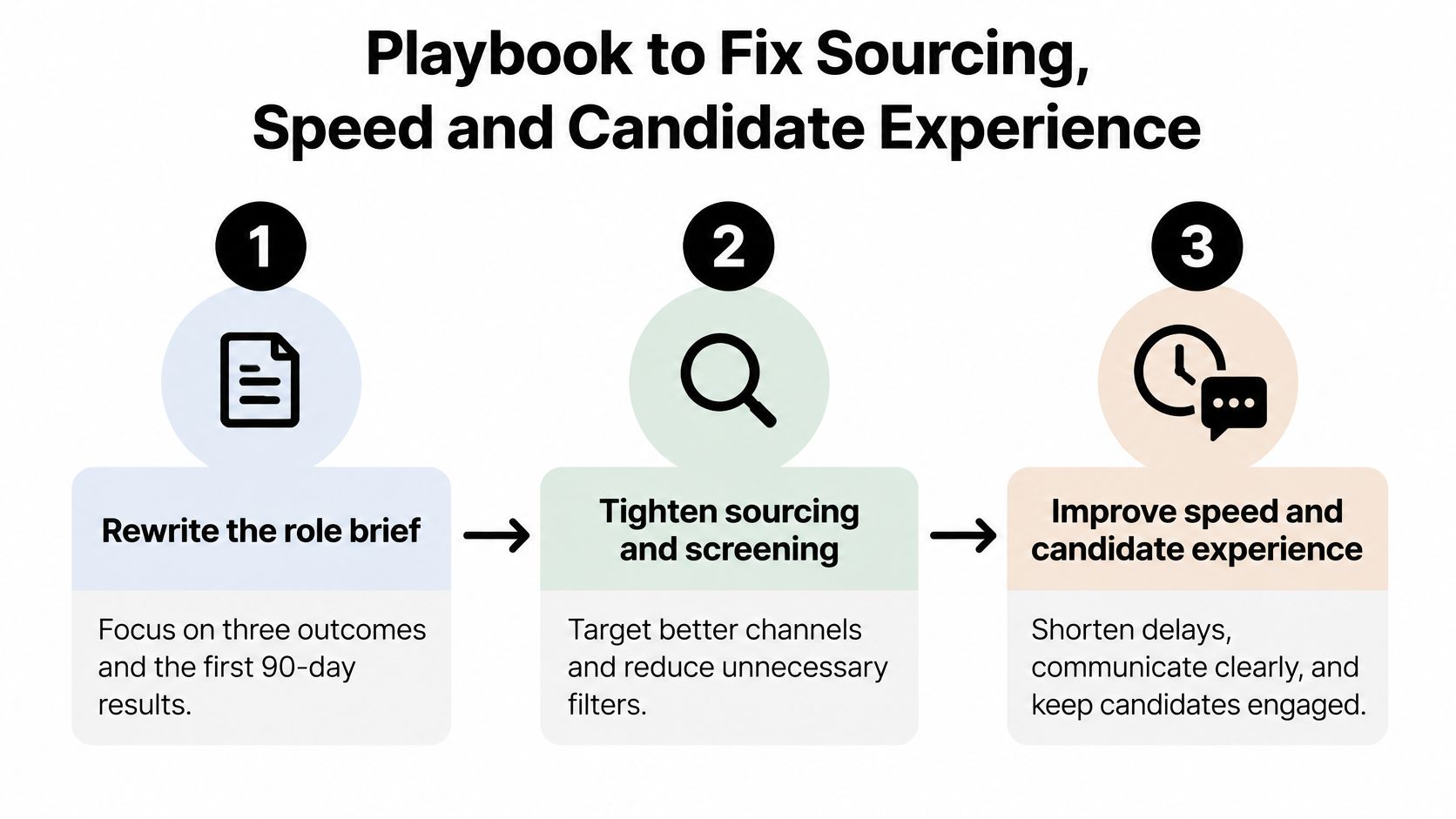
1. Rewrite the role brief around outcomes. Name three outcomes and the expected first 90-day results, then get the hiring manager to sign it before posting. The signature matters. An unsigned brief changes mid-search, and every change invalidates your shortlist criteria.
2. Map each channel to past quality of hire. Move budget away from channels that deliver volume without qualified, retained hires. For specialized functions, targeted routes beat general boards, whether that's a referral network, a professional community, or a specialist service such as the [best place to hire virtual legal assistants](https://hireparalegals.com/virtual-legal-assistants/) for legal support roles. The slip is judging a channel on applications in week one instead of retained hires later.
3. Set stage-level service levels. Commit to feedback within two working days and a decision within five. Silence is the most common reason strong candidates withdraw, and it's the cheapest problem to fix. Put the service level in the intake agreement, not in a recruiter's memory.
4. Replace open-ended interviews with structured questions. Use five to seven questions tied directly to the brief's outcomes, scored on the same scale by every interviewer. If you're debating how many rounds that requires, our breakdown of [how many interviews is too many](https://synopsix.ai/blog/how-many-interviews-is-too-many) helps you cut stages that add no new signal. Extra rounds that repeat earlier questions add delay, not accuracy.
5. Update every candidate at every stage. Send a status update when they move forward, when they're waiting, and a clear reason when they're declined. Candidates who understand where they stand stay engaged longer and speak better of you when they don't get the role. Template the updates so consistency doesn't depend on recruiter workload.
6. Track drop-off by stage weekly. Fix the stage with the largest loss first, whether that's application completion, scheduling, or post-interview silence. Teams often redesign the whole process when one stage is doing the damage.
What a Healthy Cycle Looks Like
You'll know it's working when hiring managers accept shortlists without re-screening them, because the brief, sourcing, and scoring already match their criteria. Drop-off falls from one cycle to the next, and feedback arrives without chasing.
> A healthy cycle isn't just faster. It's one where each stage produces a comparable signal you can later test against performance.
Using Assessments and AI Without Losing Trust
Faster screening isn't automatically fairer screening. In a 2025 survey, 82% of candidates said they want to know how AI evaluates their applications, and 44% of younger candidates viewed AI as fairer compared with 21% of Gen X and 18% of baby boomers, according to [iHire's State of Online Recruiting 2025](https://www.ihire.com/resourcecenter/employer/pages/the-state-of-online-recruiting-2025). The same source reports UK evidence that 33% of employers reported redesigning selection processes because of generative AI, up from 23% in 2024, while 46% were reviewing their processes. Candidates aren't rejecting automation. They're rejecting unexplained automation.
Validity Comes Before Efficiency
An assessment earns its place only when its scores correlate with job performance for the specific role you're filling. Ask vendors for validation evidence by job family and population, not a general accuracy claim. A tool validated on sales roles doesn't transfer automatically to care, logistics, or engineering roles. If a vendor can't show you the population, the criterion, and the outcome it predicted, treat the score as unproven.
Apply the same test to AI screening of applications. Consistency is valuable only if the system consistently measures something relevant. Consistent noise just produces confident mistakes at scale.
Controls That Protect Legitimacy
A clear data policy supports all four controls. By default, only the user can see their data, and no one else sees it unless the user explicitly authorizes sharing, for example with a manager, recruiter, or coach. Explanations of the key factors behind a user's results are available from Synopsix on request. That combination, candidate control plus explainability on request, is what makes a result challengeable in practice rather than in principle.
Before you approve any tool, a CHRO should be able to answer three questions. What does it measure, and for which roles is that validated? Who sees the output, and with whose permission? How can a candidate challenge it? If any answer is vague, the legitimacy gap is already open, no matter how much time the tool saves.
Closing Bias and Employer Brand Gaps
Bias and weak employer brand are process problems with measurable symptoms, not attitude problems you fix with awareness training alone.
Where Bias Enters and How to Block It
Bias enters earliest in unstructured interviews and impression-based shortlists, where similar backgrounds read as safer bets. Block it structurally. Score every candidate against the same outcome-based criteria. Have two reviewers score independently before any discussion, so the first voice in the room doesn't anchor the rest. Remove details from early screens that don't relate to the outcomes you're hiring for.
Check the pipeline at each stage, not only at offer. If shortlists narrow toward one profile type in week one, you can correct the sourcing or criteria while the search is live. Our guide on [how to reduce hiring bias](https://synopsix.ai/blog/how-to-reduce-hiring-bias) details stage-level checks you can run each round. Tie the check to the adverse impact ratio so the review is numerical, not impressionistic.
Employer Brand as an Information Problem
Candidates don't need more slogans. They need accurate expectations. Publish role outcomes and first-90-day expectations in every job ad, keep the advert consistent with what hiring managers say in interviews, and answer public candidate reviews through a fixed process with a named owner. When the ad promises strategic work and the interview describes ticket queues, offer acceptance drops and early attrition rises.
Measure brand work through offer acceptance rate and source-level yield, meaning qualified candidates per channel, not impressions or page views. If a campaign raises applications but lowers qualified yield, it made sourcing harder, not easier.
> Brand strength shows up as informed candidates who accept offers and stay. Everything else is reach.
Decide Your First Fix Before the Next Requisition
Make one decision this quarter, which challenge you'll fix first, and set up its measurement before you change anything.
1. Pick the largest gap between business need and pipeline delivery, using the volume, speed, or quality test. 2. Pull 12 months of data for that role family, covering hiring, ramp, performance, and retention. 3. Calculate the eight KPIs and record the baseline in writing. 4. Audit each tool for validation evidence by job family and population, and confirm candidates are told how it's used. 5. Compare any people-intelligence platform against those same criteria and your baseline cycle time. Synopsix can deliver a defensible hiring call in under 48 hours, and its free assessment shows your traits, leadership style and professional fit, so test speed claims against your own baseline. 6. Define success for the role first. Every metric, playbook step, and assessment depends on that definition.
The first decision isn't which tool to buy. It's what success in the role means.
---
If your team can't yet connect hiring activity to hire quality, [Synopsix](https://synopsix.ai) helps you define role success, assess candidates against the role, team, and culture, and compare finalists with your top performers so each decision leaves evidence you can test later. Start with one role family, set your baseline, and make your next hiring call defensible within 48 hours.