The Talent Acquisition Process: A 2026 Guide
By Synopsix · July 29, 2026 · 15 min read
The most expensive hiring mistakes usually happen before a recruiter ever speaks to a candidate. If your requisition is vague, your shortlist is noisy, and your interviewers are improvising, you're paying for confusion twice, once in cycle time and again in bad decisions. That's why the talent acquisition process in 2026 has to start with role design, not sourcing volume.
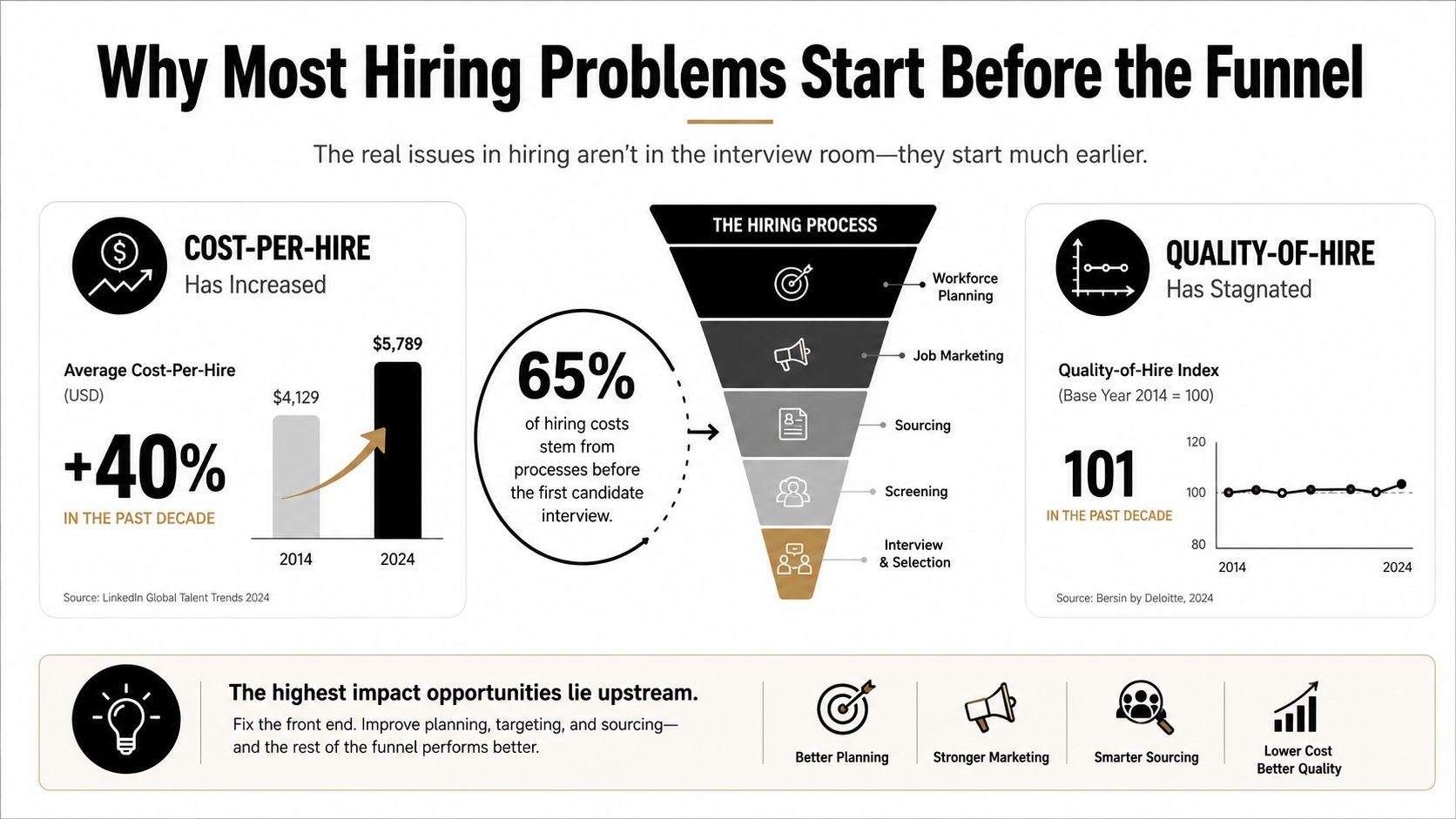
Hiring is still expensive and slow enough to punish weak process design. SHRM's benchmark has long centered cost-per-hire around $4,700, and more recent 2024 to 2026 summaries keep the U.S. and global average in the $4,683 to $4,900 range, while global time-to-fill has been reported at 43 days in a 2024 benchmark, up from 36 days in 2019, and a separate global hiring benchmark put median time-to-hire at 44 days in early 2024 ([talent acquisition statistics](https://www.hiretruffle.com/blog/talent-acquisition-statistics)). That's not a sourcing problem. That's a process design problem.
Why Most Hiring Problems Start Before the Funnel
The biggest hiring failures happen before the funnel even opens. Many teams try to fix bad hiring by adding more recruiters, more job boards, or more screening speed, then wonder why costs stay high and cycle times stay ugly. The data says the system is under strain, not just the pipeline.
Requisition clarity is the real bottleneck
A vague requisition creates a chain reaction. If the hiring manager can't name the must-haves, the recruiter sources too broadly, the interview panel debates basics, and the final decision gets dragged out by avoidable disagreement. That's why the first real work in the talent acquisition process is not posting, it's defining the job with enough precision that everyone is solving the same problem.
> Practical rule: if two interviewers describe the role differently, the requisition is not ready.
Many teams lose effectiveness at this point. They optimize later stages, screening speed, calendar coordination, candidate nudges, while leaving the upstream decision untouched. The result is predictable, more candidate volume, more noise, and more time spent sorting instead of selecting.
Why the economics point upstream
When cost-per-hire stays stubbornly high and time-to-fill stretches, it usually means the organization is paying for unnecessary rework. One ambiguous must-have can force a recruiter to restart sourcing, make interviewers evaluate different things, and send hiring managers back into debate. That's how small upstream mistakes multiply across the entire funnel.
The better frame is simple. Hiring is a decision-making system first, and an execution system second. If the decision inputs are weak, the execution layer can't rescue you, no matter how much automation or recruiter effort you throw at it.
The Five Core Stages of the Talent Acquisition Process
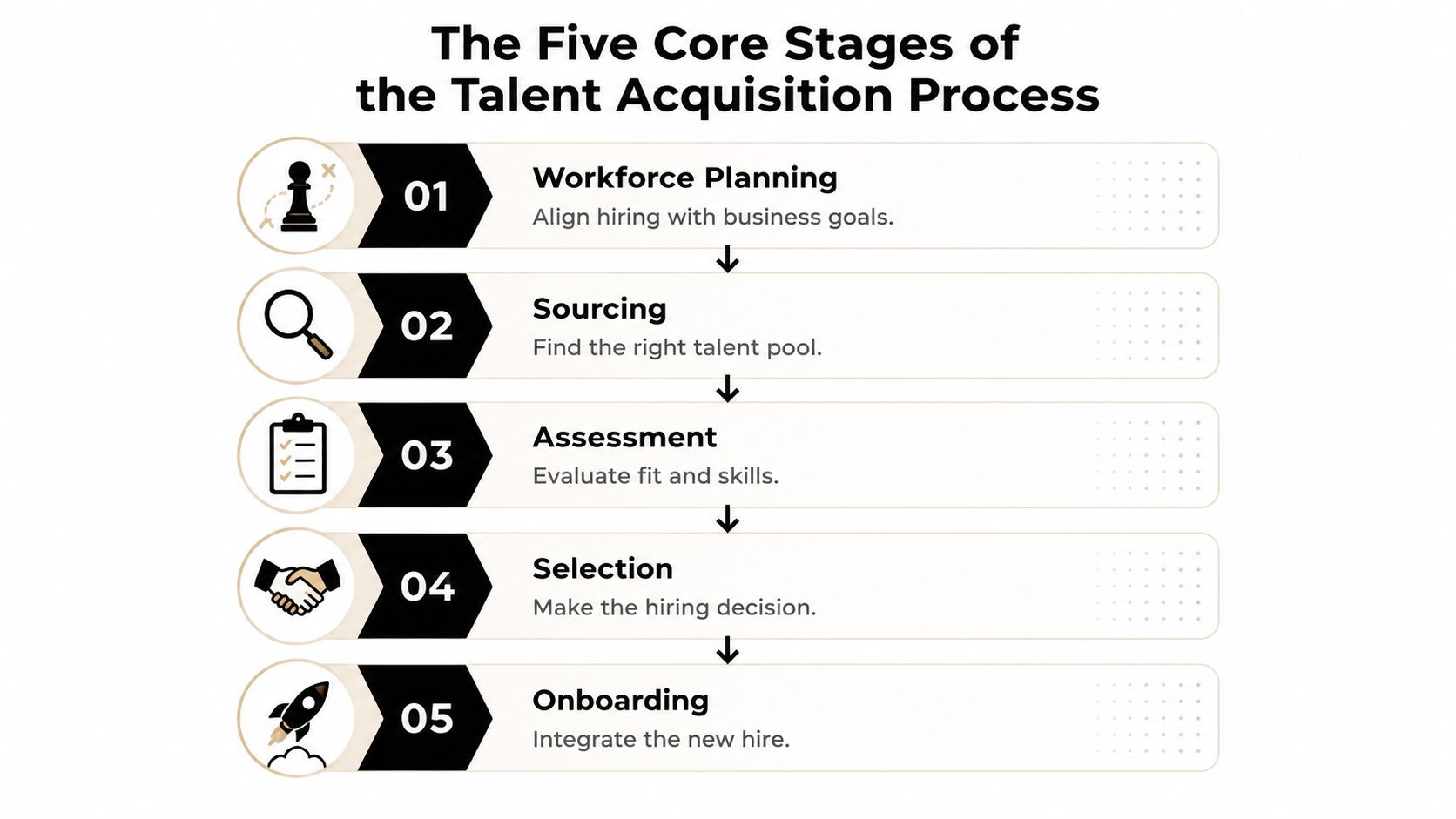
A modern talent acquisition process works best when it behaves like a house build. You don't start with paint and fixtures, you start with the foundation, then the frame, then the systems, then the finish. Hiring works the same way, and skipping one stage almost always breaks the next one.
Workforce planning sets the target
This stage decides what the business needs, when it needs it, and which skills matter most. If workforce planning is weak, every downstream step inherits the mistake. The best teams treat this as a strategic input, not a paperwork exercise.
<iframe width="100%" style="aspect-ratio: 16 / 9;" src="https://www.youtube.com/embed/bDhN_euuMlo" frameborder="0" allow="autoplay; encrypted-media" allowfullscreen></iframe>
Sourcing expands reach, it doesn't create value
Sourcing is where you find the market, but it's not where you define success. You can reach more candidates without improving quality if the role definition is sloppy. That's why sourcing should follow clear planning, not replace it.
Assessment creates decision quality
Assessment is where you test capability, judgment, and fit for the work. The strongest teams use structured behavioral evidence, not casual impressions. A published study frames talent acquisition as a broader workflow for finding, attracting, assessing, hiring, and integrating competent people into roles, which is exactly why assessment can't be treated as a side step ([talent acquisition process study](https://www.ijcrt.org/papers/IJCRT2505840.pdf)).
Selection is the commitment point
Selection is where the organization says yes, negotiates, validates, and finalizes the hire. SAP describes this stage with resume review, candidate screening, side-by-side comparison, interviews, due diligence such as background checks, and onboarding optimization, while ADP also emphasizes reference validation and final selection before the start date ([SAP talent acquisition process](https://www.sap.com/resources/what-is-talent-acquisition)). That's not administrative busywork. That's where risk gets reduced.
Onboarding turns a hire into output
If onboarding is weak, hiring success leaks away after the offer is signed. Integration, manager check-ins, and early milestones are part of the hiring system, not a separate HR afterthought.
Metrics That Actually Reveal Process Health
Most dashboards track activity, not health. Applicant counts and interview totals can make a pipeline look busy while hiding the core problem, which is usually where candidates stall, where managers disagree, or where the process loses time between stages. If you want usable insight, track the metrics that answer operational questions.
Time tells you where the delay lives
Time to hire and time to fill are not the same thing. Time to hire measures days from a candidate entering the pipeline to accepting an offer, while time to fill measures days from requisition opening to offer acceptance, so the gap isolates upstream drag such as approval latency, kickoff delay, or sourcing startup time ([talent acquisition analytics](https://www.asymbl.com/blog/talent-acquisition-analytics)). If time to fill is high but time to hire is steady, the bottleneck sits before the candidate experience even begins.
Core Talent Acquisition Metrics Compared
| Metric | What It Measures | What It Can Hide | |---|---|---| | Time to hire | Speed from pipeline entry to offer acceptance | Approval lag before sourcing starts | | Time to fill | Full requisition cycle from opening to offer acceptance | Whether the issue is upstream or in-candidate process | | Offer acceptance rate | How often finalists say yes | Weak compensation alignment or poor selling by the team | | Cost per hire | Spend required to bring someone in | Inefficient sourcing, repeated interviews, or rework | | Quality of hire | Downstream performance and fit | Whether the process is selecting the right profile | | Stage conversion rates | Movement between funnel steps | Where candidates are dropping out or being filtered out |
> The most useful metric is the one that points to a stage owner, not the one that flatters the dashboard.
Stage-level timestamps are non-negotiable
If you only log the start and end of hiring, you can't diagnose the process. You need entry and exit timestamps for every candidate at each stage, plus disposition reasons, recruiter and hiring-manager ownership, and source-of-hire. That's the raw material for bottleneck analysis and time-in-stage diagnostics, and it's the only way to tell whether the problem is sourcing quality, screening friction, or interviewer throughput ([recruiting analytics guide](https://taleva.io/blog/recruiting-analytics-complete-guide)).
For a deeper metric framework, the [Synopsix talent acquisition metrics guide](https://synopsix.ai/blog/talent-acquisition-metrics) is useful because it pushes teams toward stage-level interpretation instead of vanity reporting.
Use your tools to collect evidence, not noise
If your recruiting stack can't support stage timestamps, interviewer ownership, and disposition reasons cleanly, it's too weak for serious process management. A strong platform should help you compare candidates, not just store resumes. For teams evaluating tooling, [shorepod's top picks for recruiters](https://shorepod.com/post/the-12-best-talent-acquisition-software-platforms-for-2025) is a practical starting point because it frames software around workflow use, not buzzwords.
Role-Specific Approaches for Leadership, Sales, and Teams
One process does not fit every hire. Leadership, sales, and team-based roles demand different signals, different panels, and different pacing, even though the basic discipline stays the same. If you force all three through one template, you'll miss what matters most in each case.
Leadership hires need judgment, not just experience
Senior roles should be assessed for strategic thinking, risk tolerance, and decision quality under ambiguity. The interview panel needs people who can test how the candidate makes trade-offs, not just whether they sound polished. Cycle time is usually longer here, and it should be, because a bad leadership hire compounds faster than a bad individual contributor hire.
Sales hires need prediction, not charm
Sales roles live or die on ramp time, consistency, and attrition risk. The assessment loop has to connect behavior to performance prediction, because charisma in an interview doesn't pay the bill. The best panels test coachability, resilience, and accountability, then make sure the onboarding plan reinforces those same expectations.
Team hires need compatibility, not sameness
For collaborative roles, the question is whether the person will strengthen the group, not whether they mirror the group. A strong team hire may bring a different working style, but that style has to complement the current mix. Structured behavioral assessment matters most in this context, because it separates useful difference from cultural friction.
> Opinionated advice: stop asking whether the candidate is “a fit” until you can say what kind of fit you mean.
The stable parts of the process don't change. You still need requisition clarity, structured interviews, and real onboarding. What changes is the depth of assessment, the sourcing approach, and the interviewer mix. Leadership panels should be narrower and more senior. Sales panels should be aligned to performance signals. Team panels should be built to test collaboration, not consensus.
How People Intelligence Compresses and De-Risks the Process
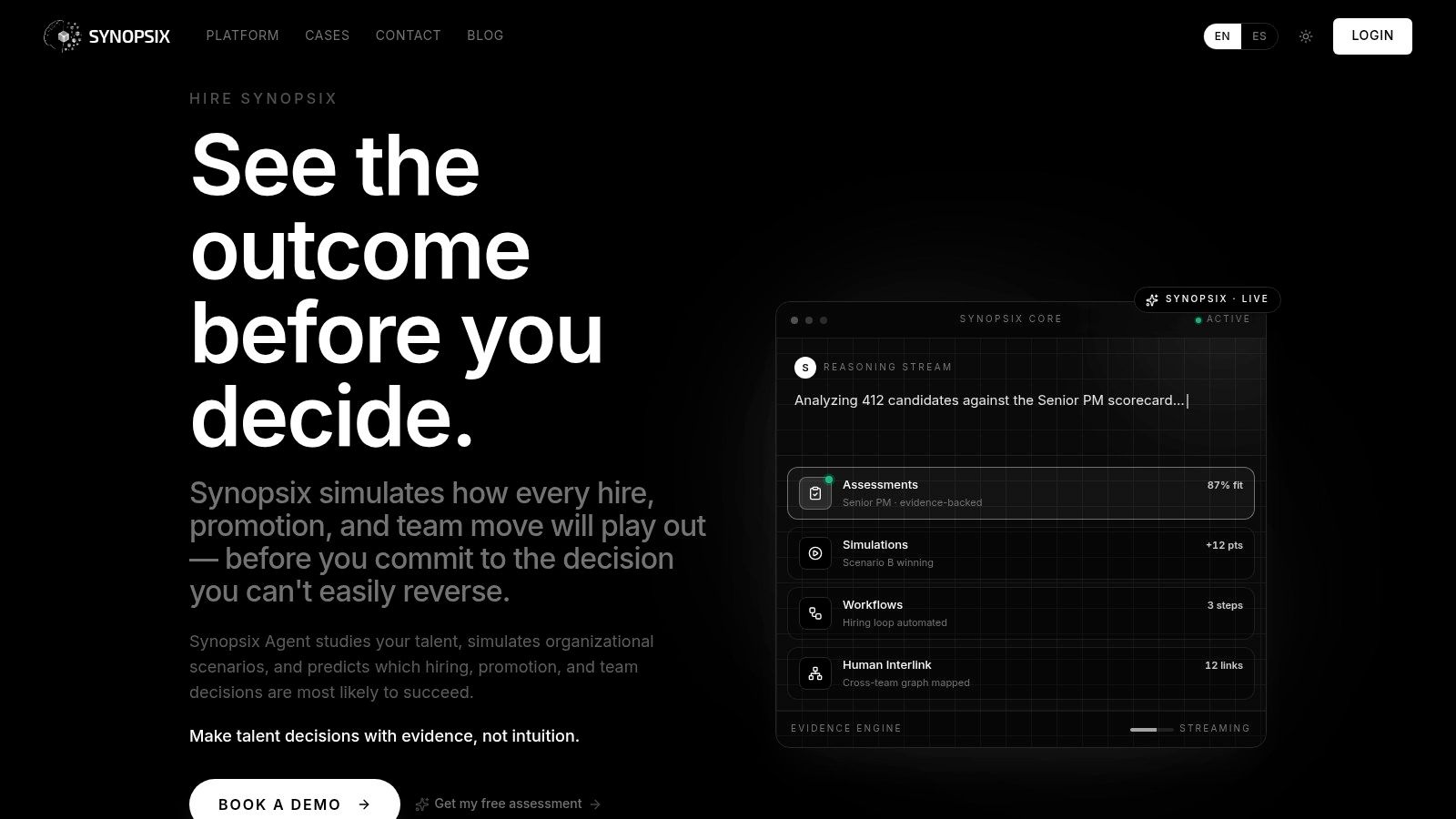
Assessment is where hiring teams lose time and signal. That's also where a people intelligence layer can change the economics of the process, because it turns subjective review into comparable decision input. Synopsix is one example of a platform in this category, and it fits where teams need behavioral assessment, role-specific reports, and team compatibility analysis in a decision-ready format.
Assessment gets faster when the output is standardized
A strong people intelligence workflow does two things well. First, it creates comparable behavioral profiles quickly. Second, it translates psychometrics into business language so hiring managers don't have to interpret raw test scores. That removes a huge source of delay, because managers spend less time decoding and more time deciding.
For a broader framing of the category, the [Synopsix talent intelligence overview](https://synopsix.ai/blog/what-is-talent-intelligence) is the most relevant internal resource.
Predictive simulations reduce the cost of surprise
The best use of assessment tech is not just speed, it's risk reduction. Predictive simulations can surface friction before the hire is made, which is much cheaper than finding out after onboarding that the person can't operate in the environment. Human Interlink style compatibility analysis adds another layer by showing where a new hire will complement or clash with the current team.
Use the right tool for the right stage
If you're hiring in a regulated or high-stakes environment, speed alone is not enough. You need assessment that is structured enough to support consistency and rich enough to support judgment. For a sector-specific example of AI screening in practice, [Talent Pronto's AI screening tool for healthcare](https://www.talentpronto.ai/blog-posts/ai-powered-talent-intelligence-platform) is a useful reference point because it shows how screening logic can be adapted to a high-volume, high-accountability setting.
The point is not to automate judgment away. The point is to remove noise so the hiring team can spend its time on the few decisions that matter.
The Hidden Talent Market Most Sourcers Overlook
Most sourcing teams keep fishing in the same ponds. They chase direct competitors, obvious job titles, and familiar career paths, then complain that the market is tight. The fundamental mistake is narrower than that; they're defining the market too tightly.
Adjacent talent beats obvious talent more often than people admit
The best candidates are not always sitting in the same industry or on the same ladder. Many companies miss strong people in adjacent industries, internal employees with non-linear backgrounds, and candidates whose skills are undervalued by conventional screening. LinkedIn's guidance on sourcing underrepresented talent pushes teams to widen their search, but too many organizations still treat that as a diversity tactic instead of a market-expansion strategy ([LinkedIn sourcing underrepresented talent](https://www.linkedin.com/business/talent/blog/talent-acquisition/go-to-strategies-for-sourcing-underrepresented-talent)).
Skills-based sourcing changes the candidate pool
If you define the role by capabilities instead of pedigree, your addressable market gets bigger immediately. That's especially useful when formal experience is a weak proxy for performance. You still need standards, but the standard should be evidence of capability, not just brand-name employers or one exact prior job title.
Internal candidates deserve more weight than they get
The fastest way to improve hiring quality is often to identify people already inside the company who can move or grow. They know the culture, ramp faster, and often need less persuasion to stay because the move is tied to development rather than escape. A practical pipeline-building resource like [how to build a talent pipeline](https://synopsix.ai/blog/how-to-build-a-talent-pipeline) is useful here because it treats readiness as an ongoing system, not a last-minute search.
The hard part is validation. When a background is unfamiliar, don't lean on pedigree to fill the gap. Use structured behavioral assessment, work samples, and role-relevant signals. That keeps the bar high while opening the market wider.
Where Processes Break and How to Fix Them
A lot of hiring pain comes from the same three failure modes. They're boring, predictable, and expensive, which is exactly why leaders should stop tolerating them.
Scenario one, the requisition drifts
A hiring manager wants speed, another stakeholder wants a unicorn, and the requisition sits open for weeks while everyone negotiates must-haves. The root cause is not sourcing, it's unclear role definition. The fix is a structured kickoff with a role scorecard, so the team agrees on what matters before anyone starts outreach.
Scenario two, the panel hires clones
Interviewer feedback sounds positive, but the finalists all feel familiar in the same way. The root cause is unstructured interviews and unconscious preference for sameness. The fix is independent scoring against behavioral criteria, then a debrief that compares evidence rather than vibes.
Scenario three, onboarding is paperwork
The candidate accepts, then spends the first month filling forms, hunting for context, and waiting for meaningful work. The root cause is treating onboarding as administration instead of integration. The fix is a role-specific 30-60-90 day plan with milestones that the manager owns, not just HR.
A useful way to think about process failure is this, if the issue shows up repeatedly in the same stage, the stage design is wrong. If it shows up in every stage, the role definition was probably wrong from the start.
For teams trying to make their data cleaner before they fix workflow, [data sourcing explained for startups](https://captapi.com/blog/data-sourcing-definition) is a handy reference because it reinforces the basics of identifying where usable information comes from.
A Practical Checklist to Improve Your Process This Quarter
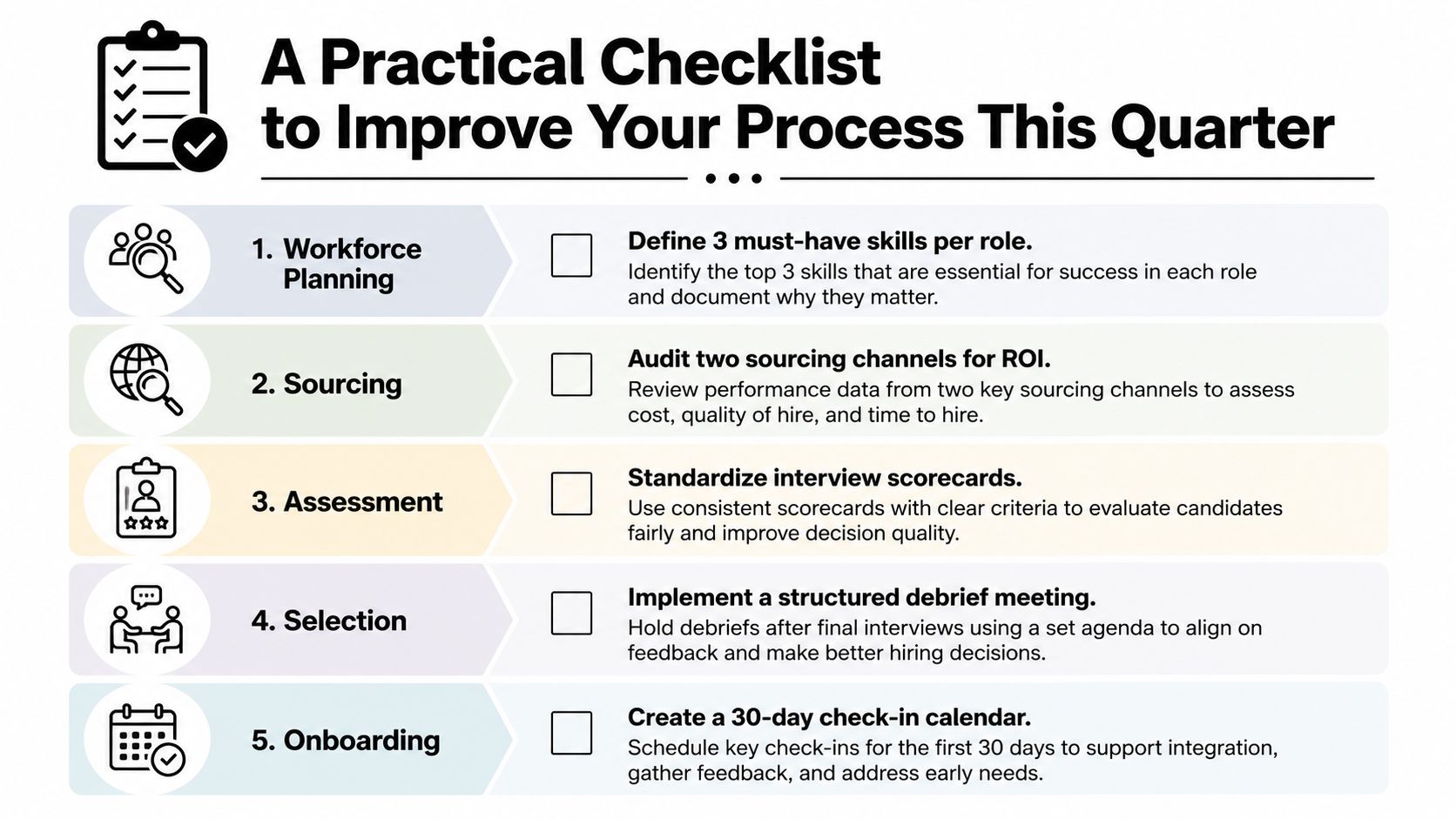
If your team wants quick results, start where the process leaks the most value. Don't rewrite everything. Fix the stage that creates the most rework, then move to the next one.
Make the work concrete by stage
| Stage | Action | Expected Impact | |---|---|---| | Workforce Planning | Define 3 must-have skills per role | Cleaner role scope and fewer false starts | | Sourcing | Audit two sourcing channels for ROI | Better channel focus and less wasted effort | | Assessment | Standardize interview scorecards | More consistent comparisons and better signal | | Selection | Implement a structured debrief meeting | Faster decisions and fewer opinion battles | | Onboarding | Create a 30-day check-in calendar | Better early integration and stronger ramp |
Use this checklist in the room, not just on paper
The three questions that expose your most impactful fix are simple. Where are we making decisions too late? Where are we collecting information we don't use? Where are we asking interviewers to guess instead of evaluate? Answer those straightforwardly, and the bottleneck usually shows itself.
---
Synopsix helps teams turn behavioral assessment into clearer hiring and team-design decisions, which matters when the bottleneck is upstream, not in the final interview. If you want a more disciplined way to evaluate candidates, compare role fit, and reduce avoidable hiring mistakes, visit [Synopsix](https://synopsix.ai) and see how people intelligence can support your hiring process.