Talent Acquisition Solutions That Actually Work in 2026
By Synopsix · September 9, 2026 · 15 min read
The requisition is three weeks old. Eight interviewers are booked, the hiring manager wants a decision, and the shortlist still feels like a collection of guesses. Your ATS shows activity, your sourcing tool shows reach, and your interview platform stores plenty of notes. Yet nobody can answer the question that matters: which candidate is most likely to succeed on this team, in this role, under these conditions?
That gap defines the next generation of talent acquisition solutions. The winning platform won't automate administration or add another dashboard. It will connect behavioral evidence, skills assessment, candidate context, and team compatibility into a decision system that helps people hire with more confidence and less delay.
The Hiring Problem Leaders Are Trying to Solve
A hiring leader usually recognizes the problem before the technology team does. Requisitions remain open while recruiters coordinate calendars, hiring managers revise requirements, and interviewers submit feedback in different formats. Candidates move through sourcing, screening, interviews, and offers, but the evidence rarely lives in one coherent view.
The operating environment has also become more demanding. Applications may be plentiful, but relevant quality is harder to identify. Recruiters manage heavier requisition loads, managers have less time to interview, and a weak hiring decision appears quickly through poor ramp-up, low engagement, or avoidable replacement work. The issue isn't a lack of effort. It's that the process asks humans to make high-consequence decisions with fragmented signals.
Talent acquisition has become a technology-driven operating function. In a [2025 recruitment statistics roundup](https://www.smartrecruiters.com/resources/article/recruitment-statistics-for-2025/), 45% of business leaders said they spend more than half their time on talent acquisition tasks, while 57% of companies allocate over 40% of their HR budgets to talent acquisition and nearly 20% allocate more than 60%. Those figures explain why the category has moved beyond administrative support. Leaders now expect hiring technology to improve efficiency, workforce planning, and cost control.
> Practical rule: If your platform reports funnel movement but can't help a hiring team understand candidate risk, it isn't a decision system yet.
Start with the decision, not the requisition. Define what success looks like in the role, which behaviors support it, what skills are essential, and where the team can tolerate development. Then require every tool in the stack to contribute evidence to that decision. A faster process matters, but speed without stronger judgment only accelerates the wrong outcome.
The rest of the buying process should follow that principle. Evaluate whether a platform compresses the loop between evidence and action, whether it makes disagreement visible, and whether it helps recruiters and managers distinguish a genuine fit from a polished application.
What Talent Acquisition Solutions Actually Are
Talent acquisition solutions are the integrated software layer supporting the full hiring lifecycle, from sourcing and screening through assessment, selection, and onboarding. The defining characteristic is shared context. Candidate records, role requirements, evaluation criteria, behavioral signals, interview feedback, and workflow actions should inform one another instead of sitting in disconnected applications.
The category has evolved in stages. Early recruiting teams coordinated through email, spreadsheets, and shared folders. Applicant tracking systems then created a central record for requisitions and candidates. Today, more advanced platforms add automation, analytics, structured assessment, simulations, and recommendations that help teams interpret evidence rather than merely store it.
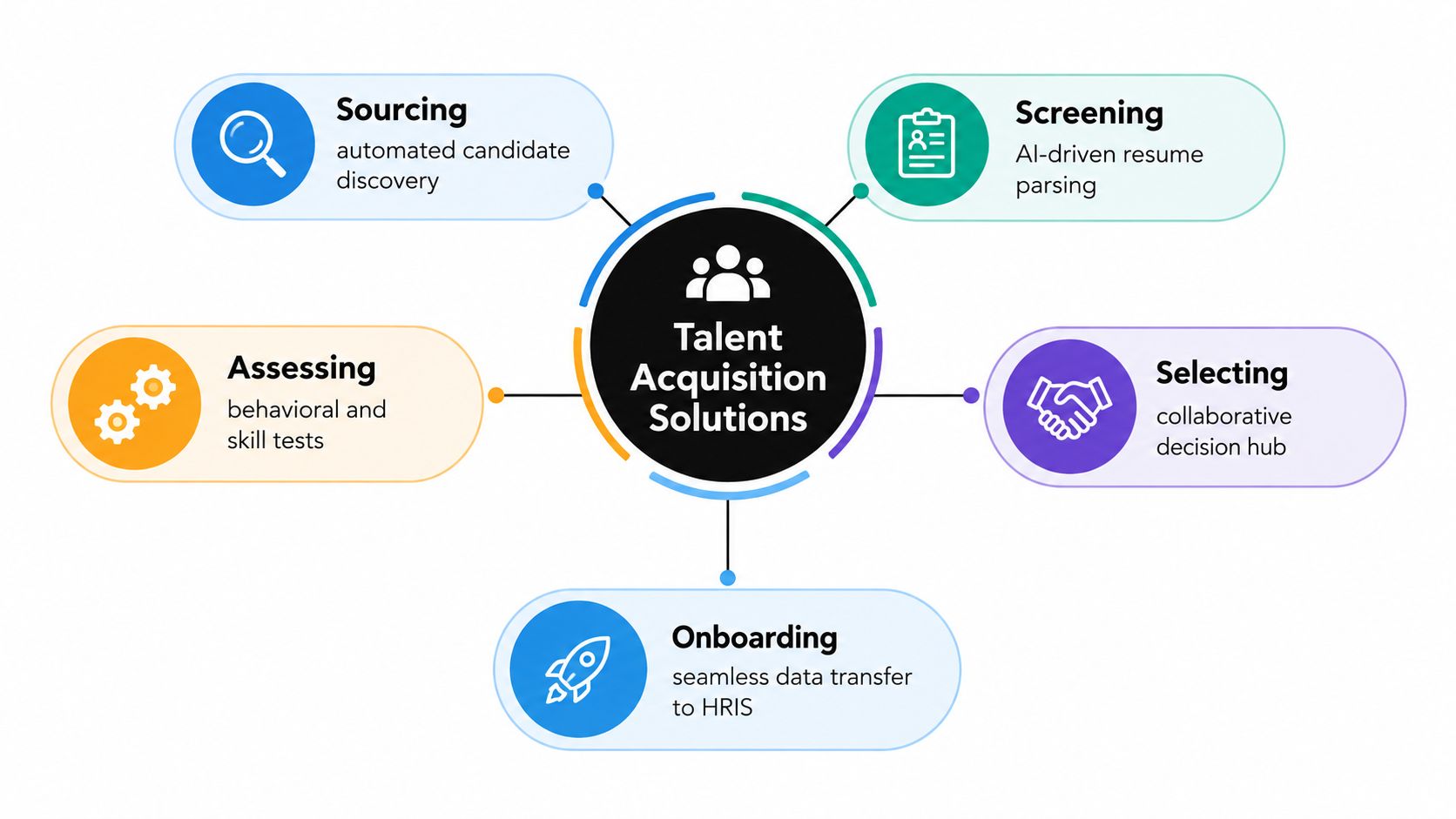
A useful analogy is navigation. A static map is a database, it tells you what exists. Turn-by-turn GPS resembles an ATS, it guides you through a defined route. A talent acquisition solution acts more like a routing engine that considers the destination, traffic, road conditions, and the driver's behavior in real time. It can tell a recruiter that a pipeline is thin, a manager that an assessment exposes a relevant risk, or a team that two technically strong finalists may create very different working dynamics.
That distinction matters because many vendor demos present a feature catalogue as if it were a strategy. A platform isn't automatically intelligent because it includes a chatbot, resume parsing, or an AI label. Buyers should assess how the system connects signals and whether humans can understand the reasoning behind a recommendation.
For a broader view of how intelligence layers fit into recruiting architecture, see this guide to the [talent intelligence platform](https://synopsix.ai/blog/talent-intelligence-platform). Teams outside traditional employment contexts can apply similar workflow principles with [volunteer management software](https://www.volunteerbadge.com/volunteer-management-software), particularly when they need to match people to roles, track participation, and coordinate decisions across a distributed operation.
Talent acquisition solutions aren't a replacement for recruiters or hiring managers. They aren't a collection of disconnected point tools, and they aren't a promise that algorithms can eliminate judgment. They should give people better evidence, clearer trade-offs, and a repeatable way to act.
Core Capabilities That Move Hiring Decisions
The right capability is the one that changes what a hiring team does next. A feature that saves clicks but leaves the hiring decision untouched belongs in the efficiency column, not the strategic value column.
Applicant tracking remains foundational. It manages requisitions, candidate stages, compliance records, interview logistics, and reporting. Its presence is nearly universal in large-company recruiting, with ATS technology detectable at 97.8% of Fortune 500 companies, or 489 out of 500 firms, according to a [2025 recruiting benchmarking report](https://www.scribd.com/document/923572364/2025-Recruiting-Benchmarking-Report). That makes ATS functionality essential, but not differentiating by itself.
Sourcing automation can search talent pools, recommend prospects, personalize outreach, and identify pipeline gaps. It drives decisions when the matching logic reflects real role requirements instead of title similarity. Resume parsing is useful table stakes. It becomes strategically valuable only when the platform combines experience with skills, behavioral evidence, availability, and relevant team context.
Assessments are where many stacks either become useful or fall apart. A credible assessment measures role-relevant capabilities and produces interpretable evidence. A glossy quiz that generates an attractive profile but doesn't affect interview questions or selection criteria is theatre. Behavioral assessments and simulations can add depth, provided the organization validates the methodology, governs access, and keeps human accountability in place.
People intelligence connects individual signals to team conditions. It can help a manager examine leadership style, collaboration patterns, communication preferences, and potential friction with existing colleagues. This capability matters most when it produces a concrete action, such as a deeper reference check, a targeted interview probe, or a development plan.
Analytics should expose decision quality, not just activity. Deloitte describes TA analytics through efficiency, effectiveness, and impact metrics, spanning descriptive, relative, analytic, and predictive analysis in its [talent acquisition analytics guidance](https://www.deloitte.com/us/en/services/consulting/services/talent-acquisition-analytics.html). That framework is more useful than a dashboard full of counts because it asks whether the process works and what may happen next.
| Capability | Decision Role | Real Impact | |---|---|---| | Applicant tracking | Creates the operating record | Must-have infrastructure, rarely a differentiator | | Sourcing automation | Expands and prioritizes the pipeline | Strong when matching reflects skills and role context | | Assessments and simulations | Tests capability and behavior | High impact when validated and tied to selection | | People intelligence | Reveals behavioral and team-fit signals | High impact for roles where collaboration affects outcomes | | Analytics | Connects process activity to hiring results | Strategic when it supports diagnosis and prediction | | Candidate experience tooling | Maintains communication and reduces friction | Important for trust and completion, not a substitute for fit | | Integrations | Moves data across HR systems | Non-negotiable for adoption and reporting integrity |
Candidate experience tools handle scheduling, status updates, reminders, and communication. They protect momentum, but a smooth process can't rescue a weak decision model. Integrations are less exciting in a demo and more important in production. If assessment results, interview feedback, and HRIS outcomes can't connect reliably, leaders won't be able to learn from completed hires.
The capability list is therefore a poor buying model. Signal connection is the differentiator. A platform with fewer modules but a coherent decision view will outperform a larger stack that forces recruiters to reconcile evidence manually.
How to Evaluate and Select the Right Platform
Evaluate a platform like a buyer, not a browser. Demos are designed to make workflows look clean. Your job is to discover what happens when requirements conflict, data is incomplete, a hiring manager ignores a prompt, or an assessment produces an uncomfortable result.
Start by mapping decisions. For each critical role, write down the evidence the team needs before moving a candidate forward, the risks worth investigating, and the person accountable for the final call. Score vendors against those decisions rather than counting features.
Build a shortlist that survives scrutiny
Use these filters before scheduling polished demonstrations:
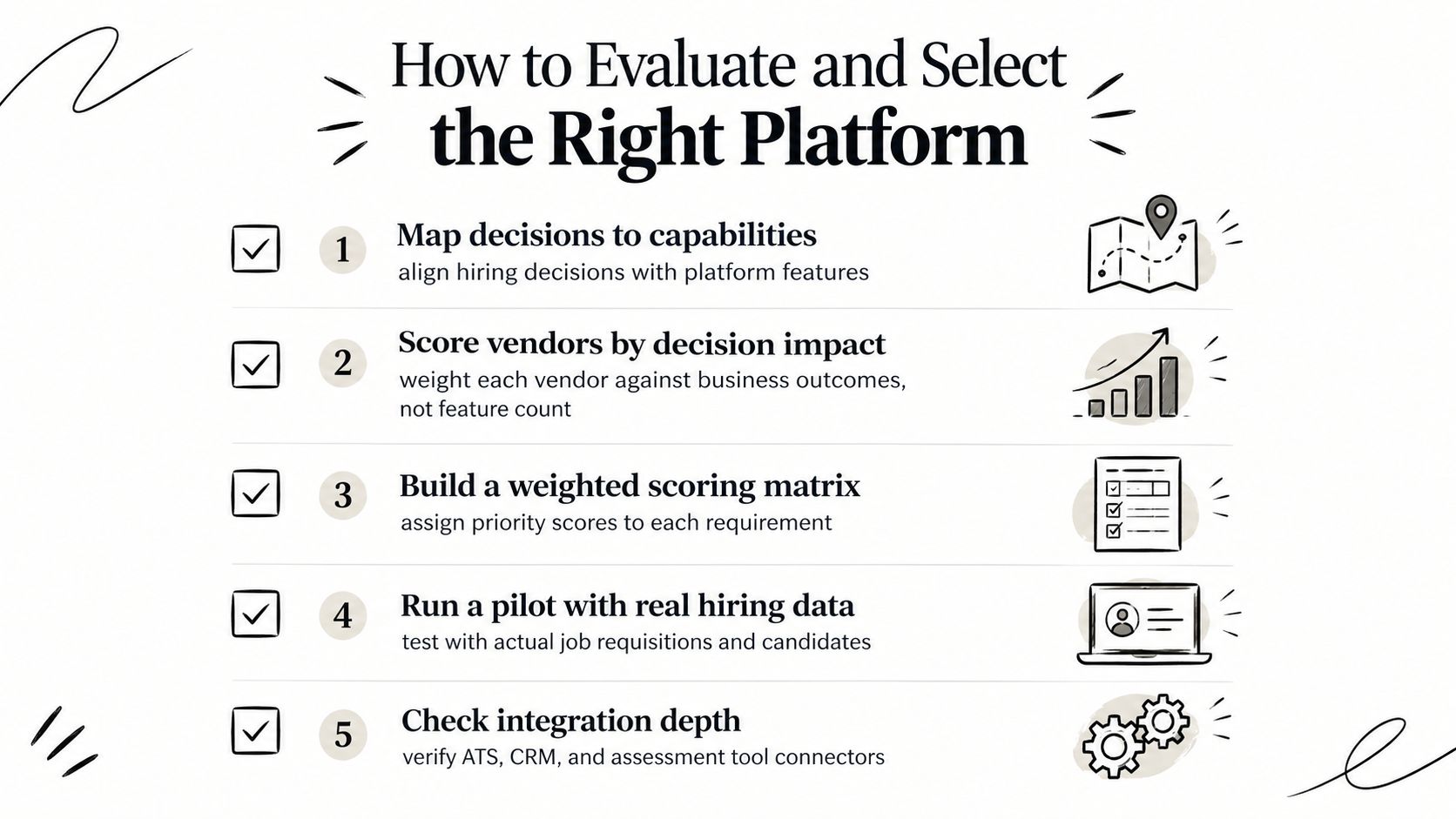
Ask each finalist to walk through a recent customer scenario similar to yours, including what failed and how the team resolved it. Vendors that can't discuss failure modes probably haven't prepared you for implementation reality. Review the [AI-powered recruitment tools](https://synopsix.ai/blog/ai-powered-recruitment-tools) with the same discipline. AI capability matters, but governance, usability, and evidence matter more.
A proof of concept should use one role, one hiring manager, and one rejected candidate. Run it against live conditions for two weeks. Watch how quickly users understand the outputs, whether feedback remains structured, and whether the system changes an actual decision rather than generating another report.
The commercial model should reinforce adoption. Tie expansion or milestone payments to agreed rollout outcomes, data integration, user participation, and reporting readiness. Don't pay for theoretical capacity that your operating model can't use.
<iframe width="100%" style="aspect-ratio: 16 / 9;" src="https://www.youtube.com/embed/Vh1dUG1wBDI" frameborder="0" allow="autoplay; encrypted-media" allowfullscreen></iframe>
A Realistic Rollout Roadmap With the KPIs That Matter
Hiring won't pause while a technology program runs. A six-month implementation that ignores live requisitions usually creates a parallel process, then loses credibility with recruiters and managers. Roll out around real hiring cycles, with a narrow starting point and clear evidence gates.
Phase one creates a usable foundation
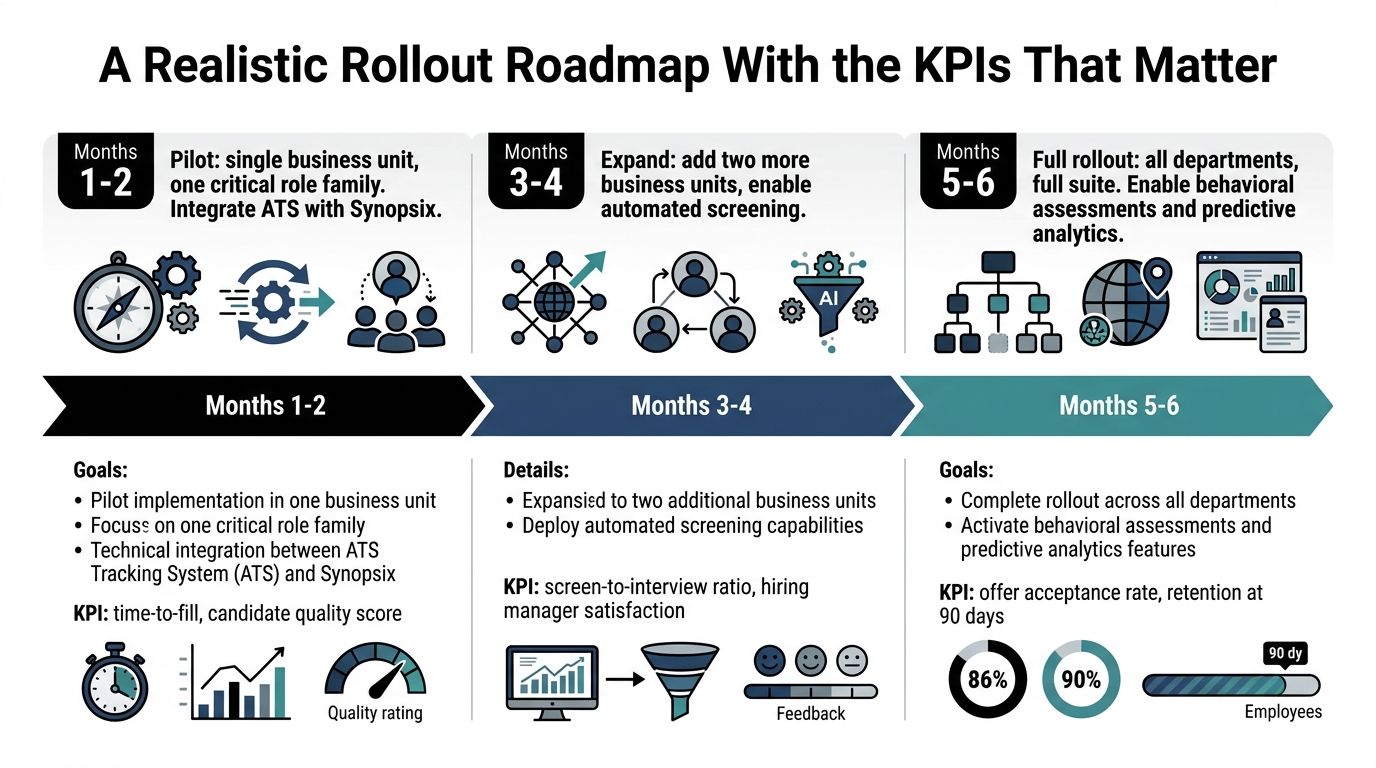
Begin with one business unit and one critical role family. Integrate the ATS with the HRIS, standardize intake requirements, and activate structured interview kits within the first thirty days. The objective isn't to switch on every feature. It's to establish a common definition of the role and a reliable record of how decisions are made.
Track time-to-fill, candidate quality signals, and completion of structured feedback. If managers won't use the interview kit, fix the workflow before adding advanced analytics.
Phase two tests evidence before changing decisions
Add assessments and analytics in shadow mode. Let the platform produce signals while the existing process remains the formal decision path. Compare what the new evidence would have changed, where it agrees with interview feedback, and where it exposes inconsistent judgment.
This is the stage for reviewing screen-to-interview movement, hiring-manager satisfaction, candidate experience, and data completeness. A shadow period prevents premature claims and gives governance owners time to inspect bias, explainability, and role relevance.
Phase three scales what has earned trust
Expand to additional business units only after the first workflow is stable. Activate people intelligence dashboards, connect assessment results to completed-hire outcomes, and tune scoring models with real evidence. The metrics should include time-to-fill, time-to-productivity, mis-hire rate, hiring-manager satisfaction, and candidate NPS, not just time-to-hire.
The distinction is important. A faster funnel that increases mis-hires costs more than it saves. Use the [talent acquisition metrics guide](https://synopsix.ai/blog/talent-acquisition-metrics) to establish definitions, ownership, and review cadence before leaders begin comparing teams.
> A rollout succeeds when the system becomes the easiest place to make a defensible hiring decision.
Review outcomes at each phase and stop expansion when data quality or adoption falls below the agreed standard. Scaling a broken process only makes the failure more expensive.
How Synopsix Changes Specific Hiring Decisions
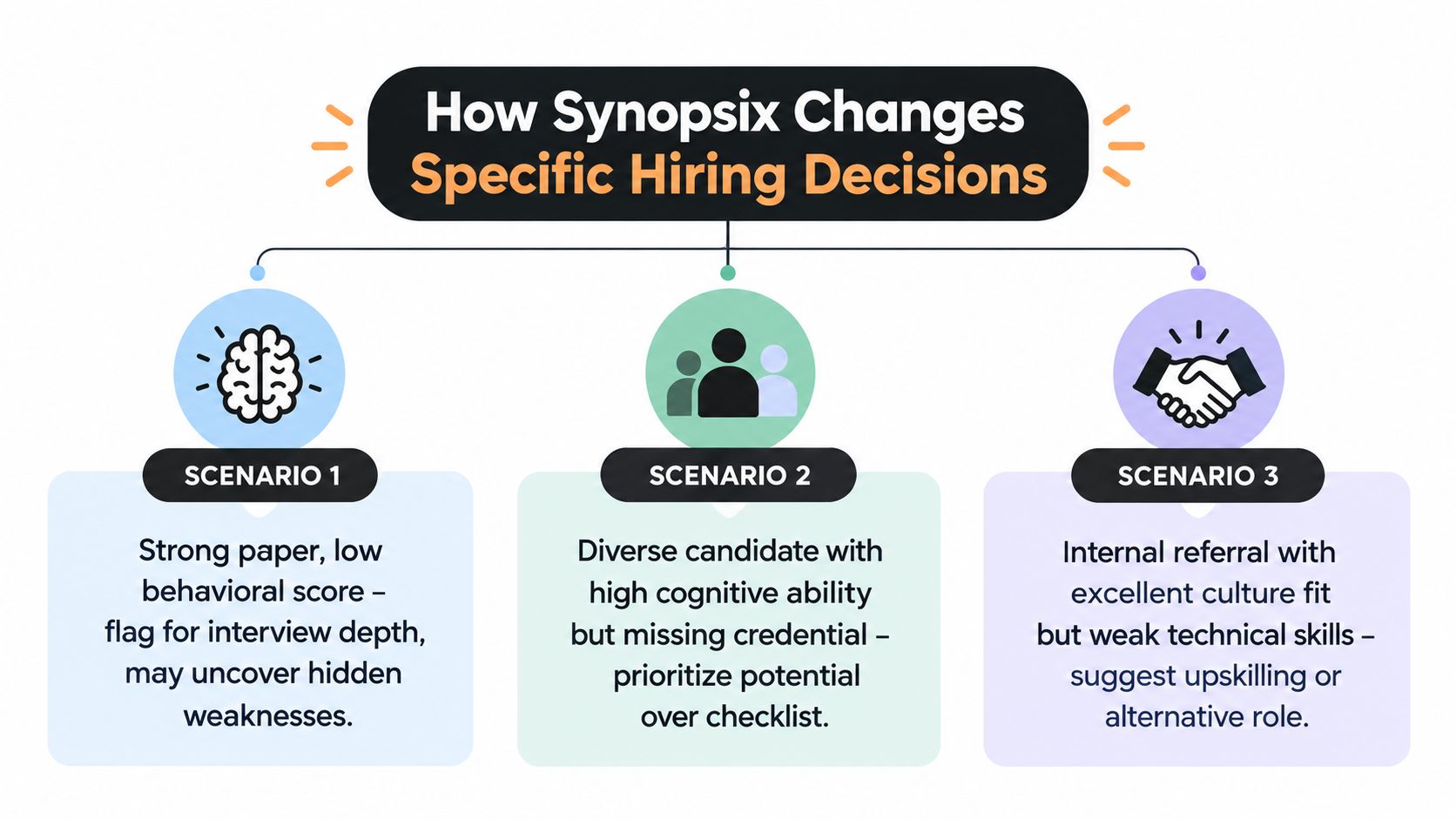
A decision system earns its place when it changes a call that a hiring team would otherwise make on incomplete evidence. The following scenarios show the type of intervention behavioral data and team-compatibility analysis can support.
The impressive finalist with a collaboration risk
A finalist has strong experience and performs well in conventional interviews. A behavioral assessment flags low collaboration, while a team-compatibility simulation indicates likely friction with the existing engineering lead. The hiring team doesn't reject the candidate automatically. It deepens the reference process and asks targeted interview questions about conflict, handoffs, and shared ownership.
The reference conversations surface the same concern. The data point didn't make the decision, but it changed the investigation before the offer. That is the right role for a behavioral signal, to expose a risk that deserves human examination rather than produce an unexplained verdict.
The sales candidates with similar credentials
Two candidates meet the stated requirements for a sales position. Their resumes and credentials don't create a meaningful distinction, so the hiring manager runs a predictive simulation focused on discovery-call handling. One candidate asks sharper questions and adapts more effectively when the buyer's needs shift.
The team uses that observed difference to structure the final discussion and review the candidate's coaching needs. Instead of relying on familiarity, confidence, or interview chemistry, the manager has role-relevant behavior to discuss.
The high-volume operations pipeline
An operations team needs to screen 500 applicants in days, using structured assessments to rank candidates by predicted retention rather than resume keywords. The number of applicants and the screening period are scenario parameters, not a verified performance result. The operational benefit is that the team applies a consistent signal before recruiters spend time on interviews.
The selection team can then examine whether those predictions align with later outcomes and whether the assessment creates access or bias concerns. Over time, completed-hire data can inform the model, but leaders shouldn't claim a retention lift until they measure it against a defined cohort and comparison process.
Synopsix fits this decision layer by combining behavioral assessments, comparable profiles, role intelligence, predictive simulations, and Human Interlink analysis of team complementarity and tension points. It should be treated as one component of a governed hiring process, with recruiters and managers accountable for the final decision.
The Payoff and What to Expect in Year One
The investment case should be built around operational outcomes, not transformation language. In the first months, leaders may see cleaner intake, faster screening, stronger shortlist discussions, and more consistent manager feedback. Later, teams can examine retention, internal mobility, diversity outcomes, and quality-of-hire evidence once behavioral baselines and team-fit signals have accumulated.
Don't promise a universal percentage improvement before establishing a baseline. The most credible business case measures how the platform affects the specific roles, managers, and workflows in scope.
| Metric | Baseline, Pre-Implementation | Months 1-3 | Months 4-6 | Months 7-12 | |---|---|---|---|---| | Time-to-hire | Current process average | Identify bottlenecks and reduce avoidable waiting | Compare assisted and legacy workflows | Evaluate sustained cycle performance | | Mis-hire reduction | Existing definition and review method | Establish risk categories and decision audit | Compare assessment signals with outcomes | Validate patterns against retention and performance | | Recruiter productivity | Current administrative workload | Track time reclaimed from coordination | Reallocate time to sourcing and manager partnership | Measure capacity against requisition demand | | Hiring-manager NPS | Current manager feedback | Capture usability and decision confidence | Improve calibration and feedback quality | Review trust, adoption, and repeat usage | | Pipeline diversity | Current funnel composition | Establish stage-by-stage visibility | Identify drop-off and screening patterns | Assess whether sourcing and selection changes improve representation |
Data visibility deserves special attention. A [2025 talent acquisition outlook report](https://www.symphonytalent.com/resources/reports/2025-talent-acquisition-outlook-report/) found 85% of TA professionals reported subpar access to recruitment data. The same report noted that hiring teams conduct 42% more interviews per hire than in 2021, while average time to hire rose from 33 to 41 days. More activity hasn't solved fragmented decision-making.
The platform's value compounds only when recruiters change habits, hiring managers engage with fit data, and leaders review the dashboards. Connect the hiring record to onboarding, including a practical [pre-boarding and training checklist](https://videolearningai.com/blog/employee-onboarding-checklist), so the organization can test whether the evidence gathered during selection supports early productivity and retention.
A mature first year ends with a defensible answer to five questions: Did decisions become faster, did risks become more visible, did managers trust the evidence, did candidates experience a coherent process, and did later outcomes validate the signals? If you can't answer those questions, you bought software, not a talent acquisition solution.
---
Synopsix turns behavioral assessments into comparable profiles, business-readable intelligence reports, predictive simulations, and team-compatibility insights for hiring and talent development. Visit [Synopsix](https://synopsix.ai) to see how its people intelligence platform can help your team connect behavioral evidence to faster, more defensible hiring decisions.